Sinitic Civilization-Book 1
Sinitic Civilization-Book 2
Tribute of Yu
Heavenly Questions
Zhou King Muwang's Travels
The Legends of Mountains & Seas
The Bamboo Annals - Book 1
The Scourge-of-God-Tetralogy:
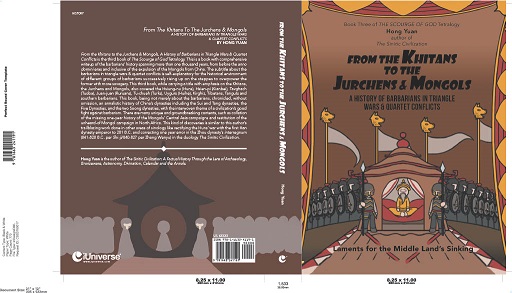
From the Khitans to the Jurchens & Mongols: A History of Barbarians in Triangle Wars and Quartet Conflicts
(available at iUniverse;
Google;
Amazon;
B&N)
|
|
THE RYUKYU PEOPLE
This webmaster had made Ryukyu into a separate section because Ryukyu was the only place where the Chinese emperors had exported the peasant labor and agriculture technology in the same fashion as the German farmers' relocation to Russia at the request of Katherine the Great.
This is different from Han Emperor Wudi's dispatching the military farming soldiers to western China during the Western Han Dynasty.
Still another purpose of this writing is to dispute the prevalent mistaken interpretation of
"liu qiu" as being equivalent to the ancient Taiwan island. The ancient term of "liu-qiu" [in "Sui Shu" (history of the Sui dynasty)], in this webmaster's opinion, was
specifically referring to Ryukyu before it became a categorical term for the islands in the southeastern Chinese seas.
Below, this webmaster will use the travelogues to validate the point that "liu-qiu" [Ryukyu] was not necessarily Taiwan, but Ryukyu [Okinawa].
And, the topic of Ryukyu would bring out a deliberate American containment policy against China, i.e., an 1850s policy that passed down from the merchant-turned naval general Matthew Perry as well as revived in the U.S. transfer of the Diaoyutai Islands, i.e., the Japanese-pronounced Senkaku Gunto [Pinnacle Islands], to Okinawa of Japan in 1971.
Ryukyu was first mentioned in "Bei Shi" (history of the Northern Dynasties) as an island country in the East China Sea, which could be reached by sailing for five days. "Bei Shi" stated that Ryukyu was an island full of caves; that it had three circles of defence-purpose fences, with water flowing by the fences; that its king was named by Huan-si-shi, with a first name of Ke-ci-dou; that it had 16 palace rooms decorated with inscription of the animals; that their people were in constant fighting with each other; that the various villages were ruled by a chief called by Niao-lian-shuai (marshal of allied birds); that it had 4-5 marshals in charge of various caves; and that they were cannibals eating the dead bodies of enemies and family members.
(Still another matter recorded in ancient Chinese classics was that the people of Ryukyu in the 6th century were similar to the Hu nomads to the north and northwest of Chinese, and described as possessing long noses.
This was similar to the claim that northern barbarians were observed to have dwelled on the islands to the west of the Korean peninsula and that the remnant Jurchens, after defeat in the hands of the Mongols, fled across the sea to the Pescadores.)
Historical Confusion As To Name & Location Of "liu-qiu" [Ryukyu]
"Bei Shi" (history of the Northern Dynasties) and "Sui Shu" (history of the Sui dynasty A.D. 581-618) recorded that the coastal Chinese people often noticed smoke or mist rising in the East China Sea during the spring and autumn time periods of the year and that Sui Dynasty Emperor Yangdi confirmed the identity of Ryukyu from a visiting Japanese emissary.
In the 3rd year of the Daye Era, i.e., A.D. 607, Emperor Yangdi dispatched Zhu Kuan [i.e., "yu qi wei", cavalry captain]
and Heh Man [i.e., "hai shi", sea master] to Ryukyu. Emperor Yangdi sent the delegation to Ryukyu in the hope of having the Ryukyu king submit to China as a vassal. The Sui Chinese failed to communicate with the Ryukyu people and
abducted one aboriginal for returning home. The next year, i.e., A.D. 608, Emperor Yangdi dispatched Zhu Kuan to Ryukyu for pacification again. The natives refused to be pacified. Zhu Kuan grabbed some clothes and shields for the emperor. It was from the clothing materials that the Japanese emissary determined that those were from the people of 'liu qiu'. Zhu Kuan requested for an expedition to punish the Ryukyu king.
Back in A.D. 607, Wa Japanese King Duo-li-si-bi-gu, who was recorded to have an imperial clan surname of A-mei (? Ame, ? heaven), sent an emissary to Sui China, stating that they had heard that the new 'buddha' emperor west of the sea had revived Buddhism and they would like to have a dozen monks study Buddhism in China. Emperor Yangdi at first refused to hear about the Wa State (Japan) because the Japanese king wrote the sentence "The Son of Heaven from the sunrise wish good health for the Son of Heaven at the sunset...." However, Emperor Yangdi sent an emissary, Pei Shiqing (Pei Qing), to the Wa State the second year, i.e., A.D. 608.
Pei Shiqing crossed the sea (the Yellow Sea) to Paekche, arrived at the Zhu-dao (Takeshima, bamboo island) Island, watched the Dan-luo-guo [? Jeju] statelet to the south, passed through the Du-si-ma-guo (? Tsushima) statelet, crossed sea [? the Japan Sea] again to the Yi-zhi-guo (? Izu) statelet, arrived at the Zhu-si-guo statelet, went eastward to the Qin-wang-guo (i.e., the Qin King's Country which was commented to be similar to the Chinese) statelet,
travelled through another dozen countries to reach the coast of Wa Japan [? which moved to Honshu from Kyushu hundreds of years earlier to become Yamato and then was renamed to Nippon at about the time of Tang Empress Wu Zetian]. Pei Shiqing recorded that the domain east of Zhu-si-guo belonged to the vassalage states of Wa Japan. The Wa King welcomed Pei Shiqing with over one hundred people, displaying the ceremonial courtesy, and beating the drums and blowing horns. Within the next ten days, the Wa King dispatched 200 cavalrymen to fetch Pei Shiqing at the outskirts of the capital. After arriving at the capital, Pei Shiqing and the Wa king exchanged gifts and tributes.
The Japanese king asked another emissary to accompany Fei Qing back to China. It was from the mouth of this Japanese emissary that Emperor Yangdi confirmed the identity of Ryukyu, an island to the southwest of Japan.
The Japanese emissary claimed to Emperor Yangdi that the cloth and shields that Zhu Kuan had grabbed from Ryukyu were from the 'Yi-ye-jiu' (Ryukyu) statelet.
Sui Emperor dispatched Chen Leng and Zhang Zhenzhou to Ryukyu.
The two, departing from Yi'an, first sailed to the Gaohua-yu Island, then after two more days, sailed to the Xi-bie-yu [?] island in between, and then one more day later, reached Ryukyu.
Among General Chen Leng's recruits from southern China would be a so-called "Kunlun" ["kun-nu", i.e., possibly the black-skinned natives from Southeast Asia who used to perform stunts and magic for the Tang Dynasty court].
The "Kunlun" interpreter, whom the Chinese had brought along with the belief that he must know the islanders' language - as the Chinese classics repeatedly stated the Wa Japanese shared the similar customs
as the natives living in southern China and today's Hainan Island, failed to subdue Ryukyu by persuasion.
Chen Leng killed the Ryukyu king (Er'chidou), burnt down the palaces, captured thousands of the Ryukyu people, and brought them back to China.
Apparently, later chronicles from Sui Dynasty onward had possibly adopted the categorical term of "liu-qiu" [Ryukyu] for all islands in the seas, to the southeast of the Chinese coastline.
Both "Sui Shu" and
Zhao Rushi's A.D. 1225 book "Zhu [various] Fan [foreign countries] Zhi [records]" mentioned that "liu-qiu" [Ryukyu] was 5-6 days trip to the east of Quanzhou of today's Fujian Province, while the Penghu Islands (Pescadores) and Taiwan are in fact situated to the exact southeast of Quanzhou.
In contrast, "Taiwan, an island beyond the Penghu Islands (Pescadores), could be reached after two days and nights of sailing [with stopver at the Pescadores]
if departing from Zhangzhou and Quanzhou per Heh Kai's proposal to Ming Emperor Chongzhen in A.D. 1635.
Note that from the Fuzhou port to Jilong [Keelung] of Taiwan, sailing would take 5 'geng' [if going straight to Taiwan without stopover], with 10 'geng' being equivalent to 24 hours.
It is clear to this webmaster that the Ryukyu Island referred in the Sui records, unlike what historian Wang Zhonghan, et al., had claimed to be designation for Taiwan, meant for today's Okinawa, while the two stopover island happened to be the Diaoyutai Islands, i.e., what the Japanese called by the Senkaku Gunto [Pinnacle Islands] after taking possession around the timeframe of
the First Sino-Japanese War.
Details about the Ryukyu's midway role between China and Japan could be seen at "Japanese Piracy, Shogunate Tallies, Korea & Taiwan Island".
"Ming Shi" (history of the Ming dynasty) lumped together about one dozen island countries or statelets, including Liu-qiu [Ryukyu], Luu-song [Luzon], He-mao-li, Mei-luo-ju [Malacca?], Sha-ya-na-bi-tan, Ji-long [Keelung, i.e., Taiwan], Wenlai [Brunei], Ma-ye-weng, Gu-ma-la-lang, Feng-jia-shi-lan, and Wen-lang-ma-shen.
Here, the distinction was made between Liu-qiu [Ryukyu] and Ji-long [Keelung, i.e., Taiwan].
"Ming Shi" stated that Mongol Yuan Emperor Shizu [i.e., Khubilai] had tried to pacify Ryukyu but the emissary failed to deliver the message.
The
Mongols attempted to land at Ryukyu in A.D. 1292, not knowing whether the island they stepped on
was Ryukyu or not, with guide Wu Zhidou escaping upon return to Penghu of Fujian.
The Mongol ships purportedly passed through the San-yu-guo (three islands) country before sailing to 'liu-qiu' [Ryukyu], with San-yu taken to be Batanes of the Philippines.
In late A.D. 1292, Khubilai (Kubilai)
sent an army of 30,000 to Java. In March of A.D. 1293, the Mongols defeated the local ruler called
King Gelang-guo at Da-ha, only to be driven off by a Javanese ally called Tuhanbiduye who was
the Javanese king’s son-in-law.
Note that the Mongols, who attacked Java in A.D. 1293, exempted San-yu (Batanes) from sending in emissaries for its possession of 200 households, only.
(See the Taiwan section for details.)
In the phylogenetic tree Ryukyuans and Ainu were neighbors, but the genetic distance between them was larger than the distances between Ryukyuans and Hondo Japanese and between Ryukyuans and Korean populations. The geographic cline of the predominant haplotype in Ryukyuans, A*24-B*54-DRB1*0405, suggests that an ancestral population possessing A*24-B*54-DRB1*0405 moved into the Okinawa Islands after the divergence of Ryukyuans from the Ainu. Such a recent gene flow, probably from South China to the Okinawa Islands, is considered the major cause of difference in genetic characteristics between Ryukyuans and the Ainu.
The Scourges-of-God Tetralogy
would be divided into four volumes covering
Hsiung-nu (Huns), Hsien-pi (Xianbei), Tavghach
(Tuoba), Juan-juan (Ruruans), Avars, Tu-chueh (Turks), Uygurs (Huihe), Khitans, Kirghiz, Tibetans, Tanguts, Jurchens, Mongols and Manchus and
southern barbarians.
Book I of the tetralogy would extract the contents on the Huns from
The Sinitic Civilization-Book II,
which rectified the Han dynasty founder-emperor's war with the Huns on mount Baideng-shan to A.D. 201 in observance of the Qin-Han dynasties' Zhuanxu-li calendar.
Book II of the Tetralogy would cover the Turks and Uygurs.
And
Book IV would be about the Manchu conquest of China.
From the Khitans to the Jurchens & Mongols: A History of Barbarians in Triangle Wars and Quartet Conflicts
, i.e., Book III of
the Scourge-of-God-Tetralogy,
focused on the Khitans, Jurchens and Mongols, as well as provided the annalistic history on the Sui and Tang dynasties, the
Five Dynasties & Ten Kingdoms, and the two Soong dynasties.
Similar to this webmaster' trailblazing work in rectifying the Han dynasty founder-emperor's war with the Huns to 201 B.C. in The Sinitic Civilization - Book II,
this Book III of the Scourge-of-God-Tetralogy
collated
the missing one-year history of the Mongols' Central Asia campaigns and restituted the
unheard-of Mongol campaign in North Africa.
|
The Scourges of God: A Debunked History of the Barbarians" - available at iUniverse|Google|Amazon|B&N
From the Khitans to the Jurchens & Mongols: A History of Barbarians in Triangle Wars and Quartet Conflicts
(The Barbarians' Tetralogy - Book III)
Epigraph,
Preface,
Introduction,
Table of Contents,
Afterword,
Bibliography,
References,
Index
|
|
Table of Contents
(From the Khitans to the Jurchens & Mongols: A History of Barbarians in Triangle Wars and Quartet Conflicts)
Chapter XXXVIII: The Mongol Invasion of Koryo, Japan, Vietnam, South &
Southeast Asia & Island States .................669
The Invasion of Koryo & Japan ............................................................................................669
The Invasion of Burma, Champa & Annam ............................................................................675
The Invasion of Java, Declaring Amnesty, and Khubilai's Death ..............................................686
|
|
Ming Dynasty Establishing Suzerainty Over Ryukyu
By the time Ming Dynasty's Emperor Hongwu overthrew the Mongol Yuan dynasty, Liu-qiu [Ryukyu] was said to have possessed three kings entitled by the "middle of the mountain" ['i.e., zhong-shan] king, "south of mountain" [i.e., shan-nan] king, and "north of mountain" [i.e., shan-bei] king.
The three kings bore the surname of "Shang4".
The three kingdom story of the 14th century sounds the same as the status quo of Ryukyu at the time of the Japanese invasion in the late 19th century when the U.S.A. offered to intervene by having China and Japan divide Ryukyu [Okinawa] into three parts, with Japan and Manchu China in control of the "south of mountain" Ryukyu and "north of mountain" Ryukyu, respectively.
The middle segment, which bore the "middle of the mountain" name [or 'zhong-shan' in the Chinese pronunciation and 'nakayama' in Japanese], could be of a similar nature to a barbarian Di nature statelet among the Warring States of North China 2500 years ago, namely, a county that derived the name for having a mountain at the center of the capital city.
That is, the "middle of the mountain" Ryukyu could be named so because it possessed a mountain right at the middle of its capital city.
In Jan of A.D. 1372, Ming Emperor Hongwu dispatched Yang Zai to Liu-qiu [Ryukyu].
Liu-qiu [Ryukyu] King Cha-du sent over his brother Tai-qi with tributes.
Emperor conferred the gifts of "da [grand] tong [unification] li [calendar]" and silk clothing onto the Ryukyu emissary.
In the winter of 1374, Tai-qi came to the Ming court again.
The Emperor asked minister Li Hao to offer cloth, 10,000 pieces of pottery, and 1,000 iron works.
In summer of A.D. 1376, Tai-qi came back with Li Hao, and was offered 40 horses.
The next year, Ryukyu sent in 1,000 grams of sulphur (sulfur), known as "liuhuang" in Chinese, i.e., Ryukyu's most famous native product and most likely the source of name "liuqiu" for Ryukyu.
(Sulphur, pronounced "liu huang [yellow]" in Chinese, could possibly be the source of the name for Ryukyu.)
The next year, King "south of mountain" sent an emissary to China with tributes, too.
In spring of 1382, King "middle of the mountain" sent an emissary, and the Ming court escorted him back.
The next year, the two kings asked for silver seals with gold embedding.
Knowing that the two kings were fighting King "north of mountain", Emperor Hongwu ordered a ceasefire.
Then the 3rd king, i.e., King "north of mountain", dispatched an emissary to China with the two other kings' delegations.
In 1385, King "north of mountain" was given a silver seal. Two kings were granted a boat each.
In A.D. 1390, the emissary of King "middle of the mountain" was caught with smuggled goods of 10 grams of spice and 300 grams of pepper.
Once goods were confiscated at the capital, the Ming paper currency was given as compensation.
In summer of 1392, King "middle of the mountain" sent a prince and a general's son to the Chinese capital
for attending the Confucian Academy [i.e., "guo zi jian"]. Emperor offered the "overseas" students both the summer clothing and winter clothing.
The next year, another general's son was sent to the capital.
In spring of 1396, the succeeding King "north of mountain" sent an emissary to China.
The Chinese Emperor asked students from "south of mountain" Liu-qiu [Ryukyu] to return to their country,
but the students returned to China in the winter, apparently enjoying life in China more than on the island.
King "middle of the mountain" sent over some female students.
King "middle of the mountain" requested for conferral of the Ming court's costumes.
The Emperor dispatched to Ryukyu 36 households of Fujian Province artisans who were good at building ships.
Emperor Huidi and Emperor Chengzu continued the relations with Liu-qiu [Ryukyu].
Japan Annexing Ryukyu
In A.D. 1879, Japan annexed Ryukyu after years earlier, in A.D. 1874, Japan launched a military expedition against the Taiwan aborigines in the footsteps of American Asian Fleet's disastrous punitive military expedition conducted by Commander George E. Belknap and Lieutenant Commander Alexander Slidell MacKenzie against the Kaolut tribes, citing the pretext that some Japanese were among fifty-four Ryukyu fishermen who were killed by the Taiwan aborigines from the Mudan (peony) tribe in A.D. 1271.
(Note that during the Japanese invasion of Taiwan in 1874, the American consul at Foochow worked on behalf of the Japanese by providing the Taiwan island's geographical layout and etc., to the Japanese army. Also note
American President Grant's attempt at making Manchu China divide Ryukyu into three parts with Japan,
and John Watson Foster's collusion with the Japanese in selling the Shimonoseki Treaty.
Among the U.S. presidents who sympathized with China would be a few like President Lincoln and his minister-envoy Anson Burlingame (1820-1870), Secretary of State John Milton Hay under President William McKinley (1897– 1901), and President Wilson and his minister Paul Samuel Reinsch (1869-1923).)
America, i.e., the United States, was and is still shortsighted today, not knowing that Korea, at one time paradise of the American Evangelicals, was delivered into the hands of the Japanese imperialists as a result of the Anglo-American confrontation against Czar Russia, and in this geopolitical process, China, the land of the Great Sinitic Civilization (Barnes & Noble,
Amazon,
Google Play|Books
and
Nook Book), was made into a piggy-backed sacrificial/funereal object -the land ruled by the most evil cult called 'communism' that was an 'import' or an 'export' of Soviet Russia.
America would not learn the lesson that the geopolitical actions it is taking today would yield the 'bad fruit' 50 years or 100 years down the road.
America, and their British cousins, must have forgot the twenty-year Anglo-Japanese military alliance that allowed Japan to develop the warplanes and aircraft carriers to invade mainland China, not to mention the post-WWI ten-year arms embargo against Republic China and George Marshall's post-WWII arms embargo against Republic China 1946-1948.
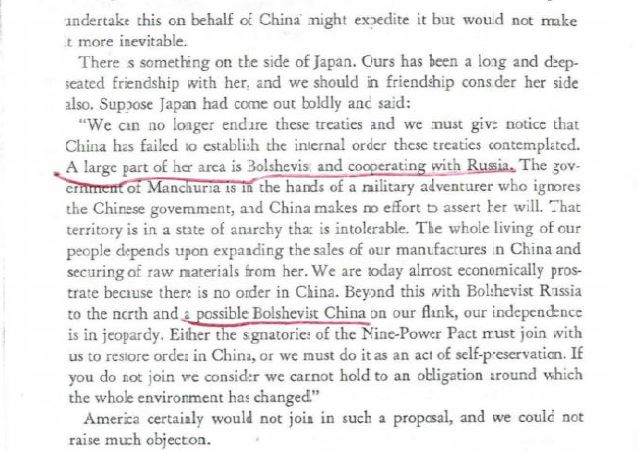
They forgot that in 1931, President Herbert Hoover gave Japan a free hand in the invasion of Manchuria on the pretext that Japan could not tolerate a half-Bolshevik China.
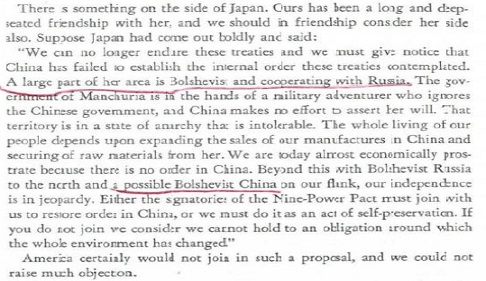 Earlier, President Hoover, who personally nipped the post-WWI communist uprisings in Germany and Hungary with the grains embargo, fed Lenin the ingenuity, i.e., the [worldwide communist revolution] road to Paris lay through Peking.
They of course forgot that
after the eruption of the 1937 Sino-Japanese War, the Americans, biased towards Japan and against China, adopted a policy of "neutrality" (what Utley called by "unpositive neutrality") against the 'belligerent' countries, namely, Japan and China, which was free and unrestrained arms sale to Japan and de facto arms embargo against China.
Note that the Japanese navy had a full blockade of China's coastline.
Note that the blockade would choke China since China did not have an industrial base to produce the basic weapons while Japan's factories could roll out the warships and airplanes on a wholesale scale.
Also note that in contrast with the Americans, the European powers, being constrained by the mediation role of the League of Nations, dared not openly sell arms to Japan.
Through 1940-1941, prior to the U.S. revocation of the 1911 U.S.-Japan Commerce Treaty, the Americans were the biggest supplier of raw material, oil, aviation oil, and weapons, to the extent that some U.S. senator called by Scott making a claim that out of every one million Chinese killed by the Japanese, 544,000 Chinese were killed by the Americans.
Thirty-one U.S. congressional members made a joint declaration to the effect that the U.S., not NAZI Germany, nor Italy, was the best ally of Japan.
Earlier, President Hoover, who personally nipped the post-WWI communist uprisings in Germany and Hungary with the grains embargo, fed Lenin the ingenuity, i.e., the [worldwide communist revolution] road to Paris lay through Peking.
They of course forgot that
after the eruption of the 1937 Sino-Japanese War, the Americans, biased towards Japan and against China, adopted a policy of "neutrality" (what Utley called by "unpositive neutrality") against the 'belligerent' countries, namely, Japan and China, which was free and unrestrained arms sale to Japan and de facto arms embargo against China.
Note that the Japanese navy had a full blockade of China's coastline.
Note that the blockade would choke China since China did not have an industrial base to produce the basic weapons while Japan's factories could roll out the warships and airplanes on a wholesale scale.
Also note that in contrast with the Americans, the European powers, being constrained by the mediation role of the League of Nations, dared not openly sell arms to Japan.
Through 1940-1941, prior to the U.S. revocation of the 1911 U.S.-Japan Commerce Treaty, the Americans were the biggest supplier of raw material, oil, aviation oil, and weapons, to the extent that some U.S. senator called by Scott making a claim that out of every one million Chinese killed by the Japanese, 544,000 Chinese were killed by the Americans.
Thirty-one U.S. congressional members made a joint declaration to the effect that the U.S., not NAZI Germany, nor Italy, was the best ally of Japan.
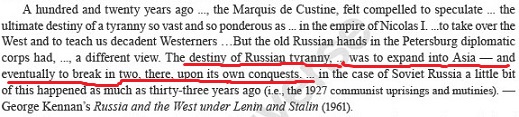 Not to mention that the Japanese navy had a full blockade of China's coastline.
America, the 'stars' that engendered or heralded the rise of the [Japan] 'sun', long ago had the blueprint to make Japan into a stalwart against China and Russia, i.e., the source of the Yellow Peril and the source of the Half-Tartars [or the Russians], respectively, --whom the Americans could not assimilate according to George Kennan.
William Christian Bullitt Jr. (1891-1967) disclosed that the Americans' national policy or strategic aim was to see the Russians and Japanese' holding a balance of power against each other in China rather than seeing either the Russians or the Japanese overpowering the other party in taking control of China.
In making this geopolitical decision, you had victimized the 1 billion humble Chinese peasants.
(Note President Wilson's doctrine that the intactness of China was vital to the white civilization -- in the sense that the nation of China should be managed delicately, that is, should not be allowed to grow too powerful to pose threat to the white civilization, nor should it be allowed to be hijacked by a non-U.S. power since China's immense human labor could be turned against the white civilization.
The theme of China to the white civilization, morphing superficially into a ***hypocritical*** American national policy of engagement with Communist China for changing the Chinese communists' behavior, rested on the same underlying logic:
"The
China Exception: Russian Communism being wicked, the
Chinese are good communists", which is an inherent fear
of the Yellow Peril,
i.e., billion Chinese would actually enjoy real
democracy, go to college and develop their intelligence.
Now, President Biden, a stooge of Communist China, explicitly abandoned the
hypocritical American policy of engagement to change communist China to his imbecilic communist buddy and dictator Xi Jinping.
Other than the stooge Bidens who ripped communist China's financial coffer (Tony Bobulinski FULL INTERVIEW Tucker Carlson), don't forget that President Roosevelt boasted of his family's ripping the China trade money in the 19th century, i.e., the opium trade;
and President Hoover certainly got the first bin of gold from the Kai-luan coal mine in collusion with the British during the 1900-1901 boxers' incident-related invasion.)
Not to mention that the Japanese navy had a full blockade of China's coastline.
America, the 'stars' that engendered or heralded the rise of the [Japan] 'sun', long ago had the blueprint to make Japan into a stalwart against China and Russia, i.e., the source of the Yellow Peril and the source of the Half-Tartars [or the Russians], respectively, --whom the Americans could not assimilate according to George Kennan.
William Christian Bullitt Jr. (1891-1967) disclosed that the Americans' national policy or strategic aim was to see the Russians and Japanese' holding a balance of power against each other in China rather than seeing either the Russians or the Japanese overpowering the other party in taking control of China.
In making this geopolitical decision, you had victimized the 1 billion humble Chinese peasants.
(Note President Wilson's doctrine that the intactness of China was vital to the white civilization -- in the sense that the nation of China should be managed delicately, that is, should not be allowed to grow too powerful to pose threat to the white civilization, nor should it be allowed to be hijacked by a non-U.S. power since China's immense human labor could be turned against the white civilization.
The theme of China to the white civilization, morphing superficially into a ***hypocritical*** American national policy of engagement with Communist China for changing the Chinese communists' behavior, rested on the same underlying logic:
"The
China Exception: Russian Communism being wicked, the
Chinese are good communists", which is an inherent fear
of the Yellow Peril,
i.e., billion Chinese would actually enjoy real
democracy, go to college and develop their intelligence.
Now, President Biden, a stooge of Communist China, explicitly abandoned the
hypocritical American policy of engagement to change communist China to his imbecilic communist buddy and dictator Xi Jinping.
Other than the stooge Bidens who ripped communist China's financial coffer (Tony Bobulinski FULL INTERVIEW Tucker Carlson), don't forget that President Roosevelt boasted of his family's ripping the China trade money in the 19th century, i.e., the opium trade;
and President Hoover certainly got the first bin of gold from the Kai-luan coal mine in collusion with the British during the 1900-1901 boxers' incident-related invasion.)
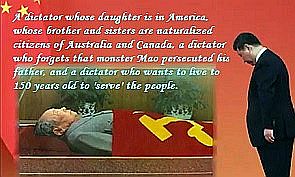 Now, you, as the midwife who delivered China into the communist hands, are morally obligated to take China [and North Korea {and Vietnam}] out of communism.
This time, you may feel your hands forced as North Korea, with its nuclear weapons, could become Communist China's cecal appendix in a repeat of history.
(The Chicoms don't understand the urgency of Trump's trade war having the roots in nuclear North Korea, nor the domino effect on North Korea and Russia after the knock-out of communist China.
Putin thought he would reap profits by sitting on the fence of the U.S.-China trade war, i.e., the Zheltorossiya dream
- revitalized by Aleksandr Gelyevich Dugin
[, and India would not be satisfied with grabbing South Tibet, Bhutan, and Sikkim alone].
Previously, this webmaster thought that the Americans could be hoodwinked by the Chicoms who might just sign any agreement just for sake of getting a red carpet at the White House in lieu of a visit to Mar-a-Lago.
With Trump's war with Communist China flaring up, this webmaster believed that China's dictator would continue to commit blunders and became the tomb digger for the Chinese communist regime.
The thuggery communists, who would not allow the millions of the Hongkong people to have autonomy, could have caused the demise of the regime over the inevitable crackdown, not knowing that the communist ascension to power had its very roots in Churchill's collusion with Roosevelt in selling out the Republic of China for sake of retaining crown jewel Hongkong after hoodwinking Wellington Koo and Chiang Kai-shek that Britain would return Hongkong to China after Japan was to surrender so as not to damage the British wartime morale.
--What happened was that Putin first jumped off the fence ahead of communist China in launching an invasion of Ukraine.)
Now, you, as the midwife who delivered China into the communist hands, are morally obligated to take China [and North Korea {and Vietnam}] out of communism.
This time, you may feel your hands forced as North Korea, with its nuclear weapons, could become Communist China's cecal appendix in a repeat of history.
(The Chicoms don't understand the urgency of Trump's trade war having the roots in nuclear North Korea, nor the domino effect on North Korea and Russia after the knock-out of communist China.
Putin thought he would reap profits by sitting on the fence of the U.S.-China trade war, i.e., the Zheltorossiya dream
- revitalized by Aleksandr Gelyevich Dugin
[, and India would not be satisfied with grabbing South Tibet, Bhutan, and Sikkim alone].
Previously, this webmaster thought that the Americans could be hoodwinked by the Chicoms who might just sign any agreement just for sake of getting a red carpet at the White House in lieu of a visit to Mar-a-Lago.
With Trump's war with Communist China flaring up, this webmaster believed that China's dictator would continue to commit blunders and became the tomb digger for the Chinese communist regime.
The thuggery communists, who would not allow the millions of the Hongkong people to have autonomy, could have caused the demise of the regime over the inevitable crackdown, not knowing that the communist ascension to power had its very roots in Churchill's collusion with Roosevelt in selling out the Republic of China for sake of retaining crown jewel Hongkong after hoodwinking Wellington Koo and Chiang Kai-shek that Britain would return Hongkong to China after Japan was to surrender so as not to damage the British wartime morale.
--What happened was that Putin first jumped off the fence ahead of communist China in launching an invasion of Ukraine.)
|
President Trump
understood the China situation and the China problem.
Should the American politicians follow the footsteps of Anson Burlingame (1820-1870),
Paul Samuel Reinsch (1869-1923)
and
Patrick Jay Hurley (1883-1963), i.e., three most prominent U.S. statemen who loved China and the Chinese people,
then the Chinese people could have a chance of salvation from the communist tyranny.
Note the historic recurrence and the repetition of similar events:
Anson Burlingame, in opposition to the anti-Chinese discriminatory whirlwinds rampant in the U.S. in the 19th century, authored the Burlingame Treaty for China and
died for China in 1870 in St. Petersburg
while still on the Manchu China's mission to the U.S. and Europe;
Paul Samuel Reinsch, who was disillusioned by President Wilson's betrayal of China over the division of WWI spoils at the Paris Peace Conference, quit the minister-to-China job to work for China and died for China in Shanghai in 1923;
and
Patrick Jay Hurley, who convinced President Roosevelt of the American moral blunders in selling out the Republic of China at Tehran and Yalta, personally travelled to Moscow and London for sake of averting and reverting China's fate of becoming a victim of WWII war spoils (i.e., the loss of Port Arthur and Hong Kong, etc.), but failed to make remedy to the secret Tehran and Yalta agreements in the aftermath of President Roosevelt's death in April 1945.
|
|
For better understanding the head-on collision between the United States and Communuist China,
refer to
the U.S.-China fatalistic conjunction through the hands of the Japanese firepower during WWII, that derived from the American unpositive neutrality;
the U.S.-China fatalistic conjunction through the hands of communist army's firepower during the 1945-1950 civil war, that derived from American-supplied Soviet August Storm weapons; and
the U.S.-China fatalistic conjunction through Joseph Stalin, Kim Il Sung and Mao Tse-ting's hands during the 1950-1953 Korean War.
|
|
|
|
More, refer to the Communist Platonic Club at wartime capital Chungking
and
The American Involvement in China: the Soviet Operation Snow, the I.P.R. Conspiracy, the Dixie Mission, the Stilwell Incident, the O.S.S. Scheme, the Coalition Government Crap, the Amerasia Case, & The China White Paper.
|
|
|
|
The Myth about the Ryukyu's Trusteeship with the U.S.
This was a myth. In Cairo, Roosevelt purportedly asked Chiang Kai-shek's opinions as to post-war Japan, including the revocation or retention of the so-called 'Tenno' system,
the independence of Okinawa, etc. Chiang purportedly answered that Okinawa should be put under the trustee control of the United Nations.
According to Herbert Feis,
Roosevelt and Churchill granted Chiang's wish to recover the territories lost to Japan since 1894-1895. Back on March 27th, Roosevelt, with Eden, Strang (William Strang, under secretary for state at the British Foreign Office), and Lord Halifax, et al., got the British to concur with China's recovery of Manchuria and Formosa, and Korea being under an international trusteeship, and prior to Hull's Moscow meeting, Roosevelt on October 5th again repeated the same words in addition to having Indo-China and the Japanese-mandated islands put under international trustees and awarding the Kurile Islands to Russia. As Chiang wished, Roosevelt was to inform Stalin at once of the offers made at Cairo, that was later published in a declaration on December 1st. The declaration proclaimed the Three Great Powers to "restrain and punish the aggression of Japan", to "covet no gain for themselves", to achieve the war purposes that "Japan should be stripped of all the islands in the Pacific" which she seized since WWI or 1914 and "the territories Japan had stolen from the Chinese", and that Japan would be "expelled from all other territories which she has taken by violence and greed" -- which was to leave open the Soviet territorial claims and American claims for Pacific islands here, and to have Korea "become free and independent" in due course.
Later, after the eruption of the Korea War,
Truman declared Taiwan a trustee island against the objection of Acheson.
Acheson, who refused to see Wellington Koo for well over one year after issuing The China White Paper, massaged words to explain the U.S. government's standground that the Yalta declaration in regards to Taiwan was only binding to the Four Powers and hence Taiwan's trustee status needed to be put on the United Nations' agenda.
Literatus Lin Yutang published an op-ed with a question: Should the United States put Taiwan under the United Nations' trusteeship, the Republic of China could request that Ryukyu be put under the trustee status of the United nations.
Rusk and Acheson then promised that should the Republic of China refrain from objecting to the Taiwan trusteeship issue, the United States would defeat the Soviet and their satellite states' motion to allow a Communist China observer to enter the U.N. to raise protests in regards to American bombing of the Sino-Korean border area and the 7th Fleet's violation of communist China's sovereighty in entering the Taiwan Straits.
Chiang's discussion did not appear to have covered the Diaoyudao (Sengaku) - since the ROC never foresaw the PRC-Japan confrontation today, and when Taiwan was supposed to revert to China in 1945, the nearby islands, which were seized at the same time
as Taiwan by Japan in the aftermath of the First Sino-Japanese War, should be returned as well - which was a common sense.
The talk on Okinawa at Cairo was merely question and answer on an informal occasion, and Roosevelt never intended to give China any benefits, other than making China
a puppet vote of the four voting members at the U.N. security council so that the U.S. could have a majority vote over the U.S.S.R.
Why so? Because, days later, Roosevelt, at Tehran, already sold out China's interests to Stalin.
The VENONA scripts already showed that the Soviet spies, every step of the way, surrounded Roosevelt and influenced Roosevelt on all decisions in favor of the Soviet Union. (The Soviet spies actually cut off the access of
people to Roosevelt, with grand eunuch Harry Hopkins being the gatekeeper to make rulings as to who got to see Roosevelt and who could not.)
At the exact same time, in Cairo, in the presence of Roosevelt's son James, Stilwell and the Soviet spy were talking about killing Chiang Kai-shek, with Roosevelt's full nodding approval.
You may refer to the memoirs by Roosevelt's son for this episode, at least 10 minutes' discussions about getting rid of Chiang and replacing Chiang with some more "manageable" person etc.
Months later, Roosevelt sent a WWI ace to the Burma-India front to seeing Stilwell with the official assassination order.
And it was one righteous American officer, who secretly tipped Chiang's son Jiang Jingguo at the last minute that Chiang was to board a plane, that Chiang did not die in a crash setup.
This is just one example to show how China (ROC) was betrayed by the "democracy" countries in WWII, not to mention the betrayal to the ROC in excluding China from the San Francisco Peace Treaty's signing.
Today's Chinese, who were duped by the communist propaganda, would not understand the history's riddles unless fully acknowledging the facts
as to how the wars [starting from at least the 1839-1842 Opium War, through the 1904 Russo-Japanese War and to the 1937 Marco Polo Bridge Incident] were provoked and how the communists ascended to power in Russia and China.
Please refer to discussions at
http://www.chinahistoryforum.com/index.php?/topic/34803-why-chiang-kai-shek-did-not-want-ryukyu
For one, Chiang Kai-shek had his strengths and shortcomings. One of the strengths that Chiang possessed was the Chinese intelligence service's successful deciphering of the Japanese foreign ministry's telegram codes in the 1930s. This was the work of Chi Buzhou, a Japan-returned student, who was able to crack the codes starting from the most common numbers like 1 ('yichi' in Japanese) and 9 ('nan' or 'kyu' in Japanese).
The Chinese broke the Japanese codes through painstaking work while the British and Americans relied on the cloned cipher machines. Chi Buzhou broke the Japanese foreign ministry codes through the Japanese radiograms' reports on the Chinese military units' numbering and order of battle, the same way as Alan Turing's deciphering the German navy's Enigma codes via the repeat words 'Heil Hitler', a technique built on top of the Polish Cipher Bureau's work on the Germany's military ciphers. The other method used was by detecting the Japanese case auxiliary characters. And, the jumble-purpose character was filtered through the comparison of odd versus even fractionating transposition of the two-letter code groups.
With this weapon, Chiang was able to read the Japanese foreign ministry's communications with their embassies and consulates in Moscow, and Honolulu, etc., till the end of the war. There were two sets of Japanese foreign ministry codes, the special and the common.
The Chinese side deciphered both sets of the Japanese foreign ministry diagram
(Whereas in the U.S., there was the so-called MAGIC deciphering project, which was a break of the common code of the Japanese foreign ministry.
As pointed out by the American cryptologic agency, the Japanese navy upgraded their codes three times, with a 'Red' code in the 1920s, a 'Blue' code in the early 1930s -that was deciphered no later than 1932, and a 'Purple' code after 1939 that was similar to the Germans' Enigma that used a machine-generated code to jumble the texts. Apparently, the Japanese, right after the eruption of the July 7, 1937 war, in upgrading their navy codes, changed their diplomatic codes as well and might cause the Chinese side difficulty to continue to read the Japanese radiograms. However, the British overcame it. The most sensitive Japanese diplomatic cables followed a similar cipher approach, which the British cloned in August 1935 under the headline of 'J Machine'. This purportedly allowed the British to read the Japanese diplomatic cables up to the spring of 1939 when Japan introduced a cipher machine called by the angoo-ki taipu b, namely, the American 'Purple' cipher. The Japanese code upgrade in the spring of 1939 stopped the British and the Americans from reading the Japanese messages. However, the Americans in January 1941 offered the raw 'Purple' cipher machine to the British which re-enabled the British to utilize the old technology to break the Japanese diplomatic telegrams.)
Armed with this weapon, Chiang was able to pre-warn the U.S. about the possible attack at the Pearl Harbor and to pre-warn the British about the Japanese plan to sink warship Prince of Wales, etc., and was able to foretell the signing of the Soviet-Japanese neutrality treaty, and other related info about Germany. This, however, was one-sided info that the Japanese communicated to their embassies and consulates in Moscow, Berlin and D.C. None of the thousands of telegrams deciphered touched on the secrets among Churchill, Roosevelt and Stalin - because Roosevelt was sneaky enough to use the special direct under-sea cable to communicate with the counterparts. Hence, Chiang was always having a naivety towards Roosevelt - especially after learning that the U.S. representative to Moscow had adamantly insisted that the ROC should be given the status as one of the four veto powers at the United Nations. Chiang never knew that he would be stabbed in the back by the U.S., not to mention the knowledge of the existence of hundreds of Soviet spies throughout the White House, the State Department, the Army, the OSS, and etc. Chiang must know that the United Nations was the top dream of Roosevelt, i.e., Roosevelt's dream to be a world leader overseeing the united nations of the Earth. That's probably why Chiang sold the crap about having Okinawa become subordinate to the United Nations post-WWII.
There was one important episode recorded in Roosevelt's conversations with Chiang, namely, the Burma campaign and the promised aid to China. After Roosevelt left Cairo, both promises were broken. There was no amphibious landing in Burma, nor financial or military aid to the ROC, not to mention the assassination scheme. Some experts analyzed the records of Roosevelt's son, and concluded that it was within about half year before the Cairo Conference that Roosevelt had fully bought the opinions from the Soviet spies that Chiang should be rid of. Roosevelt, as this webmaster said elsewhere, was someone like a dowager empress, who spent 2-3 weeks in the warm springs, and then half a day dealing with the state affairs. The affairs of the United States government were run by the grand eunuch, i.e., Comintern spy Harry Hopkins. Nobody could see Roosevelt without the approval of Harry Hopkins. And, together with G Marshall, and Eleanor Roosevelt, the three were called by triumvirate. Should Roosevelt ever test Chiang about ceding Okinawa to China, it would be Roosevelt's subconscious attempt to compensate China for his scheme to sell China's Manchuria to Stalin.
Chiang, while ignorant of those schemes, still knew that he had to count on the U.S. against Britain and the Soviet Union, two ferocious countries which would do anything to intrude into and infringe on China's interests, both collaborating with the Chinese communists in sabotaging the cause of the ROC throughout WWII. Hence, Chiang thought he had taken the PREEMPTIVE STRIKE by proposing to Roosevelt that he would agree to have Port Arthur and Dairen be treated as the "international ports". This was recorded in the Yalta Conference. Unfortunately, China's fate of being bullied, and taken advantage of, by the powers, could not be reversed, even with the leadership of Chiang Kai-shek. That's what I called the spider's web. Otherwise, how could the British Empire be called the no-sunset empire for hundreds of years. China was doomed, and this webmaster don't see a way to have the course changed from the hindsight [other than Chiang's possibly refusing the British request as to transferring the Hongkong islands to China after defeating the Japanese so that the British would not have incentives to sabotage China for preventing China from recovering HK and achieving a strong position post-WWII).
The Soviet-hijacked American government did not modify the anti-Chiang Kai-shek policy till after the eruption of the Korean War, with McArthur sending in a Survey Team to Taiwan in October 1950 and Karl L. Rankin signing an agreement on the American "Military Assistance and Advisory Group" mission in January-February 1951, which led to William Curtis Chase's being sent to Taiwan as a delegation chief in 1951.
At the same time, the Soviet agents in the U.S. government continued the scheme of nullifying Taiwan's status as part of China, using the excuse and pretext from the relatively loosely-termed Yalta Agreement to make a case of Taiwan as a trustee country, and splitting Chiang Kai-shek's government with the training of a THIRD FORCE military band in Okinawa and elsewhere.
Chiang Kai-shek's son, suspicious of the Americans' design of THE THIRD FORCE, banished or rejected the staff who worked with the American THIRD FORCE, such as Mao Sen who had to go into exile in Hongkong and the United States, successively.
See the C.I.A. farce of training a group of the former Chinese Nationalist Army troops as a Third Force, and in 1952, parachuting John T. Downey and Richard G. Fecteau into Manchuria, which led to the two guys falling into victims as the communist prisoners of war till the early 1970s.
(It would be after Dwight David Eisenhower became president in the 1953 that the U.S. would declare the secret Yalta treaty to be invalid and began to support Chiang Kai-shek's regime in Taiwan.
Taiwan followed through with voiding the 1945 Sino-Soviet friendship treaty, a treaty that Stalin was initially reluctant to replace with the Mao-proposed 1950 USSR-PRC friendship treaty for the befuddled legality that it was built on top of Churchill and Roosevelt's Yalta endorsements.)
written by Ah Xiang
|
|
 ***
***
![Though, Anna Wang [Anneliese Martens], in her memoirs, expressed jealousy over Gong Peng by stating that the Anglo-American reporters had flattered the Chinese communists and the communist movement as a result of being entranced with the goldfish-eye'ed personal assistant of Zhou Enlai](GongPeng.jpg)