Sinitic Civilization-Book 1
Sinitic Civilization-Book 2
Tribute of Yu

Heavenly Questions
Zhou King Muwang's Travels

The Legends of Mountains & Seas
The Bamboo Annals - Book 1

The Scourge-of-God-Tetralogy:
From the Khitans to the Jurchens & Mongols: A History of Barbarians in Triangle Wars and Quartet Conflicts
(available at iUniverse;
Google;
Amazon;
B&N)
|
|
 This website's contents are the result of 20 years' writings --that could be compared to the "archaeological deposits" in a literary sense.
The freelance-style writings on the website were not proof-read.
Portion of the writings, i.e., related to Pre-History, Xia, Shang, Zhou, Qin, and Han dynasties, was extracted, polished, reconciled, and synthesized into
The Sinitic Civilization - Book I which is
available now on
Barnes & Noble,
Amazon,
Google Play|Books
and
Nook.
Book II is
available now on
Amazon
and Barnes & Noble.
Check out this webmaster's 2nd edition --that realigned Han dynasty's reign years strictly observing the Zhuanxu-li calendar of October of a prior lunar year to September of the following lunar year
and
cleared this webmaster's blind spot on the authenticity of the Qinghua University's Xi Nian bamboo slips as far as Zhou King Xiewang's 21 years of co-existence with Zhou King Pingwang was concerned.
To give the readers a heads-up, this webmaster had thoroughly turned the bricks concerning the Sinitic cosmological, astronomical, astrological, historical, divinatory, and geographical records, with the indisputable discovery
of the fingerprint or footprint of the forger for the 3rd century A.D. book Shang-shu (remotely ancient history),
and
close to 50 fingerprints or footprints of the forger of the contemporary version of The Bamboo Annals --a book that was twice modified and forged after excavation.
All ancient Chinese calendars had been examined, with each and every date as to the ancient thearchs being examined from the perspective how they were forged or made up.
Using the watershed line of Qin Emperor Shihuangdi's book burning to rectify what was the original before the book burning,
this webmaster filtered out what was forged after the book burning of 213 B.C.
This webmaster furthermore filtered out the sophistry and fables that were rampant just prior to the book burning, and validated the history against the oracle bones, bronzeware and bamboo slips.
There are dedicated chapters devoted to interpreting Qu Yuan's poem Asking Heaven, the mythical mountain and sea book Shan Hai Jing, geography book Yu Gong (Lord Yu's Tributes), and Zhou King Muwang's travelogue Mu-tian-zi Zhuan, as well as a comprehensive review of ancient calendars, ancient divination, and ancient geography.
One chapter is focused on the Huns, with a comprehensive overview of the relationship between the Sinitic people and the barbarians since prehistory.
The book has appendices of two calendars: the first Zhuanxu-li anterior quarter remainder calendar (247 B.C.-85 A.D.) of the Qin Empire, as well as a conversion table of the sexagenary years of the virtual Yin-li (Shang dynasty) quarter remainder calendar versus the Gregorian calendar, that covers the years 2698 B.C. to 2018 A.D.
Refer to
Introduction_to_The_Sinitic_Civilization,
Afterword,
Table of Contents - Book I (Index)
and
Table of Contents - Book II (Index)
for details.
This website's contents are the result of 20 years' writings --that could be compared to the "archaeological deposits" in a literary sense.
The freelance-style writings on the website were not proof-read.
Portion of the writings, i.e., related to Pre-History, Xia, Shang, Zhou, Qin, and Han dynasties, was extracted, polished, reconciled, and synthesized into
The Sinitic Civilization - Book I which is
available now on
Barnes & Noble,
Amazon,
Google Play|Books
and
Nook.
Book II is
available now on
Amazon
and Barnes & Noble.
Check out this webmaster's 2nd edition --that realigned Han dynasty's reign years strictly observing the Zhuanxu-li calendar of October of a prior lunar year to September of the following lunar year
and
cleared this webmaster's blind spot on the authenticity of the Qinghua University's Xi Nian bamboo slips as far as Zhou King Xiewang's 21 years of co-existence with Zhou King Pingwang was concerned.
To give the readers a heads-up, this webmaster had thoroughly turned the bricks concerning the Sinitic cosmological, astronomical, astrological, historical, divinatory, and geographical records, with the indisputable discovery
of the fingerprint or footprint of the forger for the 3rd century A.D. book Shang-shu (remotely ancient history),
and
close to 50 fingerprints or footprints of the forger of the contemporary version of The Bamboo Annals --a book that was twice modified and forged after excavation.
All ancient Chinese calendars had been examined, with each and every date as to the ancient thearchs being examined from the perspective how they were forged or made up.
Using the watershed line of Qin Emperor Shihuangdi's book burning to rectify what was the original before the book burning,
this webmaster filtered out what was forged after the book burning of 213 B.C.
This webmaster furthermore filtered out the sophistry and fables that were rampant just prior to the book burning, and validated the history against the oracle bones, bronzeware and bamboo slips.
There are dedicated chapters devoted to interpreting Qu Yuan's poem Asking Heaven, the mythical mountain and sea book Shan Hai Jing, geography book Yu Gong (Lord Yu's Tributes), and Zhou King Muwang's travelogue Mu-tian-zi Zhuan, as well as a comprehensive review of ancient calendars, ancient divination, and ancient geography.
One chapter is focused on the Huns, with a comprehensive overview of the relationship between the Sinitic people and the barbarians since prehistory.
The book has appendices of two calendars: the first Zhuanxu-li anterior quarter remainder calendar (247 B.C.-85 A.D.) of the Qin Empire, as well as a conversion table of the sexagenary years of the virtual Yin-li (Shang dynasty) quarter remainder calendar versus the Gregorian calendar, that covers the years 2698 B.C. to 2018 A.D.
Refer to
Introduction_to_The_Sinitic_Civilization,
Afterword,
Table of Contents - Book I (Index)
and
Table of Contents - Book II (Index)
for details.
|
|
Table of lineages & reign years:
Sovereigns & Thearchs;
Xia-Shang-Zhou dynasties;
Zhou dynasty's vassalage lords;
Lu Principality lords;
Han dynasty's reign years
(Sexagenary year conversion table-2698B.C.-A.D.2018; 247B.C.-A.D.85)
|
Epigraph|Preface|Introduction|T.O.C.|Afterword|Bibliography|References|Index
(available at iUniverse|Google|Amazon|B&N)
|
|
THE HUNS - PART I
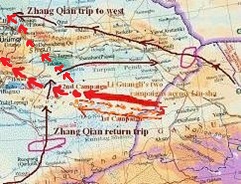 For details on when the east met with the west, see this webmaster's discussion on the Huns, the Yuezhi, the Tarim Mummies, the Yuezhi-Yushi misnomer,
the Mongoloid-Caucasoid admixture at 2000 B.C.E.,
the fallacy of the Aryan bearing of the Chinese civilization,
the fallacy of the Yuezhi jade trade,
the Yuezhi migration timeline,
as well as
the location of the Kunlun Mountain,
Queen Mother of the West,
the legendary book of mountains and seas at the Imperial China blog,
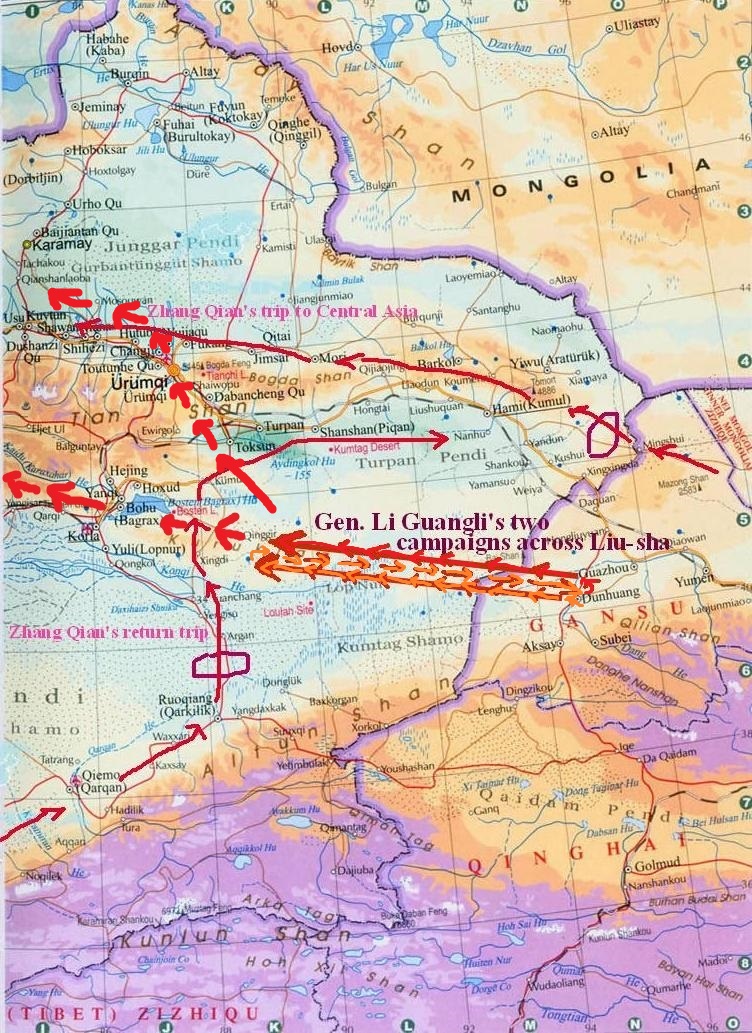
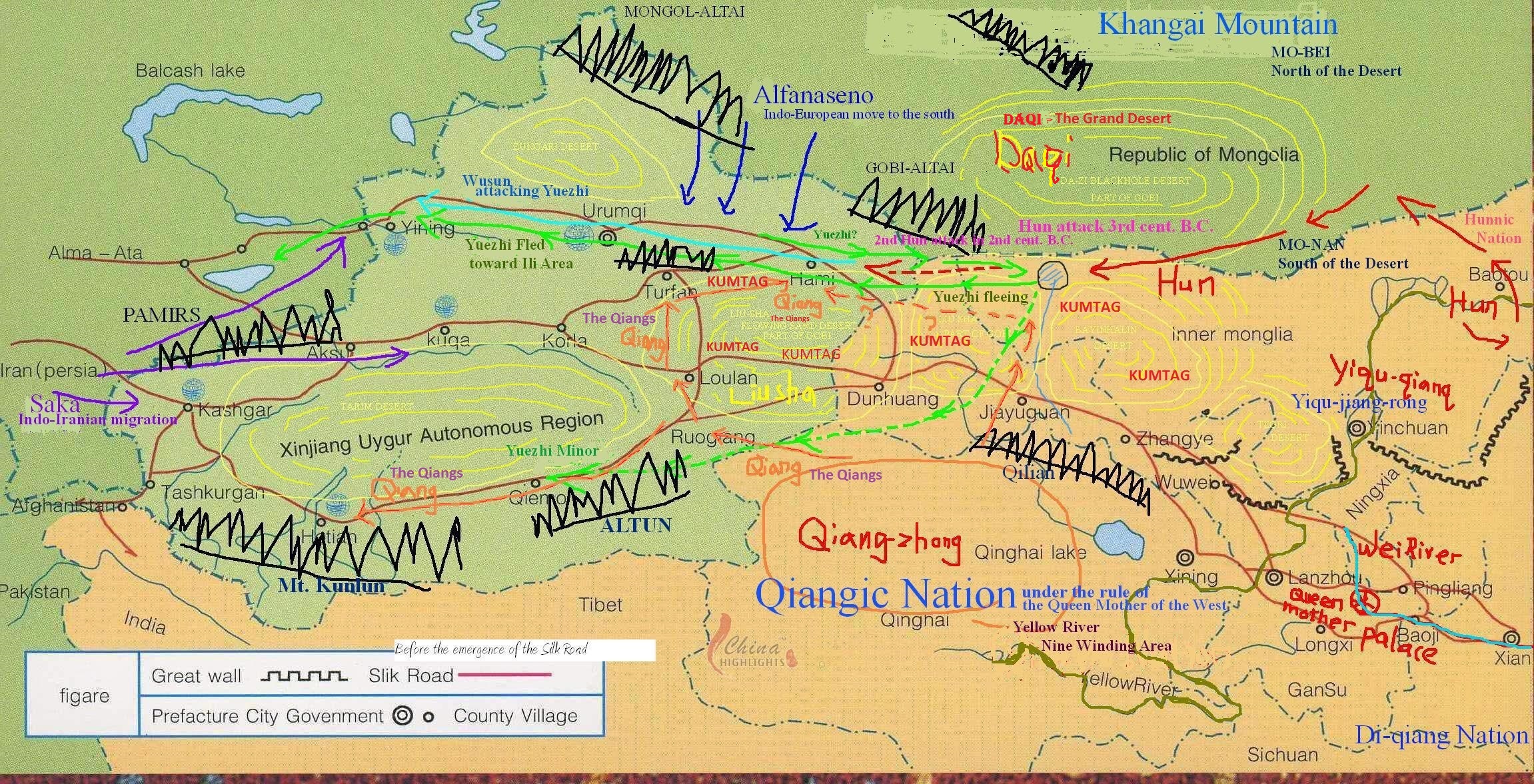
and the Qiang's possible routes of passage into Chinese Turkestan
at
http://www.imperialchina.org/Barbarians.htm which was embedded within the
Huns.html and
Turks_Uygurs.html pages.
(Note that Western Queen Mother had the prototype in an "earth mother" deity, not related to Queen Sheba of Charles Hucker.
The Mt. Kunshan jade was more likely the Mt. Huoshan jade in the Han dynasty book Huai Nan Zi, or the Mt. Yiwulü jade or the Kunlun jade that were juxtaposed together in the same book Huai Nan Zi, not related to Queen Mother of the West.
http://www.sino-platonic.org/complete/spp115_chinese_proto_indo_european.pdf provides another perspective of looking at things of the past from the perspective of language cognates. Rather believing that the Indo-Europeans ever invaded China and gave the Sinitic people the language, we could actually deduce that "Old Chinese", for its 43% correlation with the Proto-North-Caucasian, rather 23% with the Proto-Indo-European, was the source for both the cognates of the Proto-North-Caucasian and the Proto-Indo-European -- with the Proto-North-Caucasian falling under the umbrella of the Dene-Caucasian (Sino-Caucasian) Language Family that encompassed the [Proto-North-]Caucasian, Yeniseian and Sino-Tibetan languages. This is because our cousins, i.e., the N haplogroup people, relocated to North Asia and then to Latvia, Estonia, Finland and Scandinavia, bringing along the Sinitic language to the Proto-North-Caucasian who in turn gave it to the Proto-Indo-European. Note the Sinitic language cognates' 74% correlation with the Proto-Tibeto-Burman who split from the Sinitic people merely 5000-6000 years ago.)
For details on when the east met with the west, see this webmaster's discussion on the Huns, the Yuezhi, the Tarim Mummies, the Yuezhi-Yushi misnomer,
the Mongoloid-Caucasoid admixture at 2000 B.C.E.,
the fallacy of the Aryan bearing of the Chinese civilization,
the fallacy of the Yuezhi jade trade,
the Yuezhi migration timeline,
as well as
the location of the Kunlun Mountain,
Queen Mother of the West,
the legendary book of mountains and seas at the Imperial China blog,
and the Qiang's possible routes of passage into Chinese Turkestan
at
http://www.imperialchina.org/Barbarians.htm which was embedded within the
Huns.html and
Turks_Uygurs.html pages.
(Note that Western Queen Mother had the prototype in an "earth mother" deity, not related to Queen Sheba of Charles Hucker.
The Mt. Kunshan jade was more likely the Mt. Huoshan jade in the Han dynasty book Huai Nan Zi, or the Mt. Yiwulü jade or the Kunlun jade that were juxtaposed together in the same book Huai Nan Zi, not related to Queen Mother of the West.
http://www.sino-platonic.org/complete/spp115_chinese_proto_indo_european.pdf provides another perspective of looking at things of the past from the perspective of language cognates. Rather believing that the Indo-Europeans ever invaded China and gave the Sinitic people the language, we could actually deduce that "Old Chinese", for its 43% correlation with the Proto-North-Caucasian, rather 23% with the Proto-Indo-European, was the source for both the cognates of the Proto-North-Caucasian and the Proto-Indo-European -- with the Proto-North-Caucasian falling under the umbrella of the Dene-Caucasian (Sino-Caucasian) Language Family that encompassed the [Proto-North-]Caucasian, Yeniseian and Sino-Tibetan languages. This is because our cousins, i.e., the N haplogroup people, relocated to North Asia and then to Latvia, Estonia, Finland and Scandinavia, bringing along the Sinitic language to the Proto-North-Caucasian who in turn gave it to the Proto-Indo-European. Note the Sinitic language cognates' 74% correlation with the Proto-Tibeto-Burman who split from the Sinitic people merely 5000-6000 years ago.)
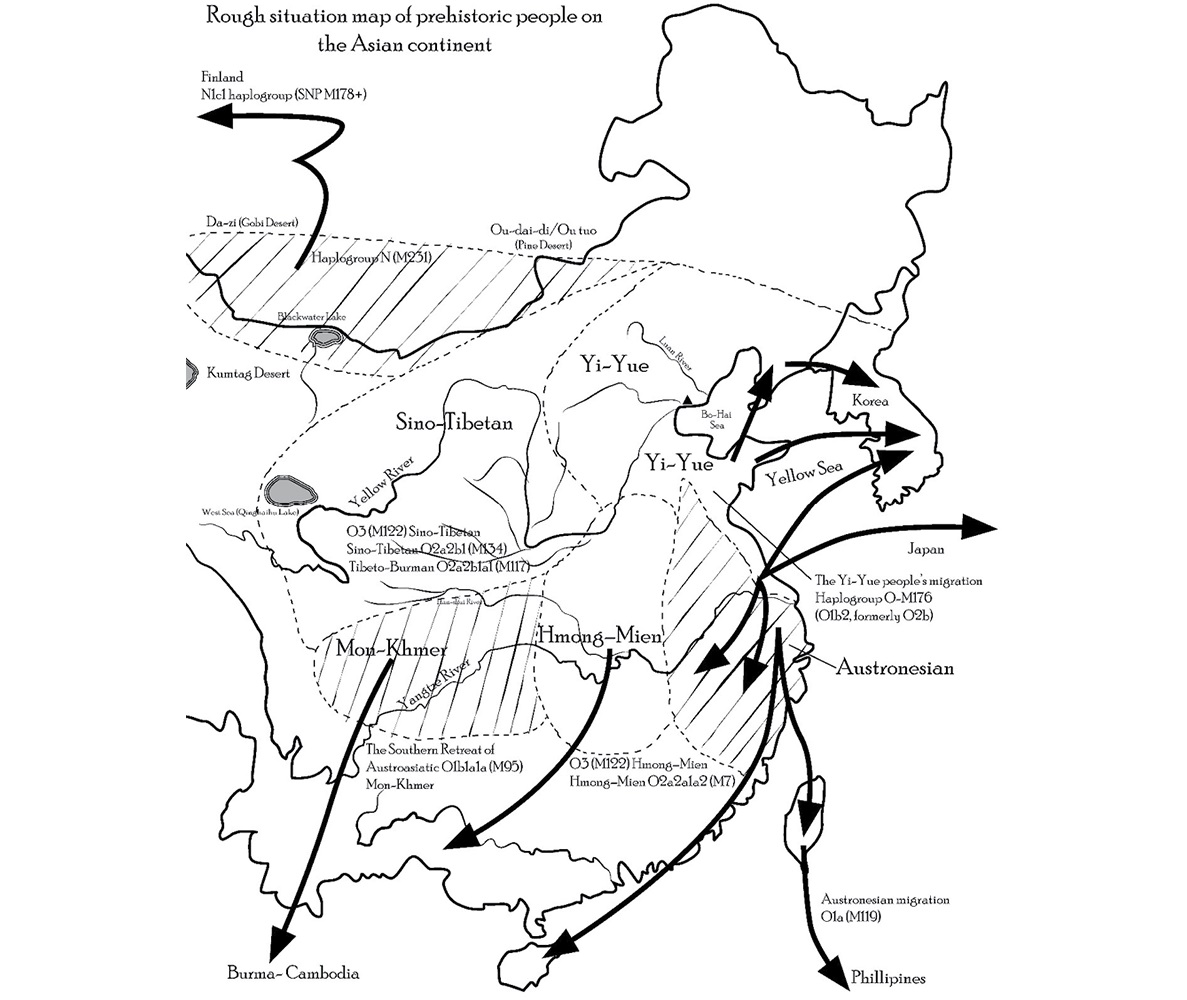
Li Hui of Fudan University of China analyzed the Asian DNAs to have derived a conclusion that ancestors of the [East] Asians possessed a distinctive Mark M89 by the time they arrived in Southeast Asia.
About 30,000 years ago, from the launching pad of Southeast Asia, the early Asians went through a genetic mutation to marker M122.
Li Hui claimed that the early migrants to the Chinese continent took three routes via two entries of today's Yunnan and Guangxi-Guangdong provinces.
More studies done after Li Hui had ascertained the dates of the O1, O2 and O3 haplogroup people, with the (O1, O2) entrants along the Southeast Chinese coast dated to have split away from the O3-haplogroup people like 20,000 years ago, much earlier than the continental peers, i.e., the Sino-Tibetans (O3a3c1-M117), Hmong-Mien (Miao-Yao, O3a3b-M7) and Mon-khmers.
According to
https://www.ncbi.nlm.nih.gov/pmc/articles/PMC5255561/
"Y chromosome suggested Tibeto-Burman populations are an admixture of the northward migrations of East Asian initial settlers with haplogroup D-M175 in the Late Paleolithic age, and the southward Di-Qiang people with dominant haplogroup O3a2c1*-M134 and O3a2c1a-M117 in the Neolithic Age. Haplogroup O3a2c1*-M134 and O3a2c1a-M117 are also characteristic lineages of Han Chinese, comprising 11.4% and 16.3%, respectively. However, another dominant paternal lineage of Han Chinese, haplogroup O3a1c-002611, is found at very low frequencies in Tibeto-Burman populations, suggesting this lineage might not have participated in the formation of Tibeto-Burman populations."
Namely, the haplogroup O3a1c-002611 Sinitic people, not the O3a2c1*-M134 and O3a2c1a-M117 barbarians, were responsible for engendering the Yangshao and Longshan civilization, and partially with the N-haplogroup people, engendering the Hongshan civilization.
The Zhou people were archaeologically speculated to have origin from today's Shanxi for the link to the Guangshe Culture –- which was in turn a derivative of the You'ao-type Laohushan Culture of the mixed N-haplogroup and O-haplogroup people.
(Since the O3a1c-002611 people were separated from the Northwestern cousins and Tibeto-Burmese at an early age, for it to have a part in the history of Northwestern China, the explanation would be to treat the Haplogroup O3a2c1*-M134 and O3a2c1a-M117 people as the historical Qiang and Hu barbarians, with the latter's paleo-Northwestern genes replacing the paleo-North-China and paleo-Central Plains genes of O3a1c-002611 Sinitic people by the Soong dynasty (A.D. 960-1279), that was likely triggered by the multiplication of the Tang dynasty's imperial house that had its origin from the Western Corridor.
The Soong dynasty royals took Tianshui of western China as the ancestral homeland, which was similar to the Tang dynasty royals' origin from the Western Corridor in western China, i.e., the Qin and Zhao states' common ancestral place.
The Soong royal house, however, could be of the Shatuo Turks' Q-haplogroup gene.
Also see this webmaster's discussion on
the ethnic nature of the ancient Huns belonging to part of the epic Jiang-rong human migration
of the Jiang-surnamed San-miao people and Yun-surnamed Xianyun people.)
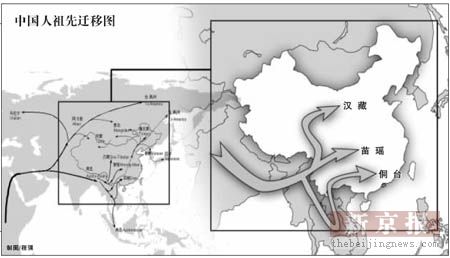 Li Hui commented that one branch of the early Asians, over 10,000 years ago, entered China's southeastern coastline with genetic marker M119. Li Hui, claiming the same ancestry as the Dai-zu and Shui-zu minorities of Southwestern China, firmly believed that his ancestors had dwelled in the Hangzhou Bay and the Yangtze Delta for 7-8 thousand years.
The people with the M119 marker would be the historical "Hundred Yue People".
The interesting theory adopted by Li Hui would be the migration of one branch of people who continued to travel non-stop along the Chinese coastline to reach the Liao-he River area of today's Manchuria.
Li Hui's speculation on basis of the DNA technology was an evolving process.
This would be likely the O2-haplogroup people, rather than the C-haplogroup or North Asia people whose historical presence in Asia could be dated 50,000 years ago, just after the earlier D-haplogroup people who were now mostly restricted in the area of Hokkaido, Japan, and known as the Ainu.
The C-haplogroup people developed into what this webmaster called by the Altaic-speaking people,
i.e., ancestors of the Mongols and Manchus.
What likely happened was that the O2-haplogroup people first travelled along the coast to reach Manchuria, and then traced back towards the south to reach the Yangtze area about 7-8000 years ago, where they evicted the O1-haplogroup people to the Southeast Asian islands.
At about the same time, the O3-haplogroup people, moving through the continent, reached today's western Liaoning at least 5000 years ago, or like 11,000 years ago on basis of the evidence of the pottery aging.
See the genetical analysis conducted by Li Hongjie of Jirin University on the remains of prehistoric people extracted from the archaeological sites.
Li Hui commented that one branch of the early Asians, over 10,000 years ago, entered China's southeastern coastline with genetic marker M119. Li Hui, claiming the same ancestry as the Dai-zu and Shui-zu minorities of Southwestern China, firmly believed that his ancestors had dwelled in the Hangzhou Bay and the Yangtze Delta for 7-8 thousand years.
The people with the M119 marker would be the historical "Hundred Yue People".
The interesting theory adopted by Li Hui would be the migration of one branch of people who continued to travel non-stop along the Chinese coastline to reach the Liao-he River area of today's Manchuria.
Li Hui's speculation on basis of the DNA technology was an evolving process.
This would be likely the O2-haplogroup people, rather than the C-haplogroup or North Asia people whose historical presence in Asia could be dated 50,000 years ago, just after the earlier D-haplogroup people who were now mostly restricted in the area of Hokkaido, Japan, and known as the Ainu.
The C-haplogroup people developed into what this webmaster called by the Altaic-speaking people,
i.e., ancestors of the Mongols and Manchus.
What likely happened was that the O2-haplogroup people first travelled along the coast to reach Manchuria, and then traced back towards the south to reach the Yangtze area about 7-8000 years ago, where they evicted the O1-haplogroup people to the Southeast Asian islands.
At about the same time, the O3-haplogroup people, moving through the continent, reached today's western Liaoning at least 5000 years ago, or like 11,000 years ago on basis of the evidence of the pottery aging.
See the genetical analysis conducted by Li Hongjie of Jirin University on the remains of prehistoric people extracted from the archaeological sites.
  Northeast (southeastern Inner Mongolia)
    Niuheliang, Lingyuan, the Hongshan Culture, 5000 YBP,
    4 N, 1 C*, 1 O

  North
   Yuxian County (the Sanguan site), Hebei,
   the Lower Xiajiadian Culture, 3400-3800 YBP, all O3
Combining Li Hui's study with the pottery excavation, we could see a clear path going north extending from around 15,000 years ago to 10,000 years ago.
Refer to Yaroslav V. Kuzmin's discourse on potteries
to see the path of migration of
proto-Mongoloids
from southwestern China (approx. 15,120+/-500 BP) to
Northeast Asia (Manchuria [13,000 BP, or c. 14,000 - 13,600 cal BC] and
Japan [c. 11,800-10,500 cal BC (c. 13,800 - 12,500 cal BP)]) to
Siberia (11,000 BP, or 11,200 - 10,900 cal BC).
In the timeframe of about 10,000 years, developing a genetic mutation to the marker M134, one branch of people who went direct north, per Li Hui, would penetrate the snowy Hengduan Mountains of the Tibetan-Qinghai Plateau to arrive at the area next to the Yellow River bends.
Owning to the cold weather environment, some physique, such as big noses, heavy lips and longer faces, developed among this group of people, i.e., ancestors of the Sino-Tibetans.
Splitting out of the northbound migrants would be those who went to the east with a new genetic marker M117, i.e., ancestors of the modern Han [a misnomer as the proper term should be Sino-Tibetan, nor the later Sinitic] Chinese.
We could say that our Sino-Tibetan ancestors forgot that they had penetrated northward the Hengduan Mountains from the Indo-China "CORRIDOR" in today's Burma-Vietnam.
"Walking down Mt Kunlun", i.e., the "collective memory of the ethnic Han Chinese" throughout China and the Southeast Asian Chinese communities, that was echoed in Guo Xiaochuan's philharmonic-agitated epic, would become the starting point of the eastward migration which our Chinese ancestors remembered.
(Li Hui grouped the 3000-year-old Chu and Qi people in the same category as the Han Chinese, albeit meeting the ancient classics' records as to the Qi statelet's lineage from the Qiangic-Tibetan Fiery Lord.
According to
https://onlinelibrary.wiley.com/doi/full/10.1111/j.1759-6831.2012.00244.x
"the frequencies of the three main subhaplogroups of O3-M122: O3a1c-002611, O3a2c1*-M134, and O3a2c1a-M117 in Han Chinese are 16.9%, 11.4%, and 16.3%, respectively (Yan et al., 2011).
The northward migration of haplogroup O3a1c-002611 started about 13 thousand years ago (KYA). The expansions of subclades F11 and F238 in ancient Han Chinese began about 5 and 7 KYA immediately after the separation between the ancestors of the Han Chinese and Tibeto-Burman.
Haplogroup O3a1c-002611 and O3a1c1-F11 started their northward migration about 12 KYA from Southeast Asia, along with other O3-M122 lineages, and reached the upper and middle Yellow River basin. About 7 KYA, haplogroup O3a1c2-F238 originated in the ancestors of modern Sino-Tibetan populations. About 6 KYA, the Han Chinese split from the Proto-Sino-Tibetan, and started their migration to the east and south (Su et al., 2000b). About 5 KYA, haplogroup O3a1c1-F11 experienced rapid expansion, probably in the Eastern Han Chinese, with recent gene flow with surrounding populations and eventually became prevalent in different ethnic groups in East Asia.)
Li Hui then pointed out that the ancient Wu people, with M7 genetic marker, came to the lower Yangtze area about 3000 years ago.
While Li Hui claimed that the M7 Wu people had split away from the northbound M134 Sino-Tibetan people, the historical Chinese classics pointed out that the Wu Statelet was established by two uncles of Zhou Dynasty King Wenwang, i.e., migrants from the Yellow River area.
The general layout by Lu Hui seems to have corroborated with Scholar Luo Xianglin's claim that early Sino-Tibetan people originated from the Mt Minshan and upper-stream River Min-jiang areas of today's Sichuan-Gansu provincial borderline and then split into two groups, with one going north to reach the Wei-shui River and upperstream Han-shui River of Shenxi Province and then eastward to Shanxi Province by crossing the Yellow River.
--Though, this webmaster's analysis of China's prehistory shows that the Sino-Tibetan people who moved to the eastern coast was one group, with the future Tibetans being actually the exiles to Northwest China from eastern and central China during the era of Lord Shun. Namely, the split of the Sinitic and proto-Tibetan people occurred prior and during the exile in the late 3rd millennium B.C.E.
(George Driem proposed that the Sino-Tibetans had splitoffs like the Western Tibeto-Burmans and the Eastern Tibeto-Burmans, with the Eastern Tibeto-Burmans forming two groups of northern and southern, who in turn split into the Northwestern Tibeto-Burmans, the Northeastern Tibeto-Burmans, the Southwestern Tibeto-Burmans, and the Southeastern Tibeto-Burmans, with a claim that the western offshoots went all the way to the Kashmir before returning east along the northern slope of the Himalayas to have a reunion with their cousins and that the Northeastern Tibeto-Burmans were the Sinitic people.)
What Li Hui did not touch on in his earliest studies were the cousin tribes of the Sino-Tibetans, namely, the Hmong-miens and Mon-khmers.
As noted at http://www.ncbi.nlm.nih.gov/pmc/articles/PMC3164178/, "A clear hierarchical structure (annual ring shape) emerged in the network of O3a3b-M7 (Fig. 2B), in which MK (Mon-Khmers) haplotypes lay at the center of the network (immediately next to the origin), HM (Hmong-Mien) haplotypes were distributed at the periphery to the MK haplotypes, and the ST (here the subfamily Tibeto-Burman) haplotypes were only found further away from the origin."
|
|
* In Commemoration of China's Fall under the Alien Conquests in A.D. 1279,
A.D. 1644 & A.D. 1949 *
 U.S.S.R./Comintern Alliance with the KMT & CCP (1923-1927)
 Korean/Chinese Communists & the 1931 Japanese Invasion of Manchuria Korean/Chinese Communists & the 1931 Japanese Invasion of Manchuria
American Involvement in China: Soviet Operation Snow, IPR Conspiracy, Dixie Mission, Stilwell
Incident, O.S.S. Scheme, Coalition Government Crap, Amerasia Case & The China White Paper
* Stay tuned for "Republican China 1911-1955: A Complete Untold History" *
|
|
Zou Rong's Revolutionary Army;
Shin Kyu Sik's
Shrine (Spirit, Kunitama) of Korea
|
This snippet is for sons and daughters of China:
Heed the sons & ministers' agony and sorrow of our ancestors who died or lived through the Mongol, Manchu and Soviet-Chicom conquest
and
the Yongjia, Jingkang and Jiashen cataclysms !
Jeanne d'Arc of China:
Teenager girl Xun Guan breaking out of the Wancheng city to borrow the relief troops in the late Western Jinn dynasty;
Liu-Shao-shi riding into the barbarian army to rescue her husband in the late Western Jinn dynasty;
teenager girl Shen Yunying breaking into Zhang Xianzhong's rebels on the horseback to avenge on father's death in the late Ming dynasty.
China's Solitary and Lone Heroes:
Nan Jiyun breaking out of the Suiyang siege and charging back into the city in the Tang dynasty;
Zhang Gui & Zhang Shun Brothers breaking through the Mongol siege of Xiangyang in the Southern Soong dynasty;
Liu Tiejun breaking through three communist field armies' siege of Kaifeng in the Republican China time period;
Zhang Jian's lone confrontation against the communist army during the June 3rd & 4th Massacre of 1989.
|
|
|
The Huns were the first Asiatic barbarians to make the trans-continental expedition, i.e., precursors to the Turks and the Mongols. Their impact was felt in ancient Rome as well as in ancient China. They were a group of intriguing people as could be seen in the claim by Charles Hucker (China's Imperial Past, page 129) that some Roman legionaries could be found in the ranks of Zhizhi Chanyu's Huns who relocated to the Jiankun Statelet in 51 B.C.E. The name 'Hun', however, could be just a categorical designation of the early Asian nomadic people, and there is no definite link between the Huns in Asia and their compatriots in Europe.
In China, the Huns in the 4th century managed to establish a short-lived dynasty. Liu Yuan of the Eastern Huns, taking advantage of the rebellion by the Xianbei in A.D. 304, left the Jinn Chinese court to organize the anti-Xianbei forces and then proclaimed himself emperor of Hunnic Han Dynasty.
Hunnic Han Dynasty, also known as Anterior Zhao Dynasty, was centered around today's Shanxi province.
As to the so-called Western Huns, they, in the second half of the 4th century, attacked the Alans between the Volga and the Don Rivers, went on to conquer the Ostrogoths and drive the Visigoths westwards, triggering the chain reaction that led to the demise of the Roman Empire. In the 5th century, the Huns pushed into Western Europe, and Attila the Hun fought the Battle of Châlons in Gaul in 451 A.D., rerouted towards Italy in 452 A.D., crossed over the Alps and swept through Milan and Northern Italy.
Who were the Huns? What did they look like? And what language did they speak?
While today's Mongolian Mongols and the Uygur Turks both claimed that they were descendants of the Huns, they could be both right or both wrong.
In 1991, the Mongolians celebrated the 2000 year anniversary of the first Hun (Hsiung-nu) state, established in 209 B.C. The Mongolian claim could be built on basis of the nomadic tribal groups which never left the Mongolian plateau. Though, Genghis Khan's Mongols could belong to the eastern Mongolia group, namely, the Tungusic group, not the early Huns who originally dwelled to the north and west of Sinitic China and then attacked into the central Mongolian steppe.
The history of the Mongols was about 1,400 years after the Huns first dominated the stage in the northern plains.
Chingiz Khan or Genghis Khan, after defeating the Naimans, Keraits, Merkits and Tatars in central Mongolia, would obtain the vassalage of two tribes of the Kirgizs of the Yenisei River in A.D. 1207, the vassalage of the Karluks in A.D. 1209 and the vassalage of the Uygurs in A.D. 1211. Earlier, in the 10th century, the Kirghiz [Kyrgyz] people were defeated by the Khitans who at one time appealed to the Huihe (Uygur) in returning the land of Mongolia. The Khitans, in the 9-10th centuries, had conquered the Dadan, Tanguts, Bohai [Palhae] & Shiwei Tribes, of which the Mengwu Shiwei subtribe would be Genghis Khan's ancestors. Before Khitan's replacement of the Kirghiz, the Kirghiz expelled the Huihe (Uygurs) from today's Mongolia in A.D. 840. The Huihe, and the Turks whom the Huihe had defeated even earlier, were recorded to be descendants of the Huns.
The name "Mongols", however, did not come about till the time of Khubilai Khan.
Both Genghis Khan's Mongols and the Uygurs, and the Tatars and the Kirghiz, were nomadic people active in Mongolia, from the Altai Mountains to Lake Bajkal and the Siberian forests, the same ground where the Huns had existed hundreds of years earlier.
The Uygur claim could be built on basis of their ancestor (Huihe)'s membership in the Tiele Tribes, a group of people sandwiched between the Huns/Turks and the original dwellers of Xinjiang or Chinese Turkistan. The Uygurs, having faith in the Chinese history classics, claimed they descended from 'Chunwei', son of the last Xia Dynasty Lord Jie.
Without citing source, Sima Qian claimed in Shi-ji that Chunwei, son of last Xia
Dynasty King Jie, fled north to be ancestor of the Huns, which could be related to the ancient legend
about the Xia people's fleeing to the northern or western border as seen in the sophistry books of the
Warring States time period. Back in the Spring and Autumn time period of the Zhou dynasty, the
royals often gave their sons the given name 'Xia' and the complementary name 'Zi-xi', with 'xi' (west)
inferring the 'Xia' word to be located in the west.
Zhou King Jing[3]wang's tracing the northwestern barbarians
to Tao-wu was direct evidence that at least the categorically-termed Yun-surnamed branch of the
barbarians, not the Jiang-surnamed San-miao exiles, had link to Gun or father of the Xia dynasty's
founder-lord Lord Yu.
Xia originally meant for the land of today's southern Shanxi Province, i.e., 'Da-Xia', but was later appropriated to northern Shanxi/Shenxi areas -- where Qin Emperor Shihuangdi claimed to have travelled the northernmost, before it was further appropriated to the land of Bactria or today's Afghanistan to be the Tu-huo-luo or the Great Xia kingdom.
After the Hunnic Han/Zhao statelets, there appeared a statelet called 'Xia' [A.D. 407-431] set up by Helian Bobo of the Tie-fu Huns, which derived its name from the fact that the Huns were recorded to be of Xiahou origin, namely, Xia Dynasty descendants. Helian Bobo, in his eulogy about the founding of Xia, traced his ancestors to Da Yu [great Yu] or Lord Yu. Later, the Tanguts, who were of the Tuoba & Qiangic heritage, established their Western Xia in about the same place (around the West and north Yellow River Bends) and in the same name, observing the historical fact that Helian Bobo's Xia was first started along the river bends.
The Huns were a group of people who constantly preyed on the Chinese to the south, the tribal states in western China and the Asia Minor, and the Eastern Hu barbarians to the east. Below, this webmaster will trace the Huns to a group of people driven out of the Hetao (sheath) area by Qin Emperor Shihuangdi and detail the history of the Rong & Di(2) barbarians as recorded in ancient China.
The Huns, in historian Sima Qian's words, descended from 'Chunwei', son of the last Xia Dynasty Lord Jie.
Literally paraphrasing China's classics, the Huns could be traced to the ancient Yun-surnamed Xianyun barbarians, while the Yun-surnamed Xianyun were exiled to the Western Corridor together with the San-miao people by ancient overlord Shun in the 3rd millennium B.C.E. The Yun-surnamed Xianyun barbarians, part of the Quan-rong and Rong-di barbarians who had sacked the Western Zhou capital of Haojing and killed Zhou King Youwang, were later invited by the Qin and Jinn principalities to the heartland of China. In no circumstance did the ancient Chinese historians ever have doubts about or got confused over the origin and ethnicity of the Yun-surnamed Xianyun barbarians, or one tribe of the Ji-surnamed Di[2] barbarians who were said to be offshoots of the uncle Tang-shu lineage (i.e., the Tang-guo statelet from the Xia dynastic time), or the Jiang-surnamed San-miao exiles. In the section on the barbarians, this webmaster covered the epic migration of the San-miao people and Yun-surnamed tribe under the exile order of Lord Shun (? 2257 - 2208 B.C.E. per Lu Jinggui; 2222-2173 B.C. per Seng Yixing; 2285-2225 B.C. per Shao Yong; 2042-1993 per the forgery bamboo annals; reign 2044-2006 B.C.E. with rule of 39 years and life of 100 years per Zhu Yongtang's adjustment of [the forgery contemporary version Jin Ben of] The Bamboo Annals).
This webmaster's tentative extrapolation was that
the San-miao people [together with the Yun-surnamed Xianyun], after exile towards Northwest China, co-mingled with the natives to become the ancient Jiang-rong and retained the relatively distinctive Yun-surname of the Xian-yun barbarians (Huns).
(There were
two uncle Tang or uncle Tang-shu in history, like descendants of the Qi-surnamed fief of Lih2 in the Zhou times or
Uncle Tang’s people who were forced to relocate to Duxian, the Du-guo, at the transitionary time of the Shang-Zhou dynasties.
Hence, the
same Ji-surnamed Di barbarian state might not had descended from Uncle Tang-shu lineage from the Xia dynastic time.
As to Sima Qian's claim or jotted-down statement that the Huns were descendants of Chunwei [son of the last Xia Dynasty lord Jie], it could be some categorical speculation similar to travelogue Mu-tian-zi Zhuan's claim that the descendants of the Shang Dynasty family were marginalized to the North Yellow River Bend, namely, every dynastic change causing the original ruling clique to be marginalized to the border to be the new generation barbarians.)
The nature of the barbarians could be seen from a record from Lu Lord Zhaogong's 9th year of Zuo Zhuan, in which Zhou King Jing[3]wang traced the history of the Ji-surnamed statelets dating from the Xia dynasty, saying that the Zhou people, for agricultural guardian Hou-ji's contribution, had enjoyed the conferral from the Xia kings the western Sinitic China's land of Wei (Wei-guo), Tai (Tai-guo), Rui (Rui-guo), Qi (Qi-guo) and Bi-guo.
The context was about Jinn Lord Huigong's inducing the Yun-surnamed cunning barbarians (i.e., 'yun-xing-zhi-jian') to live near the Zhou capital city to pose danger to the Ji-surnamed brotherly states.
The Zhou king said that Tao-wu was exiled by the ancient [Sinitic] king to the four wilderness area for guarding against the monsters in the [remote] mountains, and that when the Jinn lord had induced the Yun-surnamed cunning barbarians to intrude into the Zhou capital city's outskirts area, this then violated the norm and rules laid out by Hou-ji --which was to engender the development of agriculture and multiplicity of the Sinitic people.
What happened was that when Qin intended to get rid of the Luhun-rong & Jiang-rong around the Qin capital of Yong (Fengxiang, Shenxi), or in the ancient Yong-zhou prefecture [that was north of the Wei-shui River], in autumn of 638 B.C., the Jinn Principality adopted a policy of allowing the remotely-related barbarian clan to stay closer to the land between Qin, Jinn and Zhou Dynasty capitals: Jinn Lord Huigong, for his mother's tie with the Luhun-rong clan, relocated the Luhun-rong to Yi-chuan [i.e., the Yi-shui River area] and the Jiang-rong to today's southern Shanxi Province, i.e., namely, the southward migration to the Mt. Songshan area of the Yun-surnamed Xianyun [Huns] clan whose Qiangic nature was validated about 80 years later by a dialogue between Fan Xuan-zi of the Jinn Principality and the Jiang-rong descendant.
Prince Chong'er's mother, i.e., Da-rong-Hu-ji, and prince Yiwu or Jinn Lord Huigong's mother, i.e., Xiao-rong-zi, were sisters carrying the larger surname of Ji1, which was the same as the Zhou and Jinn royal surname, and a smaller clan name of Hu[fox]-shi. with the 'hu [fox]' character speculated to be corrupted from the 'gua' [melon] word in Guazhou, a subprefecture or subdistrict of the ancient Yongzhou prefecture.
Here, the hu [fox] clan was a subset of the Yun-surnamed barbarians --who were taken to have the same Ji1 surname as the Zhou and Jinn royal houses.
This webmaster, in the perspective that the Yun surname could be one of the earliest archaic names of China, on par with the Feng-surname of Tai-hao, the
Kui (Wei3) surname of the later Chi-di barbarians, the Jiang surname of Yandi and the Ji surname of the Yellow Lord, might be the mainstream line of the northwestern China's barbarians while the Hu-shi clan's Ji surname could be what the historians speculated to be some estranged descendants of Uncle Tang-shu.
As to Uncle Tang, there were at least two to three in history, i.e.,
Lord Gaoxin-shi's 4th son Shi-chen's descendants,
Qi2-surnamed Lord Yao's descendants,
and
Jinn Principality Lord Shu-yu's descendants.
Note that Sima Qian's Shi-ji, without elaboration, had traced the Huns to be descendants of Chunwei, or son of last Xia king Jie. Zhou King Jing(3)wang's tracing the northwestern barbarians to Tao-wu ('tao wu') was direct evidence that at least the categorically-termed Yun-surnamed branch of the barbarians, not the Jiang-surnamed San-miao exiles, had link to Gun or father of Xia Dynasty founder-lord Lord Yu.
As was detailed further in the sections on the Zhou and Qin dynasties, the ancient Sinitic Chinese, without the knowledge of the modern DNA analysis to understand that the C-haplogroup barbarian groups had split from the Sino-Tibetans like 50,000 years ago, could at best paint the above pictures about the origin of the northern barbarians. The modern DNA analysis shows that the Sinitic Chinese were mostly of the O3 haplogroup, the Yi[-Yue] people along the coast were of the O2 haplogroup, the Miao-Man [Hmong Mien] people were of the O3 haplogroup, while the Tungus were the C haplogroup people who might have further evicted the N haplogroup people to northwestern Siberia from Manchuria.
From genetic studies conducted by the Jirin University, the Finno-Ugric people, which belonged to the Hongshan Culture, at one time occupied the whole belt of today's Inner Mongolia.
The Inner Mongolia belt
barbarians and the steppe barbarians could belong to different ethnic groups of people in history,
with the Zhou people likely interfacing with a group of barbarians with a mix of the newcomer
Q-haplogroup people, while the ancient Huns, for their position and timeline of appearance in history,
more likely belonged to the N-haplogroup Finno-Ugric people with whom the Sinitic people shared
the same origin and history for over 20,000 years and fell under the same proto-Borean (Northern)
language family.
(Refer to the five Rong groups named as Yiqu-rong, Yuzhi, Wuzhi [not Wushi], Xuyan [not Quyan] and Penglu at the time of Zhou King Muwang's northwestern campaign in the 10th century B.C.E. for details on the development of the barbarians after a span of 1800 years, counting from the approximate date of about 2258 B.C. for the San Miao relocation.
This webmaster's point was that
the early Huns were most likely Qiangic proto-Tibetans or a possible separate Yun-surnamed Xianyun group which was exiled to Northwest China together with the San-miao people in the late 3rd millennium B.C.E.; the later Xianbei, Khitan, Jurchen, Mongol and Manchu people, who were proto-Manchurian or proto-Altaic, were the C haplogroup; and the "cooked" barbarians, i.e., those dwelling between the Sinitic Chinese and the "raw" barbarians, were the mixed O/C/N-haplogroup people.)
In another sense, the original Chinese 3000 years ago or 5000 years ago could not be much different from the Xi-rong & Rong-di at all.
From the physical anthropology's angle, today's northern Chinese had the traits of ancient northwestern Chinese, not the same as the ancient Sinitic people.
On basis of genetic evidence,
the haplogroup O3a1c-002611 Sinitic people was responsible for engendering the Yangshao and Longshan civilization, and partially with the N-haplogroup people, engendering the Hongshan civilization.
Since the O3a1c-002611 people were separated from the Northwestern cousins and Tibeto-Burmese at an early age, for it to have a part in the history of Northwestern China, the explanation would be to treat the Haplogroup O3a2c1*-M134 and O3a2c1a-M117 people as the historical Qiang and Hu barbarians, with the latter's paleo-Northwestern genes replacing the paleo-North-China and paleo-Central Plains genes of O3a1c-002611 Sinitic people by the Soong dynasty (A.D. 960-1279), that was likely triggered by the multiplication of the Tang dynasty's imperial house that had its origin from the Western Corridor.
https://www.ncbi.nlm.nih.gov/pmc/articles/PMC5255561/ carried an article stating that
"Y chromosome suggested Tibeto-Burman populations are an admixture of the northward migrations of East Asian initial settlers with haplogroup D-M175 in the Late Paleolithic age, and the southward Di-Qiang people with dominant haplogroup O3a2c1*-M134 and O3a2c1a-M117 in the Neolithic Age. Haplogroup O3a2c1*-M134 and O3a2c1a-M117 are also characteristic lineages of Han Chinese, comprising 11.4% and 16.3%, respectively. However, another dominant paternal lineage of Han Chinese, haplogroup O3a1c-002611, is found at very low frequencies in Tibeto-Burman populations, suggesting this lineage might not have participated in the formation of Tibeto-Burman populations."
Furthermore, the O3a1c-002611 Sinitic people contained a predictable 5000-year-old admixture of about 10-20% Euraasian Q-haplotype heritage --that the northwestern O3a2c1*-M134 and O3a2c1a-M117 people lacked.
This webmaster, with clear-cut amber or hazel eyes with a greenish ring, had been found to possess about 15% ancient Euro-Asian hunters' gene, similar to the N or Q haplogroup Uralic people in the Russian Siberian province.
Specifically, N1a (N-M96 (N-CTS7095, N-P189), a branch from the Finno-Ugrian people who should fall under the umbrella of the Dene-Caucasian (Sino-Caucasian) Language Family that encompassed the [Proto-North-]Caucasian, Yeniseian and Sino-Tibetan languages.
* In Commemoration of China's Fall under the Alien Conquests in A.D. 1279,
A.D. 1644 & A.D. 1949 *
U.S.S.R./Comintern Alliance with the KMT & CCP (1923-1927)
Korean/Chinese Communists & the 1931 Japanese Invasion of Manchuria
American Involvement in China: Soviet Operation Snow, IPR Conspiracy, Dixie Mission, Stilwell
Incident, O.S.S. Scheme, Coalition Government Crap, Amerasia Case & The China White Paper
* Stay tuned for "Republican China 1911-1955: A Complete Untold History" *
|
|
Zou Rong's Revolutionary Army;
Shin Kyu Sik's
Shrine (Spirit, Kunitama) of Korea
|
This snippet is for sons and daughters of China:
Heed the sons & ministers' agony and sorrow of our ancestors who died or lived through the Mongol, Manchu and Soviet-Chicom conquest
and
the Yongjia, Jingkang and Jiashen cataclysms !
Jeanne d'Arc of China:
Teenager girl Xun Guan breaking out of the Wancheng city to borrow the relief troops in the late Western Jinn dynasty;
Liu-Shao-shi riding into the barbarian army to rescue her husband in the late Western Jinn dynasty;
teenager girl Shen Yunying breaking into Zhang Xianzhong's rebels on the horseback to avenge on father's death in the late Ming dynasty.
China's Solitary and Lone Heroes:
Nan Jiyun breaking out of the Suiyang siege and charging back into the city in the Tang dynasty;
Zhang Gui & Zhang Shun Brothers breaking through the Mongol siege of Xiangyang in the Southern Soong dynasty;
Liu Tiejun breaking through three communist field armies' siege of Kaifeng in the Republican China time period;
Zhang Jian's lone confrontation against the communist army during the June 3rd & 4th Massacre of 1989.
|
|
|
Extrapolation of prehistoric people using the mitochondrial and nuclear DNA analysis, as well as cranial analysis, on the ancient remains extracted from the archaeological sites
In 2012, Li Hongjie of Jirin University published a study of the ancient DNA analysis of the Y chromosomes of prehistoric people dwelling in northeastern China, northern China, and northwestern China.
  Northeast (southeastern Inner Mongolia)
    Niuheliang, Lingyuan, the Hongshan Culture, 5000 YBP, 4 N, 1 C*, 1 O
    Halahaigou, the Hongshan-Xiaoheyan Culture, 4500 YBP, all N
    Dadianzi, the Lower Xiajiadian culture, 3600 YBP, 3 N, 2 O3
    Dashanqian, the Upper Xiajiadian Culture, 3000 YBP, 1 C, 3 N1c, 1 N,
    2 O3-M117, 2 O3-M324
    Jinggouzi, 2500 YBP, all C

  Northwest (Chinese Turkestan)
   Xiaohe, Xinjiang, 3500-4000 YBP, 11 R1a1a, 1 K*
   Hami (Tianshan-Beilu), Xinjiang, 3300-4000 YBP, 5 N, 1 C
   The Balikun Basin (Heigouliang), Xinjiang, 2000 YBP, 6 Q1a*, 4 Q1b, 2 Q

  Northwest (Ningxia-Qinghai-Gansu)
   Pengyang, Ningxia, 2500 YBP, all Q1a1-M120
   Xining (Taojiazhai), Qinghai, 1500 YBP, all O3-M324

  North
   Miaozigou, central-south Inner Mongolia, the Yangshao culture, 5500 YBP, all N
   Yuxian County (the Sanguan site), Hebei, the Lower Xiajiadian Culture,
   3400-3800 YBP, all O3
   Jiangxian county (the Hengbei-cun village site), Shanxi, 2800-3000 YBP,
   a Peng-guo state, 9 Q1a1, 2 O2a-M95, 1 N, 4 O3a2-P201, 2 O3, 4 O*.
What could be extrapolated from the above data was that the Sino-Tibetan O3-haplotype people, moving along the south-to-north Yellow River east of the Taihang mountain range, had pushed northward to the western Liaoning area of today's Manchuria, about the origin of the Liao-he River, and stayed there 5000 years ago.
In the Sinitic homeland of today's southern Shanxi, there was the excavation of the Taosi Culture (2500/2400 B.C.-1800 B.C.) since 1978, with the early-stage Taosi residents genetically identified to be of the O3-M122, subhaplogroup O3-M134 type.
According to the continuing archaeological excavation and analysis, the early Taosi people, hundreds of years later, were destroyed by the mid- and late-stage people with slightly different cranial characteristics, with some pending genetical analysis to possibly infer the western move of the O2/O1 haplotype people.
The cranial analysis of the ancient dwellers as far north as the Nen-jiang River (Pingyangzhen, Tailai, Heilongjiang) shed light on the audacious northernmost penetration of the O-haplotype people to the heartland of the C-haplotype people.
Moving ahead of the O3 Sino-Tibetan people would be the N-haplotype cousin-tribe which populated the whole belt of today's Inner Mongolia front about 5500 years ago. To the east, the N-haplotype people converged with the O3-haplotype cousins in today's western Liaoning area for the next 2500 years. To the west, the N-haplogroup people reached today's northern Chinese Turkestan about 4000 years ago, replacing the C-haplogroup people and the proto-Europeans called the Andronovo type.
The C-haplogroup people, who arrived in Asia like 50,000 years ago but were marginalized towards Siberia, northeastern Manchuria and coastal islands, began to gradually push back to the south, taking over the western Liaoning area about 2500 years ago and coinciding with the historical events known as the Hun-Donghu [i.e., the Eastern Hu barbarians] Wars around the ancient Songmo [pine desert] area.
The Q-haplotype (Q1a1-M120) people, whose main group had moved across the Bering Straits to the American continent 10,000-15,000 years ago, saw some remnants migrating southward.
About 3000 years ago, the Q-haplotype people, with a weight of 41% among the remains analyzed, were seen to have penetrated south to have reached Jiangxian in today's southern Shanxi Province, as seen in the remains found in the possibly [patented Xia dynastic] Si-surnamed Peng-guo state, next to the Jinn Principality.
From the Peng-guo's intermarriage with the Ji-surnamed Rui-guo and Bi-guo states, it could be sensed that the Peng-guo people did have something which made them prestigious, possibly the bronzeware utensils.
The purportedly same 'Peng' character found on the Shang oracle bones could mean the existence of the advanced bronze culture Peng-guo state as early as the Shang dynasty time period.
The Q1a1-M120 people, found in Pengyang, also populated today's western Yellow River Bend about 2500 years ago, coinciding with the historical events known as the Hun-Yuezhi Wars.
(The Yuezhi people, who were evicted by the Huns towards the Amu Darya and Syr Darya river area, were said to have left behind a Yuezhi Minor group that relocated to the south of Mt. Qishan, where cranial analysis of the ancient remains, such as from the Mogou (grind ditch) cemetery in Lintan, Gansu, found only the continuous flow of the Sino-Tibetan population among the Siwa, Siba and Xindian culture sites.
Note that the Pengyang locality was to the further west of Qingyang which in turn was to the west of the Zhou people's south-north Binxian-Qishan habitat, with the Zhou people's southern relocation having something to do with its historical conflict with the Gui-fang people carrying the archaic Kui (Wei3) surname, a group of people having intermarriage with the legendary fire guardian Zhu-rong (known as Lu-zhong-shi in the Dai Xi [Pian] section of Da-Dai Li Ji and carrying the surnames of
Ji[3], Dong, Peng, Tu,
Yun[2], Cao, Zhen, and Mi[4]),
who had extensive presence in the northern China's domain and a history as early as the start of the Sinitic civilization.
That is, the Zhou ancestors were separated from the Q1a1-M120 people by the Gui-fang/Xunyu/Rong-di barbarians.
The Q1a1-M120 people, however, could be closely situated to the J2-surnamed Mixu state in today's Lingtai of Gansu Province, i.e., a state that Zhou King Wenwang conquered in the early 11th century B.C. and Zhou King Gongwang eliminated in the late 10th century B.C.)
Li Hui, in the article "Y chromosomes of prehistoric people along the Yangtze River", concluded that the analysis of the ancient Yangtze River people showed that "at least 62.5% of the samples belonging to the O haplogroup, similar to the frequency for modern East Asian populations. A high frequency of O1 was found in Liangzhu Culture sites around the mouth of the Yangtze River, linking this culture to modern Austronesian and Daic populations. A rare haplogroup, O3d, was found at the Daxi site in the middle reaches of the Yangtze River, indicating that the Daxi people might be the ancestors of modern Hmong-Mien populations, which show only small traces of O3d today."
More recent genetical studied concluded that Y Chromosomes of 40% Chinese Descend from Three Neolithic Super-Grandfathers, with the main patrilineal expansion in China having "occurred in the Neolithic Era and might be related to the development of agriculture", corresponding with the middle Neolithic cultures such as Yangshao (6.9-4.9 kya) and Dawenkou Culture (6.2-4.6 kya) in the Yellow River Basin.
The Scourges-of-God Tetralogy
would be divided into four volumes covering
Hsiung-nu (Huns), Hsien-pi (Xianbei), Tavghach
(Tuoba), Juan-juan (Ruruans), Avars, Tu-chueh (Turks), Uygurs (Huihe), Khitans, Kirghiz, Tibetans, Tanguts, Jurchens, Mongols and Manchus and
southern barbarians.
Book I of the tetralogy would extract the contents on the Huns from
The Sinitic Civilization-Book II,
which rectified the Han dynasty founder-emperor's war with the Huns on mount Baideng-shan to A.D. 201 in observance of the Qin-Han dynasties' Zhuanxu-li calendar.
Book II of the Tetralogy would cover the Turks and Uygurs.
And
Book IV would be about the Manchu conquest of China.
From the Khitans to the Jurchens & Mongols: A History of Barbarians in Triangle Wars and Quartet Conflicts
, i.e., Book III of
the Scourge-of-God-Tetralogy,
focused on the Khitans, Jurchens and Mongols, as well as provided the annalistic history on the Sui and Tang dynasties, the
Five Dynasties & Ten Kingdoms, and the two Soong dynasties.
Similar to this webmaster' trailblazing work in rectifying the Han dynasty founder-emperor's war with the Huns to 201 B.C. in The Sinitic Civilization - Book II,
this Book III of the Scourge-of-God-Tetralogy
collated
the missing one-year history of the Mongols' Central Asia campaigns and restituted the
unheard-of Mongol campaign in North Africa.
|
The Scourges of God: A Debunked History of the Barbarians" - available at iUniverse|Google|Amazon|B&N
From the Khitans to the Jurchens & Mongols: A History of Barbarians in Triangle Wars and Quartet Conflicts
(The Barbarians' Tetralogy - Book III)
Epigraph,
Preface,
Introduction,
Table of Contents,
Afterword,
Bibliography,
References,
Index
|
|
Table of Contents
(From the Khitans to the Jurchens & Mongols: A History of Barbarians in Triangle Wars and Quartet Conflicts)
Section One: The Barbarians of the Steppes
Chapter I: The Hu (Huns) & Eastern Hu Barbarians ............................................1
The Huns .............................................................................................................3
The Eastern Hu (Dong-hu) Barbarians: Xianbei & Wuhuan ....................................7
The Duan, Murong & Yuwen Xianbei Clans, and the Tuoba Xianbei ..................... 13
The Khitans, Xi, Kuzhen-xi, Shi-wei & Malgal ......................................................15
Section Two: The Sui & Tang Dynasties
Chapter III: The Turks vs. the Sui Dynasty .............................................................25
Chapter IX: The Shatuo Turks ..............................................................................106
Origin of the Shatuo ..............................................................................................106
Shatuo Mercenaries Serving the Tang Dynasty .......................................................109
Shatuo Quelling the Rebellion of Pang Xun, Wang Xianzhi & Huang Chao ............. 110
The Khitans, the Shatuo, the Tanguts vs. the Five Dynasties ..................................170
Chapter XXII: The Mongol Attacks on the Tatars, Naimans, Keraits, Tanguts,
Jurchens, Khitans in Manchuria & Kara-Khitay (from A.D. 1202
to 1219) ....................403
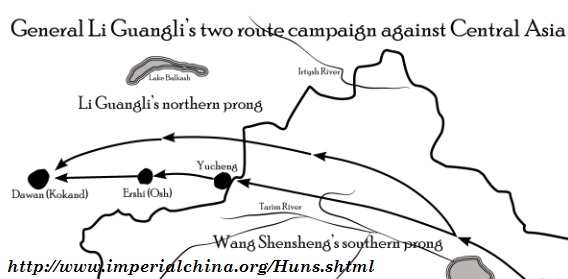
Chapter XXIII: The Mongol Campaigns Against Semiryechye & Central Asia
(A.D. 1216-1224) ................423
The Mongol Campaign against Kuchlug's Kara-Khitay (A.D. 1218) ........................425
|
|
The Hunnic Successors
The distinction of the early Huns from other groups of people (the Yuezhi, for example) is clear. The Hunnic ancestry & successors, however, pose some ambiguity. Before touching on the origin of the Huns, this webmaster will have some discussion of the successors of the Huns. The successors will include the Avars, the Ruruans, the Gaoche, the Tiele Tribes and the Turks, etc. Most European history books pointed out that the Ruruans (Juan-juan or Rouran) were 'Mongolian', and they claimed that the Genghis Mongols were descendants of the Ruruans. This false claim could be built on the basis of one comment in The History Of Tuoba Wei Dynasty, namely, the founder of the Ruruans might have origin in the Dong-hu (Eastern Hu) barbarians, i.e., a group of people related to the Tungusic people of Manchuria and eastern Mongolia.
The most likely successor of the Huns were the Avars or the Hephthalites (or the Ephthalites or Epthalites or Hunas or White Huns
or Hayathelites or Ye-tai) who crossed (A.D. 425) the Syr Darya (Jaxartes) River
and invaded Persia, conquered Kabul's Kushans (founded in c. A.D. 50 by Kujula
Kadphises who united the five Yüeh-chih tribes and established the Kushan Empire
stretching from Persia to Transoxiana to Tarim Basin to the Ganges in Upper Indus).
Before the Turks defeated the Ye-tai (Ye-da), the Ye-tai (Ye-da) for about 250 years controlled
the area of today’s Central Asia and Chinese Turkestan, more than what the later Khwarazm empire
of the 12th-13th centuries had achieved. Ye-tai was taken to be Yandaiyilituo or the Hephthalites, who
were speculated to be descendants of the Kushan Yuezhi; or speculated to be mutation of ‘Hua’ for
chieftain San-hua of the first century A.D. Though, between the Kushan Yuezhi (which was equated
to the Gandhara state by monk Xuan-zang of the 7th century A.D.) and the Ye-tai (Hephthalites) of the 5th
century A.D. there was the Sassanid Empire (A.D. 224-651) invasion of Gandhara of the 3rd century,
and after the successive rule of the Sassanians and the Hephthalites, today’s Afghanistan, where the
Kushan Yuezhi used to be, was renamed back to Du-huo-luo (Tukhara/Tochari) in the 7th century A.D.
Bei Shi (history of the northern dynasties) specifically named King Ji-duo-luo (Kidarite King Kidara I, circa
350-386 C.E.) as belonging to the Yuezhi Major people with capital at Shengyanshi-cheng (Sheng-Jianshi,
i.e., Balkh) and bordering with the Ruruan in the north but made a confusing second entry about
Yuezhi Minor’s descent as from a son of King Ji-duo-luo and its conflict with the Huns as if living in
the 3rd and 2nd centuries B.C, five hundred years prior. Namely, Bei Shi could have mixed up historical
records in both entries on Yuezhi, with Kidarite King Kidara not related to the Yuezhi but actually
the very Huns who warred with the Ruruans of the Eastern Hu origin and conquered the descendants
of the Kushan Yuezhi from the A.D. 430s onward.
Countering the Avars to the east were the Ruruans.
After the Ruruan founder fled to the Altai Mountains and the northern Mongolia territory, he conquered and absorbed remnant Hunnic tribes and Gao-che people. Tuoba Wei Dynasty, claiming heritage from a son of China's Huangdi (i.e., the Yellow Lord or Emperor), had united northern China in A.D. 386. Tuoba (Tuoba) treated the Ruruans as the descendants of the Huns and commented that "though the Ruruans were Hunnic in nature but their ancestry was hard to corroborate". On another occasion, the Tuoba Wei Emperor agreed with a Rouran asylum-seeker in saying that they were indeed from the same family, i.e., the Eastern Hu barbarians. Both the Ruruan founder and the Tuoba originated from the east of Mongolia. The Hunnic relationship with the Ruruans would be explored in the section on the Hunnic Split of A.D. 89, a time when the Northern Huns, under the attack of General Dou Xian and Dou Xian's Southern Hun allies, fled westward to the ancient Kang-chu territory.
The Ruruans, after being defeated by the Turks, were said to have migrated towards the west to become the ancestors of the Avars (? no record in the Chinese chronology).
The Avars actually controlled today's Chinese Turkestan and Central Asia for 100 to 200 years as successors to the Huns, and could not have been related to the Ruruans who were Tungusic or Mongolic.
From archaelogical excavations, it was ascertained by genetic testing that the Avars who raided into today's Hungary and western Europe in the 6th and 7th centuries composed of two thirds N-haplogroup Finno-Ugric type people and one third Q-haplogroup Central Asians.
Ashina Shidianmi, i.e., Turkic Tumen Khan's brother and Muchu Khan's uncle, expelled the Avars to the Volga.
Ashina Shidianmi (Istemi Kagan), who stayed behind while Tumen was campaigning east against the Ruruans, conducted a western campaign in A.D. 552.
The Ruruans who stayed behind in Mongolia and the Altai Mountains were absorbed by the Turks. Numerous Hunnic rebels rose up against the Tuoba, but the two states which ultimately replaced both the Western Tuoba Wei and Eastern Tuoba Wei were not Hunnic in nature, but the Xianbei or the Xianbei who absorbed the Huns after the Huns' defeat in the 1st century A.D. The Huns later played the role of contributing to the decline and disintegration of Tuoba's Wei Dynasty. After the Tuoba put down the Hunnic rebellion, some of the Huns would be relocated to today's Hebei Province by the Tuoba in A.D. 523. After Tuoba, the Huns lost its prominence, and would be difficult to trace for the five-six hundreds between the Tuoba Wei Dynasty and Genghis Khan's Mongols.
During the early Tuoba period, Tuoba Wei Emperor Daowudi (reign 386-409) launched numerous western / northwestern campaigns against the Ruruans as well as the Gao-che people, in a similar fashion as Han Emperor Wudi's campaigns against the Huns. The Chinese history put Gaoche (descendants of the Chi-di or Red Di people, also known as the Dingling, who once resided in central China during the Zhou Dynasty time period), in a different category from the dozen tribal states in Chinese Turkistan. Records showed that the Gaoche people had similar traits as the early Huns, and they were called the 'nephews' of the Huns, and was said to have basically the same language as the Huns. Among the Gaoche would be family names like Hulü.
By the early 5th century A.D., there were six major tribes of Di-shi, Yuanhe-shi, Hulü-shi, Jipi-shi [where the future Turgesh were said to be have originated from], and Yiqijing-shi. Additionally, there were twelve clans of the Fufuluo tribe who were to found the Gao-che statelet near Gaochang (Turpan, Karakhoja) of Chinese Turkestan.
The Di-shi could be the group who moved south into North China to build the Di-wei Dynasty to compete against the Xianbei Yan statelets and Eastern Jinn during the Sixteen Nation time period.
The words Gao-che mean "high wheeled carts" which was to point out that the Gaoche people liked to ride in high-wheeled carts. The Gao-che had zigzag wars with the Ruruans, and there was a similar story about using the skull of a dead chieftain as drinking utensil [i.e., wine vessel]. (The earliest reference to skull as a utensil for holding wine could be traced to Zhao Xiang-zi's killing the opponent Zhi-bo during the Warring States time period. See Sima Qian's Shi-ji, Section On Assassins.)
During late Tuoba Wei Dynasty, there appeared many references to the 'Tiele' or 'Chile' tribes and their rebellion against the Tuoba. History said that Tiele Tribes derived from the Gaoche people. The Tiele Tribes, with many of later familiar Huihe family names, were recorded to have spread everywhere, i.e., north of the Luo River, west of Yiwu & north of Yanqi, southwest of the Altai Mountains, and north of the ancient Kangju Statelet.
The Turks were said to be an alternative race of the Huns, and they originally sought protection with the Ruruan by fleeing to the Altai and worked for the Ruruan as iron miners (i.e., iron smith). The hint here is to link the ancestors of the Turks to the Huns under Juqu's Northern Liang Dynasty.
The Turks later took advantage of the Tiele's wars against the Ruruans, attacked the Tiele Tribes from the rear, and absorbed 50,000 Tiele households to become a powerful entity. The Turks, after their proposal for inter-marriage with their Ruruan master was rejected, would attack the Ruruans and kill the Ruruan khan. After the son of a Ruruan khan fled to Northern Qi, the uncle of the Ruruan khan was to become the new Ruruan khan.
The Turks then drove the new Ruruan Khan into the Northern Zhou territory. The Turks defeated the Ye-tai in the west, the Khitans in the east and the Qigu in the north, and built the Turkic empire.
|
|
|
|
|
|
|
Sovereigns & Thearchs;
Xia-Shang-Zhou dynasties;
Zhou dynasty's vassalage lords;
Lu Principality lords;
Han dynasty's reign years
(Sexagenary year conversion table-2698B.C.-A.D.2018; 247B.C.-A.D.85)
|
|
The Sinitic Civilization - Book I is
available now at
iUniverse,
Barnes & Noble,
Amazon,
Google Play|Books
and
Nook.
The Sinitic Civilization - Book II is available at
iUniverse,
Amazon and Barnes & Noble.
Check out the 2nd edition preface that had an overview of the epact adjustment of the quarter remainder calendars of the Qin and Han dynasties, and the 3rd edition introductory that had an overview of Sinitic China's divinatory history of 8000 years.
The 2nd edition, which realigned the Han dynasty's reign years strictly observing the Zhuanxu-li calendar of October of a prior lunar year to September of the following lunar year, also cleared this webmaster's blind spot on the authenticity of the Qinghua University's Xi Nian bamboo slips as far as Zhou King Xiewang's 21 years of co-existence with Zhou King Pingwang was concerned, a handicap due to sticking to Wang Guowei's Gu Ben Bamboo Annals and ignoring the records in Kong Yingda's Zheng Yi.
Stayed tuned for Book III that is to cover the years of A.D. 86-1279, i.e., the Mongol conquest of China, that caused a loss of 80% of China's population and broke the Sinitic nation's spine.
Preview of annalistic histories of the Sui and Tang dynasties, the
Five Dynasties, and the two Soong dynasties
could be seen in
From the Khitans to the Jurchens & Mongols: A History of Barbarians in Triangle Wars and Quartet Conflicts
(The Barbarians' Tetralogy - Book III: available at iUniverse;
Google;
Amazon;
B&N).
(A final update of the civilization series, that is scheduled for October 2022, would put back the table of the Lu Principality ruling lords' reign years, that was inadvertently dropped from Book I during the 2nd update.)
|
|
Book II - Table of Contents:
Section Seven: The Han Dynasty
Chapter XXIX: The Chen Sheng & Wu Guang Rebellion 345
Chapter XXX: The Chu-Han War 356
Chapter XXXI: The Han Dynasty’s Chronological History 367
Han Emperor Gaozu (Liu Bang, reign 202-195 B.C.; 206-202 B.C. as King Han-wang) 369
Han Emperor Huidi (Liu Ying2, 210-188 B.C.; commonly-taken wrong reign 194-188 B.C.; nominal reign Oct 195-Sept 188 B.C.; actual reign May 195-Aug 188 B.C.) 375
The Lv Family Interregnum 377
Han Emperor Xiaowendi (Liu Heng, 202-157 B.C.; commonly-taken wrong reign 179-157 B.C.; nominal Oct 180-Sept 164 B.C.; actual leap Sept 180-Sept 164 B.C.) 378
Han Emperor Jingdi (Liu Qi, 188-141 B.C.; commonly-taken wrong reign 156-141 B.C.; nominal Oct 157-Sept 141 B.C.; actual Jun 157-Jan 141 B.C.) 381
Han Emperor Wudi (Liu Che, 156-87 B.C.; commonly-taken wrong reign 140-87 B.C.; nominal Oct 141-Dec 87 B.C.; actual Jan 141-Feb 87 B.C.) 385
Invasion into the Korean Peninsula 391
Relationship with the Huns 392
Relationship with the Southern Statelets 397
Sima Qian’s Shi-ji 401
Chapter XXXII: The Calendar Reform & the Taichu-li Calendar 403
Chapter XXXIII: The Hunnic Empire 409
Origin of the Huns 409
The Rong & Di Barbarians in the Context of Relation to the Fiery Thearch, the San-miao Exiles and the last Xia Dynasty King 413
The Zhou, Qin and Jinn’s Zigzag Wars with the Barbarians & the Construction of the Great Walls 417
Mote’s Hun Empire, the Yuezhi People, and the Early Han Dynasty 424
The Huns & the Eastern Hu Barbarians 430
The Hunnic Government Structure & the Dragon Reverence 431
Chapter XXXIV: The Han Dynasty’s Wars with the Huns 435
Chapter XXXV: The Western Han Dynasty’s Chronological History Continued 472
Han Emperor Zhaodi (Liu Fuling, 94-74 B.C.; nominal reign Jan 86-Dec 74 B.C.; actual reign Feb 87-Apr 74 B.C.) 472
Han Emperor Feidi (Liu Heh, 92-59 B.C.; reign 74 B.C.) 473
Han Emperor Xuandi (Liu Xun, 91-48 B.C.; nominal reign Jan 73-Dec 49 B.C.; actual reign Jun 74-Dec 49 B.C.) 474
Han Emperor Yuandi (Liu Shi, 75-33 B.C.; nominal reign Jan 48-Dec 33 B.C.; actual reign Dec 49-May 33 B.C.)
478
Han Emperor Chengdi (Liu Ao, 51-7 B.C.; nominal reign Jan 32-Dec 7 B.C.; actual reign June 33-Mar 7 B.C.) 479
Han Emperor Aidi (Liu Xin1, 27-1 B.C.; nominal reign Jan 6-Dec 1 B.C.; actual reign Apr 7-Jun 1 B.C.) 484
Han Emperor Pingdi (Liu Kan, 9 B.C.-6 A.D.; nominal reign Jan 1 A.D.-Dec 5 A.D.; actual reign Sep 1 B.C.-Dec 5 A.D.) 486
Han Emperor Ru-zi Ying (Liu Ying, 5-25 A.D.; nominal reign Jan 6-Nov 8 A.D.) 487
Chapter XXXVI: The Western Expedition, The Kunlun Mountain & Shan Hai Jing 489
Han Emperor Wudi Seeking Elixir from the Immortals on the Kunlun Mountain 491
Credible Geography Book on the Mountains Possibly Expanded to Include the Legendary Kunlun Mountain 493
Unearthly Things in the Mountains’ Component of The Legends of Mountains & Seas 501
The Divination Nature and Age of the Seas’ Component of The Legends of Mountains & Seas 506
Chapter XXXVII: Shan Hai Jing & The Ancient Divination 520
Chapter XXXVIII: The Hundred Schools of Thoughts 536
Chapter XXXIX: The Interregnum of Xin Dynasty, Xuan-Han Dynasty & Chi-Mei Han Dynasty 551
Chapter XL: The Latter Han Dynasty’s Chronological History 560
Han Emperor Guangwudi (reign A.D. 25-57) 560
The Relation with the Southern Huns 561
The Invasion War against the Sichuan Basin and the Unification of China 562
The Implicit Prophecy ('chen') and Latitude ('wei') Interpretation of Six Classics 564
Han Emperor Mingdi (Liu Zhuang, nominal reign A.D. 58-75; actual reign A.D. 57-75) 566
Han Emperor Zhangdi (Liu Da, nominal reign A.D. 76-88; actual reign A.D. 75-88) 568
The Sifen-li Calendar & Disconnect of the Sexagenary Calendar From the Jupiter’s Chronogram 570
Chapter XLI: Discourse on The Authenticity of Shang-Shu (Remotely Ancient History) 572
Epilogue 579
References on the Founding-masters, Masters and Disciples of the Hundreds of Schools of Thoughts 622
The Han emperors' reign years shown above are the only uniquely-correct chronology that is calibrated by the Zhuanxu-li calendar and Wu Xing Zhan (Five Planets' Divination)
|
|
Origins
Of The Huns - Rong & Di
The Huns were called 'Xiongnu' or 'Hsiung-nu ' (literally meaning ferocious slaves) in Chinese. 'Hu' was said to be the Hunnic self-designation. Some linguists pointed out that ancient categorical name of 'Hu' for barbarians could be a fast-paced pronunciation of two characters of 'Xiongnu'.
Some scholars believe Xiongnu was the same as the ancient names like 'Xunyu' or 'Xianyun'.
According to Sima Qian, among the northern barbarians would be the 'Shan-rong' (Mountain Rong), Xunyu or Xianyun at the times of Lord Yao and Lord Shun, the Chunwei tribe at the [end] times of Xia Dynasty, the Gui-fang (ghost domain -a word that had no derogatory ghost denotation in ancient China other than meaning the deceased ancestors) at the times of Shang Dynasty, again the Xianyun barbarians at the times of Zhou Dynasty, and the Xiongnu (Huns) at the times of Han Dynasty.
(Sima Qian's lumping the Gui-fang people together with the step barbarians could have misled the future scholars. The Gui-fang people that the Shang queen Fu-hao had campaigned against appeared to be the Xia dynasty remnants who stayed behind in the Great Xia land, which was situated right next to the Shang capital city Chaoge or the Xia capital city at the You-song-shi Ruins (Yuncheng, Shanxi Province), near Mingtiao [which must have mutated to the future Tiao{-rong} barbarians with whom the Jinn and Zhou armies fought, and the present Mt. Zhongtiaoshan].
Wang Zhonghan cited the Shang oracle bones to equate one of major Shang vassals, i.e., Marquis Jiu-hou (i.e., Gui-hou of Gui-fang [ghost domain]), as equivalent to descendants of the overthrown Xia dynasty's people.
Yi (Zhou divination) stated that [Shang dynasty] Lord Gao-zong campaigned against Gui-fang, and Hou Han Shu, in its Xi-qiang Zhuan (section on the Western Qiangs), stated that it took [Shang king] Wu-ding three years to campaign against and defeat the Xi-rong and Gui-fang barbarians.
Hence, Shi Jing eulogized the Shang's accomplishments with the sentence that the Di and Qiang [barbarians] people dared not renegade on paying the pilgrimage to the Shang king.
Later historians, in books like Tong Dian etc., traced the origin of the western barbarians to the San-miao exiles, and pointed out that those barbarians, known as 'quan [doggy] yi [barbarians]' at the time, had intruded to the east when Xia King Tai-kang lost his throne, to be dealt a defeat in the hands of successor Xia king Xiang, but reaching the Mt. Qishan area after last Xia King Jie was overthrown by Shang, to be dealt another defeat in the hands of Shang founder-king Tang. Further, the Quan-yi barbarians did receive some conferral of rankings from Xia King Hou-xie, namely, some records jotted down in The Bamboo Annals.
Gui-fang was listed together with the Xi-rong barbarians against whom Shang King Wu-ding, i.e., Gao-zong, campaigned against per YI, meaning that it was a group of the western barbarians, not northern.)
The Huns were said to have originated from 'Chunwei' (or Xunyu), the son of last Xia Dynasty Lord Jie. The Uygurs claimed they descended from this very person. Sima Qian's Shi-ji mentioned that Jie was driven to the Youcao area, possibly the ancient E4 land at the southern end of Mt. Lüliangshan of Shanxi; that Jie's son (Chunwei) married Jie's concubines; and that son Chunwei fled north where he became the ancestor of the later Huns.
Both Sima Qian's Shi-ji and Ban Gu's Han Shu said that the Huns were the descendants of Xiahou-shi (i.e., the Xia descendant or the Xia king, with 'hou' paraphrased as lord in Zuo Zhuan); that they migrated to the Western Rong areas during the demise years of Xia Dynasty; and that they would attack the ancestors of the Zhou Dynasty founder in a place called 'Bin'. The Zhou ancestors were forced to relocate to the Qishan Mountain. The Zhou kings had zigzag wars with the Rongs.
The barbarians, by the name of 'Shanrong', 'Xunyu' or 'Xianyun', had been apparently roaming on the east-west Asian steppe over 4000 years ago, prior to the Xia-Shang-Zhou dynasties. The steppe that the ancient texts referred to was more likely Inner Mongolia, not Outer Mongolia.
(Zhu Xueyuan disputed Sima Qian's claim as to the time the barbarians began to roam the steppe, pointing out that Sima Qian's words for "beyond the 'Tang' and 'Yu'" could mean a location beyond the Tangwu locality, not beyond the eras of ancient overlord Tao-tang-shi [overlord Yao] and overlord Yu-shun [overlord Shun].
This was a stretch, though.
Per Zhu Xueyuan, the reading of "beyond 'Tang' and 'Yu'" should be a geographical concept to mean the land beyond the central kingdom domain as under Lord Tang and Lord Yu, not a time concept to mean "beyond the eras of Lord Yao and Lord Shun". This could be a fanciful reading of ancient classics.)
The demise of Xia Dynasty would see Chunwei, the son of last Xia Dynasty Lord Jie, fleeing to the northwest to join the barbarians and becoming the de facto ancestor of the later Huns. Sima Qian's section on Shang Dynasty did not mention too much on the steppe people other than the "Jie" legend.
Ban Gu commented that Huns did not usually carry the family names and that beginning from Tou-man [i.e., Mote (Modu)'s father], the names of Hunnic chanyu rulers were recorded in the Chinese chronicles.
The suffix 'du' in Modu was interesting in that Hu-tu, who was apparently part of the Hu-shi [fox clan] entourage from Jinn Lord Xian'gong [?-651 B.C.]'s intermarriage with the same-Ji-surnamed Di barbarians, carried a barbarian 'tu' suffix that came to be known as king or prince in the later Xianbei and Turkic history as well as was speculated to be a soundex of the Hunnic founding chanyu 'Modu' - which was more a Hunnic, Qiangic and Jie-hu suffix as seen in the numerous Qiangic princes of the Sixteen Nation time period.
Note also that the Jinn royals, who were said to have the Ji descendants living among the Ji-surnamed barbarians Di tribe, at one time had their Jinn Lord 'E'hou supported by a son of King of the ancient nine Huai-surnamed clans to be a lord in the ancient E4 land, which was possibly the Nanchao exile place of last Xia King Jie.
In this webmaster's opinion, every dynastic change saw the original rulers being pushed out of the central plains and marginalized into the barbarians at the border.
What went into oblivion in China’s history was the Shimao Culture (about 2300-1800 B.C.) at the concave-in area of the Northeastern Yellow River Bend, that predated the literature-corroborated Da-Xia (great Xia) Sinitic civilization by just a few hundreds of years in history.
This is the area that fit in with what Yu Gong described as Jishi the piled-up rocks, where Lord Yu started the flood control work.
Shimao, bing classified under the development stage of the Longshan Culture (2500-1900 B.C.), possessed the 'fei-zu li' (three-fat-legs) cookers, a type of pottery also seen in the Laohushan (tiger mountain) Culture, i.e., a mixture of N-haplogroup Finno-Ugric people and O-haplogroup Sino-Tibetan people.
Shimao, a high plateau city with a range of 2000 and 2840 meters long, was a mystery on par with Taosi (2500/2400 B.C.-1800 B.C.) in the fabled Xia heartland, with both sites likely destroyed by some unknown people in a timeline not fully fitting in with the transitioning time period of the Xia and Shang dynasties.
It appears that the people along the two banks of the Eastern Yellow River Bend were typical paleo-Northwestern and paleo-Central-Plains types while the people in the Shimao area could be the mixed N and O haplotypes.
While both Shimao and Taosi matched with Shao Yong’s divinatory Xia dynasty chronicling in Huang Ji
Shi Jing (Qi 2187 B.C. to Jie or Di-Lügui 1766 B.C.), it conflicted with archaeological periodization for the Xia (Erlitou: Dongxiafeng 2200-1700 B.C./Yanshi 1900-1500 B.C.) and Shang (Erligang: 1510-1460 B.C.) ruins.
The Xia dynasty was known in literature to have ended in the You-Xia-zhi-ju land south of the Yellow River, i.e., about the areas of Erlitou and Erligang, with the Reign Year
Periodization
Project's unsubstantiated archaeological years 2070-
1600 B.C. being similarly aligned as the forgery bamboo annals' years of 1978-1557 B.C.
The only way to reconcile the numbers would be to realistically shorten the 16 Xia kings' summary years to about 300 years or less to make the case that Xia had left both Shimao and Taosi for the You-Xia-zhi-ju land at about 1800 B.C. under purportedly threats from the northern people who could be "uncooked" Laohushan-type people, the "uncooked" paleo-Northwestern people, or the Q1a1-M120 haplotype people from the west - that was purportedly seen in the Lijiaya Culture, a culture similar to Zhukaigou (Zhaimao, with a snake-grain pattern pottery of Northwestern China) of the paleo-North-China type (who were speculated to have later been driven by the Shang people to southern Siberia to be ancestors
of the Huns, bringing with them the Sinitic round bottom jar
potteries, the
three-leg potteries, the battle hatchets, the bronze arrows, the white jade circular wrist wear,
and the spears, etc., features of the Karasuk Culture, 1400-800 B.C.) but containing the paleo-Central-Plains type skulls (i.e., non-Q1a1-M120 people).
After the Shang people overthrew Xia, the influence of the Xia remnants was restricted to their historical land of southern Shanxi Province.
Chunwei, i.e., the son of last Xia Dynasty Lord Jie, was recorded by Sima Qian to have fled north to be ancestors of the Huns. In this so-called Da-xia or the Great Xia land could be found Uncle Tang's fief, who was said to be Ji-surnamed, and postulated to be the same as the later Gui-fang people carrying the 'gui' [which had no derogatory ghost denotation in ancient China other than meaning the deceased ancestors] or 'kui' (Wei3) surname.
After the Zhou dynasty overthrew Shang, the Zhou people had forcefully resettled several groups of the Xia [not Shang] people to the Mt. Qinling Range area, from the historical Grand Xia land, among the others, Uncle Tang's people.
When Zhou overthrew Shang, the Shang remnants were known as some King Bo's country in the western territories.
Other than King Bo's Rong, Mu-tian-zi Zhuan, i.e., Zhou King Muwang's Travelogue, carried records to the effect that the Shang Dynasty descendants were assigned the fief around the Northern Yellow River Bend as Count or Guardian-god of the River [i.e., He-bo].
The Shang dynasty people could be related to the Laohushan (tiger mountain) Culture (3000-2000 B.C.), that was in turn a mixed type of the Yangshao (4000-3000 B.C.) and Miaozigou (3000-2500 B.C.) cultures, with the latter ascribed to the N-haplotype people, i.e., the Finno-Ugric people who once populated the entire belt of today’s Inner Mongolia and together with the Sinitic people, engendered the Hongshan Culture.
Note that the Zhou people
were speculated to have origin from today's Shanxi for the link to the Guangshe Culture –which was
in turn a derivative of the You'ao-type Laohushan Culture.
(The bloody human sacrifice practice of the Shang dynasty gave this webmaster an impression that the Shang ruling cliques could be non-Sinitic but the N-haplogroup Finno-Ugric people - who were later marginalized to the Northern Yellow River Bend in the fiction Mu-tian-zi Zhuan as well as marginalized to western China by the Zhou people.
Should we make a claim that the Xia people were the mixed O and N haplogroup people, the Shang ruling clique could be
originally the "uncooked" N-haplogroup people but the Zhou ruling clique could be
the "acquaintance" N-haplogroup people or the original relatively-civilized O-N mixed people.)
The Shang Dynasty remnants, after the Zhou people overthrew them, were themselves marginalized to the North Yellow River Bend after the Zhou people overthrew the Shang rule in the 12th century B.C.E., as seen in Zhou King Muwang's travelogue.
In Zhou King Muwang's travelogue, around 1000 B.C.E. timeframe, we could see the Shang Dynasty remnants being assigned the land of the Northern Yellow River Bend
Travelogue Mu-tian-zi claimed that the descendants of the Shang Dynasty family were marginalized to the North Yellow River Bend to be the guardian and god of the Yellow River.
One more legacy of the Shang people would be a group of people in Gansu-Shenxi areas.
Qin Lord Wen'gong would defeat the Rong and gave the land east of Mt. Qishan back to Zhou court.
The Qin people, later at the time of Qin Lord Mugong, claimed to dwell between Mt. Qishan and the ancient Yongzhou prefecture [with demarcation at the Wei-shui River].
Another group of the Rong people defeated by Qin Lord Ninggong would be ruled by 'King Bo'. This would be a Xi-rong lord by the title of 'Bo' in a place called 'Dang(4) She' where the character 'dang' was said to be a mutation of the Shang Dynasty founder, 'Shang-Tang'. Ancient classics said that this group of people claimed heritage from Shang-Tang and used the ancient Shang capital name 'Bo' for the title of their king. Ancient scholar Xu Guang claimed that 'Dang' should be pronounced as 'Tang' for the Shang dynasty founder, while 'She' was meant for the Du-xian county.
Qin Lord Ninggong (r. B.C.E. 715-704) would defeat King Bo and drove King Bo towards the Rong people during the 3rd year reign, i.e., in 713 B.C. Ninggong conquered King Bo's Dang-shi clan during the 12th year reign, i.e., 704 B.C.
Shang King Wuding's wife, Fuhao, would be the famous female warrior of China who had led a campaign against the ancient Gui-fang (ghost domain) barbarians (speculated to be either on the northern steppe or in Shanxi Province, but could be actually related to the legendary fire guardian Zhu-rong (known as Lu-zhong-shi)
for
intermarriage
or an alternative name for the Ji-surnamed Uncle Tang's descendants). Shang Dynasty also warred with the Jiang-fang (i.e., the Qiangic people, including ancestors of the Zhou people) in the west and the Ren-fang [i.e., the original Yi people] in the east.
As expounded below, the Rong people in the west, sharing possibly the same blood-line with the Xia Chinese but differing in the 'culture' such as cuisine, clothing, money [actually gifts of value bestowed on each other] and language, appeared to be an early offshoot of the Sino-Tibetan speaking Qiangic people.
After the demise of Shang Dynasty, records from Zhou Dynasty mentioned a group of Rong under King Bo in northwestern China. Qin Lord Wengong (r. B.C.E. 765-716) defeated King Bo's Rong and gave the land east of Qishan Mountain back to the Zhou court. This would be a Xi-rong lord by the title of 'Bo' in a place called 'Dang(4) She' where the character 'dang' was said to be a mutation of the Shang Dynasty founder, 'Shang-Tang'. The ancient classics said that this group of people claimed heritage from Shang-Tang and used the ancient Shang capital name 'Bo' for the title of their kings. Qin Lord Ninggong (r. B.C.E. 715-704) defeat King Bo and drove King Bo towards the Rong people during the 3rd year reign, i.e., in 713 B.C. Ninggong conquered King Bo's Dang-shi clan during the 12th year reign, i.e., 704 B.C.
Note that the Sinitic Chinese, with a tradition of maintaining a copious record of history, could at best paint the above pictures about the origin of the northern barbarians.
* In Commemoration of China's Fall under the Alien Conquests in A.D. 1279,
A.D. 1644 & A.D. 1949 *
U.S.S.R./Comintern Alliance with the KMT & CCP (1923-1927)
Korean/Chinese Communists & the 1931 Japanese Invasion of Manchuria
American Involvement in China: Soviet Operation Snow, IPR Conspiracy, Dixie Mission, Stilwell
Incident, O.S.S. Scheme, Coalition Government Crap, Amerasia Case & The China White Paper
* Stay tuned for "Republican China 1911-1955: A Complete Untold History" *
|
|
Zou Rong's Revolutionary Army;
Shin Kyu Sik's
Shrine (Spirit, Kunitama) of Korea
|
This snippet is for sons and daughters of China:
Heed the sons & ministers' agony and sorrow of our ancestors who died or lived through the Mongol, Manchu and Soviet-Chicom conquest
and
the Yongjia, Jingkang and Jiashen cataclysms !
Jeanne d'Arc of China:
Teenager girl Xun Guan breaking out of the Wancheng city to borrow the relief troops in the late Western Jinn dynasty;
Liu-Shao-shi riding into the barbarian army to rescue her husband in the late Western Jinn dynasty;
teenager girl Shen Yunying breaking into Zhang Xianzhong's rebels on the horseback to avenge on father's death in the late Ming dynasty.
China's Solitary and Lone Heroes:
Nan Jiyun breaking out of the Suiyang siege and charging back into the city in the Tang dynasty;
Zhang Gui & Zhang Shun Brothers breaking through the Mongol siege of Xiangyang in the Southern Soong dynasty;
Liu Tiejun breaking through three communist field armies' siege of Kaifeng in the Republican China time period;
Zhang Jian's lone confrontation against the communist army during the June 3rd & 4th Massacre of 1989.
|
|
|
The Rong's Possible Link To the Qiangic People
Following the Sinitic logic, the early Huns were most likely Qiangic
proto-Tibetans or a possible separate Yun-surnamed Xianyun group which was exiled to Northwest China together with the San-miao people in the late 3rd millennium B.C.E., while the later Xianbei, Khitan, Jurchen, Mongol and Manchu people were proto-Manchurian or proto-Altaic.
The confusion would be resolved should this webmaster pinpoint the C haplogroup or the Tungus people further away from the border with Sinitic China to be the area of the Amur River, Sungari River and the northern Khing'an Mountain Range while treating the "cooked" barbarians, i.e., those dwelling between the Sinitic Chinese and the "raw" barbarians as the mixed O/C/N-haplogroup people.
Two ancient categorical designation of the barbarians would be 'Rong(2)' and 'Di(2)'. The Rong word was used mostly with the word 'Xi' for west, while 'Di' with the word 'Bei' for north.
The Rong would be a categorical designation of barbarians in the west & northwest. (Shanrong or Mountain Rong, however, belonged to southern Manchuria.) Rongs are differentiated into "Jiangrong" (carrying the name Jiang of the tribe of Yandi the Fiery Lord), "Xirong" (Western Rong), "Quanrong" (Doggy Rong, a derogatory designation, similar to Mongols' calling the Tartars "Noghai" the running dogs), and "Shanrong" (Mountain Rong) or "Beirong" (Northern Rong, who are most likely the ancestors of ancient Koreans who lost large patch of land to the allied forces of Yan and Qi principalities of Zhou Dynasty).
Scholar Wang Zhonghan pointed out that ancient Chinese did not distinguish between 'Rong(2)' and 'Di(2)' till after the middle Spring & Autumn time period of Zhou Dynasty, with those barbarian statelets to the north of Jinn, Zheng, Wey & Xing titled 'Di92)" while those to inside and to the south of Jinn titled "Rong(2)".
The composition of the Rong in the west and northwest were many-layered. In light of King Bo, this webmaster could say that some descendants or affiliates of Shang would be related to the King Bo's Rong people. (Huangfu Mi of Jinn Dynasty had doubts about King Bo's ancestry in Shang-Tang.) Huangfu Mi of Jinn Dynasty treated King Bo as a branch of 'Xi-yi' or the Western Yi aliens. (Huangfu Mi, however, might have omitted the fact that the 'Yi' [not the misnomer Dong-yi or the eastern Yi from later Zhou Dynasty time period] people were the same group of people who lived along the eastern Chinese coast, then moved to the Yangtze River area, and were ultimately exiled to western China. Hence the ancient designation Yi applied to the same people from the east coast to the western deserts.
Yi is more an inclusive word to mean aliens, and the Qiangs and Di(1) people could be called Xi Yi, i.e., Yi in the west, while some southwestern barbarians would be called Xi-Nan Yi, namely, southwestern Yi.)
Some of the Rongs at the time of Zhou Dynasty could be of Qiangic or Di(1) nature.
Indeed, scholar Wang Zhonghan researched into the ethnicity of the ancient Rong-di people, analyzed the ancient ambiguity in regards to bundling the 'Qiang' and 'Hu' barbarians, and concluded that the ancient barbarians were more likely Qiangic [Sino-Tibetan] from the west than the [misnomer] Huns from the north.
(Latter Han Dynasty adopted the segregation policy of 'Qiang' from 'Hu' by controlling the He-xi [West of the Western Yellow River Bend] and the Silk Road.)
The Qiangs, in turn, would be the descendants of the Yandi (Fiery Lord or Fiery Emperor) tribal group carrying the tribal name "Jiang". "Xin Tang Shi" (New History Of Tang Dynasty) said that the Tibetans belonged to the Xi Qiang, namely, the western Qiangic people. There were 150 different groups of Qiangic people, widely dispersed among Sichuan, Gansu, Qinghai and Shenxi Provinces.
Ancient classics stated that the word 'qiang' means the shepherds in the west. The book which was called 'Continuum To Hou Han Shu' stated that the Qiangs were alternative race of the Jiang surname tribes of San Miao.
According to Sima Qian, the 'San-Miao' people, who originally resided in the middle Yangtze River area where the later Chu Statelet was, were mostly relocated to western China to guard against the western barbarians. Lord Shun relocated them to western China as punishment for their aiding Dan-zhu (the son of Lord Yao with reign ? 2357-2258 B.C.E.; reign 2144-2048 or a rule of 97 years and life of 118 years per Zhu Yongtang's adjustment of The Bamboo Annals) in rebellion.
Reading through China's history, this webmaster could distinguish at least three groups of Rong in the west, Xirong or the Western Rong, Quanrong or the Doggy Rong, and Rong-di or the Rong-Di Rong. (Borrowing "Shan Hai Jing", Quan-yi or Quan-rong, one of the varieties of the Rong people, could have derived from Huangdi the Yellow Lord since Huangdi bore Miao-long, Miaolong bore Nong-ming, Nongming bore Bai-quan [the White dog] which was the ancestors of Quanrong.) All three groups could be of same family, could be related to Jie the son of last Xia Lord as Shi-ji claimed, and could be related to descendants of Shang Dynasty (as detailed in the story of King Bo of the Shang heritage). Qin's ancestors absorbed eight Xi-rong Tribes, and Qin was also responsible for helping Zhou drive the Doggy Rong out of the Zhou capital. The Rong-di Rongs had migrated to the central plains of China, and the Jinn Principality and its three successor states have very close connection with them. The Rong-di Rongs had inter-marriage with the Zhou Kingdom, and they later split into Chidi and Baidi as explained below.
In all, there were mainly two groups of barbarians to the west or the northwest, the Qiangic barbarians and a variation termed by Di[2] or Rong-di[2]. At the very beginning, in the late 3rd millennium B.C.E., Lord Shun had exiled both [proto-Qiangic] San-miao and the Yun-surnamed Xianyun barbarians to the San-wei-shan area, near today's Dunhuang Grotto. The exile illustrated the point that northwestern China was the backyard of Sinitic China in the 3rd millennium B.C.E., where the rebellious tribes were kept for better management. After 1-2 thousand years, the barbarians, using this webmaster's common sense, would mutate into the Rong versus Di[2] groups, or the later more-explicitly-classified Qiang versus Hu (Huns) groups.
The Hu (Huns) groups, for their position in-between Sinitic China and the Tungusic people of western Manchuria and northeastern Mongolia, could be a mixture of the original Qiangic-admixtured Yun-surnamed Xianyun barbarians in northwestern China and the Tungusic people in western Manchuria and northeastern Mongolia
The Xia Chinese versus the Rong - Differing In the 'Culture', Not the 'Blood-Line'
What distinguished the Chinese from the Rong or the Di would mostly likely lie in the customs, not the ethnicity.
Zhou Dynasty's founder, per Shi-ji, Gugong abolished the Rong & Di customs, built a city in a plain called Zhou-yuan under the foot of Mount Qishan, and devised the five posts of si tu, si ma, si kong, si shi, & si kou per the Shang Dynasty court system. Similar to the Zhou founder, Qin's ancestors had emerged from the barbaric West to become the ruler of China. In both cases, they discarded the Rong & Di(2) customs and adopted the rituals of the central China of the time.
Shang Yang [the Reformer for Qin Dynasty] claimed that he should be ascribed the great contributions to Qin because he was responsible for i) renovating Qin's Rong-Di customs such as parent and son living in the same bedroom and ii) differentiating the protocol of men from women.
Scholar Liu Qihan (Liu Qihua) stated that the difference between the Rong and the Chinese lied in 'culture', not 'blood-line'.
In article "The Rong People In the Nine Ancient Prefectures versus the Rong-yu Xia People", Liu Qihan (Liu Qihua) cited the ancient classics Zhou Yu's paragraph: "In the ancient times, Gong-gong-shi ... had first worked on repairing the 100 rivers (including the flooding of the Yellow River) ... Gong-gong-shi's descendant, Count Yu (i.e., Lord Yu), repented over his father Gun's mistake in flood control ... Gong-gong-shi's grandson, Si-yue, had acted as an assistant to Lord Yu in flood control ... Hence, Si-yue was conferred the fief of the Si-yue-guo [four mountains] Statelet and assigned the surname of 'Jiang' which included the clan name of 'Lü' ... Today (i.e., in Zhou Dynasty times), the clan names of Shen and Lü had declined in prestige and influence but the 'Jiang' family still prevailed in the Qi Principality [on the Shandong peninsula]."
Liu Qihan (Liu Qihua) further cited ancient classics Zuo Zhuan and listed the statement of Ju-zhi, a son or prince of the Jiang-rong barbarians, as paraphrased below: "Everyone had said that our folks, i.e., the miscellaneous Rong people, belonged to the descendants of Si-yue [four mountains]... Our various Rong people differed from the Hua (i.e., Xia) people in cuisine, clothing, money [actually gifts of value bestowed on each other] and language."
Liu Qihan (Liu Qihua) speculated that the clan names of Shen-Lü-Qi-Xu etc., who entered China during Western Zhou Dynasty, had been the Rong people who came eastward to China earlier, while Jiang-rong would be the original Rong people who came into China during the Eastern Zhou Dynasty time period.
This was of course simplistic since the real distinction between the Sinitic and proto-Tibetan/Qiangic ancestors lied in the culture and politics, which was basically some rituals and a system to observe as well as an ancient court-to-court courier system to keep the ruling cliques in touch, through pilgrimage and assemblies.
What Liu Qihan (Liu Qhua) had missed was the epic migration in the Chinese history ever, namely, the exile of the Yun-surnamed Xianyun [misnomer] [barbarian] people and the [later Qiangic-designated] San-miao people from today's eastern Chinese coast or the mid-Yangtze area to Northwest China, i.e., Sinitic China's backyard, in the late 3rd millennium B.C.E.
That is, the majority of the Jiang-surnamed tribesmen, who were descendants of the Fiery Overlord, had migrated to Western China from the east, while some minority number had stayed on in the original habitat, with Jiang Taigong [Zhou King Wenwang's prime minister equivalent] to inherit the original Jiang-surnamed Shandong peninsula habitat in the 11th century B.C.E., about 1200-1300 years after the epic exile.
The same origin validation could be seen in Zheng Yu of Guo Yu, wherein Shi-bo, in a dialogue with Zheng Lord Huan'gong, expounded the distinction between the Sinitic principalities [related to the Zhou royals, the brothers of the Zhou royals' mothers, and the nephews and uncles on the mothers' side] from those related to the Maan, Jing, Rong and Di barbarians, not counting the Yi barbarians who were taken to be beyond the eastern statelets of Qi, Lu, Cao, Soong, Teng, Xue, Zou, and Ju. For the barbarians, Shi-bo apparently made a case of identifying the Sinitic cliques ruling the barbarians from the barbarians themselves. Shi-bo, in the passage on the 'Jing' or Chu barbarians [who were counted among the southern 'Maan' group], explicitly listed the lineage of the 'Jing' or Chu ancestors, stating that Chu lord Xiong Yan had born four sons Bo-shuang, Zhong-xue, Shu-xiong and Ji-xun, with names bearing the Sinitic brotherly order, among whom the 3rd son fled to be a ruler among the southern 'Pu' [i.e., the later Hundred Pu] people and the 4th son took over the lordship in the spirits of ancient ancestors Chong-li -- also taken to be two brothers of Chong and Lih[2] -- with the Lih line tacking on the hereditary fire guardian [minister] post known as 'Zhu-rong' [i.e., virtues shining like fire]. Shi-bo's point was that in extrapolating on the achievements of descendants of Yu-mu [lord Shun's line], Xia-yu [lord Yu], Zhou-qi [Zhou ancestor Qi or Hou-ji], it was claimed that inevitably Zhu-rong's descendants, who had produced Count Kunwu[-shi] in the Xia dynasty and Count Da-peng and Count Shi-wei[2] in the Shang dynasty, should see the Mi-surnamed Chu people asserting themselves in the Zhou dynasty time period. Altogether, Shi-bo pointed to the Jiang-surnamed people [i.e., descendants of Bo-yi{-fu} who assisted overlord Yao as protocol minister], Ying-surnamed people [i.e., descendants of Bo-yi who assisted overlord Shun as interior minister], and Jing-Mi-surnamed Chu people as possible contestants for the Zhou dynasty's rule -- another Sinitic theme of power rotation.
The Yuezhi versus the 'Jiang' Surname Tribe Of the San-Miao People
There were some claims that purportedly linked the ancient Yuezhi people to the Indo-Europeans.
There were some inconclusive DNA studies that had speculated a purported link to the non-Mongoloid on basis of incomplete analysis of Linzi DNA on the tomb remains of the ancient people living on the Shandong Peninsula 2500-3000 years ago. Such racial demeaning approach led to claims that the ancient Rong-di people were non-Mongoloid or that the ancient Chang-di barbarian & Zhongshan-guo people, because they were said to be 'chang' or tall, were non-Mongoloid.
http://mbe.oupjournals.org/cgi/content/abstract/20/2/214 carried an article about the new research paper by the Society for Molecular Biology and Evolution, claiming that "The reanalysis of two previously published ancient mtDNA population data sets from Linzi (same province) then indicates that the ancient populations had features in common with the modern populations from south China rather than any specific affinity to the European mtDNA pool". (Prof Wei Chu-Hsien, in China & America, had research into 'bat cave' drawings on Taiwan Island and concluded that ancient Taiwan aboriginals had migrated there from coastal China.)
A thorough perusal of the ancient history only leads to one conclusion, i.e., the ancient Rong-di people and their offsprings were ancestors of today's Tibetans.
More detailed records about Yuezhi would come after Zhang Qian's visit to Central Asia, unfortunately.
Kuo Di Zhi, written by Li Tai of Tang Dynasty [A.D. 705-907], stated that the Yuezhi country included ancient Liangzhou, Ganzhou, Suzhou, Yanzhou and Shazhou [Dunhuang], i.e., today's Gansu, Ningxia and western Shenxi Provinces.
Hence there was the speculation that in the West Yellow River Bend area could also be found Yuezhi people.
The place names like Liangzhou, Ganzhou, Suzhou, Yanzhou and Shazhou were all products of late Han Dynasty.
Kuo Di Zhi was a much later book that could have error in extrapolating the presence of Yuezhi beyond the Western Corridor.
Or those zhou-suffixed places, being part of Zou Yan's Greater Nine Prefectures versus China proper's nine prefectures, were indeed the dwelling places of the Yuezhi --should this webmaster equate the Yuezhi as being equivalent to
descendants of the Yun-surnamed Xianyun barbarians and the San-miao people - whom Zhou King Muwang had relocated to the origin of the Jing-shui and Wei-shui Rivers in the 10th century B.C.E.; or
--should this webmaster equate the Yuezhi as being equivalent to
the Yun-surnamed Xianyun barbarians -- whom the Qin people in the 8th century B.C.E. around forcefully relocated to central China from the Western Corridor.
Note that the ancient record said that the Jiang-rong and Yun-surnamed Xianyun barbarians "immigrated" from the ancient Gua-zhou or Guazhou prefecture, with the 'gua' character misinterpreted for thousands of years in history.
As speculated by some people, the origin of 'Gua-zhou' could be a mutation from 'Guayan zhi xian' in Lu Lord Xuan'gong 15th Year of Zuo Zhuan, meaning the county of 'gua' [or 'hu', i.e., fox] descendants, somewhere in the Yellow River sheath area.
(See the Xianyun barbarians during Zhou Dynasty &
the Qin principality relocating the Xianyun barbarians in the 8th century B.C.E.
for this webmaster's viewpoint that
there were no Yuezhi living at the Western Corridor in the 7th century B.C.E., other than the Yun-surnamed Xianyun barbarians, while the whole corridor was under the influence and control of the Qin people before the Qin people possibly moved east to assert the control in the original land of the Zhou people and hence relaxed the rule in the west during the hundreds of years after the 7th century B.C.E. campaign against the Xianyun people at Guazhou.
As Fan Xuanzi said to Jiang-rong king Ju-zhi, the Qin people pressured and chased the Jiang-rong ancestor Wu-li in the land of Guazhou but Jinn lord Huigong intervened to save them and suggested to have them relocate to the heartland of Sinitic China, where they became the Jinn's mercenaries for the next hundred years.)
Sima Qian claimed that Yuezhi, before the migration, lived between Qilian [Mountain] and Dunhuang [hill], and that the satellite Yuezhi statelets, after migrating to Central Asia, still adopted as their clan name the ancient city name of 'Zhaowu' [??? said to be today's Zhaowu-cun Village in Linze-xian (bordering the lake) County, which was renamed in Jinn Emperor Wudi's era from Zhaowu-xian County under the Zhangye-jun Commandary that was set up in 111 B.C.E.]. As far as Qilian [Mountain] and Dunhuang [hill] were concerned, Yu Taishan, et al., had found conflicting statements in Sima Qian's Shi-ji to point out that Qilian, a much later term that could have origin in the Huns' language, meant for heaven, and hence Qilian could be no other than today's Tianshan Mountain Range around Urumqi, while some other historian, on basis of the later timestamp of the Dunhuang name in the Chinese history, pointed to a soundex naming of Dunhong in the Legends of the Mountains and Seas to prove that the ancient Chinese meant Dunhong to be a place near today's Urumqi and that Sima Qian could actually mean Dunhuang to be Dunhong. Hence, what Sima Qian meant by the Yuezhi people dwelling between Qilian and Dunhuang would be nothing more than saying that the Yuezhi people might have lived near today's Urumqi, i.e., still within the northern domain of Chinese Turkestan.
Alternatively, it could be said that when Han Dynasty in 111 B.C. set up the Zhaowu county, they were acknowledging some historical sayings from before the 200s B.C., when the Huns were said to have expelled the Yuezhi.
The bamboo strips excavated showed that the nine Zhaowu clans lived at the Juyan County of Zhangye Commandary, pointing to the possibility that the county of Zhaowu near Zhangye was not necessarily the dwelling place of the Yuezhi, but the lakeside outpost at Lake Juyan.
This webmaster tried to reconcile Sima Qian's statement in regards to the migration of the Lesser Yuezhi, in the aftermath of the Huns' attack in the last years of the 3rd century BCE,
to give the Yuezhi people some credit of living a bit further to the east, i.e., staying somewhere near the Blackwater Lake [i.e., the Ejina Lake]. By making this assumption, this webmaster assumed that the Lesser Yuezhi people, namely, the sick, the elderly and the young, climbed the Qilian-shan Mountain [today's Qilian-shan, not what Yu Taishan, et al., had postulated to be the Tianshan or the Heavenly Mountain Range in Turkestan] to live among the Qiangs --unless Sima Qian actually meant that the Huns had raided deep into the Chinese Turkestan in the first place, driving the Greater Yuezhi into fleeing towards the Ili area to the west and the Lesser Yuezhi into moving across today's Tianshan or the Heavenly Mountain Range to live with the Qiangs in Khotan, at the southeastern rim of the Taklamakan Desert, a historical dwelling place of the Qiangs since the late 3rd millennium BCE.
The Lesser Yuezhi, consisting of the sick, elderly and young, fled across the [Qilian] mountains
[later-named Qilian Mountain of Gansu, not likely the Tianshan or Heavenly Mountain of Chinese Turkestan --also known as the Bei-shan or the Northern Mountain in contrast with the Nan-shan or Southern Mountain that separated Tibet from Chinese Turkestan]. History said that the Lesser Yuezhi went
to live among the Qiangic people in the south, i.e., the central Qiangic nation's land south of the Qilian-shan of Gansu, not the Khotan area per Yu Taishan.
The Lesser Yuezhi, together with another group of interestingly-coined Qin-hu people [which could either mean the Hu barbarians previously subordinate to the Qin Dynasty rule or the Qin refugees fleeing to Northwest China], a similar name to Qin-haan on the Korean peninsula [which was a group of people who claimed origin from China's Qin Dynasty], had acted as Han Dynasty's mercenary troops in the campaign against the Huns and other barbarians.
This webmaster has doubt about the ethnic nature of the Yuezhi --who could be one variety of the Yiqu-rong barbarians who in turn derived from one of the original exiled barbarian groups in the 3rd millennium B.C.E. While there was definite description about the Wusun, there was no such description till the Three Kingdom time period when the Yuezhi, who had dwelled in Central Asia for 300-400 years already, were described by the Chinese to possess the red and white color. This webmaster at most would treat the Yuezhi as admixture.
In Chinese classics, the only reference to the non-Mongoloid beings were the eyesocket as referenced by Shi Zi in the 4th century B.C.E., a book that could be written in the Han dynasty and after the 104-102 B.C. campaign against Central Asia.
The demarcation point of the 4th century BCE or the 3rd century BCE (when the Huns attacked the Yuezhi) was important in determining the second point of contact between the Mongoloid and the Caucasoid,
after the first Mongoloid-Caucasoid mummy contact around 2000 BCE near today's
Tianshan or the Heavenly Mountain, known as Bei-shan or the Northern [Turkestan] Mountain at Han Emperor Wudi's timeframe.
It would be in the 4th century BCE that Shi-zi first wrote down the sentence speculating that 2000 years earlier, at the time of the
Yellow Overlord, there were the deep-socket-eye people living to the north.
This brilliant piece of work by Shi-zi apparently adopted some then-current information available as of the 4th century BCE, in a similar fashion to
the later forgery Guan-zi which, relying on the then-current information available as of the 1st century A.D., claimed that
Qi Hegemony Lord Huan'gong had crossed the 'liu sha' [Kumtag] Desert to conquer the Yu-shi [or misnomer Yuezhi] people.
Alternative historical accounts validated an important characteristics of the ancient Yuezhi people, i.e.,
a trade profession entity having a long term relationship with ancient China, from Han Emperor Wudi's China onward,
as the supplier of horses [not jade in prehistoric China, as there was an apparent misnomer in equating the ancient Yu-shi tribe to the Yuezhi people by soundex].
Also note that the "seas" component of Shan Hai Jing could be relatively new in comparison with the "mountain" part of Shan Hai Jing. Hence, the writings on Chaoxian (Korea) in Shan Hai Jing were after-the-matter-of-known-facts. (Note that the "seas" component of Shan Hai Jing could be relatively new in comparison with the "mountain" part of Shan Hai Jing, namely, after-the-matter-of-known-facts, should we take the geographical description of today's Chinese Turkestan as something acquired after the trip of Zhang Qian - whose travel to the west was touted as 'piercing the vacuum', meaning no predecessor before him.
The book was compiled by Liu Xin (53 B.C.-23 A.D.). The book, totaling 18 chapters nowadays, apparently developed the different contents throughout the Zhou, Qin, Han and Jinn dynasties. It was deduced that Liu Xin combined the five chapters of the book on the "mountains" (Wu Zang San Jing) with the chapters on the "[over-]seas" contents to become a consolidated mountains and seas' book. The seas or overseas' components could be further separated into two groups, i.e., the "inner seas" and the "outer seas" sections that were compiled by Liu Xin and the "within-seas" and the "overseas wilderness" sections that were possibly collected by Guo Pu (A.D. 276-324), with the former two sections possibly synchronizing with the Han empire's military expansion, and the latter two sharing similar contents as Lian-shan Yi (divination on concatenated [undulating] mountain ranges), Gui-cang Yi (returning-to-earth hoarding divination), A.D. 279 Ji-zhong tomb divination texts, and the 1993 Wangjiatai excavated divination texts.)
In conclusion of this episode, this webmaster would say that this equation was erudite Wang Guowei's No. 1 blunder as Yu-shi, which could be taken as either the western Yu [Wu] or the northern Yu [Wu] remnants from the descendant of one of the two elder brothers who 'emigrated' to the Yangtze River and the Taihu Lake 3000 years ago, had absolutely nothing to do with the Yue-zhi people. (Mark the words here as this webmaster rarely found some obvious fallacy among distinguished scholars like Wang Guowei or Qian Zhongshu, other than the Yuezhi equivalency fallacy by Wang Guowei and the fallacious 'xuan nü' [black beauty] interpretation by Qian Zhongshu.)
The Jiang-rong barbarians, the Various Di barbarians and the Viscount Wuzhong-zi's barbarian Group
Scholar Wang Zhonghan studied the ancient designation of 'Rong-di', concluded that it would be in Han Dynasty that the Chinese would make a distinction between the Qiangs and the Hu [Huns] people, and speculated that the early nomadic groups like Rong-di were Qiangic in nature, something that would revert back to the paradox as to how the Sino-Tibetan Qiangic language had evolved into the Altaic speech that was to be observed among the later Turks and Mongols.
For hundreds of years, the Zhou Chinese history mainly covered the entanglement with the Jiang-rong barbarians. During Zhou King Xuanwang's 26th year, Jinn lord Muhou campaigned against Qianmu (thousand acre), which was possibly taken over by the Jiang-rong barbarians. During the 39th year of his reign, or 789 B.C., King Xuanwang attacked the Jiang-rong barbarians (a race of the Xi Yi or western Yi barbarians, said to be descendants of ancient minister 'Si Yue' or 'four mountains' under Lord Yu), but he was defeated by Jiang-Rong and lost his Nan-ren (i.e., the southern soldiers from today's Nanyang, Henan Province). Later, in the Battle of Xiaoshan, the Jinn state mobilized the Jiang-rong barbarians, who might have dwelled at Qianmu, to ambush the Qin army at Mt. Xiaoshan, between the Zhou capital city of Luoyi and the Zheng capital city of today's Zhengzhou.
Before the Jiang-rong barbarians were recorded to be in the heartland of China since Zhou King Xuanwang's timeframe, the Rong-Di barbarians were said to have been resettled by Zhou King Muwang at the origin of the Jing-shui and Wei-shui rivers. The Rong-Di barbarians from the west, who were bundled together, might indeed have two separate identities, with the southern group named by 'rong' south of the Wei-he River and the northern parallel-moving group, namely, the barbarians in the Yellow River sheath area and north of the Wei-he River area. The northern group, which possibly moved across the Yellow River to today's Shanxi Province, were further divided into two groups, known at the time as Chidi (Red Di) and Baidi (White Di), plus another group called Chang Di (long leg Di). Other than the Di, there were numerous other barbarian groups at the northern belt, including i) the future Yiqu-rong state which was situated to the north of the Qin state and ii) the Wuzhong-rong state (i.e., the so-called 'Shan-rong' or the Mountain Rongs) against which the Qi Principality Lord Huan'gong (r. 685-643 B.C.) campaigned in today's Hebei-Shanxi provinces and possibly as far north as southern Manchuria, and against which [and the "qun-di" or the various Di allied states] Jinn General Zhongxing Wu (Zhonghang Wu/Xun Wu, ?-519 B.C.) battled against at Taiyuan (Dayuan, or Dalu).
The Di barbarians, unlike the Jiang-rong barbarians, apparently dwelled on the two sides of the Yellow River spanning today's Shenxi-Shanxi provinces. In another word, the barbarians who lived on the east and west banks of the Yellow River had unfettered cross-river traffic for hundreds of years, with the verifiable record being the Jinn Prince Chong'er's seeking asylum with his mother's Di barbarian tribe. Jinn Xian'gong (r. 676-651 B.C.), from the Bai-di state, obtained Hu-ji and Xiao-rong-zi, with sons Chong'er and Yi-wu born, respectively.
The Rond-di barbarians, who had made peace with the Jinn Principality, had later split into Bai-di and Chi-di.
Baidi (White Di) dwelled in ancient Yanzhou (today's Yan'an), Suizhou (today's Suide) and Yinzhou (today's Ningxia on west Yellow River Bend). Zuo Shi Chun-qiu stated Jinn defeated Baidi and their remnants were known as Bai-bu-hu later. Chidi (Red Di) dwelled in a place called Lu(4), near today's Shangdang, Shanxi Province. Zuo Shi Chun-qiu stated that the Jinn Principality destroyed the Lu(4) tribe of the Chidi people, and their remnants were known as Chi-she-hu later.
Here, what was clear about some elements of the Chidi (Chi-di) and the Baidi (Bai-di) appeared to be the remotely-related kinsmen of the Ji-surnamed Sinitic Chinese, to the extent of sharing the same last name 'Ji' which caused havoc to the inter-marriage between the Zhou principalities [i.e., Jinn] and those barbarians [i.e., non-agricultural and non-sedentary, to be exact] tribes. That is, some 'Di[2]' tribe, which was apparently part of the Chidi (Chi-di) and the Baidi (Bai-di) affiliated tribes which appeared to be related to the Rong-di and Li-rong barbarians, with the categorical Yun-surnamed Xianyun designation, who were exiled to the west together with the Fiery Overlord's Jiang-surname-designated San-Miao people. The history alternatively claimed that some descendants of Uncle Tang-shu [apparently from the ancient Yao-Tang-shi lineage or even earlier overlords like Chu guardian-god Zhu-rong, rather the founder of the Jinn Principality] had moved to live among the barbarian tribes, and hence had been commented to have carried the same 'Ji' surname of the Zhou Dynasty royal lineage, or the 'Ji' surname of the Jinn Principality.
Another way to illustrate the existence of the Ji-surnamed barbarians: Jinn Principality Prince Chong'e (Chong Er, ?-628 B.C.) escaped to the Di(2) Statelet in 655 B.C. Prince Chong Er's birth mother was from the Di barbarian, with the Hu-shi surname which was said to have origin in Tang-shu [Uncle Tang], i.e., the Ji-surnamed Di[2] barbarians who were said to be offshoots of the Tang-shu lineage, or the much earlier Tang-guo statelet from the Xia dynastic time.
Here is a way to differentiate the Chinese from the barbarians, namely, the culture, not the bloodline.
In the Chinese history, there were interesting points being made to infer that the ancestors of the barbarians were the unfilial sons of the Yellow Overlord, the Fiery Overlord and et al., and those tribes might have originally joined the San-miao rebellion and hence were exiled to Northwest China, where they relatively retained their independent tribal features, yielding to the fact that the Chinese classics made a division line between the Yun-surnamed Xianyun exiles and the Jiang-surnamed San-miao exiles.
Should this webmaster buy Wang Zhonghan's research showing the early Huns were the Sino-Tibetan Jiang-rong, then the Hunnic language [or its successor Turkic language] could not be Altaic as was that of the later Mongols and the Jurchens/Manchus, i.e., all later predatory tribes from today's northern Xing'an Ridge and the Amur River area.
In separate sections, this webmaster touched on the hair style of the barbarians, including the pigtail style of Tuoba, the cut hair style of the Xianbei and Wuhuan, and the cut hair and pigtail style of the Jurchens and Manchus, to state that both the Huns and the later Turks had in fact shared a similar hair style as the Sinitic Chinese, namely, no hair cut plus the bundling of hair.
In history, there was an episode about Zhou King Pingwang's moving to Luoyi in 770 B.C. as the new capital city, and Zhou minister ('tai shi') Xin You's observation of the natives living in the Yi-chuan River area: Xin Chou, upon seeing the people without the Sinitic patented hair coils, commented that there was no need for one hundred years to see this land to be taken over by the Rong barbarians.
The difference between the Huns and the Sinitic Chinese was "hu2 [Huns] fu2 [clothing] ZHUI1 [back of the head] jie2 [bundling the hair]", while the Sinitic Chinese bundled the hair at the top of the head. As commented by historian Huang Wenbi, the Qiangic people in western China, who had been exiled there from the east as this webmaster had repeatedly said, shared the same customs as the ancient Yi people along the eastern Chinese coast, namely, they did not bundle hair and further had an opposite direction as far as wrapping the clothing was concerned, namely, "bei4? pi1?[dangling] fa1 [hair] zuo3 [left] REN4 [overlapping part of Chinese gown]".
(Historian Lü Simian believed that the character pi1 [dangling] could mean bei4, i.e., knife-cut.)
Or, the White Di and Red Di people, i.e., descendants of the Yun-surnamed Xianyun barbarians, after crossing the Yellow River, had mixed up with the Ji-surnamed tribe of Uncle Tang-shu, someone who could be related to the descendants of the Qi-surnamed fief of Lih2.
And, after this mix-up, the Huns [or their successor Turks] were later commented to carry the Sinitic customs like in the retention of full hair.
(Zhou King Wuwang initially conferred the Qi-surnamed descendant of Lord Yao (i.e., Liu Lei, for example, whom the Han dynasty emperors took as their ancestor) the Ji fief [later the Jizhou prefecture, a statelet to the southwest of today's Peking as well as the abbreviation for the Hebei province of today].
King Wuwang also assigned the land of Lih2 to another Lord Yao's descendant, with a record stating that Viscount Lu4-ying'er of the Lih2 state had married Jinn lord Jinggong's sister, Bo-ji.
At about this place, there was still another state under the control of Marquis Haan-hou who received Zhou King Xuanwang's order to rebuild and expand the city of Haan-cheng (Gu'an, Hebei) for creating detente onto the northern barbarians of 'Zhui' and 'Mo'.)
* In Commemoration of China's Fall under the Alien Conquests in A.D. 1279,
A.D. 1644 & A.D. 1949 *
U.S.S.R./Comintern Alliance with the KMT & CCP (1923-1927)
Korean/Chinese Communists & the 1931 Japanese Invasion of Manchuria
American Involvement in China: Soviet Operation Snow, IPR Conspiracy, Dixie Mission, Stilwell
Incident, O.S.S. Scheme, Coalition Government Crap, Amerasia Case & The China White Paper
* Stay tuned for "Republican China 1911-1955: A Complete Untold History" *
|
|
Zou Rong's Revolutionary Army;
Shin Kyu Sik's
Shrine (Spirit, Kunitama) of Korea
|
This snippet is for sons and daughters of China:
Heed the sons & ministers' agony and sorrow of our ancestors who died or lived through the Mongol, Manchu and Soviet-Chicom conquest
and
the Yongjia, Jingkang and Jiashen cataclysms !
Jeanne d'Arc of China:
Teenager girl Xun Guan breaking out of the Wancheng city to borrow the relief troops in the late Western Jinn dynasty;
Liu-Shao-shi riding into the barbarian army to rescue her husband in the late Western Jinn dynasty;
teenager girl Shen Yunying breaking into Zhang Xianzhong's rebels on the horseback to avenge on father's death in the late Ming dynasty.
China's Solitary and Lone Heroes:
Nan Jiyun breaking out of the Suiyang siege and charging back into the city in the Tang dynasty;
Zhang Gui & Zhang Shun Brothers breaking through the Mongol siege of Xiangyang in the Southern Soong dynasty;
Liu Tiejun breaking through three communist field armies' siege of Kaifeng in the Republican China time period;
Zhang Jian's lone confrontation against the communist army during the June 3rd & 4th Massacre of 1989.
|
|
|
The Yuezhi versus the Xia People
According to the ancient records, after the Shang Dynasty overthrew Xia, the remnant Xia people fled northward and westward, and the majority of them were said to have returned to their ancestral home in today's southern Shanxi Province or the Da-xia [Great Xia] land, i.e., the ancient 'ji-zhou' prefecture or 'zhongguo' the central statelet. Some of those Xia people who fled northward and westward, per early 20th century scholar Wang Guowei, would become the Yuezhi (? a big blunder as what history recorded was the Yu-shi tribe carrying the title of the ancient overlord Yu, not the soundex Yue) in the west and the Huns in the north. (Ancient classics stated that Chunwei, son of the last Xia lord Jie, fled to the north to be ancestors of the Huns. What likely happened was that the Sinitic kings of the Xia dynasty could be related to the Finno-Ugric people who once populated today's Inner Mongolia belt.)
Should this webmaster buy Wang Guowei's speculation as to Yuezhi, then it would throw the discussion into an ethnicity dispute unless we discount the actual linkage between the 3rd century B.C.E. Yuezhi and the 2000 B.C.E. Loulan Mummies in Chinese Turkestan, i.e., the Xinjiang [new dominion] Autonomous Region.
Indeed, Wang Guowei, who did not know of the mummies, believed that the Yuezhi were related to Da-xia or the ancient pronunciation for Tu-huo-luo.
As the archaeological excavation had shown, in the Lake Juyan area, around the 130-120 B.C.E., about 80 years after the Huns evicted the Yuezhi, there were numerous Yuezhi people with names from the nine Zhaowu clans, including
K'ang (Samarkand), An (Bukhara), Shih (Tashkent, i.e., Kishsh [Kashana]), Mi (Maymurgh [Penjikent]), Ts'ao (Kaputana), Ho (Kushanik [Kusanya]),
Mu (Murv, ? Huoxun [Khwarezmia]), and Su (Sudi, Bilinmemektedir).
Could it be possible that the nine names might be actually related to the ancient Chinese, dispersed to Central Asia where they mixed up with the locals, and then returned to western China?
The bamboo strips excavated, however, threw the issue into further disputes as some records stated that some merchant named Shi-zi-gong [character 'Shi[2]' here being different from character 'Shi[3]' of the Zhaowu clans] was black-skinned, carried long hair [whiskers?], and had obtained a pass to go through the Juyan outpost for travel between China's capital and Central Asia.
(Scholar Yang Ximei, who inherited Li Ji's erroneous method of analyzing the skulls of Shang Dynasty tombs to infer the existence of different racial groups in ancient China, had speculated on this dark-skinned trader as being possibly related to the Li-rong barbarians who sacked Western Zhou Dynasty's capital Haojing and killed Zhou King Youwang, on basis of literal interpretation of the word 'li' for blackness.)
Note that the travel between China and Central Asia could not be possible before the Han Dynasty army were to evict the Huns from the Western Corridor and the Juyan Lake area around 130-120 B.C.E. Over a dozen years earlier, when Zhang Qian trekked across the same place, he was detained by the Huns and scolded by chanyu with a statement to the effect that should he send someone to the [Nan-]Yue Statelet in today's Canton, would the Han Dynasty emperor allow the Hunnic emissary to pass through? Further, Zhang Qian, in today's Afghanistan, spotted the merchandise that the merchants said were shipped over from China via today's India, which further corroborated this webmaster's claim that the only trade route available for China's silk to reach as far as Rome in the 1st millennium B.C.E. was the southern route, sea or land, not the desert road to the north, nor the steppe.
Further, this webmaster believed that this dark-skinned person could actually belong to the group of people who carried the D-haplogroup gene, who were said to have footprints in today's Tibet and southwestern China per Li Hui's article on
Inferring human history in East Asia from Y chromosomes.
As to Yuezhi, history chronicles recorded the nine Zhao-wu clans. Now in the coins of the Kushan empire, there was research showing that the Yuezhi emigrants had used the word 'zhao' (or 'shao') for the meaning of a king. The alternative interpretation for the Yuezhi hometown city of 'Zhaowu' (or 'Shaowu') would be that of a king's city. One thousand years later, the Di-Qiang barbarians, who pushed south to Southwest China from the Western Corridor, had launched a separate Nan-zhao (Nan-shao) State, with the more definite application of the word 'zhao' (or 'shao') as the king or king's decree or the kingdom. In this sense, the connotation of the Yuezhi king's designation could be thoroughly defined.
In the ancient Thailand, the king was called by 'chao', another soundex.
It is understandable that Wang Guowei might have blundered in the early 20th century since the Loulan mummies were not known at that time.
Or scholar Wang Guowei, an erudite, was correct - in that the Yuezhi were not Indo-European but indeed part of the Sinitic Xia family.
Wang's point was that history shows that the [Asiatic] invaders came from the East while the [Central Asia] traders came from the West.
That is, in Wang Guowei's opinion, the very name of Tu-huo-luo (or Du-huo-luo or Du-hu-luo), which was commonly taken as the ancient Chinese pronunciation for 'da' (great, which could be pronounced as 'du' in today's Yangtze dialect) and 'Xia' (pronounced as 'h-w-o-h' in today's Yangtze dialect) had actually migrated to today's Afghanistan from China in the same east-to-west pattern as the later Huns, Turks and Mongols.
Wang cited Qing Dynasty scholar Shen Yian and some Westerner for first proposing this Da-xia and Tu-huo-luo theory, while acknowledging that the base was none other than Yi Zhou Shu, Shang[-dynasty]-shu and Guan Zi which this webmaster had debunked as a forgery from the latter days, namely, after Han Emperor Wudi's campaign to Central Asia.
In another word, Wang Guowei's foundation was on the shaky ground of forged books from after the Hun-Yuezhi War.
(Wang Guowei of course reviewed Zhou King Muwang's travelogue, a fiction written in about the 4th century B.C.E. [i.e., prior to the Hun-Yuezhi War], wherein there was extensive discussion on Da-xia and Mt. Kunlun.)
This webmaster would now expound on the underlying logic behind Wang Guowei's fallacy as to equating the Yu-shi clan to the Yuezhi.
Liu Qihan (Liu Qihua) cited Guo Yu's statement in regards to You-yu-shi as proof that the Yu clan had deep connection with the Xia people.
Liu Qihan (Liu Qihua) claimed that Yu-shi and Xia-hou-shi might have generations of inter-marriage the same way as Ji-surname and Jiang-surname tribes in ancient China or the Khitan's YeLü-shi clan and the Xiao-shi clan did to each other.
The statement from Guo Yu, 'qi [thereupon] zai [in] you-yu, you [there was] Chong-bo Gun', was paraphrased by Liu Qihan (Liu Qihua) like this: "In the ancient times, Count Chong-bo Gun also reigned in the land of the You-yu-shi clan." Count Chong-bo Gun was the father of Lord Yu and dwelled in southern or southwestern Shanxi Province, i.e., the east bank of today's East Yellow River Bend.
The actual context of this sentence, however, could be simply a statement that during Lord Shun's You-yu-shi Dynasty, there was a minister called Count Chong-bo.
The You-yu-shi clan's locality, considered the second 'Xia Ruins' in archaeology, would include the sites in today's eastern Shenxi Province, i.e., Hancheng (west bank of the today's East Yellow River Bend) and Pucheng (west bank of Luo-shui River).
This part of the land, plus the Yellow River concave-in land, would be later called the Grand Xia land.
This shows that the Xia people had in fact dwelled on both banks of the Yellow River plus the inflexion point in today's northeastern Henan Province.
Today's East Yellow River Bend was known as 'Xi-he' or the western river because the Yellow River did not flow horizontally into the sea via Shandong Province but made an eastern bend northward for exit into the sea in today's Hebei Province.
(Incidentally, Guo Moruo located the Wu-shan Mountain, Long-xian County, Shenxi Province as the place for the You-yu-shi clan by interpreting the character 'yu' as equivalent to the character 'wu'.)
Nevertheless, Wang Guowei had good points worthy of acknowledgment.
Wang Guowei, who did not have the knowledge about the mummies, dug through the ancient records to conclude that
Tu-huo-luo used to be located at the southern rim of the Taklamakan Desert or between Khotan and the Pamirs, and that they did not migrate to Bactria till about 155 B.C.E. around, twenty years ahead of the consecutive Schythian and Yuezhi invasion from north of the Amu Darya River.
Wang Guowei, citing the Han Shu, claimed that the deep-eyesocket people were noted beyond the Dayuan [central Asia] in Han Dynasty but appeared to be reaching the area west of Gaochang [Turpan, Karakhoja] by the time of the Southern-Northern Dynasties as recorded in Bei Shi, concluded that the Caucasoid had moved east from beyond the Pamirs in a matter of 500 years.
All in all, Wang Guowei, continuously citing Monk Hui-chao's travels in Central Asia, pointed out that the invaders, i.e., the Turks, had distinction from the central Asia 'Hu' [who had exclusively-appropriated the said 'Hu' naming after the decline of the Huns - who self-designated themselves with such a name], the original inhabitants of Central Asia, and hence believed that both the Yuezhi and the Tu-huo-luo [Da-xia or the Great Xia] people were actually the Mongoloid "invaders", the same as the later Huns, Turks and Mongols.
(We of course knew that there existed the 2000 B.C.E. mummies in Chinese Turkestan; however, the existence of mummies just meant that at a certain point of time, i.e., 2000 B.C.E. around, there were some Indo-European mummies in that area, who had admixture with the Khams [proto-]Tibetans. My point was that since Khotan was known throughout history as a place with people like the Chinese, the Khams [proto-]Tibetans could have dominated over the area from around 2000 B.C.E. till another encounter between the west and east in the 4th century B.C.E. With this assumption, this webmaster could safely assume that the Yuezhi, plus the Da-xia [or Tu-huo-luo] could indeed be related to the Sinitic Chinese.
Hungarian philologist and Orientalist Sandor Korosi Csoma (1784-1842), a Szekely (Magyar), spent over a dozen of years in Ladakh, next to Tibet, in search of the elusive Magyar homeland and believed from the linguistic perspective that the Magyars migrated to Bokharia to Hungary from northern Tibet.
The Hungarians were affiliated with the Finnish, Bulgar and Sami people, i.e., the Finno-Ugric people who likely took the steppe route to reach the Semiryechye and Ural areas before further dispersion to Central Asia to the south and the Volga areas to the west.)
It is widely agreed upon that after Shang Dynasty overthrew the Xia rule in 1766 B.C., the remnant Xia people fled northward and westward, and the majority of them returned to their ancestral home in southern Shanxi Prov. Those remnant Xia people remained on the two banks of the Yellow River Bend, across Shanxi-Shenxi provinces, for another 1100 years at minimum.
Per section Qi Yu of Guo Yu, Qi Lord Huan'gong (r. 685-643 B.C.), who proclaimed himself a 'hegemony lord' in 679 B.C.E. and destroyed the statelets of Shan-rong and Guzhu near today's Hebei-Manchuria border in 664 B.C., had campaigned against the Bai-di barbarians in the west in 651 B.C.E. (i.e., the 9th year of Lu Lord Xigong). Qi Huan'gong was recorded to have occupied 'da xia' (i.e., the Grand Xia land) and might have crossed the Yellow River to subjugate 'xi yu' (i.e., the western Yu-shi clan's land). The Grand Xia's land, by the 7th century B.C., would probably be lying in today's northern Shanxi Province only since Qin Emperor Shihuangdi (r. 246-210 B.C.; actual reign May 247-July 210 B.C.) had his accomplishments of the unification of China inscribed with such words as "reaching as far as the 'da xia' land in the north", namely, near today's Taiyuan of Shanxi Prov. 'xi yu' certainly pointed to the areas west of the East Yellow River Bend, namely, Hancheng and Pucheng of eastern Shenxi Prov.
This webmaster's conclusion is that the Yuezhi people had nothing to do with the You-yu-shi or the Yu-shi clan of the Xia people who were defeated by the Shang people in 1766 B.C.E.
Alternative studies of the Indo-European migrations could be checked for timing and movement.
Wang Guowei and Xu Zhongshu, including Liu Qihan (Liu Qihua), had all mistakenly pointed to the You-yu-shi clan as the origin for mutation into the first syllable of Yuezhi.
(Or, Wang Guowei, et al.,, were all correct, and the Yuezhi were indeed related to the Sinitic Xia Chinese as their nine tidy Sinitic surnames {including K'ang (Samarkand), An (Bukhara), Shih (Tashkent, i.e., Kishsh [Kashana]), Mi (Maymurgh [Penjikent]), Ts'ao (Kaputana), Ho (Kushanik [Kusanya]), Mu (Murv, ? Huoxun [Khwarezmia]), and Su (Sudi, Bilinmemektedir)} manifested themselves during and after the Hun-Yuezhi War of the 3rd century B.C.E.)
The Xia Chinese vs the Huns, the Qiangic Tibetans vs the [? Tokharai] Yuezhi, & the Yuezhi vs the Loulan Mummies
Nova, in its TV series,
http://www.pbs.org/wgbh/nova/chinamum/taklamakan.html
shows the excavations of mysterious 3000-year-old mummies in China's western
desert, inside today's New Dominions Province.
This webmaster could not find the definite link between the Yuezhi and the Loulan Mummies. The dating from the Chinese prehistory, however,
shows that the Qiangic San-Miao people arrived in today's Gansu Province earlier than the Yuezhi people no matter whether the Yuezhi were Indo-European or not and no matter the Yuezhi people had ever crossed the Kumtag Desert to reach ancient China --which this webmaster had doubts about.
Note that the 'San-Miao' people were mostly relocated to western China to guard against the western barbarians by Lord Shun as punishment for their aiding Dan Zhu (the son of Lord Yao [reign 2357-2258 B.C.E. ?]) in rebellion.
Also note more Tang Chinese mummies were found in this area than Indo-Europeans mummies.
http://homepages.utoledo.edu/nlight/uyghhst.htm had a good exposition of the "remarkably racialized ideas" and approaches built on basis of the mummies.
More,
further diggings in the Loulan area, i.e., the ancient Salty Lake and Salty River (Peacock Rover), led to a site called by Xiaohe or the Little River, next to the Salty River (Peacock Rover), where Mongoloid Mummies were discovered.
It appears to me there was indeed good carbon dating on Xiaohe excavation, saying "The entire necropolis can be divided, based on the archeological materials, into earlier and later layers. Radiocarbon measurement (14C) dates the lowest layer of occupation to around 3980 ± 40 BP (personal communications; calibrated and measured by Wu Xiaohong, Head of the Laboratory of Accelerator Mass Spectrometry, Peking University), which is older than that of the Gumugou cemetery (dated to 3800)." The article claimed that the 'Mongoloid' mtDNA had similarity to some present South Siberian population. (For details, check http://www.biomedcentral.com/1741-7007/8/15 for the full article "Evidence that a West-East admixed population lived in the Tarim Basin as early as the early Bronze Age".)
The linking of this certain mtDNA in Xiaohe/Loulan area to a modern Siberian population could be said to be circumvential at best since a lot of things had happened in the past 2-3000 years.
It kind of had the same timing as the Mongoloid mummies that were discovered to the north and east of the Tianshan Mountain.
More than what was found about the mtDNA at Xiaohe/Loulan, there were mummies of the Khams Tibetan type found to the further north,
at the Tianshan-Altaic mountain areas, which presented a much more convincing point that the proto-Tibetan Qiangs had indeed crossed over the strip of the sand desert near Loulan to reach the north side of Tianshan.
Possibly, the Khams [proto-]Tibetan, after reaching Tianshan Mountain Range, moved towards Hami (Qumul) to the east as well, where there were the Hami (Qumul) Mongoloid mummies excavated.
http://www.taklamakan.org/allied_comm/commonv-1-8.html carried an article by Takla entitled "The Origins of Relations Between Tibet and Other Countries in Central Asia", stating that "according to the researches of Sir Aurel Stein [i.e., the arch thief of China's Dunhuang Grotto treasures] on the origins of the people of Khotan, most were the descendants of the Aryans. They also had in them Turkic and Tibetan blood, though the Tibetan blood was more pronounced. He discovered ancient documents at a place called Nye-yar [Niya] in Khotan and he has stated that the script of these documents contained no Pali, Arabic (Muslim) or Turkic terminology. All were Tibetan terms and phrases."
The Tibetans, clearly descendants of the Sino-Tibetan-speaking Qiangic San-Miao people, had their influence reaching the southern Chinese Turkistan in addition to the He-xi Corridor.
P.T. Takla stated further that "according to Wu Hriu(2), the facial features of the people of Khotan were dissimilar to those of the rest of the Horpa barbarians of Drugu (Uighurs belonging to the Turkic people) and similar, to an extent, to the Chinese. Khotan in the north-west was called Li-yul by the ancient Tibetans. Since Khotan was territorially contiguous with Tibet, there are reasons to believe that the inhabitants of Khotan had originated from Tibet."
Concluding this episode, this webmaster's unchanged belief is still that the San-Miao people first reached the He-xi Corridor of Gansu Province 4000 years ago, i.e., the late 3rd millennium BCE, and onward to the Khotan area of southern Chinese Turkistan.
Further, those proto-Qiangs penetrated the Taklamakan Desert to reach the north side of the Tianshan Mountain.
The Tokharai (soundex of Tu-huo-luo), should they be possibly related to the Indo-Scythians, reached the areas of Lake Koko Nor [and later Tunhuang Grotto??] much later than the San-miao exiles.
Should the Tokharai (soundex of Tu-huo-luo) was actually related to the Sinitic Xia people, then they had been in the Western Corridor since the 2200s B.C.E.
It is never an accident that the early Chinese legends were full of events about the west, including Mt Kunlun, Queen Mother of the West, the Khotan jade, and the Mt Kunwu Diamond Ore etc. (Ancient Chinese, after Sima Qian's era, might have extrapolated the ancient Mt Kunlun to today's Kunlun Mountain in southern Turkestan that extended from the Pamirs and separated Tibet from Turkestan --as history recorded that Han Dynasty Wudi first named the mountain range that separated Tibet from Turkestan, then known as Nan-shan or the southern mountain [which was the same name as used for today's Qilian Mountain, a range that extended to be the Qin-ling Ridge south of Xi'an], to be Kunlun, a term to mean magnificent and heavenly, which was "either or" as well as "both" the name for today's Qilian Mountain [the very first ancient Nan-shan or the southern mountain] and the Helan-shan Mountain next to the western Yellow River bend.
Albert von Le Coq's Observations
Albert von Le Coq, in his 1928 book "The Buried Treasures Of Chinese Turkestan", had tackled the issue of human migration that occurred in the New Dominion Province. Albert von Le Coq, after personably excavating and observing the sculptures and statutes, gave a sound judgment as to the timeline of the said migration by people from the west, east and south. Albert von Le Coq's conclusion would be the same as what this webmaster had expounded via the written historical chronicles, i.e., the Mongoloid people fully Turkified the territory by the 10th century.
Albert von Le Coq believed that the Scythians had come over to Chinese Turkestan from today's Russian domain that was to the north of the Caspian Sea.
Buddhism spread to the Kabul River area. Greek Historian Herodotus called the people in the Kabul River [Hindu Kush Valley] area by Aparytai, i.e., Jian-tuo-luo [Gandhara, with 'Gandha' meaning moon and 'ara' meaning land], who had served under ancient Persian King Xerxes.
At this time, the images of buddha still retained the modeling on basis of Greek gods Apollo and Dionysus.
Alexandre the Great then exerted Greek influences over Central Asia, including Bactria, i.e., today's Afghanistan. By 130 B.C., the Greeks were overtaken by the Parthians and the Kushan Yuezhi.
With facilitation of the Kushan Yuezhi, Buddhism spread into Chinese Turkestan with Iranian & Indian inputs via two routes, i) Bactria -> the Pamirs -> Kashgar-Shache-Khotan, 2) Kashmir -> the Kara-Kunlun Pass [Karakorum Pass] -> Kashgar-Shache-Khotan. Then, Buddhism arrived in the Turpan oasis and onward to China.
Albert von Le Coq concluded that three racial inputs converged in Chinese Turkestan, namely, the Indo-European to the west, the Indo-Iranian to the south and west, and the Indians [should be the Qiangic people per translator Zhan Hongzhi of "Buried Treasures Of Chinese Turkestan"] to the south.
Albert von Le Coq classified Su-te [Sogdians] as the ancient Iranians who distributed mainly in Samarkand and Bokhara area.
Albert von Le Coq classified the ruling class from Kuqa to Turpan as Tochari, and also pointed out that the 'misnomer' Tochari designated 100 as 'kand' similar to the Latin 'centum'.
Albert von Le Coq pointed out that the Tochari tombs contained similar bronze burials as the Schythian tombs in Crimea.
(Zhan Hongzhi pointed out that it was the Yuezhi who were a branch of the Tochari, not the other way around. Yuezhi meant for 'protector of the moon' per Ban Gu's "Hou Han Shu", which was to corroborate the fact that the Yuezhi people revered the moon god. The moon certainly is what today's Islamic nations revered the most. Zhan Hongzhi also mentioned that Tochari tombs could be as old as 4000 years.)
Albert von Le Coq cited Chinese records [? possible possessing the source of the same fallacy as Wang Guowei's extrapolation of the Yu-shi clan as equivalent to the first syllable of Yuezhi] in claiming that the Tochari had intruded into the Yellow River bend in the 3rd century B.C.E. till they were defeated by the Huns in 170 B.C.E. approximately [should be 177-176 B.C.E. should he meant for the 2nd Hunnic-Yuezhi War].
The Huns' attack against the Yuezhi to the west triggered a chain reaction, with the Yuezhi attacking the Wusun, killing Wusun king Nandou-mi.
The Huns attacked to the west around 176 B.C., defeating Loulan, Wusun and Hujie, etc.., in a battle near today's Yiwu per Yu Taishan.
Before 160 B.C. (Hou-yuan Era 4th year), about 161 B.C., when Laoshang Chanyu was still alive, the Wusun king, Liejiao-mi, defeated the Yuezhi and took over today's Ili area. The Wusun people, who were previously attacked by the Yuezhi, went on a revenge against the Yuezhi. The Yuezhi people were driven away from the Scythian land by the Wusun.
Being defeated by the Huns repeatedly, the Yuezhi fled to the West to take over the Scythian land, and the Scythians fled south to take over Bactria from the Greeks in 135 B.C. The Yuezhi went further to take over Bactria from the Scythians.
Zhang Qian, who took the 138-126 B.C. trip to the west, met the Yuezhi people at the Amu Darya before the Yuezhi crossed the river to defeat Bactria.
Kushan, the major tribe among five Yuezhi tribes, would build the Kushan Yuezhi empire after conquering India and Sistan. Buddhism flourished throughout the Kushan reign till the 5th century AD.
Albert von Le Coq stated that the Turks began to attack oases in Chinese Turkestan around 760 AD.
The Uygurs [i.e., Uighurs] reached Gaochang [Karakhoja], i.e., near Turpan, and became subject to Buddhism influences.
However, the Uygur king was a Manichaean, while some of his subjects adopted Christianity.
Except for the Turkic clothing, Chinese chopsticks, and calligraphy pens, the Uygurs had adopted Su-te [Sogdian] lettering and medicine.
Albert von Le Coq claimed that for the next two hundred years, the Uygurs would control the whole area of Chinese Turkistan and became 'westernized' except for their Mongoloid facial outlooks.
By the 9th century, however, the Uygurs suffered a defeat in the hands of the Kirghiz -who were originally a possible Indo-European group but were later conquered by the Huns to become apparently mixed, wherein the Han Dynasty General Li Ling was assigned as the Hunnic rightside virtuous king. (It is possible that the original Kirghiz were already mixed prior to the Hunnic attack as the N-haplogroup of people had already moved against the northwestern Siberia after they were possibly evicted from Manchuria by the C-haplogroup which was in turn evicted by the Sino-Tibetan O3-haplogroup of people from North China.) Then, the Uygurs surrendered to the Mongols who had recruited so many young people that the irrigated lands of Chinese Turkestan would be abandoned to the moving sands.
The Yuezhi versus the Scythians
The Chinese recorded that the Scythians were called 'Sai' (aka 'Sai Ren' or 'Sai Zhong'), and this group of people were described to be located to the west of the Yueh-chih (Yuezhi) people.
Kuo Di Zhi stated erroneously that the Yuezhi country included ancient Liangzhou, Ganzhou, Suzhou, Yanzhou and Shazhou, i.e., today's Gansu and Shenxi Provinces.
The place names like Liangzhou, Ganzhou, Suzhou, Yanzhou and Shazhou were all products of late Han Dynasty.
"Kuo Di Zhi" was a much later book that could have error in extrapolating the presence of Yuezhi beyond the Western Corridor 1000 years ahead of its time. "Kuo Di Zhi" could have the valid point about those 'zhou'-suffixed places should we adopt Zou Yan's school of thought about the Greater Nine Prefectures or should we examine the 7th century B.C.E. records in regards to the Qin people's relocating the Yun-surnamed Xianyun barbarians to the heartland of China from Gua-zhou.
It was noted in history that Jinn had relocated the Yun-surnamed Xianyun barbarians (i.e., the Jiang-rong-shi people as called by Fan-xuan-zi) to the Luo-shui River area, saying that they were pressured by the Qin people to leave Guazhou [which was wrongly taken to be some place on the Western Corridor and in the Dunhuang-Jiuquan area but could be right inside of the Yellow River Sheath, with the character 'gua' in Guazhou being possibly a corruption from the character 'Hu' for fox].
--According to Zou Yan's school of thought about the Greater Nine Prefectures, Guazhou had to be one of the nine prefectures among another cluster of the nine Greater prefectures of the world.)
http://lcweb2.loc.gov/cgi-bin/query/r?frd/cstdy:@field(DOCID+mn0013)
claimed that in the vast area "from the Korean Peninsula in the east, across the northern tier of China to the Kazakh Soviet Socialist Republic and to the Pamir Mountains and Lake Balkash in the west ... this has been an area of constant ferment from which emerged numerous migrations and invasions to the southeast (into China), to the southwest (into Transoxiana--modern Uzbek Soviet Socialist Republic, Iran, and India), and to the west (across Scythia toward Europe). By the eighth century B.C., the inhabitants of much of this region evidently were nomadic Indo-European speakers, either Scythians or their kin. Also scattered throughout the area were many other tribes that were primarily Mongol in their ethnologic characteristics."
There are numerous excavations of the Scythian tombs in the Caucasus and the Central Asia, with artifacts like 1500 B.C.E. bronze axes in Siberia, 1200 B.C.E. Cimmerian bronze north of the Black Sea, 800 B.C.E. Scythian gold artifacts north of the Caspian, but not in East Asia. 600 B.C.E. bronze artifacts from Baikal were labelled as Hunnic. More, Russian archaeologists pointed out that Hunnic excavations of Mongolia pointed to the nature of agricultural settlements among the early Huns. Do remember that one son of the Yellow Overlord left for the north 4000 years ago.
It would be difficult to make a distinction between the two nomadic groups by pre-defining their domains. Could the early human beings reject each other simply by bodily appearance and hence maintain their separate physique till today? This webmaster might uphold this argument by making an analogy to the relationship of dog versus wolf. It is reported via the DNA studies that the dogs split from the wolves about 135,000 years ago, that they did not change in appearance till 15,000 years ago, and that they had undergone inbreeding in the last several hundreds of years, only (see Mercury News, July 25th, 2000 edition). This webmaster would not know when the Mongoloid and the Caucasoid split from each other; however, it might not be too much remote, and could be just around 15,000-50,000 years ago.
The physique of the Caucasoid might point to the likelihood that their ancestors had lived in the severe cold weather of the northern hemisphere much longer than others, where they developed the lighter skin, high nose bridge and bodily hair.
This might not be true either, as the Mongoloids might have to sustain even colder weather in the ancient world to have developed into today's physique for better protection of bodily heat.
As for the Scythians, some archaeological discoveries claimed that the 'animal' motif of the Scythians were noted in the Caspians in the 7th century B.C.E. and earlier, about the Altaic Mountain around the 5th century B.C.E. and near the Ordos in the 3rd century B.C.E..
This meant the east and west were closing in at the time of the 5th to 3rd centuries B.C.E. But, it might not one directional move. It could be two directional movements. The possible reason that this motif was found closer to China in the 3rd century, however, had to do with the Hun-Yuezhi War that saw the Yuezhi being pushed west, who in turn attacked the Wusun and the Scythians.
This webmaster's point is that there was no definite link between the Schythians [or the Wusuns] and the Yuezhi.
On basis of the mummy excavation, this webmaster could speculate that the east and west met each other about 2000 B.C.E. near today's Tianshan or Heavenly Mountain in Chinese Turkestan. The Mongoloid, i.e., the Khams proto-Tibetans, remained dominant along the southeastern Taklamakan Desert rim. Then, about the 3rd century B.C.E., the Huns, through the Kumtag-Gobi desert road [passing through today's Kumul], attacked into Chinese Turkestan against the Yuezhi - making a contact with the Indo-Europeans should this webmaster hypothetically assume that the Yuezhi, with nine clans bearing the neat and tidy Chinese characters, were actually not related to the Sinitic Chinese in the first place.
The more likely case could be that the Yuezhi were related to the Sinitic or an admixture while the Wusun and the Scythians were not related to the Mongoloid.
The second contact between the Mongoloids and the Caucasoids was significant in that the more exact writings in the Chinese records could be traced to the Hun-Yuezhi War, with the geographical knowledge dating to this point of time, and no earlier than that.
In the ancient Chinese book The Legends of the Mountains & Seas, this webmaster could tell that this book, which had an ascertainable date of the 4th century B.C.E., contained the "mountain" component and a "four seas" component, with the former about the Sinitic China's five mountain ranges and the latter having the great details into the geography of the Chinese Turkestan, with the description of the westward water inflow to Lake Bositeng which then overflew eastward to become the source of water for the Salty Sea (i.e., Luobupo Lake).
The Sinitic China's five mountain ranges had to be older than the 4th century B.C.E., while the "four seas" component must be written after the Hun-Yuezhi War.
The Legends of the Mountains & Seas's geological determination as to the source of the Yellow River to be the underground current from the Salty Sea (i.e., Luobupo Lake) where the so-called unchanging level of water was a subject of debate among the Chinese since at least the written date of the said book.
Though, disputes exist as to where the Dunhong Water flew, which could either break or make the theory that ancient Chinese ever visited Turkestan to gain the geological knowledge: the 'northern mountains' components of the book put the Dunhong water and the Kunlun hill in the northern range [somewhere near the same mountain range as the mountain range on the east side of the Eastern Yellow River Bend in Shanxi Province]; redundantly and in conflict, the 'western mountains' components of the book referred to the Kunlun hill to be on the west side of the Western Yellow River Bend; and the 'western [within the over-]seas' component of the book further ascertained the Kunlun hill to be to the western direction.
(Note that the "seas" component of Shan Hai Jing could be relatively new in comparison with the "mountain" part of Shan Hai Jing, namely, after-the-matter-of-known-facts.)
To reconcile above records, one would have to say that in ancient times the northern sheath area of the Yellow River was a marshland and a big lake.
While the "mountain" part of Shan Hai Jing, which could be written at least in the 4th century B.C.E., had pinpointed the "Dunhong" River to be somewhere north of the sheath area,
the "seas" component of Shan Hai Jing, which speculated on Dunhong towards the west, could be very likely a product of the latter-day addition, and hence after the matter of known facts - which was Han Dynasty Wudi's campaigns against the Huns in the Western Corridor as well as against Central Asia.
It would be Li[4] Daoyuan who made the final say in equating the Dunhong water to the source of the water of Bositeng Lake and subsequently the under-current source of the Yellow River.
(This was to become a subject that Han Emperor Wudi had ordered Zhang Qian, the emissary to Central Asia, to make discovery about.)
For further discussions on the Barbarians & the Chinese, please refer to
Zhou/Qin People's Zigzag Wars With the Rong & Di
Aside from the Rong-di Rong, Xi-rong, Jiang-rong & Quan-rong (aka Kunyi/Hunyi or Quanyi) in northwestern China, there were the Mountain Rongs (Beirong or Wuzhong) in the northeast and the Chang-Di barbarian in Shandong. Across the areas of the Yellow River Bend and northern Shanxi-Shenxi provinces would be numerous small 'Rong' and 'Di' statelets, including Chi-di and Bai-di etc.
The Chi-di and Bai-di barbarians, who were said to share the same Ji royal name as the Jinn or Zhou family, could have come east at the invitation of the Qin and Jin principalities.
They could be traced to the same group of Rong and Di barbarians in the west.
To explain the possible link of the ancient Chi-di and Bai-di barbarians to the later well-known barbarians, the Chinese classics hinted that the Kirghiz people in today's TUVA area had a custom of wearing the red clothes while the Xianbei had a custom of wearing the white clothes.
Now back to the Rong people at the time of Zhou Dynasty.
The Rong-di's relationship with the Doggy Rong was not clear, but could be of the same family.
History book mentioned that Rong-di was of dog ancestry, related to Pan-hu the ancestor of the San-Miao people who were exiled to Gansu Province by Lord Shun from the mid-Yangtze area.
Should there be any hint to the difference of the barbarians to the west, it would be the group under the 'Ji' name versus the group under the 'Jiang' name. Namely, both groups of barbarians could be traced to the Yellow Overlord's Ji tribe and the Fiery Overlord's Jiang [Qiang] tribe.
The most explicit reference to the barbarians would be Overlord Shun's exiling the San-miao-shi people to the San-wei-shan Mountain, near today's Dunhuang on the Western Corridor during the 3rd millennium B.C.E.
Per Zuo Zhuan, the Yun-surnamed mixture barbarians dwelled at Guazhou on the Western Corridor. Du Yu of Western Jinn Dynasty commented that the Yun surname was the ancestor of the Yin-rong, and they were exiled to the San-wei-shan Mountain together with the San-miao people.
(Later, during Southern Liang Dynasty, Xun Ji purportedly cited Han Shu in making a wild claim that Sai-zhong [race], the Scythians, were of the Yun-surnamed Rong barbarians. It could be an error since no such entry was found in Han Shu, but the damages had been done in causing confusion to people throughout history.)
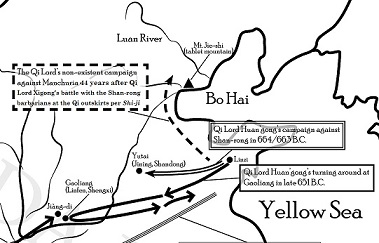
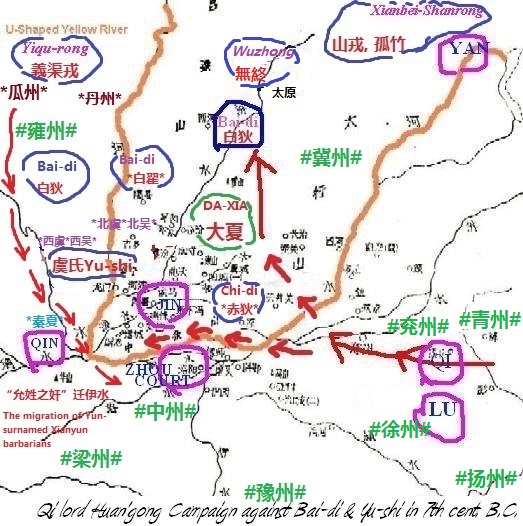
Sima Qian's Shi-ji and Ban Gu's Han Shu said that the Quanrongs (possibly ancestors of the Huns), at one time, attacked ancestors of the Zhou people, forcing the Zhou people into a move to the Qishan Mountain where they set up the Zhou statelet.
Count of West, Xibo, namely, Zhou Ancestor Ji Chang, once attacked the Doggy Rongs (said to be same as the Xianyun barbarian on the [Ordos rather than further north] steppe).
Poem Cai Wei claimed that at the time of Zhou King Wenwang, there were Kunyi (i.e., Quanrong) to the west and Yan-yun to the north.
The poem claimed that the barbarians ravaged the Zhou people's homeland.
Dozen years later, Zhou King Wuwang exiled the Rongs north of the Jing & Luo Rivers. The Rongs were also called Huangfu at the time, a name to mean their 'erratic submission'.
200 years later, during the 17th year reign [i.e., 956 B.C.E. per the forgery The Bamboo Annals], Zhou King Muwang was noted for defeating the barbarians, reaching Qinghai-Gansu regions in the west, meeting with Queen Mother of West on Mt Kunlun [possibly around Dunhuang area], and then relocating the barbarians eastward to the starting point of the Jing-shui River for better management [in a similar fashion to Han Emperor Wudi's relocating the Southern Huns to the south of the north Yellow River Bend].
Zhou King Muwang attacked the Doggy Rongs and history recorded that he captured four white wolves & four white deers (white deer and white wolf being the titles of ministers of the Rong-di barbarians) during his campaign. The Huangfu (Doggy Rong) people then no longer sent in yearly gifts and tributes. Zhou King Yiwang, grandson of King Muwang (r. 1,001 - 946 BC; 962-908 per The Bamboo Annals), would be attacked by the Rongs. King Yiwang ordered Guo-gong to attack the Taiyuan-rong. The great grandson, King Xuanwang (reign 827 - 782), finally fought back against the Rongs.
King Xuanwang, in the 5th year reign, ordered General Nan-zhong to build a castle at Shuo-fang when the Quan-rong intruded to the north bank of the Jingshui River, and ordered Yi Jifu to defeat Xianyun at Taiyuan.
Shi Jing eulogized King Xuanwang's reaching "Taiyuan" [i.e., in the Ningxia area, or the origin of the Jing-shui River] and fighting the Jiangrong. King Xuanwang, in the 39th year reign, defeated the Jiang-rong (Shen-rong) at Qianmou per Guo Yu.
Dongzhou Lieguo Zi said that King Xuanwang would be futile in fighting the Jiang-Rong barbarians at Taiyuan. (Jiangrong could mean the same as Quanrong or the later Rong-di Rong or different should this webmaster note the difference of Yun surname versus Ji versus Jiang surname of the two groups of barbarians.)
Thereafter, King Youwang (reign 781-771) was killed by the Doggy Rongs at the foothill of the Lishan Mountain and capital Haojing was sacked. The Quanrong & Xirong had come to aid Marquis Shenhou (father-in-law of King Youwang of Western Zhou, c 11 cent - 770 B.C.) in killing King Youwang of Zhou Dynasty in 770 B.C. The Rongs who stayed on at Lishan were called the Li-rong. The Rongs moved to live between the Jing & Wei Rivers. Lord Qin Xianggong was conferred the old land of Zhou by Zhou King Pingwang (reign 770-720). Zhou King Pingwang encouraged the Qin Lord to drive out the Quanrongs.
Geography: The Jing River is renowned for its clearness. It originated in today's Ningxia, entered Shenxi, converged with the Wei River, and then flew into the Yellow River. The Wei River originated from Gansu, entered Shenxi, converged with Jing River, and flew into the Yellow River. The Luo River originated from Shenxi, flew through Henan, and then entered the Yellow River.
The Quanrong or Doggy Rong of the west were also named Quan-yi-shi (Doggy alien tribe) or Hunyi / Kunyi (Kunlun Mountain aliens?, but was commented to be the same as character 'hun4' for the meaning of mixing-up). The Shan Hai Jing legends stated that Huangdi or the Yellow Lord bore Miao-long, Miaolong bore Nong-ming, Nongming bore Bai-quan (White dog) which was the ancestors of the Quanrong people. Shan Hai Jing also stated that Quan-yi had the human face but a beast-like body. An ancient scholar called Jia Kui stated that the Quan-yi was one of the varieties of the Rong people.
Among the above names, one group of barbarians would be called the Rong-di(2) people. Some Rong and Di must have mixed up, and one more designation would be the Rong-di Rong who moved east and later split into Chidi and Baidi in today's Shanxi Province domain.
This webmaster's intuition was that the Rong and Di people in northwestern China in the ancient times could be following the same pattern as the later Qiang and Hu barbarians during Han Dynasty emperor Wudi's timeframe. (Wang Zhonghan cited scholar Wang Guowei in pointing out that 'Rong' was a barbarian designation from Zhou King Youwang to Lu Lord Yin'gong & Lu Lord Huan'gong, while the 'Di[2]' designation came about after Lu Lord Zhuanggong & Lu Lord Min'gong. The character "Rong" was equivalent to weaponry, ferociousness and other derogatory meanings. Ancient classics, like "Shi[-jing]" and "[Shang-]Shu" interpreted Di[2] as the "faraway barbarians".)
Other than the wars between the Zhou people and the barbarians, the Qin people had warred with the barbarians as well.
Qin warred with various Rong people over a time span of over 600 years. When Zhou King Liwang was ruling despotically, the Xi Rong (Xirong or Western Rong) people rebelled in the west and killed most of the Daluo lineage of the Qin people. Zhou King Xuanwang conferred Qin Lord 'Qin Zhong' (r. B.C.E. 845-822 ?) the title of 'Da Fu' and ordered him to quell the Xirong.
Per the forgery The Bamboo Annals, Zhou King Xuanwang (Ji Jing, reign 827-782 B.C. per Shi-ji; 826-782 B.C. per Zhang Wenyu/Lai2 Ding), in the 4th year reign, ordered Qin Zhong to attack the Rong barbarians.
Qin Lord Zhuanggong's senior son, Shifu, would swear that he would kill the king of the Rong people to avenge the death of Qin Zhong before returning to the Qin capital.
Per The Bamboo Annals, twenty years later, Zhou King Xuanwang sent an army to Taiyuan to attack the Taiyuan-rong but did not succeed; and another five years later, King Xuanwang attacked Tiao-rong and Ben-rong but got defeated; and another two years, the Rong people destroyed Marquis Jiang-hou's fief; and another one year later, King Xuanwang campaigned against the Shen-rong and defeated them.
Per Shi Jing, the Rong that King Xuanwang campaigned against were in fact called by Yan-yun.
King Xuanwang, other than the threat from the northwest, had to fight the Xu-rong and Jing people from the south and southeast.
Qin Zhuanggong's junior son would be Qin Lord Xianggong (Ying Kai) who assisted Zhou King Pingwang (reign 770-720) in cracking down on both the Western Rong and the Doggy Rong. Shifu was taken prisoner of war by the Xi Rong people during the 2nd year reign of Qin Lord Xianggong and did not get released till one year later.
During the 7th year reign of Qin Lord Xianggong, i.e., 771 B.C., the Doggy Rong barbarians sacked the Zhou capital at the invitation of Marquis Shen (i.e., Shenhou) and killed Zhou King Youwang.
Qin Lord Xianggong (Ying Kai) died during the 12th year of his reign (766 B.C.) when he campaigned against the Rong at Qishan.
Qin Lord Wengong (r. B.C.E. 765-716), during his 16th year reign, defeated the Rong at Qishan. Wengong would give the land east of Qishan back to the Zhou court.
Qin Lord Ninggong (r. B.C.E. 715-704) would defeat King Bo and drove King Bo towards the Rong people during the 3rd year reign, i.e., 713 B.C. Ninggong conquered King Bo's Dang-shi clan during the 12th year reign, i.e., 704 B.C.
Qin Lord Wugong (r. B.C.E. 697-677), during the 10th year reign, exterminated the Gui[1]-rong (Shanggui of Longxi) and Ji-rong (Tianshui Commandary), and the next year, exterminated Du-bo Fief (southeast of Xi'an), Zheng-guo Fief (Zheng-xian County) and Xiao-guo Fief (an alternative Guo Fief, different from the Guo domain conferred by Zhou King Wenwang onto his brother, Guo-shu). Xiao-guo Fief was said to be a branch of the Qiang people.
Meanwhile, lord of the Jinn Principality, Jinn Xian'gong (r. 676-651 B.C.), attacked the Li-rong (Xi Rong) barbarians during his 5th year reign, i.e., 672 B.C.E. approx, and captured a Li-rong woman called Li-ji. (History said that the Li-rong barbarian carried the Ji surname as the Zhou and Jinn families.)
The Jinn Principality began the process of expansion that would merge and conquer dozen barbarian statelets on the two banks of the east Yellow River Bend, with Jinn Lord Xian'gong merging 17 statelets and subjugating 38 others [per "Haan Fei-zi"].
Per the ancient classics, by the 5th century B.C.E., all barbarians who stayed in central China, except for the Yiqu-rong, would either succumb to the Sinitic Chinese rule or flee back to the homeland beyond the western border.
After the defeat in the hands of Jinn Lord Wen'gong, the Di barbarians, who lived in the land of Xi-he (today's east segment of the Yellow River loop or bend), between the Yin (Yan'an/Yenan, Shenxi) and the [northern-]Luo River, where they were called by the White Di and Red Di barbarians.
Note that ancient West Yellow River Bend is the same as today's East Yellow River Bend. Ancient Yellow River Bend did not equate to today's inverse U-shaped course with the North Bend lying inside Inner Mongolia Autonomous Region, but the U-shaped Bend with South Bend in southern Shanxi Province and then a south-to-north turn in Hebei Province for exit into the sea.
Baidi (White Di) dwelled in the ancient Yanzhou (today's Yan'an), Suizhou (today's Suide) and Yinzhou (today's Ningxia on west Yellow River Bend) prefectures. Zuo Shi Chun-qiu stated Jinn defeated Baidi and the remnants were known as Bai-bu-hu later. Chidi (Red Di) dwelled in a place called Lu(4), near today's Shangdang. Zuo Shi Chun-qiu stated that Jinn Principality destroyed the Lu(4) tribe of the Chidi, and the remnants were known as Chi-she-hu barbarians later.
The earliest written records on the Red Di and White Di's ancestors would be in Zheng Yu of Guo Yu, wherein Shi-bo, a court minister, in 774 B.C. analyzed the barbarian groups with Zheng Lord Huan'gong, mentioning the later White Di and Red Di states of Xianyu, Lu4, Luo4, Quan2, Xu2 and Pu2.
SHI BEN claimed that the White Di people carried the Jiu4 surname which the later historians claimed to be a mutated writing of the Yellow Lord's Ji1 surname.
(Han Dynasty scholar Wang Fu, in Qian Fu [hermit gentleman] Lun [discourse], claimed that among the antiquity surnames, the Red Di were Kui-surnamed and the White Di were Heng-surnamed. The later scholars pointed out that 'Heng', like Jiu4, was a mutated writing of Ji1.)
Qi Lord Huan'gong purportedly destroyed the statelets of Shan-rong and Guzhu between today's Peking and Manchuria.
Guan Zi, in the Xiao Kuang section, claimed that Qi Lord Huan'gong purportedly in the mid-7th century B.C. campaigned against Gu-zhu, Shan-rong, and Hui-he (i.e., dirty raccoon), with Hui-he being equivalent to the Fu-yu people who were ancestors of Koguryo, Paekche and the Yamato Japanese. That is, Guan Zi was very much a Han dynasty book carrying the latter-known names of the barbarians.
Guzhu was formerly the Zhu-guo Statelet, a vassal of ex-Shang dynasty.
In the northeast, the Shan-rong barbarians, i.e., the Mountain Rong barbarians, who were customarily taken to be of the Tungusic stock [per historian Fu Qian], were said by Sima Qian to have gone across the Yan Principality of today's Hebei Province to attack the Qi Principality in today's Shandong Province. Sima Qian, in Shi-ji, stated that this happened sixty-five years after the relocation of Zhou King Pingwang's capital city to Luoyi and Qin Lord Xianggong's campaign against the [western] Rong barbarians at the Qishan Mountain, namely, about 705 B.C. Sima Qian stated that the Mountain Rongs, who attacked the Yan Principality, had intruded to the outskirts of Qi's capital city and fought against Qi Lord Ligong (i.e., Xigong). Sima Qian's Shi-ji stated that another forty-four years later, which would be 661 B.C. [after deduction from 705 B.C.], the Mountain Rongs attacked Yan again. Yan Lord Zhuanggong requested aid with Qi, which culminating in the Yan-Qi joint armies destroying the Mountain Rong Statelet as well as the Guzhu Statelet around 664 B.C. The story of 'old horses knew the way home' would be about the joint army being lost after they penetrated deep into the Shanrong land. Hence, Yan Statelet extended by 500 li to the northwest, in addition to the eastward 50 li which was given to Count Yan for his escorting Marquis Qi all the way into the Qi Statelet.
--Sima Qian, who wrote about the [northern] Yan lords' lineage on basis of the Shi Ben book, mentioned the above sensational stories which did not conform with Zuo Zhuan, a book that recorded the Ji2-surnamed South Yan state from 718 B.C. to a Zheng lord's Yan-ji2 wife bearing a son called by orchid around 649 B.C. but did not specifically name the North Yan state matter till 545 B.C. on which occasion the North Yan count visited the Jinn state.
This webmaster, checking the Qi marquis' itinaries in year 664 B.C., only found an entry about a diplomatic summit, in the winter of 644 B.C., between the Lu lord and the Qi marquis at Lu-ji, in regards to the campaigns against the Shan-rong or the Shanrong (Mountain Rong) barbarians who attacked the [most likely southern] Yan state.
If it was the year 661 B.C., the Qi marquis would be busy dealing with the Chang-di barbarians' invasion of the Xing-guo and Wey states, with no time to take care of the other hot spots.
During the 16th year of Zhou King Huiwang (reign 676-652), namely, 661 B.C., the Chang Di barbarians who were located near today's Ji'nan City of Shandong Province, under Sou Man, attacked the Wey and Xing principalities. The Chang-Di barbarians, hearing of Qi army's counter-attacks at the Mountain-rong, embarked on a pillage in central China by attacking the Wey and Xing statelets. The Chang Di barbarians killed Wey Lord Yigong (r. B.C.E. 668-660 ?) who was notorious for indulging in raising numerous birds called 'he' (cranes), and the barbarians cut him into pieces. A Wey minister would later find Yigong's liver to be intact, and hence he committed suicide by cutting apart his chest and saving Yigong's liver inside of his body.
(Chang-di, who was disputed to be about merely a family of long-leg clan rulers like Sou Man, not a long-leg tribe, was said to be an alternative name for the Mountain Rong barbarians.
In the Warring States time period and the Han dynasty, sophistry books mis-interpreted Chang-di as a long-leg giants' tribe, with Confucius' disciples faking a comment by the master in regards to a lineage history of giants from the era of sage-kings.)
Jin (Jinn) Principality also helped the Zhou King by attacking the Rongs and then escorted the king back to his throne 4 years after the king went into exile. The Rong-di moved to live in a place called Luhun, and they would later be forced to relocate elsewhere by the Qin-Jinn principalities.
When Qin intended to get rid of the Luhun-rong & Jiang-rong around capital Yong in 638 B.C., the Jinn Principality adopted a policy of allowing the remotely-related barbarian clan to stay closer to the land between the Qin, Jinn and Zhou Dynasty capitals: Jinn Lord Huigong, for his mother's tie with the Luhun-rong clan, relocated the Luhun-rong to the Yi-chuan River and the Jiang-rong to today's southern Shanxi Province, i.e., namely, the southward migration to the Mt Songshan area of the Yun-surnamed Xianyun [Huns] clan whose Qiangic nature was validated about 80 years later by the dialogue between Fan Xuan-zi of the Jinn Principality and Rong-zi-Ju-zhi, the descendant of Jiang-rong.
Fan Xuan-zi said that you, the Jiang-rong-shi people, were pressured by the Qin people to leave Guazhou [which was wrongly taken to be some place on the Western Corridor and in the Dunhuang-Jiuquan area but could be right inside of the Yellow River Sheath, with the character 'gua' in Guazhou being possibly a corruption from the character 'Hu' for fox]; and that when your ancestor, Wu-li, trekked across the land of thorns to seek shelter with the Jinn lord Huigong, our lord had yielded the land to you and shared food with you.
For those Rong who dwelled on the southern bank of the Yellow River, they were alternatively called the 'Yin [sun shade] Rong' or the 'Jiu-zhou [nine greater prefectures] Rong', a term which was to have applied Zou Yan's nine greater prefecture school of thought for enclosing the barbarians in a larger humanity family, who were to develop into a threat to the extent that the Chu Army campaigned against the Luhun-rong in 606 B.C.E.
(The above dialogue also ascertained the fact that there were no Yuezhi in the 7th century B.C.E., with the whole territory under the influence and control of the Qin people, after the relocation of the Yun-surnamed Xianyun people. More, the Qin statelet would expand northward to take over the land of the Yiqu-rong in today's central and northern Shenxi Province, again encountering no Yuezhi but some varieties of the Yiqu-rong people, a name that appeared in Shang King Wu-yi's time in the contemporary version of The Bamboo Annals to be a group of barbarians defeated by the Zhou founding-king's father Ji-li --which could be an insertion from the latter-day recompilation since this name was not seen for five hundred years in-between.)
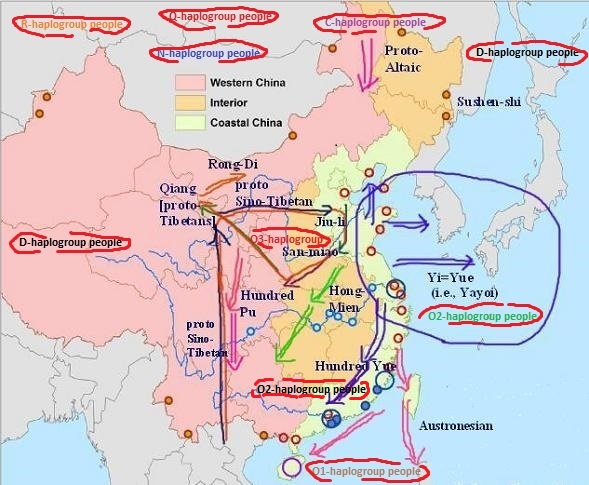
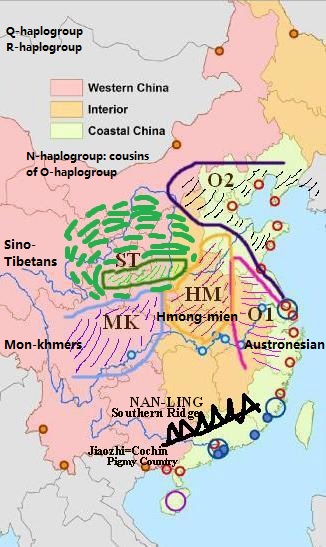
Meanwhile, the group of the barbarians penetrated southwestward to the Yellow River line and crossed the river to pose threat to the Zhou kingdom.
The invitation of the barbarians to the heartland of Zhou China caused some havoc.
During the 3rd year of Zhou King Xiangwang's reign, a half brother, by the name of Shu-dai [Zi-dai], colluded with the Rong and Di barbarians in attacking King Xiangwang. (The Rong-di barbarians had come to aid Shu-dai as a conspiracy of Shu-dai's mother, ex-queen Huihou.) The Jinn Principality attacked the Rong to help the Zhou court. Shu-dai fled to the Qi Principality. The Qi Principality also helped the Zhou court by sending Guan Zhong on a campaign against the Rong people. At the Zhou court, King Xiangwang expressed gratitude to Guan Zhong, mentioning the fact that Zhou King Wuwang had married the daughter of Jiang Taigong (founder of the Qi Principality) as wife. Three years after the death of Qi Lord Huan'gong, Shu-dai returned to the Zhou court from the Qi Principality at the request of Zhou King Xiangwang.
When Shu-dai rebelled in 649 B.C.E., he assembled various Rong people in the Yi-shui and Luo-shui area, including the Yangju-rong, Quan'gao-rong and Yi-luo-rong, etc., for a fire attack against the Zhou capital. (Those were said to be Yi-surnamed Rong barbarians. Now that this webmaster had listed the Yun-surnamed, Jiang-surnamed, Ji-surnamed and Yi-surnamed barbarians, it would not be a riddle for you guys to understand why the nine Zhaowu clans of the Yuezhi sounded so Sinitic.)
During the 12th year reign of Qin Lord Mugong, i.e., 648 BC, Guan Zhong of the Qi state passed away.
King Xiangwang campaigned against the Zheng Principality in collaboration with the Rong-di barbarians in 637 B.C. King Xiangwang, to show his favor for the Rong-di, took in a daughter of the Rong-di ruler as his queen. But in the next year, King Xiangwang abandoned queen of the Rong-di origin, and the Rong-di came to attack the Zhou court in revenge.
In the autumn of 636 BC, the brother of Zhou King Xiangwang, Shu-dai, hired the Di barbarians in attacking the Zhou court. King Xiangwang fled to the Zheng Principality. When the Rong-di sacked the Zhou capital, King Xiangwang fled to Zheng. Shu-dai was made into the king. Shu-dai took over King Xiangwang's Rong-di queen as his concubine. The Rong-di hence moved to live next to the Zhou capital. The Rong-di extended their domain as eastward as the Wey Principality.
In 636 B.C.E. approx, the Rong-di attacked Zhou King Xiangwang (reign 651-619) at the encouragement of the Zhou Queen who was a daughter of the Rong-di ruler. The Jinn Principality helped the Zhou King by attacking the Rongs and then escorted the king back to his throne 4 years after the king went into exile
Back in 659 B.C., Qin Lord Mugong conquered the Maojin-rong barbarians.
Two years after the Xiao'er defeat, in 625 B.C., Qin Lord Mugong dispatched Mengmingshi on another campaign against Jinn.
At the Mt. Xiao-er Battle, the Jiang-rong barbarians had assisted Jinn in ambushing the Qin army, which was a pincer-attack.
After the setback, Qin, which was impeded to the east, turned around to expand westward.
Qin Lord Mugong conquered 8 Western Rong tribes.
In 623 B.C., i.e., during the 37th year reign, Qin Lord Mugong, using You Yu as a guide, campaigned against eight Xi-rong barbarian states and conquered the Xi-rong Statelet under their lord Chi Ban [i.e., likely the historical Yiqu-rong statelet or the future Yuezhi people].
The eight Xi-rong barbarian states, per Shi-ji, could include: Mianzu, Gun-rong, Di[2]yuan[2], Huan-rong, Yiqu-rong, Dali, Wuzhi and Xuyan.
Once Chi Ban submitted to Qin, the remnant Western Rongs in the west acknowledged the Qin overlordship. Qin Lord Mugong would conquer altogether a dozen (12) states in today's Gansu-Shaanxi areas and controlled the western China of the times. The Zhou King dispatched Duke Zhaogong to congratulating Qin with a gold drum.
During the 3rd year reign of Qin Lord Gonggong, i.e., 606 B.C., Chu Lord Zhuangwang campaigned northward against the Luhun-rong barbarians and inquired about the Zhou cauldrons when passing through the Zhou capital.
The Luhun-rong barbarians, according to Hou Han Shu, had relocated to central China from the ancient "Gua-zhou" prefecture. Alternatively speaking, per ancient scholar Du Yu, the Luhun-rong barbarians, with the clan name of Yun-shi, originally dwelled to the northwest of the Qin and Jinn principalities, but Qin/Jinn inducingly relocated them to the Yichuan area (i.e., Xincheng, Henan Province) during the 22nd year reign of Lu Lord Xigong (r. B.C.E. 659-627), i.e., in 638 B.C.
Later, in 525 B.C.E., the Luhun-rongs were destroyed by the Jinn Principality, with its chieftain fleeing south to seek asylum with Chu. Later Han dynasty scholar Lu Jia claimed descent from the Luhun-rongs.
Though, the Jinn Principality was still surrounded by the barbarian Di people at the time.
At the origin of the Wei-shui River, around the later Longxi and Tianshui commandaries, there were the Di-rong, Rong-rong, Gui-rong, and Ji-rong barbarians;
to the north of the Jing-shui River, there were Yiqu-rongs in the later Anhua Commandary;
in the Luo-chuan River area, there was the Dali-rongs;
to the south of Wei-shui River, there were the Li-rongs;
in the Yi-shui and Luo-shui area, there were the Yangju-rong, and Quangao-rong tribes; and
at the origin of the Ying-shui River, there were the Youman-shi-rong.
By the later Zhou Dynasty time period, among the barbarian groups, there were Mianzu (today's Tianshui), Gun-rong, Di[2] (Wushi-jun of the Jinn Dynasty time period), and Huan-rong (Xiangwu of Weizhou) to the west of the Qin Principality, Yiqu-Dali-Wuzhi-Xuyan to the north of the Qin Principality, Linhu-Loufan to the north of Jin (Jinn) Principality, and Donghu-Shanrong to the north of the Yan Principality.
Mianzu could be pronounced as Raozhu. Gun-rong (Quanrong) was also known as Kunrong or Hunrong or Hunyi. The character 'hun4' for Hunyi or Hun-yi could be the same one as Hunnic King Hunye or Kunye, a word meaning the mixing-up.
Summarized by Tong Dian, there were four barbarian groups at the origin of the Jing-shui River, with Di-rong and Huan-rong in the later Longxi-jun Commanday and Gui-rong and Ji-rong in the later Tianshui-jun Commandary.
Yiqu-rong was one of the Xi-rong or Western rong stateles at the ancient Qingzhou and Ningzhou areas. Dali-rong dwelled in today's Fengxu County. Wuzhi [not Wushi, the same as Yuezhi not being Yueshi] was originally living in part of the Zhou land, but this land was taken over by the Rong people. Qin King Huiwang took it back from the Rongs later, and launched the Wuzhi county [i.e., in today's Pingliang area].
Xuyan was in today's Yanchi [salt pond] of Ningxia.
Dali-rong dwelled in today's Fengxu County.
Tong Dian further pointed out that the Li-rong barbarians dwelled to the south of the Wei-shui River, the Yangju-rong and Quangao-rong dwelled around the Yi-shui and Luo-he Rivers, and the Man-shi-zhi-rong (Manshi-rong, i.e., some barbarians possibly related to the southern or the Pu group) dwelled to the west of the Ying-shui and Luo-he Rivers.
Linhu was later destroyed by General Li Mu. Li Mu (?-229 B.C.), a Zhao Principality general who was counted as one of the four famous [together with Bai Qi, Wang Jian and Lian Po) during the Warring States time period, in the mid-240s B.C. induced the Huns into invading south and thoroughly defeated about 100,000 Huns in the Yanmen [swan gate] area. Loufan also belonged to today's Yanmen'guan Pass area (Ningwu of Shanxi).
During the 13th year reign of Zhou King Jianwang, i.e., 573 B.C., Jinn Lord Ligong was killed by Luan Shu and Zhongxing Yan (Zhonghang Yan). Jinn dispatched emissaries (led by a Zhi family member) to the Zhou court to retrieve Zi-zhou as Lord Daogong. Jinn Lord Daogong made peace with Rong-di (who attacked Zhou King Xiangwang earlier), and the Rong-di sent in gifts and tributes to Jinn.
Another one hundred years, Zhao Xiang-zi of Zhao Principality took over Bing and Dai areas near Yanmen'guan Pass. Zhao, together with Haan and Wei families, destroyed another opponent called Zhi-bo and split Jinn into three states of Haan, Zhao & Wei.
In 461 B.C., Qin Lord Ligong, with 20,000 army, attacked the Dali-rong barbarians and took over Dali-rong capital.
In 444 B.C., Qin Lord Ligong attacked the Yiqu-rong barbarians in the areas of later Qingzhou and Ningzhou and captured the Yiqu-rong king.
Around 430 B.C., the Yiqu-rong barbarians counter-attacked Qin and reached south of the Wei-shui River.
Qin Lord Xiaogong (r. B.C.E. 361-338), during the first year reign, Qin Xiaogong made an open announcement for seeking talents all over China in the attempt of restoring Qin Mugong's glories. In the east, Qin Xiaogong took over the Shaancheng city, and in the west, he defeated and killed a Rong king by the name of Huan-wang near Tianshui, Gansu Prov.
* In Commemoration of China's Fall under the Alien Conquests in A.D. 1279,
A.D. 1644 & A.D. 1949 *
U.S.S.R./Comintern Alliance with the KMT & CCP (1923-1927)
Korean/Chinese Communists & the 1931 Japanese Invasion of Manchuria
American Involvement in China: Soviet Operation Snow, IPR Conspiracy, Dixie Mission, Stilwell
Incident, O.S.S. Scheme, Coalition Government Crap, Amerasia Case & The China White Paper
* Stay tuned for "Republican China 1911-1955: A Complete Untold History" *
|
|
Zou Rong's Revolutionary Army;
Shin Kyu Sik's
Shrine (Spirit, Kunitama) of Korea
|
This snippet is for sons and daughters of China:
Heed the sons & ministers' agony and sorrow of our ancestors who died or lived through the Mongol, Manchu and Soviet-Chicom conquest
and
the Yongjia, Jingkang and Jiashen cataclysms !
Jeanne d'Arc of China:
Teenager girl Xun Guan breaking out of the Wancheng city to borrow the relief troops in the late Western Jinn dynasty;
Liu-Shao-shi riding into the barbarian army to rescue her husband in the late Western Jinn dynasty;
teenager girl Shen Yunying breaking into Zhang Xianzhong's rebels on the horseback to avenge on father's death in the late Ming dynasty.
China's Solitary and Lone Heroes:
Nan Jiyun breaking out of the Suiyang siege and charging back into the city in the Tang dynasty;
Zhang Gui & Zhang Shun Brothers breaking through the Mongol siege of Xiangyang in the Southern Soong dynasty;
Liu Tiejun breaking through three communist field armies' siege of Kaifeng in the Republican China time period;
Zhang Jian's lone confrontation against the communist army during the June 3rd & 4th Massacre of 1989.
|
|
|
Qin's Historical Relations with the Yiqu-rong Barbarians
Among the barbarians to the west and north of the Qin people, there were the so-called Yiqu-rong who were wrongly speculated to have existed since the Shang Dynasty by the sophistry books like Yi Zhou Shu.
It was said by the sophistry books like Yi Zhou Shu that Jiang Taigong sent Nangong Shi to visiting the Yiqu-rong, with the latter submitting gifts to Shang King Zhouwang as requital.
Those writings about Yiqu-rong were apparently made up during the Han dynasty.
The Yiqu-rong people dwelled in today's Guyuan area, the origin of the Jingshui River and along the banks of the Yellow River.
In the Zhou Dynasty time period, Zhou King Muwang resettled the barbarians at the origin of the Jingshui River, among them, Yiqu-rong, Yuzhi, Wuzhi, Xuyan and Penglu, namely, the five Rongs as noted in history.
(The naming here could be the source of the later name for the Yuezhi people, should the Yuezhi be counted as being related to the Sinitic Chinese and dwelled near China from the beginning.)
Yiqu-rong established its own statelet after the Rong-di sacked the Zhou capital Haojing and killed Zhou King Youwang.
Subsequently, Yiqu-rong was speculated to have merged Penglu and Yuzhi, etc., with domain extending to the Qiaoshan [Arch] mountain to the east and Guyuan to the west, the Jingshui River to the south, and the Sheath Area of the Yellow River to the north.
Mo Zi purportedly recorded that the Yiqu-rong people had a tradition of burning their dead.
In 651 B.C., Yiqu-rong sent You-yu to seeing Qin Lord Mugong who bought over the emissary who was of the Jinn background. Qin Mugong attacked and took over some land from Yiqu-rong.
In 430 B.C., Yiqu-rong attacked Qin and took over the lowerstream Wei River, and pushed to south of the Wei River.
Yiqu-rong, per ancient tactics book, had at one time sent emissary to seeking an alliance with the rest of the Chinese statelets against Qin.
By 327, Qin pacified Yiqu-rong as a vassal and made its territories the Qin counties.
To the north and northwest, Qin defeated the Yiqu-rong barbarians, and subsequently in 327, turned some of the Yiqu-rong land into the Yiqu-rong County. Back in 331 B.C., Qin King Hui[wen]wang sent 'shu zhang' Cao to quelling the internal Yiqu-rong rebellion. In 327 B.C., the Yiqu-rong lord called himself a minister under the Qin lord. With the Yiqu-rong barbarians under control, the Qin king travelled to Bei-he or the North Yellow River, an area that probably extended from the area next to Ganquan to the northern Yellow River Bend area, in 320 B.C. Later in 315 B.C., Qin further took over 25 cities from Yiqu-rong. In 310 B.C., Qin King Wuwang's 1st year, Qin defeated the Yiqu-rong rebellion. Sima Qian, in Shi-ji, briefly talked about Qin King Xiaowenwang's northern trip in two places. In the six-nation table, Sima Qian stated that the Qin king travelled north to the Rong barbarians' land during the 5th year of the Gengyuan Era, namely, 320 B.C., and reached 'he-shang', namely, the upperstream Yellow River [which should be anywhere north of the Yellow River inflection area]. After this time, the Qin state having no use for the original Great Wall that extended from the original Tianshui homeland across the upperstream Jing-shui River to the Guyang (Dingyang/Yan'an, Shenxi) area, built the west-to-east elm tree belt Great Wall within the sheath, with a Yu-xi-sai fort recorded in history, near today's Yulin (elm forest), Shenxi. In the Qin Ben-ji section, Sima Qian stated that the king travelled to 'Bei-he', namely, the North River. By the Eastern Han dynasty, Ban Gu, possibly using the divination materials, claimed that [misnomer] Qin King Xiaowenwang visited Quyan, with the barbarians surrendering a five-feet (hoof) ox. Later historians continued to pile onto the extrapolated history, with Shi-ji Zheng-yi claiming that the Qin king reached the Lingzhou and Xiazhou prefectures which were on the middle segment of the Western Yellow River Bend.
In 318 B.C. Yiqu-rong rebelled against Qin, and allied with five Chinese statelets.
In 314 B.C., Qin, after victories in the unification wars, turned around to attack Yiqu-rong.
After about one century of relative peace, Qin began to expand by attacking Dali & Yiqu-rong.
The barbarian statelets like Dali & Yiqu-rong built several dozen castles.
The Yiqu-Rong built castles to counter Qin.
Qin King Huiwang took over 25 cities from the Yiqu-rong.
In 306, Qin dowager queen Xiantaihou seduced the Yiqu-rong king in Ganquan-gong.
At the time of Qin King Zhaowang, Qin Queen Xuantaihou killed a Yiqu-rong King. (King Zhaoxiangwang's mother, Queen Dowager Xuantaihou, adultered with the former Rong king from the Yiqu-rong Statelet, with two sons born.)
Qin dowager queen Xiantaihou killed the Yiqu-rong king in 272 B.C., about 34 years after the seduction.
Hence, Qin made the Yiqu-rong land into the Qin commandaries and counties, which was said to be the start of the Qin commandary-county system.
The Building Of The Walls
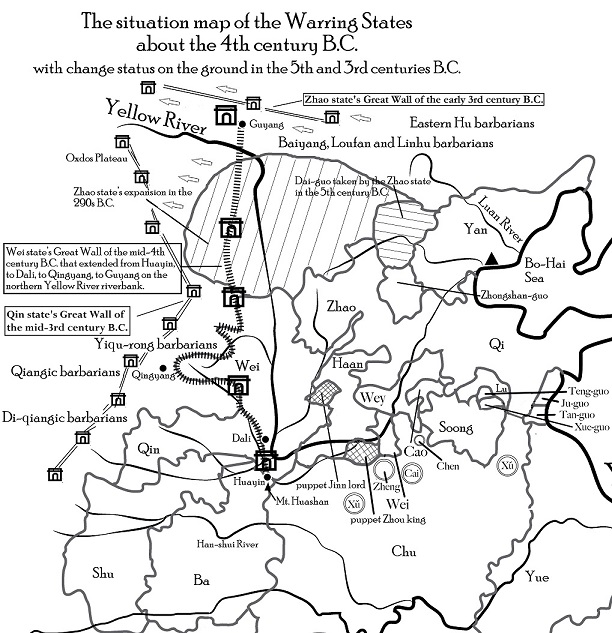 In 355 BC, Qin Lord Xiaogong met Wei King Huiwang at the border. In 354 BC, Qin fought Wei at Yuanli. The Wei principality, which had to fight against both Qin and the Rong people, built the Great Wall that extended though the Qingyang area of eastern Gansu, through today's counties of Zhengning, Ningxian and Heshui. Under the attack by Qin, Wei lost large patches of land to the west of the Yellow River, and relocated the capital city to Daliang.
During the 10th year reign, i.e., in 352 BC, Shang Yang was conferred the post of da liangzao (the 16th level in 20 tiers of the Qin officialdom), and he took over the Anyi city of Wei to the east of the river. In 350 BC, Qin Lord Xiaogong made Xian'yang (today's Chang'an county, Xi'an Municipality) the new Qin capital.
In 355 BC, Qin Lord Xiaogong met Wei King Huiwang at the border. In 354 BC, Qin fought Wei at Yuanli. The Wei principality, which had to fight against both Qin and the Rong people, built the Great Wall that extended though the Qingyang area of eastern Gansu, through today's counties of Zhengning, Ningxian and Heshui. Under the attack by Qin, Wei lost large patches of land to the west of the Yellow River, and relocated the capital city to Daliang.
During the 10th year reign, i.e., in 352 BC, Shang Yang was conferred the post of da liangzao (the 16th level in 20 tiers of the Qin officialdom), and he took over the Anyi city of Wei to the east of the river. In 350 BC, Qin Lord Xiaogong made Xian'yang (today's Chang'an county, Xi'an Municipality) the new Qin capital.
Qin, under Qin King Zhaoxiangwang, continued wars against the Wei & Zhao principalities.
Qin King Zhaoxiangwang's mother, Queen Dowager Xuantaihou, adultered with a Rong king from the Yiqu-rong Statelet in today's northwestern Shenxi Province. She had two sons born with the Yiqu-rong King, but she killed the Yiqu-rong King and incorporated the lands of Longxi (Gansu), Beidi (today's Yinchuan of Ningxia) [[??]] and Shangjun (Yulin, Shenxi Province)]] on behalf of Qin.
Qin took over the Shangjun (upperstream river) commandary from the Wei state. Qin re-built the Great Wall at Longxi of Gansu, Beidi and Shangjun of today's Shenxi land. Qin rebuilt the wall on basis of the Wei Principality's Great Wall, while Wei inherited the Jinn Principality legacy, namely, the former Jinn lord's resettling the Yun-surnamed Xianyun and Jiang-rong barbarians to the heartland of China. Part of the segments of the Great Wall previously belonged to the Wei Principality.
(Yi-qu, whose DNA could contain the Q-haplogroup gene of ancient Huns, dwelled in the area north of the Wei-shui River, that previously belonged to the White Di barbarians during the Spring & Autumn time period.)
The two successive Jinn states which bordered with the northern barbarians, Wei & Zhao, plus Qin and Yan, would be busy fighting the barbarians for hundreds of years, and they built separate walls to drive out the barbarians. Zhao King Wulingwang in 309 B.C.E. adopted reforms by wearing the Hu cavalry clothing and he defeated Linhu and Loufan and built the Great Wall from Dai to the Yinshan Mountain. Zhao set up the Yunzhong, Yanmen and Dai prefectures. Around 300 B.C.E., a Yan Principality General by the name of Qin-kai, after returning from the Donghu (Eastern Hu) barbarians as a hostage, attacked Donghu and drove them away for 1000 li distance. Yan built the Great Wall and set up the Shanggu, Yuyang, You-beiping, Liaoxi and Liaodong prefectures.
In the mid-240s B.C., Zhao Principality general Li Mu (?-229 B.C.) induced the Huns into invading south and thoroughly defeated about 100,000 Huns in the Yanmen (swan gate) area.
Li Mu, building on top of the victory, routed the Hunnic vassals to the north of Zhao, destroyed the Chanbao statelet, pacified the Lin-hu (forest Hu), and expelled the Dong-hu barbarians [who were purportedly known as the Mountain Rong in the Jehol mountains at the time of Qi counsellor Guan Zhong [Guan-zi]'s campaign four centuries earlier --but more likely residing in the Shanxi mountain area].
The Qin State founded the first united empire of Qin in 221 B.C. After the Qin unification of China, Emperor Shihuangdi ordered General Meng Tian on a campaign that would drive the so-called Hu barbarians or the Huns out of the areas south of the Yellow River. The Huns under Mote (Modu or Modok)'s father, Dou-man (Tou-man), fled northward and would not return till General Meng Tian died ten years later. Details about barbarians were also covered at prehistory section.
Ban Gu, in his three sections on the Huns, just summed up the nomadic history indiscriminately. This webmaster could not find any corroborative explanation as to those barbarians, and the literal interpretation would be like this: Chi meaning red, Bai meaning White, Chang meaning long or tall, while Rong meaning wooly (against 'mao' character for the hairy skin). To make sense of those Rong & Di people, Quanrong means the Doggy Rongs, Linhu the Forest Hu barbarians, Donghu the Eastern Hu barbarians, and Shanrong the Mountain Rongs. "Loufan" would be a group of people to be conquered by the Huns around the turn of Qin-Han Dynasties. "Donghu" would be denoting the Tungusic ancestors of the later Xianbei and Wuhuan barbarians. "Shanrong" were the people dwelling in the Jehol mountain area and the northwestern Shanxi mountain area, from whom the Yan-Qi joint armies took over large patches of land.
Note that white or red were designations of the tribal clothing customs or related symbols, and they had nothing to do with hair or skin. Shang Dynasty used the black bird as a totem, for example, and Clyde Winters' appropriation in claiming a Negroid origin of the Shang people was fallacious. Similarly, the minority people in Southwest China, like Bai-zu and Yi-zu, had derived from Bai-man (white [teeth] barbarian) and Hei-man (black [teeth] barbarian) of the Di-Qiang people or ancestors of today's Tibetans.
The closest affiliation to the Huns would be the Rong-di Rongs who had inter-marriage with the Zhou Kingdom and later split into Red Di and White Di. The later group of people called 'Dingling' were said to have derived from Chi Di or Red Di. The Gaoche people, ancestors of the Huihe (Uygurs), were said to have derived from Dingling. ('Dingling', in my opinion, was a much abused categorical name, and it was used in many places of ancient Chinese records where satisfactory explanations were lacking.) The Doggy Rongs' relationship to the Western Rong was not clear. The Doggy Rongs were called Huangfu as this webmaster mentioned above, and they were said to be the same as 'Xianyun' barbarians. Then came the Rong-di barbarians who had inter-marriage with the Zhou Kingdom at one time. It is possible the Rong-di barbarians were the same as the Huangfu while the Huangfu would be the same as the Doggy Rongs. The safest bet would be to go to those Rong-di barbarians for the Hunnic origin as ancient Chinese classics invariably linked the Huns to the Yun-surnamed Xianyun barbarians. If so, that means the Hunnic ancestors originally lived in eastern China, were exiled to Northwest China in the late 3rd millennium B.C.E., dwelled in the Western Corridor in the early 1st millennium B.C.E., were invited to the heartland of China later, and had at one time lived in the heart of Zhou China before a Sinitic Chinese campaign expelled all barbarians out of the central plains during the 5th-6th centuries B.C.E.
By the time of Qin Empire (221 - 206 B.C.), Emperor Shihuangdi (Shi Huangdi), being given a necromancy note stating that the people who would destroy Qin would be named 'Hu' (which turned out to be the name of his junior son, Hu Hai or Hu-hai), would embark on a northern expedition against a people called Xiongnu (i.e., Huns) who were categorically called Hu barbarians at that time. The record shows that the Huns lived not far away from the Chinese after all. Ban Gu, in his History of the Han Dynasty, said that the Rong-di barbarians were interspersed in the land north of the Jing River and the Wei Rivers, that Qin Emperor Shihuangdi drove them out, and that Qin China went as far west as Lintao (Tao being the Tao River in today's Gansu Province). Qin empire would take over today's Hetao (the sleeve-shaped land surrounded by the Yellow River Bend on three sides) areas and set up 44 counties. Thereafter, Qing emperor ordered general Meng Tian to cross the Yellow River, and Yinshan Mountains of Inner Mongolia were taken, where 43 more counties were set up. In both campaigns, Qin migrated convicts to the new counties. It is very clear to me that the Huns had been driven out of China from the very beginning. When Han Dynasty (206 B.C.E. - 220 AD) reunited China, Xiongnu (Huns) would be the name for the barbarians in north and northwest of China, while Donghu (Eastern Hu barbarians) would be the name given to the barbarians to the east of the Huns. The word "nu" of Xiongnu means 'slave' literally, while the word "Xiong" means ferocious'. (In latter times, Manchurian kings and emperors would call anyone serving them as "nu cai", i.e., slaves.)
For further discussions on Barbarians & Chinese, please refer to
Linguistic Exploration
A research via linguistics could help in determining the ethnicity of the Huns. There are three branches in the Altaic language family: the Mongolian, Turkic and Tungusic. While the Mongolian and Turkic languages share many similarities, possibly because of the fact that the Mongols relied on the Uygur Turks for creation of the Mongol written language and consequent inter-exchange, the Tungusic branch is very much a separate branch which would include today's Manchus, and Mongols.
Conventional wisdom points to some speculation that the Huns belong to the Turkic branch. Though no linguist existed at the Han Dynasty time period to study the Hun language, it seemed that the Han Chinese had no difficulty in communicating with the Huns. Zhang Qian the Han emissary had hired a Hun guide for the purpose of travelling to Central Asia, not for interpretation. The Huns were very enthusiastic in retaining the Chinese as ministers in their court. At one point in time, the Huns had worn Chinese clothes sent over by the Han emperor. They discarded the Chinese clothing after they were told that the Chinese emperor tried to 'Sinicize' them by tricking them into the silk clothing instead of the cavalry clothing.
(Note that before the Xianbei cavalry adopted the stirrups during the sixteen nations' time period, the Hunnic light cavalry was no match to the Chinese bow infantry or chariots, as seen in Han General Li Ling's 6000 bowmen countering 100,000 Hunnic horsemen to a standstill.)
Examples of Hunnic words:
chanyu - king; gutu (hutu) - son; juci - princess; yanzhi - queen; chengli - heaven; tuqi [or later Turkic 'teqin'] - virtuous; ruodi - filial;
outuo - tent.
Most linguists assert that the Huns were Turkic-speaking.
Though, it was said that the later Mongols had the concept of 10,000, such as the military formation 'tumen' while the Turks had no such word but the English equivalent of 'ten thousand'.
The Turks, who originated between the Juyan Lake and the Heavenly Mountain area, appeared to be different from the later Mongols who originated in the Northern Xing'an Mountain Range.
The difference of the two groups could be related to the N-haplotype versus C-haplotype, or most likely to the Q-haplotype versus C-haplotype, genetically speaking.
The relationship between the Qiangic Proto-Tibetans and the Proto-Hun, per Assertions By Wang Zhonghan, could be discerned by the observations from the history annals.
In section on the northern barbarians, Scholar Wang Zhonghan pointed out that the northern barbarians and western barbarians were similar [i.e., the Qiangs] at the Spring-Autumn time period of Zhou Dynasty, but by the time of the late Warring States time period of Zhou Dynasty, the Chinese began to see the northern barbarians as different from the western barbarians. The Northern barbarians would be ancestors of i) the later Huns to the north and northwest, and ii) the Dong-hu [Xianbei & Wuhuan] to the north and northeast, who were to evolve into the so-called Altaic speaking nomadic people.
Wang Zhonghan's points are: the western barbarians, i.e., the Qiangs, originated from Mt Longshan [i.e., Liupanshan], while the northern barbarians originated from north of Mt Yinshan [Inner Mongolia] and beyond. What is important here is the speculation that those northern barbarians from north of Yinshan [i.e., Khingan Ridge of Manchuria] might be related to the Shang Chinese refugees who fled to northeast after a defeat by Zhou Dynasty, not to mention the historical record in regards to Zhou Dynasty's dispatching ex-Shang Prince Ji-zi to today's Manchuria and Korea as a Zhou vassal.
Wang Zhonghan touched upon the mixing-up between the western barbarians [Qiangs] and the northern barbarians [Hu],
which was similar to the mix-up of the Xianbei and the Xiongnu [Hun] in the later Han Dynasty and Three Kingdon time periods.
To reconcile the historical disputes as to the ethnic nature of 'the Barbarians', this webmaster would agree with Wang Zhonghan in pointing out that
coming out of either the fertile land of Manchuria near the Japan Sea or the fertile land of Manchuria near the Amur River to the north, the ancestors of the Tungusic people,
had spread across the northern plains to be partial ancestors of the Huns and [whole] ancestors of the Mongols, mixed up with the Qiangic Jiang-rong barbarians to be part of the Huns who were identified to be no longer similar to the 'western' [or Jiang-rong] barbarians,
and went on to subdue the Yuezhi to the west [i.e., in Chinese Turkestan, more precisely speaking] as part of the Mote (Modu) Chanyu Huns.
Note that my point was that the barbarians came from the direction of Manchuria had mixed up with the Qiangic Jiang-rong barbarians, but the lineage and the essence of the Huns at this point remained that of the Sino-Tibetans, no matter they were the Qiangic Jiang-rong migrants from the west or descendants of the ex-Shang Dynasty remnants or descendants of the ex-Xia Dynasty remnants.
Whereas my early speculation could be wrong in saying that the Altaic [more precisely, Manchuria] language could be a derivative to the Tibetan branch of the Sino-Tibetan language family, [since one language family would not likely derive from some other language family but split from each other,]
the interpretation of Wang Zhonghan's observation as to the similarity and difference of the western/northern barbarians could only mean that the northern barbarians came to overpower the western barbarian -- as far as the language family was concerned, meaning that the Altaic [Manchuria] language came to overtake the Sino-Tibetan language of the Huns by the later time period of the Zhou Dynasty.
Incidentally, the ancient classical [Sinitic] Chinese language had totally different syntax from today's commonly-spoken Chinese: e.g., as far as the inverse of object and noun was concerned.
Ancient Chinese also possessed staccato, i.e., final stops -p, -tr -k of the entering tone, that is not seen in today's Mandarin.
An example would be 'pu' (servant), which was equivalent to the ancient Chinese kings or lords'
declension for self bugu, that was equivalent to Japanese boku or the Huns' king title of pugu.
Alternatively speaking, Zhu Xueyuan, a contemporary Chinese, had wildly speculated that the multiple syllables' given names of rulers of the Qin Statelet and other Zhou vassals could point to some Altaic origin.
Zhu was definitely and 100% wrong on the names of Hu-hai and Fu-su, i.e., two princes of the Qin emperor Shihuangdi.
Fu Su was a name of some plant's blossom on the mountain [versus the lotus flowers in the lower land] in Shi Jing: "shan you fu-su, xi you he-hua".
Often mis-quoted as some extant pieces of the Hunnic language by the historians would be a sentence uttered by Monk Fotucheng in regards to Jie-hu ruler Shi Le's war against the Hunnic Zhao Dynasty ruler, i.e., Liu Yao, during the Sixteen Nations time period.
Fotucheng, a monk who came to China in A.D. 310 from either today's Chinese Turkestan or Central Asia, commented to Shi Le in A.D. 328 with the statement of "xiu4 zhi1 ti4 li4 wang3? pu1 gu3 qu2 tu1 dang1" (latinized: syog tieg t'lei lied kang b'uok kuk g'iw t'uk tang), meaning that should Shi Le personally lead the army to counterattack the Hunnic army, then the outcome would be the capture of "pu-gu" (Hunnic ruler Liu Yao).
The Jie-hu barbarians, who were either speculated to be descendants of the 'misnomer' Yuezhi Minor [on basis of the wording "Qiang-qu" in the Biography on Shi Le in Jinn Shu] or the high-nosebridge Central Asians [who were recorded to carry out Shi Le's order to bury the dead with fire], were a separate ethnic group who were attached to the Huns and hence relocated to China at the same time the Huns re-settled in today's Shanxi Province as part of the Chinese dynasties' policy to manage the barbarians or who travelled to China to take advantage of the vacuum in the aftermath of the Huns' mass killings of the Chinese after the A.D. 304 rebellion.
The relationship between Jie-hu rulers Shi Le and his son was adoption, with Gao Seng Zhuan (biographies of distinguished monks) stating that his adopted son was from Jibin, i.e., Kabul of Afghanistan.
The Jie-hu exterminated the whole Hunnic royal clan of Tu-ge after defeating the Huns, which was to say the two groups were unrelated or alternatively speaking, the Jie-hu language was not the same as the Huns.
(Another misquoted description in regards to the Huns would be the incident of Shi Xuan killing Cui Yue for the latter's ridiculing the deep-set eyesocket of a Jie-hu minister. See Bao Jie's fallacy in equating the Jie-hu to the Huns.)
While the Huns left no written language, the Turks possessed a so-called Orkhon scripts which, like the lost languages of the Khitans, the Tanguts and the Jurchens, had all appeared to contain some kind of revision on top of Chinese.
A simple comparison of some words in later Mongolian language yields the following interesting points: The word for the Mongols, Mongqol irgen, is the same word 'irgen' as used in ancient Chinese pronunciation which could be corroborated by the Cantonese pronunciation of 'irgen' and Japanese pronunciation of 'nin' or 'dgen'. Still more interesting is the fact that Genghis Khan's name, Timuchin, shared the same prefix as some of his brothers and sister, with Ti meaning nothing more than a Chinese word 'Tie' for iron or smith.
JOHANN WILHELM ADOLF KIRCHHOFF (1826-1908) mentioned two Kara-Kirghiz groups, i.e., "the On or "Right" in the east, with seven branches (Bogu, Sary-Bagishch, Son-Bagishch, Sultu or Solye, Cherik, Sayak, Bassinz), and the Sol or "Left" in the west, with four branches (Kokche or Kfichy, Soru, Mundus, Kitai or Kintai)". As stated at http://57.1911encyclopedia.org/K/KI/KIRGHIZ.htm, the "Sol section occupies the region between the Talass and Oxus headstreams in Ferghana (Khokand) and Bokhara, ... The On section lies on both sides of the Tian-shan, about Lake Issyk-kul, and in the Chu, Tekes and Narin (upper Jaxartes) valleys." Once again, ancient Chinese words, like right for 'you' (mutated into 'on') and left for 'zuo' (mutated into 'sol'), were adopted by nomadic tribes on the steppe. Note that the Huns used to designate their officials into rightside and leftside virtuous kings, similar to Qin Principality's adoption of rightside and leftside prime ministers.
Isenbike Togan of Middle East Technical University stated that "written Chinese is also a system of signs... Central Asian people who were not Chinese used this system at some time in the past, including the Turks." Isenbike Togan concluded that the Turkish word for 'freezing' came from Chinese word 'dong[4]'.
Reader jianx mentioned that "...many words
have similar sound and meaning as chinese -- the madarin... A few examples:
Chinese: Bo2: father's brother --> turkish: Bey: same meaning( more general);
Wa(1)Di(4): low land --> Vadi: valley;
Shui(3): water --> Sui: water;
Jie(2): sister --> ajia: female relative, sister.
...Turkish people have chinese last names. For example,
Turkish 'Tan' is obviously a chinese last name. In turkish, it
means 'sunrise', which is nearly identical to 'Dan(4)' in chinese --- the
Zhou Dynasty's famous Zhou(1)Gong(1) Dan(4) --- you should know it means that
the sun is rising over the horizon."
However, languages should not be the determinant factor in determining the ethnicity since people could adopt other languages by inter-exchange.
The so-called Turkic language was a term denoting some common pronunciation components among the various nomadic groups of people roaming the Eurasian continent, and it is exactly due to this kind of mobility that could lead to the result that the Magyar or Hungarian language (which belongs to the Finno-Ugric family) contains many words of Turkish origin, relating to animal husbandry and political and military organization.
It was speculated that the Magyars had migrated (c.460) from the Urals to the Northern Caucasus region. Remained there for about 400 years, they were allied with the Khazars of the Turkish origin. Late in the 9th cent, the Pechenegs forced the Magyars westward across today's Southern Russia and into present Romania. They defeated the Bulgar czar Simeon I, but Simeon, with the help of the Pechenegs, forced them northward into Hungary where they permanently settled in A.D. 895. They conquered Moravia and penetrated deep into Germany until they were checked (955) by Holy Roman Emperor Otto I at the Lechfeld. The terms Magyar and Hungarian were speculated to be identical, but in the non-Hungarian languages the word Magyar is frequently used to distinguish the Hungarian-speaking population of Hungary from the German, Slavic, and Romanian minorities. Székely, an ethnic group of Transylvania and of present-day Romania, is another good example. The Székely (also known as Szeklers or Siculi) were speculated to have come into Transylvania either with or before the Magyars. Their organization was of the Turkic type, and they were speculated to be probably of the Turkic (possibly Avar) stock.
The Avars, with an Avar khanate formed by remaining Hephthalites (White Huns), after defeat in the hands of the Turks and after its Hephthalite Empire was destroyed by the Turks and Sassanians in today's Iran in A.D. 553-568, moved west to the Russian steppe to form the Avar Khanate in the late 6th cent.
By the 11th cent., however, they were speculated to have adopted the Magyar speech. Some scholars disputed the word 'adopt' since they believe that Székely were speculated to be of the Magyar family, related to one of the two sons of Attila the Hun. Székely later formed one of three privileged nations of Transylvania (the others being the Magyars and the Saxons).
The
Huns vs the Eastern Hu Barbarians
The 'Donghu' barbarians are an interesting group of people and they joined the Hunnic / Jiehu forces sacking northern China in the 4th century, similar to the Visigoths in sacking Roman Empire. The word 'dong' means east in Chinese, and this group of people are referred to as proto-Tungusic. Donghu (or Tung Hu, the Eastern Hu) would be a proto-Tungus group mentioned in Chinese histories as existing as early as the fourth century B.C. (In the paragraph on the 'Zigzag Wars With the Rong & Di', we had on record the Donghu barbarians in the 7th century B.C.) The ancestors of Xianbei and Wuhuan people were originally located much to the center of Mongolia and northern China. They lived to the east of the Huns.
Per historian Lü Simian's interpretation, both the Huns and the Dong-hu lived at the opposite edge of a 1000-li desolate place, called by 'ou-tuo' or the Pine Desert area, with the Hunnic eastern court set at today's Kalgan while the Dong-hu barbarians situated about 1000-li to the north of today's Kalgan.
The 'ou-tuo' word, later taken to mean the barbarian tents, was interpreted to be the barbarians' outpost on a cliff or an in-the-ground cavehouse.
Sima Qian, in Shi-ji, carried another 'ou'-prefixed word called Ou-Dai-di to mean some land beyond the barbarian Dai-di place (today's Yuxian, Hebei), which was to say that the Ou-dai-di place that the Zhao state conquered could be the land between today's Kalgan and Yuxian, Hebei.
(According to the Jinn Yu interpretation of Wei Zhao [from the Wu dynasty of the Three Kingdom era], Xianbei was related to the Dong-yi statelets in the ancient times after they were called over to the Zhou capital for a meeting after Zhou King Chengwang and Duke Zhou quelled the rebellion by the Shang remnants and the Dong-yi people.
Wei Zhao could have made the wrong deduction, thinking Guo Yu was a contemporary book recording the actual dialogues from Zhou King Muwang downward.
There was no such concept as Xianbei in the early 1st millennium B.C.E., nor the concept of the 'Xianyu' barbarians during Zhou King Youwang's timeframe.)
The Huns and the Eastern Hu barbarians were not friends. Hunnic king Mote (Modu) (often wrongly pronounced as Maodun in Mandarin) first defeated the Eastern Hu barbarians and then attacked the Han dynasty, once encircling the army led by Han's first emperor Liu Pang. In the later times, the Eastern Hu barbarians and the Qiang barbarians had acted as the mercenaries of the Han Chinese emperors in fighting the Huns. More history about Donghu would be described at Xianbei & Wuhuan.
The Donghu barbarians and the Yueh-chih [Yüeh-chih or Yuezhi] people were said to be stronger than the Huns according to Ban Gu. The Huns retreated to the north of the Yellow River and did not return till Qin's General Meng Tian were ordered to be killed by Qin's second emperor. The Huns, weaker than Yuezhi or Donghu, were required to send in their prince to the Yueh-chih (Yuezhi) as hostage. Mote (Modu) (Modok), who escaped from Yueh-chih (Yuezhi) alive, later in 209 B.C.E. (?), killed his father and his elder brother and proclaimed himself 'chanyu', a word meaning the grand expanse of the universe, similar to Chinese 'Tian Zi' [Son of the Heaven]. (The term 'chanyu' was often mis-pronounced and mis-typed as 'shan-yu' wherein 'shan' denotes a Chinese surname usually.)
Before the Huns attacked southward and southwestward, they conquered 5 states to the north, including Hunyu, Qushi (Qushe, Quyi), Gekun, Xinkuang (Xinli), and 'Dingling'. Dingling would be part of later Gaoche people. Dingling was said to have dwelled in a place to the north of the later Kangju (Sogdia) people by the time of writing of Wei Lüe. With the tribes and clans subjugated, Mote (Modu/Modok) boasted of an army of 300,000.
When the Donghu barbarians accused the first Hunnic Chanyu Mote (Modu) of patricide, they were driven away by the Huns. Later, Han Emperor Wudi (reign commonly-taken wrong reign 140-87 B.C. or 140-86 B.C.; nominal October 141-Dec 87 B.C.; actual January 141-Feb 87 B.C.) later relocated the Donghu barbarians to today's Liaoning Province for segregation from the Huns.
By the first century AD, two major subdivisions of the Donghu had developed: the Xianbei in the north and the Wuhuan in the south, by names of the two mountains. This also exemplifies the kind of mobility of nomadic people across the whole northern plains of Eurasian continent.
The early Eastern Xianbei people were composed of three tribes of Yuwen, Duan and Murong as well as closely allied with the Koguryo people in the areas of today's Manchurian-Korean border. An alternative school of thought stated that Xianbei people were comprised of the Chinese coolie who fled from Qin Emperor Shihuangdi's order to build the Great Wall at the northern borders.
The barbarians somewhat likened their status to each other. While they were pillaging in northern China, they constantly called themselves as well as their nomadic adversaries by the usual Chinese derogatory terminology of "barbarians". They constantly expressed doubts about themselves as well as their competitors becoming an orthodox emperor ruling northern China. While the so-called Tungunzic Donghu barbarians might not be of the same family as the Huns, they did show some kind of identification with each other. Hunnic Duke Liu Xuan, in discussions with the emperor Liu Yüan of Hunnic Han (A.D. 304-329) about attacking the Xianbei barbarians on behalf of Chinese emperor, said, "The Xianbei and Wuhuan barbarians are in fact of same kind as us, why should we attack them on behalf of the Chinese?"
At times of Qin Empire, the Huns were called "Hu", and general Meng Tian is famous for fighting the Huns to the extent that the "Hu barbarians dared not to graze their horses southward."
In order to distinguish between the Huns from the Hu barbarians in northern and northeastern China, the Chinese used the words "Donghu" to denote the eastern Hu barbarians.
* In Commemoration of China's Fall under the Alien Conquests in A.D. 1279,
A.D. 1644 & A.D. 1949 *
U.S.S.R./Comintern Alliance with the KMT & CCP (1923-1927)
Korean/Chinese Communists & the 1931 Japanese Invasion of Manchuria
American Involvement in China: Soviet Operation Snow, IPR Conspiracy, Dixie Mission, Stilwell
Incident, O.S.S. Scheme, Coalition Government Crap, Amerasia Case & The China White Paper
* Stay tuned for "Republican China 1911-1955: A Complete Untold History" *
|
|
Zou Rong's Revolutionary Army;
Shin Kyu Sik's
Shrine (Spirit, Kunitama) of Korea
|
This snippet is for sons and daughters of China:
Heed the sons & ministers' agony and sorrow of our ancestors who died or lived through the Mongol, Manchu and Soviet-Chicom conquest
and
the Yongjia, Jingkang and Jiashen cataclysms !
Jeanne d'Arc of China:
Teenager girl Xun Guan breaking out of the Wancheng city to borrow the relief troops in the late Western Jinn dynasty;
Liu-Shao-shi riding into the barbarian army to rescue her husband in the late Western Jinn dynasty;
teenager girl Shen Yunying breaking into Zhang Xianzhong's rebels on the horseback to avenge on father's death in the late Ming dynasty.
China's Solitary and Lone Heroes:
Nan Jiyun breaking out of the Suiyang siege and charging back into the city in the Tang dynasty;
Zhang Gui & Zhang Shun Brothers breaking through the Mongol siege of Xiangyang in the Southern Soong dynasty;
Liu Tiejun breaking through three communist field armies' siege of Kaifeng in the Republican China time period;
Zhang Jian's lone confrontation against the communist army during the June 3rd & 4th Massacre of 1989.
|
|
|
Mote (Modu)'s Hun Empire and the Early Han Dynasty
In A.D. 308, Hunnic king Liu Yüan proclaimed himself emperor of Hunnic Han Dynasty on basis of one sound logic: Hunnic kings had historically acknowledged that they were the nephews of Han Chinese emperors. By designating his dynasty as 'Han', he intended to play the card of asserting the so-called 'Mandate of Heaven'.
The first major contact between the Huns and Han Dynasty started with Han Emperor Liu Bang's campaign against the Huns. The Huns, taking advantage of the civil wars going on in China, had retaken the Ordos area by the end of Qin Dynasty. Emperor Gaozu (Liu Bang, r. February 206-Feb 202 as king, February 202-Apr 195 B.C. as emperor), after unification of China, looked down upon the Huns and personally led a campaign.
Han Emperor Liu Bang led 300,000 army to attack the Huns in October of 201 B.C. Liu Bang's chariots and cavalry army was encircled at Mount Baideng by the Huns for seven days. The Hunnic queen was bribed to allow the Han emperor to leave Baideng. Liu Bang exited the Baideng for Pingcheng, where General Zhou Bo also arrived with the bulk of the infantry of the 300,000 army.
The Baideng siege could have happened anytime in October-November of 201 B.C., which was the emperor's 7th year, with 100% of the history books wrong by one year, something noted in The Sinitic Civilization.
Han China signed a peace treaty with the Huns by means of inter-marriage with the Han princesses. Peace ensued with intermittent Hunnic raids around the northern border.
The Huns, who had evicted the Yuezhi from the Lake Juyan area earlier, then sent scouts in search of the Yuezhi and attacked today's Chinese Turkestan.
The Huns, as a group of people having origin from China's Xia Dynasty and dwelling in Ordos (Hetao) originally, came to the Chinese Turkistan as an outsider.
The Huns Attacking the Yuezhi
In 215 B.C.E., General Meng Tian kicked out the Huns from the Ordos. The Huns did not return to the area till the end of Qin Dynasty.
The Huns in 209 B.C.E. sent elder prince Mote (Modu) to the Yuezhi as hostage, and then attacked the Yuezhi to induce them into killing Mote (Modu).
(The Huns' military activities could have happened any time between 209 B.C. and 202 B.C. Xu Guang, in Shi-ji Yin-yi, claimed that Mote was enthroned in the 'ren-chen' year or Qin Emperor Ershidi's 1st year, which was year 209 on the virtual Yin-li calendar -that deviated from the actual Zhuanxu-li calendar by one year early.
See further discourse in the section "The Huns Attacking the Han Chinese".)
The Yuezhi (Yueh-chih) people were not weak at the beginning. The Huns, in fact, needed to send in hostage to the Yueh-chih (Yuezhi) on the contrary. The father of Hunnic Chanyu Mote (Modu) had at first planned to borrow the Yueh-chih (Yuezhi) knife in killing Mote (Modu) so that he could have his junior son succeed him. Mote (Modu) was dispatched to Yueh-chih (Yuezhi) as a hostage, but the Huns attacked the Yueh-chih (Yuezhi) thereafter. Mote (Modu) had barely escaped the Yueh-chih (Yuezhi) alive. Later, in 202 (? has to be before 206 B.C.E.) B.C., Mote (Modu) killed his father and brother and named himself 'chanyu', i.e., the king or emperor of the Huns. When the king of Eastern Hu barbarians heard about Mote (Modu)'s patricide, he challenged Mote (Modu) by sending emissary to Mote (Modu) and demanding the 'qianli-ma' ('winged steed') and again Mote (Modu)'s wife. Mote (Modu) gave up the horse and his wife on the first two occasions and then attacked the Dong Hu barbarians when asked to cede the land between the Huns and the Dong Hu. Mote (Modu) defeated the Dong Hu barbarians and killed their king.
The Huns then defeated two other tribal states called 'Loufan' and 'Baiyang' (white sheep) which were located between the Huns and the Chinese. (Baiyang King was recorded to have dwelled south of the Yellow River.)
The Huns' attack against the Yuezhi to the west triggered a chain reaction, with the Yuezhi attacking the Wusun, killing Wusun king Nandoumi.
The Huns, other than evicting the Yuezhi from Lake Juyan, possibly took control of the Western Corridor [He-xi Corridor] by that time.
Though, nine Zhaowu clans of the Yuezhi people were recorded to have stayed on at the Blackwater Lake about 80 years after.
The son of Yueh-chih (Yuezhi) was ordered to stay behind, and they were referred to as the Yueh-chih (Yuezhi) Minor [the Lesser Yüeh-chih] who survived in Western China for hundreds of years.
In the Juyan-ze Lake area, bamboo strips (slips) were discovered, with evidence of existence of names of the [famed] nine Zhaowu clans, 80 years or 3-4 generations after the first Hunnic attack against the Yuezhi: K'ang (Samarkand), An (Bukhara), Shih (Tashkent, i.e., Kishsh [Kashana]), Mi (Maymurgh [Penjikent]), Ts'ao (Kaputana), Ho (Kushanik [Kusanya]),
Mu (Murv, ? Huoxun [Khwarezmia]), and Su (Sudi, Bilinmemektedir).
The Huns continued to raid to the west.
According to Chinese history, in 175 B.C.E., the Hunnic chanyu wrote to Han emperor saying that in 176 B.C., he ordered one of his kings, Youxianwang (rightside virtuous king), to go west to strike at the Yueh-chih (Yuezhi) as punishment for the Hunnic king's breaking peace near the Chinese border. Hunnic chanyu's letter mentioned that they defeated the Yueh-chih (Yuezhi) people by conquering Loulan, Wusun and Hujie, etc., altogether 26 statelets in Chinese Turkistan.
This
would be about the timeframe of 176-174 B.C. as Han Shu recorded the war as happened after the
king disturbed peace at the Chinese border in the summer of the 3rd year of the Qian-yuan Era, i.e., after summer of 177 B.C. In 174
B.C. (the Qian-yuan Era 6th year), Emperor Wendi replied to Chanyu Mote (Modu), emphasizing the
wish for peace.
Originally, the Hunnic chanyu took custody of the Wusun prince and allocated the land in the western territories to the Wusun; however,
the new Wusun king, Liejiaomi, after growing up, distanced himself from the Huns.
The Huns attacked to the west around 176 [?] B.C., hence defeating Loulan, Wusun and Hujie etc., in a battle near today's Yiwu per Yu Taishan, and taking control of 26 statelets in Chinese Turkistan.
The newly-enthroned Chanyu Laoshang sent scouts in search of the Yuezhi and mounted another campaign against the Yuezhi, killed the Yuezhi king, and made the king's skull as a drinking utensil.
The Yuezhi queen acted as a regent and led her people in a further move to the west.
(The skull utensil would become Hunnic legacy which would be retrieved for employment on major celebrations. People would have to admire the Hunnic spirit to preserve this piece of work after hundreds of years of wars, turmoil and relocations.)
After being defeated by the Huns, the Yueh-chih (Yuezhi) first migrated to today's Ili area.
The Yuezhi, in turn, attacked the Scythians in today's Ili River area, hence dwelling at the Ili River and the Chu-he River
[from the Ili and Chuhe river basins in the east to the Sir (Syrdarya) River valley].
In 174 B.C., Han Emperor Wendi (commonly-taken wrong reign 179-157 B.C.; nominal October 180-Sept
164 B.C.; actual leap September 180-Sept
164 B.C.)
replied to Mote (Modu) (Modok, wrongly pronounced as Maodun) Chanyu emphasizing the wish for peace. With Mote dead, his son, Jiyu, got enthroned as Laoshang Chanyu. Wendi ordered that an eunuch by the name of Zhongxing Shuo (Zhonghang Shuo/Zhonghang Yue) accompany a Han princess to the Huns. Zhongxing Shuo tricked Laoshang Chanyu in saying that Han Dynasty intended the Huns to wear the silk clothes instead of the cavalry clothes. Zhongxing Shuo would instigate the Huns in attacking Han, and he also taught the Huns how to count cattle and horses.
Before 160 B.C. (Hou-yuan Era 4th year), about 161 B.C., the Wusun king, Liejiaomi, defeated the Yuezhi and took over today's Ili area.
At the time of Junchen Chanyu, the Yuezhi, under the attack of possibly the Wusun-Hun alliance, relocated south to Bactria, the land of Da-xia (Tu-huo-luo) or today's Afghanistan, after passing the Fergana area.
Under the attack of the Wusun, the Yueh-chih (Yuezhi) migrated southwest in 141-128 B.C.E. to the Oxus Valley, pushing out the Scythians again.
The new country in Central Asia would be called Yueh-chih (Yuezhi) Major [the Greater Yüeh-chih]. This touched off a wave of 'chain reactions'. The Scythians went to take over the Greco-Bactria kingdom. The Wusun people, who were previously enslaved by the Yüeh-chih, went on a revenge against the Yüeh-chih. The Yueh-chih (Yuezhi) people were driven away from the Scythian land by the Wusun Statelet. Yueh-chih (Yuezhi) moved on to occupy Bactria. The Scythians, under the pressure of the Yüeh-chih, entered India after 135 B.C.E. and finished the last remaining Greeks there. The Kushan Yueh-chih (Yuezhi) followed the path of the Scythians certainly, intruded into the Indus area, and they would dominate Central Asia for hundreds of years.
When they moved to Central Asia under the attacks of the Huns, the Yuezhi were said to have adopted the city name of 'Zhaowu' for their family name, for sake of not forgetting their roots; in the future Chinese history books, repeating citations were made to infer to the fact that the statelets in Central Asia fell under the umbrella of the original Nine Zhaowu clans, where the number "nine" could also mean numerous as denoted by the Nine Yi People or the Nine Name Hu Clans, etc.
The actual locality of Zhaowu is unknown.
There were wide disputes concerning what pre-Yuezhi or pre-Hunnic nameplaces for Qilian and Dunhuang meant in Sima Qian's Shi-ji.
There is a good chance that Sima Qian actually meant today's Tianshan or Heavenly Mountain in Xinjiang (Chinese Turkestan) to be Qilian, while Dunhuang, a prefecture that was set up along the Corridor west of the Yellow River after the Han Dynasty
defeated the Huns, could not have existed before the Hunnic-Yuezhi War. There are people who linked Dunhuang to Dunhong as recorded in Shan Hai Jing or the Classics of the Mountains and Seas, which was strenuous at best.
Kuo Di Zhi from Tang Dynasty erroneously stated that Yuezhi country included ancient Liangzhou, Ganzhou, Suzhou, Yanzhou and Shazhou, i.e.,
today's Gansu and Shenxi Provinces.
(To interpret whether there was ever the existence of those ancient "zhou"-suffixed places west of the Yellow River, some people could have strenuously adopted the theory of Zou Yan's Greater Nine Prefecture versus Lesser Nine Prefecture for reconciliation.
In ancient classics, though, there was a reference to the Qin people re-settling the Yun-surnamed Xianyun barbarians to the east from Gua-zhou, a place that was not necessarily on the Western Corridor but in the Yellow River sheath area.)
The Yueh-chih (Yuezhi), after the migration, set up the Kushan Empire in Bactria and Afghanistan during the period of 141-128 B.C.
In A.D. 50, Kujula Kadphises united the five Yueh-chih tribes and established the Kushan Empire. Later, King Kanishka was said to have extended the Kushan Empire to the Tarim Basin, covering territories from Persia to Transoxiana to the Tarim Basin to the Ganges in the Upper Indus, with Buddhism as the state religion.
(Bactria, translated as 'da xia' in Chinese, was also mistaken by Wang Guowei as validation of his extrapolation of Xia's You-yu-shi clan as equivalent to Yuezhi.
Wang Guowei speculated that the Yuezhi people, after their defeat in the hands of the Huns, fled to Bactria to found a similar 'xia' kingdom and that even the later 'Tu-huo-luo' kingdom of Afghanistan could be a mutation of the ancient pronunciation for 'da xia'. This webmaster expounded on Wang Guowei's blunder earlier in this section. Note that Bactria existed at the time of Alexander the Great's invasion which was before the Yuezhi migrated to the west.
Also note that unconventional Chinese legend also touched on 'Persia': According to "New Tang History", the junior son of Changyi (son of Huangdi the Yellow Lord), by the name of An, had relocated to the Western Rong area and designated his state as 'Anxi', a name that later would be used for Persia or Parthia.)
|
|
|
|
|
|
|
Sovereigns & Thearchs;
Xia-Shang-Zhou dynasties;
Zhou dynasty's vassalage lords;
Lu Principality lords;
Han dynasty's reign years
(Sexagenary year conversion table-2698B.C.-A.D.2018; 247B.C.-A.D.85)
|
|
The Sinitic Civilization - Book I is
available now at
iUniverse,
Barnes & Noble,
Amazon,
Google Play|Books
and
Nook.
The Sinitic Civilization - Book II is available at
iUniverse,
Amazon and Barnes & Noble.
Check out the 2nd edition preface that had an overview of the epact adjustment of the quarter remainder calendars of the Qin and Han dynasties, and the 3rd edition introductory that had an overview of Sinitic China's divinatory history of 8000 years.
The 2nd edition, which realigned the Han dynasty's reign years strictly observing the Zhuanxu-li calendar of October of a prior lunar year to September of the following lunar year, also cleared this webmaster's blind spot on the authenticity of the Qinghua University's Xi Nian bamboo slips as far as Zhou King Xiewang's 21 years of co-existence with Zhou King Pingwang was concerned, a handicap due to sticking to Wang Guowei's Gu Ben Bamboo Annals and ignoring the records in Kong Yingda's Zheng Yi.
Stayed tuned for Book III that is to cover the years of A.D. 86-1279, i.e., the Mongol conquest of China, that caused a loss of 80% of China's population and broke the Sinitic nation's spine.
Preview of annalistic histories of the Sui and Tang dynasties, the
Five Dynasties, and the two Soong dynasties
could be seen in
From the Khitans to the Jurchens & Mongols: A History of Barbarians in Triangle Wars and Quartet Conflicts
(The Barbarians' Tetralogy - Book III: available at iUniverse;
Google;
Amazon;
B&N).
(A final update of the civilization series, that is scheduled for October 2022, would put back the table of the Lu Principality ruling lords' reign years, that was inadvertently dropped from Book I during the 2nd update.)
|
|
Book II - Table of Contents:
Chapter XXXI: The Han Dynasty's Chronological History p.367
Invasion into the Korean Peninsula p.391
Chapter XXXVI: The Western Expedition, The Kunlun Mountain & Shan Hai Jing p.489
Han Emperor Wudi Seeking Elixir from the Immortals on the Kunlun Mountain p.491
Credible Geography Book on the Mountains Possibly Expanded to Include the Legendary Kunlun Mountain p.493
Unearthly Things in the Mountains' Component of The Legends of Mountains & Seas p.501
The Divination Nature and Age of the Seas' Component of The Legends of Mountains & Seas p.506
Chapter XXXVII: The Legends of Mountains & Seas (Shan Hai Jing) & The Ancient Divination p.520
The Divination Nature and Age of the Seas' Component in The Legends of Mountains & Seas - Debunking the Theory of "Asiatic Fathers of America"
Shan Hai Jing, in the "within-seas" and "great [overseas] wilderness sections, contained three interesting matters, namely, an alternative history of the thearchs that differed from the five thearchs' lineage in Shi-ji and Da-dai Li-ji; the wind gods that had the trace from the oracle bones of the Shang dynasty time period; and the divination topics such as Xia King Qi3's bestriding the flying dragons to rise to the heaven.
It could be speculated that the mythic writings in the seas' components of Shan Hai Jing were the result of the emperor's seeking the panacea or elixir. Note that dozens of diplomatic missions were sent to the west, with an apparent side order for ascertaining the locality of the legendary Kunlun Mountain where the immortals lived. If the mountain sections of Shan Hai Jing was written before Zhang Qian's trip to the west, the writer(s) of the sea sections, possibly following the "mountains" component of Shan Hai Jing (i.e., The Legends of the Mountains and Seas), expanded the writings on Kunlun, the Queen Mother (old woman), and the origin of the Yellow River, etc., into the chapters known as "The Book on the Within-Seas", "The Book on the Inner Seas", "The Book on the Outer Seas", and "The Book on the [Overseas] Wilderness" --a highly speculative book that talked about the panacea, the immortals, the various gods, as well as the ancestral human gods like Tai-hao the Senior (i.e., wind or phoenix-surnamed ancestor), Huang-di the Yellow Thearch, Yan-di the Fiery Thearch, Shao-hao the Junior (i.e., Ji3-surnamed ancestor), Overlord Zhuanxu, Overlord Di-ku, Overlord Yao, Overlord Shun, the founder-kings of the Xia, Shang and Zhou dynasties, as well as mythical figures like Lord Di-jun, et al. (Depending on the coverage of the overlords in different sections of the sea components of Shan Hai Jing, there were unfounded claims among the modern historians that those particular sections of the book were from some particular past dynasties like Xia or Shang.)
The mountain part of Shan Hai Jing, while having its geographical layout built on top of Yu Gong (Lord Yu's Tributes), was not written as a geography book but with possibly two purposes, namely, a proclivity for expounding sacrifice and primitive prophecy conducted on the mountains and hills, and a description of the treasures and wealth of the mountains. The second purpose was similar to the forgery Han dynasty political economy book Guan Zi --which, like the "Salt & Iron Debate" of the Han dynasty, contained chapters on the mountains such as 'Shan-guo Gui' (mountain nations' track, i.e., finance management), Shan Quan Shu (mountain's whimsical mathematical strategy), and Shan Zhi Shu (mountain's utmost mathematical strategy), containing similar description of the treasures and wealth of the mountains. The writings sharing the common geographical data or similar raw materials with the mountain part of Shan Hai Jing included Qu Yuan's poems like Tian Wen (asking heaven); Mu-tian-zi Zhuan (Zhou King Muwang's travelogue); and Lv-shi Chun-qiu.
(The four eastern mountain ranges were mistakenly appropriated to North America by Henriette Mertz in the 1958 book Pale Ink, which was the author's overzealous pursuit of the topic of Asiatic fathers of the Amerindians. Henriette Mertz also had the wild imagination about the deep gully beyond the east sea, stating that it was the Grand Canyon of Arizona. Henriette Mertz, who had erroneously appropriated the mountains and valleys in Shan Hai Jing to North America, had some validity as to the link of monk Hui-shen to Quetzalcoatl.)
In contrast, the seas or overseas' components of Shan Hai Jing transcribed the unearthly animals, human-faced animal gods and strange-looking people in the mountain part of Shan Hai Jing into the names of countries or tribes as seen in Lv-shi Chun-qiu and Han dynasty book Huai Nan Zi, exhibiting the seas or overseas' components to be later than the mountain part. The seas or overseas' components could be further separated into two groups, namely, the "inner seas" and the "outer seas" sections that were compiled by Liu Xin of the Han dynasty and the "within-seas" and the "overseas wilderness" sections that were collected by Guo Pu of the Jinn dynasty, with the former two sections possibly synchronizing with the Han empire's military expansion, and the latter two sections sharing similar contents seen in the divinatory books Lian-shan Yi and Gui-cang Yi, including the Wangjiatai excavated divination texts of the 3rd century B.C. and possible materials from the Ji-zhong tomb excavation materials that were possibly a few decades earlier than the Wangjiatai texts.
Gui-cang Yi, like what the seas' component of Shan Hai Jing did in extensively copycatting Qu Yuan's and the other Chu Principality poems, had taken some of the poems' concepts as part of the divination texts, such as the "Feng-xue" (wind cave) in poem Bei Hui-feng [feeling sad about the percolating wind], and the "Yun-zhong[-jun]" (god in the cloud) and "Dong-jun" (eastern god) deities in poem Jiu Ge (nine songs), for example. While the divination in the seas or overseas' components of Shan Hai Jing could be relatively old, like the age of the Ji-zhong tomb and Wangjiatai excavation texts, the materials had apparently undergone revision through the Zhou, Qin, Han and Jinn dynasties, for about half millennium's time, as seen in Guo Pu's citation of eight polars in Qi3-shi1 of Gui-cang Yi to describe Xi-he2's reign in the empty mulberry land under the 'cang-cang' blue sky, as well as in the erroneous interpretation of Xia King Qi3's rising to the sky to be a high lord's guest as some theft of heavenly music, not an award from the high lord.
Simply speaking, the seas or overseas' components of Shan Hai Jing, though carrying the names of countries like in today's Korea, Chinese Turkestan and India, etc., were not about geography at all but divination. The divination materials, similar to those in Shi1 Fa, Gui-cang Yi, the Wangjiatai divination script, and the divination in Mu-tian-zi Zhuan, served the same augury purpose of the late Warring States time period, albeit possessing their separate freelance or freewheeling traits.
For example,
The one eyed son of Lord Shaohao in the "great northern wilderness" (Da Huang Bei Jing) section of Shan Hai Jing, like the one-hand and one-eye 'shen-mu-guo' (the deep eye socket) state in the "Northern Outer Seas" section, which was speculated to be the legendary one-eyed state Arimaspi that was described by Herodotus in Histories as located north of Scythia and east of Issedones and linked to the three-eye stone statutes of the Okunev Culture in Minusinsk, could have its source in some one-eye bird in the northern mountain range of Shan Hai Jing, and the one-eye and three-tail 'huan' foxlike animal on Mt. Yiwang-zhi-shan in the western mountain range.
Some conclusive statement could be made about the alternative divination methods other than Zhou Yi (i.e., Yi-jing). No matter Gui-cang Yi, Shi1 Fa, the Wangjiatai divination script, Mu-tian-zi Zhuan, or the mountain part and seas' part of Shan Hai Jing, they served the same augury purpose of the late Warring States time period, that possessed their separate freelance or freewheeling traits in the land of the Wei Principality in the case of the Ji-zhong tomb's type of Gui-cang Yi divination or in the land of the Chu Principality in the case of Shi1 Fa and Wangjiatai divination bamboo slips. The line augury objects in Shi1 Fa under the stalk numbers "eight", "five" and "four", with similarity to the augury topics in Zhou Yi and Gui-cang Yi's four trigram images or diagrams, could be said to be like what was seen as the primitive prophecy in the mountain part of Shan Hai Jing. Roughly, Shi1 Fa matched the primitive prophecy in the mountain part of Shan Hai Jing, while Gui-cang Yi, namely, the Wangjiatai scripts or the Ji-zhong tomb's type of Gui-cang Yi divination, matched the seas' part of Shan Hai Jing as far as divination was concerned.
For details, refer to
THE SINITIC CIVILATION Book II, available on Amazon,
B&N.
Epigraph|Preface|Introduction|T.O.C.|Afterword|Bibliography|References|Index
(available at iUniverse|Google|Amazon|B&N)
|
|
The Hunnic Government Structure & the Dragon Reverence
The Huns had preyed upon Chinese Turkistan to exact tributes and taxes. The Huns, according to Ban Gu, devised an official entitled 'Tongpu duwei' in 92 BC(?), similar to governor, and sent this person to the post in charge of ancient tribal states of Yanqi [Karashahr], Weixu and Yuli [Weili], located to the southwest of today's Urumqi. ('tongpu', i.e., two Chinese characters borrowed by the Huns, literally means "servants", which was to manifest the Hunnic master-slave relationship with Chinese Turkistan.) Hunnic 'Ri-zhu-wang' (king of sun chasing) was usually stationed in the 'west court', while Hunnic 'central court' was always in Outer Mongolia. Huns possessed an 'east court' which was in charge of eastern Mongolia and Manchuria.
Modok established his government in rightside (you) and leftside (zuo) structure, and altogether would be 24 chieftains, including:
rightside virtuous king (you xian-wang) and leftside virtuous king (zuo xian-wang);
rightside luli king and leftside luli king;
rightside grand general (you da-jiang) and leftside grand general (zuo da-jiang);
rightside grand duwei and leftside grand duwei (duwei, a Qin-era title meaning governing captain);
rightside grand danghu and leftside grand danghu ('danghu' literally meaning superintendent of households);
rightside gudu-hou and leftside gudu-hou (hou meaning marquis).
Princes were usually given the title of 'Tuqi' or 'Zhuqi', meaning virtuous. Virtuous kings took charge of danghu, with 10,000 cavalry.
(The Huns had extensively adopted the Chinese characters and Chinese titles in the royal rankings.)
Huns were recorded to have reverence for the 'Dragon'. Their capital was called by a Chinese name of 'ting'. In this sense, the Huns are the true descendants of the Dragon. Ancient Chinese, however, disliked the Dragon, and it could be shown in the proverb, 'Shegong Hao Long', i.e., the Old Man Shegong's Pretentious Fondness for Dragons. Ban Gu recorded that once a year, the Huns would converge in chanyu's court in the first month of the year, and in the month of May, would converge in a spot in central Mongolia for dragon reverence. The place is called 'Long Cheng' (Dragon city) or 'Huang Long' (i.e., yellow dragon). The Huns revered ancestors, Heaven/Earth and ghosts & spirits. There was a reference to a Hunnic pilgrimage called 'San Long Si', i.e., Three Dragon Pilgrimage. The later Jurchens would call their capital in Manchuria by a same name, i.e., Huanglong-fu. Reading through the rituals of Euro-Asian nomadic people, the conclusion is that dragon reverence was a popular shamanism. In the month of August, the Huns had the autumn worshipping festival, with a requirement that they must revere at a forest. Li Ling and Su Wu, in their correspondence, mentioned this custom, and later Donghu would erect trees for reverence should they fail to find a forest. Huns also looked to the stars and moon as signs for actions: They would launch an attack when there was a full moon. Also recorded would be their live burial customs, and ministers and concubines, in maybe hundreds, would be included.
Among Hunnic tribal affiliations, the Tuge (Zhuge) tribal affiliation was the most elite, and the Hunnic 'chanyu' would be selected out of this group. The Huns enjoyed 4 big family names: Huyan, Bu (Xubu), Lan, and Qiao. Huyan could assume the title of leftside or rightside 'sun chasing kings', Bu (Xubu) the title of leftside or rightside 'juqu', Lan leftside or rightside 'danghu', and Qiao leftside or rightside 'duhou'. Huyan and bu (xubu) families used to have inter-marriages with chanyu family. (Later Xianbei boasted of Huyan and Lan surnames, too.) Xubu was in charge of justice. The posts of 'gudu-hou' would be acting like prime ministers. Hunnic 24 chieftains would have the levels of qian-zhang (1,000 head), bai-zhang (100 head), shi-zhang (10 head), and other titulars like xiang, duwei, danghu, juqu.
* In Commemoration of China's Fall under the Alien Conquests in A.D. 1279,
A.D. 1644 & A.D. 1949 *
U.S.S.R./Comintern Alliance with the KMT & CCP (1923-1927)
Korean/Chinese Communists & the 1931 Japanese Invasion of Manchuria
American Involvement in China: Soviet Operation Snow, IPR Conspiracy, Dixie Mission, Stilwell
Incident, O.S.S. Scheme, Coalition Government Crap, Amerasia Case & The China White Paper
* Stay tuned for "Republican China 1911-1955: A Complete Untold History" *
|
|
Zou Rong's Revolutionary Army;
Shin Kyu Sik's
Shrine (Spirit, Kunitama) of Korea
|
This snippet is for sons and daughters of China:
Heed the sons & ministers' agony and sorrow of our ancestors who died or lived through the Mongol, Manchu and Soviet-Chicom conquest
and
the Yongjia, Jingkang and Jiashen cataclysms !
Jeanne d'Arc of China:
Teenager girl Xun Guan breaking out of the Wancheng city to borrow the relief troops in the late Western Jinn dynasty;
Liu-Shao-shi riding into the barbarian army to rescue her husband in the late Western Jinn dynasty;
teenager girl Shen Yunying breaking into Zhang Xianzhong's rebels on the horseback to avenge on father's death in the late Ming dynasty.
China's Solitary and Lone Heroes:
Nan Jiyun breaking out of the Suiyang siege and charging back into the city in the Tang dynasty;
Zhang Gui & Zhang Shun Brothers breaking through the Mongol siege of Xiangyang in the Southern Soong dynasty;
Liu Tiejun breaking through three communist field armies' siege of Kaifeng in the Republican China time period;
Zhang Jian's lone confrontation against the communist army during the June 3rd & 4th Massacre of 1989.
|
|
|
The Huns Attacking the Han Chinese
When the Huns raided northern China and encircled the city of Mayi in September of the emperor's 6th year (October 202-September 201 B.C.), Han Emperor Liu Bang sent Xin, King of Han(2) Principality, to resist the Huns.
But Xin, after being encircled by 100-200 thousand Huns, decided to negotiate with the Huns for peace. Emperor Liu Bang accused Xin of being a coward, and Xin, for fear of punishment, surrendered to Mote (Modu). Emperor Liu Bang led 300,000 army to attack the Huns. The Huns, with an army of 400 thousand, then encircled the vanguard army led by first Han Emperor Liu Bang (i.e., Han Gaozu, r. February 206-Feb 202 as king, February 202-Apr 195 B.C. as emperor) on Mount Baideng for seven days sometime in October-November of 201 B.C., which was the emperor's 7th year, with 100% of the history books wrong by one year, something noted in The Sinitic Civilization.
Note this webmaster's correction of the Battle of Mayi to year 201 B.C.
All history books had error in the Han dynasty's reign years.
This webmaster's 2nd edition of the Sinitic Civilization realigned Han dynasty's reign years strictly observing the Zhuanxu-li calendar of October of a prior lunar year to September of the following lunar year.
Gernet, not sure about the Chinese quarter remainder calendars' mechanism in the Qin and Han dynasties, hedged himself in pinning the Hunnic-Han War, namely, Emperor Liu Bang's defeat at the Baideng mountain, to the period "201-200 B.C.", which should be November 201 B.C. when strictly observing the Zhuanxu-li calendar's ordinal months.
Mount Baideng is to the south of today's Datong County, Shanxi Province. It was said that Mote (Modu) had placed 4 groups of horses with respective colors in four directions, arranging his battle engagement in a strategical way. The siege was ended only after Liu Bang's counsellor, Chen Ping, bribed Mote (Modu)'s wife by bragging about the number of beauties in Chinese court and hinting that they could replace her should Mote (Modu) succeed in capturing the Chinese capital. When attacked by the Huns again, Liu Bang's counsellor, Liu Jing, proposed that the elder princess be married over to Mote (Modu). Liu selected a court maid of honor and sent her to Mote (Modu) as his own daughter. Liu Jing (Lou Jing) further proposed that the prestigious families of former Zhou principalities, Chu-Zhao-Jing(3) families of Chu in southern China and Tian-Huai families of Qi in Shandong Province, be relocated to Chang'an for sake of defence against the Huns as well as easy supervision of those Zhou Dynasty people. Altogether over 100 thousand people, including many ex-Zhou noble families dispatched by other kings in their respective principalities, were relocated to Chang'an.
The Huns' military activities could have happened any time between 209 B.C. and 202 B.C.
Xu Guang, in Shi-ji Yin-yi, claimed that Mote was enthroned in the 'ren-chen' year or Qin Emperor Ershidi's 1st year, which was year 209 on the virtual Yin-li calendar -that deviated from the actual Zhuanxu-li calendar by one year early.
Xu Guang, who mistook the existence of a 'yi-mao' Zhuanxu-li calendar, could not have knowledge of the actual Jupiter's position on the ecliptic to pinpoint a 'ren-chen' sexagenary year. In the 1998-1999 online draft of the book The Sinitic Civilization, that was posted to imprialchina.org, an attempt was made to estimate the year for Mote's attack of the Eastern Hu nomads to be 206 B.C. and the attack of the Yuezhi about 203 B.C. or Mote's 7th year reign, with the year 206 B.C. based on Wang Zhonghan's research and the estimated year 203 B.C. based on the writings on the Huns by Cai Dongfan and Wang Zhonghan. Nicola Di Cosmo (Ancient China and its Enemies: The Rise of Nomadic Power in East Asian History, Cambridge University Press (2002)) claimed that the attacks of Donghu and Yuezhi happened in 208 B.C. and 203 B.C, respectively. Note that the Han dynasty's reign years in the prevalent history books deviated from the actual Zhuanxu-li calendar by one year. Either Wang Zhonghan's number or Di Cosmo's number could have double-jeopardy error as there could be further deviation due to misreading of the Qin and Han dynasties' calendars. For example, Thomas Barfield (The Perilous Frontier, Cambridge, MA: Basil Blackwell (1989)) stated that the Han founder-emperor's 201 B.C. Baideng debacle happened in year 200 B.C., not knowing that the early Han emperors' reign years started in October of a prior year and ended in September of the consecutive year.
Unlike Di Cosmo or Thomas Barfield,
Gernet, a brilliant Sinologist but modest enough to know he was not sure about the Chinese quarter remainder calendars' mechanism in the Qin and Han dynasties, hedged himself in pinning the Hunnic-Han War, namely, Emperor Liu Bang's defeat at the Baideng mountain, to the period "201-200 B.C.", which should be November 201 B.C.
See this webmaster's 2nd edition of The Sinitic Civilization --that realigned Han dynasty's reign years strictly observing the Zhuanxu-li calendar of October of a prior lunar year to September of the following lunar year, will be released any time now.
In September of the 6th Han year (October 202-September 201 B.C.), Haan-wang-xin surrendered to the
Huns. In October or the first month of the 7th Han year, the emperor personally travelled to Tong-di
to attack Haan-wang-xin. Haan-wang-xin fled to the Huns for asylum. A descendant of the former
Zhao Principality, by the name of Zhao Li, was made into the new Zhao king.
After Haan-wang-xin, i.e., King of the Han (2) Principality defected to the Huns, prime minister of the Dai Principality, Chen Xi (a friend of Marquis of Huaiying, Haan Xin), rebelled against the Han (4) Emperor in 197 B.C., or September of the 10th year rule of Emperor Liu Bang (r. February 206-Feb 202 as king, February 202-Apr 195 B.C. as emperor).
Chen Xi himself defected to the Huns after losing battles to Han Emperor, while Han2 Xin (who had earlier encouraged Chen Xi to plot the rebellion out of anger at Han Emperor for demoting him to marquis from king) was executed together with his wife and mother's lineages, so-called 3 lineage extinction, by Han Empress Lü-hou.
King Peng Yue of the Liang Principality did not answer the call to quell the Chen Xi rebellion. He was arrested by Emperor Liu Bang and put to death by Empress Lü-hou.
King Ying Bu of the Huainan Principality was accused by his minister of plotting to rebel against Han Emperor, and during the battle, he wounded Han Emperor Liu Bang with an arrow. Ying Bu was killed by his relative, King Wu Chen of the Changsha Principality. During the conflict of Chen Xi rebellion, Chen had requested for aid from Hunnic Chanyu Mote (Modu); Mote (Modu), however, did not assist Chen Qi at the beginning because of his inter-marriage with Han Dynasty.
King Lu Wan of the Yan Principality sent his general (Zhang Sheng) to Mote (Modu) in the attempt of stopping Mote (Modu) from aiding Chen Xi. But, Zhang Sheng, incited by the son of ex-Yan king Zang Tu who had been seeking asylum with the Huns, had decided to go against Lu Wan's will. King Lu Wan acquiesced when he thought to himself that the non-Liu kings had now been reduced to only two, himself and King of the Changsha Principality while Han Emperor Liu Bang had conferred 8 king titles to his own kinsmen (6 being Liu Bang's own sons and 2 the sons of his two brothers). The 8 kings would be for Qi, Chu, Dai, Wu, Zhao, Liang, Huaiyang and Huainan. Han Emperor sent his general Fan Kuai to campaign against King Lu Wan when he heard of the Yan Principality's collusion with the Huns. Han Emperor passed away shortly. King Lu Wan, hearing about the emperor's death, drove his people northward and surrendered to Hunnic Chanyu Mote (Modu). King Lu Wan was conferred the title of 'Eastern Hun King Lu-wang'. (Lu Wan's wife would later come to see Empress Luhou for a talk of return to China, and Lu Wan's grandson defected back to China years later.
Haan-wang-xin, in the Hunnic Tui-dang-cheng fort, born a son called Haan Tuidang who returned with his mother to the Han territory during Lü-hou (r. August 188-July 180 B.C.)'s reign years and was conferred the old Haan-wang-xin's title of Marquis Gonggao-hou. Haan Tuidang born sons Haan Ru and Haan Ying. Haan Ying, a 'bo shi' [doctorate] in Emperor Wendi's times, was to become the founding master of the Haan school of thought on Shi Jing [book of poems].)
After the death of Han Emperor Liu Bang, Hunnic Chanyu Mote (Modu) sent over a letter humiliating Han Empress Lü-hou (Lühou) via a proposition of a marriage between him and Empress Lü-hou and hence a combination of the Hunnic Empire and the Han Empire. Empress Lü-hou declined it and sent over some other Liu family girl to continue the inter-marriage with the Huns.
Emperor Wendi Continuing the Intermarriage Policy With the Huns
When Emperor Xiaowendi (Wendi) got enthroned in 179 B.C., he continued the inter-marriage policy. But the Huns still harassed the border, and Hunnic Rightside Virtuous King invaded south of Yellow River in 176 B.C. Wendi dispatched prime minister Guan Ying and an army of 85,000 and Huns fled across the river. In 175 B.C., Hunnic chanyu sent a messenger claiming that he had penalized Rightside Virtuous King by sending him on a campaign against Yuezhi in the west.
In early time period of Former Han Dynasty (202 B.C. - A.D. 220), Han emperors used to marry princess to Hunnic kings in exchange for peace, which proved to be futile.
Jia Yi was appointed tutor for King Liang-huai-wang (Liu Ji). Jia Yi made proposals to the emperor regarding the Huns (i.e., 'wu er' [five baits, including jewelry, food, music, money, and bestowment]), the system, and the princely states. His point was that the less intimate princes could pose dangers to the emperor while the more intimate princes could create troubles for the emperor.
(Many times, the Han emperors used court maids of honor in lieu of princess. In contrast, later Tang Dynasty sent orthodox princess to Tibet.)
In 173 B.C., Han Emperor Wendi replied to Modok Chanyu emphasizing the wish for peace. Soon after that, Modok died, and his son, Jiyu got enthroned as Laoshang Chanyu. Wendi ordered that a eunuch by the name of Zhongxing Shuo (Zhonghang Shuo/Zhonghang Yue) accompany a Han princess to the Huns. Zhongxing Shuo would instigate the Huns in attacking the Han, and he also taught the Huns how to count cattle and horses. Zhongxing Shuo also made the size of bamboo for chanyu letters to be double the size of Han Emperor, and paraphrased the chanyu as 'Born by Heaven & Earth and Confirmed by Sun & Moon'. By 165 B.C., i.e., the 14th year of Emperor Xiaowendi, Huns, with 140,000 cavalry, raided into China again, attacked Xiaoguan Pass, killed the Han official 'du-wei' (governing captain) of Beidi Commandary and burnt down an ex-Qin rotating palace (Palace Linguang), and attacked ex-Qin rotating Palace of Ganquan in the Yongzhou Commandary area.
Emperor Xiaowendi dispatched 100000 cavalry, led by Zhou She & Zhang Wu, against the Huns by stationing the army next to Chang'an city. Lu Qing, Wei Xiao, Zhou Zao, Zhang Xiangru and Dong Chi were ordered to attack the Huns.
The Huns stayed put for several months before retreating out of "sai" [border garrison] in face of Han armies which accumulated in the number of hundreds of thousands.
Thereafter, Huns harassed the border almost yearly, inflicting damages in the border areas of Yunzhong & Liaodong. In 161 B.C., Wendi replied to Laoshang Chanyu, acknowledging the gifts sent by Hunnic juqu & danghu emissaries and emphasizing the need to maintain the peace between the two countries. Laoshang Chanyu replied that he had decreed that whoever invade Han border would be penalized by death. In 159 B.C., Laoshang Chanyu died, and his son, Junchen, got enthroned. Wendi continued the inter-marriage policy. Two years later, Huns invaded Shangjun and Yunzhong with 30,000 cavalry, respectively, and killed Chinese at the borderline. Emperor Wendi frequently dispatched 3 columns of armies against the Hunnic invasions by stationing them at Beidi, Juzhu [Daixian county] and Feihukou as well as reinforced capital defence at Xiliu, Jimen and Bashang.
Months later, Huns retreated from Juzhu after Han army came to the border.
Emperor Jingdi
When Emperor Jingdi (188 - 141 B.C.; commonly-taken wrong reign 156-141 B.C.; nominal October 157-Sept 141 B.C.; actual Jun 157-Jan 141 B.C.) got enthroned in 157 B.C., he continued the inter-marriage policy.
Emperor Jingdi, while not expanding wars with the Huns, sought to establish the military farming in the border areas.
At one time, King of Zhao, together with Chu King and Yue King, for sake of rebelling against the emperor, had requested with the Huns for support. Once Zhao rebellion was quelled, Huns agreed to inter-marriage. Huns had small scale border harassment throughout Emperor Jingdi's reign.
Han Emperor Wudi's Abortive Attempt At Ambushing the Huns
It would be during the reign of Emperor Wudi (commonly-taken wrong reign 140-87 B.C. or 140-86 B.C.; nominal October 141-Dec 87 B.C.; actual January 141-Feb 87 B.C.)
that the Chinese fought back.
Huns and Chinese traded with each other at the foot of the Great Wall till a Han emissary from Mayi city was dispatched to the Huns for setting up a trap to ambush the Huns. Huns were seduced to Wuzhou-sai border garrison with the offer of riches of Mayi city.
A Han general by the name of Wang Hui was the person who proposed that Han army set up a trap to attract the Huns into an ambush. Yushi Dafu Han An'guo led 300,000 army and set up a trap at Mayi, but Hunnic chanyu, suspicious of the quietness along the way, caught a Han captain [Shi Xingjiao at Yanmen] who disclosed the ambush scheme. Huns, in the number of 100,000 cavalry, fled home. Chanyu conferred the title of "tian-wang [heaven king]" onto Shi Xingjiao. Wang Hui, with 30,000 men, did not dare to attack the Huns when Huns retreated and he was imprisoned for his cowardice. Hence the Huns declined inter-marriage and began to raid into China frequently. Ban Gu stated that the Huns also traded with Han Dynasty in border fairs at the same time.
Zhang Qian's Trip To Central Asia
From the mouth of a defecting Hun, Emperor Wudi learnt about the relocation of the Yueh-chih (Yuezhi) Major to the west of the Huns. Hence, in 138 B.C.E., Wudi sent an emissary called Zhang Qian, a Hun guide called Tangyifu (Ganfu) and 100 people on a trek across the west. Zhang Qian was arrested by the Huns soon, and he was forced to live among the Huns for several dozen years and he had married and born two children. Zhang, however, did not forget about Wudi's order, and he fled with his Hun guide to the west and reached the state of Dayuan [Dawan] (Kokand?, Fergana Valley) at about 128-127 B.C.E. With the assistance from Dayuan [Dawan] king, he was escorted to Kangju where the Kanju king assisted him further on his trip to Bactria, the place where the Yueh-chih (Yuezhi) Major had settled down.
After a stay of about one year, Zhang Qian returned east at about 126 B.C.E.
Zhang Qian returned to China after another arrest by the Huns.
About one year later, when the Huns were in turmoil ensuing from the chanyu's death in 126 B.C., Zhang Qian fled back to China with Hunnic wife, and the Hun guide.
Sima Qian and history chronicles called Zhang Qian's travel to the west by the term of "piercing the vacuum" as a eulogy of his personal verification of the West.
In 123, Zhang Qian assisted Wei Qing in campaigning against the Huns, and the next year, assisted Li Guang on another campaign.
Because of Lady Wei (Wei-zi-fu), brother Wei Qing was appointed as a general for leading the campaign against the Huns. Huo Qubing, i.e., Wei Qing's nephew, also took part in the campaigns and scored major victories against the Huns.
Zhang Qian was sent on another trip to the west, this time to visiting the Wusun people. Meanwhile, Wudi sent search teams across Southwestern China to look for the path of India to Bactria.
After China defeated the Huns and took over the Western Corridor territory, Emperor Wudi dispatched several dozen missions to the west, with up to ten missions in a year sometimes, and staffed by as many as several hundreds of people.
Wudi's another objective was to check out the source of the Yellow River, where the legendary Mt. Kunlun,
i.e., the land where the immortals lived. In another word, Han Emperor Wudi, like Qin Emperor Shihuangdi, was looking for the elixir.
Other than The Legends of the Mountains and Seas, ancient classics Er Ya stated that the Yellow River originated from the Kunlun-xu, i.e., the Ruins of Kunlun, and hinted Kunlun to be the land of jade, while classics Yu Ben Ji stated that the same, hinting that Kunlun could be as tall as 2,500 li.
Historian Sima Qian ridiculed Han Emperor Wudi and emissary Zhang Qian for their seeking the mythical Kunlun that did not exist in his opinion.
Emperor Wudi, in frustration, personally pinned the mountain south of today's Khotan to be Mt. Kunlun.
(Possibly following the more reliable "mountains" component of The Legends of the Mountains and Seas, some later Chinese writing, as contained in the "western [within the over-]seas" section and the "western [overseas] wilderness" section, stated respectively that Kunlun-xu was located to the northwest of China and that Kunlun-qiu [hill] was between the Chi-shui [Red Water River] and Hei-shui [Black Water River]. When this webmaster said 'possibly', it was because quite some senior scholars classified the mythical "[within the over-]seas" and "[overseas] wilderness" sections to be written earlier than the mountain component.)
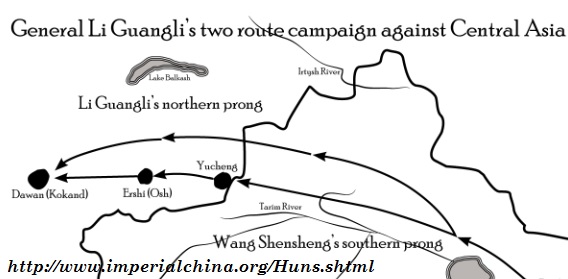 Historical Chinese records point to Kunlun as the source of jade and diamond trade; however, nothing particular beyond Chinese Turkistan was mentioned.
The trade on the Silk Road did not flourish till hundreds of years later. In history, there were at least two paths that could have more important roles than Silk Road 2000 years ago. Certainly, the sea routes also existed between Rome and China, by which the silk had actually been shipped rather than via the more precarious land of conflicting statelets and tribes.
The precarious nature of the Road across deserts could be seen in General Li Guangli's losing 80% of his soldiers when he first campaigned against Dayuan [Dawan] (Kokand?, Fergana Valley) in 104 B.C. (People who claimed nomadic propagation of horse and cavalry to China might propose a northern belt route. Should we read the Chinese records, then we often encountered passages like the barbarians losing 6-7 out of 10 people and cattle during some storms. A good example of the same kind of precarious nature on the steppe could be illustrated in Zhizhi Chanyu's losing the bulk of fighters during the relocation to Kang-ju territory. While Zhizhi Chanyu stationed in the Jiankun territory, Sogdian king intended to attack the Wusun Statelet with the Hunnic assistance. Zhizhi Chanyu arrived in the destination with only 3000 remnants.)
Historical Chinese records point to Kunlun as the source of jade and diamond trade; however, nothing particular beyond Chinese Turkistan was mentioned.
The trade on the Silk Road did not flourish till hundreds of years later. In history, there were at least two paths that could have more important roles than Silk Road 2000 years ago. Certainly, the sea routes also existed between Rome and China, by which the silk had actually been shipped rather than via the more precarious land of conflicting statelets and tribes.
The precarious nature of the Road across deserts could be seen in General Li Guangli's losing 80% of his soldiers when he first campaigned against Dayuan [Dawan] (Kokand?, Fergana Valley) in 104 B.C. (People who claimed nomadic propagation of horse and cavalry to China might propose a northern belt route. Should we read the Chinese records, then we often encountered passages like the barbarians losing 6-7 out of 10 people and cattle during some storms. A good example of the same kind of precarious nature on the steppe could be illustrated in Zhizhi Chanyu's losing the bulk of fighters during the relocation to Kang-ju territory. While Zhizhi Chanyu stationed in the Jiankun territory, Sogdian king intended to attack the Wusun Statelet with the Hunnic assistance. Zhizhi Chanyu arrived in the destination with only 3000 remnants.)
Upon Zhang's return from the west, after a span of 13 years, Emperor Wudi first ordered 4 expeditions to the southwest of China to search for a route to India. This is because Zhang Qian reported that he saw Ju-jiang (some kind of spicy sauce), Zangke (a place in today's Sichuan Province) bamboo products (Qiong-zang) and Sichuan clothing (Shu-bu) which the Bactria merchants said were shipped over from India. Wudi got in touch with the Yelang Statelet and Dian-Yue Statelet, etc.
A gold seal was conferred upon the Dian-yue king.
What the Silk Road Contributed To the World Civilization
Aly Mazaheri, an ethnic Iranian and a French sinologist, in La Route De La Soie (1983), claimed that
China needed only "Fergana stallions" from the rest of the world, while the rest of the world needed everything from China, all facilitated by the Silk Road.
Aly Mazaheri stated that at the time Persian King Sha-na-di-er dispatched last mission to Manchu Qing Emperor Qianlong [reign 1736-1795], British had taken over 75% of the trade between Orient and Occident while Russians had the other 25%.
Silk Road, in Aly Mazaheri's opinions, had lost its role not due to the discovery of sea route, but due to the newly manufactured products that had come to replace the traditional Chinese products shipped over from Silk Road: i.e., synthetic musk replacing Chinese musk; products of industrial revolution replacing Chinese iron cast ovens, iron wok, steel nails, pliers, needles, scissors, iron file, and hammers; Venice tin-coated glass replacing Chinese bronze mirrors; Swedish matches replacing Chinese fire-making sickle that Europe had utilized for 18 centuries; and Russian water-mark paper replacing high quality Chinese paper in 19th century.
Further, Aly Mazaheri pointed out that the Europeans had confusion about the identity of China by stating that Portuguese governor in India dispatched Benoit Goez on an overland trip via silk road to verify that the Khitay was the same as China, which culminated in Benoit Goez's arrival in Suzhou [Gansu Prov] in A.D. 1604.
Han Emperor Wudi's Campaigns Against the Huns
Han emperors Wendi and Jingdi were renowned for their frugality. Their policies as to the Huns would be pacification. Han Emperor Wudi, however, embarked upon a policy of expansion.
Between 130 and 121 B.C., the Chinese armies drove the Huns back across the Great Wall, and weakened the Huns in Gansu Province as well as Inner Mongolia. Famous Chinese generals, like Wei Qing and Li Guang would emerge in this time period.
Five years after the abortive Mayi trap,
at about 129 B.C., the Huns raided into the Chinese territories again.
Han Emperor Wudi dispatched four generals and 40,000 cavalry against the Huns at Huguan Pass Trade Fair.
Wudi dispatched 4 columns of armies against the Huns, with Wei Qing departing from Shanggu (today's Huailai County, Hebei Province), Gongsun Ao from Dai Prefecture (today's Guangling, Shanxi Province and Yuxian County, Hebei Province), Gongsun He from Yunzhong (today's Tuoketuo County, Inner Mongolia), and Li Guang from Yanmen or Yanmenguan Pass (today's Youyue County, Shanxi Province). Only Wei Qing won a small victory by capturing 700 Huns. General Li Guang barely escaped after being captured by the Huns. Li Guang, et al., were demoted for the defeat.
The Huns, in the winter, attacked Yuyang area, near today's Peking.
The next year, the Huns, with 20,000 cavalry, invaded the Manchuria territory and killed Liaoxi tai-shou (i.e., grand governor or grand guardian to the west of Liao River). The Huns then invaded Yuyang, near Beijing, and almost finished the thousand cavalry led by Haan An'guo and retreated when the Han relief army arrived.
The Huns invaded Yanmen next and killed about 1000 people. General Han Anguo was defeated.
Li Guang was called upon again and he was assigned the post of governor of You-Beiping ((rightside to today's Peking, i.e., the name for today's Beijing), a place that belonged to the Ji-zhou territory. Li Guang stayed there for five years before he was recalled to the capital again.
When the Huns raided Beijing area again, Wudi dispatched Wei Qing and 30000 soldiers out of the Yanmen Pass, and sent General Li Xi out of Dai Prefecture. Wei Qing won some small victories again by killing and capturing 1000 Huns.
In 127 B.C., the Huns attacked Shanggu and Yuyang (today's northeastern Beijing, Hebei Province). Wudi ordered Wei Qing and Li Xi on a campaign out of Yunzhong to reach Longxi (today's Weisui and Tiaohe Rivers, Gansu Province).
Wei Qing departed from Yunzhong, defeated two Hunnic kings in Baiyang and Loufan territories, took over the Hunnic land south of the Yellow River, captured and killed thousands of Huns, looted millions of sheep, and campaigned all the way to Longxi of Gansu.
Wei Qing was conferred the title of Marquis Changping. Wudi, in imitation of Qin Shihuangdi, ordered the construction of a castle on the north bank of the north Yellow River Bend, and two commandaries, Wuyuan and Shuofang, were set up. Ban Gu stated that Han Dynasty abandoned two counties in Shanggu (today's Kalgan) to the Huns.
In the following winter, around 126 B.C., Hunnic Junchen Chanyu died, and brother King Zuo-you-li-wang Yi-zi-ye made himself the Hunnic chanyu. Yi-zi-ye defeated the son of Hunnic Junchen Chanyu, and son of Hunnic Junchen Chanyu surrendered to Han.
Around 126 B.C., Hunnic Chanyu Junchen died. Junchen's son (Yudan) was driven off by Junchen's brother, Leftside Guli King, and this would be the Hunnic Chanyu Yizhiye (Yizhicha). Yudan fled to the Han court and was conferred the title of Marquis She'an. Marquis She'an died in a few months.
In the summer, tens of thousands of the Hunnic cavalry invaded the Dai-jun Commandary.
The Huns killed 'tai-shou' [magistrate] Gong You of the Dai Prefecture and captured over thousand people. In the autumn, the Huns attacked the Yanmen [swan gate] Pass and killed over thousand people. The next year, the Huns repeatedly attacked Dai, Dingxiang and Shangjun. The Hunnic Youxianwang (rightside virtuous king) tried to retake the Shuofang Commandary for recovering the lost territories south of the Yellow River. The Hunnic Youxianwang raided Shuofang and south of the Yellow River repeatedly.
In 124 B.C., Wei Qing was conferred the post of Da jiang-jun (Grand General or Generalissimo) for defeating the Hunnic 'rightside virtuous king' and capturing 150,000 Huns.
In spring of 124 B.C., Wudi ordered Wei Qing to lead an army of 100,000 on a campaign against the Hunnic Youxianwang in Gaoque by departing Shuofang. Wei Qing, after trekking over 300 kilometers, captured 15,000 Huns and over 10 chieftains via a surprise attack at night. The Drunken Hunnic Youxianwang escaped.
In the autumn, Huns raided Dai-jun, killed captain Zhu Yang ['du-wei' Zhu Ying?] and captured 1000 Chinese.
The next spring, Wei Qing was conferred the post as 'Da jiang-jun' (namely, the Grand General). Wei Qing commanded 6 generals, and obtained the auxiliary support from General Su Jian, Li Ju, Gongsun He, and Li Cai. Wudi, meantime, ordered General Li Xi to attack the Huns from the east.
Wei Qing was ordered to counter-attack the Huns with command of 6 generals and 100,000 strong army. Wei brought his nephew, Huo Qubing, with him.
Wei Qing departed the Ding-Xiang area, trekked hundred li distance, and captured and killed 19,000 Huns at a cost of losing two Han generals and 3000 cavalry: Zhao Xin (a defector Hunnic chieftain who was conferred the title of marquis) surrendered to the Huns after a defeat in the hands of the Hunnic chanyu's main bulk of army, and Su Jian escaped after a defeat in the hands of the Huns.
Wudi personally stood up to give Wei a toast, and ministers went to the capital's gate to greet Wei's victorious return.
Wei's three babies and his generals were conferred the marquisdom titles; Wei Qing married with a 40 year old widow, Princess Pingyang.
General Zhao Xin surrendered to the Huns. General Huo Qubing, however, had a small victory. Wudi, to enrich the depleted royal savings spent on the campaigns against the Huns, decreed that officialdom could be bought with money.
The Hunnic chanyu was delighted at capturing Zhao Xin, married his sister to him, and built a castle called the 'Zhao Xin Fort' for him. Su Jian escaped during the process of Zhao Xin's surrender to the Huns, while Huo Qubing was able to capture the Hunnic prime minister and an uncle of the Hunnic chanyu. Huo Qubing was conferred the title of Marquis Guanjun-hou [i.e., marquis champion or the general above all]. Meantime, Zhang Qian was conferred the title of Marquis Bowang-hou [i.e., marquis who looked beyond or marquis of broad vision] for his western tour to Central Asia and acting as a guide in the raid into the Hunnic territory. Zhao Xin somehow persuaded Hunnic Chanyu Yizhiye (Yizhicha) into stopping the harassment against Han for some time. The next year, the Huns briefly raided Shanggu and killed over hundred people.
In the spring of the ensuing year, Emperor Wudi ordered expeditions to the Western Corridor. Departing from Longxi (Gansu Province), Huo Qubing, with over 100,000 cavalry, attacked the Huns in and around Yanzhi [Yanqi] Mountains and killed or captured 8000 Huns. Huo killed two Hunnic kings, King Zhelan and King Luhou, captured the prince of Hunnic king Hunye (Kunye), and grabbed the gold statute [which was speculated to be a Buddhist or some religious idol] of King Xiuchu (Xiutu, Xiuzhu). In 121 B.C., Wudi ordered another campaign, with Huo Qubing and Gongsun Ao [marquis heqi-hou] departing from the northern border of Longxi & Beidi, while Li Guang and Zhang Qian departed from the Beijing area of Youbeiping for attacking the Hunnic leftside virtuous king. Huo crossed Juyan Lake area and attacked the Huns in and around the Qilian Mountains, with 30,000 Huns either captured or killed. But Li Guang lost more than half of his 4000 soldiers after being encircled by the Hunnic leftside virtuous king while Zhang Qian was demoted for not sending the relief to Li Guang at the eastern frontier on time.
In the autumn, Hunnic King Hunye (Kunye), for fear of punishment by Hunnic chanyu, killed King Xiuchu (Xiutu, Xiuzhu) and surrendered his 40000 people to Huo Qubing. Wudi relocated the Huns to five prefectures: Longxi, Beidi (today's northern Shenxi Province), Shangjun (today's northeastern Shenxi Province), Shuofang [along the Northern Yellow River Bend], and Yunzhong [along the Northern Yellow River Bend]. Wudi further set up Wuwei and Qiuquan Commandaries in the old territories of King Hunye (Kunye).
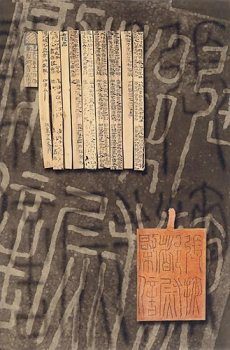 Han Dynasty relocated the poverty-stricken people of the Guan-zhong area to the Hunnic territory of Xin-Qin-zhong (i.e., Newfound-Qin-land), and reduced the garrison to the west of Beidi by half.
According to excavated bamboo strips from the Lake Juyan area, there were still to be found nine Zhaowu clans whom Zhang Qian visited in Central Asia dozen years ago.
The discovery here posed an interesting question about the relative importance of the Juyan Lake area versus the Western Corridor as far as the Yuezhi's original habitat was concerned.
The bamboo strips, i.e., household data from Han Dynasty's newly-established Juyan County, clearly pointed to the fact that the original Yuezhi people, after 80 years or 3-4 generations since the first Hunnic attack against them, still dwelled in large numbers at the Lake Juyan.
This is also the basis that this webmaster gave the Yuezhi the credit of living at the Lake Juyan in the 4th-3rd centuries at http://imperialchina.org/Barbarians.htm.
The credit this webmaster gave was at most the 4th-3rd centuries. Why so? Because Zhou King Muwang's travelogue, which was written about the 4th-3rd centuries or earlier, did not describe anything existing in the Lake Juyan area [both at Zhou King Muwang's era of 1000 B.C.E. and at the date the book was written] other than 1000-li distance of feathers lying around the Da-ze or Lake Juyan. My point was that the Yuezhi, should they come from the west, could not have come to the area earlier than the 4th-3rd centuries.
(Now a question this webmaster liked to pose: Were the original Yuezhi people a Mongoloid group carrying the Zhaowu clan names like 'Shi', 'Kang', and etc.? It is hard to conjure that the Yuezhi would have carried the nine neat Chinese surnames like 'Shi' and 'Kang' etc. in the barbaric west while the Qiangs barely left behind any recorded names similar to the Sinitic surnames. [The Huns did possess the Sinitic-sounding surnames and titles.]
More, could a group of 'Mongoloid' Yuezhi migrants change their physique in a matter of 80 years after their arrival in Central Asia?
Then why did the Chinese records failed to jot down anything on the Yuezhi from before the Hun-Yuezhi War prior to the 200s B.C.E.?)
Han Dynasty relocated the poverty-stricken people of the Guan-zhong area to the Hunnic territory of Xin-Qin-zhong (i.e., Newfound-Qin-land), and reduced the garrison to the west of Beidi by half.
According to excavated bamboo strips from the Lake Juyan area, there were still to be found nine Zhaowu clans whom Zhang Qian visited in Central Asia dozen years ago.
The discovery here posed an interesting question about the relative importance of the Juyan Lake area versus the Western Corridor as far as the Yuezhi's original habitat was concerned.
The bamboo strips, i.e., household data from Han Dynasty's newly-established Juyan County, clearly pointed to the fact that the original Yuezhi people, after 80 years or 3-4 generations since the first Hunnic attack against them, still dwelled in large numbers at the Lake Juyan.
This is also the basis that this webmaster gave the Yuezhi the credit of living at the Lake Juyan in the 4th-3rd centuries at http://imperialchina.org/Barbarians.htm.
The credit this webmaster gave was at most the 4th-3rd centuries. Why so? Because Zhou King Muwang's travelogue, which was written about the 4th-3rd centuries or earlier, did not describe anything existing in the Lake Juyan area [both at Zhou King Muwang's era of 1000 B.C.E. and at the date the book was written] other than 1000-li distance of feathers lying around the Da-ze or Lake Juyan. My point was that the Yuezhi, should they come from the west, could not have come to the area earlier than the 4th-3rd centuries.
(Now a question this webmaster liked to pose: Were the original Yuezhi people a Mongoloid group carrying the Zhaowu clan names like 'Shi', 'Kang', and etc.? It is hard to conjure that the Yuezhi would have carried the nine neat Chinese surnames like 'Shi' and 'Kang' etc. in the barbaric west while the Qiangs barely left behind any recorded names similar to the Sinitic surnames. [The Huns did possess the Sinitic-sounding surnames and titles.]
More, could a group of 'Mongoloid' Yuezhi migrants change their physique in a matter of 80 years after their arrival in Central Asia?
Then why did the Chinese records failed to jot down anything on the Yuezhi from before the Hun-Yuezhi War prior to the 200s B.C.E.?)
The next spring, the Huns raided Youbeiping and Dingxiang with tens of thousands of cavalry and inflicted a casualty of thousands on the Chinese.
As for the Lesser Yuezhi, they were recorded to have the nine clans staying at the Juyan Lake when Huo Qubing defeated the Huns and took over the area in 121 B.C.E.
Some of the Lesser Yuezhi migrated to the area to the west of Dunhuang.
In 88 B.C.E., the Lesser Yuezhi served as a messenger between the Huns and the Qiangs.
In 61 B.C.,
citing the five planets' gathering in the east skies and the Venus' position in the high sky,
the emperor ordered 'po-Qiang jiang-jun' Xin Wuxian's 6100 troops,
'Dunhuang tai-shou' Kuai's 2000 soldiers,
'Changshui jiao-wei' Fu Chang, and
Duke Jiuquan-hou Feng Fengshi to command Nuo-qiang (Ruo-qiang) and Yuezhi troops of 4000 and 'wang-lu' miscellaneous dislodged barbarians of 12000 to attack the Han-qiang (Han-Jian-qiang) with 30 days' supplies, with the troops reaching the Xian-shui River's 'gou-lian' angle-winding area, about 800-li distance from Jiuquan, as well as Zhao Chongguo's army for a pincer-attack from the north and east.
Zhao Chongguo countered the emperor with defeating Xianling-qiang and then pacifying Han-qiang and Teng-qiang without a fight.
By the Eastern Han time period, the Lesser Yuezhi were called by Huangzhong-yuezhi-hu and Yi-cong-hu etc., with dwelling areas in the Huang-shui River of Qinghai and Xiping-Zhangye commandaries on the Western Corridor.
In 101 A.D., the Huangzhong-yuezhi-hu took part in Han army's attack against the Shaodang-qiang.
By the Three Kingdom time period, the Lesser Yuezhi were seen along the southern Taklamakan Desert, and known as Congzi-qiang, Bai-ma (white horse), and Huangniu-qiang (yellow buffalo Qiang) etc.
* In Commemoration of China's Fall under the Alien Conquests in A.D. 1279,
A.D. 1644 & A.D. 1949 *
U.S.S.R./Comintern Alliance with the KMT & CCP (1923-1927)
Korean/Chinese Communists & the 1931 Japanese Invasion of Manchuria
American Involvement in China: Soviet Operation Snow, IPR Conspiracy, Dixie Mission, Stilwell
Incident, O.S.S. Scheme, Coalition Government Crap, Amerasia Case & The China White Paper
* Stay tuned for "Republican China 1911-1955: A Complete Untold History" *
|
|
Zou Rong's Revolutionary Army;
Shin Kyu Sik's
Shrine (Spirit, Kunitama) of Korea
|
This snippet is for sons and daughters of China:
Heed the sons & ministers' agony and sorrow of our ancestors who died or lived through the Mongol, Manchu and Soviet-Chicom conquest
and
the Yongjia, Jingkang and Jiashen cataclysms !
Jeanne d'Arc of China:
Teenager girl Xun Guan breaking out of the Wancheng city to borrow the relief troops in the late Western Jinn dynasty;
Liu-Shao-shi riding into the barbarian army to rescue her husband in the late Western Jinn dynasty;
teenager girl Shen Yunying breaking into Zhang Xianzhong's rebels on the horseback to avenge on father's death in the late Ming dynasty.
China's Solitary and Lone Heroes:
Nan Jiyun breaking out of the Suiyang siege and charging back into the city in the Tang dynasty;
Zhang Gui & Zhang Shun Brothers breaking through the Mongol siege of Xiangyang in the Southern Soong dynasty;
Liu Tiejun breaking through three communist field armies' siege of Kaifeng in the Republican China time period;
Zhang Jian's lone confrontation against the communist army during the June 3rd & 4th Massacre of 1989.
|
|
|
Campaigns Deep Into the Outer Mongolia Territory
In spring of 119 B.C., Wudi ordered another campaign against the Huns who dwelled to the north of Gobi. With 200,000 [100,000 per Ban Gu] cavalry, 100,000 soldiers and auxiliary and logistic horses numbering 140,000, the Han armies attacked the Huns deep into today's Outer Mongolia. Wei Qing departed from Dai, while Huo Qubing departed from Dingxiang for an injunction at "mo bei" [i.e., north of the Gobi]. After one day fierce fighting, the Hunnic chanyu fled with hundreds of cavalry when the Han armies at dusk launched a two prong attacks in the severe winter weather. The Han armies chased all the way to the "Zhao Xin City", capturing or killing 19,000 Huns.
The Hunnic Rightside 'gu-li' King, thinking that his chanyu might have died, assumed the post of chanyu and gave up the post after the return of the real chanyu.
Hu Qubing also fought against the Hunnic leftside virtuous king after travelling 2000 li distance from the Dai area and captured or killed 70,000 Huns. Hu Qubing reached the Langjuxu-shan Mountain and Linhan-hai Lake in Outer Mongolia.
The Linhan-hai Lake could be today's Lake Baikal, along which coast Huo Qubing was surprised to see the inverted Great North (Dagger) Star when looking up at the night skies.
On this occasion, Li Guang committed suicide for his missing the schedule.
With the Huns gone, the Han Dynasty established the 'military farming' from Shuofang to Lingju in the west and assigned 50,000-60,000 soldiers.
The Han Princess Marrying over to the Wusun [at today's Ili]
Zhang Qian told Emperor Wudi that Han should marry over a princess to the Wusun Statelet so that the Huns would lose their support in Western China, a strategy called 'cutting off the right arm of the Huns'. Zhang said that Wusun originally dwelled around Dunhuang, and the areas around the Qilian Mountains, together with Yüeh-chih. But Yueh-chih (Yuezhi) attacked them. The Wusun king's son asked the Huns to help them in defeating the Yüeh-chih. When Yueh-chih (Yuezhi) took over the Scythian land, Wu-sun went on to drive the Yueh-chih (Yuezhi) to Bactria.
In 119 B.C., Zhang was ordered again to go west with hundreds of messengers and emissaries. When those messengers and emissaries returned to the capital, they did a calculation and derived the number of 36 statelets across the west of China.
Zhang Qian's second trip culminated in the inter-marriage between Wusun and the Han Dynasty, with Han Princess Xieyou and Xijun married with the Wusun kings [i.e., "kunmo"] consecutively.
Wudi sent the military expeditions into the Hunnic territories frequently. Historians said he had used up his royal savings in waging the war on the Huns.
Wudi's extravagant lifestyle would also be embodied by his war efforts to retrieve the 'Heavenly Horses' (flying horses) in Central Asia.
The Wusun horses were originally called 'Tian Ma', namely, the Heavenly Horses, but later Emperor Wudi renamed the Wusun horses by 'Xi Ji Ma' or the western-most horses while the Dayuan [Dawan] horses were given the name of 'Tian Ma'.
Han Emperor Wudi Reversing the 'Intermarriage' Policy to Have Huns Send in Hostages
At the persuasion of Zhao Xin, Hunnic Chanyu Yi-zi-ye requested for peace with Han. Emperor Wudi agreed to peace after reflecting on the loss of over 100,000 horses. Wudi sent an emissary, Ren Pi, to the Huns, but Ren Pi was detained by the Huns.
Ban Gu stated that Han stopped attacking the Huns after the death of Huo Qubing.
Both Wei Qing and Huo Qubing's death appeared to be of no fault but could be emperor Wudi's arrangement to rid of the military strongmen.
Years later, Hunnic Chanyu Yi-zi-ye died after being on the throne for 13 years. Son Wu-wei assumed the chanyu throne during the 3rd year of the Yuanding Era, i.e., 114 B.C.E. Han Dynasty was busy fighting two Yue statelets in the south, while the Huns refrained from attacking the border in the north.
Three years after Hunnic Chanyu Wu-wei's enthronement, the Han Dynasty quelled the southern Yue statelets.
Gongsun Ao, with 15,000 cavalry, was dispatched to the north from Jiuquan. After trekking 2,000 li distance, Gongsun Ao failed to locate the Huns. Meanwhile, Zhao Ponu, with 10,000 cavalry, departed from Lingju, and failed to locate the Huns after reaching the Xiongnu-he-shui [Hunnic Water] River.
Emperor Wudi personally descended upon the Shuofang Commandary and received welcome from 180,000 cavalrymen. Wudi dispatched emissary Guo Ji to the Hunnic chanyu for informing about the decapitated head of the Southern Yue King.
Chanyu executed his Hunnic minister who advocated a meeting with Guo Ji and retained Guo Ji as a hostage at Bei-hai-shang [i.e., beyond the Lake Baikal].
Han emissary, Wang Wu, went to see the Hunnic chanyu, blackened his face using the Hunnic customs and persuaded the Hunnic chanyu about sending over a Hunnic prince to the Han court as hostage.
Another Han emissary, Yang Xin, also visited the chanyu.
At this time, the Han Dynasty court had conquered today's northern Korea as well as established the Jiuquan-jun commandary on the silk road for segregating the Qiangs from the Huns.
The Han court had also dispatched emissaries to Yuezhi, Bactria, and Wusun in central Asia. A Han princess was married over to the Wusun king as a means of diffusing the Hunnic support in the west.
Han established two more border garrisons to the north without invoking any complaint from the Huns.
Yang Xin, refusing to put aside the Han court's diplomatic symbol, discussed the 'intermarriage' with the chanyu outside of the tent. Yang Xin insisted that the Huns send in their prince as a hostage before the Han court could renew intermarriage. The Huns and the Chinese did not back down from each other's positions, and the Huns and Chinese often retained the opposite party's emissaries as retaliation.
After Yang Xin returned to the Han court, Wang Wu was dispatched to the Huns again. The Hunnic chanyu claimed that he was eager to go to the Chinese capital for seeing the emperor for sake of receiving the imperial bestowals. The Han court built a residency for chanyu at the capital. However, the Hunnic chanyu merely dispatched a noble to the Han court. When this Hunnic emissary died of illness, the chanyu retained the Han emissary Lu Chongguo on the pretext that the Chinese had murdered the noble. The Huns dispatched cavalry for pillaging the border again. Guo Chang was stationed east of the Shuofang commandary for guarding against the Huns.
In Chinese Turkestan, statelets like Loulan and Cheshi (Jushi/Gushi) often took the order from the Huns in killing the Chinese emissaries.
In 108 BC, General Zhao Ponu, with 700 cavalry, attacked and defeated Loulan.
In 105 B.C., i.e., the 6th year of the Yuanfeng Era, Hunnic Chanyu Wu-wei died. Son Zhan-shi-lu was enthroned.
The Han court dispatched some emissaries for condoling the Huns. However, the Huns retained the Han emissaries.
The Huns and Chinese retained opposite party's emissaries for more than one dozen batches.
General Huo Qubing earlier set up the Qiuquan and Wuwei Commandaries in today's Gansu Province, and later more commandaries were set up, i.e., Zhangye and Dunhuang, under which a Zhaowu county was named after the purported fact that the Yuezhi was said to have nine Zhaowu clans dwelling there before being forced to migrate to the west in the hands of the Huns. For the first time, the Chinese colonized in the non-Chinese territories. Civilians were relocated to guard the posts along with the army troops. After General Li Guangli campaigned against the ancient state of Dayuan [Dawan] (Kokand?, Fergana Valley) in Central Asia, more posts were set up on the Silk Road. From Dunhuang to the Qinghaihu Lake, the 'farming soldiers' were stationed.
(Unlike what some entusiasts claimed, Zhangye was not the soundex for Zhaowu, but an abbbreviation for the statement "cutting off the Hun's arm and extending China's arm tuck, with 'zhang' meaning extending and 'ye' meaning the arm tuck. More, Jiuquan meant for the spring of water that tasted like wine.)
Han Emperor Wudi's Campaigns against Turkistan & Central Asia
When the small statelets, like Gushi and Loulan, harassed the Han emissaries, Emperor Wudi sent General Zhao Puonu on a campaign against the two statelets in 109 B.C. General Zhao caught the King of the Loulan statelet and conquered the Gushi statelet.
When Dayuan [Dawan] (Kokand?, Fergana Valley) refused to trade their horses with Han, and further killed the Han emissary and robbed the gold horse, Emperor Wudi sent General Li Guangli on a campaign against Dayuan [Dawan] in 104 B.C. General Li Guangli's first campaign, with tens of thousands of convicts, failed to capture a city called Yucheng in between, near the Salty Lake or the Salty [Peacock] River. General Li Guangli returned with less than 20% of the forces in about 2 years, but the Emperor Wudi stopped him from coming inside of the Yumen (Jade Gate) Pass. General Li Guangli hence stayed in Dunhuang.
At this time, another Han general, i.e., Zhao Puonu, lost 20,000 men to the Huns. Wudi decided to conquer Dayuan [Dawan] first before concentrating on the Huns. He ordered 60,000 second-class citizens and convicts on a new campaign against Dayuan [Dawan], with the logistical support of 100,000 buffalos and 30,000 horses. After a siege of over 40 days, in 102 B.C., Dayuan [Dawan] (Kokand?, Fergana Valley) killed their king and surrendered to Han. Li Gaungli retrieved a dozen top-class horses and over 3,000 middle-class horses, and returned to China.
At the time Li Gaungli campaigned in Central Asia, the Huns had internal turmoil. When the Huns suffered calamity in husbandry due to a severe cold winter, the Hunnic rightside and leftside 'duwei' [captains] stealthily collaborated with the Chinese in toppling the chanyu. The Han court built a "surrender castle" for the Hunnic captains to use. The Chinese forces, about 20000 cavalry headed by Zhao Puonu, departed for the joint military actions. The chanyu found out about the plot and killed the Hunnic captains. Zhao Puonu caught a few thousand Huns. Before Zhao Puonu returned to the "surrender castle", 80,000 Hunnic cavalry surrounded him. Zhao Puonu was caught by the Huns when seeking water outside of the camp at night. The Hunnic chanyu then lay siege of the "surrender castle", withdrew from the siege after failure to sack it, and pillaged the border.
The next year, during the 3rd year reign, the Hunnic chanyu died while on the way of personally leading an attack at the "surrender castle" again.
Hunnic rightside virtuous king Ju-li-hu, i.e., Zhan-shi-lu's uncle and Wu-wei's brother, assumed the throne as chanyu in 102 B.C., i.e., the 3rd year of the Taichu Era.
New Hunnic Chanyu Calling Himself a Nephew
To counter the Huns, Xu Ziwei built castles along the road of about hundred li distance beyond the Wuyuan-sai [five plains] garrison; Han Sui and Wei Kang acted as the auxiliary support; and Lu Bode built a citadel at the Lake Juyan-ze. (At one time during the Tang Dynasty, Lake Juyan, where the E-ji-na River flew to, still possessed 300 square kilometers in size.)
In 101 B.C., the Han Dynasty established military farming in today's Luntai & Quli and assigned an official entitled the "emissarial colonel" ["i.e., shi-zhe jiao-wei"] there.
In the autumn, the Huns raided the Yunzhong, Dingxiang, Wuyuan and Shuofang commandaries and killed few thousand Han people. The Hunnic rightside virtuous king raided Jiuquan and Zhangye to the west and captured few thousand people. Hearing that General Li Guangli was returning from Central Asia, the Huns planned for an ambush on the road but changed mind later. The Hunnic chanyu, with a reign of less than one year, died of illness in the winter. A brother, i.e., the rightside grand duwei [captain], assumed the chanyu post.
In 101 B.C., Han Emperor Wudi proposed a general attack at the Huns for avenging on the first Han emperor's defeat in the hands of the Huns as well as first Han empress's humiliation of being asked for marriage with Modu [Modok].
After succeeding Xu-li-hu Chanyu, the new Hunnic chanyu, Qie-di-hou for appeasing the Chinese, in 100 B.C. released all emissaries and hostages who refused to surrender to the Huns, including Lu Chongguo. The chanyu pretended to be humble by calling himself a nephew. However, once Su Wu brought to the Huns a huge amount of money and wealth, the Hunnic chanyu became arrogant again.
The next year, Zhao Puonu fled back to the Han court from the Hunnic captivity.
Han Emissary Su Wu Being A Shepherd For 19 Years & Li Ling Surrendering to The Huns
Frictions with the Huns continued. A Han emissary, Su Wu, was detained and sent to Lake Bajkal to be a shepherd for 19 years.
The Su Wu story was like this:
In 100 B.C., Emperor Wudi sent a mission of over 100 people, led by Su Wu, to the Huns. Su Wu was detained by the Huns, and sent to Bei-Hai [North Sea, i.e., Lake Baykal]. Su Wu had returned after Huo Guang (General Ho Chu-ping's brother) requested for Su with the Hunnic king who had initially cheated Huo in saying that Su was long dead. A Hunnic insider informed the Han emissary of Su Wu's exile. The Han emperor made up a story of catching a bird with a message tied to the leg stating that Su Wu was at Lake Bajkal.
In the initial years, the chanyu's brother, King Yu-qian-wang, when hunting near the northern lake area, often dropped by to render some aid to Su Wu.
Wudi decided to dispatch an army to punish the Huns for the Hunnic meddling in the affairs of Cheshi (Jushi/Gushi) in today's Chinese Turkistan.
The next year, 99 B.C. or the second year of the Tianhan Era, in the autumn, Wudi dispatched Li Guangli and 30,000 cavalry against the Huns from the Jiuquan area. At Tianshan [heavenly mountain], Li Guangli at one time captured or killed 10,000 Huns. However, in a later war, Li Guangli barely escaped from the encirclement by the Huns, with a loss of 6-7 out of 10 soldiers. Two more generals were sent to fighting the Huns, with Li Ling volunteering to go on a northern expedition with 5000 archers.
Li Ling, who was ordered to welcome Li Guangli's return from the 102 B.C. campaign, was initially ordered to provide logistics for Li Guangli to the west for the 99 B.C. campaign; however, Li Ling volunteered to take the fight against the Huns to the north without cavalry.
Veteran General Lu Bode, who had conquered northern and central Vietnam, was ordered to assist Li Ling.
However, Lu Bode, who was not willing to act as an assistant to Li Ling, wrote to the emperor to defer the auxiliary military action.
One contingent of 5000 Jing-chu archers (arrow soldiers) from Jiuquan and Zhangye, who were from the former Chu Principality territory, led by "qi duwei" [cavalry captain] Li Ling (grandson of Li Guang), departed from the Juyan Lake [i.e., Lake E-ji-na or Lake Khara Khoto] in September for a mission to go to the Shoujiang-cheng [accepting the Hunnic surrender] fort.
To the north of the Juyan Lake, after travelling for 30 days to have arrived at the upper Longle-shui River to the south of east Mt. Junji-shan, Li Ling encountered the Huns numbering 30,000 and was encircled by the Huns.
Li Ling attacked and defeated the Huns and charged onto a hill. The Hunnic chanyu, being shocked by a small Chinese force, called over more than 80,000 cavalrymen.
For 4-5 days, the Han army retreated along the old Longcheng [dragon city] path towards the southeast, passing the reeds and forests area.
The Huns, who were thinking about abandonment of the siege for fearing a possible inducement into a trap, received a tip from a defector called Guan Gan about the Chinese archers' exhaustion of arrows and no sight of reinforcement, and renewed the siege.
Li Ling continued to withdraw to the south, and before reaching Mt. Dihan-shan, had used up 500,000 arrows within a day.
At night, Li Ling, with deputy Haan Yannian and the 3000 remnants, broke out for the south, with an order to re-assemble at Zheluzhang [repel the barbarian fort].
The Huns chased Li Ling without let-up. Haan Yannian (son of Haan Qianqiu) was killed in the battle.
General Li Ling surrendered to the Huns after engaging half a dozen rounds of retreating fights, inflicting a casualty of 10,000 onto the Huns and exhausting all the arrows. Only 400 soldiers escaped back to the Chinese territory which was over 100 leagues away.
Later, during the 97 B.C. campaign to the north, the Emperor sent Gongsun Ao to the Hunnic territory for retrieving Li Ling. However, Gongsun Ao reported back a rumor about Li Ling's training the Huns.
The emperor ordered Li Ling's family to be exterminated.
Li Ling, saying that it was another defector general Li Xu who was training the Huns, killed Li Xu, over which the Hunnic queen was mad and wanted to kill Li Ling. The Hunnic chanyu sent Li Ling to the north for asylum till the queen passed away.
The Hunnic chanyu married his daughter to Li Ling and assigned him the title of King You-xian-wang, on the same par with another defector minister Wei Lü (i.e., King Dingling-wang).
Li Ling, with the death of his family families in the hands of Han court, joined the Huns in counter-attacking the Han army in 91 B.C. Li Ling was later assigned as the "rightside virtuous king" to the ancient Jiankun Statelet where his descendants claimed to the Tang emperors as sharing the same last name as the Kirghiz. Li Ling's son assisted one Hunnic rivalry chanyu, i.e., Wuji Chanyu, during the internal power struggles against Huhanye (Huhancha) Chanyu.
(In Abakan, Khakassia, Russia, namely, part of the Minusinsk Depression, at the confluence of the Yenisei and Abakan Rivers, there was discovery in 1940 of ruins of a Chinese-style building that was speculated to be the palace of Li Ling's Jiankun fief.)
After Li Ling surrendered to the Huns in 99 B.C., the Hunnic chanyu sent Li Ling to visiting Su Wu in the attempt at persuading the Han emissary to surrender.
At the time Han Emperor Wudi died, Li Ling visited Su Wu with the news that the border area Chinese, near Yuzhong, all worn the white mourning clothes, saying the emperor had died. Su Wu, at the news, cried for several months, with blood vomited.
(Su Wu had returned after Huo Guang (General Ho Chu-ping's brother) requested for Su with the Hunnic king who had initially cheated Huo in saying that Su was long dead. A Hunnic insider, i.e., Chang Hui [who was Su Wu's deputy], informed the Han emissary of Su Wu's exile and whereabouts, and helped to concoct a story stating that the Han emperor, when hunting at the Shangling-yuan hunting ground, shot down a bird with a message tied to the leg stating that Su Wu was at Beihai (i.e., today's Lake Bajkal).
Huo Guang was noted for dispatching Fu Jiezhi [of possibly Yiqu-rong background] to Loulan to assassinate the Loulan king, An-gui, in 77 B.C.E. Before that, General Zhao Ponu in 108 B.C.E. attacked Loulan with 700 cavalry and killed the Loulan king.
Li Ling, who declined to return to China, wrote a poem to express his anguish: "lu [roadpath] qiongjue [ending] xi [modal] shiren [arrows and blades] cui [destroyed], shizhong [troops] mie [died] xie [modal] ming [fame] yi [already] tui [ruined].")
Li Guangli & the Huns
Two years later, General Li Guangli, with his 70,000 troops & 60000 cavalry, departed Shuofang; Lu Bode converged with Li Guangli with another 10000. Haan Sui departed from Wuyuan with 30000 troops; and Gongsun Ao commanded 10000 cavalry and 30000 infantry from Yanmen-guan Pass. Hunnic chanyu relocated his people and belongings to the north of Yuwu-shui River, while preparing 100000 army against the Han expedition forces south of the river. Li Guangli fought against the Huns for over ten days. Han armies withdrew thereafter without any result.
The next year, the Hunnic chanyu died after a reign of five years. Senior son, i.e., the Hunnic leftside righteous king, became Hunnic Chanyu Hulugu in 96 B.C.
Hunnic Chanyu Hulugu, who originally tried to yield the throne to his brother Zuo-da-jiang [leftside grand general], died few years later. Under the previous promise, brother Zuo-da-jiang assumed the post while the son of Hulugu was renamed "sun chasing king".
The Huns raided Shanggu & Wuyuan and killed people in the border area. The next year, about 90 B.C., the Huns raided Wuyuan & Jiuquan and killed captains in two places. Li Guangli was dispatched against the Huns.
In 90 B.C., General Li Guangli and his 70,000 troops departed from Wuyuan, while Shang Qiucheng led 30,000 for exiting Xihe and Mang Tong led a 40,000-men cavalry for exiting Jiuquan.
The Hunnic chanyu again relocated his belongings to the north of "Zhao Xin City", near a river called Zhiju-shui River, while the Hunnic leftside virtuous king drove his people 600-700 li distance away from Yuwu-shui River.
General Shang Qiucheng returned after locating no Huns. The Huns then dispatched their generals and 30,000 cavalry, together with defector general Li Ling, against the Chinese, and followed the Chinese army to Junji-shan Mountain where they fought a battle for nine days. After the Han army inflicted heavy casualty on the Huns, the Huns retreated at Punu-shui River.
In the west, Mang Tong met with 20,000 Hunnic cavalry headed by the Hunnic rightside grand duwei [captain] and Wei Lü. The Huns withdrew after seeing Mang Tong leading 40,000 cavalry. Han Dynasty, meantime, dispatched troops against Cheshi (Jushi/Gushi) in Chinese Turkistan for preventing them from a collusion with the Huns. The Chinese troops captured the king and the people of Cheshi.
At this time, General Li Guangli encountered 5000 cavalry led by the Hunnic rightside grand duwei [captain] and Wei Lü, defeated the Huns, and chased the Huns to Fan-fu-ren [Madam Fan] Castle.
Hearing that his wife was implicated in a palace upheaval, General Li Guangli intended to intrude deeper into the Hun territory to make a big feat so as to avoid punishment upon return to the capital.
Li Guangli, whose wife was arrested by the emperor for involvement in the 'wugu' [poisonous {bugs} magic witchcraft] incident and the conspiracy to substitute a crown prince, hastily launched a battle against the Huns at the frontier upon learning of the upheaval at the nation's capital, and after a defeat, surrendered to the Huns.
Subordinates were wary of Li Guangli's mentality and conspired to sell out to the Huns. General Li Guangli arrived in Zhiju-shui River.
With 20,000 cavalry, Li Guangli crossed the river. On one day, Li Guangli met with the Hunnic leftside virtuous king and leftside grand general [Zuo-da-jiang], and fought the 20,000 Hunnic cavalry for a whole day. The Han army killed the Hunnic
leftside grand general.
When a subordinate officer intended to kill Li Guangli for surrendering to the Huns, Li Guangli retreated to Yanran-shan Mountain where 50,000 Hunnic cavalry ambushed Li Guangli, dug a ditch in the front at night, attacked Li Guangli's camp from behind, and defeated the Han army by pushing the Han army into the ditch.
Li Guangli himself surrendered to the Huns. Chanyu married his daughter to Li Guangli and made him above Wei Lü in the ranks. Li Guangli was killed one year later [about 89 BC?] by the Huns after Wei Lü [another Han defector] vilified him for envying the favor that Li Guangli received from the Hunnic chanyu.
Chanyu then wrote to the Han emperor, stating: "The Han Chinese to the south and the 'Hu' people to the north ... the so-called "Hu" meant the 'privileged son of the Heaven' ... I [chanyu] want to renew the intermarriage with the Han princess ..." (Note the Huns corresponded with the Chinese in the Chinese pictographic languages since the barbarians had no written language at all.)
When the Han emissary arrived at the Hunnic court, the chanyu rebuked Han Dynasty for a Han prince's rebellion against the Han emperor as a violation of Confucian "Li-Yi" [courtesy & righteousness]. The Han emissary countered it by stating that Chanyu Modu (Mote) even engaged in patricide while the Han prince's rebellion was merely an argument between father and son due to instigation by prime minister. The Han emissary was hence retained by the Huns for three years.
Han Emperor Zhaodi [reign 86-74 BC]
Three years after Li Guangli's capture, i.e., in 87 B.C., Han Emperor Wudi passed away. After a fighting for over twenty years, the Hunnic chanyu, hurt by the Han army's penetrations, wanted peace with Han Dynasty badly.
Another three years later, chanyu decided upon intermarriage but died shortly afterward. Before the death of chanyu, the mother of the Hunnic chanyu killed a virtuous half brother of the chanyu, i.e., "zuo-da-wei" [leftside grand captain]. The elder brother of "zuo-da-wei", who shared the same mother as "zuo-da-wei", refused to see chanyu. Wei Lü and the mother of Hunnic chanyu, in 85 B.C., hid the news of the death of chanyu and erected the son of chanyu as the new chanyu against the Hunnic chanyu's death-bed wish.
The Hunnic leftside virtuous king and rightside gu-li king, unhappy over the enthronement of the new chanyu, conspired to defect to the Han court. The two kings further coerced King Lu-tu [Lu-zhu?] in a conspiracy to gain the support of Wusun [Ili] for attacking chanyu together. King Lu-tu [Lu-zhu?] disclosed the scheme to chanyu. However, the two kings accused King Lu-tu [Lu-zhu?] of rebellion against chanyu.
Two years later, in the autumn, the Huns invaded the Dai prefecture and killed a Han captain. The new chanyu thought about Wei Lü's scheme of building castles and hoarding grains for sake of defence against a possible Han attack.
Chanyu also thought about using Su Wu and Ma Hong as two Han emissaries for relaying some good-will gestures in 82 B.C.
Li Ling was asked to see Su Wu by the Hunnic chanyu. Li told Su that Su's wife had already remarried and Su's two brothers had died in China. But Su Wu refused to surrender. Li gave a Hun woman to Su as his wife. When Su returned to China, he had only eight of his previous companions with him.
The next year, Huns, with about 20,000 cavalry from the leftside and rightside tribes, pillaged the border in four columns. The Han army defeated them, captured and killed 9000 Huns, and caught alive Hunnic King Ou-tuo-wang. The Hunnic chanyu, worried about King Ou-tuo-wang's possible leading the path on behalf of the Han army for an attack, relocated far away towards the northwest.
After the death of Wei Lü, the brother of Hunnic chanyu continued to advocate for intermarriage with the Han court. After the death of the brother of the Hunnic chanyu, the Hunnic chanyu planned an invasion of Jiuquan and Zhangye on the Sild Road. However, the Han army was informed of the invasion beforehand and thoroughly defeated the three Hunnic columns with the armies from Zhangye "tai-shou" [magistrate] and the auxiliary troops from the military farming areas. Captain Guo Zhong, who commanded the auxiliary troops, was promoted to Marquis Cheng'an-hou, and "qian-zhang" [thousand household]. King Yiqu-wang was offered 200 Chinese grams of gold and 200 horses for killing a Hunnic king.
At the times of Han Emperor Zhaodi, military farming was conducted in the Luntai & Quli areas.
In Chinese Turkestan, the new Loulan king also allied with the Huns.
The Qiuci king attacked the Chinese farming station of Luntai and killed farming general Lai Dan.
To punish Loulan, Fu Jiezi was sent to assassinating the Loulan king, An-gui, during a reception when visiting the Loulan kingdom.
The Huns versus the Wuhuan
One more year later, 3000 Hunnic cavalry invaded the Wuyuan [five plains] area and killed few thousand Chinese.
Tens of thousands of the Huns followed through by attacking the borderside castles.
Ban Gu stated that the Chinese beacon fires were so advanced that the Huns no longer reaped the lootings easily.
At this time, the Han court heard from some Hunnic defectors that the Huns had dispatched an army of 20,000 cavalry against the Wuhuan in the east to punish the Wuhuan people for digging up the tombs of the Hunnic chanyu.
General Huo Guang consulted with Zhao Chongguo as to ambushing the Huns. Fan Mingyou, against Zhao Chongguo, supported the idea of attacking the Huns by taking advantage of the Hun-Wuhuan entangles.
Fan Mingyou, who was conferred the post as "du-liao" [trespassing the Liao-he River area] General, led an army of 20,000 cavalry against the Huns. The Huns retreated upon the news of the Han army closing in. Without catching up with the Huns, Fan Mingyou hence attacked the fatigued Wuhuan, killed 3 kings, and captured or killed 6,000 Wuhuan. Fan Mingyou was conferred Marquis Pingling-hou.
The Huns then changed target to attack Wusun in the west and invaded the Cheyan & Wushi areas. The Huns tried to pressure Wusun into surrendering the princess. The Wusun Princess [i.e., a Chinese princess] petitioned for help with the Han court. Before the Han court could decree on a military action, Han Emperor Zhaodi [reign 86-74 BC] passed away. Han Emperor Xuandi [reign 73-49 BC] enthroned.
At the times of Han Emperor Zhaodi, military farming was conducted in the Luntai & Quli areas. In Chinese Turkestan, the new Loulan king also allied with the Huns. The Qiuci king attacked the Chinese farming station of Luntai and killed farming general Lai Dan. To punish Loulan, Fu Jiezi (?-65 B.C.) was sent to assassinating the Loulan king, An-gui, during a reception when visiting the Loulan kingdom. Huo Guang was noted for dispatching Fu Jiezhi [of possibly the Yiqu-rong background] to Loulan to assassinate the Loulan king, An-gui, in 77 B.C.E., for which Fu Jiezhi received the conferral as Marquis Yiyang-hou. (Before that, General Zhao Ponu in 108 B.C.E. attacked Loulan with 700 cavalry and killed the Loulan king.)
* In Commemoration of China's Fall under the Alien Conquests in A.D. 1279,
A.D. 1644 & A.D. 1949 *
U.S.S.R./Comintern Alliance with the KMT & CCP (1923-1927)
Korean/Chinese Communists & the 1931 Japanese Invasion of Manchuria
American Involvement in China: Soviet Operation Snow, IPR Conspiracy, Dixie Mission, Stilwell
Incident, O.S.S. Scheme, Coalition Government Crap, Amerasia Case & The China White Paper
* Stay tuned for "Republican China 1911-1955: A Complete Untold History" *
|
|
Zou Rong's Revolutionary Army;
Shin Kyu Sik's
Shrine (Spirit, Kunitama) of Korea
|
This snippet is for sons and daughters of China:
Heed the sons & ministers' agony and sorrow of our ancestors who died or lived through the Mongol, Manchu and Soviet-Chicom conquest
and
the Yongjia, Jingkang and Jiashen cataclysms !
Jeanne d'Arc of China:
Teenager girl Xun Guan breaking out of the Wancheng city to borrow the relief troops in the late Western Jinn dynasty;
Liu-Shao-shi riding into the barbarian army to rescue her husband in the late Western Jinn dynasty;
teenager girl Shen Yunying breaking into Zhang Xianzhong's rebels on the horseback to avenge on father's death in the late Ming dynasty.
China's Solitary and Lone Heroes:
Nan Jiyun breaking out of the Suiyang siege and charging back into the city in the Tang dynasty;
Zhang Gui & Zhang Shun Brothers breaking through the Mongol siege of Xiangyang in the Southern Soong dynasty;
Liu Tiejun breaking through three communist field armies' siege of Kaifeng in the Republican China time period;
Zhang Jian's lone confrontation against the communist army during the June 3rd & 4th Massacre of 1989.
|
|
|
Emperor Xuandi & the Wusun Ally
In 73 B.C., Huo Guang proposed to return the regency to the emperor. Phoenixes were seen in Jiaodong-jun and Qianshen-jun commandaries on the Shandong peninsula. During the reign, the Han army in 72 B.C. allied with Wusun against the Huns. Five generals, Tian Guangming, Zhao Chongguo, Tian Shun, Fan Mingyou and Haan Zeng, altogether an army of 150,000, including cavalry and chariots, followed Chang Hui on the expedition to the northwest.
When Wusun "kun-mi" [i.e., king] proposed to mount a joint attack at the Huns with half of the nation's troops and 50000 horses, Han Emperor Xuandi, in 72 B.C., mobilized a huge army against the Huns: Tian Guangming, being conferred Qilian General, was to depart Xi-he [the Zungar Banner of Inner Mongolia] with 40000 cavalry; Fan Mingyou, i.e., General Du-liao [crossing the Liao River of Manchuria], was to depart Zhangye with 30000 cavalry; Haan Zeng was to depart Yunzhong with 30000 cavalry; Zhao Chongguo, being conferred Pulei [Sarighkol] General, was to depart Jiuquan with 30000 cavalry; and Tian Shun, i.e., Yunzhong "tai-shou" [magistrate], being conferred Huya [tiger teeth] General, was to depart Wuyuan with 30000 cavalry.
In the west, "jiao-wei" [i.e., colonel] Chang Hui commanded the troops of Wusun and other allies in the western territories, including the Wusun King and totaling 50000 cavalry.
The Huns, hearing of the campaign, fled with children, elderly and stocks. The Han armies failed to locate any significant Huns. Fan Mingyou, at Puli-shui River, about 1200 li distance away from border garrison, captured or killed 700 Huns. Han Zeng captured or killed about 100 Huns after trekking 1200 li distance. Zhang Chongguo, having failed to catch up with the conversion with Wusun troops at Pulei-ze Lake, would capture or kill 300 Huns, including Hunnic King Puyin-wang [i.e., an emissary of chanyu], after a trek of 1800 li distance. Tian Guangming, after a trek of 1600 li distance, captured or killed about 19 Huns at Jiyi-shan Mountain. Tian Shun, after a trek of 80000 li distance, captured or killed about 19 Huns at Danyu-shui River. Both Tian Guangming and Tian Shun were ordered by Han emperor to commit suicide for dereliction later.
In contrast, the western prong scored major victory against the Huns.
In 71 B.C., Chang Hui, commanding the Wusun army, defeated the Huns.
In the west, at about 71 B.C., Chang Hui and the Wusun troops sacked the Hunnic court of the rightside gu-li king, caught chanyu's father and sister-in-law and numerous kings, captured or killed 39000 Huns, and looted 700000 stocks like horses, sheep, buffalos, mules and camels etc.
Chang Hui was upgraded to Marquis Changluo-hou.
Chang Hui was subsequently sent to Wusun again, and En route of return, attacked Qiuci which previously killed Han emissary Lai Dan.
Chang Hui thereafter mobilized 50000 army from the Western Territories in campaigning against Qiuci for its killing of Lai Dan, a Chinese general in charge of farming soldiers at Wu-lei [Luntai] six years earlier. (At the times of Han Emperor Zhaodi, military farming was first conducted in Luntai & Quli areas.)
The new Qiuci king had to surrender a minister by the name of Gu-yi for execution.
The Huns hence hated Wusun a lot. In the winter, chanyu personally commanded a retaliation force against the Wusun and caught some elderly and sick people. On the way home, the Huns lost 9 out 10 people in a severe winter storm.
Taking advantage of the Hunnic decline, the Dingling statelet in Siberia attacked the Huns from the north, the Wuhuan attacked the Huns from east, and the Wusun attacked from the west. Tens of thousands of Huns died. Starvation would cost the Huns a loss of 3 out 10 people, and the Hunnic cattle lost half in number.
Further, Hunnic subordinates disintegrated from the alliance.
When the Han army intruded into the Hun territory with 3000 cavalry, the Han army easily caught a few thousand Huns. Border hence became more serene than ever.
In 68 B.C., the Hunnic chanyu passed away, and brother "leftside virtuous king" assumed the throne as Chanyu Xulüquanqu.
When Han abandoned the border garrisons, the new chanyu sent in emissary for intermarriage. However, the "leftside grand juqu" [i.e., the father of a deposed queen of former chanyu] conspired to send in cavalry against Han after the footsteps of the Hunnic emissary in a claim of using the old Han Chinese trick. Three Hunnic emissaries promptly notified Han of the Hunnic scheme and the Huns hence aborted their pillage.
In this year, the Huns suffered another famine and lost 6-7 out of 10 cattle. In the autumn, a Hunnic tribe, after entangles with King Outuo, surrendered to Han.
Replacing Chang Hui as protector-general in the Western Territories would be Zheng Ji [?-49 BC].
The next year, i.e., 68 B.C., troops from the Western Territories under the command of Zheng Ji attacked Cheshi (Jushi/Gushi), i.e., a Hunnic ally. Cheshi, i.e., today's Ji-mu-sa-e of New Dominion Province, was situated on the linkage point between Han Dynasty and Wusun, north of Tianshan Mountain. Cheshi King Wu-gui, having married a Hunnic princess, often ambushed the Chinese emissaries. Zheng Ji assembled 1500 farming soldiers and about 10000 auxiliary troops for a campaign against Cheshi and caught the king. Chanyu retrieved the remnant Cheshi people and made a brother of the former Cheshi king into the new king. The Han court sent in new farming soldiers to the Cheshi land.
The old Cheshi king sought asylum in Wusun.
Military farming, which was restricted to Wulei [Luntai] & Quli areas at the times of Han Emperor Zhaodi, was expanded to Cheshi & Loulan area.
Still one more year later, the Huns dispatched the leftside and rightside grand generals against farming soldiers in the Cheshi land as well as against the Wusun statelet.
Two years later, the Huns attacked Cheshi farming garrison again in vain.
Zheng Ji, in face of Hunnic attacks, rescinded the Cheshi military farming and moved across Tianshan [Heavenly] Mountain to merge with Qu-li's farming garrison.
The Han court relocated the Cheshi people to Jiao-he River [Yar-khoto] area [i.e., Turpan], which was then termed the Frontal Cheshi Statelet.
Next year, Dingling harassed the Huns again. One year later, Huns aborted an attack at Han after a Hunnic noble surrendered to Han and chanyu caught the illness of blood vomiting. Chanyu died in 60 B.C., after a reign of nine years, before his king was sent to Han court for peace talk.
In 65 B.C., Feng Fengshi, en route of trip to Dawan (Fergana), attacked Shache which previously killed Han emissary Xi Chongguo. In 63 B.C., phoenixes were seen on Mt. Taishan. In this year, the Qiangic tribes made an alliance. Lang-he, a chieftain from the Yuezhi Minor, i.e., Marquis Qiang-hou, attempted to borrow the troops from the Huns and planned to sever the Han dynasty's trade route at Shanshan and Dunhuang. In 61 B.C., Yiqu Anguo cheated over thirty Qiangic chieftains to a meeting and killed them all, which led to the Qiangic rebellion. Yiqu Anguo retreated to Lingju. Zhao Chongguo and Xu Yanshou were dispatched to quelling the Qiangic rebellion. In 60 B.C., the Han army quelled the Western Qiangic land and set up the Jincheng fort.
In 60 B.C., the farming garrison was revoked after the success in quelling the Qiangic rebellion and executing Xian-ling chieftain Yang Yi (Marquis Guiyi-qiang-hou). Zhao Chongguo (137-52 B.C.), after death in 52 B.C., had his portrait listed among eleven meritorious ministers at the Qi-lin-ge Palace.
The Protector-General Office For Western Territories
By the time of Emperor Xuandi (reign 73-48 B.C.), south of Tianshan Mountains was under Han Chinese control. A Hunnic king called 'Ri-zhu-wang' (king of sun chasing) offended Hunnic chanyu , and hence he defected to Han China, yielding to Chinese the original Hunnic control of northern part of Chinese Turkistan. By 62 B.C., north of Tianshan Mountains was firmly controlled by Chinese as well. Colonization went as far as the ancient state of Shache [Yarkand]. This post was responsible for reporting on the situations in such states as Kangju (Sogdiana) and Wusun (Ili).
In 60 B.C., the Han court established the Xi-yu [western territories] Duhu-fu [pacifying] office at Wulei to take charge of the countries as far as today's Central Asia. The Hunnic sun-chasing king came to surrender. Zheng Ji, commanding 50,000 troops from the Quli and Qiuci states, escorted Hunnic sun-chasing king (Xian-xian-dan) and his several tens of thousands of followers to Chang'an, with those going astray killed en route. Zheng Ji was conferred the title of Marquis Anyuan-hou. The Huns began the intermarriage peace process afterwards.
By 60 B.C., Emperor Xuandi established the Office of 'Xi Yu Protector-General' (Xi Yu meaning 'Western Region' or 'Western Territories') to supervise the "36 states" north and south of the Tianshan Mountains.
Zheng Ji's protector-general office, located at Wulei, was in charge of farming soldiers as well as the 36 statelets.
The protector-general office was put in charge of military farming, officialdom & vassal conferral and validations, supervision of Qiangic people, communication & transportation, beacon tower ['feng sui'] maintenance, and certainly commerce and trade.
Han Shu claimed that about 376 persons, ranging from citadel chief, hundred person chief, thousand person chief, duwei, danghu, general, prime minister, marquis to king, had been conferred Han court's officialdom seals [gold seals vs violet seals] and silk thread for seals. Han court also dispatched representatives to kings and county magistrates as either military officials or civil service officials, which were validated by excavations from Wulei ruins in Luntai county. Also excavated in Khoten would be local coins with Han Chinese characters on the face and Central Asian marks on the back.
Continuing with Zheng Ji, over 18 Chinese had been assigned the post of protector-general, with the seal of last protector-general Li Chong excavated from Shaya-xian county of Qiuci [Kuqa] recently. Among the protector-generals, from Han Emperor Xuandi's reign to Xin Dynasty, would be Zheng Ji, Han Xuan, Gan Yanshou (from the Yuzhi land of Yiqu-rong and of possibly Yiqu-rong background), Duan Huizong, Lian Bao, Han Li, Guo Shun, Du Jian, Dan Qin, and Li Chong, et al.
Wu-sun "kun-mi" [i.e., king] Weng-gui-mi proposed to have his crown prince marry with a Chinese princess.
Xiao Wangzhi objected to the idea. Though, Emperor Xuandi in 60 B.C. ordered Marquis Changluo-hou (Chang Hui) to escort the princess to the west. Before exiting the border pass, the Wusun king died, and a nephew made himself a king.
Chang Hui, leaving the princess at Dunhuang, personally travelled to Wusun to reprimand the Wusun nephew and made the crown prince a king. Then, Chang Hui returned to retrieve the princess. However, Xiao Wangzhi refuted the idea, saying that this time, the princess might make a pretext not to go to Wusun as the Wusun rulers would not treat the Han dynasty good as during the 40-year time period when the former Han princess was with the Wusun.
Xiao Wangzhi refuted the idea, saying that this time, the princess might make a pretext not to go to Wusun as the Wusun rulers would not treat the Han dynasty good as they did in the past 40 years. Ni-mi took over Xieyou and born a son. Later, Xieyou colluded with the Han emissaries in an abortive assassination against Ni-mi, for which the two emissaries were ordered to be executed by the emperor. When Ni-mi's son laid a siege of Chigu-cheng for months, Zheng Ji rescued the princess. Wujiutu, i.e., Wenggui-mi's son born with a Hun prince, killed Ni-mi but refused to support Yuan'gui-mi as king. With Madam Feng Liao's mediation, Xin Wuxian, taking 15,000 troops to Dunhuang, forced the Wusun nobles into a compromise in making Yuan'gui-mi a major king and Wujiutu a minor king. Xin Wuxian, a Didao native, was listed with son Xin Qingji by Han Shu among the great Qin-Han generals of the 'west' origin.
The Hunnic Internal Turmoil
The Hunnic internal turmoil once led to the existence of five 'chanyu'.
Xulüquanqu Chanyu, who released Han emissary Su Wu, died in 60 B.C.
Woyanjutu Chanyu (reign 60-58 B.C.), by the name of Tuqitang/Tu-qi-tang, succeeded Xulüquanqu Chanyu.
The Hunnic nobles rebelled against Woyanjutu Chanyu.
There were Tuqi Chanyu (reign 58-56 B.C.), Hujie Chanyu (reign 57 B.C.), Cheli Chanyu (reign 57-56 B.C.), Wuji Chanyu (reign 57 B.C.), Lunzhen Chanyu (reign 56-54 BC; successor of Wuji Chanyu), Zhizhi Chanyu and Yilimu Chanyu (reign 49 B.C.) competing against each other concurrently and successively.
Nine years earlier, queen zhuan-qu, after being discarded out of favor, went into adultery with the rightside virtuous king. At the time of death of chanyu, the rightside virtuous king did not heed the queen's call and went to the 'dragon city'. When chanyu died, Hunnic king Xing-wei-yang tried to assemble kings in vain. Queen zhuan-qu and her brother conspired to erect Tu-qi-tang [Zhu-qi-tang?, the rightside virtuous king] as the new chanyu.
The new chanyu killed away the ministers of the former chanyu, including King Xing-wei-yang and utilized queen zhuan-qu's brother as a top minister. The son of former Chanyu Xu-lu-quan-qu fled to the land of his father-in-law Wu-chan-mu, i.e., a small statelet between Wusun and Kangju. Hunnic 'Rizhuwang' [i.e., sun chasing king], whose sister was married to Wu-chan-mu, would lead several tens of thousands of cavalry for a defection to the Han court. Hunnic 'Rizhuwang' [Xian-xian-dan ? or Xian-xian-shan] was conferred the title of Gui-de-hou [i.e., Marquis Returning Gratitude].
The new chanyu then made his own brother the new Hunnic 'Rizhuwang'.
With the Hunnic 'Rizhuwang' defecting to the Chinese, the Hunnic governor post of "tongpu duwei" automatically revoked itself in Chinese Turkistan.
On the Chinese side, the post of "shizhe [emissary] xiaowei (jiaowei) [colonel]" was renamed "wuji xiaowei (jiaowei)" in charge of military farming at Gaochang [i.e., Turpan, Karakhoja].
The defection of 'Rizhuwang' had to do with Hunnic Youxianwang (rightside virtuous king) taking over the power with the help of ex-queen. 'Rizhuwang' was the brother (?) of the dead Hunnic chanyu. 'Rizhuwang' sent an emissary to Han protector-general at Quli, Zheng Ji, for help. In 60 B.C.E. approximately, Zheng Ji sent an army of 50,000 and escorted 'Rizhuwang' to the Han capital, i.e., Chang'an.
When new chanyu killed two more brothers of defector Hunnic 'Rizhuwang' Xian-xian-dan, Wu-chan-mu admonished the chanyu in vain. After a Hunnic king died, the new chanyu [i.e., Hunnic emperor] instituted his own son instead of selecting a descendant of the dead king, which caused an eastward relocation of the tribe of this Hunnic king.
The new chanyu led 10,000 cavalry in a chase of the relocating tribe but he was defeated.
The new chanyu also antagonized another prominent noble, i.e., "zuo-di-gui-ren" [leftside land's noble man]. (Note the Huns had extensively adopted the Chinese characters and Chinese titles in the royal rankings, which was to alternatively show that the Hunnic nobles, if not the Hunnic people, were indeed related to the Sinitic Xia Chinese -even though the Huns, after raiding to the west, had acquired the non-Mongoloid physique.)
One year later, Wuhuan attacked the Huns in the east, and Hunnic King Gu-xi-wang was worried about chanyu's rebuking his defeat in the hands of Wuhuan.
Hunnic King Gu-xi-wang colluded with Wu-chan-mu and "zuo-di-gui-ren" in supporting
the son of the former Hunnic chanyu for setting up an independent court and calling himself 'Huhanye (Huhancha) Chanyu' (often wrongly pronounced as Huhanxie Chanyu).
About 40000-50000 people in leftside land assembled to oppose the new chanyu at north of Gu-qie-shui River. After a brother ["rightside virtuous king"] refused to lend support to the new chanyu, new chanyu committed suicide in 58 B.C., after a reign of three years.
Leftside grand juqu, i.e., Du-rong-qi, led his people to the service of 'Huhanye (Huhancha) Chanyu'.
After the death of the usurping Hunnic chanyu, three more Hunnic leaders proclaimed themselves 'chanyu', leading to co-existence of five 'chanyu'.
'Huhanye (Huhancha) Chanyu' attempted to kill rightside virtuous king.
In the winter, Leftside grand juqu, i.e., Du-rong-qi, colluded with rightside virtuous king in erecting "sun chasing king" [Bo-xu-tang] as Tu-qi [Zhu-qi] Chanyu. Tu-qi [Zhu-qi] Chanyu dispatched tens of thousands of troops eastward against 'Huhanye (Huhancha) Chanyu'. After defeating 'Huhanye (Huhancha) Chanyu', Tu-qi [Zhu-qi] Chanyu made his two sons into rightside and leftside gu-li kings.
In the autumn of the following year, Tu-qi [Zhu-qi] Chanyu dispatched a brother of Xian-xian-dan, Hunnic "duwei" [captain] Wu-ji and 20,000 cavalry against 'Huhanye (Huhancha) Chanyu'.
In the west, Hunnic King Hu-jie-wang colluded with a Hunnic "danghu" in bad-mouthing the rightside virtuous king. Tu-qi [Zhu-qi] Chanyu fell into the trap and killed the rightside virtuous king. Hunnic King Hu-jie-wang, being worried about his safety, fled away to be Hu-jie Chanyu.
The brother of Xian-xian-dan declared himself Chen-li Chanyu.
Hunnic "duwei" [captain] Wu-ji declared himself Wu-ji Chanyu.
Tu-qi [Zhu-qi] Chanyu dispatched Du-rong-qi against Wu-ji Chanyu, while he himself attacked Chen-li Chanyu. Chen-li Chanyu and Wu-ji Chanyu fled to the northwest and hence combined with Hu-jie Chanyu into 40,000 strong forces.
Tu-qi [Zhu-qi] Chanyu, leaving 40,000 cavalry against Hu-han-ye Chanyu in the east, campaigned against Chen-li Chanyu with another 40,000 cavalry. Chen-li Chanyu fled to northwest.
The next year, Hu-han-ye Chanyu sent a brother against
Tu-qi [Zhu-qi] Chanyu and inflicted a casualty of 10,000 onto Tu-qi [Zhu-qi] Chanyu.
Tu-qi [Zhu-qi] Chanyu personally led 60,000 cavalry for 1000 li distance campaign against Hu-han-ye Chanyu.
After a defeat, Tu-qi [Zhu-qi] Chanyu committed suicide. The son of Tu-qi [Zhu-qi] Chanyu, together with Du-rong-qi, fled to seek asylum with the Han court.
Chen-li Chanyu surrendered to Hu-han-ye Chanyu.
Tens of thousands of people under Hu-han-ye Chanyu's "leftside grand general" also sought suzerainty with the Chinese.
At this time, the son of defector Han general Li Ling erected Wu-ji Chanyu.
Hu-han-ye Chanyu campaigned against Wu-ji Chanyu and killed him.
During the Wufeng Era (57-54 B.C.), there was suggestion to attack the Huns by taking advantage of the Hunnic turmoil.
Emperor Xuandi inquired with Haan Zeng ('da sima' and 'cheji jiang-jun'), Zhang Yanshou (Marquis Fuping-hou), Yang Yun ('guang lu xun') and Dai Changle ('taipu'). Xiao Wangzhi, citing the Jinn general Fan-xuan-zi's calling off the campaign against the Qi state at the time of the Qi state mourning, suggested a condolence mission.
Hence, Emperor Xuandi assisted Huhanye (Huhancha) Chanyu in stabilizing the Hunnic country instead of attacking the Huns.
Huhanye (Huhancha) Chanyu's Seeking Suzerainty With the Chinese
Soon, the younger and elder brothers of Hu-han-ye Chanyu rebelled. Younger brother of Hu-han-ye Chanyu, i.e., King Xiu-xun-wang, declared himself Run-zhen Chanyu in the west, while elder brother of Hu-han-ye Chanyu, i.e., the rightside virtuous king, declared himself Zhi-zhi Gu-du-hou Chanyu in the east.
Two years later, Run-zhen Chanyu attacked Zhi-zhi Gu-du-hou Chanyu. Zhi-zhi Gu-du-hou Chanyu killed Run-zhen Chanyu and then combined forces against Hu-han-ye Chanyu.
Zhi-zhi Gu-du-hou Chanyu defeated Hu-han-ye Chanyu and obtained the Hunnic central court in today's Outer Mongolia.
Hence, in 53 B.C., 'Huhanye (Huhancha) Chanyu', against the objections of most ministers, dispatched his son [the rightside virtuous king] to the Han Chinese court as a hostage and sought suzerainty by moving his people southward.
Around 53 B.C., hearing that 'Huhanye (Huhancha) Chanyu' obtained the support of the Han Chinese, the last competing 'chanyu', Zhizhi, sent his son [the rightside grand general] to the Han Court as a hostage as well.
In 52 B.C., 'Huhanye (Huhancha) Chanyu' arrived in Wuyuan Garrison and went on to see Han Emperor Xuandi in Ganquan-gong Palace in January of 51 B.C. 'Huhanye (Huhancha) Chanyu' and his entourage received a grand welcome at the capital, with various Han ministers and vassals giving reception at Weiqiao Bridge. 'Huhanye (Huhancha) Chanyu' stayed at Chang'an for one month. Han Emperor dispatched Dong Zhong & Haan Chang and 16,000 cavalry as an escort to see Hu-han-ye departing the fort of Jilu-zhai [chicken and deer garrison] of Shuofang [northern domain] Commandary.
Zhizhi Chanyu dispatched emissary to the Han court as well.
The next year, two chanyu respectively dispatched emissaries to the Han court.
One more year later, 'Huhanye (Huhancha) Chanyu' came to the Han court again, and received bestowals of 110 leather clothes, 9000 units of silk, and 8000 grams of cotton. No escort was dispatched for seeing him off.
The Hunnic Split of 51 B.C.E. & Zhizhi Chanyu's Campaigning To The West
Woyanjutu Chanyu (reign 60-58 B.C.), by the name of Tuqitang, succeeded Xulüquanqu Chanyu who had three sons: Zhizhi, Huhaye and a son who was the rightside guli king.
For Woyanjutu Chanyu's cruelty, the Hunnic kings and marquis rebelled against him.
There were Tuqi Chanyu (reign 58-56 B.C.), Hujie Chanyu (reign 57 B.C.), Cheli Chanyu (reign 57-56 B.C.), Wuji Chanyu (reign 57 B.C.), Lunzhen Chanyu (reign 56-54 BC; successor of Wuji Chanyu), Zhizhi Chanyu and Yilimu Chanyu (reign 49 B.C.) competing against each other concurrently and successively.
Zhizhi raided to the west. At this time, a brother of former Tu-qi [Zhu-qi] Chanyu defected away from Huhanye (Huhancha) Chanyu for the west and declared himself Yilimu Chanyu. Zhizhi Chanyu killed Yilimu Chanyu, and with a combined force of 50,000, stayed in the west upon hearing the news that the Han court might assist Huhanye (Huhancha) Chanyu in fighting him.
For countering the Han court and Huhanye (Huhancha), Zhizhi sent an emissary to Wusun "Xiao-kunmi" [lesser king] Wujiutu for an alliance. However, Wusun killed Zhizhi's emissary and delivered the head to Han's protector-general office. More, Wusun dispatched 8,000 cavalry against Zhizhi but got defeated by Zhizhi.
Zhizhi further defeated Wujie in the north and Jiankun in the west. Further in the north, Zhizhi defeated the Dingling statelet. With combined forces from three statelets, Zhizhi then attacked Wusun several times. Zhizhi made Jiankun (i.e., later Kirghiz territory or today's Tuva land) the locality of his capital. Ban Gu's Han Shu claimed that Jiankun was located 7000 li distance to the west of the main chanyu court in Mongolia and 5000 li distance to the north of Cheshi (Jushi/Gushi) in Chinese Turkistan.
At about 48 B.C., i.e., the year Han Emperor Yuandi [r 48-32 BC] got enthroned, 'Huhanye (Huhancha) Chanyu' wrote to the Chinese court about his economic hardship.
Yuandi decreed that Yunzhong & Wuyuan commanderies transport 20,000 units of grains to the Huns.
At this time, Zhizhi Chanyu requested with the Han court for releasing his son.
The Han court ordered Gu Ji escort the prince to Zhizhi. However, Zhizhi Chanyu killed Gu Ji without a reason.
Zhizhi, being afraid of Han for his killing the Han emissary, relocated to the west, namely, the ancient Jiankun Statelet. This relocation also had to do with the request from the Kangju (Sogdiana) king.
Western history books said that the Hunnic empire split into two hordes in 51 B.C., with the Eastern Horde subject to China. Reading through records on the Huns, this webmaster could only point to the event of relocation to the Jiankun Statelet by 'Zhizhi Chanyu' for an explanation. 'Zhizhi Chanyu' descendants, namely, the Kirghiz, would stage a comeback in the 9th century and replaced the Huihe (Uygurs) around 840s A.D. So to say, this group of Huns might not be counted as the ancestors of the Western Huns headed by Attila.
During Yuandi's reign, the official "wuji xiaowei (jiaowei)" was put in charge of military farming at Cheshi (Jushi/Gushi).
Western Han Dynasty's "wuji xiaowei (jiaowei)" would turn into Eastern Han Dynasty's "yihe duwei" at the times of Eastern Han Emperor Mingdi [reign 58-75 AD].
At about 47 B.C., the Han court returned Huhanye (Huhancha)'s son by ordering that Haan Chang & Zhang Meng escorted the prince back to the Hun territory.
Haan Chang & Zhang Meng inquired with Huhanye (Huhancha) Chanyu as to the rumor that Zhizhi Chanyu might have killed emissary Gu Ji.
Hearing that the Southern Huns talked about a return to the north of Gobi, Haan Chang & Zhang Meng, on their own initiative, made a swear with Huhanye (Huhancha) Chanyu in the attempt of retaining the Huns for better management. Haan Chang & Zhang Meng climbed Mt Dongshan at Ruo-shui River with Huhanye (Huhancha) Chanyu and drank the blood-dripped wine via the Yuezhi king's skull which was used as a drinking utensil.
The swear claimed that the Han Chinese and Xiongnu [Huns] promise to be of same family forever.
A white horse was killed for the ceremony.
Upon the return of Haan Chang & Zhang Meng, Han court ministers rebuked the two guys for making a 'perpetual' alliance without consulting with the emperor. The Han emperor ordered that the swear be released but the alliance be kept. Later, Huhanye (Huhancha) Chanyu returned to the north of the desert, i.e., "Mo-bei", where there was no longer threat from contender Zhizhi Chanyu.
While Zhizhi Chanyu stationed in the Jiankun territory, the Kangju (Sogdian) king intended to attack the Wusun Statelet with the Hunnic assistance.
Kangju (Sogdian) king sent an emissary to Zhizhi, with a gift of several thousands of camels and horses.
On the way to Kangju (Sogdiana), Zhizhi Chanyu lost quite some people due to the cold weather. About 3,000 remnants arrived in the Kangju territory for the alliance.
Zhizhi built a castle by the Talas River (i.e., Dulai-shui), called by the 'zhizhi-cheng' fort. In 36 B.C., the Han army attacked the Huns to the west of the Pamirs. In this year, Chen Tang tacked on the deputy 'jiao-wei' post for the 'xiyu duhu fu' office.
Governor-general Gan Yanshou answered the call from Wusun and sent 6 columns of armies to defeat Kangju (Sogdiana) and 'Zhizhi Chanyu'.
Governor-general Gan Yanshou answered the call from Wusun and sent 6 columns of armies, about 40,000 troops, to defeat Kangju (Sogdiana) and 'Zhizhi Chanyu'. It was said that Chen Tang forced Gan Yanshou into launching the attack. Chen Tang, after death, received the compliment as Marquis 'po-hu zhuang-hou' from usurper emperor Wang Mang.
Zhizhi's descendants would later call themselves the Kirghiz, a mutation in the pronunciation of 'Zhizhi'.
After the death of Zhizhi, Huhanye (Huhancha) Chanyu was both happy and worried. Previously, Huhanye (Huhancha) wrote to the Han court that he did not visit Han emperor frequently because he was worried that Zhizhi might attack him.
In 33 B.C., 'Huhanye (Huhancha) Chanyu', came to the Han capital and was married with lady Wang Zhaojun, a court maid of honor. Altogether five Chinese women were given to the Hunnic king. Wang Zhaojun volunteered for the mission.
(Lady Zhaojun,
like many princesses and maids of honor married with the Huns or other nomadic kings
before and after her, would later re-marry with the successor Hunnic King,
a practice adopted by the barbarians throughout history.) Peace ensued for
dozens of years.
Wang born a son with Huhanye (Huhancha) Chanyu, and after the death of Huhanye (Huhancha), was married with Fuzhulei Chanyu (Diao-tao-mo-gao), an elder stepson, with whom Wang born two more daughters.)
named
Huhanye (Huhancha) Chanyu, after the marriage with Wang Zhaojun, wrote to the Han court, expressing the wish to guard the borderline from Shanggu to Dunhuang in lieu of Han Dynasty's border garrisons and beacon towers.
A court minister, Hou Ying, objected to the abandonment of garrisons by citing the past history. Hou Ying emphasized that the Hunnic chieftains often claimed that the Huns often cried whenever passing through Mt Yinshan area, a historical belt that was a good hunting and grazing ground due to the abundance of animals and the grass/trees.
Hou Ying also mentioned that border garrisons and beacon towers had played the role of preventing the disobedient Chinese from slipping across the border for engaging in the banditry.
Hence, emperor wrote to Huhanye (Huhancha) about the need to retain border garrisons for guarding against the banditry. Huhanye (Huhancha) replied to express understanding of the great idea.
Lady Wang Zhaojun, titled 'ning [pacifying] hu [Huns] yanzhi [queen]', had born son Yituzhiyasi who was made into the rightside sun chasing king.
Huhanye (Huhancha) Chanyu died in the second year of Emperor Chengdi's Jianshi Era, i.e., 31 B.C., after a reign of 28 years.
Huhanye (Huhancha) Chanyu died in the second year of Emperor Chengdi's Jianshi Era, i.e., 31 B.C., after a reign of 28 years, with son Fuzhulei-ruodi Chanyu succeeding the throne.
Fuzhulei-ruodi Chanyu, with 'ruodi' meaning the Chinese equivalent posthumous title of 'xiao' or filial, was succeeded by brother Qiu-mi-xu (i.e., Souxie-ruodi Chanyu).
Souxie-ruodi Chanyu died in 12 B.C. while en route to the Chinese capital city for congratulating Han Emperor Chengdi's enthronement, and was succeeded by brother [Luandi-]Moche, namely Cheya[-ruodi] Chanyu.
Cheya[-ruodi] Chanyu was succeeded by brother Rangzhiyasi, namely, Wuzhuliu-ruodi Chanyu.
Wusun, which split into two states of Kunmi Minor and Kunmi Major, had turmoil. Kunmi Major Yuan'gui-mi passed the throne to son Xing-mi, a weak ruler under the Han or Madam Feng Liao's control while Kunmi Minor Wujiutu passed the throne to son Fuli who was killed by brother Rier. Duan Huizong supported Fuli's son, i.e., Anri, as the king. After Xing-mi died and stepgrandson Cili-mi took over the throne, Madam Feng Liao returned to China with her three grandchildren. During the Yangshuo Era (24-21 B.C.), Duan Huizong tacked on the protector-general's post again. Duan Huizong received Kunmi Minor King Anri in Qiuci [as a result of the nobles' hostility to Han] but mishandled a Kangju prince's surrender. In 17 B.C., "Kunmi Minor" King Anri was killed by the locals. Duan Huizong made Mozhenjiang, i.e., Fuli's another son, a king. One year later, the "Kunmi Major" king (Cilimi) was killed by Mozhenjiang who was Anri's brother. Duan Huizong made Yizhimi into a king. Yizhimi killed Mozhenjiang. During the Yuanyan Era (12-9 B.C.), Duan Huizong, with 30 archers, killed Fan-qiu, i.e., Mozhenjiang's son, as punishment for killing a Wusun king with the Han royal blood. In 11 B.C., Anlimi, i.e., Anri's son, became the Kunmi Minor king. When Mozhenjiang's brother Bei-yuan rebelled, Duan Huizong and Sun Jian were sent to the west. Bei-yuan fled to Kangju. At the turn of the B.C.-A.D. eras, protecter-general Sun Jian quelled Bei-yuan's rebellion.
* In Commemoration of China's Fall under the Alien Conquests in A.D. 1279,
A.D. 1644 & A.D. 1949 *
U.S.S.R./Comintern Alliance with the KMT & CCP (1923-1927)
Korean/Chinese Communists & the 1931 Japanese Invasion of Manchuria
American Involvement in China: Soviet Operation Snow, IPR Conspiracy, Dixie Mission, Stilwell
Incident, O.S.S. Scheme, Coalition Government Crap, Amerasia Case & The China White Paper
* Stay tuned for "Republican China 1911-1955: A Complete Untold History" *
|
|
Zou Rong's Revolutionary Army;
Shin Kyu Sik's
Shrine (Spirit, Kunitama) of Korea
|
This snippet is for sons and daughters of China:
Heed the sons & ministers' agony and sorrow of our ancestors who died or lived through the Mongol, Manchu and Soviet-Chicom conquest
and
the Yongjia, Jingkang and Jiashen cataclysms !
Jeanne d'Arc of China:
Teenager girl Xun Guan breaking out of the Wancheng city to borrow the relief troops in the late Western Jinn dynasty;
Liu-Shao-shi riding into the barbarian army to rescue her husband in the late Western Jinn dynasty;
teenager girl Shen Yunying breaking into Zhang Xianzhong's rebels on the horseback to avenge on father's death in the late Ming dynasty.
China's Solitary and Lone Heroes:
Nan Jiyun breaking out of the Suiyang siege and charging back into the city in the Tang dynasty;
Zhang Gui & Zhang Shun Brothers breaking through the Mongol siege of Xiangyang in the Southern Soong dynasty;
Liu Tiejun breaking through three communist field armies' siege of Kaifeng in the Republican China time period;
Zhang Jian's lone confrontation against the communist army during the June 3rd & 4th Massacre of 1989.
|
|
|
The Xin Dynasty [9-23 AD]
At one time, two daughters of Lady Wang Zhaojun were invited by Wang Mang to visit the Han court, and the Hunnic king promptly sent over one of Lady Wang's daughters to the Han Court. This girl stayed in the Han court for one whole year. After Wang Mang usurped the Han Dynasty, and named his dynasty Xin, namely, new, he would re-cast the seals bearing his new dynastic names and sent those seals to the Hunnic kings in exchange for the old seals conferred by Han Emperors. Later, the Huns found out about the trick and rebelled against Wang Mang's Xin Dynasty.
Wang Mang failed to quell the Hunnic rebellion. He called upon the two sons of a brother of Lady Wang Zhaojun and sent them to the Huns frequently as 'ambassadors of friendship'. The two sons of Lady Wang Zhaojun's brother's would often contact the husband of an elder daughter of Lady Wang Zhaojun to broker peace.
Wang Mang, to sow dissent against Wuzhuliu-ruodi Chanyu, invited a Hunnic brother with the given name 'xian', a son of Huhanye (Huhancha) Chanyu, to the Chinese border area of Yunzhong and made him Wulei-ruodi Chanyu in A.D. 11.
Wulei-ruodi Chanyu fled to the Hunnic territory where he was supported by Lady Wang Zhaojun's son-in-law 'you-gudu-hou' Xubu Dang as the Hunnic chanyu when Wuzhuliu-ruodi Chanyu died in A.D. 13.
Wang Mang, however, continued his tricks and he at one time placed into custody the Hunnic husband of an elder daughter of Lady Wang Zhaojun as a hostage, intending to support him as the new Hunnic king.
Xubu Juci, i.e., Wang Zhaojun's daughter, visited Xihe-sai to see uncle-in-law Wang She4 (Wang Xi) to broker peace with China.
Xubu Dang was conferred the title of Duke Houan-gong by Emperor Wang Mang, and later was induced to travel to the border area where he was supported as Xubu Chanyu in competition against the Hunnic chanyu.
Wulei-ruodi Chanyu was succeeded by Huduershi-ruodi Chanyu in A.D. 18.
The Huns sent a delegation to the Xin dynasty, headed by 'da juqu' She1 (son of Xubu Dang) and Hunnic king Xidu-wang (son of Dangyu Juci, a junior daughter of Lady Wang Zhaojun).
Wang Mang schemed to support 'da juqu' She1 as the new Hunnic king, which aborted when the Xin dynasty was overthrown by the Lulin and Chimei rebellion.
During Wang Mang's reign, the Hun-Han relationship was the worst. The subsequent turmoil and rebellion which overthrew Xin Dynasty would allow the Huns to re-take control of parts of Chinese Turkistan.
(Xubu Juci, by the name of Yun, and Xubu Dang, were both killed when the rebels sacked the capital city and overthrew the Xin dynasty.)
It would be in A.D. 73 that Eastern Han Dynasty dispatched major campaigns against the Huns. General Dou Xian and Geng Zhong defeated the Huns in and beyond Jiuquan on the Silk Road, further defeated Hunnic King Huyan-wang to the north of Tianshan Mountain, and took over Yiwu [Hami] and established the post of "yihe duwei" [i.e., farming captain].
As an offshoot of the campaign, in A.D. 73 [the 16th year of Mingdi's Yongping Era], Ban Chao was dispatched along the southern side of Tianshan Mountain for recovering the Chinese control over the Western Territories.
The Huns & the Latter Han Dynasty
In A.D. 48, the Hunnic Empire dissolved due to internal fights. The Hunnic internal turmoil had very much to do with the killing of Lady Wang Zhaojun's son by a Hunnic kinsman. The Huns adopted a rule of passing on the kingdom to brothers, but one brother of the Huns refused to acknowledge Wang Zhaojun's son as a legal heir.
In A.D. 73 (?), Han Dynasty sent a huge expedition against the Huns. Ban Gu (General Ban Chao's brother) wrote an extolling article and had it inscribed on a stone monument in today's Outer Mongolia. After a period of passive dealings with the Huns, Eastern Han Dynasty (A.D. 25-220) adopted the policies of its predecessor, namely, cutting off the right arm of the Huns, namely, the territories of today's Western China. It recovered the lost territories, driving the Huns back into the Altai Mountains and the steppes north of the Gobi.
General Dou Xian and Geng Zhong defeated the Huns in and beyond Jiuquan on the Silk Road, further defeated Hunnic King Huyan-wang to the north of Tianshan Mountain, and took over Yiwu [Hami, i.e., ancient Komul] and established the post of "yihe duwei" [i.e., farming captain].
As an offshoot of the campaign, Ban Chao was dispatched along the southern side of Tianshan Mountain for recovering Chinese control over the Western Territories.
Bao Chao utilized diplomacy and the Han Dynasty's prestige in subjugating the Hunnic vassals such as Shanshan [Pichang], Yutian [Khoten], and Shule etc.
At the times of Eastern Han Emperor Mingdi [reign 58-75 AD], Eastern Han Dynasty's "yihe duwei", on basis of Western Han Dynasty's "wuji xiaowei (jiaowei)", was put in charge of military farming. Also stationed in Chinese Turkistan would be "xiyu [western territories] zhangshi [senior minister]" who was under the supervision of Dunhuang "tai-shou" [i.e., prefecture governor]. In 1959, a seal bearing "si [manage] he [rice paddy] fu [office] yin [seal]" was excavated in Ni-ya of Minfeng-xian county. Chinese archaeology had revealed ruins of military farming in such counties as Luntai, Shaya, Ruoqiang and Luo-bu-po [i.e., Lake Koko Nor], with traces of barns, canals, flood gates, castles, wells, metallurgy sites, potteries, woks, iron spades, wind blowers, low banks and ridges between fields, coins, wooden inscription plates, and mail relay stations. Scholar Huang Wenbi stated that military farming was controlled by two offices of Ganchang [Khocho] to the left and Gumo to the right. Hou Han Shu mentioned that a grand general was in charge of five military farming units which were subdivided into the "qu" units of left and right.
Aside from the military farming, two more forms were employed, i.e., the convict farming and the civilian farming.
Records from the Juyan Lake military farming pointed to family members co-living with soldiers on site. Ruoqiang, Shanshan, Qiemo and Qiuci, with iron ore and metallurgy, had produced iron sickles, iron saws, and iron ploughs.
Han Shu mentioned that as many as 600,000 horses were raised by Han China in northwestern territories at one time.
At the times of Eastern Han Emperor Mingdi [reign 58-75 A.D.], Eastern Han Dynasty's "yihe duwei", on basis of the Western Han dynasty's "wuji xiaowei", was put in charge of military farming. Also stationed in Chinese Turkistan would be "xiyu [western territories] zhangshi [senior minister]" who was under the supervision of the Dunhuang "tai-shou" [i.e., prefecture governor].
In 1959, a seal bearing "si [manage] he [rice paddy] fu [office] yin [seal]" was excavated in Ni-ya of the Minfeng-xian County.
After a period of passive dealings with the Huns, the Eastern Han dynasty (A.D. 25-220) adopted the policies of its predecessor, namely, cutting off the right arm of the Huns, namely, the territories of today's Western China, and recovered the lost territories, driving the Huns back into the Altai Mountains and the steppes north of the Gobi. In A.D. 73, during Han Emperor Mingdi's 15th year of the Yongping Era, Geng Bing was ordered to attack the Huns. Four routes of the Han army attacked the Huns, with Dou Gu and Geng Zhong's route and Geng Bing and Qin Peng's route scoring major victories. In A.D. 74, Geng Bing and Dou Gu, with 14,000 cavalry, defeated the Northern Huns at Cheshi (Jushi) and pacified Cheshi King Ande. The Eastern Han dynasty renewed the Western Han practice, appointing Chen Mu as 'du-hu' (protector-general) for the Western Territories, Geng Gong as 'wu xiaowei' ('wu' colonel) and Guan Pang as 'ji xiaowei' ('ji' colonel). In early A.D. 75, the Hunnic 'zuo luli-wang' king led a 20,000 strong army counterattack, killed Cheshi (Jushi) King Ande and routed a 300-men Han relief army send by Geng Gong. Geng Gong, using the poisonous arrows, repelled the Hunnic siege of the Jinpu-cheng fort. Months later, Geng Gong, in preparation for the Hunnic attacks, relocated to the Shule fort by the side of a mountain. The Huns came to lay a siege of Shule. Geng Gong, having recruited thousands of locals as 'xian-deng' (climbing first) commandos, charged at and defeated the Hunnic cavalry. The Huns cut off the mountain stream. Geng Gong ordered to dig a well as deep as 15 'zhang' (yards). The Huns, seeing the water splashed by the Han army, abandoned the siege. One month later, Han Emperor Mingdi passed away. Months later, the Yanqi and Qiuci states defected to the Huns again, and killed Protector-general Chen Mu. The Huns laid a siege of Guan Pang at the Liuzhong-cheng fort. Guan Pang sent an urgent message to the Han court. The new Cheshi (Jushi) king defected to the Huns and combined troops to attack Geng Gong. Geng Gong, with several dozen troops left, still persisted, and cooked the bows as food. The Huns sent an emissary to pacify Geng Gong with offer of a title as King Baiwu-wang (white house). Geng Gong tricked to kill the emissary. Geng Gong sent Fan Qiang to Dunhuang for requesting the winter clothes. At the Han court, minister ('sikong') Di4 Wulun proposed abandoning the western territories, and Bao Yu ('situ') advocated for rescuing the garrison troops, with a claim that otherwise nobody would fight the Huns should the Huns invade China. Emperor Zhangdi ordered Geng Bing ('zheng-xi [campaigning west] jiang-jun') to command Qin Peng, Wang Meng, Huangfu Yuan, and 7000 troops for recusing the Liuzhong-fort, including troops under the Jiuquan and Dunhuang magistrates. Guan Pang died in battle at Liuzhong. The relief army, after repelling the Huns, decided to return home. At Fan Qiang's insistence, Wang Meng allocated 2000 troops for Fan Qiang to guide on a trek through the snowy Bogeda mountain road to Shule. Among Geng Gong's army, only twenty-six people survived the war. The next year, the troops retreated back to China, with the Huns tracing behind. By the time Geng Gong arrived in China, he had only 13 men left. Geng Gong received the emperor's conferral as 'qi du-wei' (cavalry captain).
The Hunnic Split of A.D. 89
In 85, the Xianbei attacked the Huns.
In 88, the Xianbei attacked the Huns, killing Chanyu Youliu.
Around A.D. 89, General Dou Xian, under the order of his empress sister, led a huge army comprising of soldiers from Beijing Area and the Southern Hun allies, had a decisive battle over the Northern Huns at Jiluoshan Mountains.
In 89, Geng Bing, Dou Xian and Deng Hong, together with an allied army of 30,000 Southern Huns, departed Shuofang-jun to attack the Northern Huns.
The Han army chased the Huns deep into the northwest territories, defeated 81 Hunnic tribes, and captured over 200 thousand Huns. History of the Northern Dynasties recorded that the chanyu of Northern Huns fled westward to the ancient Kang-chu Statelet, while the remaining weak and elderly Huns relocated to the north of the Qiuci (Chouci) Statelet. In the west, the descendants of those Huns would set up a country called Nie-Ban [Yue-ban] (a word that was used for Nirvana), in the ancient Kang-chu or Kang-ju territories which was to the northwest of the ancient Wusun Statelet.
The Han army chased the Huns deep into the northwestern territories, to Yanran-shan [Hang'ai, Hangayn, Khangai] Mountain in today's Outer Mongolia, defeated 81 Hunnic tribes, and captured over 200 thousand Huns.
History of the Northern Dynasties recorded that Chanyu of the Northern Huns fled westward to the ancient Kang-chu Statelet,
while the remaining weak and elderly Huns relocated to the north of the Chouci [Qiuci] Statelet in today's Chinese Turkestan.
In spring 90, another campaign was launched against the Northern Huns with the assistance of the Southern Huns. The joint army killed 8000 Huns.
In A.D. 91, General Dou Xian mounted another deadly campaign against the Northern Huns. Geng Kui defeated and expelled chanyu of the Northern Huns at Mount Jinwei-shan (? the Altaic Mountain). The Northern Huns hence began a migration that would lead to the chain reaction to the West. Scholar Luo Xianglin stated that the Huns split into two groups: the Ye-da [White Huns] posing threat to the Sassanian Dynasty to the northeast of today's Iran, and the western offshoot moving to south of the Ural Mountain.
Luo Xianglin further stated that the Western Huns, under Balamir, relocated towards Europe in A.D. 372 due to a famine, conquering the Eastern Goths and driving away the Western Goths. Balamir, after conquering the territories north of the Danube, received the tributes from the Roman emperor. Balamir's son would be Attila who, with 700,000 strong army, campaigned against East Roman Empire in A.D. 447 and attacked Western Roman Empire in A.D. 450.
Bribery to the Barbarians
The remnant Northern Huns selected a brother of chanyu, rightside Guli king Yu-chu-jian, as the new leader.
With the Northern Huns' chanyu disappearing with no trace, a brother, rightside luli-wang king, by the name of Yuchujian (Yu-chu-jian), was made into the new chanyu at Pulei-hai. Yuan An and Ren Kui, claiming the three Han emperors' practice of supporting the Southern Huns, objected to sanctioning a Northern Huns' chanyu.
In A.D. 91, Dou Xian allowed the Hunnic leftside luli-wang king, i.e., Yuchujian or Yu-chu-jian, to become a chanyu. Yuan An was noted for crying at the court over the young age of Han Emperor Hedi and the danger of the Dou family's overpowering the emperor.
The Han ministers cited the yearly cost of 100.9 million money doled out for the Southern Huns and 74.8 million for the Western Territories, claiming that the Northern Huns could require more money.
The Xianbei barbarians were to receive more bribery than the Southern Huns.
Later Xianbei-Wuhuan were bribed with 270 million coins annually.
In A.D. 92, Wang Fu and Ren Shang attacked and defeated Yu-chu-jian. In A.D. 93, Wang Fu attacked Yu-chu-jian again.
The Northern Huns, being thoroughly defeated, sought asylum with the Southern Huns.
In A.D. 94, the Northern Huns rebelled and made a Southern Hun chieftain, Feng-hou, as the Northern Hun chanyu. Eastern Han Dynasty army, together with the Xianbei and Wuhuan, with a total army of 40,000, attacked Feng-hou, chasing him out of the Southern Hun territory. In A.D. 107, Feng-hou moved to control Chinese Turkestan by taking advantage of the Chinese abandoning the governor-office in the western territories. The Xianbei, who expanded to the Western Corridor area in the wake of the Hunnic decline, defeated Feng-hou in A.D. 118 and took over the Hun remnants.
As far as the Northern Huns were concerned, the remnants, after fleeing to the Wusun territory in the aftermath of a defeat in A.D. 91, regrouped themselves. In 119 A.D., the Northern Huns sacked Yiwu (Hami) and killed Han Dynasty general Suo Ban.
Ban Yong was sent to the west as 'xiyu zhangshi', i.e., the senior emissary for the western territories.
In regards to the Huns, Gernet had a brilliant reading of the Han dynasty chronicles to understand what China's colonial policy was really about, pointing out that "of ... ten milliards (i.e., 1 billion coins' equivalent revenues of the Han dynasty), three or four were absorbed every year by the annual gifts to foreign peoples", including 100,900,000 ch'ien (coins) to the southern Hsiung-nu in A.D. 91 and 74.8 million to the western territories.
(This is exactly the same bribery work as today's idiotic "Belt & Road" policy of Communist China. Namely, Communist China's Africanizing the Chinese continent in addition to doling out huge amounts of foreign exchange to the Southeast Asian countries, the Pacific Island countries, the Southwestern Asian countries, the Central Asian countries, the African countries, the Latin American countries, and the European countries, etc.
For those who came to China to take advantage of communist China's generosity, be reminded that China was prone to dynastic cycles of violence that could lead to death of 60-90% of the population, with precedents like the eradication of the Arab-Persian paramilitary regime and settlement in Canton in the 9th century,
and in Quanzhou in the 14th century.
Note that Gernet, a brilliant Sinologist, was wrong in treating the Chinese communist revolution as another indigenous or autochthonous cycle of 50 years in Cathay.
Gernet erred in claiming that the "peasant militias", i.e., Soviet-sponsored proxies, founded in 1949 the communist nation after sweeping away "a military dictatorship", i.e., Republic of China, not knowing that it was the Soviet-supplied artillery divisions and regiments that blasted the cities of Jinzhou, Xinbao'an, Taiyuan and Tientsin to pieces.)
Two Colonial Policies Of the Han Dynasty
Two colonial policies were adopted at the time. The other policy would be setting up the castles along the Silk Road, which would effectively segregate the Huns from the Qiangic barbarians in today's Qinghai-Gansu areas. This is in addition to the first policy of cutting off the right arm of the Huns. General Ban Chao (Pan Chao) was dispatched to today's Xinjiang areas where he stayed for 30 years, till reaching the age of 70. Ban Chao was entitled 'du hu' (protector general) of 'Xi Yu', i.e., the Western Territories and Marquis Dingyuan-hou.
In A.D. 97, one small expedition led by Gan Ying, a secretarial official under General Pan Ch'ao, crossed the Pamir Mountains and reached the Xihai or West Sea (Caspian Sea?) in search of Lijian (Alexandra, Egypt), i.e., Rome. When Pan Chao's soldiers reached the sea, they were cheated by the local Arab ruler about insurmountability of the high seas. History recorded that the locals cheated Gan Ying about some kind of creature on the Sea which might cause travelers homesick. Arabs tried to stop the Chinese from going to Rome for sake of monopolizing the silk and tea trade. This kind of Chinese expansion will usually give today's Chinese countrymen a wrong impression in that the Chinese empire was very powerful at that time.
(If the West Sea was the Caspian, then at this place, Alexander the Great had a delusion at the Caspian, thinking that the sea was insurmountable. There is a confusion here as to the exact sea referred as 'Xi Hai' or West Sea. Ancient classics claimed that Arabs and Parthians traded with Romans at Xihai Sea. Hence, Xihai would be most likely the Mediterranean rather than the Caspian. Some Chinese expert believed that West Sea referred to the Arab Sea. Thus, Gan Ying had reached the Mediterranean coast. Yu taishan believed that "Li-jian" in Shi-ji and Han Shu was Ptolemy Egypt, but Rome in Hou Han Shu & Wei Lüe.)
Ban Chao versus the Kushan Yuezhi
In Western History book, there was citation of Pan Chao's defeating the Yueh-chih (Yuezhi) Kushan Empire. The truth is nothing more than Pan Chao's wisdom in defending Western territories from the attack of the 70 thousand strong army sent by the Kushan Yueh-chih (Yuezhi) king. Ban had ruled the western territories via a very small contingent, a couple of thousands of Han troops. When Ban first embarked on his trip to the West, he had 36 Chinese, only. Later, the Han Emperor sent him a contingent of 500 and another contingent of maybe 2-3000 men. In the early years, the Chinese posts in the West were often in perils. At one time, several thousand soldiers stood steadfast against a Hunnic encirclement for several years, and one general (Geng Gong) was famous for preaching to the Heaven for water after digging deep into the ground without any trace of water.
The Kushans had been mostly an outsider during the whole time period of about 30 years when Ban was busy conquering the 36-50 kingdoms of Xinjiang and driving out the Hun influence. The Kushan king had at one time helped Ban Chao (Pan Chao) in not sending a relief army to the pro-Hun kingdom. The Kushan king got only enraged after Pan Chao threw to the ground the letter which was to request for a Han princess for marriage. Pan Chao had only a few thousand Chinese soldiers, and the rest were locals. Pan told his troops that the Yüeh-chih, with 70,000 people, would soon run out of grain supply and they would go home by themselves. When Yueh-chih (Yuezhi) sent an emissary to a neighboring country for borrowing grains, Pan ambushed the emissary and cut off the head of the Yueh-chih (Yuezhi) emissary. Thereafter, the Yueh-chih (Yuezhi) promised that they would never wage war with the Han Chinese again and retreated to Central Asia.
With few than thousands of soldiers who had actually been dispatched by the Han Dynasty, and most of those soldiers were actually convicts, Ban had been able to colonize the territories in the same way as the British did in India one thousand years later. Ban first successfully adopted the policy of "ruling aliens with aliens".
Though, Ban Chao's efforts were very much ignored by the Emperor. For many years, until the age of 70, he had petitioned time and again with the Han Emperor for permission to return to China proper for retirement, and his request was not approved till he asked his historian-sister relay a message to the emperor for mercy. Ban Chao had sent his son on a mission back to the Han Court at one time, mentioning in his letter to the emperor that he wished to have his son come to China to take a personal look at China proper. In his sister's letter, there was reference to the fact that the two to three dozen Chinese who accompanied Pan on his journey to the West (at the order of General Dou Gu 30 years earlier) had all died in remote lands. In the same year Ban Chao returned to China, he died at age 71. Shortly thereafter, Ban's successor lost the control of western territories to the Huns. Uygur nationalists mentioned that Ban Chao's son fled back to China proper the second year Ban Chao left the western territories. To save the few thousands of Chinese stranded in the West, Han emperor ordered big contingents, in tens of thousands, to march out of the Yumen-guan Pass for rescuing the Han garrison troops.
Ban Yong
Around A.D. 120, Cao Zong, i.e., governor of Dunhuang, requested with the Han Court for relief. Earlier, Cao Zong tried to recover the lost territories in the Chinese Turkistan by sending his official (Suo Ban) to the Yiwu Statelet. The Shanshan King and the "Frontal Cheshi (Jushi/Gushi)" ["qian cheshi"] King both submitted to Cao Zong, but the "Hind Cheshi" ["hou cheshi"] requested with the Hunnic armies for defeating the Frontal Cheshi. The Huns controlled the northern route of the Silk Road.
The Northern Huns sacked Yiwu and killed Suo Ban in 119 A.D.
Ban Yong, son of Ban Chao, proposed a restoration of 300 farming soldiers and a deputy governor-general in Dunhuang. Ban Yong further proposed that a senior official be dispatched to Loulan with 500 farming soldiers for sake of cutting off the invasion of Qiuci (Chouci) / Yanqi and beefing up the courage of Shanshan / Yutian against the threats of the Northern Huns.
Ban Yong ordered to station the army at Liuzhong (middle of the willow trees), namely, today's Turpan.
In A.D. 124, Ban Yong was conferred the post of senior official for the western territories ('xiyu zhangshi'). In A.D. 124 and 125, Ban Yong defeated the Huns twice. From A.D. 125 to 127, as "zhang shi" [senior minister of the Han court], Ban Yong won over the defection of Qiuci (Chouci) King plus their two accessory states, Gumuo and Wensu. Together, they defeated the "Frontal Cheshi (Jushi/Gushi)" and the Northern Huns. In A.D. 125, Ban Yong, leading 6000 cavalry consisting of the barbarian troops from Shanshan, Shule and Frontal Cheshi, defeated the "Hind Cheshi". Ban Yong went on to drive the Northern Huns away, and he captured 20,000 Huns. Later, Ban Yong was ordered to attack the Yanqi Statelet, but Ban Yong was punished by Han Emperor Shundi because Ban Yong did not catch up with his colleague who deliberately arrived at Yanqi first and defeated Yanqi.
Ban Yong wrote "Records Of What I Saw and Heard In the Western Territories". Later Historian Fan Ye, in Hou Han Shu, completed his section on the "western territories" on basis of Ban Yong's records.
After Ban Yong left the territory, the Huns asserted their influence again. In 137 A.D., General Fei Cen defeated Hunnic king Yuyan-wang at Balikun. In 151 A.D., General Sima Da, departing Pulei-hai Lake (Balikun Lake), defeated Hunnic king Huyan-wang, and expelled the Huns to the west.
Under Ban Yong would be a chieftain named San-hua (three slippery).
Southern Liang Dynasty [A.D. 502-557], in the inscription on Liang chih-kung-t'u, speculated that the "Hua-guo" [the Avar or Hephthalites] was possibly a country founded by the descendants of this Western Territory chieftain called "San-hua" [three slippery] who followed General Ban Yong of Han Dynasty in the campaigns of the western territories.
(This 'hua' had nothing to do with China's Hua [flowery] or Zhou Dynasty's vassal "hua-guo" state.
Note the fallacy of equating 'hua' [slippery] to 'hua' [flowery] seen at
http://encyclopedia.lockergnome.com/s/b/Huaguo.)
* In Commemoration of China's Fall under the Alien Conquests in A.D. 1279,
A.D. 1644 & A.D. 1949 *
U.S.S.R./Comintern Alliance with the KMT & CCP (1923-1927)
Korean/Chinese Communists & the 1931 Japanese Invasion of Manchuria
American Involvement in China: Soviet Operation Snow, IPR Conspiracy, Dixie Mission, Stilwell
Incident, O.S.S. Scheme, Coalition Government Crap, Amerasia Case & The China White Paper
* Stay tuned for "Republican China 1911-1955: A Complete Untold History" *
|
|
Zou Rong's Revolutionary Army;
Shin Kyu Sik's
Shrine (Spirit, Kunitama) of Korea
|
This snippet is for sons and daughters of China:
Heed the sons & ministers' agony and sorrow of our ancestors who died or lived through the Mongol, Manchu and Soviet-Chicom conquest
and
the Yongjia, Jingkang and Jiashen cataclysms !
Jeanne d'Arc of China:
Teenager girl Xun Guan breaking out of the Wancheng city to borrow the relief troops in the late Western Jinn dynasty;
Liu-Shao-shi riding into the barbarian army to rescue her husband in the late Western Jinn dynasty;
teenager girl Shen Yunying breaking into Zhang Xianzhong's rebels on the horseback to avenge on father's death in the late Ming dynasty.
China's Solitary and Lone Heroes:
Nan Jiyun breaking out of the Suiyang siege and charging back into the city in the Tang dynasty;
Zhang Gui & Zhang Shun Brothers breaking through the Mongol siege of Xiangyang in the Southern Soong dynasty;
Liu Tiejun breaking through three communist field armies' siege of Kaifeng in the Republican China time period;
Zhang Jian's lone confrontation against the communist army during the June 3rd & 4th Massacre of 1989.
|
|
|
The Huns During the Wei-Jinn Time Periods
By the time of Three Kingdoms Period (A.D. 220-280),
Cao Cao [Ts'ao Ts'ao], the nominal protector of Latter Han emperor, around A.D. 210s, ordered the Eastern
Huns (who were called 'Southern Huns' at that time, descendants of 'Huhanye (Huhancha) Chanyu') to settle down in today's Taiyuan area, Shanxi Province. Cao Cao reorganized thirty thousand Hun tribes into five tribal groups and further divided the leftside tribal group into two subgroups, to be led by Zuoxianwang (leftside virtuous king) and Youxianwang (rightside virtuous king). Ts'ao Ts'ao designated an official called 'marshal' for each of the five tribes and assigned a Chinese 'si-ma' (army minister or underminister) to supervise them.
Ts'ao later negotiated with Zuoxianwang for the release of Cai Wenji, the daughter
of a Han Chinese minister. Lady Cai was grabbed by the Huns in an earlier
raid, and lived with the Huns for twelve years, with two children born
with the Hunnic king.
Historians had blamed Ts'ao for introducing the Huns back to the ancestral land of the Huns, and it would be in this area that the Huns multiplied into a huge threat to later dynasty of Western Jinn.(A.D. 265-316) The truth is that the Southern Huns had stayed in this area for one hundred years already and they were given privileges of tax exemption by Han Dynasty.
By the end of Ts'ao Wei Dynasty, the title of 'marshal' was changed to 'captain ['duwei']. The leftside Tribe 'duwei' was allowed to control 10,000 households and they dwelled in Cishi County, Taiyuan; Leftside Tribe, 6,000 households, Qixian County; Southside Tribe, 3,000 households, Puzi County; Northside Tribe, 4,000 households, Xingxin County; and Central Tribe, 6,000 households, Daling County. After Jinn Dynasty was founded in A.D. 265, the Huns outside of the border suffered a major flooding, and hence 20,000 more households of Huns from Saini and Heinan were relocated to Yiyang, west of the Yellow River Bend. In A.D. 284, 29,300 Huns, led by Hutai Ah'hou, submitted to the Jinn Chinese. The second year, another group of the Huns, 11,500 Huns in total, came to Jinn China. History of the Jinn Dynasty recorded that altogether 19 Hunnic tribal affiliations came to China. Among them, the Tuge tribal affiliation was the most elite, where the Hunnic 'chanyu' would be selected. The Huns enjoyed 4 big family names, Huyan, Po, Lan, and Qiao. Huyan could assume the title of leftside or rightside 'sun chasing kings', Bu (Xubu) the title of leftside or rightside 'juqu', Lan leftside or rightside 'danghu', and Qiao leftside or rightside 'duhou'. Around the 295s AD, the Huns began to rebel against the Jinn Chinese authorities, killing officials and looting.
Reading records throughout
the Former and Latter Han Dynasties, one conclusion could be reached for
the Huns. This group of people is a unique one which used the name Hun
throughout history. They were a stubborn or persistent nomadic people who
is bent on predating on and fighting the sedentary Chinese. It will be understandable to know that
it was Qin's emperor who had driven the Huns away from the Hetao (i.e., the Yellow River sheath) area in the
first place. At the time, there were more than two dozen small nomadic
kingdoms and/or tribal states in the Gobi, Mongolia and today's New Dominion
areas, but the Huns never settled down as a static county or state or city
like the others, especially those oasis statelets in Chinese Turkestan. They were constantly on the move. The only reason
that they did not succeed in overthrowing the Chinese dynasty would lie in
what Chen Shou said in San Guo Zhi, namely, the Han emperors had conducted
constant raids into the fertile lands of the Gobi and Mongolia, which played
a role of disrupting the growth or multiplicity of the Huns. What the Huns
had been doing for hundreds of years was in fact engaged in the seesaw
warfare with the Chinese for the control of the western territories. Both
the Han Chinese and the Huns constantly dispatched the emissaries to the
small nomadic states and/or tribal states in Chinese Turkestan (i.e., today's New Dominion
areas), either requesting tributes or
threatening the tribal statelets with force in demanding them to sever diplomatic relations
or suzerainty with the opposite parties. When one state and/or tribal state
surrendered to the Han Chinese or the Huns, the Huns and the Han Chinese
would send expeditions to attack the traitor state or tribal statelet as
punishment. It's the small state and/or tribal statelet sandwiched in between
that suffered the most.
The weakened Huns provided a vacuum for the Xianbei (or Hsien-pei in Wade-Giles) to move in in the middle of the 1st century AD. The Xianbei were the northern branch of the Donghu (or Tung Hu, the Eastern Hu), a proto-Tungusic group mentioned in Chinese historical records as existing as early as the fourth century B.C. By the first century, two major subdivisions of the Donghu had developed: the Xianbei in the north and the Wuhuan in the south. The Xianbei expanded their territories, and they took over most of the northern territories held by the Huns previously. There appeared a Xianbei chieftain called Tanshikui (reign A.D. 156-181) who established a Xianbei alliance by absorbing several tens of thousands of Huns. By the time of Three Kingdoms Period (A.D. 220-280), the Wuhuan barbarians had taken control of today's Hebei Province and Peking areas.
Cao Wei Dynasty broke a new Xianbei alliance by sending an assassin to kill a Xianbei chieftain called Kebineng. Warlord Yüan Shao campaigned against the Wuhuans and controlled three prefectures of Wuhuan barbarians. After Ts'ao Ts'ao defeated Yuan Shao, Yüan's two sons, Yüan Shang and Yüan Xi fled to the refuge with the Wuhuans. Ts'ao Ts'ao campaigned against the Wuhuans, killed a chieftain called Datu (with same last character as Hunnic Chanyu Motu), and took over the control of southern Manchuria. The Xianbei nomad, with major tribes of Murong, Yuwen, Duan as well as the Koreans, would take the place of the Wuhuans. They would establish many successive states, which, although short-lived, gave rise to numerous tribal states along the Chinese frontier. Among these states was that of the Tuoba (T'o-pa in Wade-Giles), a subgroup of the Xianbei, in modern China's Shanxi Province.
The Xianbei and the Wuhuan used mounted archers in warfare, and they had been good mercenaries for the Han Chinese and the Wei Chinese. Among General Ts'ao Ts'ao columns of army against the Shu State during the three Kingdoms Period (A.D. 220-280), many would be the Xianbei barbarians wearing stirrups.
* In Commemoration of China's Fall under the Alien Conquests in A.D. 1279,
A.D. 1644 & A.D. 1949 *
U.S.S.R./Comintern Alliance with the KMT & CCP (1923-1927)
Korean/Chinese Communists & the 1931 Japanese Invasion of Manchuria
American Involvement in China: Soviet Operation Snow, IPR Conspiracy, Dixie Mission, Stilwell
Incident, O.S.S. Scheme, Coalition Government Crap, Amerasia Case & The China White Paper
* Stay tuned for "Republican China 1911-1955: A Complete Untold History" *
|
|
Zou Rong's Revolutionary Army;
Shin Kyu Sik's
Shrine (Spirit, Kunitama) of Korea
|
This snippet is for sons and daughters of China:
Heed the sons & ministers' agony and sorrow of our ancestors who died or lived through the Mongol, Manchu and Soviet-Chicom conquest
and
the Yongjia, Jingkang and Jiashen cataclysms !
Jeanne d'Arc of China:
Teenager girl Xun Guan breaking out of the Wancheng city to borrow the relief troops in the late Western Jinn dynasty;
Liu-Shao-shi riding into the barbarian army to rescue her husband in the late Western Jinn dynasty;
teenager girl Shen Yunying breaking into Zhang Xianzhong's rebels on the horseback to avenge on father's death in the late Ming dynasty.
China's Solitary and Lone Heroes:
Nan Jiyun breaking out of the Suiyang siege and charging back into the city in the Tang dynasty;
Zhang Gui & Zhang Shun Brothers breaking through the Mongol siege of Xiangyang in the Southern Soong dynasty;
Liu Tiejun breaking through three communist field armies' siege of Kaifeng in the Republican China time period;
Zhang Jian's lone confrontation against the communist army during the June 3rd & 4th Massacre of 1989.
|
|
|
Hunnic Han & Zhao Dynasty (A.D. 304-329)
When the Western Jinn Dynasty (AD
265-316) reunited China, Hunnic King Zuoxianwang sent
his son Liu Yüan to Jinn Dynasty to be a hostage, which was a norm laid
out by Ts'ao in late Han period. Liu Yüan spent most of his time in Chinese
court and was a very ambitious man suspected by one Chinese minister as
well as protected by another minister. When Liu Yüan's father died, he
was allowed to go back to the Hun tribes for the funeral in A.D. 304. Then,
he returned to the court to fulfill his mission as a hostage. When a Jin
Dynasty border general (Wang Jun) invited the Xianbei and Wuhuan barbarians
(proto-Tungus people) in attacking Jinn Chinese capital, Liu Yüan requested
with Jinn emperor to go back to the Hun tribes for organizing counter-Xianbei
forces. Liu Yüan returned to the Huns in A.D. 308, and helped Jinn fight
the Xianbei and the Jinn rebel Wang Jun. Thereafter, Liu Yüan returned to
Jinn court and was appointed Da-dudu (i.e., "grand marshal") of the five
Hunnic Tribal Groups. In A.D. 311, Hunnic King Youxianwang Liu Xuan proposed
that Liu Yüan proclaim to be the great Hunnic emperor. Liu Yüan, who, like
all other Hunnic kings, had adopted the family name "Liu" of Han emperors,
agreed to the proposal and proclaimed the founding of the dynasty of Hunnic
Han, meaning a posterior dynasty of Han against Jinn (AD
265-316) and Wei (A.D. 220-265)
which usurped Han, in the sense of succession. Liu stated, "The great Chinese
saint, Lord Yü, was originally a Xirong (western Rong) and the Zhou
kings (1122? B.C.E. - 221 B.C.) were
from the Dongyi (eastern Yi) barbarians, where is the logic that the [Chinese] emperors
must be of the same ethnical origin?" After Liu Yüan's death, the Huns
under Liu Yüan's son, Liu Cong, took over the Jinn capital of Luoyang in A.D. 311;
the Western Jinn court selected a new emperor one year later and re-established
its capital in Chang'an (today's Xi'an, Shaanxi province), only to be sacked by the Huns
again in A.D. 316. Hence began the historical time period called the "Five Nomadic Groups
Ravaging China", with the five nomadic groups being the Huns, Jiehu, Xianbei (including
Wuhuan & Tuoba), Qiang, & Di.
The Hun's Han Dynasty did not
last long. The same palace power struggles between queens and princes,
which plagued the Western Jinn dynasty just years earlier, would re-emerge.
The father-in-law of Liu Can, i.e., the new Hunnic Han emperor, killed Liu
Can and dug up the tombs of Liu Yüan and Liu Cong. Prime Minister Liu Yao
(cousin of the Hunnic Han emperor) and General Shi Le (a Jie or Jie-hu, i.e.,
one of the five nomadic groups) led the troops to crack down on the
palace rebellion. Later, Liu Yao changed the dynasty name to Zhao
from Han in A.D. 319. General Shi Le's ambition led to the declaration of
a separate [Jie-hu] Zhao Dynasty (A.D. 319-352),
called Posterior Zhao Dynasty in contrast with Liu Yao's [Hunnic] Zhao Dynasty.
By A.D. 328-9, Shi Le's Posterior Zhao destroyed Liu Yao's Zhao, ending the
small Hunnic empire established in China's central plains spanning today's Henan
and Shanxi-Shaanxi provinces.
This would be more concisely a struggle between the so-called pure-Mongoloid Hunnic group, or non-Mongoloid Huns from the beginning, and the mixed-race [or high nosebridge] Hunnic group.
Five
Nomad Groups Ravaging China
The impact of the barbarians on northern China had been compared to that felt by Rome. We could probably sense the influx of the barbarians by calculating a rough figure for the Huns. When General Ts'ao Ts'ao re-organized thirty thousand Hun tribes into today's Shanxi-Shaanxi provinces during the 2nd century AD, we could estimate the Huns to be having 50-100 persons per tribe, to yield about 1.5-3 million. As to the Chinese population, it had been in a state of fluctuating to a peak of 50 million every dynastic cycle, with every dynastic change costing a loss of half the population. This webmaster will do a calculation of minor nomadic tribe population on another occasion. Two very good examples remain to achieve a more accurate estimation of the figures. One example would be Emperor Fu Juan's order to disseminate his Di barbarians among posts in northern China, and another example would be the extermination of the Jiehu.
Emperor Fu Juan, after a revolt of his kinsmen, decided to disperse his tribesmen across various military posts,
and altogether 15,000 households were driven out of the capital --which inherently weakened his hold on the power when rebellion broke out and no kinsmen could come to his aid.
As to the Jie-hu, Shi Ming, an adopted son of Jiehu's Posterior Zhao, had at one time killed about 200,000 Jiehu.
The Jiehu people, who appeared to have equal weight as the Huns, carried an interesting name 'Jie' that was coded with the Chinese derogatory character part that meant for the 'animal'.
In Lady Wang Zhaojun's poems referring to her stay among the Huns, she used the 'Jie-hu' characters repeatedly, which could mean that the ruling Hunnic aristocracy could have become a mixed race, with distinguished Central Asia traits,
after the Huns had raided into Chinese Turkestan in the 3rd century B.C.E. and mixed with the Indo-European for over 400-500 years.
(See Monk Fotucheng's admonishing Shi Hu in saying that the past of the Jie-hu king [? Shi Hu or his ancestors], a merchant, previously attended a gathering in today's Afghanistan, on which occasion some priest claimed that the Jie-hu merchant would one day rule the land of Jinn China.)
By A.D. 317, all of China north of the Yangtze River/Huai River had been overrun by nomadic people: the Xianbei from the north and the northeast; some remnants of the Xiongnu (Hun) from the northwest; and the Qiang people of Gansu and Tibet from the west and the southwest. Chaos prevailed as these groups warred with each other. The Chinese south of the Yangtze had failed to reconquer the northern region. General Zu Di crossed the Yangtze River but failed to hold on to the gain. The notable thing about this time period is that there were still several Chinese strongholds in today's Hebei/Shandong provinces and in the western Silk Road corridor, that were cut off from the court in southern China.
Shi Le's son, Shi Hu, would be killed by his own general, Ran Min (a Chinese), and Jiehu nomad's Posterior Zhao (A.D. 319-352) was destroyed in A.D. 352. Ran Min's Ran Wei Dynasty (short-lived to be on the list of the 16 Nations) would be destroyed by Xianbei's Anterior Yan (A.D. 337-370) Dynasty. Di group's Anterior Qin (A.D. 351-394)
would destroy Xianbei's Anterior Yan in A.D. 370. Di's Qin Dynasty would try
to attack the Chinese of Eastern Jinn Dynasty (A.D. 317-420) south
of the Huai River. After losing the battle to the Jinn Chinese under general Xie Xuan and Xie An in A.D. 384, two Di-Qin generals (of the Qiangic and the Xianbei origins, respectively) overthrew
the Di's Qin Dynasty (A.D. 351-394) and set up a separate Posterior Qin Dynasty
(A.D. 384-417) and a Posterior Yan Dynasty (AD
384-410). Eastern Jinn Dynasty's army, under general
Liu Yü, renewed northern expeditions and finally destroyed the Posterior
Qin Dynasty of the Qiangs (A.D. 384-417) and Posterior Yan Dynasty of Xianbei (AD
384-409) south of the Yellow River and in today's Xi'an
area.
Southern China
In A.D. 420, General Liu Yü (who claimed the Han heritage) of Eastern Jinn Chinese
usurped the power by proclaiming the founding of Southern Soong Dynasty (AD
420-479) in place of Eastern Jinn Dynasty. There would
appear three more Han Chinese dynasties, namely Southern Qi (AD
479-502), Southern Liang (AD
502-557), and Southern Chen (AD
557-589). The last one, Chen, would be swallowed by
the Sui Dynasty (A.D. 581-618)
which had replaced the Tuoba dynasties in Northern China.
Tuoba's
Wei Dynasty, the Ruruans, & the Hunnic Decline
By the end of the fourth century,
the region between the Huai River and the Gobi, including much of modern
Xinjiang, was dominated by the Tuoba. The word "To" means earth and "Ba" means descendants
in northern Chinese dialect. Tuoba barbarians are said to be a branch of the
Xianbei barbarians, the proto-Tungus people. According to "History Of Tuoba Wei Dynasty", the Tuobas claimed heritage from the junior son of the Yellow Overlord or Huangdi. The Yellow Overlord was said to represent the virtue of 'earth', one of the five forms of materials in ancient Chinese metaphysics. Further, it is claimed that the Tuobas were not recorded in Chinese history because the ancestors of Tuobas did not want to join the ranks of the Huns, etc., in pillaging China. Tuoba Xianbei was said to be a group of people who dwelled to the northeastern-most of all Xianbei. The Eastern Xianbei would include tribes like Yuwen, Murong and Duan, while the Western Xianbei would include Qifu & Tufa (to mutate into Tubo in Chinese and Tibet in English).
In earlier times of Western Jinn Dynasty, Tuobas were befriended by a Chinese border general called Liu Kun whose strategy was to "fight the aliens via the aliens". Liu Kun had
requested with Western Jinn emperor for the authorization to have the Tuobas
settle down in today's Yanmen Pass, an area called the Dai prefecture in
Qin Empire's times. Liu even sent his son to the Tuobas as a hostage. After
the death of Liu Kun in the hands of Liu's Xianbei ally in today's Beijing
area, the Tuobas would assert themselves over the other barbarians. Emerging
as a partially Sinicized state of Dai between A.D. 338 and 376 in the Shanxi
area, the Tuoba established control over the region as the Northern Wei
Dynasty
(A.D. 386-533).
Taking advantage of two wars which weakened the Xianbei-Qiangs-Chinese, respectively, namely, 1) the war waged by Hunnic Xia (AD
407-431) and 2) the northern expedition by General Liu
Yu, the Tuobas turned out to be the last beneficiary in northern China.
General Liu Yü of Eastern Jinn Dynasty first attacked the Xianbei in today's Jiangsu-Shandong provinces, and then attacked the Qiangic barbarians in today's Luoyang-Xi'an areas. However, General Liu was eager to return to Nanking to usurp the Jinn Dynasty, and his army in Luoyang-Xi'an areas were defeated by the Hunnic Xia. The Hunnic Xia, however, would soon be replaced by the Tuobas who had steadily built up their power base in today's Shanxi-Hebei areas. The Hunnic Xia had once requested aid from another Hunnic people, the Ruruans in the Altai Mountains, but the Tuobas had been able to defeat them both.
The Tuoba Wei Dynasty
(A.D. 386-534) armies drove back the Ruruan (referred to as the Ruanruan or the Juan-Juan by Chinese chroniclers), a newly arising nomadic Hunnic people in the steppes north
of the Altai Mountains, and reconstructed the Great Wall. Western history books said the Tuoba people's rise had put pressure on the Ruruans who in turn caused the migration
of the Huns towards Europe. During the fourth century, the Huns left the
steppes north of the Aral Sea to invade Europe. The Chinese history put the Ruruans in the same category as the Huns, and the group of Huns who invaded Europe would be very likely another competing tribes who lost their wars to the Ruruans.
Northern Wei moved its capital southward to Loyang in A.D. 493 and the Tuobas changed their family
name to the Chinese name of "Yuan" [i.e., meaning the very origin]. Northern Wei would continue the attacks at Southern China
and the seesaw warfare continued till Northern Wei split
into two parts of the Eastern and Western Wei Dynasties in A.D. 534, later to
be usurped by Northern Qi Dynasty (A.D. 550-577)
and Northern Zhou Dynasty (A.D. 557-581)
under two generals of Eastern and Western Wei Dynasties, respectively.
By the middle of the fifth century AD, Northern Wei had penetrated into the
Tarim Basin in Inner Asia, as had the Chinese in the second century.
With the disapearance of the Hunnic empire of Han/Zhao in China's central plains, the Eastern Huns would dissipate into the melting pots of the time,
"Five Nomad Groups Ravaging China". There
are two more small dynasties established by the Huns during the 16 Nations
time period of A.D. 304-420, namely, Northern Liang (AD
397-439) and Helian Bobo's Xia (A.D. 407-431).
But they all ended up defeated by the Tuoba, a sub-Tungusic group which
emerged out of the Xianbei and Wuhuan barbarians from today's Manchuria. Historical records showed that the Huns served in the army of the Tuoba's Wei Dynasty, but unsuccessfully
rebelled in A.D. 523.
Tuoba set up six garrisons or prefectures in northern China and Mongolia. In this very place, the Hunnic remnants were very active.
Many soldiers and generals serving in the Tuoba army were Hunnic. More than that, the Ruruans, kinsmen of the Huns in my opinion, had staged numerous comebacks against the Tuobas from their base in the Altai Mountains. The Ruruans at one time tried to help their Hunnic kinsmen of Hunnic Xia Dynasty. At the other time, the Ruruans colluded with the Tuobas in cracking down on the Hunnic rebellions in the northern six garrisons of the Tuobas. Joining the Hunnic rebellion against the Tuobas would be several groups of people by the name of 'Tiele' or 'Chile', ancestors of later Uygurs.
The Huns, Xianbei, Tiele, and the Chinese all served in the army of the Tuoba's Wei Dynasty. Major northern posts and towns of the Tuoba Dynasty were in the hands of the Huns. Numerous generals of the Tuoba army were Hunnic, too. The nature of this time period would be the mingling of various groups of the barbarians and sometimes it is difficult to differentiate between the ethnicity. The Huns rebelled in today's Wuyuan area, Inner Mongolia in A.D. 523. The Tuobas, together with the Ruruans, cracked down on the Huns. Thereafter, the Tuobas
moved about 200 thousand Huns to today's Hebei province. The Hunnic rebellion contributed to the decline and disintegration of the Tuoba Wei Dynasty, and it had been directly responsible for the gradual rising of two generals under Wei Dynasty, general Yuwen Tai and general Gao Huan, who had later helped to set up as well as usurp Eastern Wei and Western Wei Dynasty, respectively. General Yuwen Tai of Northern Zhou (A.D. 557-581) and General Gao Yang were Xianbei in ethnicity though Gao Yang carried a Chinese last name of Gao.
The Gao-shi clan was also the name adopted by Koguryo.
The Ruruan had in fact served as an example for the later Turks in extracting benefits from both Western Wei and Eastern Wei. At one time, the Eastern Wei sent their Tuoba princess to the Ruruans as a bride, and the Western Wei promptly sent in their princess to the brother of the Ruruan king as a bride. In order to maintain closer relations with the Ruruans, the Emperor of Western Wei had divorced with his empress and requested for marriage with the daughter of the Ruruan king. The Ruruan king had further forced the Western Wei Emperor into ordering his ex-wife commit suicide.
During the Tuoba era, the Huns in northern China had finally disappeared as a group. Those who had remained in the Altai Mountains area had survived as the Ruruans, to be defeated by the Turks later. Their European counterparts would have dissapeared much earlier, soon after Attila's death in A.D. 453.
In China, there is still a famous Hunnic family name in existence today. That would be the name of Hu'yan. This shows that the Huns did not just disappear altogether. At least their names had survived.
Description of the Non-Mongoloid Physique
For further discussions on the Barbarians & the Chinese, please refer to
The non-Mongoloid physique did exist among the Chinese as a result of the Chinese interaction with the Hunnish, Turkic and Mongol people during the course of history. As history had recorded, various steppe people, at certain points, had been recorded to have carried different physical features as to hair, nose, eye and skin. The Hunnish, Turkic and Mongol people, however, should be considered more Mongoloid than else, with the Huns and Turks acting as a kind of buffer in between the Mongoloid and Caucasoid people since prehistory.
A good writing of the physique from the perspective of cranial shapes could be seen at http://humpopgenfudan.cn/p/D/D8.pdf.
To clarify the Chinese ethnic continuity, this webmaster had expounded Huangdi's ethnicity in related discussions in the prehistory.htm section. This webmaster had cited Prof Wei Chu-Hsien's interpretation of ancient classics "Shi-zi" (approx 338 B.C.E. works) in authenticating the ethnicity about the barbarians in four directions: Guan-xiong-guo in the south, Chang-gu-guo (Chang-gong? long arm) in the west, Shen-mu-guo (deep eye socket) in the north, and Yuhu and Yujing as east-sea and north-sea seagods.
This webmaster will use "Shi-zi" and "Shan Hai Jing" records of the deep eye socket people to the north of Huangdi as corroboration that the Huangdi people were not of deep-socket eyes at all.
Once and for all, this webmaster had settled the issues in regards to Huangdi or the Yellow Overlord, i.e.,
i) semantic error in translating the overlord for 'di4' into emperor; ii) Nordic racist appropriation in attaching the Caucasian tag to Huangdi.
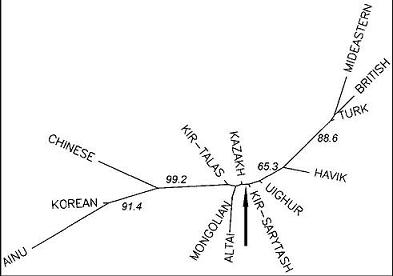 (For reasoning as to how did Shi-zi know that there were deep-socket eye people living to the north of Huangdi
or the Yellow Overlord who lived about 2000 years before the 4th century B.C.E., please refer to the section on Huangdi's Ethnicity
to see postulation that at about the 4th century BCE when Shi-zi fled to today's Sichuan,
there could have started the first contact between the Huns and the Indo-European,
or the second contact between the Mongoloid and the Caucasoid.
Also refer to studies by
"Records of the past, Volume 1" by Records of the Past Exploration Society,
that showed that there were in Minusinsk, an area to the north of Outer Mongolia, there was trace of dolicho-cephalic skulls,
but the Caucasoid Samoyades (Samoyedes) were replaced by the Mongoloid Samoyades. The time of contact for this conflict to the north of today's Outer Mongolia, in the opinion of this webmaster, would be about the 4th century BCE or the 3rd century BCE, i.e.,
the time when the Huns attacked the Yuezhi to the west, as well as the time when Shi-zi jotted down the records with wild speculation that there were deep-socket-eye people living to the north of
the Yellow Overlord about 2000 years ahead of him.)
(For reasoning as to how did Shi-zi know that there were deep-socket eye people living to the north of Huangdi
or the Yellow Overlord who lived about 2000 years before the 4th century B.C.E., please refer to the section on Huangdi's Ethnicity
to see postulation that at about the 4th century BCE when Shi-zi fled to today's Sichuan,
there could have started the first contact between the Huns and the Indo-European,
or the second contact between the Mongoloid and the Caucasoid.
Also refer to studies by
"Records of the past, Volume 1" by Records of the Past Exploration Society,
that showed that there were in Minusinsk, an area to the north of Outer Mongolia, there was trace of dolicho-cephalic skulls,
but the Caucasoid Samoyades (Samoyedes) were replaced by the Mongoloid Samoyades. The time of contact for this conflict to the north of today's Outer Mongolia, in the opinion of this webmaster, would be about the 4th century BCE or the 3rd century BCE, i.e.,
the time when the Huns attacked the Yuezhi to the west, as well as the time when Shi-zi jotted down the records with wild speculation that there were deep-socket-eye people living to the north of
the Yellow Overlord about 2000 years ahead of him.)
In the paragraph on the origin of the Huns, this webmaster had expounded the ethnic nature of various Rong people as mainly the Sino-Tibetan speaking Qiangic people.
Wang Zhonghan analyzed the relationship between the Qiangic Proto-Tibetan and the [misnomer 'Altaic'] Proto-Huns to derive a conclusion that "the northern barbarians and western barbarians were similar [i.e., Qiangs] at the Spring-Autumn time period, but by the time of the late Warring States, the Chinese began to see the northern barbarians as different from the western barbarians".
DNA studies, i.e., "Nuclear and Mitochondrial DNA Analysis of a 2,000-Year-Old Necropolis
in the Egyin Gol Valley of Mongolia", as illustrated at
http://www.journals.uchicago.edu/AJHG/journal/issues/v73n2/35013/35013.web.pdf,
showed presence in today's Outer Mongolia of different groups of people over 2000 years ago.
The geographical isolation of the Chinese continent, separated by the huge Gobi "Desert Sea", explained why there had existed the limited contacts between the east and the west
till the [misnomer Altaic-speaking] Huns raided to the west [and the north, i.e., today's Minusinsk] from the east.
I would make a claim here that the Huns were semi-Sinicized people who had lived along the Chinese border for thousands of years, and the Huns were much more civilized than the later Jurchens and Mongols. My speculation is that the ancient Chinese could have much in common with the Huns.
The early Chinese historical accounts did not have much hint as to the physique of the Huns. That is probably to do with my speculation that the ancient Chinese of 2000 years ago might not be different from the Huns at all.
I would also cast doubts on the nature of the Huns under Attila who invaded Europe. Because the European historians stated that those Huns who first invaded Europe were so barbaric that they did not eat cooked foods at all. The Atilla Huns do not sound like their Asian kinsmen.
Early Chinese historical accounts did record the difference in the physique of people in Chinese Turkistan and beyond. Earlier records said the people to the west of the ancient Gaochang Statelet (Turpan, Karakhoja) possessed the features of high nose bridge and deep socket eyes. Records also stated that the people beyond the Pamir Mountains possessed the high nose bridge and hairy skin. Later accounts mentioned the existence of 'blue-apple' people in today's southern Chinese Turkistan. (The Chinese character for 'blue', namely, 'bi', could also mean 'dark green'.)
In northwestern Siberia, the Kirghiz people, descendants of the Jiankun Statelet located to the northwest of Siberia, i.e., the Tuva area, were recorded to be a group of people who had the 'green eyes'. The Kirghiz, with the help of a traitor Huihu (Uygur) general, defeated and expelled Huihe from Mongolia around A.D. 840s.
Chinese history recorded that the northern Mongolians possessed the 'chestnut-colored eyes'.
It would be in the Ming Dynasty's history book that we found description of the modern Europeans, namely, 'cat-eyed', 'eagle-mouthed', and 'red-haired'.
Interestingly, the Ming Chinese did not talk too much about the Portuguese who were known as 'Falangji' (a word mutated from 'Frank' and also meant for cannons that the Arabs mimicked on basis of the European invention), while the Dutch were nicknamed 'Hongmaogui', namely, the red-haired ghosts. In this sense, the Portuguese could appear much more different than the Dutch.
The relationship between the Chinese and the barbarians/barbarians was very much intertwined. The first recorded defection to the Huns would be the son of King Zang Tu of Yan Principality in late 3rd century B.C. (King Zang Tu was conferred the king title by General Xiang Yu, not Emperor Liu Bang the first emperor of Han Dynasty.) The son of Zang Tu later instigated the rebellion and defection of King Lu Wan of Yan Principality. (Lu Wan was a childhood pal of Emperor Liu Bang, and Liu Bang conferred him the title of king as an appreciation of their childhood friendship after defeating the rebellion of King Zang Tu.) Before Lu Wan' defection, King of Haan(2) Principality, Xin, failed to resist the Huns and surrendered to the Huns for fear of punishment by Liu Bang. The prime minister of Dai Principality, Chen Xi, also fled to the Huns. So to say that quite some Chinese kings and officials had joined hands with the Huns during the early years of Han Dynasty ( 206 BC-23 AD). Han Emperor Wudi, who reigned from 141 to 87 B.C., would campaign against the Huns several times. Some generals under Wudi, like General Li Ling (the grandson of General Li Guang), had surrendered to the Huns. Certainly, many Huns and their nobles were taken prisoners or surrendered to the Han Chinese, too. The son of one Hunnic king, Jin-mi-di, would later be appointed a post in the Chinese court, and he would be responsible for maintaining Liu family heritage of the Han Dynasty during several palace struggles.
Jin-mi-di was initially favored by the emperor to assist with the crown prince; however, Jin-mi-di yielded the job to Huo Guang, saying that the appointment of him could lead to the Huns' contempt of the Han dynasty.
Jin-mi-di (134-86 B.C.) died of illness in 86 B.C., for whose funeral Emperor Zhaodi made a parade of chariot army soldiers all the way to the Maoling Mausoleum. Jin-mi-di's two junior sons were given the job of living together with the emperor.
Tribal empires rose and fell, the conquered and the conquerors mixed up, and ethnic and linguistic dividing lines blurred.
Notable would be the fact that the so-called Indo-European barbarians, i.e., the Scythians ('Sai Ren' or 'Sai Zhong' People),
had migrated to Oxus (ancient Kuei or Gui River) and the Iranian world a long time ago.
It would be during the Western Jinn (A.D. 265-316) that historical accounts record extensively the difference of the physique of some barbarians from the Chinese.
Those descriptions are mostly to do with the Xianbei barbarians whose ancestors were driven to Manchuria by the Huns but later made a comeback to defeat the Huns and took over the Mongolia steppe
in place of the Huns.
When an Eastern Jinn minister (Wang Dun) rebelled against Emperor Mingdi in A.D. 322-325,
he called the emperor by a derogatory name of "Huangxu-nu of the Xianbei", meaning the "yellow-haired slave of the Xianbei barbarians".
This is because Mingdi's mother was from the Dai prefecture, i.e., the Yanmen'guan Pass area in today's Shanxi, where the Xianbei had a dominant presence.
Following records of "Huangtou [yellow head] Xianbei", there were "Huangtou [yellow head] Shiwei" during the Mongols' timeframe and "Huangtou [yellow head] Jurchen" during the Jurchen Jin time period,
all validating a point that the nomadic people, like the later Mongols and the later Jurchens, had raided into the northwestern Siberia area to have conquered the Kirghiz people or their kinsmen --who were said to carry the Indo-European features as to the hair color.
My interpretation would be to take the ancient Chinese color of yellow as brown, while the dark brown hair is very common among today's northern Chinese,
and that
"Huangtou [yellow head] Xianbei",
"Huangtou [yellow head] Shiwei"
and
"Huangtou [yellow head] Jurchen" were merely a minority component of the nomadic tribal federation of the steppe.
(In the Tang Dynasty, poet Du Fu had a sentence to the effect of calling "huangtou xi-er", i.e., a yellow-headed man of the Xi [Kuzhen-xi] tribe. And in Xin Tang Shu, a statement was made to refer to Li Duozuo as having ancestry of a Malgal chieftain, with a nickname called "huangtou dudu [governor-general]".
Also see my research into non-existent sacking of the Jinn capital city of Luoyang by Huangtou Xianbei that was carried by Tang Dynasty poet Zhang Ji [or by Song Dynasty poet Su Shi] hundreds of years later in regards to the misguided speculation on the nature of the Xianbei.)
Emperor Fu Jian of Anterior Qin Dynasty (A.D. 351-394) called the Xianbei rebels by 'Bai Lu', namely, 'white' enemies.
Historians, including Cai Dongfan, speculated that the Xianbei, whose ancestors fled to the deep territory of Manchuria under the Hunnic attack, might have possessed lighter skin on basis of the misnomer word 'bai' [whiteness];
and Ming-Qing dynastic printing houses, which compiled China's 25 chronicles into commonly-readable series, had pointed out
that the Jinn Dynasty wealthy in northern China liked to buy Xianbei women as concubines for the height of those women.
Having interpreted "Huangxu-nu of the Xianbei" as the "yellow-haired slave of the Xianbei",
I would conclude that the Xianbei 'Bai Lu' could merely mean white-colored clothing people by adopting Scholar Wang Zhonghan's linkage of ancient Bai-yi [White Yi] subgroup of Yi [misnomer Dong-yi or Eastern Yi] barbarians to the tribal custom of wearing white-colored clothes.
Indeed, today's Koreans, i.e., kinsmen of the Tungunzic Dong Hu, still had a tradition of wearing white robe.
(Corroborating factor would be: In the eyes of the Qiang1/Di1 people, northerners like the Xianbei might possess the lighter skin.
Today's Tibetans and Qiangs in Sichuan do possess the darker-complexions.
Using modern science, we could attribute the shade difference among southern and northern Mongolian stock people to different levels of the ultra-violet exposure.
In any case, this webmaster believes that you could not bundle the two epithets of 'huang xu' [yellow hair] and 'bai lu' [white enemy] to make a case, but to interpret the two
epithets separately; otherwise, a wrong conclusion could be reached to make it a case of one plus one equals two.)
Another disputable claim would be related to the Jiehu people.
As to the Jiehu, i.e., one of the five tribal groups which pillaged China, they were said to have possessed the higher nose bridge than the other nomadic groups.
There is a claim that the Jiehu people dwelled in three counties in today's Shanxi, including Jieshe. However, it could be that the place was a newly-added name to denote the fact that the Jiehu lived there, not that the Jiehu derived the name from the said place. According to the conversation between Fotucheng and Shi Hu, the Jiehu ruler, though a second-generation in comparison with founder Shi Le, was still someone to be born outside of the China domain. This means that the Jie-hu migrants entered China to settle down next to the Huns as relatively newcomers.
The Jiehu and the Huns were not friends as the Jie-hu rounded up all Tuge clan of the Huns in an ethnic cleansing.
Shi Min, an adopted son of Jiehu's Posterior Zhao, had at one time killed about 200,000 Jiehu barbarians. Jiehu was an alternative race of the Huns. History recorded that the criteria used for sorting out the Jiehu was the nose bridge.
History said that Shi Min's armies killed those people who looked like Jiehu because of the high nose bridge.
The Jiehu founder, Shi Le, was said to have travelled out of his domain to seek for employment or career in his early years. Shi Le was at one time captured in today's Shandong Province when the local Jinn warlord was given advice to round up the Hu barbarians for filling up the army ranks. This points to some kind of melting-pots as existed in the late Western Jinn time periods.
As detailed in Monk Fotucheng-related writings, the Jie-hu appeared to be Central Asian immigrants who followed the Huns the same way as the Central Asian Sogdians' following the Uygurs in the later Tang Dynasty.
The relationship between Jie-hu rulers Shi Le and his son Shi Hu (Shi Jilong) was adoption, with Gao Seng Zhuan (biographies of distinguished monks) stating that his adopted son was from Jibin, i.e., Kabul of Afghanistan.
From Monk Fotucheng's mouth, we could tell that the past of the Jie-hu king [? Shi Hu or his ancestors], a merchant, previously attended a gathering in today's Afghanistan, on which occasion some priest claimed that the Jie-hu merchant would one day rule the land of Jinn China.
The Jie-hu appeared to possess the "Hu Tian [heaven]" temple, which was speculated to be of
a Zoroastrian temple.
(Note that the Jie-hu appeared to be truly Central Asian with the high nose bridge but the high nose bridge alone was not the only measure of ethnicity. The high nose bridge had been observed among the Tanguts of Xi-xia [Western Xia] Dynasty as well as today's Yi-zu minority in southwestern China, i.e., they all possessed the dark face with red decoration and comparatively higher nose bridge. After a close examination of Ainu's hairy body, one could put away the "racial approach" with a claim that neither the high nose bridge itself nor hairy body itself was not equivalent to a Caucasoid.)
The 16 Nations (A.D. 304-420) were comprised of the various nomadic groups of people, i.e., the Huns, Jiehu, Xianbei (including Wuhuan & Tuoba), Qiang, & Di. Ultimately, the Tuobas, who were of the Northern Xianbei heritage, took over northern China. The leftover Huns in the Mongolia steppe were absorbed by the Ruruans, and the Ruruans were defeated and exterminated by the Turks. The Tuobas would deal with the onslaughts by the Ruruans first and then the Turks. The Tuobas got Sinicized in northern China. Ultimately, Tuoba Wei Dynasty would be usurped by two generals of the Xianbei heritage. By Sui Dynasty (A.D. 581-618), the Turks would replace their Ruruan masters as the strongest power in the northern steppe.
Ashina Turks might have possessed some features different from other Huns. In the 17th year of Western Wei's Datong era, i.e., A.D. 551, Turkic Khan Tumen (Bumin) obtained Tuoba Princess Changle as a bride. In the first year of Western Wei Emperor Feidi, Tumen defeated the Ruruans and Tumen declared himself Khan Yili. Tumen's son, named Keluo, was Khan Yixiji, and he defeated Ruruan Khan's brother (Dengshuzi). Yixiji's brother, Sijin (Sinjibu?), aka Yandu, would succeed Khan Yixiji as Khan Muchu. Sijin was recorded to be red-faced and have possessed the eyes like "liuli" [now meaning brown and green imperial construction, previously meaning five-color glass].
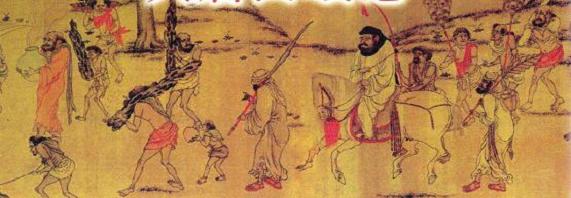
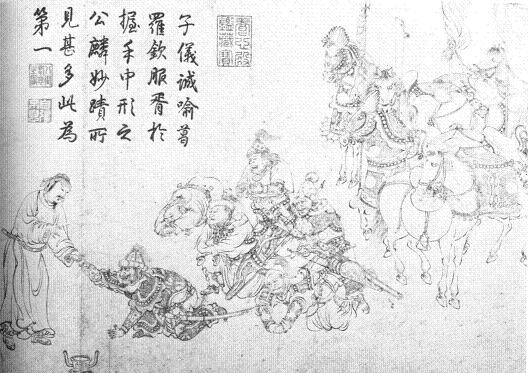
|
Below maps were added to the http://www.imperialchina.org/Barbarians.htm which was embedded within the
http://www.imperialchina.org/Huns.html and
http://www.imperialchina.org/Turks_Uygurs.html
pages.
On basis of the new archaeological findings and historical Chinese records, this webmaster will tentatively speculate on when the east met with the west.
First this webmaster wants to debunk the fallacies in regards to the equation of the ancient Yu-shi tribe to the Yuezhi, and the speculation on the jade trade that the Yuezhi was falsely accredited with.
The forged Guan Zi [管子] statement contained a reference which was a misnomer related to the 'Yu-shi' tribe, a term that was erroneously speculated by a few annotators in history, as well as scholar Wang Guowei of the early 20th century,
to be the same as Yuezhi per soundex.
Guo Yu, a political discourse book that was similar to Zhan Guo Ce, could be merely Han dynasty Confucian compilings, while Guan Zi, i.e., the fabled Legalist founding master, was at most a political economy book written in the late Western Han dynasty or at the turn of B.C. and A.D.
See Barbarians.htm for more discussion on the forged statements in Guan Zi [管子] (which historian Ma Feibai pierced sentence by sentence).
Around the Xin (New) Dynasty (AD 6-23), there occurred
a forgery movement by the Chinese scholars, possibly with the intention of substantiating the mandate of the usurper Wang Mang's dynasty.
The classics which were proved to be forgeries
include "Guan Zi [管子]", which historian Ma Feibai pierced sentence by sentence.
Using Ma's same logic, this webmaster had found the two other books, "Yi-zhou-shu" [逸周书] or "Zhou-shu" (Zhou Dynasty [11th cen. B.C. - 256 B.C.] [abbrev. 周书] book,
not the Zhou-shu [周书] from Posterior Zhou Dynasty of the South-North Dynasty time period of AD 557-581) and "Shang[1]-shu" [商书] (Shang Dynasty [16-11th cent. B.C.] book, not Shang[4]-shu [尚书], i.e., the remotely ancient book which was said to be abridged by Zuo Qiuming [Zuoqiu Ming]),
to be written in the exact same style and could be forgeries by possibly the same person[s].
Discarding the forgery of Guan Zi [管子] basically eliminated the whole foundation upon which the existence of the Yuezhi and the jade trade was built,
a fallacy which was widely cited in
the most recent 10-20 years, i.e., the 1990s and 2000s, to the effect that the fabricated Yuezhi had lived close to the heartland of China, playing the role of bearing the Aryan civilization to China.
Another school of thought, which was intended to discredit the Yellow Civilization, would be the false claim that the Sinitic Civilization "began in 3000 B.C. at Liangzhu", namely, the Yangtze River estuary --which was a taken-out-of-context judgment on the new findings from the multiple Neolithic sites and their age from across China.
Still another school would be the claim that the Shang Chinese were the ancient Koreans.
(A recent writing on the ancient forgeries at the imperialchina.org blog, which was not in the sense of political correctness till the later Western Han Dynasty, is available in pdf format: ImperialChinaOrg-on-forgeries.pdf.)
 This webmaster never thought the people of the Central Asia or in Chinese Turkestan were an intermediary form of human evolution,
which was the basis of calling the Siberian origin of the Koreans a 'moo' point.
This webmaster had pointed out that in the collective memory of the Sino-Tibetans, that passed down by generations through millennia,
the Sinitic Chinese had forgot that they had travelled north from today's Burma-Vietnam while claiming to have walked down Mt Kunlun.
Previously, this webmaster checked into the historical context as well as the geo situation to find out about when the east met with the west,
and believed that the 3rd century B.C.E. Hun-Yuezhi War could be the start of the contact between Sinitic China and the West, i.e., the trigger that led to the chain reaction of the Yuezhi attacking the Wusun, and the Wusun attacking the Scythians, and so on.
With the new archeological findings, this webmaster would add that about 5000 years ago, the proto-Tibetan Qiangs had indeed penetrated into Chinese Turkestan,
to the north side of Mt Tianshan, from perhaps the southeastern rim of the Taklamakan Desert, 2000 years ahead of the Hun-Yuezhi War.
This webmaster never thought the people of the Central Asia or in Chinese Turkestan were an intermediary form of human evolution,
which was the basis of calling the Siberian origin of the Koreans a 'moo' point.
This webmaster had pointed out that in the collective memory of the Sino-Tibetans, that passed down by generations through millennia,
the Sinitic Chinese had forgot that they had travelled north from today's Burma-Vietnam while claiming to have walked down Mt Kunlun.
Previously, this webmaster checked into the historical context as well as the geo situation to find out about when the east met with the west,
and believed that the 3rd century B.C.E. Hun-Yuezhi War could be the start of the contact between Sinitic China and the West, i.e., the trigger that led to the chain reaction of the Yuezhi attacking the Wusun, and the Wusun attacking the Scythians, and so on.
With the new archeological findings, this webmaster would add that about 5000 years ago, the proto-Tibetan Qiangs had indeed penetrated into Chinese Turkestan,
to the north side of Mt Tianshan, from perhaps the southeastern rim of the Taklamakan Desert, 2000 years ahead of the Hun-Yuezhi War.
Now, this webmaster made a hypothetical claim here that the Huns could have encountered the Yuezhi at the "Great Lake" ("da ze"), namely, the Juyan Lake.
In the Juyan-ze Lake area, the bamboo strips (slips) were discovered, with evidence of the existence of names of the [famed] nine Zhaowu clans, 80 years or 3-4 generations after the first Hunnic attack against the Yuezhi: K'ang (Samarkand), An (Bukhara), Shih (Tashkent, i.e., Kishsh [Kashana]), Mi (Maymurgh [Penjikent]), Ts'ao (Kaputana), Ho (Kushanik [Kusanya]),
Mu (Murv, ? Huoxun [Khwarezmia]), and Su (Sudi, Bilinmemektedir). Here, the likely event was that the nine clans invaded Central Asia, where they mutated their [possibly Sinitic] names to the multiple-syllable statelet names, before the descendants of the nine clans returned to the east in the subsequent half millennium.
See Wang Guowei's theory of invaders coming from the East while traders from the West for understanding the nature of the nine Zhaowu clans of the Yuezhi.
Note the difference of one year in the chronicling, as seen across the history writings on the Han dynasty, which was the result of the wholesale misunderstanding of the Qin Empire's Zhuanxu-li calendar and the virtual Yin-li (Shang dynasty) calendar, something covered in this webmaster's book The Sinitic Civilization.
All history books had error in the Han dynasty's reign years, including the Hunnic chronicling years.
The Huns’ military activities could have happened any time between 209 B.C. and 202 B.C.
Nicola Di Cosmo (Ancient China and its Enemies: The Rise of Nomadic Power in East Asian
History, Cambridge University Press (2002)) claimed that the attacks of Donghu and Yuezhi happened in
208 B.C. and 203 B.C, respectively.
Thomas Barfield (The Perilous Frontier,
Cambridge, MA: Basil Blackwell (1989)) stated that the Han founder-emperor's October-November 201 B.C. Baideng
debacle happened in year 200 B.C., not knowing that the early Han emperors' reign years started in
October of a prior year and ended in September of the consecutive year.
Professor Gernet hedged himself in pinning the Hunnic-Han War, namely, Emperor Liu Bang's defeat at the Baideng mountain, to the period "201-200 B.C.", which should be November 201 B.C. when strictly observing the Zhuanxu-li calendar's ordinal months.
Click on the below picture for the enlarged map showing the first Hunnic attack at the Yuezhi possibly around the ancient Juyan Lake
(later known as the
Kharakhoto [Blackwater] Lake, Ejina or Juyan - before this 'West Sea' concept was applied to today's Qinghai-hu Lake by the usurper-emperor Wang Mang when he set up the Xi-hai-jun commandary using the imaginary four-seas' concept in Shan Hai Jing (The Legends of Mountains & Seas).
The reason that this webmaster made this hypothesis is that the Huns were more subsequently recorded to have fought another war against the Wusun, Loulan, Hujie and etc., i.e., the twenty-six statelets of Chinese Turkestan, at the place somewhere near Yiwu in the 2nd century B.C.,
to the east of Turpan, which then triggered the Wusun migration to Ili where they further drove the Yuezhi towards
today's Afghanistan.
(See Barbarians.htm for more discussions on the Yuezhi migration timeline.)
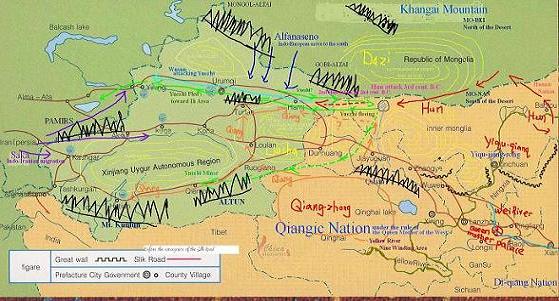
|
|
|
|
|
|
|
Sovereigns & Thearchs;
Xia-Shang-Zhou dynasties;
Zhou dynasty's vassalage lords;
Lu Principality lords;
Han dynasty's reign years
(Sexagenary year conversion table-2698B.C.-A.D.2018; 247B.C.-A.D.85)
|
|
The Sinitic Civilization - Book I is
available now at
iUniverse,
Barnes & Noble,
Amazon,
Google Play|Books
and
Nook.
The Sinitic Civilization - Book II is available at
iUniverse,
Amazon and Barnes & Noble.
Check out the 2nd edition preface that had an overview of the epact adjustment of the quarter remainder calendars of the Qin and Han dynasties, and the 3rd edition introductory that had an overview of Sinitic China's divinatory history of 8000 years.
The 2nd edition, which realigned the Han dynasty's reign years strictly observing the Zhuanxu-li calendar of October of a prior lunar year to September of the following lunar year, also cleared this webmaster's blind spot on the authenticity of the Qinghua University's Xi Nian bamboo slips as far as Zhou King Xiewang's 21 years of co-existence with Zhou King Pingwang was concerned, a handicap due to sticking to Wang Guowei's Gu Ben Bamboo Annals and ignoring the records in Kong Yingda's Zheng Yi.
Stayed tuned for Book III that is to cover the years of A.D. 86-1279, i.e., the Mongol conquest of China, that caused a loss of 80% of China's population and broke the Sinitic nation's spine.
Preview of annalistic histories of the Sui and Tang dynasties, the
Five Dynasties, and the two Soong dynasties
could be seen in
From the Khitans to the Jurchens & Mongols: A History of Barbarians in Triangle Wars and Quartet Conflicts
(The Barbarians' Tetralogy - Book III: available at iUniverse;
Google;
Amazon;
B&N).
(A final update of the civilization series, that is scheduled for October 2022, would put back the table of the Lu Principality ruling lords' reign years, that was inadvertently dropped from Book I during the 2nd update.)
|
|
Book II - Table of Contents:
Section Seven: The Han Dynasty
Relationship with the Huns 392
Chapter XXXIII: The Hunnic Empire 409
Origin of the Huns 409
The Rong & Di Barbarians in the Context of Relation to the Fiery Thearch, the San-miao Exiles and the last Xia Dynasty King 413
The Zhou, Qin and Jinn's Zigzag Wars with the Barbarians & the Construction of the Great Walls 417
Mote's Hun Empire, the Yuezhi People, and the Early Han Dynasty 424
The Huns & the Eastern Hu Barbarians 430
The Hunnic Government Structure & the Dragon Reverence 431
Chapter XXXIV: The Han Dynasty's Wars with the Huns 435
Chapter XXXVI: The Western Expedition, The Kunlun Mountain & Shan Hai Jing 489
Han Emperor Wudi Seeking Elixir from the Immortals on the Kunlun Mountain 491
Credible Geography Book on the Mountains Possibly Expanded to Include the Legendary Kunlun Mountain 493
Unearthly Things in the Mountains' Component of The Legends of Mountains & Seas 501
The Divination Nature and Age of the Seas' Component of The Legends of Mountains & Seas 506
Chapter XXXVII: Shan Hai Jing & The Ancient Divination 520
Chapter XL: The Latter Han Dynasty's Chronological History 560
The Relation with the Southern Huns 561
|
|
On the modern map, there was a tiny sand bridge between Chinese Turkistan and China, which was the narrow strip of desert sand to the east of Hami.
However, this corridor, today's Kumul line, could be a recent event.
There was the historical Da-qi4 blackhole desert to the east, nowadays called by the generic name GOBI. Specifically, near today's Hohhot, there was an ancient Chinese geological name called "qi4 kou", namely, the entry point into the Da-qi4 Desert.
The ancient Sino-Tibetan migration into the Tianshan Mountain could have come north from south, i.e., the Tibetan Plateau/Ruoqiang direction to the south --though this webmaster hesitated about the
passibility of the "Liu-sha" [quick sand] desert between Ruoqiang and Loulan (Lop Nur), which was another tiny sand bridge noticeable on the modern map.
Judging from Han Dynasty emissary Zhang Qian's change of mind on his return trip to go home along the Hami strip rather than going straight east across the Qiang-zhong [i.e., the middle Qiang nation land], we could tell that the northern strip was perhaps the most traveler-friendly.
(Could Zhang Qian had changed his mind in the hope of sneaking into the Hunnic territory to see the child he had with a Hunnic woman?)
That was Han Emperor Wudi (commonly-taken wrong reign 140-87 B.C. or 140-86 B.C.; nominal Oct 141-Dec 87 B.C.; actual Jan 141-Feb 87 B.C.)'s reign of B.C. 141-87, i.e., 141 BC and later, much later than Hun-Yuezhi wars.
Now, let's talk about the human migration.
There were widespread discussions of the 'Caucasoid' mummies in Chinese Turkestan, with the 'Loulan Beaty' purportedly dated 2000 B.C., while the southern 'cousins' in the Khotan area dated 100-300 B.C.
The timeline suggested a move from north to south, not west to east.
The 2000 B.C. Caucasoid mummies found in Loulan, in the Turpan Depression/Kumtag Desert, in-between Altaic/Tianshan Mountains and the Altun Mountain (Ruoqiang), could be the Indo-European people coming from the north of the Altaic Mountain [the Mongol Altaic Mountain of today], near the Alfaniesevo (Alfanesevo) bronze culture.
Though, Yuezhi might not be of this group of people coming from north.
Further diggings in the Loulan area, i.e., the ancient Salty Lake and Salty River (Peacock Rover), led to a site called by Xiaohe or the Little River, next to the Salty River (Peacock Rover), where the Mongoloid Mummies were discovered.
It appears to this webmaster that there was indeed good carbon dating on the Xiaohe excavation, which stated that "The entire necropolis can be divided, based on the archeological materials, into earlier and later layers. Radiocarbon measurement (14C) dates the lowest layer of occupation to around 3980 +/1 40 BP (personal communications; calibrated and measured by Wu Xiaohong, Head of the Laboratory of Accelerator Mass Spectrometry, Peking University), which is older than that of the Gumugou cemetery (dated to 3800)." The article claimed that the 'Mongoloid' mtDNA had similarity to some present South Siberian population. (For details, check http://www.biomedcentral.com/1741-7007/8/15 for the full article "Evidence that a West-East admixed population lived in the Tarim Basin as early as the early Bronze Age".)
The linking of this certain mtDNA in the Xiaohe/Loulan area to a modern Siberian population could be said to be circumvential at best since a lot of things might had happened in the past 4000 years.
That is, the linkage to the Siberian population could be actually an effect, not a source.
This area kind of had the same timing as the Mongoloid mummies that were discovered to the north and east of the Tianshan Mountain.
More than what was found about the mtDNA at Xiaohe/Loulan, there were mummies of the Khams-Tibetan type found to the further north,
in the Tianshan-Altaic mountain areas, which presented a much more convincing point that the proto-Tibetan Qiangs, from the south, had indeed crossed over the strip of the sand desert near Loulan to reach the north side of Tianshan.
Possibly, the Khams [proto-]Tibetan, after reaching the Tianshan Mountain Range, moved towards Hami (Qumul) to the east, where there were the Hami (Qumul) Mongoloid mummies excavated.
Note that today's Kham Tibetans were not far away from the historical Sanxingdui (three star) Excavations in western Sichuan, that was discovered by Gaway Hann (an American professor of the former Hua-xi [west China] University),
a Neolithic/Bronze culture dating from about 4800 to 2800 years ago, as well as a bridge providing Southwest China's tin to the Shang dynasty
and the Zhou dynasty.
This webmaster's reasoning was that the Qiangs had a dominance in the area since China's prehistory, like 5000 years ago, at least the time of the Yellow Emperor [Huangdi (? BC 2697 - 2599; reign 2402-2303 with rule of 100 years per Zhu Yongtang's adjustment of
The Bamboo Annals], and they controlled the southern rim, southeastern rim and eastern rim of the Taklamakan Desert, and somehow around 2000 B.C., penetrated northward to reach the two sides of the Tianshan mountain range, while the so-called Caucasoid oases in their path, namely, the Loulan area, might have risen and fallen numerous times in history -- if they ever existed there prior to the penetration by the Khams [proto-]Tibetans.
Or the other way around, the Khams [proto-]Tibetans could be speculated to have penetrated to the two sides of the Tianshan mountain range earlier than the Indo-Europeans, and subsequently encountered the Indo-Europeans near the Tianshan Mountain, and ultimately the Indo-Europeans gradually dominated over the area and eliminated the trace of the Khams [proto-]Tibetans, pressing them back to the southeastern rim of the Taklamakan Desert.
(See Barbarians.htm for more discussions on the ancient human migrations.)
There could have been a striking similarity between the Mongol attack at the Tanguts in the 13th cent. A.D. and the Hun attack at the Yuezhi in the 3rd cent. B.C.
Both took the desert road towards the Blackwater Lake.
It kind of gives you a picture how the Huns first raided to the west against the Yuezhi, forcing the Yuezhi Major to flee west while the elderly and the children, i.e., the Yuezhi Minor,
crossed the Qilian mountain to seek asylum with the Qiangs, and per Yu Taishan, continued to move on towards the southeastern rim of the Taklamakan Desert,
towards
Khotan where the people were recorded to be Chinese or Hua-xia-looking, throughout China's Han and Tang dynastic records, till annihilated sometime during the Islamic invasion of the
Buddhist stronghold of Khotan or possibly during the earlier Turkic-Uygur conquest of the Chinese Turkistan.
Note the discovery of the so-called 100-300 BC Caucasoid in Khotan, which matched with the escape timeframe of the Yuezhi Minor.
(Another recent writing on Zhou King Muwang's travelogue at the imperialchina.org blog, is available in pdf format [Mu-tian-zi.pdf], exhibited the westernmost extent of the ancient Chinese kingdom to be no more than the edge of the Kumtag Desert and right at the Black Water Lake.)
This webmaster tried to reconcile Sima Qian's statement in regards to the migration of the Lesser Yuezhi,
in the aftermath of the Huns' attack in the last years of the 3rd century BCE,
to give the Yuezhi people some credit of living a bit further to the east, i.e.,
staying somewhere near the Blackwater Lake [i.e., the Ejina Lake].
By making this assumption, this webmaster assumed that the Lesser Yuezhi people, namely, the sick, the elderly and the young,
climbed the Qilian-shan Mountain [today's Qilian-shan, not what Yu Taishan et al had postulated to be the Tianshan
or the Heavenly Mountain Range in Turkestan] to live among the Qiangs
--unless Sima Qian actually meant that the Huns had raided deep into the Chinese Turkestan in the first place,
driving the Greater Yuezhi into a flee towards the Ili area to the west and the Lesser Yuezhi into a move across today's Tianshan
or the Heavenly Mountain Range to live with the Qiangs in Khotan, at the southeastern rim of the Taklamakan Desert,
a historical dwelling place of the Qiangs since the late 3rd millennium BCE.
In conclusion, there were two points of contact between the west and the east, one time around the 2000 BCE, and another time in the 4th century BCE (or more exactly the 3rd century BC when the Huns attacked the Yuezhi, triggering the chain reaction to the west).
The demarcation point of the 4th century BCE or the 3rd century BCE was important in determining the second point of contact between the Mongoloid and the Caucasoid,
after the first Mongoloid-Caucasoid mummy contact around 2000 BCE near today's
Tianshan or the Heavenly Mountain, known as Bei-shan or the Northern [Turkestan] Mountain at Han Emperor Wudi (commonly-taken wrong reign 140-87 B.C. or 140-86 B.C.; nominal Oct 141-Dec 87 B.C.; actual Jan 141-Feb 87 B.C.)'s timeframe.
There were widespread discussions of the 'Caucasoid' mummies in Chinese Turkestan, with the 'Loulan Beaty' purportedly dated 2000 B.C., while the southern 'cousins' in the Khotan area dated 100-300 B.C.
The timeline suggested a move from north to south, not west to east.
The 2000 B.C. Caucasoid mummies found in Loulan, in the Turpan Depression/Kumtag Desert, in-between Altaic/Tianshan Mountains and the Altun Mountain (Ruoqiang), could be the Indo-European people coming from the north of the Altaic Mountain [the Mongol Altaic Mountain of today], near the Alfaniesevo (Alfanesevo) bronze culture.
Archaeologically speaking,
the admixture mummies in Chinese Turkestan pointed to the west-east interbreeding around 2000 B.C., after an interruption of contacts for like 6,000 years, as seen in the spread of the North China microlithic stone tools to the west about 10,000 years ago, including today's Chinese Turkestan, and its replacement of the European Paleolithic bladelet tools. About 3500-2500 B.C., the proto-Indo-Europeans, with the haplogroup R1b-M269, arrived at Minusinsk where they founded the Afanasevo chalcolithic culture and bronze culture (3200-2000 B.C.). People of the Afanasevo culture spread southward to today's Chinese Turkestan with the patented grey sand-textured (coarse) round-bottom pottery jars with engraved and embossed patterns.
Direction-wise, the Q-haplogroup people, i.e., cousins of the Caucasoid R-haplogroup people, likely arrived in today's Siberia heartland before the Last Glacial Maximum, while within the last 10,000 years, the C-haplogroup people pushed west and south from the northeastern direction and the N-haplogroup people pushed west and north from the southeastern direction. The patented Sinitic gourd-shaped colored and red potteries with a beam neck were seen to have penetrated to Central Asia. It could be the O3-haplogroup ancient Qiangs who brought the Sinitic colored (painted) potteries to today's Chinese Turkestan in late 3rd millennium and the early 2nd millennium B.C. While the millet and sorghum (as seen in the Begash site in Kazakhstan) could have spread westward to Central Asia with the colored potteries, the wheat products, sheep and goats, and the spoke-wheeled carts might have spread to China through this east-west contact along the two sides of the Tianshan Mountain.
The 'Tokharai' Yuezhi people, however, might not be the misnomer Indo-European as they could be part of the
barbarians whom Zhou King Muwang resettled at the origin of the Jing-shui River in the 11th century
B.C., among them, the later known five Rong groups of Yiqu, Yuzhi, Wuzhi, Xuyan (Quyan) and
Penglu, or the later Yiqu-rong barbarians as noted in the Warring States time period --which could
be the origin for the misnomer 'Indo-European' Yuezhi. The recent DNA analysis of the remains of
the ancient tombs had found the trace of the Q-haplogroup people at Pengyang of Ningxia, next to the
Western Yellow River Bend, and along the routes that the Yuezhi people had dwelled.
According to the recent DNA studies, before the emergence of the Indo-Europeans, the proto-Indo-Europeans, who had origin in southwestern Siberia approximately 38,000 years ago, relocated to the Volga area about 28200-22800 years ago, where they split into R1a (i.e., ancestors of modern Eastern Europeans, Indians) and R1b (i.e., ancestors of Basques, Celts and modern Western Europeans).
The Scythians, or the purportedly Indo-European 'Tokharai' Yuezhi, and majority stocks of the later Central Asians, belonged to the R1a offshoot.
There was the spread of North China's microlithic stone tools towards the west over 10,000 years ago.
The 6000-year-old Lingjiatan piglet-bird-head jade octagram could imply an ancient transfusion of the 10,000-year-old double-head emblem to Central Asia from China.
It would not be farfetched to state that the Sumerian cuneiform's speedy transformation to logophonetic, consonantal alphabetic and syllabic signs among different groups of the Central Asia and Middle Eastern people could imply the Sumerian script's likely origin as an out-of-area and imported product from let's say North China.
Here, with the existence of the obscure pre-2000 B.C copper-based metallurgy in northern China, such as the controversial brass pieces of the fourth and third millennium B.C., there was no rebutting the spread of ancient metallurgy technology to China from the west.
A tentative conclusion could be made in that the ancient world(s) did have some unknown form of discrete, disparate and non-continuous links between the East and West. However, this kind of East-West links were disrupted numerous times, with the consequence of loss of such links amounting to thousands of years in-between, as seen in the westward spread of the microlithic tools, the octagram, the double-head eagle emblem, the pictographic characters, and the red potteries.
http://www.sino-platonic.org/complete/spp115_chinese_proto_indo_european.pdf provides another perspective of looking at things of the past from the perspective of language cognates. Rather believing that the Indo-Europeans ever invaded China and gave the Sinitic people the language, we could actually deduce that "Old Chinese", for its 43% correlation with the Proto-North-Caucasian, rather 23% with the Proto-Indo-European, was the source for both the cognates of the Proto-North-Caucasian and the Proto-Indo-European. This is because our cousins, i.e., the N haplogroup people, relocated to North Asia and then to Latvia, Estonia, Finland and Scandinavia, bringing along the Sinitic language to the Proto-North-Caucasian who in turn gave it to the Proto-Indo-European.
Linguistically, the proto-Caucasian should fall under the umbrella of the Dene-Caucasian (Sino-Caucasian) Language Family that encompassed the [Proto-North-]Caucasian, Yeniseian and Sino-Tibetan languages.
In 2012, Li Hongjie of Jirin University published a paleogenetic study of the ancient DNA of prehistoric people dwelling in northeastern China, northern China, and northwestern China, with the results showing that the predominant population in Niuheliang of southwestern Manchuria, Dadianzi of Inner Mongolia and Hami of northeastern Chinese Turkestan over 3000-5000 years ago, that roughly matched with the Xiajiadian Culture and Hongshan Culture's timeframe, belonged to the Y-chromosome people of the N-haplogroup type, namely, people related to ancestors of the Finnish, Sami and Hungarian people. And it would be about 2000-4000 years ago that the R-haplogroup and Q-haplogroup people began to be seen in Chinese Turkestan and northwestern China. Following this timeline, it is more plausible that people of the Xia and Shang dynasties of ancient China had the company of the N-haplogroup people, with both the Sinitic O-haplogroup and the N-haplogroup people actually sharing the same origin for over 20,000 years, and the Zhou people could be interfacing with the Q-haplogroup people towards the northwest, which implied that the northern barbarians or the Huns' composition could have changed through history. The Huns, for their position and timeline of appearance, more likely belonged to the Q-haplogroup people than the N-haplogroup people, with both groups plus the ancient Sinitic Chinese likely falling under the same proto-Borean (Northern) language family.
This webmaster, possessing the amber-colored or hazel eyes with a greenish ring, had been found to possess about 15% ancient Euro-Asian hunters' gene, specifically, N1a (N-M96 (N-CTS7095, N-P189), a branch of the Finno-Ugrian people.
It would be in the 4th century BCE that Shi-zi first wrote down the sentence speculating that 2000 years earlier, at the time of the
Yellow Overlord, there were the deep-eyesocket people living to the north.
This brilliant piece of work by Shi-zi apparently adopted some then-current information available as of the 4th century BCE, in a similar fashion to
the later forgery Guan Zi which, relying on the then-current information available as of the 1st century AD, claimed that
Qi Hegemony Lord Huan'gong had crossed the 'Kumtag Desert' to conquer the Yu-shi [or misnomer Yuezhi] people.
Here, mark this webmaster's words: Yu-shi, having absolutely nothing to do with the Yue-zhi people [as erudite Wang Guowei claimed --a No. 1 blunder of the most famous Chinese scholar of the 20th century], could be taken as either the western Yu [Wu] or the northern Yu [Wu] remnants from the descendant of one of the two elder brothers who 'emigrated' to the Yangtze River and the Taihu Lake 3000 years ago.
(Shi-zi could be a latter-day add-on as well since half of the original texts were lost in the Three Kingdom time period, and the majority of the re-compiled texts were lost again in the Soong Dynasty. One important fact about Shi-zi that this webmaster wants to emphasize is that it could be on the same par as the classics Shan Hai Jing, i.e., the Book of Mountains and Seas, and the author or the authors of some of the contents of the two books of Shi Zi and Shan Hai Jing could be of the same origin.
Note that the seas or overseas' components of Shan Hai Jing, i.e., The Legends Mountain and Sea Legends, though carrying the names of countries like in today's Korea, Chinese Turkestan and India, etc., were not about geography at all but divination. The divination materials, similar to those in Shi1 Fa, Gui-cang Yi, the Wangjiatai divination script, and the divination in Mu-tian-zi Zhuan, served the same augury purpose of the late Warring States time period, albeit possessing their separate freelance or freewheeling traits.
For example,
The one eyed son of Lord Shaohao in the "great northern wilderness" (Da Huang Bei Jing) section of Shan Hai Jing, like the one-hand and one-eye 'shen-mu-guo' (the deep eye socket) state in the "Northern Outer Seas" section, which was speculated to be the legendary one-eyed state Arimaspi that was described by Herodotus in Histories as located north of Scythia and east of Issedones and linked to the three-eye stone statutes of the Okunev Culture in Minusinsk, could have its source in some one-eye bird in the northern mountain range of Shan Hai Jing, and the one-eye and three-tail 'huan' foxlike animal on Mt. Yiwang-zhi-shan in the western mountain range.)
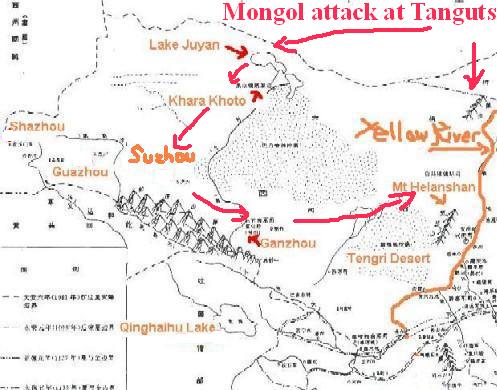
|
|
(For further details, check into this webmaster's "Extrapolation of prehistoric people using the mitochondrial and nuclear DNA analysis, as well as cranial analysis, on the ancient remains extracted from the archaeological sites" on basis of the Jirin University DNA analysis.)
In the 7th century, there was a record in regards to the difference of the Ashina Turks from the ordinary Hu or the Huns. A Turkic khan called Simo was not recommended for the post as Turkic Arch-Khan because he looked more like an ordinary 'Hu' nomad than an Ashina Turk.
Simo, for his appearance similar to the Hu barbarians of today's Central Asia, was suspected to be not of the Ashina stock, and hence was conferred the post as 'Jiabi Tele [te-le]', not a higher post as 'she[4]'.
This kind of records, however, did corroborate the fact that the Central Asian features, maybe in areas like the deep socket eyes and high nose bridge, were rare in relationship with the general physique of the people in the steppe area. Speculation would be that the majority Huns were of the Mongol stock, but a few Altaic people, like the Jiehu & some of the Ashina Turks, had inherited or picked up the Caucasian features of Chinese Turkistan or Central Asia, possibly after the ancestral Huns raided to the west.
Orkhon Turks (Eastern Turks) were defeated by the Uygurs. The Uygurs would control the Kirghiz in the west and the Khitans in the east.
Around the 8th century, the Kirghiz people would come into play. According to Xin Wu Dai Shi (New History Of The Five Dynasties), the Kirghiz belonged to the ancient 'Jiankun' Statelet which was located to the western-most of the Huns, 7000 li away from the Hunnic central court in today's Mongolia, in fact. They should be to the west of the Yiwu Statelet and to the north of the Yanqi Statelet, i.e., both localities in today's northern Turkestan. Hunnic Chanyu Zhizhi destroyed Jiankun and an ex-Han General Li Ling, who surrendered to the Huns, was assigned to the land of Jiankun as King Youxianwang (the rightside virtuous king) with an army of 80,000. "New History Of The Five Dynasties" said that the Kirghiz possessed the lighter skin, red hair, green eyes and taller height, and that those Kirghiz with the black hair must be the descendants of Li Ling.
At one time, during Tang Emperor Suzong's reign of A.D. 758-760, the Huihu (Uygur) conquered the Jiankun Statelet of the Kirghiz. The Kirghis allied themselves with the Tibetans, Arabs and Karlaks. Kirghiz, with the help of a traitor Huihu (Uygur) general and combining a cavalry force of 100000, defeated Huihu (Uygur) and killed the Huihu khan around A.D. 840s.
The Kirghiz claimed that they shared the same last name as the Tang emperors, i.e., Li. They claimed to be descendants of General Li Ling of 800 years earlier. They sent another emissary to the Tang court, and it took the emissary three years to make the circumvential trip to the Tang court for seeing Emperor Wuzong. Later, the Kirghiz sent another emissary and made a proposal to attack the Huihu (Uygur) together with Tang. It would be in A.D. 859 that Tang Emperor Xuandi decided to confer the Kirghiz the title of Khan Bravery-Intelligence. Tang was hesitant in conferring the king title and making the Kirghiz an alternative rival to the defunct Huihu power. Xin Wu Dai Shi said the Kirghiz paid three more pilgrimages during the era of the A.D. 860-875, but they failed to exterminate the Huihu (Uygur).
With the downfall of the Uygur kingdom, the Khitans had their Uygur seal replaced by Tang China and then ruled eastern Mongolia, most of Manchuria, and much of northern China by A.D. 925. When the Kirghiz defeated the Huihe (Uygurs) in A.D. 840 and took over northern Mongolia, there was a group of people called the Naimans who remained in their homeland in the Altai Mountains and attached themselves to the Kirghiz. The Naimans were said to be a Mongol name for a group of the Turkic tribe called by 'Sakiz Oghuz' or the Eight Oghuz, a name which purportedly existed in the 8th century. Gradually, the Naimans grew in strength and drove the Kirghiz towards the River Yenisei and rooted the Keraits from their homeland on the Irtysh in the Altai and drove them towards Manchuria, hence indirectly causing the Khitans to move to northern China where they established the Liao Dynasty in A.D. 907-1125, a name associated with the Liao-he River in Manchuria. The Khitans changed their dynastic names back and forth between Liao and Khitan, several times. The Khitans conquered the Xi and Shiwei Tribes, the Dadan Tribes, the Bohai Tungus people and the Sino-Tibetan Tanguts.
After the fall of the Tang Dynasty (A.D. 619-907), three dynasties among the Five Dynasties (A.D. 907-960), i.e., Posterior Tang 923-936, Posterior Jinn 936-946, Posterior Han 947-950, were ruled by the Sha'to Turks. The remaining Orkhon Turks were not heard from after China's Five Dynasties time period. The Huihe (Uygurs or Uighurs) took refuge in today's Ganzhou [Gansu] and Xinjiang [after being replaced by the Kirghiz and expelled from Mongolia.
During the 10th century, among over twenty Shiwei tribes, there would be another interesting name called by the 'Huangtou Shiwei', i.e., yellow-head Shiwei. Xin Wu Dai Shi, citing the account of a Chinese (Hu Qiao) taken into a prisoner of war by the Khitans, mentioned that there was a statelet called Yujuelu with the 'Maodou' (hairy head) people to the northwest of Shiwei and to the north of the Kirghiz people. Also to the northeast of Shiwei would be another group of 'Maoshou' or the hairy head people.
Genghis Khan was rumored to have carried the red hair and green eyes. Paul Ratchnevsky quoted the contemporary Chinese Zhao Hong as saying that Genghis Khan differed from the other Tartars in that he was tall and had long beard, and quoted Marco Polo as saying that Khubilai did have the black hair but a fair complexion 'ringed with red'. Rashid ad-Din, in 'The Collected Chronicles', said that Genghis Khan was amazed to see that Khubilai had the black hair while the rest of their family had the red hair and commented that his grandson must have taken his old uncles' features.
Genghis Khan belonged to the Borjigid clan which was a branch of the Kiyats to which the Jurchens (Jurchids), Changsi'ut and the Kiyat-Sayar also belonged. The importance of the Borjigids lies in the legend that after the death of Dobun-mergen, the alleged ancestress Alan-ko bore Bodunchar after being visited by a strange 'golden glittering man'. Rashid ad-Din alluded to a foreign origin of the visitor and described him as having the red hair and blue-green eyes. Paul Ratchnevsky speculated that the mysterious visitor could be a Kirghiz since the Kirghiz people were said to be tall and possessed the red hair and green eyes.
Note that Rashid ad-Din's writings came from the secondary sources and rumors and that Yuan Shi (History of Yuan Dynasty) only recorded that Bodunchar had the grey eyes against the chestnut-colored eyes of his brothers and half-brothers. Nothing was mentioned of the hair or skin of Bodunchar or Genghis Khan.
This webmaster's pointing out the above features had led some people to speculation that the ancient Chinese were not necessarily Chinese in the modern sense.
Note the important linguistic differentiation here.
The Chinese spoke a Sino-Tibetan tongue, or the monosyllable Sinitic language.
The Rong & Di2 barbarians, who could be originally the Sino-Tibetan Jiang-rong but were later overwhelmed by the northern barbarians from today's Mongolia and the Tungusic people from Manchuria, and were known later as the Turks, spoke the Altaic tongue -- which this webmaster believed to have first originated from today's Manchuria rather than what this misnomer name meant for the Altaic mountains at the border of today's Chinese Turkestan and Outer Mongolia.
 This webmaster would ask people to go to Xi'an and observe the terra cotta soldiers for a clear idea as to how the ancient Chinese looked like over 2300 years ago.
To dispel racially polarized extrapolation, this webmaster had discussed the issue of the Qin Chinese ethnicity in the Qin Dynasty section.
This webmaster explained why, versus the Altaic-speaking steppe people, the Zhou people were mainly Sino-Tibetan speaking Chinese, with their ancestors serving the Xia kings as agricultural ministers, before a move to the west, and the Qin people' clan leaders were, more precisely speaking, related to the Xu-Yi people who lived along the Huai-shui River and then moved west --a point that was hinted in the Hunnic king Liu Yuan's claim that the Zhou Dynasty kings derived from the 'Eastern Yi' people.
This webmaster had listed two good examples to show that the Qin/Zhou Chinese were not color-blind people as this webmaster researched the early Chinese classics to extract the meaning of blackness as coined in 'Qian Shou' and 'Li Min' for relation to the skin, not the hair.
To dispel any speculation, this webmaster had listed the following sentence as a proof that the ancient Chinese took pride in hair's density and blackness as beauty and health: In classics Zuo Zhuan, during the 28th year reign of Lu Lord Zhaogong, a statement was made to infer that in the old times, a You-reng-shi woman bored a beautiful daughter, with 'zhen[3] hei[1]' (i.e., dense and black) hair.
This webmaster would ask people to go to Xi'an and observe the terra cotta soldiers for a clear idea as to how the ancient Chinese looked like over 2300 years ago.
To dispel racially polarized extrapolation, this webmaster had discussed the issue of the Qin Chinese ethnicity in the Qin Dynasty section.
This webmaster explained why, versus the Altaic-speaking steppe people, the Zhou people were mainly Sino-Tibetan speaking Chinese, with their ancestors serving the Xia kings as agricultural ministers, before a move to the west, and the Qin people' clan leaders were, more precisely speaking, related to the Xu-Yi people who lived along the Huai-shui River and then moved west --a point that was hinted in the Hunnic king Liu Yuan's claim that the Zhou Dynasty kings derived from the 'Eastern Yi' people.
This webmaster had listed two good examples to show that the Qin/Zhou Chinese were not color-blind people as this webmaster researched the early Chinese classics to extract the meaning of blackness as coined in 'Qian Shou' and 'Li Min' for relation to the skin, not the hair.
To dispel any speculation, this webmaster had listed the following sentence as a proof that the ancient Chinese took pride in hair's density and blackness as beauty and health: In classics Zuo Zhuan, during the 28th year reign of Lu Lord Zhaogong, a statement was made to infer that in the old times, a You-reng-shi woman bored a beautiful daughter, with 'zhen[3] hei[1]' (i.e., dense and black) hair.
|
|
|
|
|
|
|
Sovereigns & Thearchs;
Xia-Shang-Zhou dynasties;
Zhou dynasty's vassalage lords;
Lu Principality lords;
Han dynasty's reign years
(Sexagenary year conversion table-2698B.C.-A.D.2018; 247B.C.-A.D.85)
|
|
The Sinitic Civilization - Book I is
available now on
iUniverse,
Barnes & Noble,
Amazon,
Google Play|Books
and
Nook.
The Sinitic Civilization - Book II is
available at
iUniverse,
Amazon and Barnes & Noble.
Check out the 2nd edition preface that realigned the Han dynasty's reign years strictly observing the Zhuanxu-li calendar of October of a prior lunar year to September of the following lunar year, and the 3rd edition introduction that had an overview of Sinitic China's divinatory history of 8000 years.
The 2nd edition preface had an overview of the epact adjustment of the quarter remainder calendars of the Qin and Han dynasties, and the 3rd edition introduction had an overview of Sinitic China's divinatory history of 8000 years.
The 2nd edition realigned the Han dynasty's reign years strictly observing the Zhuanxu-li calendar of October of a prior lunar year to September of the following lunar year.
Stayed tuned for Book III that is to cover the years of A.D. 86-1279, i.e., the Mongol conquest of China, that caused a loss of 80% of China's population and broke the Sinitic nation's spine.
Preview of annalistic histories of the Sui and Tang dynasties, the
Five Dynasties, and the two Soong dynasties
could be seen in
From the Khitans to the Jurchens & Mongols: A History of Barbarians in Triangle Wars and Quartet Conflicts
(The Barbarians' Tetralogy - Book III: available at iUniverse;
Google Play|Books;
Amazon;
B&N).
(A final update of the civilization series is scheduled for October of 2022, that would put back the table of the Lu Principality ruling lords' reign years, that was inadvertently dropped from Book I during the 2nd update.)
|
|
Now, the Scourge-of-God-Tetralogy.
Book III of
The Barbarian Tetralogy, i.e., this webmaster's barbarism series, is released in October of 2022 by iUniverse. This barbarism series would be divided into four volumes covering the Huns, the Xianbei, the Turks, the Uygurs, the Khitans, the Tanguts, the Jurchens, the Mongols and the Manchus.
Book I of the tetralogy would extract the contents on the Huns from
The Sinitic Civilization-Book II,
which rectified the Han dynasty founder-emperor's war with the Huns on mount Baideng-shan to A.D. 201 in observance of the Qin-Han dynasties' Zhuanxu-li calendar.
Book II of the Tetralogy would cover the Turks and Uygurs.
And
Book IV would be about the Manchu conquest of China.
From the Khitans to the Jurchens & Mongols: A History of Barbarians in Triangle Wars and Quartet Conflicts
, i.e., Book III of
the Scourge-of-God-Tetralogy,
focused on the Khitans, Jurchens and Mongols, with the missing one-year history of the Mongols' Central Asia campaigns rectified.
This webmaster, other than the contribution to the Sinology studies in rectifying the Huns' war to 201 B.C., and realigned the missing one-year history of the Mongol Central Asia war, had one more important accomplishment, i.e., the correction of one year error in the Zhou dynasty's interregnum (841-828 B.C. per Shi-ji/840-827 per Zhang Wenyu) in
The Sinitic Civilization-Book I, a cornerstone of China's dynastic history.
|
The Scourges of God: A Debunked History of the Barbarians (available at iUniverse|Google Play|Google Books|Amazon|B&N)
From the Khitans to the Jurchens & Mongols: A History of Barbarians in Triangle Wars and Quartet Conflicts
(The Barbarians' Tetralogy - Book III)
Epigraph,
Preface,
Introduction,
Table of Contents,
Afterword,
Bibliography,
References,
Index
|
|
Written by Ah Xiang
|
|
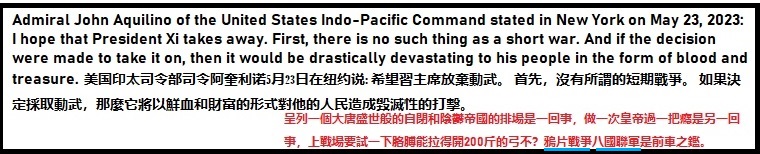
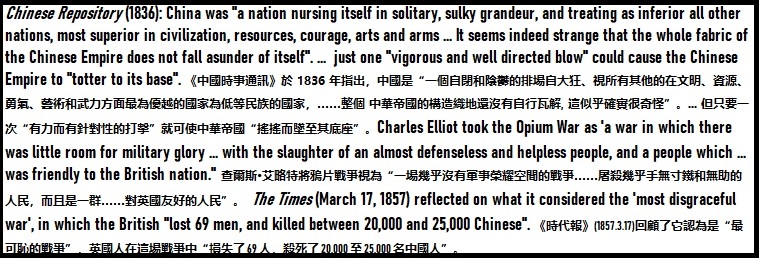





 ***
***



![Though, Anna Wang [Anneliese Martens], in her memoirs, expressed jealousy over Gong Peng by stating that the Anglo-American reporters had flattered the Chinese communists and the communist movement as a result of being entranced with the goldfish-eye'ed personal assistant of Zhou Enlai](GongPeng.jpg)