Sinitic Civilization-Book 1
Sinitic Civilization-Book 2
Tribute of Yu

Heavenly Questions
Zhou King Muwang's Travels
The Legends of Mountains & Seas
The Bamboo Annals - Book 1

The Scourge-of-God-Tetralogy:
From the Khitans to the Jurchens & Mongols: A History of Barbarians in Triangle Wars and Quartet Conflicts
(available at iUniverse;
Google;
Amazon;
B&N)
|
|
 This website's contents are the result of 20 years' writings --that could be compared to the "archaeological deposits" in a literary sense.
The freelance-style writings on the website were not proof-read.
Portion of the writings, i.e., related to Pre-History, Xia, Shang, Zhou, Qin, and Han dynasties, was extracted, polished, reconciled, and synthesized into
The Sinitic Civilization - Book I which is
available now on
Barnes & Noble,
Amazon,
Google Play|Books
and
Nook.
Book II is
available now on
Amazon
and Barnes & Noble.
Check out this webmaster's 2nd edition --that realigned Han dynasty's reign years strictly observing the Zhuanxu-li calendar of October of a prior lunar year to September of the following lunar year
and
cleared this webmaster's blind spot on the authenticity of the Qinghua University's Xi Nian bamboo slips as far as Zhou King Xiewang's 21 years of co-existence with Zhou King Pingwang was concerned.
To give the readers a heads-up, this webmaster had thoroughly turned the bricks concerning the Sinitic cosmological, astronomical, astrological, historical, divinatory, and geographical records, with the indisputable discovery
of the fingerprint or footprint of the forger for the 3rd century A.D. book Shang-shu (remotely ancient history),
and
close to 50 fingerprints or footprints of the forger of the contemporary version of The Bamboo Annals --a book that was twice modified and forged after excavation.
All ancient Chinese calendars had been examined, with each and every date as to the ancient thearchs being examined from the perspective how they were forged or made up.
Using the watershed line of Qin Emperor Shihuangdi's book burning to rectify what was the original before the book burning,
this webmaster filtered out what was forged after the book burning of 213 B.C.
This webmaster furthermore filtered out the sophistry and fables that were rampant just prior to the book burning, and validated the history against the oracle bones, bronzeware and bamboo slips.
There are dedicated chapters devoted to interpreting Qu Yuan's poem Asking Heaven, the mythical mountain and sea book Shan Hai Jing, geography book Yu Gong (Lord Yu's Tributes), and Zhou King Muwang's travelogue Mu-tian-zi Zhuan, as well as a comprehensive review of ancient calendars, ancient divination, and ancient geography.
One chapter is focused on the Huns, with a comprehensive overview of the relationship between the Sinitic people and the barbarians since prehistory.
The book has appendices of two calendars: the first Zhuanxu-li anterior quarter remainder calendar (247 B.C.-85 A.D.) of the Qin Empire, as well as a conversion table of the sexagenary years of the virtual Yin-li (Shang dynasty) quarter remainder calendar versus the Gregorian calendar, that covers the years 2698 B.C. to 2018 A.D.
Refer to
Introduction_to_The_Sinitic_Civilization,
Afterword,
Table of Contents - Book I (Index)
and
Table of Contents - Book II (Index)
for details.
This website's contents are the result of 20 years' writings --that could be compared to the "archaeological deposits" in a literary sense.
The freelance-style writings on the website were not proof-read.
Portion of the writings, i.e., related to Pre-History, Xia, Shang, Zhou, Qin, and Han dynasties, was extracted, polished, reconciled, and synthesized into
The Sinitic Civilization - Book I which is
available now on
Barnes & Noble,
Amazon,
Google Play|Books
and
Nook.
Book II is
available now on
Amazon
and Barnes & Noble.
Check out this webmaster's 2nd edition --that realigned Han dynasty's reign years strictly observing the Zhuanxu-li calendar of October of a prior lunar year to September of the following lunar year
and
cleared this webmaster's blind spot on the authenticity of the Qinghua University's Xi Nian bamboo slips as far as Zhou King Xiewang's 21 years of co-existence with Zhou King Pingwang was concerned.
To give the readers a heads-up, this webmaster had thoroughly turned the bricks concerning the Sinitic cosmological, astronomical, astrological, historical, divinatory, and geographical records, with the indisputable discovery
of the fingerprint or footprint of the forger for the 3rd century A.D. book Shang-shu (remotely ancient history),
and
close to 50 fingerprints or footprints of the forger of the contemporary version of The Bamboo Annals --a book that was twice modified and forged after excavation.
All ancient Chinese calendars had been examined, with each and every date as to the ancient thearchs being examined from the perspective how they were forged or made up.
Using the watershed line of Qin Emperor Shihuangdi's book burning to rectify what was the original before the book burning,
this webmaster filtered out what was forged after the book burning of 213 B.C.
This webmaster furthermore filtered out the sophistry and fables that were rampant just prior to the book burning, and validated the history against the oracle bones, bronzeware and bamboo slips.
There are dedicated chapters devoted to interpreting Qu Yuan's poem Asking Heaven, the mythical mountain and sea book Shan Hai Jing, geography book Yu Gong (Lord Yu's Tributes), and Zhou King Muwang's travelogue Mu-tian-zi Zhuan, as well as a comprehensive review of ancient calendars, ancient divination, and ancient geography.
One chapter is focused on the Huns, with a comprehensive overview of the relationship between the Sinitic people and the barbarians since prehistory.
The book has appendices of two calendars: the first Zhuanxu-li anterior quarter remainder calendar (247 B.C.-85 A.D.) of the Qin Empire, as well as a conversion table of the sexagenary years of the virtual Yin-li (Shang dynasty) quarter remainder calendar versus the Gregorian calendar, that covers the years 2698 B.C. to 2018 A.D.
Refer to
Introduction_to_The_Sinitic_Civilization,
Afterword,
Table of Contents - Book I (Index)
and
Table of Contents - Book II (Index)
for details.
|
|
Table of lineages & reign years:
Sovereigns & Thearchs;
Xia-Shang-Zhou dynasties;
Zhou dynasty's vassalage lords;
Lu Principality lords;
Han dynasty's reign years
(Sexagenary year conversion table-2698B.C.-A.D.2018; 247B.C.-A.D.85)
|
Epigraph|Preface|Introduction|T.O.C.|Afterword|Bibliography|References|Index
(available at iUniverse|Google|Amazon|B&N)
|
|
THE MONGOLS - PART I
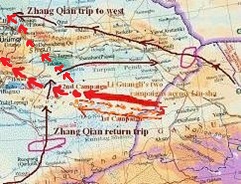 For details on when the east met with the west, see this webmaster's discussion on the Huns, the Yuezhi, the Tarim Mummies, the Yuezhi-Yushi misnomer,
the Mongoloid-Caucasoid admixture at 2000 B.C.E.,
the fallacy of the Aryan bearing of the Chinese civilization,
the fallacy of the Yuezhi jade trade,
the Yuezhi migration timeline,
as well as
the location of the Kunlun Mountain,
Queen Mother of the West,
the legendary book of mountains and seas at the Imperial China blog,
and the Qiang's possible routes of passage into Chinese Turkestan
at
http://www.imperialchina.org/Barbarians.htm which was embedded within the
Huns.html and
Turks_Uygurs.html pages.
(Note that Western Queen Mother had the prototype in an "earth mother" deity, not related to Queen Sheba of Charles Hucker.
The Mt. Kunshan jade was more likely the Mt. Huoshan jade in the Han dynasty book Huai Nan Zi, or the Mt. Yiwulü jade or the Kunlun jade that were juxtaposed together in the same book Huai Nan Zi, not related to Queen Mother of the West.
http://www.sino-platonic.org/complete/spp115_chinese_proto_indo_european.pdf provides another perspective of looking at things of the past from the perspective of language cognates. Rather believing that the Indo-Europeans ever invaded China and gave the Sinitic people the language, we could actually deduce that "Old Chinese", for its 43% correlation with the Proto-North-Caucasian, rather 23% with the Proto-Indo-European, was the source for both the cognates of the Proto-North-Caucasian and the Proto-Indo-European -- with the Proto-North-Caucasian falling under the umbrella of the Dene-Caucasian (Sino-Caucasian) Language Family that encompassed the [Proto-North-]Caucasian, Yeniseian and Sino-Tibetan languages. This is because our cousins, i.e., the N haplogroup people, relocated to North Asia and then to Latvia, Estonia, Finland and Scandinavia, bringing along the Sinitic language to the Proto-North-Caucasian who in turn gave it to the Proto-Indo-European. Note the Sinitic language cognates' 74% correlation with the Proto-Tibeto-Burman who split from the Sinitic people merely 5000-6000 years ago.)
For details on when the east met with the west, see this webmaster's discussion on the Huns, the Yuezhi, the Tarim Mummies, the Yuezhi-Yushi misnomer,
the Mongoloid-Caucasoid admixture at 2000 B.C.E.,
the fallacy of the Aryan bearing of the Chinese civilization,
the fallacy of the Yuezhi jade trade,
the Yuezhi migration timeline,
as well as
the location of the Kunlun Mountain,
Queen Mother of the West,
the legendary book of mountains and seas at the Imperial China blog,
and the Qiang's possible routes of passage into Chinese Turkestan
at
http://www.imperialchina.org/Barbarians.htm which was embedded within the
Huns.html and
Turks_Uygurs.html pages.
(Note that Western Queen Mother had the prototype in an "earth mother" deity, not related to Queen Sheba of Charles Hucker.
The Mt. Kunshan jade was more likely the Mt. Huoshan jade in the Han dynasty book Huai Nan Zi, or the Mt. Yiwulü jade or the Kunlun jade that were juxtaposed together in the same book Huai Nan Zi, not related to Queen Mother of the West.
http://www.sino-platonic.org/complete/spp115_chinese_proto_indo_european.pdf provides another perspective of looking at things of the past from the perspective of language cognates. Rather believing that the Indo-Europeans ever invaded China and gave the Sinitic people the language, we could actually deduce that "Old Chinese", for its 43% correlation with the Proto-North-Caucasian, rather 23% with the Proto-Indo-European, was the source for both the cognates of the Proto-North-Caucasian and the Proto-Indo-European -- with the Proto-North-Caucasian falling under the umbrella of the Dene-Caucasian (Sino-Caucasian) Language Family that encompassed the [Proto-North-]Caucasian, Yeniseian and Sino-Tibetan languages. This is because our cousins, i.e., the N haplogroup people, relocated to North Asia and then to Latvia, Estonia, Finland and Scandinavia, bringing along the Sinitic language to the Proto-North-Caucasian who in turn gave it to the Proto-Indo-European. Note the Sinitic language cognates' 74% correlation with the Proto-Tibeto-Burman who split from the Sinitic people merely 5000-6000 years ago.)
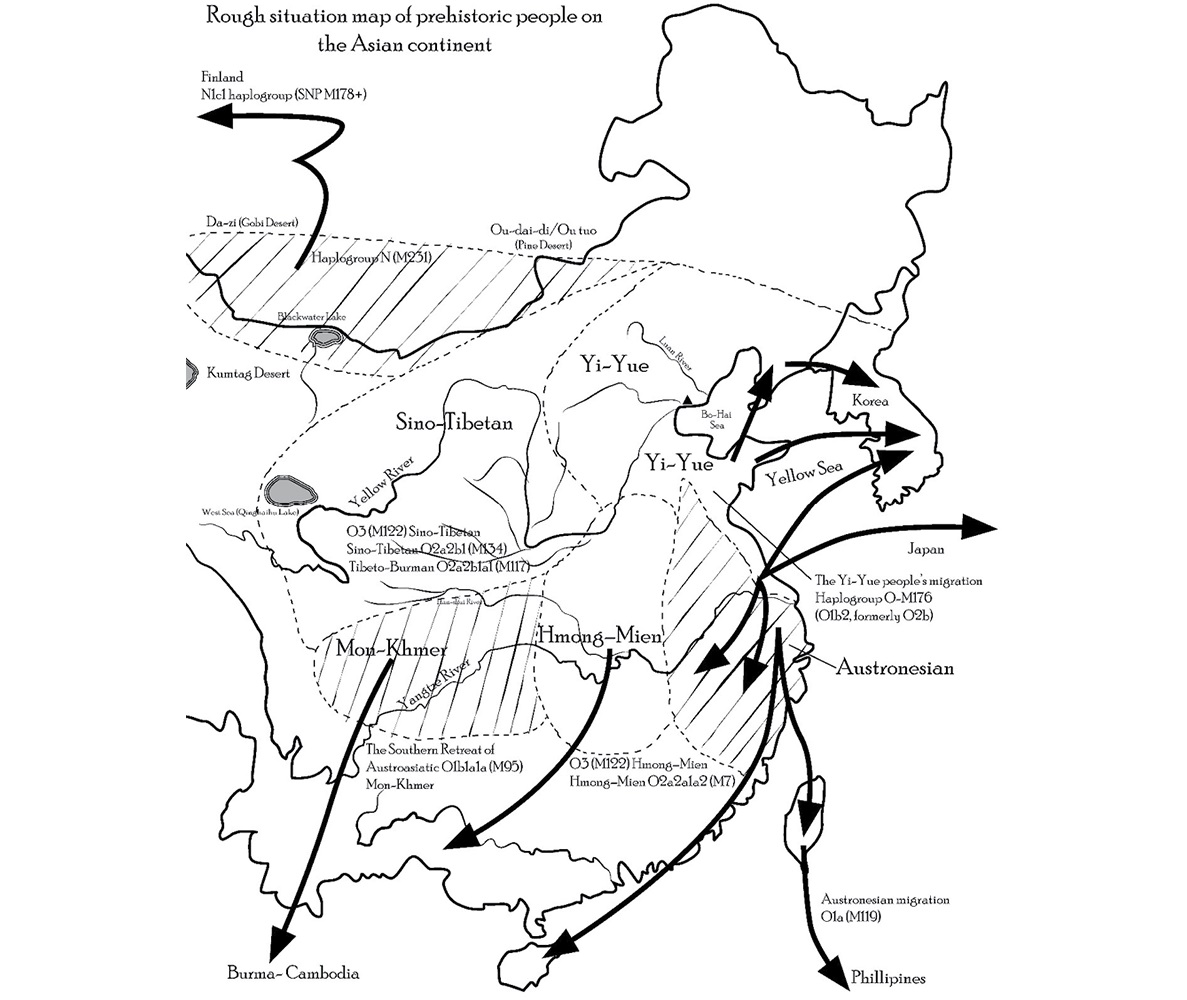
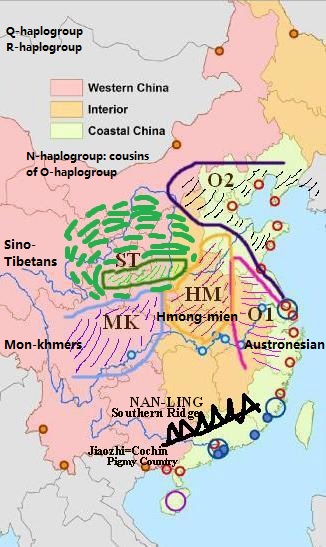
Li Hui of Fudan University of China analyzed the Asian DNAs to have derived a conclusion that ancestors of the [East] Asians possessed a distinctive Mark M89 by the time they arrived in Southeast Asia.
About 30,000 years ago, from the launching pad of Southeast Asia, the early Asians went through a genetic mutation to marker M122.
Li Hui claimed that the early migrants to the Chinese continent took three routes via two entries of today's Yunnan and Guangxi-Guangdong provinces.
More studies done after Li Hui had ascertained the dates of the O1, O2 and O3 haplogroup people, with the (O1, O2) entrants along the Southeast Chinese coast dated to have split away from the O3-haplogroup people like 20,000 years ago, much earlier than the continental peers, i.e., the Sino-Tibetans (O3a3c1-M117), Hmong-Mien (Miao-Yao, O3a3b-M7) and Mon-khmers.
According to
https://www.ncbi.nlm.nih.gov/pmc/articles/PMC5255561/
"Y chromosome suggested Tibeto-Burman populations are an admixture of the northward migrations of East Asian initial settlers with haplogroup D-M175 in the Late Paleolithic age, and the southward Di-Qiang people with dominant haplogroup O3a2c1*-M134 and O3a2c1a-M117 in the Neolithic Age. Haplogroup O3a2c1*-M134 and O3a2c1a-M117 are also characteristic lineages of Han Chinese, comprising 11.4% and 16.3%, respectively. However, another dominant paternal lineage of Han Chinese, haplogroup O3a1c-002611, is found at very low frequencies in Tibeto-Burman populations, suggesting this lineage might not have participated in the formation of Tibeto-Burman populations."
Namely, the haplogroup O3a1c-002611 Sinitic people, not the O3a2c1*-M134 and O3a2c1a-M117 barbarians, were responsible for engendering the Yangshao and Longshan civilization, and partially with the N-haplogroup people, engendering the Hongshan civilization.
The Zhou people were archaeologically speculated to have origin from today's Shanxi for the link to the Guangshe Culture –- which was in turn a derivative of the You'ao-type Laohushan Culture of the mixed N-haplogroup and O-haplogroup people.
(Since the O3a1c-002611 people were separated from the Northwestern cousins and Tibeto-Burmese at an early age, for it to have a part in the history of Northwestern China, the explanation would be to treat the Haplogroup O3a2c1*-M134 and O3a2c1a-M117 people as the historical Qiang and Hu barbarians, with the latter's paleo-Northwestern genes replacing the paleo-North-China and paleo-Central Plains genes of O3a1c-002611 Sinitic people by the Soong dynasty (A.D. 960-1279), that was likely triggered by the multiplication of the Tang dynasty's imperial house that had its origin from the Western Corridor.
The Soong dynasty royals took Tianshui of western China as the ancestral homeland, which was similar to the Tang dynasty royals' origin from the Western Corridor in western China, i.e., the Qin and Zhao states' common ancestral place.
The Soong royal house, however, could be of the Shatuo Turks' Q-haplogroup gene.
Also see this webmaster's discussion on
the ethnic nature of the ancient Huns belonging to part of the epic Jiang-rong human migration
of the Jiang-surnamed San-miao people and Yun-surnamed Xianyun people.)
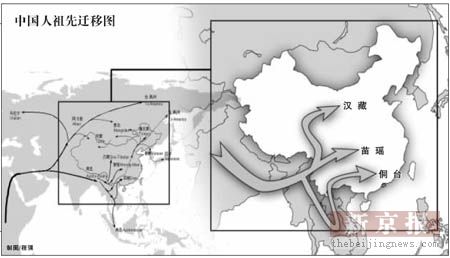 Li Hui commented that one branch of the early Asians, over 10,000 years ago, entered China's southeastern coastline with genetic marker M119. Li Hui, claiming the same ancestry as the Dai-zu and Shui-zu minorities of Southwestern China, firmly believed that his ancestors had dwelled in the Hangzhou Bay and the Yangtze Delta for 7-8 thousand years.
The people with the M119 marker would be the historical "Hundred Yue People".
The interesting theory adopted by Li Hui would be the migration of one branch of people who continued to travel non-stop along the Chinese coastline to reach the Liao-he River area of today's Manchuria.
Li Hui's speculation on basis of the DNA technology was an evolving process.
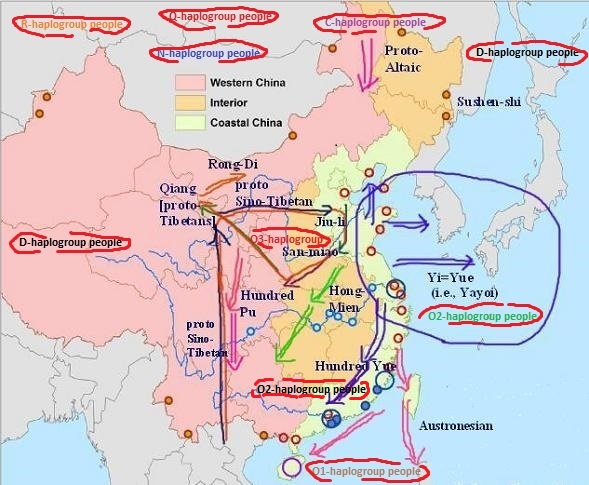
This would be likely the O2-haplogroup people, rather than the C-haplogroup or North Asia people whose historical presence in Asia could be dated 50,000 years ago, just after the earlier D-haplogroup people who were now mostly restricted in the area of Hokkaido, Japan, and known as the Ainu.
The C-haplogroup people developed into what this webmaster called by the Altaic-speaking people,
i.e., ancestors of the Mongols and Manchus.
What likely happened was that the O2-haplogroup people first travelled along the coast to reach Manchuria, and then traced back towards the south to reach the Yangtze area about 7-8000 years ago, where they evicted the O1-haplogroup people to the Southeast Asian islands.
At about the same time, the O3-haplogroup people, moving through the continent, reached today's western Liaoning at least 5000 years ago, or like 11,000 years ago on basis of the evidence of the pottery aging.
See the genetical analysis conducted by Li Hongjie of Jirin University on the remains of prehistoric people extracted from the archaeological sites.
Li Hui commented that one branch of the early Asians, over 10,000 years ago, entered China's southeastern coastline with genetic marker M119. Li Hui, claiming the same ancestry as the Dai-zu and Shui-zu minorities of Southwestern China, firmly believed that his ancestors had dwelled in the Hangzhou Bay and the Yangtze Delta for 7-8 thousand years.
The people with the M119 marker would be the historical "Hundred Yue People".
The interesting theory adopted by Li Hui would be the migration of one branch of people who continued to travel non-stop along the Chinese coastline to reach the Liao-he River area of today's Manchuria.
Li Hui's speculation on basis of the DNA technology was an evolving process.
This would be likely the O2-haplogroup people, rather than the C-haplogroup or North Asia people whose historical presence in Asia could be dated 50,000 years ago, just after the earlier D-haplogroup people who were now mostly restricted in the area of Hokkaido, Japan, and known as the Ainu.
The C-haplogroup people developed into what this webmaster called by the Altaic-speaking people,
i.e., ancestors of the Mongols and Manchus.
What likely happened was that the O2-haplogroup people first travelled along the coast to reach Manchuria, and then traced back towards the south to reach the Yangtze area about 7-8000 years ago, where they evicted the O1-haplogroup people to the Southeast Asian islands.
At about the same time, the O3-haplogroup people, moving through the continent, reached today's western Liaoning at least 5000 years ago, or like 11,000 years ago on basis of the evidence of the pottery aging.
See the genetical analysis conducted by Li Hongjie of Jirin University on the remains of prehistoric people extracted from the archaeological sites.
  Northeast (southeastern Inner Mongolia)
    Niuheliang, Lingyuan, the Hongshan Culture, 5000 YBP,
    4 N, 1 C*, 1 O

  North
   Yuxian County (the Sanguan site), Hebei,
   the Lower Xiajiadian Culture, 3400-3800 YBP, all O3
Combining Li Hui's study with the pottery excavation, we could see a clear path going north extending from around 15,000 years ago to 10,000 years ago.
Refer to Yaroslav V. Kuzmin's discourse on potteries
to see the path of migration of
proto-Mongoloids
from southwestern China (approx. 15,120+/-500 BP) to
Northeast Asia (Manchuria [13,000 BP, or c. 14,000 - 13,600 cal BC] and
Japan [c. 11,800-10,500 cal BC (c. 13,800 - 12,500 cal BP)]) to
Siberia (11,000 BP, or 11,200 - 10,900 cal BC).
In the timeframe of about 10,000 years, developing a genetic mutation to the marker M134, one branch of people who went direct north, per Li Hui, would penetrate the snowy Hengduan Mountains of the Tibetan-Qinghai Plateau to arrive at the area next to the Yellow River bends.
Owning to the cold weather environment, some physique, such as big noses, heavy lips and longer faces, developed among this group of people, i.e., ancestors of the Sino-Tibetans.
Splitting out of the northbound migrants would be those who went to the east with a new genetic marker M117, i.e., ancestors of the modern Han [a misnomer as the proper term should be Sino-Tibetan, nor the later Sinitic] Chinese.
We could say that our Sino-Tibetan ancestors forgot that they had penetrated northward the Hengduan Mountains from the Indo-China "CORRIDOR" in today's Burma-Vietnam.
"Walking down Mt Kunlun", i.e., the "collective memory of the ethnic Han Chinese" throughout China and the Southeast Asian Chinese communities, that was echoed in Guo Xiaochuan's philharmonic-agitated epic, would become the starting point of the eastward migration which our Chinese ancestors remembered.
(Li Hui grouped the 3000-year-old Chu and Qi people in the same category as the Han Chinese, albeit meeting the ancient classics' records as to the Qi statelet's lineage from the Qiangic-Tibetan Fiery Lord.
According to
https://onlinelibrary.wiley.com/doi/full/10.1111/j.1759-6831.2012.00244.x
"the frequencies of the three main subhaplogroups of O3-M122: O3a1c-002611, O3a2c1*-M134, and O3a2c1a-M117 in Han Chinese are 16.9%, 11.4%, and 16.3%, respectively (Yan et al., 2011).
The northward migration of haplogroup O3a1c-002611 started about 13 thousand years ago (KYA). The expansions of subclades F11 and F238 in ancient Han Chinese began about 5 and 7 KYA immediately after the separation between the ancestors of the Han Chinese and Tibeto-Burman.
Haplogroup O3a1c-002611 and O3a1c1-F11 started their northward migration about 12 KYA from Southeast Asia, along with other O3-M122 lineages, and reached the upper and middle Yellow River basin. About 7 KYA, haplogroup O3a1c2-F238 originated in the ancestors of modern Sino-Tibetan populations. About 6 KYA, the Han Chinese split from the Proto-Sino-Tibetan, and started their migration to the east and south (Su et al., 2000b). About 5 KYA, haplogroup O3a1c1-F11 experienced rapid expansion, probably in the Eastern Han Chinese, with recent gene flow with surrounding populations and eventually became prevalent in different ethnic groups in East Asia.)
Li Hui then pointed out that the ancient Wu people, with M7 genetic marker, came to the lower Yangtze area about 3000 years ago.
While Li Hui claimed that the M7 Wu people had split away from the northbound M134 Sino-Tibetan people, the historical Chinese classics pointed out that the Wu Statelet was established by two uncles of Zhou Dynasty King Wenwang, i.e., migrants from the Yellow River area.
The general layout by Lu Hui seems to have corroborated with Scholar Luo Xianglin's claim that early Sino-Tibetan people originated from the Mt Minshan and upper-stream River Min-jiang areas of today's Sichuan-Gansu provincial borderline and then split into two groups, with one going north to reach the Wei-shui River and upperstream Han-shui River of Shenxi Province and then eastward to Shanxi Province by crossing the Yellow River.
--Though, this webmaster's analysis of China's prehistory shows that the Sino-Tibetan people who moved to the eastern coast was one group, with the future Tibetans being actually the exiles to Northwest China from eastern and central China during the era of Lord Shun. Namely, the split of the Sinitic and proto-Tibetan people occurred prior and during the exile in the late 3rd millennium B.C.E.
(George Driem proposed that the Sino-Tibetans had splitoffs like the Western Tibeto-Burmans and the Eastern Tibeto-Burmans, with the Eastern Tibeto-Burmans forming two groups of northern and southern, who in turn split into the Northwestern Tibeto-Burmans, the Northeastern Tibeto-Burmans, the Southwestern Tibeto-Burmans, and the Southeastern Tibeto-Burmans, with a claim that the western offshoots went all the way to the Kashmir before returning east along the northern slope of the Himalayas to have a reunion with their cousins and that the Northeastern Tibeto-Burmans were the Sinitic people.)
What Li Hui did not touch on in his earliest studies were the cousin tribes of the Sino-Tibetans, namely, the Hmong-miens and Mon-khmers.
As noted at http://www.ncbi.nlm.nih.gov/pmc/articles/PMC3164178/, "A clear hierarchical structure (annual ring shape) emerged in the network of O3a3b-M7 (Fig. 2B), in which MK (Mon-Khmers) haplotypes lay at the center of the network (immediately next to the origin), HM (Hmong-Mien) haplotypes were distributed at the periphery to the MK haplotypes, and the ST (here the subfamily Tibeto-Burman) haplotypes were only found further away from the origin."
|
|
* In Commemoration of China's Fall under the Alien Conquests in A.D. 1279,
A.D. 1644 & A.D. 1949 *
 U.S.S.R./Comintern Alliance with the KMT & CCP (1923-1927)
 Korean/Chinese Communists & the 1931 Japanese Invasion of Manchuria Korean/Chinese Communists & the 1931 Japanese Invasion of Manchuria
American Involvement in China: Soviet Operation Snow, IPR Conspiracy, Dixie Mission, Stilwell
Incident, O.S.S. Scheme, Coalition Government Crap, Amerasia Case & The China White Paper
* Stay tuned for "Republican China 1911-1955: A Complete Untold History" *
|
|
Zou Rong's Revolutionary Army;
Shin Kyu Sik's
Shrine (Spirit, Kunitama) of Korea
|
This snippet is for sons and daughters of China:
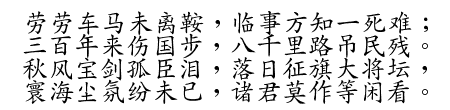
Heed the sons & ministers' agony and sorrow of our ancestors who died or lived through the Mongol, Manchu and Soviet-Chicom conquest
and
the Yongjia, Jingkang and Jiashen cataclysms !
Jeanne d'Arc of China:
Teenager girl Xun Guan breaking out of the Wancheng city to borrow the relief troops in the late Western Jinn dynasty;
Liu-Shao-shi riding into the barbarian army to rescue her husband in the late Western Jinn dynasty;
teenager girl Shen Yunying breaking into Zhang Xianzhong's rebels on the horseback to avenge on father's death in the late Ming dynasty.
China's Solitary and Lone Heroes:
Nan Jiyun breaking out of the Suiyang siege and charging back into the city in the Tang dynasty;
Zhang Gui & Zhang Shun Brothers breaking through the Mongol siege of Xiangyang in the Southern Soong dynasty;
Liu Tiejun breaking through three communist field armies' siege of Kaifeng in the Republican China time period;
Zhang Jian's lone confrontation against the communist army during the June 3rd & 4th Massacre of 1989.
|
|
|
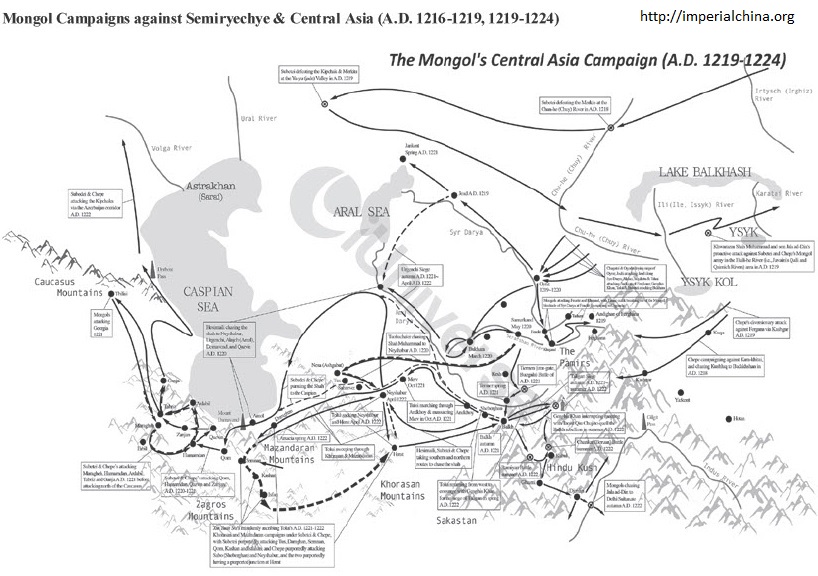
The Mongol history is a topic widely touched upon, and a good source will be "Mongolia - A Country Study" linked at http://lcweb2.loc.gov/frd/cs/mntoc.html authored by Robert L. Worden and Andrea Matles Savada, eds. Washington, DC: Federal Research Division of the Library of Congress, 1989. An excerpt could be seen at http://www.shsu.edu/~his_ncp/Mongolia.html. Most of the studies concentrated on the Mongols at the time of Chinggis Khan (Jenghiz Khan or Genghis Khan) and his trans-continental empire. What I am interested in is historical authentication, and this kind of research is probably best achieved by Paul Ratchnevsky whose German version of the book, "Genghis Khan: His Life And Legacy" (first published in 1983 by Franz Steiner Verlag GMBH), was translated into English in 1991 by Blackwell Publishers Ltd. The author thoroughly compared all available records, from "Secret History of the Mongols" (military sagas authored around 1228 by Shigi-Khutukhu the adopted son of the Khan), Chinese version "Shenwu Qin Zheng Lu (The Campaigns of Genghis Khan)" (derived from Altan Debter-Golden Book, the same source as used by Rashid), "Yuan Shi (history of the Yuan dynasty)" (edited by Khubilai), Juvaini's "History of the World Conqueror", and two books by Rashid ad-Din the Jewish doctor of the Mongol Il-khans of Persia: "Jami'al-tawrikh (Collected Chronicles)" and "History of the Tribes".
Some western scholars, in their description of the Mongol military brutality, would point out that it was Genghis Khan's Mongols who helped to lay the foundation of today's Russia and China. They would further express their admiration for Genghis Khan's ambition and military feats for uniting the Mongols into a strong nation and his exceptional military talents in defeating any rival in front of him. While it might be true that the Mongols played a role in forming today's Russia, it's definitely not the case with China, a country experiencing integration and disunity in a predictable fashion for the past thousands of years.
 As to Genghis Khan's personal traits, they are not very different from other heroes or tyrants in the human history. For Genghis Khan, I will list three as most important of all: revenge, lust, and predacity. Genghis Khan lost his father at an early age, as a result of his father being poisoned by the Ta-ta-er tribe. This is in addition to the Ta-ta-er tribe's betraying his ancestors to the Jurchens. He would be deprived of the tribal privileges by his own people after the death of his father. Hence, Genghis Khan's life-time objective became indisputably clear: to avenge himself on his enemies. Genghis Khan would first retake leadership of his own tribe, and then defeat the Ta-ta-er (not today's Tartars), the top enemy. The final revenge would be that on the Jurchens who were driven out of their first capital of Peking, and the second capital of Kaifeng, and finally the Jurchens were denied a request to surrender. (In contrast, the later Manchu people would treat the Mongols much better.) As to the second trait, Genghis Khan launched several campaigns against the Tanguts' Xixia (Western Xia) and Jurchens' Jin (Gold), but on the initial wars against both parties, respectively, he withdrew his forces after the emperors of Xixia and Jin negotiated peace by surrendering their young daughters to Genghis Khan as brides. It was rumored that Genghis Khan died of poisoning in the hands of his Tangut wife when he campaigned against Xixia the 2nd time. Genghis Khan's life philosophy is best quoted in all books available, namely, he once asked his sons, "What will be the happiest thing ever for a man in his lifetime?" He told his sons that it would be to kill the male population of his enemies, grab the daughters and wives of his enemies, and take them as his wives & concubines.
Indeed, the Mongols mercilessly slaughtered the male population of clans and tribes they conquered.
The myth that the Mongols spared those who surrendered was simply not true. The Mongols either killed all males or those males who had a height above the wheel of a cart. E.g., after taking over Samarkand where the defenders surrendered, Genghis Khan would kill all 40,000 prisoners at night, with about 30,000 skilled workers and artisans spared and another 30,000 labor taken as slaves.
The simple trick is like this: the Mongols tricked the conquered city by separating the males from females, ordered the males to dwell outside of the city wall, and slaughtered them at night.
Similar genocides could be found among the Spanish Conquistadors and British colonialists in North America and Australia. (http://www.bbc.co.uk/history/genes/population/proof.shtml carried an article proving that the Spanish Conquistadors slaughtered indigenous Amerindian men and enslaved the women as exhibited by the Iberian Y chromosomes and Amerindian mtDNA in today's Colombia.)
For nomads like Genghis Khan, the traits (genetic or not) remain quite simple: Since the nomads do not have grain reserves for natural disasters as the agricultural settlers do, the first thing the nomads would undertake would be to raid into the sedentary communities. Coupled with his two former traits, Genghis Khan's accomplishments are certainly understandable.
Then who are those Mongols? They are not necessarily the same as today's Mongolians. Today, both the Mongolians and the Kazaks claim that they were the true descendants of Genghis Khan, and some people in southwestern China also claimed the same heritage. When Mr Liang Suming (the Last Confucian Of China) published an article "An Exploration Into Yuan Dynasty" in 1918 and hence was appointed lecturer of philosophy at Peking University, people would not know that Liang, a youth of 25 from Guiling, today's Guangxi Province in Southern China, would be a Mongol in heritage. The Mongols held on to their stronghold in today's Guangxi-Yunnan areas much longer after they lost China proper. Recent DNA tests conducted against the remains of the Khitan tombs, however, pointed to the possibility that those Mongols in today's Yunan-Guangxi areas were more Khitan than Mongol. Those people in southwestern China did historically claim that they were the descendants of the Khitans who were dispatched to southern China by the Mongols in the 14th century. (The DNA tests, interestingly, also linked the Dawo'er or Dagur people in today's Manchuria as the closest kin of the ancient Khitans.)
Then, who were those people called the Mongols (generically the Kiyats) came from at the time of Genghis Khan? What was their lineage and who would be their direct descendants today? And, what did Paul Ratchnevsky say in his book "Genghis Khan: His Life And Legacy" about the origins of various steppe tribes, the ambiguous birth year of Genghis Khan, and most importantly, missing 10 year history of the Khan?
Mengwu Shiwei
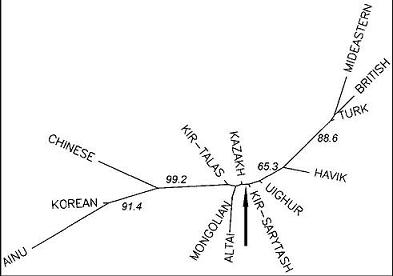 It will be a tough call to tell the difference between the Turkic, Mongol and Tungusic tribes. We had spent considerable time exploring into the Huns and the Turks. It will help in clarifying the origin of the Mongols. Before the Mongols, there existed the Hsiung-nu (Huns), Hsien-pi (Xianbei), Tavghach (Tuoba), Juan-juan (Ruruans), Tu-chueh (Turks), Uygurs [Huihe, i.e., ancestors of the Uighurs (see the Turk section)], Kirghiz, and Khitans. Tribal empires rose and fell, the conquered and the conquerors mixed up, and ethnic and linguistic dividing lines blurred. Notable would be the fact that the so-called [misnomer Indo-European] Yuezhi (Yüeh-chih) migrated to Oxus and the proto-Iranian world a long time ago. The Huns, who drove away the Yuezhi in the 3rd century BC Hunnic-Yuezhi War, raided as far west as the ancient Jiankun [Kirgiz] territory or today's Tuva territory. The Turks, and the later Mongols, followed the path of the former.
For further discussions on Barbarians & Chinese, please refer to
After the Hunnic decline in late first century AD, the Xianbei moved west to take over the Huns' territories. The Xianbei mixed up with the Huns. There appeared a Xianbei chieftain called Tanshikui (reign A.D. 156-181) who established a Xianbei alliance by absorbing dozens of thousands of Hunnic clans ("bu luo"). The Tanshikui alliance disintegrated after the death of Tanshikui. Between the Xianbei and the Chinese were three prefectures of the Wuhuan people, to whom the Xianbei were originally subordinate.
Yuan Shao, one of the warlords of the late Han Dynasty time period, campaigned against the Wuhuans and controlled three Wuhua prefectures. After Ts'ao Ts'ao defeated Yuan Shao, Yuan's two sons, Yuan Shang and Yuan Xi fled to seek refuge with the Wuhuans.
Ts'ao Ts'ao, i.e., Han Dynasty's prime minister, pacified the Wuhuan in a long-distance trek to Liucheng in today's southern Manchuria. Ts'ao Ts'ao campaigned against the Wuhuan, killed a chieftain called Tadu (with same last character as Hunnic Chanyu Mote [often spelled as Modu or Modok], and took over the control of southern Manchuria. The Xianbei then took the place of the Wuhuan, and three major groups were seen: the Greater Xianbei under Budugeng, and the Lesser Xianbei.
The Xianbei chieftain called Kebi'neng emerged to take the place of the Wuhuan in southern Manchuria. Cao Wei Dynasty, to deal with the emerging threat from the Xianbei, sent an assassin to kill Kebi'neng.
In mid-238, Sima Yi's Cao Wei army made a stealthy Liao-River-crossing to sack Xiangping, exterminated the whole family of Gongsun Yuan as well as massacred over 2000 senior officers and officials and over 7000 men above the age of 15, ending 50 years of Gongsun family's ruling in Manchuria and Korea. Further details are available at:
Han Prime Minister Cao Cao's Campaign against the Wuhuan;
Yan Zhi & Wang Xiong Pacifying the Xianbei;
Cao Wei Dynasty's Campaign against the Gongsun Family in Manchuria.
By deporting 40,000 households of Sinitic Chinese or over 300,000 people back to North China from Manchuria in A.D. 238, Sima Yi effectually yielded the area to the Tungusic people.
Among the Xianbei who were to take the place of the Wuhuan to dominate the area would be
the clans of
Duan, Murong and Yuwen.
The Xianbei, with major tribes of Murong, Yuwen, Duan, would establish many short-lived successive states along the Chinese frontier. The Xianbei enjoyed hundreds of thousands of cavalry, as seen in its intrusion into North China to defeat Ran Min's Wei Dynasty during the Sixteen Nation time period. (Note the later Jurchens, who were called by the "cooked" or white Dadan versus the "raw" or black Dadan [i.e., the Mongols] had more pigs than horses.)
The Huns set up their Hunnic Han or Zhao Dynasties by the end of Western Jinn Dynasty. Also Hunnic will be a Xia Dynasty, established by Helian Bobo, who was said to be of a mingle nature, called 'Tie Fu'. The Tie Fu Huns were born of Xianbei mother and Hunnic father. Among these states, the Tuoba or Tuoba (T'o-pa in Wade-Giles), a subgroup of the Xianbei, took over northern China and established Tuoba Wei Dynasty. In and north of the Altai, the leftover Huns were absorbed by the Ruruans whose founder, who once served under Tuoba Xianbei, fled to the Altai and built up a strong power by absorbing the Huns and Gao-che people. Then, the Ruruans were defeated and exterminated by the Turks. Tuoba would deal with the onslaughts by the Ruruans first and then the Turks. The Tuoba themselves got Sinicized in northern China. (In today's northern Chinese province was a county named Shiwei, and in the Russian Far East was a prefecture named Tuoba.)
In A.D. 443, the barbarians who took over Tuoba's old territories, i.e., the upper Heilongjiang River and northern Xing'an Ridge (Greater Khingan Mountains), came to see Tuoba Wei Emperor (Tuoba Tao) and told him that they found the Tuoba ancestors' stone house, called 'Ga Xian Dong'. Tuoba Tao sent a minister called Li Chang to the stone house which was carved out of a natural cavern. In the 1980s, this cavern was discovered as well as the inscriptions left by Li Chang. Ultimately, Tuoba Wei Dynasty would be usurped by two generals of Xianbei heritage.
The people who dwelled in the old Xianbei-Wuhuan-Tuoba territories would be the later Shiwei Tribes (ancestors of Mengwu Shiwei or Genghis Khan's Mongols), the Khitans, the Xi nomads, and the Malgal people etc. They would be the ancestors of the later Jurchens or the Mongols. The Khitans first appeared on the stage.
The Khitans, occupying the old territories of the Xianbei, were said to be related to the Tungus, according to "New History of the Five Dynasties". Specifically, "New History of the Tang Dynasty" mentioned that the Khitans were the descendants of the Kebi'neng Xianbei. (Alternatively, "Old History of the Five Dynasties" said that the Khitans were alternative race of the Huns which was a generic name for all nomads.) By referring the Khitans to either Huns or Xianbei, the ancient Chinese merely acknowledged the fact that the northern invaders had come from the same direction.
Specifically, the Chinese history stated that the Khitans derived from the Yuwen Xianbei who fled north to the Songmo [pine desert] area after a defeat in the hands of their fellow Xianbei clans. Among the two fellow Xianbei clans, the Murong clan was responsible for establishing the 'Yan' statelets and the Tuyuhun kingdom in western China while the Duan clan could have a member travelling as far as the Western Corridor, and a further descendant moving to southwest China to launch the Dali kingdom.
New History of the Tang Dynasty said that by the time of Tuoba's Northern Wei Dynasty (A.D. 386-534), the ancestors of the Khitans adopted the name 'Khitan' ["Qidan" in Chinese] for themselves.
The Khitans lived around the Liao River in today's Manchuria, or more specifically in the pine desert area or the upperstream Liao River. To the east of the Khitans will be Koguryo, to the west the Xi nomads (said to be alternative race of the Huns or a split tribe from the Khitans), to the north the Huji (Malgal) and Shiwei Tribes, and to the south Yingzhou Prefecture of Tuoba Wei Dynasty.
"New History of the Tang Dynasty" said the Khitans possessed eight tribes and they were subject to the Turks. Prior to Sui Dynasty (A.D. 581-618), the Turks replaced their Ruruan masters as the strongest power in the northern steppe. Around the 620s, the Khitan chieftain came to see Tang's first Emperor, Tang Gaozu (Li Yuan), together with the Malgal chieftain. At the times of Tang Empress Wuhou, the Khitans began to rebel against Tang. In A.D. 712, the Khitans submitted to Tang and was conferred the title of King of Songmo [pine desert] Prefecture. Heads of the eight Khitan tribes were conferred posts as general, too. A Tang royal family princess, Princess Yongle, was sent to the Khitan khan as wife. More Tang princesses were married over to the Khitans. By the mid-750s, the Khitans defeated the Tang army led by An Lushan, a mingle of the Turks and the Hu from Central Asia. The Khitans later submitted to the Uygurs. It would be in A.D. 842 that the Khitans came to submit to Tang again after the Uygur kingdom was destroyed by the Kirghiz. Governor-general of Youzhou, Zhang Zhongwu, would replace the Khitan's Uygur seal with a Tang seal. In the A.D. 860s, the Khitans came to pay pilgrimages to Tang. After the fall of the Tang Dynasty (A.D. 619-907), three dynasties among the Five Dynasties (A.D. 907-960), Posterior Tang 923-936, Posterior Jin 936-946, Posterior Han 947-950, were ruled by the Sha'to Turks. The remaining Orkhon Turks were not heard from after China's Five Dynasties time period. With the demise of the Tang Dynasty (A.D. 618-907), the Khitans began to conquer the Xi nomads, Tanguts, Dada [Dadan], and Shiwei statelets. The Uygurs (Uighurs) fled to the Tibetans and Karlaks to take refuge in Ganzhou and today's Xinjiang after being replaced by the Kirghiz.
The Shiwei people were said to be an alternative race of the Khitans, according to New History of the Tang Dynasty .
The Sui dynasty annals carried the names of five Shiwei tribes (southern Nan-Shiwei, northern Bei-Shiwei, Bo-Shiwei [carrying later Khitan 'bo' for the 'nabo' camp), Shenmoheng-Shiwei and Major Da-Shiwei), and the Tang dynasty annals carried nine clusters of tribes (Lingxi-Shiwei [west of ridge], Shanbei-Shiwei [north of mountain], Yellow-head Huangtou-Shiwei, major Da-ruzhe-Shiwei, minor Xiao-ruzhe-Shiwei, Powo-Shiwei, Nebei-Shiwei, and Luotuo-Shiwei [camel]) plus additional attached tribes of another dozen or so names including Wusugu, Yesaimo, Sanhezhi, Hexie, Nali, Damolou, Dagou, Wuluohu, Wuwan-guo (i.e., the Wuhuan state carrying the ancient Wuhuan name 500 years prior), major Da-Shiwei, western Xi-Shiwei, Mengwu-Shiwei, Luozu-Shiwei, eastern Dong-Shiwei, etc.
The Shiwei people shared the same language as the Malgal people (ancestors of the Jurchens and the Manchus).
They dwelled in the upper Heilongjiang River and the Argun River area. The location was to the east of the Turks, to the west of the Malgals,
and to the north of the Khitans.
The ancient record about the same language shared by Shiwei and Malgal could be the determinant about the origin of this group of Tungusic people. Note that before the Huji and Malgal, there was the ancient Fuyu people who split into the Eastern Fuyu and Northern Fuyu in today's Manchuria, with the eastern group going on to launch the Koguryo and Paekche kingdoms. Before the Fuyu people, there was extensive description of the 'Mo' people who were pressured by the Xianyun into an eastern move into Manchuria from northern China - which was a migration recorded in Shi-jing, an early Zhou Dynasty book, an event preceding the later Huns' attack against the Xianbei at the turn of Qin-Han dynasties.
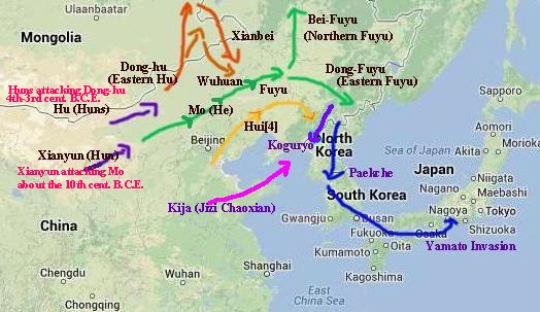
There were over 20 Shiwei tribes on record, including Mengwu Shiwei, ancestors of Genghis Khan Mongols.
Among the numerous Shiwei tribes would be an interesting name called 'Huangtou Shiwei', i.e., the yellow head Shiwei.
"Xin Wu Dai Shi" (new history of the Five Dynasties), citing the account of a Chinese (Hu Qiao) taken prisoner of war by the Khitans,
mentioned that there was a statelet called Yujuelu with 'Maodou' (hairy head) people to the northwest of Shiwei and to the north of the Kirghiz people.
Hu Qiao talked about how the Khitans changed their barbaric way of life by learning to make tents and carts from the Hei-che-zi (black cart} tribe.
Also to the northeast of Shiwei would be another group of 'Maoshou' or hairy head people.
Hu Qiao also mentioned a statelet called 'Gou-guo' ['doggy statelet'] where the babies born would be human beings if a girl,
but dogs if a boy. (Hu Qiao's account also depicted a northern expedition towards the Arctic Area by the ancient barbarians.)
Mengwu Shiwei
Against this setting, we would encounter the ancestors of the Mongols. The Shiwei tribes would be where we are to trace the Mongols for their origin.
The section Shi-wei Zhuan in Xin Tang Shu stated that there was the Shi-wei Major tribe beyond the mountain, a tribe dwelling next to the Shi-jian-he River, with the river having origin in the Ju-lun Lake and flowing towards the east. South of the Shi-jian-he River would be the Meng-wa Tribe, namely, the Mongols' original tribe. The Shi-jian-he River was taken to be today's Erguna River and the Ju-lun Lake Hulun-buir lake.
According to the Chinese history, there were over twenty Shi-wei (Shiwei) Tribes, including East Shiwei, West Shiwei, Mengwu Shiwei and Luozu Shiwei, among others. Mengwu Shiwei would be where the ancestors of the future Mongols under Genghis Khan's grandfathers came from. Mengwu Shiwei, according to the history account, dwelled in the upper segment of today's Heilongjiang River and belonged to the 'forest people' against the 'pastoral people'.
There was unfounded speculation that the Mongols' ancestors, i.e., 'shi wei', dwelled in central China thousands of years ago.
In Chang Fa of Shang Song4 in Shi-jing, there was an entry about Shang Dynasty founder-king Shang-tang's campaigns against several states, with the poem saying that Shang-tang first eliminated the Peng-surnamed Wei[3] and Si-surnamed Gu[4] states before tackling the Si-surnamed Kunwu-shi people, namely, 'Wei-Gu ji fa, Kunwu Xia-Jie'.
The Wei[3] state, also known as Shi[3]-wei[2] [or Xi1-wei2-shi which preceded the legendary Fuxi in Zhuang-zi's fable Da Zhong Shi of Zhuang Zi], was commonly taken to be located in today's Huaxian County of Henan, north of the Yellow River.
In Lu Lord Zhaogong's 11th year of Zuo Zhuan, there was a reply from Chang-hong to Zhou King Jingwang, in which the remotely ancient state of Shi[3]-wei[2] was taken to be a lunar lodge among the 28 mansions of the Constellation, i.e., the 'ying[2]-shi[4]' (encampment) mansion.
Shi[3]-wei[2] was also related to Liu Lei, a dragon trainer in the Xia dynasty, whom the Han Dynasty founder claimed to be their ancestor.
Shi3-wei[2] was taken by Xu Zhongshu to be literally meaning the pig-skin clothed, a tradition later seen among the Yilou and Jurchen barbarians of Manchuria. The inference was that the Mongols' or the Jurchens' ancestors dwelled in central China thousands of years ago.
This, however, was more likely a wishful thinking of the modern times, with the Mongol 'shi-wei' name being much later terminology that happened to be a soundex, not a written record to the effect that the Mongols had carried on the name from their ancestors, knowing that the barbarians did not know how to count their age.
Genghis Khan's Mongols were a Turco-Mongol mixture after
their ancestors migrated to the three rivers' area of Tu'ula, Kerulen
and Onon in central Mongolia.
Ancestors of Genghis Khan's Mongols, over ten generations backward, already migrated westward
to the three rivers' area of Tu'ula, Kerulen and Onon, and enjoyed the hereditary conferral of the title
of 'linghu' or Chinese 'linggong' which meant a Khitan Liao dynasty's court-sanctioned 'tribal duke'
equivalent.
The Khitans, who were of the same family as the later Mongols, differentiated
themselves from their barbarian cousins of the Mongol stock or Turco-Mongol stock by classifying
the barbarians under nine Da-da or Da-dan[4] tribes in Liao Shi (history of the Liao dynasty). Da-da
originally meant for a group of adversaries living to the east of the Turks in the 5th century A.D., and
was seen in the Turks' steles, such as Otuz-Tatar (san-shi-xing [thirty surnames] Da-da[2]) on the Kultigin
Stele (A.D. 732), and Toquz-Tatar (jiu-xing [nine surnames] Da-da[2]) on the Bilge Qaghan Stele
(A.D. 734). The Khitans were ethnically different from the Turkic/Uygur/Kirghiz stock to the west and
geographically different from the Tungusic stock in Manchuria. The Khitans, who belonged to the
Eastern Hu or Tungusic group, were also called by the Da-da (Dadan), a name the Khitans apparently
disliked for the likely reason that the Khitans were not admixed with the Turks or Finno-Ugric people
as the Da-da people were. The Jurchens, who called the Mongols by Da-dan[4] in Jin Shi (history of the
Jurchen Jin dynasty), could take themselves to be not admixed with the Turks or the Turco-Mongols.
Through the 1190s A.D., there were continuous wars between the Jurchens and Yelü
Dashi's Kara-Khitay in the three rivers' area of Mongolia and across the Gobi Desert.
In
another word, the Khitans were more kinsmen to the Mongols than to the Jurchens, one likely reason
that Genghis Khan, after routing the Jurchens, claimed to Yelü Chucai that the Mongols had avenged
on the Jurchens the old feuds on behalf of the Khitans.
The Khitans, who were related to the Mongols, were said in Bai-guan Zhi of Liao Shi to have a Pi-shi-jun army, with historian Xu Zhongshu taking Pi-shi to be the inverse of Shi-wei, namely, the origin of his claim that 'wei' meant for the [pig] skin.
According to Meng-da Shi Lu (Factual Notes on the Black Dadan), the Jurchens and the Dadan [i.e., the Mongols], whose C haplogroup gene was validated today, were of the same family, with their appearance being that of hairlessness except for Genghis Khan and his immediate circle, and that the distinction made for the Dadan people was due to their civilized levels, with those near the Chinese called by cooked, those faraway called raw, and among the raw, there were two groups of black and white, black meaning the extreme uncivilized and the white meaning somewhat civilized. Genghis Khan's Mongols, according to the book, belonged to the Black Dadan, whose barbarity was exhibited in its customs of having each horseman round up ten non-Mongol villagers as fodder to fill moats and sack forts, while the Jurchens belonged to the White Dadan. The Dadan, according to the Chinese classics, could have some ingredients from the Shatuo Turks of the Tang Dynasty period.
(This was basically the same 'human sea [wave]' attacks undertaken by the Chinese communists during the 1945-1950 civil wars to exhaust the bullets of the Chinese government troops which was put under an arms embargo by George Marshall and Harry Truman.)
The Shiwei people were said to be an alternative race of the Khitans, according to Xin Tang Shi (new history of Tang dynasty).
They could be related to the ancient 'Dingling' people. Dingling, a generic name, was said to be derived from the ancient Chi-di people, while Chi-di, together with Bai-di,
wherein the words 'chi' and 'bai' meant more likely white clothing and red clothing than else, were related to the Quan-rong barbarians who moved eastward across the East Yellow River Bend from West China [namely, the Qiangic land - the place ancient overlord Yao had exiled the San-miao people].
The early Gaoche people, where the Uygurs had looked for ancestry, were said to have relation to the Dingling as well.
All this pointed to the original San-miao epic exile, plus three successive sources, i.e., the son of last Xia Dynasty King Jie, the remnants of the Shang Dynasty along the North Yellow River Bend,
the Chi-di people who warred and inter-married with the same Ji-surnamed Jinn Principality of Zhou Dynasty.
Note that the Sinitic Chinese, with a tradition of maintaining a copious record of history, could at best paint the above pictures about the origin of the northern barbarians.
To explain the possible link of the ancient Chi-di and Bai-di barbarians to the later well-known barbarians, the Chinese classics hinted that the Kirghiz people in today's TUVA area had a custom of wearing the red clothes while the Xianbei had a custom of wearing the white clothes.
Following the Sinitic logic, the early Huns were most likely Qiangic
proto-Tibetans or a possible separate Yun-surnamed Xianyun group which was exiled to Northwest China together with the San-miao people in the late 3rd millennium B.C.E., while the later Xianbei, Khitan, Jurchen, Mongol and Manchu people were proto-Manchurian or proto-Altaic.
The confusion would be resolved should we pinpoint the C haplogroup or the Tungus people further away from the border with Sinitic China to be the area of the Amur River, Sungari River and the northern Khing'an Mountain Range while treating the "cooked Dadan" people, i.e., those dwelling between the Sinitic Chinese and the "raw Dadan" as the mixed O/C/N-haplogroup people.
(For further details, check into this webmaster's "Extrapolation of prehistoric people using the mitochondrial and nuclear DNA analysis, as well as cranial analysis, on the ancient remains extracted from the archaeological sites" on basis of the Jirin University DNA analysis.)
Similar to the account of the 'Huangtou' Shiwei in the Chinese history chronicles, there were entries in the Chinese history records about 'Huangtou' Xianbei as part of a federation of possibly 20-30 Xianbei tribes and clans before the Mongols, as well as 'Huangtou Jurchen'.
This pointed to the nomadic confederation that extended from Manchuria all the way to the northwestern direction to include the Indo-Europeans
in possibly today's Tuva, an area not far away from Minusinsk where excavations show existence of people with different skulls.
In the Tang dynasty, poet Du Fu had a sentence to the effect of calling "huangtou Xi-er", i.e., a yellow-headed man of the Xi [Kuzhen-xi/Kumo-xi] tribe. And in Xin Tang Shu, a statement was made to refer to Li Duozuo as having ancestry of a Malgal chieftain, with a nickname called "huangtou dudu [governor-general]".
Also see my research into non-existent sacking of the Jinn capital city of Luoyang by Huangtou Xianbei that was carried by Tang Dynasty poet Zhang Ji [or by Soong Dynasty poet Su Shi] hundreds of years later in regards to the misguided speculation on the nature of the Xianbei.
Zhang Ji apparently wrote multiple poems, talking about 'Xi-er' or a Xi barbarian standing on top of a buffalo as well as describing the Kunlun-nu or black-skinned and curly hair Kunlun slaves who were sold to Tang China from Southeast Asia. Kunlun, a mythical locality in fables like Mu-tian-zi Zhuan, was speculated by some people to mean the Altaic word 'kara' or blackness.
The Jurchens
were classified into the 'he-su-kuan' cooked
or acquaintance Jurchens (whom Khitan founder Abaoji forcefully resettled at Liaoyang with several
thousand households of big-clan Jurchens after conquering thirty-six barbarian tribes in Manchuria),
the noncooked and non-raw Jurchens in Xian[2]zhou (Xian[2]ping; Kaiyuan of Liaoning), the raw (i.e.,
uncivilized) Jurchens to the north of Sumo (Sungari) and northeast of Ningjiang, and the Huangtou
(yellow-head with yellow iris and green apple) Donghai (east sea) Jurchens further to the northeast
towards the Japan Sea.
Modern erudite Wang Guowei had located more Jinn, Tang and Soong dynasties' poems with description of the hairy and high-nose-bridge physique. Wang Guowei ascertained Posterior Tang Emperor Zhuangzong's appearance through a record about Wang Jinqing's observance of the emperor's statute near Luoyang, which exhibited someone with hair surrounding the two eyes, i.e., a hairy feature of the Shatuo Turks.
The Shiwei people first came to Tang Dynasty during the 5th year of Tang Emperor Taizong's reign, A.D. 631. Shiwei came to the Tang court over a dozen times. By the 4th year of Zhenyuan Era, A.D. 788(?), Xi nomads joined Shiwei in attacking the Zhengwu governor office. Shiwei were later taken over by the Khitan Empire. When the Jurchens rose up against the Khitans and moved into northern China, the Shiwei and Mongolia territories were nominally controlled by the Jurchens via three major Jurchen vassals: the Naimans, the Keraits and the Ta-ta-er (Tatars).
The Mongol Legends
Legends claimed that Mengwu Shiwei clan was defeated by the neighboring clans and that only a few people survived by fleeing into the Erkene-kun Mountains. An able man by the name of Qi-yan took charge of the remnants, and his name 'Qi-yan' would mutate into the later tribal name of 'Kiyat'. History of the Yuan Dynasty stated that Genghis Khan's clan name was 'Qiwowen-shi'. Qi-yan was said to have found an iron mine inside the Erkene-kun Mountains, and after melting the irons of a cavern, they found a road leading them out of the mountains.
Ke Shaomin's Xin Yuan Shi, a revisionist history that borrowed the purported European (including Russian) and Arab (including Persian) sources from Hong Jun's Yuan-shi Yi-wen zheng-by (validated supplement as to the translated texts about the Yuan dynasty history), claimed that only one man and one woman survived in escaping to the A-er-ge-nai-gun (Erkene-kun) mountain, wherein they bore two children by the name of Nao-gu and Qi-yan (Qi-wo-wen).
Over a dozen generations later would appear a person by the name of Duo-ben-ba-yan or Tuo-ben-muo-er-gen (Dobu Mergen) who married Alan-ko (Alan Gua). After having two children, Duo-ben-ba-yan passed away; however, Alan-ko was said to have immaculate conception, bearing three more children, including Bodunchar who possessed grey eyes against the chestnut eye color of the brothers.
Yuan Shi implied that Alan-ko bore just one son Bodunchar via immaculate conception.
Xin Yuan Shi, a revisionist history, claimed three sons or triplets,
and
added details to the effect that clansmen dispelled doubts after being invited to her bedroom the following night to witness the white glittering light.
The three brothers from the 'immaculate conception' were to form the Katagin, Seljiuts, and the Borjigin clans, respectively, with the former two later being part of Jamuka's coalition against Timuchin.
Bodunchar's descendants were to form the Ni-lun (Ni-er-lun) Mengwu tribe that possessed the Katagin, Seljiuts, and the Borjigin clans, respectively, with the former two clans later becoming part of Jamuka's coalition against Timuchin.
Alan-ko's two elder children were to form the Die-er-lie-jin (Da-li-jin, Darligin) Mengwu tribe.
Mengwu itself was later twisted to mean "khamag" (all-encompassing or great Mongols).
Bodunchar, together with his four elder brothers,
raided the Zha-e-chi-wu (Tayichi'ut) tribe and took over a woman called Bo-rui-ha-dun.
One of Bodunchar's grandson married Monolun and bore nine sons.
Monolun, according to History of the Yuan Dynasty, had bad temper and at one time killed some children of the neighboring Jalair clan by running a cart over the kids. The Jalair clan raided them in retaliation, and only one son of Monolun, i.e., Kaidu, survived. Later, Kaidu defeated the Jalair clan to be a leader of the early Mongol people. Also of the Bodunchar descendancy would be fifth generation grandson, Kabul Khan.
Genghis Khan's Mongols Called Themselves by the 'Ta-ta-er' (Generically the Kiyats)
However, contemporaries pointed out that the Genghis Mongols called themselves by the 'Tatars' (i.e., Ta-ta-er in Mandarin transliteration), not the Tartars used by the Westerners for designating the Manchu nor the same-name Tartars who lived in today's southeastern Russia.
Zhao Gong's Meng-da Bei Lu specifically stated
that the Mongols proclaimed themselves as 'Da-chao' or the grand court [that mutated to Khubilai's 'Yuan Chao' or the Yuan dynasty per Hirata Shigeki], and first used the rabbit and dragon samsara years before adopting the sexagenary 'geng-chen' (1217) and 'xin-si' (1218) years;
that the Mongols could have heard of a defunct Meng-gu-si country and adopted the 'Meng' name at the instigation of defector Jurchens;
that he heard the Mongol ruler, self-termed the 'Mo-hou' [Mahoraga] king, calling himself by Da-dan-ren or a Da-dan person; and that Nan-qian Lu's claim of the Mongols' promulgating to the Jurchens of a Longhu [dragon & tiger] Era 9th year must be a defector Jurchen Confucian's work.
'Ta-ta-er', also called by Zu-bu by the Khitans and Jurchens, appeared to be a transliteration of Da-da[1], Da-da[3], and Ta-tan, etc., originally meant for a group of adversaries living to the east of the Turks in the 5th century.
The 'Ta-ta-er' tribes, with numerous clans, themselves appeared to be a major or dominant part of the Onggirat tribal group or confederation, with the Onggirat people repeatedly resettled first by the Khitans and then by the Jurchens in all directions of the Khing'an Mountain Range.
It would be after the Jurchens took out the Zu-bu rebels, i.e., the Onggirats in the mid-1190s, that Genghis Khan's Kiyat clan and Toghrul's Keraits became the new master of the Mongolian plains.
And, it would be under viceroy Muhuali that the word 'Meng-gu' was adopted in communications with Southern Soong, which could be the Khitan or Jurchen Confucians' borrowing of an archaic name as a statelet name for conveniency's sake.
It would be Khubilai Khan who would officially endorse the name 'Mengwu', the English equivalent of which was 'Mongol'.
According to communist historian Wu Han, Meng-gu or the word Mongol derived from Genghis Khan's declaration of the 'Kuoke-menggu' (Yeke-Mongghol) Ulus, i.e., the tents' world of Yeke-Manghuole-ulusi – where 'Manghuole' itself derived from a name of ancestor Bei-er-tie-chi-na (Börte-chino, meaning grey wolf)'s wife Huo-ai-ma-lan-le (Gua Maral, white deer/fallow doe) or Manghuole-zhen-huo'a, i.e., Manghuole woman ('zhen') beauty ('huo'a').
Genghis Khan Mongols, who were said to be of the Kiyat clan, identified themselves with the branch of the forest people called the Tayichi'uts, the Jurkins, the Oirats and the Onggirats.
The ancestors of Genghis Khan's Mongols belonged to the Borjigid tribe which branched off from the Kiyats, i.e., Qi-yan or the Qiwowen-shi people from the legends of Secret History of the Mongols.
The Onggirats connection lies in the fact that Yisugei abducted a woman called Ho'elun as his wife, and the future Yuan Dynasty's internal ruling decreed that emperors must marry Onggirat women as empresses.
The terminology of Da-da, with different pictograph transliteration of Da-da[1], Da-da[3], and Ta-tan, etc., that originally meant for a group of adversaries living to the east of the Turks in the 5th century, and was seen in the Turks' steles, such as Otuz-Tatar (san-shi-xing [thirty surnames] Da-da[2]) on the Kul-tigin Stele (A.D. 732) that was known as the Orkhon [river valley] stele inscription, and Toquz-Tatar (jiu-xing [nine surnames] Da-da[2]) on the Bilge Qaghan Stele (A.D. 734). Liao Shi (history of the Liao dynasty) had multiple entries about nine Da-dan[4] tribes -- a name the Mongols changed to Zu-bu according to Wang Guowei but more likely changed by the Khitans themselves (who were of the same family as the later Mongols) for differentiation from their barbarian cousins of the Mongol stock [which was ethnically different from the Turkic/Uygur/Kirghiz stock to the west and geographically different from the Tungusic stock in Manchuria]. Jin Shi (history of the Jurchen Jin dynasty), in the biography on rightside prime minister Tudan Yi, called the Mongols by Da-dan4. Li Xinchuan's Jianyan yilai chaoye zaji (miscellaneous records of the court and mundane world since the Jianyan Era [A.D. 1227]) made a distinction in putting the Mongols under Hei-dada[2] (black Da-da[2]), who were alternatively called by Meng-da for the purported adoption of the Da-Menggu-guo state's titular name, and expressed bewilderment over the convergence of two different states of Da-da[2] and Menggu-guo, that straddled across the Xing'an Ridge.
(The forgery
Qi-dan
Guo Zhi mentioned a
Menggu-shan (Meng[2]gu[3]-shan) mountain,
with Zhou Liangxiao believing that the word Mongol (meng[2]gu[3]) derived from the Khitan 'Meng[2]-gu si' [barbarian
management] sub-ministry, that was located in the Khitan Shang-jing (upper capital) city of Linhuang,
with a Longmei-gong (dragon's brow) palace built in the shape of three mountains of Tianti (heavenly
ladder), Mengguo (Meng country) and Bielu per Liao Shi.)
The Jurchens, who had origin in the Mohe (Malgal) people along the Sungari River and the Chinese-Koryo border, were keen on completely wiping out the Khitans, with multiple expeditions launched against the Khatun city from A.D. 1131 to 1165, at the three rivers area of Tu'ula, Kerulen and Onon, and the Orkhon River area,
as well as in A.D. 1196, on which occasion Jurchen Jin prime minister Wanyan Xiang defeated the Zu-bu (i.e., Tatars) in cooperation with Genghis Khan's Mongols (i.e., generically the Kiyats) and Toghrul's Keraits, and erected two stone monuments in the Jurchen script and Chinese characters, that came to be known as Jiufeng Shibi Ji-gong Bei (cliff steles in commemoration of the feats on mount Jiufeng [nine peaks]; Serven Khaalga stele).
In the section on the Tayichi'uts and Mengwu, we will explain a bit more about their inter-relationship.
The Mongols possibly possessed the same kinsmanship as the Khitans & Jurchens
Historian Lü Simian speculated that Genghis Khan's Mongols were a mixture of Dada [Dadan] [with mixture from the Shatuo Turks] and Shiwei on basis of the fact that both the Turks and the Mongols treated the wolf as their ancestor.
Also note that the Mongol legend about seeking asylum in an iron mountain was similar to the Turk legend from 800-900 years ahead.
Some historian said the Khitans once used the word 'Onggirat' for themselves and the Jurchens [Jurchids] used 'Qonggirat' for the tribal name as well. In the same area where the Mongols lived, more than 800 years ago, there were the pigtail Tuoba people, and 1000 years ago, there were the shaved-head Xianbei people. The Jurchens and the Manchus, who belonged to the group of the Tungusic people near the Japan Sea, might have picked up the hair style from the barbarians around the Xing'an Mountains.
In separate sections, we touched on the hair style of the barbarians, including the pigtail style of Tuoba, the cut hair style of the Xianbei and Wuhuan, and the cut hair and pigtail style of the Jurchens and Manchus, to state that both the Huns and the later Turks in fact shared a similar hair style as the Sinitic Chinese, namely, no hair cut plus the bundling of hair. The difference between the Huns and the Sinitic Chinese was "hu[2] [Huns] fu[2] [clothing] ZHUI[1] [back of the head] jie[2] [bundling the hair]", while the Sinitic Chinese bundled the hair at the top of the head. As commented by historian Huang Wenbi, the Qiangic people in western China, who had been exiled there from the east as this webmaster had repeatedly said, shared the same customs as the ancient Yi people along the eastern Chinese coast, namely, they did not bundle hair and further had an opposite direction as far as wrapping the clothing was concerned, namely, "bei[4]? pi1?[dangling] fa[1] [hair] zuo[3] [left] REN[4] [overlapping part of Chinese gown]".
--This webmaster's point was that the Qiangs were of the San-miao lineage and carried some customs of the Eastern Yi nature while dwelling in central China, the Huns were related to the Sinitic Chinese [O3 haplogroup], and the Tungus [C haplogroup] from the northeast were different from the Huns. More, the Tungus [C haplogroup], who were likely evicted from North China and the eastern Chinese coast by the O-haplogroup people, could have evicted the N haplogroup to northwestern Siberia from western Manchuria. [The C haplogroup might have pushed the Q haplogroup or the ancestors of AmerIndians to the Americas about 15,000 years ago.] (Note that this webmaster, to reconcile the fact that the Sino-Tibetans were all O3 haplogroup, need to make a statement that the bird-totem Yi people along the coast, whose squatting [or spreading feet] and flat forehead customs were shared by the C-haplogroup Tungus, belonged to the O2 haplogroup. As to the N haplogroup who were evicted to northwestern Siberia, they [together with C-haplogroup people] might have pushed south to Chinese Turkestan from today's TUVA area to have eliminated the R haplogroup people whose 2000 B.C.E. mummies were excavated together with the Khams type proto-Tibetan mummies in the deserts.)
Note that there was a book called
"Records of the past, Volume 1"
by Records of the Past Exploration Society in the early 20th century. They noted that in Minusinsk, an area to the north of Outer Mongolia, there was trace of dolicho-cephalic skulls,
which was to say that at one time the Indo-Europeans pushed direct north to the Arctic direction, but later those Samoyades (Samoyedes) were replaced by the 'Mongoloid' Samoyades
who shared the same traits as those who populated the Americas, Manchuria and Japan.
The book claimed that they were pushed to "... the bleak region about the mouths of the Ob and the Yenisei Rivers, extending westward nearly to the White Sea...
they have been driven by the Mongol races, which pressed upon them from the south."
The Samoyades (Samoyedes) were the Finno-Ugric people at one time clustered together with the paleo-North-China Sinitic people and
belonged to the same Dene-Caucasian language family.
Yaroslav V. Kuzmin of Pacific Institute of Geography, Vladivostok, Russia, had written an article called "East and Siberia: review of chronology
for the oldest Neolithic cultures" in which he painted a smooth northward trace of potteries
starting from Guangxi and Hunan provinces of southwestern and southern China to Manchuria/Japan. The dates are:
Guangxi Province: the Miaoyan site, layer 5: 15 220±
260 BP (BA94137b) and 15120±500 BP (BA94137a)
(Zhao and Wu 2000);
Hunan Province: the earliest pottery-associated charcoal
14C date 13 680±270 BP (BA95058);
Japan: the earliest site with pottery is Odai Yamamoto
in northern Honshu (Aomori Prefecture),
the 14C age for layer
4 was estimated as 13 050±
108 BP, and the 14C age for
layer 3 as 13 170±56 BP;
Manchuria:
pottery appeared in
the Amur River basin at c. 13 000 BP, or c. 14 000–
13 600 cal BC;
and Siberia: the earliest pottery is dated
to about 11 000 BP, or 11 200– 10 900 cal BC.
The above dates pointed to the migration of a proto-Mongoloid group, who preceded the M122 Sino-Tibetans, to Northeast Asia in a timeframe between 15,000 and 10,000 years ago.
For more discussions on the ancient Mongolian migration, refer to http://imperialchina.org/Pre-history.html#Potteries.
Mengwu Shiwei (a Separate Meng[2]gu[3] State)'s Conflicts with the Jurchens
Later historical records quoted the Jurchen Jin Dynasty's history (compiled by Mongol Yuan Dynasty's prime minister) as saying that the 'Mengwu' people had a rebellion led by Kabul-khan (Ha-bu-le Khan). It was said that after the migration of the Jurchens to north China, the Borjigin people (who derived from Mengwu Shiwei) emerged in central Mongolia as the leading clan of a loose federation. Kabul Khan raided into Jurchen Jin in A.D. 1135 by taking advantage of Jurchen's southern campaign against the Soong Chinese. The Jurchen emperor, Wanyan Sheng, hearing of Mongol disturbance, called on Kabul Khan to the Jurchen capital. Kabul Khan, being drunken, did not show respect for the Jurchen emperor. When the Jurchens dispatched emissaries to Kabul Khan twice for recalling him to the Jurchen capital, Kabul Khan killed the Jurchen emissaries. Then, the Jurchens dispatched General Hu Shahu on a campaign against Kabul Khan. The Jurchens were defeated by Kabul Khan. When Jin Emperor Xizong (Wanyan Dan, son of Wanyan Aguda) died, his grandson colluded with Jurchen Jin General Wuzu in killing an uncle called Dalai, and Dalai's descendants fled to Kabul-khan's Mengwu people for assistance in avenging on the new Jurchen emperor. This caused the Jurchens to abort their southern campaigns against the Chinese of Southern Soong Dynasty. Jurchen General Wu-zu was sent to the northern border to fight the Mengwu people.
Unable to fight the Mengwu people, the Jurchens negotiated a peace treaty with the Mengwu in A.D. 1147 and moreover conferred Kabul-khan the title of king of the Mengwu people.
--This whole thread of stories could be made up by the later people.
This part of the Jurchen-Mongol wars' history was most likely forgeries.
Kabul Khan's Mongols, who should be properly called by the Kiyats, the Borjigins, or Kiyat-Borjigins - if not simply Da-da or the Tatars, could have conflicted with the Jurchens and even killed the Jurchen emissaries as claimed; however, Jurchen General Hu1-Sha1-hu1's war, or Wanyan Zongpan & Wanyan Xiyin's war (A.D. 1135 per Jianyan yilai xi-nian yao-lu), or Wanyan Zongbi (Jin-wuzhu)'s war (A.D. 1146 per Jianyan yilai xi-nian yao-lu), could be against a soundex Meng[2]gu[3] state in Manchuria, not in today's Mongolia.
Wang Guowei believed that all records concerning the early Mongol-Jurchen wars, inside and outside China, such as M. le Baron C. D'Ohsson (1780-1855)'s Histoire des Mongoles,
were all rooted in the two forgery books, i.e.,
Xing-cheng Lu
and
Zheng Meng Ji.
The Mongols, after receiving the Jurchen conferral, declared a dynastic era of Tianxing (heavenly revival), an apparently abstract concept unknown to the barbarians but carried [three quarters of a century later] by Zhao Gong's Meng-da Bei Lu (backup records of the Mengwu-dadan barbarians) via citation of Li Liang's Zheng Meng Ji (history of campaigning against the Mongols).
Hong Hao, a Soong emissary with the Jurchens at the time of Wanyan Dalai's death and author of Song-mo Ji Wen (records of what I heard at the Pine Desert), disputed the authenticity of Li Liang's Zheng Meng Ji.
Xing-cheng Lu (records of Jurchen campaigns [against the Mongols])'s claim that the Jurchens were required to annually provide the Mongols 250,000 ox and sheep each, 300,000 pi[3] (folds) of silk, and 300,000 liang (Chinese ounces) of cloth was apparently absurdity, to which the Southern Soong dynasty's potpourri compiling further added a so-called Jurchen tribute payment to the Mongols by 500,000 hu[2] (Chinese bushels) of rice and beans -- not knowing that the barbarians did not eat rice but meat.
What actually happened was the continuing wars of the Jurchens versus the Khitans, the Da-da[2] (including the Tatars and the later Mongols' cousin tribes) from the 1130s to the 1190s.
After the death of Kabul-khan, the 'Mengwu' people were commented to have disintegrated. Kabul-khan decreed that his brother, Ambaki, be the leader. The Mongols then had wars with the Ta-ta-er (Tatar) tribe. The Tatar tribe tricked Ambaki into an arrest via a proposition for an inter-marriage, and then sent both Ambaki and Kabul-khan's elder son to the Jurchens for execution. Kabul-khan's 4th son, Kaidu (Hu-du-la Khan), would avenge on the Jurchens. Kaidu passed on the reign to the 3rd son of his brother, i.e., Yesugei (Yi-su-ke-yi). (Yisugei, Genghis Khan's father and Emperor Shenyuan posthumously, would be the fifth generation of Kabul Khan, according to History of the Yuan Dynasty.) Yesugei would avenge on the Tatar tribe and kill a chieftain by the name of Timuchin (Timujin), a same name assigned to his son. Yesugei, who was chief of the Kiyat subclan of the Borjigin, was later poisoned by the Tatars in A.D. 1175, when Genghis Khan (Timuchin or Temujin) was only twelve years old. Genghis Khan is like either 3 or 4 generations apart from Kabul-khan. The Kiyat people rejected Timuchin as their leader and chose one of Timuchin's kins, instead. Temujin and his immediate family were deserted even by Yisugei's brothers who went to the Tayichi'ut clan. By the early 13th century, Genghis Khan would unite all Turko-Mongol tribes, including the Kiyats, Ta-ta-er, Merkits, Keraits and Naimans.
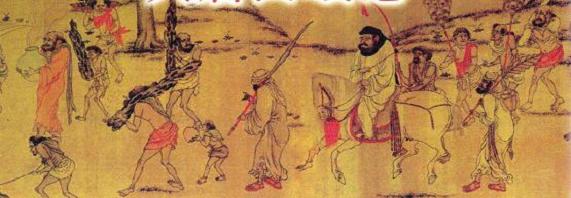
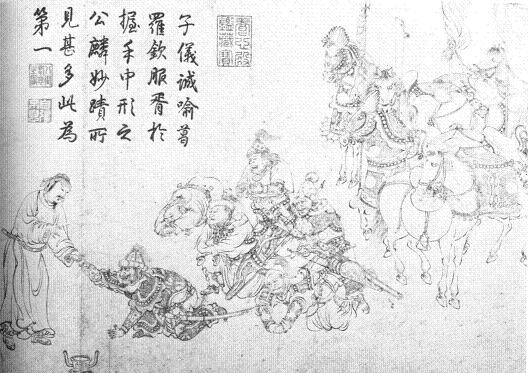
|
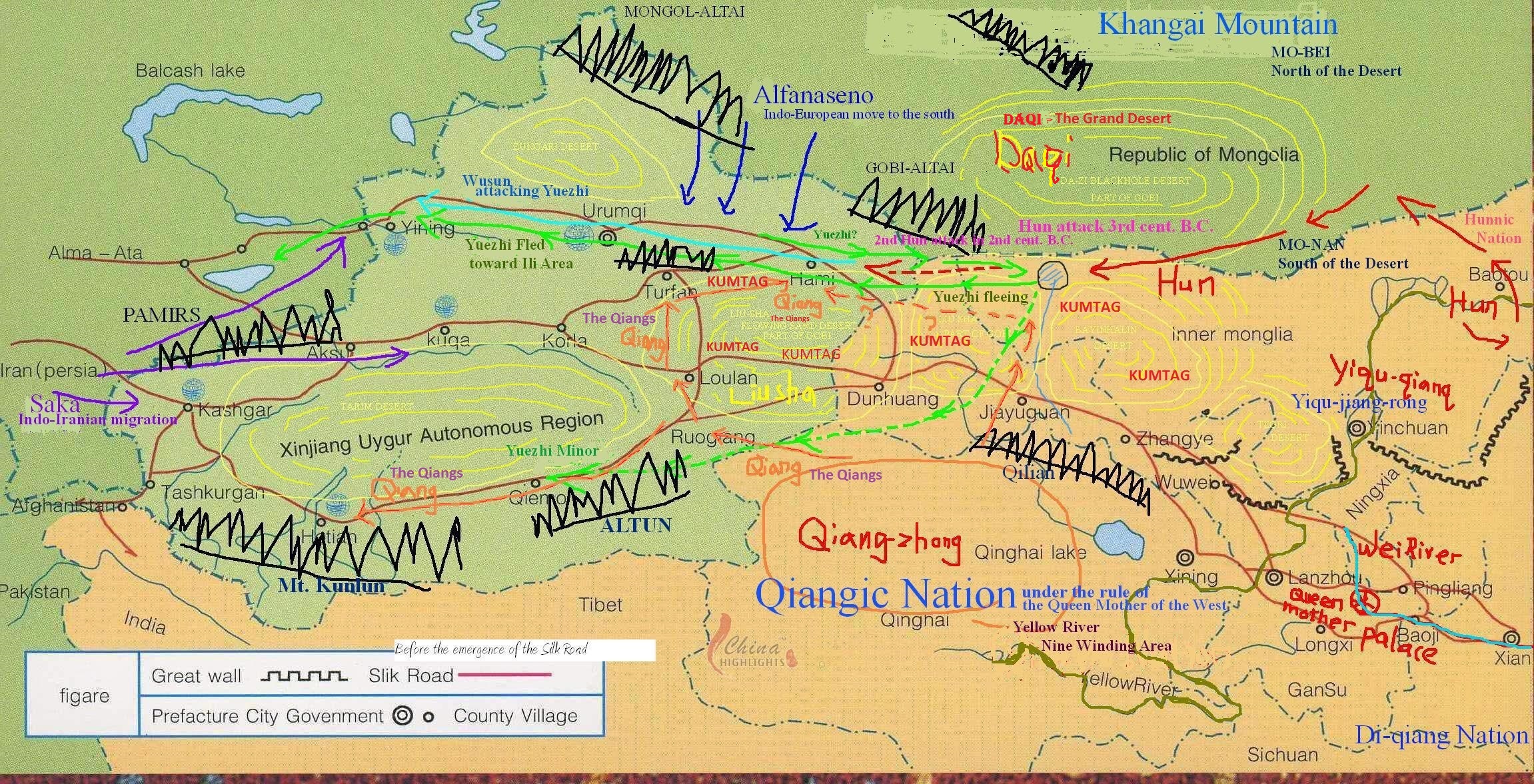
Below maps were added to the http://www.imperialchina.org/Barbarians.htm which was embedded within the
http://www.imperialchina.org/Huns.html and
http://www.imperialchina.org/Turks_Uygurs.html
pages.
On basis of the new archaeological findings and historical Chinese records, this webmaster will tentatively speculate on when the east met with the west.
First this webmaster wants to debunk the fallacies in regards to the equation of the ancient Yu-shi tribe to the Yuezhi, and the speculation on the jade trade that the Yuezhi was falsely accredited with.
The forged Guan Zi [管子] statement contained a reference which was a misnomer related to the 'Yu-shi' tribe, a term that was erroneously speculated by a few annotators in history, as well as scholar Wang Guowei of the early 20th century,
to be the same as Yuezhi per soundex.
Guo Yu, a political discourse book that was similar to Zhan Guo Ce, could be merely Han dynasty Confucian compilings, while Guan Zi, i.e., the fabled Legalist founding master, was at most a political economy book written in the late Western Han dynasty or at the turn of B.C. and A.D.
See Barbarians.htm for more discussion on the forged statements in Guan Zi [管子] (which historian Ma Feibai pierced sentence by sentence).
Around the Xin (New) Dynasty (AD 6-23), there occurred
a forgery movement by the Chinese scholars, possibly with the intention of substantiating the mandate of the usurper Wang Mang's dynasty.
The classics which were proved to be forgeries
include "Guan Zi [管子]", which historian Ma Feibai pierced sentence by sentence.
Using Ma's same logic, this webmaster had found the two other books, "Yi-zhou-shu" [逸周书] or "Zhou-shu" (Zhou Dynasty [11th cen. B.C. - 256 B.C.] [abbrev. 周书] book,
not the Zhou-shu [周书] from Posterior Zhou Dynasty of the South-North Dynasty time period of AD 557-581) and "Shang[1]-shu" [商书] (Shang Dynasty [16-11th cent. B.C.] book, not Shang[4]-shu [尚书], i.e., the remotely ancient book which was said to be abridged by Zuo Qiuming [Zuoqiu Ming]),
to be written in the exact same style and could be forgeries by possibly the same person[s].
Discarding the forgery of Guan Zi [管子] basically eliminated the whole foundation upon which the existence of the Yuezhi and the jade trade was built,
a fallacy which was widely cited in
the most recent 10-20 years, i.e., the 1990s and 2000s, to the effect that the fabricated Yuezhi had lived close to the heartland of China, playing the role of bearing the Aryan civilization to China.
Another school of thought, which was intended to discredit the Yellow Civilization, would be the false claim that the Sinitic Civilization "began in 3000 B.C. at Liangzhu", namely, the Yangtze River estuary --which was a taken-out-of-context judgment on the new findings from the multiple Neolithic sites and their age from across China.
Still another school would be the claim that the Shang Chinese were the ancient Koreans.
(A recent writing on the ancient forgeries at the imperialchina.org blog, which was not in the sense of political correctness till the later Western Han Dynasty, is available in pdf format: ImperialChinaOrg-on-forgeries.pdf.)
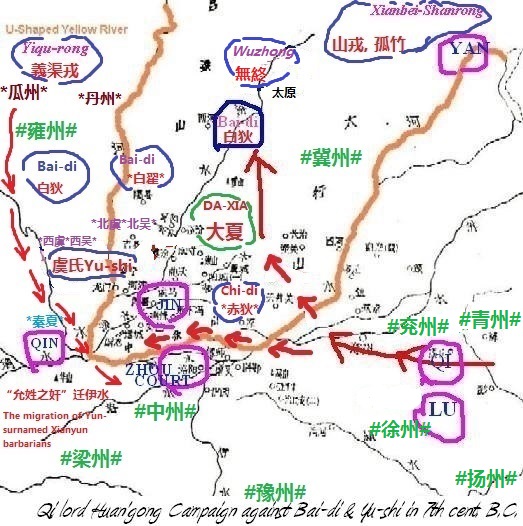 This webmaster never thought the people of the Central Asia or in Chinese Turkestan were an intermediary form of human evolution,
which was the basis of calling the Siberian origin of the Koreans a 'moo' point.
This webmaster had pointed out that in the collective memory of the Sino-Tibetans, that passed down by generations through millennia,
the Sinitic Chinese had forgot that they had travelled north from today's Burma-Vietnam while claiming to have walked down Mt Kunlun.
Previously, this webmaster checked into the historical context as well as the geo situation to find out about when the east met with the west,
and believed that the 3rd century B.C.E. Hun-Yuezhi War could be the start of the contact between Sinitic China and the West, i.e., the trigger that led to the chain reaction of the Yuezhi attacking the Wusun, and the Wusun attacking the Scythians, and so on.
With the new archeological findings, this webmaster would add that about 5000 years ago, the proto-Tibetan Qiangs had indeed penetrated into Chinese Turkestan,
to the north side of Mt Tianshan, from perhaps the southeastern rim of the Taklamakan Desert, 2000 years ahead of the Hun-Yuezhi War.
This webmaster never thought the people of the Central Asia or in Chinese Turkestan were an intermediary form of human evolution,
which was the basis of calling the Siberian origin of the Koreans a 'moo' point.
This webmaster had pointed out that in the collective memory of the Sino-Tibetans, that passed down by generations through millennia,
the Sinitic Chinese had forgot that they had travelled north from today's Burma-Vietnam while claiming to have walked down Mt Kunlun.
Previously, this webmaster checked into the historical context as well as the geo situation to find out about when the east met with the west,
and believed that the 3rd century B.C.E. Hun-Yuezhi War could be the start of the contact between Sinitic China and the West, i.e., the trigger that led to the chain reaction of the Yuezhi attacking the Wusun, and the Wusun attacking the Scythians, and so on.
With the new archeological findings, this webmaster would add that about 5000 years ago, the proto-Tibetan Qiangs had indeed penetrated into Chinese Turkestan,
to the north side of Mt Tianshan, from perhaps the southeastern rim of the Taklamakan Desert, 2000 years ahead of the Hun-Yuezhi War.
Now, this webmaster made a hypothetical claim here that the Huns could have encountered the Yuezhi at the "Great Lake" ("da ze"), namely, the Juyan Lake.
In the Juyan-ze Lake area, the bamboo strips (slips) were discovered, with evidence of the existence of names of the [famed] nine Zhaowu clans, 80 years or 3-4 generations after the first Hunnic attack against the Yuezhi: K'ang (Samarkand), An (Bukhara), Shih (Tashkent, i.e., Kishsh [Kashana]), Mi (Maymurgh [Penjikent]), Ts'ao (Kaputana), Ho (Kushanik [Kusanya]),
Mu (Murv, ? Huoxun [Khwarezmia]), and Su (Sudi, Bilinmemektedir). Here, the likely event was that the nine clans invaded Central Asia, where they mutated their [possibly Sinitic] names to the multiple-syllable statelet names, before the descendants of the nine clans returned to the east in the subsequent half millennium.
See Wang Guowei's theory of invaders coming from the East while traders from the West for understanding the nature of the nine Zhaowu clans of the Yuezhi.
Note the difference of one year in the chronicling, as seen across the history writings on the Han dynasty, which was the result of the wholesale misunderstanding of the Qin Empire's Zhuanxu-li calendar and the virtual Yin-li (Shang dynasty) calendar, something covered in this webmaster's book The Sinitic Civilization.
All history books had error in the Han dynasty's reign years, including the Hunnic chronicling years.
The Huns’ military activities could have happened any time between 209 B.C. and 202 B.C.
Nicola Di Cosmo (Ancient China and its Enemies: The Rise of Nomadic Power in East Asian
History, Cambridge University Press (2002)) claimed that the attacks of Donghu and Yuezhi happened in
208 B.C. and 203 B.C, respectively.
Thomas Barfield (The Perilous Frontier,
Cambridge, MA: Basil Blackwell (1989)) stated that the Han founder-emperor's October-November 201 B.C. Baideng
debacle happened in year 200 B.C., not knowing that the early Han emperors' reign years started in
October of a prior year and ended in September of the consecutive year.
Professor Gernet hedged himself in pinning the Hunnic-Han War, namely, Emperor Liu Bang's defeat at the Baideng mountain, to the period "201-200 B.C.", which should be November 201 B.C. when strictly observing the Zhuanxu-li calendar's ordinal months.
Click on the below picture for the enlarged map showing the first Hunnic attack at the Yuezhi possibly around the ancient Juyan Lake
(later known as the
Kharakhoto [Blackwater] Lake, Ejina or Juyan - before this 'West Sea' concept was applied to today's Qinghai-hu Lake by the usurper-emperor Wang Mang when he set up the Xi-hai-jun commandary using the imaginary four-seas' concept in Shan Hai Jing (The Legends of Mountains & Seas).
The reason that this webmaster made this hypothesis is that the Huns were more subsequently recorded to have fought another war against the Wusun, Loulan, Hujie and etc., i.e., the twenty-six statelets of Chinese Turkestan, at the place somewhere near Yiwu in the 2nd century B.C.,
to the east of Turpan, which then triggered the Wusun migration to Ili where they further drove the Yuezhi towards
today's Afghanistan.
(See Barbarians.htm for more discussions on the Yuezhi migration timeline.)
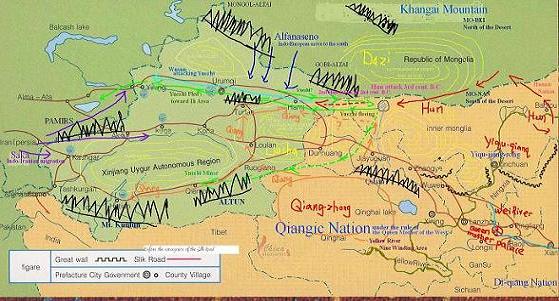
|
|
|
|
|
|
|
Sovereigns & Thearchs;
Xia-Shang-Zhou dynasties;
Zhou dynasty's vassalage lords;
Lu Principality lords;
Han dynasty's reign years
(Sexagenary year conversion table-2698B.C.-A.D.2018; 247B.C.-A.D.85)
|
|
The Sinitic Civilization - Book I is
available now at
iUniverse,
Barnes & Noble,
Amazon,
Google Play|Books
and
Nook.
The Sinitic Civilization - Book II is available at
iUniverse,
Amazon and Barnes & Noble.
Check out the 2nd edition preface that had an overview of the epact adjustment of the quarter remainder calendars of the Qin and Han dynasties, and the 3rd edition introductory that had an overview of Sinitic China's divinatory history of 8000 years.
The 2nd edition, which realigned the Han dynasty's reign years strictly observing the Zhuanxu-li calendar of October of a prior lunar year to September of the following lunar year, also cleared this webmaster's blind spot on the authenticity of the Qinghua University's Xi Nian bamboo slips as far as Zhou King Xiewang's 21 years of co-existence with Zhou King Pingwang was concerned, a handicap due to sticking to Wang Guowei's Gu Ben Bamboo Annals and ignoring the records in Kong Yingda's Zheng Yi.
Stayed tuned for Book III that is to cover the years of A.D. 86-1279, i.e., the Mongol conquest of China, that caused a loss of 80% of China's population and broke the Sinitic nation's spine.
Preview of annalistic histories of the Sui and Tang dynasties, the
Five Dynasties, and the two Soong dynasties
could be seen in
From the Khitans to the Jurchens & Mongols: A History of Barbarians in Triangle Wars and Quartet Conflicts
(The Barbarians' Tetralogy - Book III: available at iUniverse;
Google;
Amazon;
B&N).
(A final update of the civilization series, that is scheduled for October 2022, would put back the table of the Lu Principality ruling lords' reign years, that was inadvertently dropped from Book I during the 2nd update.)
|
|
Book II - Table of Contents:
Section Seven: The Han Dynasty
Relationship with the Huns 392
Chapter XXXIII: The Hunnic Empire 409
Origin of the Huns 409
The Rong & Di Barbarians in the Context of Relation to the Fiery Thearch, the San-miao Exiles and the last Xia Dynasty King 413
The Zhou, Qin and Jinn's Zigzag Wars with the Barbarians & the Construction of the Great Walls 417
Mote's Hun Empire, the Yuezhi People, and the Early Han Dynasty 424
The Huns & the Eastern Hu Barbarians 430
The Hunnic Government Structure & the Dragon Reverence 431
Chapter XXXIV: The Han Dynasty's Wars with the Huns 435
Chapter XXXVI: The Western Expedition, The Kunlun Mountain & Shan Hai Jing 489
Han Emperor Wudi Seeking Elixir from the Immortals on the Kunlun Mountain 491
Credible Geography Book on the Mountains Possibly Expanded to Include the Legendary Kunlun Mountain 493
Unearthly Things in the Mountains' Component of The Legends of Mountains & Seas 501
The Divination Nature and Age of the Seas' Component of The Legends of Mountains & Seas 506
Chapter XXXVII: Shan Hai Jing & The Ancient Divination 520
Chapter XL: The Latter Han Dynasty's Chronological History 560
The Relation with the Southern Huns 561
|
|
On the modern map, there was a tiny sand bridge between Chinese Turkistan and China, which was the narrow strip of desert sand to the east of Hami.
However, this corridor, today's Kumul line, could be a recent event.
There was the historical Da-qi4 blackhole desert to the east, nowadays called by the generic name GOBI. Specifically, near today's Hohhot, there was an ancient Chinese geological name called "qi4 kou", namely, the entry point into the Da-qi4 Desert.
The ancient Sino-Tibetan migration into the Tianshan Mountain could have come north from south, i.e., the Tibetan Plateau/Ruoqiang direction to the south --though this webmaster hesitated about the
passibility of the "Liu-sha" [quick sand] desert between Ruoqiang and Loulan (Lop Nur), which was another tiny sand bridge noticeable on the modern map.
Judging from Han Dynasty emissary Zhang Qian's change of mind on his return trip to go home along the Hami strip rather than going straight east across the Qiang-zhong [i.e., the middle Qiang nation land], we could tell that the northern strip was perhaps the most traveler-friendly.
(Could Zhang Qian had changed his mind in the hope of sneaking into the Hunnic territory to see the child he had with a Hunnic woman?)
That was Han Emperor Wudi (commonly-taken wrong reign 140-87 B.C. or 140-86 B.C.; nominal Oct 141-Dec 87 B.C.; actual Jan 141-Feb 87 B.C.)'s reign of B.C. 141-87, i.e., 141 BC and later, much later than Hun-Yuezhi wars.
Now, let's talk about the human migration.
There were widespread discussions of the 'Caucasoid' mummies in Chinese Turkestan, with the 'Loulan Beaty' purportedly dated 2000 B.C., while the southern 'cousins' in the Khotan area dated 100-300 B.C.
The timeline suggested a move from north to south, not west to east.
The 2000 B.C. Caucasoid mummies found in Loulan, in the Turpan Depression/Kumtag Desert, in-between Altaic/Tianshan Mountains and the Altun Mountain (Ruoqiang), could be the Indo-European people coming from the north of the Altaic Mountain [the Mongol Altaic Mountain of today], near the Alfaniesevo (Alfanesevo) bronze culture.
Though, Yuezhi might not be of this group of people coming from north.
Further diggings in the Loulan area, i.e., the ancient Salty Lake and Salty River (Peacock Rover), led to a site called by Xiaohe or the Little River, next to the Salty River (Peacock Rover), where the Mongoloid Mummies were discovered.
It appears to this webmaster that there was indeed good carbon dating on the Xiaohe excavation, which stated that "The entire necropolis can be divided, based on the archeological materials, into earlier and later layers. Radiocarbon measurement (14C) dates the lowest layer of occupation to around 3980 +/1 40 BP (personal communications; calibrated and measured by Wu Xiaohong, Head of the Laboratory of Accelerator Mass Spectrometry, Peking University), which is older than that of the Gumugou cemetery (dated to 3800)." The article claimed that the 'Mongoloid' mtDNA had similarity to some present South Siberian population. (For details, check http://www.biomedcentral.com/1741-7007/8/15 for the full article "Evidence that a West-East admixed population lived in the Tarim Basin as early as the early Bronze Age".)
The linking of this certain mtDNA in the Xiaohe/Loulan area to a modern Siberian population could be said to be circumvential at best since a lot of things might had happened in the past 4000 years.
That is, the linkage to the Siberian population could be actually an effect, not a source.
This area kind of had the same timing as the Mongoloid mummies that were discovered to the north and east of the Tianshan Mountain.
More than what was found about the mtDNA at Xiaohe/Loulan, there were mummies of the Khams-Tibetan type found to the further north,
in the Tianshan-Altaic mountain areas, which presented a much more convincing point that the proto-Tibetan Qiangs, from the south, had indeed crossed over the strip of the sand desert near Loulan to reach the north side of Tianshan.
Possibly, the Khams [proto-]Tibetan, after reaching the Tianshan Mountain Range, moved towards Hami (Qumul) to the east, where there were the Hami (Qumul) Mongoloid mummies excavated.
Note that today's Kham Tibetans were not far away from the historical Sanxingdui (three star) Excavations in western Sichuan, that was discovered by Gaway Hann (an American professor of the former Hua-xi [west China] University),
a Neolithic/Bronze culture dating from about 4800 to 2800 years ago, as well as a bridge providing Southwest China's tin to the Shang dynasty
and the Zhou dynasty.
This webmaster's reasoning was that the Qiangs had a dominance in the area since China's prehistory, like 5000 years ago, at least the time of the Yellow Emperor [Huangdi (? BC 2697 - 2599; reign 2402-2303 with rule of 100 years per Zhu Yongtang's adjustment of
The Bamboo Annals], and they controlled the southern rim, southeastern rim and eastern rim of the Taklamakan Desert, and somehow around 2000 B.C., penetrated northward to reach the two sides of the Tianshan mountain range, while the so-called Caucasoid oases in their path, namely, the Loulan area, might have risen and fallen numerous times in history -- if they ever existed there prior to the penetration by the Khams [proto-]Tibetans.
Or the other way around, the Khams [proto-]Tibetans could be speculated to have penetrated to the two sides of the Tianshan mountain range earlier than the Indo-Europeans, and subsequently encountered the Indo-Europeans near the Tianshan Mountain, and ultimately the Indo-Europeans gradually dominated over the area and eliminated the trace of the Khams [proto-]Tibetans, pressing them back to the southeastern rim of the Taklamakan Desert.
(See Barbarians.htm for more discussions on the ancient human migrations.)
There could have been a striking similarity between the Mongol attack at the Tanguts in the 13th cent. A.D. and the Hun attack at the Yuezhi in the 3rd cent. B.C.
Both took the desert road towards the Blackwater Lake.
It kind of gives you a picture how the Huns first raided to the west against the Yuezhi, forcing the Yuezhi Major to flee west while the elderly and the children, i.e., the Yuezhi Minor,
crossed the Qilian mountain to seek asylum with the Qiangs, and per Yu Taishan, continued to move on towards the southeastern rim of the Taklamakan Desert,
towards
Khotan where the people were recorded to be Chinese or Hua-xia-looking, throughout China's Han and Tang dynastic records, till annihilated sometime during the Islamic invasion of the
Buddhist stronghold of Khotan or possibly during the earlier Turkic-Uygur conquest of the Chinese Turkistan.
Note the discovery of the so-called 100-300 BC Caucasoid in Khotan, which matched with the escape timeframe of the Yuezhi Minor.
(Another recent writing on Zhou King Muwang's travelogue at the imperialchina.org blog, is available in pdf format [Mu-tian-zi.pdf], exhibited the westernmost extent of the ancient Chinese kingdom to be no more than the edge of the Kumtag Desert and right at the Black Water Lake.)
This webmaster tried to reconcile Sima Qian's statement in regards to the migration of the Lesser Yuezhi,
in the aftermath of the Huns' attack in the last years of the 3rd century BCE,
to give the Yuezhi people some credit of living a bit further to the east, i.e.,
staying somewhere near the Blackwater Lake [i.e., the Ejina Lake].
By making this assumption, this webmaster assumed that the Lesser Yuezhi people, namely, the sick, the elderly and the young,
climbed the Qilian-shan Mountain [today's Qilian-shan, not what Yu Taishan et al had postulated to be the Tianshan
or the Heavenly Mountain Range in Turkestan] to live among the Qiangs
--unless Sima Qian actually meant that the Huns had raided deep into the Chinese Turkestan in the first place,
driving the Greater Yuezhi into a flee towards the Ili area to the west and the Lesser Yuezhi into a move across today's Tianshan
or the Heavenly Mountain Range to live with the Qiangs in Khotan, at the southeastern rim of the Taklamakan Desert,
a historical dwelling place of the Qiangs since the late 3rd millennium BCE.
In conclusion, there were two points of contact between the west and the east, one time around the 2000 BCE, and another time in the 4th century BCE (or more exactly the 3rd century BC when the Huns attacked the Yuezhi, triggering the chain reaction to the west).
The demarcation point of the 4th century BCE or the 3rd century BCE was important in determining the second point of contact between the Mongoloid and the Caucasoid,
after the first Mongoloid-Caucasoid mummy contact around 2000 BCE near today's
Tianshan or the Heavenly Mountain, known as Bei-shan or the Northern [Turkestan] Mountain at Han Emperor Wudi (commonly-taken wrong reign 140-87 B.C. or 140-86 B.C.; nominal Oct 141-Dec 87 B.C.; actual Jan 141-Feb 87 B.C.)'s timeframe.
There were widespread discussions of the 'Caucasoid' mummies in Chinese Turkestan, with the 'Loulan Beaty' purportedly dated 2000 B.C., while the southern 'cousins' in the Khotan area dated 100-300 B.C.
The timeline suggested a move from north to south, not west to east.
The 2000 B.C. Caucasoid mummies found in Loulan, in the Turpan Depression/Kumtag Desert, in-between Altaic/Tianshan Mountains and the Altun Mountain (Ruoqiang), could be the Indo-European people coming from the north of the Altaic Mountain [the Mongol Altaic Mountain of today], near the Alfaniesevo (Alfanesevo) bronze culture.
Archaeologically speaking,
the admixture mummies in Chinese Turkestan pointed to the west-east interbreeding around 2000 B.C., after an interruption of contacts for like 6,000 years, as seen in the spread of the North China microlithic stone tools to the west about 10,000 years ago, including today's Chinese Turkestan, and its replacement of the European Paleolithic bladelet tools. About 3500-2500 B.C., the proto-Indo-Europeans, with the haplogroup R1b-M269, arrived at Minusinsk where they founded the Afanasevo chalcolithic culture and bronze culture (3200-2000 B.C.). People of the Afanasevo culture spread southward to today's Chinese Turkestan with the patented grey sand-textured (coarse) round-bottom pottery jars with engraved and embossed patterns.
Direction-wise, the Q-haplogroup people, i.e., cousins of the Caucasoid R-haplogroup people, likely arrived in today's Siberia heartland before the Last Glacial Maximum, while within the last 10,000 years, the C-haplogroup people pushed west and south from the northeastern direction and the N-haplogroup people pushed west and north from the southeastern direction. The patented Sinitic gourd-shaped colored and red potteries with a beam neck were seen to have penetrated to Central Asia. It could be the O3-haplogroup ancient Qiangs who brought the Sinitic colored (painted) potteries to today's Chinese Turkestan in late 3rd millennium and the early 2nd millennium B.C. While the millet and sorghum (as seen in the Begash site in Kazakhstan) could have spread westward to Central Asia with the colored potteries, the wheat products, sheep and goats, and the spoke-wheeled carts might have spread to China through this east-west contact along the two sides of the Tianshan Mountain.
The 'Tokharai' Yuezhi people, however, might not be the misnomer Indo-European as they could be part of the
barbarians whom Zhou King Muwang resettled at the origin of the Jing-shui River in the 11th century
B.C., among them, the later known five Rong groups of Yiqu, Yuzhi, Wuzhi, Xuyan (Quyan) and
Penglu, or the later Yiqu-rong barbarians as noted in the Warring States time period --which could
be the origin for the misnomer 'Indo-European' Yuezhi. The recent DNA analysis of the remains of
the ancient tombs had found the trace of the Q-haplogroup people at Pengyang of Ningxia, next to the
Western Yellow River Bend, and along the routes that the Yuezhi people had dwelled.
According to the recent DNA studies, before the emergence of the Indo-Europeans, the proto-Indo-Europeans, who had origin in southwestern Siberia approximately 38,000 years ago, relocated to the Volga area about 28200-22800 years ago, where they split into R1a (i.e., ancestors of modern Eastern Europeans, Indians) and R1b (i.e., ancestors of Basques, Celts and modern Western Europeans).
The Scythians, or the purportedly Indo-European 'Tokharai' Yuezhi, and majority stocks of the later Central Asians, belonged to the R1a offshoot.
There was the spread of North China's microlithic stone tools towards the west over 10,000 years ago.
The 6000-year-old Lingjiatan piglet-bird-head jade octagram could imply an ancient transfusion of the 10,000-year-old double-head emblem to Central Asia from China.
It would not be farfetched to state that the Sumerian cuneiform's speedy transformation to logophonetic, consonantal alphabetic and syllabic signs among different groups of the Central Asia and Middle Eastern people could imply the Sumerian script's likely origin as an out-of-area and imported product from let's say North China.
Here, with the existence of the obscure pre-2000 B.C copper-based metallurgy in northern China, such as the controversial brass pieces of the fourth and third millennium B.C., there was no rebutting the spread of ancient metallurgy technology to China from the west.
A tentative conclusion could be made in that the ancient world(s) did have some unknown form of discrete, disparate and non-continuous links between the East and West. However, this kind of East-West links were disrupted numerous times, with the consequence of loss of such links amounting to thousands of years in-between, as seen in the westward spread of the microlithic tools, the octagram, the double-head eagle emblem, the pictographic characters, and the red potteries.
http://www.sino-platonic.org/complete/spp115_chinese_proto_indo_european.pdf provides another perspective of looking at things of the past from the perspective of language cognates. Rather believing that the Indo-Europeans ever invaded China and gave the Sinitic people the language, we could actually deduce that "Old Chinese", for its 43% correlation with the Proto-North-Caucasian, rather 23% with the Proto-Indo-European, was the source for both the cognates of the Proto-North-Caucasian and the Proto-Indo-European. This is because our cousins, i.e., the N haplogroup people, relocated to North Asia and then to Latvia, Estonia, Finland and Scandinavia, bringing along the Sinitic language to the Proto-North-Caucasian who in turn gave it to the Proto-Indo-European.
Linguistically, the proto-Caucasian should fall under the umbrella of the Dene-Caucasian (Sino-Caucasian) Language Family that encompassed the [Proto-North-]Caucasian, Yeniseian and Sino-Tibetan languages.
In 2012, Li Hongjie of Jirin University published a paleogenetic study of the ancient DNA of prehistoric people dwelling in northeastern China, northern China, and northwestern China, with the results showing that the predominant population in Niuheliang of southwestern Manchuria, Dadianzi of Inner Mongolia and Hami of northeastern Chinese Turkestan over 3000-5000 years ago, that roughly matched with the Xiajiadian Culture and Hongshan Culture's timeframe, belonged to the Y-chromosome people of the N-haplogroup type, namely, people related to ancestors of the Finnish, Sami and Hungarian people. And it would be about 2000-4000 years ago that the R-haplogroup and Q-haplogroup people began to be seen in Chinese Turkestan and northwestern China. Following this timeline, it is more plausible that people of the Xia and Shang dynasties of ancient China had the company of the N-haplogroup people, with both the Sinitic O-haplogroup and the N-haplogroup people actually sharing the same origin for over 20,000 years, and the Zhou people could be interfacing with the Q-haplogroup people towards the northwest, which implied that the northern barbarians or the Huns' composition could have changed through history. The Huns, for their position and timeline of appearance, more likely belonged to the Q-haplogroup people than the N-haplogroup people, with both groups plus the ancient Sinitic Chinese likely falling under the same proto-Borean (Northern) language family.
This webmaster, possessing the amber-colored or hazel eyes with a greenish ring, had been found to possess about 15% ancient Euro-Asian hunters' gene, specifically, N1a (N-M96 (N-CTS7095, N-P189), a branch of the Finno-Ugrian people.
It would be in the 4th century BCE that Shi-zi first wrote down the sentence speculating that 2000 years earlier, at the time of the
Yellow Overlord, there were the deep-eyesocket people living to the north.
This brilliant piece of work by Shi-zi apparently adopted some then-current information available as of the 4th century BCE, in a similar fashion to
the later forgery Guan Zi which, relying on the then-current information available as of the 1st century AD, claimed that
Qi Hegemony Lord Huan'gong had crossed the 'Kumtag Desert' to conquer the Yu-shi [or misnomer Yuezhi] people.
Here, mark this webmaster's words: Yu-shi, having absolutely nothing to do with the Yue-zhi people [as erudite Wang Guowei claimed --a No. 1 blunder of the most famous Chinese scholar of the 20th century], could be taken as either the western Yu [Wu] or the northern Yu [Wu] remnants from the descendant of one of the two elder brothers who 'emigrated' to the Yangtze River and the Taihu Lake 3000 years ago.
(Shi-zi could be a latter-day add-on as well since half of the original texts were lost in the Three Kingdom time period, and the majority of the re-compiled texts were lost again in the Soong Dynasty. One important fact about Shi-zi that this webmaster wants to emphasize is that it could be on the same par as the classics Shan Hai Jing, i.e., the Book of Mountains and Seas, and the author or the authors of some of the contents of the two books of Shi Zi and Shan Hai Jing could be of the same origin.
Note that the seas or overseas' components of Shan Hai Jing, i.e., The Legends Mountain and Sea Legends, though carrying the names of countries like in today's Korea, Chinese Turkestan and India, etc., were not about geography at all but divination. The divination materials, similar to those in Shi1 Fa, Gui-cang Yi, the Wangjiatai divination script, and the divination in Mu-tian-zi Zhuan, served the same augury purpose of the late Warring States time period, albeit possessing their separate freelance or freewheeling traits.
For example,
The one eyed son of Lord Shaohao in the "great northern wilderness" (Da Huang Bei Jing) section of Shan Hai Jing, like the one-hand and one-eye 'shen-mu-guo' (the deep eye socket) state in the "Northern Outer Seas" section, which was speculated to be the legendary one-eyed state Arimaspi that was described by Herodotus in Histories as located north of Scythia and east of Issedones and linked to the three-eye stone statutes of the Okunev Culture in Minusinsk, could have its source in some one-eye bird in the northern mountain range of Shan Hai Jing, and the one-eye and three-tail 'huan' foxlike animal on Mt. Yiwang-zhi-shan in the western mountain range.)
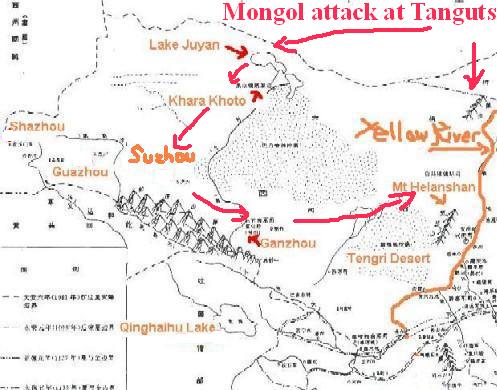
|
|
Turko-Mongol Tribes & Clans
Most European history books pointed out that the Ruruans [Rouran or Ru-ru] were 'Mongolian',
and they even claimed that Genghis Khan Mongols were descendants of the Ruruans. The Hunnic relationship with the Ruruans (said to be the successors of the Huns) has been explored in the Hun section. Tuoba Xianbei treated the founder of the Ruruan people as belonging to Donghu, i.e., Tungusic people in the east which included Xianbei, Wuhan and Tuoba. The Ruruan founder later fled to the Altai Mountains and conquered the remaining Hunnic successors there, hence mixing up with the Huns and Gao-che people in the west. My research into various records, however, shows that the Ruruans were more Hunnic than Turkic or Mongol. The Hunnic successors would include the Ruruans, the Turks, and the Tiele Tribes (ancestors of the Uygurs) etc.
As described at http://lcweb2.loc.gov/cgi-bin/query/r?frd/cstdy:@field(DOCID+mn0018), "during those centuries, the vast region of deserts, mountains, and grazing land was inhabited by people resembling each other in racial, cultural, and linguistic characteristics; ethnologically they were essentially Mongol." ... Generally, the Mongols and the closely related Tatars inhabited the northern and the eastern areas; the Türk (who already had begun to spread over western Asia and southeastern Europe) were in the west and the southwest; the Tangut, who were more closely related to the Tibetans than were the other nomads and who were not a Turkic people, were in eastern Xinjiang, Gansu, and western Inner Mongolia ... The Liao state was homogeneous, and the Kitan had begun to lose their nomadic characteristics. ... To the west and the northwest of Liao were many other Mongol tribes, linked together in various tenuous alliances and groupings, but with little national cohesiveness. In Gansu and eastern Xinjiang, the Tanguts--who had taken advantage of the Tang decline--had formed a state, Western Xia or Xixia (1038-1227), nominally under the Chinese suzerainty. Xinjiang was dominated by the Uygurs, who were loosely allied with the Chinese."
During the Soong Dynasty, Tangut's Tuoba Sigong descendant sought suzerainty with the Soong Chinese and changed their last name to the Soong royal family name of 'Zhao' from the Tang family name of 'Li'. However, Xixia sought suzerainty with the Khitans at the same time.
In A.D. 1044, i.e., Soong Emperor Renzong's 4th year of the Qingli Era, the Tanguts and the Soong Chinese reached the Qingli Peace Accord.
The demarcation line between Turkic and Mongol tribes is so much blurred that any definitive assertion could be a fallacy at best. http://berclo.net/page97/97en-steppe-empires.html mentioned that among the tribes, "some are Turkic (Kyrgyz, Kerait, Uygur), some Mongol (Oirat, Tatar) and some Turko-Mongol (Naiman, Merkit)." This differentiation may not be scientific, in my opinion.
In the following, I will discuss the relationships between 'Mengwu' (the Mongols) and clans like the Tayichi'uts, Paul Ratchnevsky's validity as to how the Naimans & the Keraits triggered the founding of the Khitan Liao,
and how the Genghis Mongols took over of the northern land by defeating the Tatars (not today's misnomer Tartars who were a group of Slavs living in the Soviet Caucasus area, with some recent immigrants to today's Chinese Turkestan about one century ago) and other clans. Also covered would be three waves of Mongol invasions towards the west. Mongol activities in China and later expulsion to their homeland will be explored as well. This webmaster would briefly expound the Mongol myth that the Mongols came from 'Blue-Grey Wolf' and 'Radiant Doe', 10 generations before the mythical Alan-ko'a born Bodunchar, and the lineage of Kaidu-khan, Kabul Khan, Ambaki, Yisugei and Timuchin [i.e., Genghis Khan] in the context of forged records in written literature versus corroborated Jurchen-Tatar wars on the stelae.
Naimans
When the Kirghiz defeated the Huihe (Uygurs) in A.D. 840 and took over northern Mongolia, there was a group of people called the Naimans who remained in their homeland in the Altai Mountains and attached themselves to the Kirghiz. The Naimans is said to be a Mongol name for a group of the Turkic tribe called 'Sakiz Oghuz' or the Eight Oghuz, a name which existed in 8th century. (The authentic Oghuz Turks would find their way to Anatolia, separately.)
Gradually, the Naimans grew in strength and drove the Kirghiz to the River Yenesei and rooted the Keraits from their homeland on the Irtysh in the Altai and drove them towards Manchuria, hence indirectly causing the Khitans to move to northern China where they established the Liao Dynasty in A.D. 907-1125. (This was Paul Ratchnevsky's recital. The Keraits, in the opinion of Ren Aijun, belonged to the same family as Genghis Khan's Mongols, with both groups having origin from the Shi-wei tribes in the Erguna River, the Hulun-buir Lake and the AMur River.)
The Naiman federation adopted the script and the religion (Buddhism) of their southern neighbor, the Uygurs, and maintained relations with the Kara-Khitai or Western Liao empire founded by Yeliu-taishi who fled to Turfan after Liao was defeated in Manchuria by the Jurchens. Though the Naimans are said to be of Turkic origin, their customs and habits had become Mongolized in a matter of hundreds of years. The Naimans later adopted Nestorian Christianity, and were observed to be so by William of Rubruck in A.D. 1253 (see Paul Ratchnevsky). It will be through the Naimans that Genghis Khan adopted the Uigur script and became civilized. When Genghis Khan defeated the Naimans, Kuchlug, son of the Naiman Tayang-khan, sought refuge in Kara-Khitai and converted to Buddhism from Nestorian.
The reason Timuchin (Genghis Khan) had defeated the Naimans is mainly that the Naimans split into two groups, i.e., Tayang-khan (conferred Taiwang or great king by the Jurchens) and Buiruk-khan, and they could not unite into a common front. The alliance of Timuchin and Toghrul (Keraits) first defeated Buiruk in A.D. 1199 (and killed him in A.D. 1207), and then defeated the Tayang-khan.
Tayang-khan's Naimans took over a small territory of Timuchin. Timuchin dispatched Hubilai and Chepe on a forerunner campaign against Tayang-khan. Tayang-khan, though allied with Merkits (under Tuotuo), Jadirats (under Jamuka), Kerait remnants (under A'lingtaishi), Wei-la, Ji-la, Tatar remnants, Katagin and Seljiuts, lost the war to Timuchin. Tayang-khan died with all his soldiers. Jamuka, who first deserted the Toghrul's Keraits, would desert Tayang-khan's Naimans before this fight started. Jamuka himself would be turned over by his own men and died in the hands of Timuchin's clan.
Timuchin took over Taya-khan's wife and subjugated his allies.
Katagin, Seljiuts, Duo-lu-ban and remnant Tatars surrendered. When Timuchin continued on to attack Merkits, Tutuo the Merkits' khan fled to Buiruk-khan's Naimans.
The Merkits fled west but were defeated again in A.D. 1204 and the whole tribe was taken over by Timuchin.
In A.D. 1206, Timuchin (Genghis Khan) held a grand assembly and received the title as Genghis Khan.
Keraits
East of the Naimans, from the Orkhon River in the west to the Onon and Kerulen rivers, was the new home of the Keraits. This is a group of people that had been disputed by Tao Zongyi (T'ao Tsung-i 1316- ?) to be the Mongols, but Rashid ad-Din placed them in a subgroup with the Naimans, Uygurs, Kirghiz, Kipchaks and other Turkic peoples while acknowledging the resemblances between the Keraits and the Mongols. Still one more Chinese, Tu Ji, in his "History of the Mongols" (Mengwuer Shiji), assumed that the Keraits were Turkic and originated from Turkic Kangli and Ghuzz and their language was Turkic. It was also said that an important Kirghiz tribe bears the name of Kirai, which is equivalent to Kerait. As to their Mongol characteristics, Paul Ratchnevscky assumed that some Khitans were left behind and got assimilated into the Keraits. Paul Ratchnevsky emphasized the amicableness between the Keraits and West Khitans as exemplified by the fact that Kerait's khan, Toghrul, had once sought refuge in Western Liao. Paul Ratchnevsky mentioned that the Keraits accepted Nestorian faith and that the grandfather and father of Toghrul had Latin names like Marghus (Markus) and Qurjaquz (Kyriakus).
Acording to Ren Aijun's Liao-chao Shi Gao, the Shi-wei people migrated out of the historic habitat for the west and south, with ancestors of the later Keraits and Mongols relocating westward to the three rivers' area of Tu'ula, Kerulen and Onon in central Mongolia and the later Mount Yinshan Da[2]-da[2] or Mount Yinshan Shi-wei relocating southward to the Yinshan Mountain area, i.e., Hei-chezi-Shi-wei (black cart Shi-wei) in today's southeastern Xilingele Banner.
Liao Shi pointed out that there were eight Kerait tribes known as "ba 'shilie' Dilie" [eight tribes of 'Dilie'), which were clustered with the Wugu tribe in the Erguna River and the Hulun-buir Lake area, to the south of which were miscellaneous Shi-wei-tagged tribes like major and minor Da-Huang[tou]-Shiwei/Xiao-Huang[tou]-Shiwei (with 'huangtou' [yellow head] also written as 'huangpi' [yellow skin] -- which could be a mistake since 'yellow skin' Pi-shi was actually a military army unit), Choupo-Shiwei (with 'choupo' [stinky pond] having similar sound as later 'Zu-bu' name for the Dadans), and Hei-chezi-Shi-wei.
Living next to Hei-chezi-Shi-wei would be the White Xi[2] (Tiele), Xi and Khitans to the north and east;
the Western Turk and Eastern Turk remnants, the Three-Tribe Shatuo, the Six-prefecture Sogdians, the Tuyuhun (Hun[2], Tuihun, Tuhun, or Sheng-Tuhun[raw Tuhun]) and Tanguts (Dangxiang-Xiao-bo carrying the Tibetan 'bo' name), and the Qibi (Tiele) people to the south and west;
and
the Mount Jiashan Tanguts (Jiashan-Dangxiang) in the Yinshan Mountains.
Further to the east of Hei-chezi-Shi-wei and in today's Duolun and Zhangbei area would be Yili and Yueli Shi-wei tribes that were later conquered by the Khitans.
Yisugei had helped the Kerait chieftain, Toghrul, twice. Toghrul was resented by his tribesmen for killing his brothers. When Toghrul was defeated by his uncle and fled with few hundreds of horsemen, Yisugei would come to his aid and drive Toghrul's uncle to the Tanguts' Western Xia territory. Later, Toghrul's brother rebelled as well, and Toghrul had to flee southwestward to the three statelets of 'Hexi', 'Huihu' and 'Huihui' (Uygur, Qiangic and Tibetan territories) for asylum. Thereafter, Toghrul sought asylum with the Kara Khitans.
When Toghrul escaped back to Mongolia, Timuchin would give him a good reception and treat Toghrul as 'father'. Timuchin later defeated the Merkits and gave the captured people to Toghrul. Toghrul hence gained strength. Toghrul and Timuchin cooperated few times in fighting the Naimans thereafter.
The importance of the Keraits would lie in the fact that Timuchin sought the protection under Toghrul (To-wo-ling-le) and their alliance laid the foundation for the uprise of the Mengwu Mongols. Toghrul enjoyed a title called Wang Khan which was conferred by the Jurchens and hence an alliance with Toghrul served the purpose of elevating Timuchin's position among the nomads. (The conferral of king onto the Kerait chieftain by the Jurchens was disputed to be at the time Timuchin invited both the Keraits and the Xie-che-bi-ji [Xueche Biji] to pincer-attack the Tatars together with the Jurchens in the 1190s, which was disputed to be A.D. 1290, not 1294, nor 1295, nor 1296.) After exterminating the Tatars in A.D. 1202, Timuchin broke with Toghrul's Keraits, and Genghis Kan killed Toghrul in A.D. 1203 and took over the Kerait throne.
Merkits & the Women Abduction
The savage and warlike Merkits are not to be discounted here. It would be Timuchin's father, Yisugei, a Kiyat-Borjirid, who robbed Ho'elun from the Merkits in the first place. Years later, the Merkits would avenge themselves by attacking Genghis Khan and abducting his wife, Borte (a girl from subtribe of the Onggirat). This abduction rendered ambiguous the legitimacy of Timuchin's first son (Jochi) since Borte born the child while being rescued many months later. It would be the alliance of the Keraits and the Genghis clan, together with another rival clan of Jumaka (Timuchin's boyhood friend), that would be responsible for defeating the Merkits and rescuing Borte. The Merkits lived south of Lake Baikal on the lower Selenga. They lived by fishing and hunting. While Tao Zongyi and Rashid ad-Din regarded them as the Mongols, others thought they were Turkic. In A.D. 1096, the Merkits rebelled against the Khitan Liao and were defeated. In the end, they were defeated by Genghis and assimilated into his clan.
Tatars (Ta-ta-er, not today's misnomer Tartars)
An immortal name as it sounds, this is a much abused name ever seen, considered to be a collective name for all tribes and nomads of Asia by the Europeans (see Latinized Tartarus, Greek Tartaros, and Germanic Tatar). When Dr Sun Tat-sen called on the Chinese to overthrow the Manchus, he proposed a slogan called "Expel the Tartars (Da Lu) and Restore Our China". Paul Ratchnevsky indiscriminately applied the later generic term 'Tartar' to the specific group of nomads called Tatar or Ta-ta-er.
(I had used Tatar for the name of the enemy tribe of Genghis Khan's Mengwu people
while reserving Tartar for today's Slavic Tartars, not using Tartars in the sense of designations by Ratchnevsky and modern Western scholars for Genghis Khan's Mongols.)
Then, how long a history did this name have?
While Paul Ratchnevsky mentioned that the Tartar name was recorded as early as the Kul-tegin inscription of 731-732, there was a difference in the Chinese pictographic form for the denotations. Father of Li Chunxu (founder of Posterior Tang A.D. 923-936), before Tang Dynasty ended in A.D. 907, had once sought refuge with a group of nomads called the Dada [Dadan], a word that was used by Dr Sun in his slogan. This early group of the Dada [Dadan] people apparently lived north of China's Shanxi Province, the ancient Dai prefecture. It would be extremely difficult to associate the Tatars (Tartars) with those who existed 200 years before Genghis Khan.
According to Wu Dai Shi (history of the Five Dynasties), Da'dan were remnants of the Mohe Tribes (see Manchurian section), namely, ancestors of the Jurchens. They were originally located to the northeast of the Xi Nomads (alternative race of the Huns and later absorbed by the Khitans) and the Khitans. Being attacked by the Khitans, the Dada [Dadan] people were scattered around, with some subject to the Khitans and some subject to Po'hai (a statelet to be absorbed by the Khitans later). One Dada [Dadan] tribe relocated to the Yinshan Mountains and became known as Dada [Dadan] by the end of Tang Dynasty. During Tang Emperor Yizhong's reign, A.D. 859-875, they joined hands with the Sha'to Turks in helping Tang to crack down on the Pang Xun rebellion. When the Sha'to Turks, under Li Guochang and his son Li Keyong, were defeated by the Tuhun nomads of Helian Duo (see Tibetan section), the Li Sha'to Turks sought asylum with the Dada [Dadan] people. Once Tang Dynasty called upon Li Keyong, the Dada [Dadan] people followed the Sha'to Turks in the campaigns against the Huang Chao Rebellion. After that, the Dada [Dadan] people dwelled between Yun and Dai prefectures of today's Shanxi Province. At the times of Posterior Tang (A.D. 923-936), the Dada [Dadan] people often answered calls in the campaigns against the Khitans. History records that the Dada [Dadan] people were still in contact with China at the times of Posterior Zhou (A.D. 951-960).
According to Rashid, the Tatar nation consisted of 70 thousand households or 350 thousand people in 12-13th centuries and
they occupied the Kunlun and Buir lakes between the Kerulen River and the central Khingan Mountains. They were the richest people in Mongolia as a result of silver mining, but internal quarrels kept them weak and they acted as the vassals of the Jurchen Jin Dynasty (founded in A.D. 1115) and constantly played the role of a hatchetman in subjugating various Mongol tribes. The Tatars had assisted the early Jurchens in defeating the Mongol (Meng-wu) rebellions, handed over Mongol leader Ambakai (disputed to have adopted the tribal name of Tayichi'ut) and Kabul Khan's elder son to the Jurchens for execution in A.D. 1150s, and dealt the remaining Meng-wu tribes a decisive defeat near Lake Buir in A.D. 1160s.
The conflicting information in regards to Ambakai is that he was said to be a brother of Kabul-khan and had adopted a different tribal name of Tayichi'ut. Secret History of the Mongols said when Kabul-khan died, his wish was to have Ambakai to be the khan. But Rashid al-Din said that Kabul-khan's son assumed the leadership of the Mengwu people while Ambakai only led the Tayichi'ut clan. This webmaster would buy Secret History of the Mongols' version since I agree with Paul Ratchnevsky that Rashid had tried to paint a better picture for his Mongol host. The death of Ambakai is because Ambakai had antagonized the Tatars by killing their shaman who was called over to cure for his brother-in-law. The Tatars cheated him into a trap by requesting for a marriage with Ambakai's daughter. Kabul-khan's elder son was caught by the Tatars when he went to them to request for the release of Ambakai. Both of them died as a result of Jurchens nailing them to wooden donkeys. However, the Tatars would pay back their debt later.
In A.D. 1195, the Tatars had a quarrel with the Jurchens over the bounty from the war against the Onggirats. Jurchen Prime Minister, Wayan Xiang, campaigned in Mongolia. In A.D. 1196, Timuchin, taking advantage of the Jurchen campaign against the Tatar chieftain Moutchin Soultou, pincer-attacked the Tatars together with the Jurchens, and defeated the Tatars. (There is an alternative account stating that it was in year A.D. 1190 that the pincer-attack against the Tatars occurred, not A.D. 1294, nor 1295, nor 1296.) Finally in A.D. 1202, Timuchin defeated them again, slaughtered all their men and enslaved all their women.
The Oirats
The Oirats belonged to the forest tribes. It was said that Genghis Khan's forebearers belonged to the forest groups. The Oirats once joined Jumuka (A.D. 1201) in fighting Timuchin and Toghrul. Thereafter, the Oirats went to the Naimans together with Jamuka and the Keraits after Timuchin split with the Keraits and killed Toghrul. However, due to their close relationship, the Oirats and the Onggirats turned out to be Timuchin's best allies in later years.
Both Russian historian Vladimirtsov and Rashid ad-Din commented that the dividing line between the forest people and the pastoral people is not clear, and they would switch positions should one party lose possession of the herd in a raid and become forest clans while the other party took possession of the herd and become pastoral.
The relationship between the Oirats and the Onggirat is not clear; however, they belonged to the same group, the forest people, were branches of the Kiyats, and had close relationship with Timuchin's clan.
Onggirat & Genghis Khan's Wife
According to Rashid ad-Din, the Onggirat clan was a branch of the Kiyats while the Kiyat is a subclan of the Borjigin Mongols.
This claim was wrong as we would cite the Jurchen literature to show that Rashid ad-Din had inverted the tribe and clan relationship, with the Onggirat being predominant all around the Xing'an Mountain Ridge as a result of the Khitans and consecutively the Jurchens dispersing the Onggirats for better control.
Some historian said the Khitans had once used the word 'Onggirat' for themselves and the Jurchens (Jurchids) had used 'Qonggirat' for the tribal name. The Onggirats connection lie in the fact that Yisugei had robbed Ho'elun from the Merkits as said earlier. However, Ho'elun, was not a Merkit and she was a bribe whom Merkit's Chiledu had brought home from the Olkunu'ut, a minor tribe of the Onggirat. Nomadic ways of abduction posed extraordinary uncertainties in the fate of the women, and it was said that Ho'elun, seeing that Yisugei had invited two of his brothers along to attack her bridegroom, undressed her coat as a gift for Chiledu and asked Chiledu to run for his life, saying that he could find another woman to marry should he be able to live on. Years later, when Timuchin was 8-9 years old, Yisugei went to the Boskur subtribe of the Onggirat to find Borte as a fiancée. Yisugei left his son (Timuchin) with Borte's father. It was on his way back that Yisugei was poisoned by the Ta-ta-er (Tatars). Later, Timuchin, at about age 15, or A.D. 1182, went back to his stepfather for Borte. Borte's wedding gift, a sable cloak, would be presented to Toghrul (whom Timuchin took as his stepfather) as a gift. The alliance of the Onggirat tribe had played an important role in his uprise.
The Onggirats, according to Rashid ad-Din, could be traced to the early Mongol warriors who, defeated by the Turks, sought refuge in the Erkene-kun Mountains.
What the Chinese history shows is that the Onggirats were a mainstay tribe active all around the Xing'an Ridge.
Through the 12th century A.D., there were continuous wars between the Jurchens and Yelü
Dashi's Kara-Khitay in the three rivers' area of Mongolia and across the Gobi Desert, with the Jurchen wars with the Onggirats continuing for almost a century.
The Jurchens, who had origin in the Mohe (Malgal) people along the Sungari River and the
Chinese-Koryo border, were keen on completely wiping out the Khitans, with multiple expeditions
launched against the Khatun city of central Mongolia from A.D. 1131 to 1165 [with target set for the
Khitans], as well as in A.D. 1196 [with target set for the Da-da[2] or Zu-bu], on which occasion Jurchen Jin
prime minister Wanyan Xiang defeated the Zu-bu (i.e., Tatars) in cooperation with Genghis Khan's
Mongols (i.e., generically the Kiyats) and Toghrul's Keraits, and erected two stone monuments in the
Jurchen script and Chinese characters, that came to be known as Jiufeng Shibi Ji-gong Bei (cliff steles
in commemoration of the feats on mount Jiufeng [nine peaks]). It could be seen from various fragmentary
historic records that from the A.D. 1130s to the 1190s, the Jurchens continued the wars against the
Khitans in the territories of today's Mongolia and Chinese Turkestan, against the Da-da[2] (including
the Tatars and the later Mongols' cousin tribes) along the western and northwestern slope of the Khing'an
Mountain Range, and against the unconquered tribes in Manchuria proper where the Jurchens fortified
the Tai4zhou, Zhao4zhou and Yichun forts and later in the A.D. 1210s resisted the Mongol invasion
led by Genghis Khan's brother Jochi-Kasar and Wozhen Nayen (Anchen-noyan, Wochen-noyan).
Borjigid & the color of the eyes
The Borjigid clan was a branch of the Kiyats, to which the Jurchens (Jurchids), Changsi'ut and the Kiyat-Sayar also belonged.
The Borjigid was purportedly a tribe to which the Jurchens (Jurchids), Changsi'ut and the Kiyat-
Sayar also belonged; history annals from Jin Shi and Liao Shi implied that the Da-da[2] (Dadan, Tatar)
and the Jurchens could actually be related to the Onggirats, if not equivalent or equal to the Onggirats
- whose defeat by the Jurchens in the late A.D. 1190s paved the way for the rise of Genghis Khan's
Kiyat-Borjigin.
According to Rashid ad-Din, the Onggirat clan was a branch of the Kiyats while the Kiyat was
a subclan of the Borjigin Mongols.
Note that Onggirat was predominant all around the Xing'an Mountain Ridge as a result of the Khitans and consecutively the Jurchens dispersing the Onggirats for better control.
The Borjigids had a legend that after the death of Dobun-mergen,
the alleged ancestress Alan-ko bore Bodunchar after being visited by a strange 'golden glittering man'.
Rashid ad-Din provided this rumor by alluding to a foreign origin of the visitor and described him as having red hair and blue-green eyes.
It is not strange that the nomads used the 'Light Conception Motif' to mystify their origins since the lifestyle of nomads was predatory, killing men and robbing women, and something had to be made up to cover up some sexual encounter while the woman was alone in the wilderness.
Paul Ratchnevsky speculated that the mysterious visitor could be a Kirghiz since the Kirghiz people were said to be tall and possess red hair and green eyes, and he further speculated that in contrast with the red-haired Kirghiz, Chinese Tangshu (Tang History) had said those nomads with black hair were descendants of a Chinese general called Li Ling (Han Dynasty historian Sima Qian's friend) who surrendered to the Huns.
Note that Tang records stated that the Kirghiz disliked the BLACK hair and took it as a bad omen.
More, refer to discussions on Jiankun & Minusinsk.
Chinese records showed that the Mongolians had possessed 'chestnut colored' eyes. Today's Chinese,
who were color-blind, sang a song, the "Dragon's Descendants", which were about 'black-colored eyes'.
Paul Ratchnevsky quoted the contemporary Zhao Gong as saying that Genghis Khan differed from other Tartars
in that he was tall and had long beard, and quoted Marco Polo as saying that Khubilai did have black eyes but fair complexion 'ringed with red'.
Rashid ad-Din, in 'Collected Chronicles', said that Genghis Khan was amazed to see that Khubilai had black hair
while the rest of their family had red hair and said his grandson must have taken 'his old uncles' features.
(I will deem Rashid's account with some suspicion. Cai Dongfan, the last distinguished imperial examinee from the Manchu era, stated
that Bodunchar had grey eyes against the chestnut-colored eyes of his brothers and half-brothers,
and nothing was mentioned of the hair or skin. My personal opinion is that
it would be impossible that only Genghis Khan himself looked different from the other 'Tatars'
(not the same as today's Tartars) in the eyes of Zhao Gong,
and that the lineage of the Borjigid should be running down along all tribal lines, including the Tayichi'uts and the Jurkins.)
Paul Ratchnevsky quoted some Islamic records saying the Kirghiz people had light color in skin and eyes.
Paul Ratchnevsky speculated about the connection of the Kirghiz to the Borjigid clan as the cause of Genghis Khan's purportedly non-Mongoloid features.
Note that the Borjigid was a branch of the Kiyats, to which the Jurchens (Jurchids) also belonged.
According to Rashid ad-Din, the Onggirat clan was a branch of the Kiyats while the Kiyat was
a subclan of the Borjigin Mongols.
Note that Onggirat was predominant all around the Xing'an Mountain Ridge as a result of the Khitans and consecutively the Jurchens dispersing the Onggirats for better control.
According to "New History of the Five Dynasties",
the Kirghiz belonged to the ancient 'Jiankun' Statelet which was located to the western-most of the Huns.
They should be to the west of the Yiwu Statelet and to the north of Yanqi Statelet (both in the Chinese Turkestan, and to the west of the Blackwater Lake).
Hunnic Chanyu Zhizhi destroyed Jiankun and ex-Han General Li Ling, who surrendered to the Huns, was assigned to the land of Jiankun
as King of Youxianwang, namely, the rightside virtuous king,
with an army of 80,000. "New History of the Five Dynasties" said that
the Kirghiz possessed lighter skin, red hair, green eyes and taller height, and
that those Kirghiz people with black hair must be the descendants of Li Ling.
The land of Jiankun, in my opinion, is the same place as today's Russian TUVA Republic, i.e.,
a land that the Soviets stole from China in the early 1920s.
TUVA was next to the Minusinsk region where the "Past Exploration Society" in early 20th century claimed the dolicho-cephalic Samoyades (Samoyedes) used to live before they were kicked out by the Mongol Samoyades (Samoyedes).
At one time, during Tang Emperor Suzong's reign of A.D. 758-760, the Huihu (Uygur) conquered the Jiankun Statelet of the Kirghiz.
The Kirgiz allied themselves with Tibetans, Arabs and Karlaks.
The Kirghiz, with the help of a defecting Huihu (Uygur) general and combining a cavalry forces of 100000, defeated Huihu (Uygur)
and killed the Huihu khan around A.D. 840s.
Fifteen Huihu (Uygur) tribes fled westward to the Karlaks, while some remnants fled southward to Tibetans for protection.
Another thirteen families, under the new khan Wujie Tele, moved towards Tang China.
The Huihu (Uygur) people, under Khan Wujie, attacked Tiande and Zhenwu cities (near today's Datong, Shanxi areas), and Tang border governor-general Liu Mian counterattacked. Tang Court, at the request of Princess Taihe, agreed to let Huihu (Uygur) reside to the west of Zhenwu city. Further, Tang gave them 20,000 units of grain supply. This group of Huihu (Uygur) would be engaged with fights against Tang China, Tibetans, Xi Nomads of Manchuria, Sha'to Turks, and Kirgiz for years, till they were totally destroyed. Today's Huihu (Uygur) should look towards those who fled to the Karlaks and Tibetans for their ancestors.
Kirghiz Khan, Ah Ri, earlier, had retrieved Tang Princess Taihe from the Huihu (Uygur) and sent her on the way to Tang China. But the new khan of Huihu (Uygur), Wujie, killed Kirghiz emissary and brought Princess Taihe back to their court. Kirghiz claimed that they shared the same last name as Tang emperors. They sent another emissary to Tang, and it took the emissary three years to reach Tang to see Emperor Wuzong. Later Kirghiz sent another emissary and made a proposal to attack Huihu (Uygur) together. It would be in A.D. 859 that Tang Emperor Xuandi decided to confer the Kirghiz the title of Khan Bravery-Intelligence. New History of the Five Dynasties said Kirghiz paid three more pilgrimages during A.D. 860-875, but they failed to exterminate Huihu (Uygur).
Jalair
Possibly of the Turkic ancestry, this group of people were captured by the Timuchin's clan and became vassals. In early days, this group of people had raided the pasture of rich Mongol woman, Monolun (wife of the grandson of Bodunchar), and killed her and her eight sons. Only Kaidu was saved by his uncle Nachin and later Kaidu defeated the Jalair to be a leader of the early Mongol people. The Jalairs became very much attached to the Mongol people in the ensuing years. Later, they were to become vassals and got assimilated. Mukali was said to be one of them.
Jurkin
Okin-barkak's son, Sorkatu-jurki, is designated by Paul Ratchnevsky as the founder of the Jurkin. Okin-barak was the eldest son of Kabul-khan and he was Yisugei's uncle. The Jurkin wrestler, Buri-boko, was the grandson of Kabul-khan. Secret History of the Mongols talked about a banquet held by Timuchin and the Jurkin princes in celebration of several tribes defecting to him from Jamuka's camp. Two stewards of respective tribes, Buri-boko (Yisugei's cousin who went to the Jurkins for his hobby of wrestling long time ago) and Belgutei (Timuchin's elder brother) had a quarrel with each other over some clan members' actions. Fights broke out among the guests of the two sides.
The Jurkins are Timuchin's kinsmen, and they were called Kiyat-Jukins. When the Tatars rebelled against the Jurchens, the Jurchens came to Mongolia to fight the Tatars. In middle of A.D. 1196, the Tatars retreated in face of the Jurchen attack, and Timuchin called on the Jurkins to join him in attacking the Tatars. Not getting a response from the Jurkins for six days, he attacked the Tatars together with Toghrul's army and killed one Tatar prince. Hence, Timuchin was rewarded by Jurchens. When Naimans robbed Timuchin clansmen, Timuchin sent 60 men to the Jurkin clan for borrowing soldiers. Jurkins killed ten and stripped the clothes of the rest of Timuchin men. Because of this, Timuchin campaigned against them and killed the Jurkin princes including Buri his own kinsman in A.D. 1196-1197.
Wang'gu
When Naimans tried to attack Timuchin, Tayang-khan had sent an emissary to a place near the Great Wall and Jurchen Jin for forging an alliance with a group of people called Wang'gu. This group of people were said to be different from the Mongols. There is speculation that they might be related to the earlier Shatuo Turks. Wang'gu chieftain, however, arrested the emissary and sent the prisoner to Timuchin. When Timuchin attacked the Naimans, the Wang'gu chieftain came along as an ally.
Jadirats and Genghis Khan's blood-brother Jamuka
When Timuchin was 11 years old, he played with Jamuka of the Jadarat clan on the Onon river. The two should be considered kinsmen, and that's why the word clan, not tribe, is used here. They were anda, i.e., blood brothers.
However, the two had no blood relationship. Because Jamuka descended from the son born by A-dang-han before she was robbed by Timuchin's ancestor, Bo-dun-char-er (i.e., ancestor of the Borjigin clan), one of the three sons from the 'immaculate conception'. The clan name 'Jadirat' meant a loosely-organized group of people for denoting the original abducted people.
When the Merkits abducted Borte, Timuchin sought help with Toghrul of the Keraits whom Jamuka had also allied with. Jamuka raised 20,000 people, plus another 20,000 people from Toghrul's Keraits. According to Secret History of the Mongols, Jamuka raised 10,000 men from Timuchin's clans and another 10,000 from among his own people. Jamuka entered the battlefield 3 days ahead of Toghrul and played a decisive role in defeating the Merkits in A.D. 1184. After that, Jamuka and Timuchin camped together for about one and a half years and they slept under one blanket. However, they split after Jamuka found out that Timuchin had a bigger ambition and would not follow his lead. At the time they split, Jamuka had already lost some of the people whom he had raised from Timuchin clans for the battle against the Merkits.
Timuchin rallied his people to have him selected as a khan [in A.D. 1189 per historian Lih Dongfang] and further demanded with Jamuka that he approve the support of several affiliated tribes and clans for Timuchin. When one of Timuchi's men shot dead Jamuka's brother, Jamuka officially declared a war on Timuchin and mobilized thirteen units (tribal or clan units) of troops, about 30,000 men, to attack Timuchin to the south. Timuchin had 13 clans under him, totaling close to 30,000 men. Timuchin split his forces into 13 groups for countering Jamuka. Jamuka's coalition consisted of the Tayichi'ut, the Ikires (a branch of Onggirats), the Uru'ud, the Noyakins, the Barulas and the Ba'arin (those clans or subclans being beyond my ken). Somewhere to the southwest of today's Hulun Lake, Jamuka totally defeated Timuchin, possibly forcing him into seeking asylum inside of the Jurchen territory, till Timuchin rose again in A.D. 1196 per Paul Ratchnevsky -- which could be wrong as we would show the alternative history account that in A.D. 1290, Timuchin and his Kerait ally joined the Jurchens in defeating the ta-ta-er tribe and killing the Ta-ta-er chieftain.
In between, for about ten years, Timuchin's whereabouts were ambiguous and historians (see Paul Ratchnevsky) thought it was a taboo. After A.D. 1196, Timuchin would gain more and more people, while Jamuka would incur loss till he was betrayed over to Timuchin by his own people in the final.
Historian Lih Dongfang, however, pointed out that Timuchin, after fleeing northwestward, collected more tribes and clans as a result of Jamuka's retaliatory measures against the tribes and clans which were sympathetic with Timuchin. Lih Dongfang further pointed out that Timuchin destroyed the Zhu-er-qin clan, joined forces with the Keraits in attacking the ta-ta-er tribe, rescue the Kerait chieftain when being ousted by a brother of the Kerait chieftain, joined forces with the Keraits in attacking the Merkits, and joined forces with the Keraits in attacking the Naimans.
Hearing that Timuchin and Toghrul had defeated the Buirak Naiman and the Tayichi'uts consecutively, the Tatars, Katagin, Seljiuts, Duo-lu-ban, and Onggirat formed an alliance. But the Onggirat chieftain secretly sent a messenger to Timuchin about the forthcoming allied attack. Timuchin and Toghrul then attacked the alliance. Timuchin attacked and defeated the Tatars. When the Onggirat were wrongly attacked, the Onggirat fled to Jamuka's Jadirat clan.
In A.D. 1201, Jamuka was elected as Gur-khan, i.e., khan of all tribes, by his coalition of the
Katagin, Seljiuts, Duo-lu-ban, Onggirat, Yi-qi-la-si, and Huo-lu-la-si.
There were on records three major campaigns between Timuchin and Jamuka.
It would be in year A.D. 1200-1201 that Timuchin would exact his revenge on the Tayichi'uts on which occasion he defeated the Jumaka coalition including the Tayichi'uts and killed all Tayichi'ut men.
The second battle was waged somewhere near the Hailar River and Te-ruo-ke (? Tieni[-he]) River in 1201, after Jamuka was made into the Gur-khan.
Timuchin defeated the alliance, and the Onggirat sought vassalage with Timuchin. Jamuka escaped.
Then, Timuchin campaigned against the two Ta-ta-er tribes: An'chi-Tatar and Chahan-Tatar.
Yuan Shi, starting here with a sexagenary year, put it under A.D. 1202.
Yuan Shi listed four Tartar clans, which were all eliminated.
After a defeat, Jamuka in the autumn of A.D. 1202 reorganized an alliance, including the Merkits and Naimans, to wage a third battle.
The Merkit chieftain, Tuoheituo'a (Toqto'a), staged a comeback to attack Timuchin.
Naiman Khan Buirak allied with the Katagin, Seljiuts, Duo-lu-ban and Tatar for the war against Timuchin and Toghrul.
The Battle of Kuo-yi-tian (Köyiten) was waged near the upper Halaha (Khalkha) River.
In this war, Jamuka himself did not participate but the three chieftains of the Naimans (under Buyiluhei-han [Buirak]), the Uduyid Merkits (under Tuoheituo'er-bieqi) and the Oirats (under Huduhhe).
Joining the Naimans would be remnants of
the Tayichi'ut,
Duo-er-bian (Duo-lu-ban),
He-da-jin (Ha-da-jin [Katagin]),
Sa-le-zhi-wu-ti (San-zhi-wu [Seljiuts]),
and
Ta-ta-er (Tatar), etc.
In face of attack, Timuchin and Toghrul first retreated to the Wuluhui-Shilianzhen River area (in today's East Ujimqin Banner), a plAce near the Mo'ergele (Mergel-gol) River and where existed a A-lan[-zhai] fortress and the Jurchen Jin's northern segment of the Great Wall.
When the Naimans' allied army approached Kuo-yi-tian (Köyiten, Que-yi-tan), Timuchin and Toghrul's generals charged forward at the same time and defeated the Naimans' alliance.
The Naimans were defeated after their witch-agitated wind and snow blew back against them.
While Toghrul went on to pursue Jamuka, Timuchin exacted revenge on the Tayich'uts who imprisoned him when he was a teenager: Timuchin slaughtered all the males of the Yayichi'ut clan and took in their women.
Jamuka surrendered to Toghrul, over which Timuchin broke with Toghrul per Lih Dongfang.
Jamuka sowed dissension between Timuchin and Toghrul. Some of Timuchin's kinsmen (Dalitai, An'dan and Huocha'er) defected to a prince of Toghrul. History of the Yuan Dynasty mentioned that Toghrul and his son Ilqa Senggun intended to assassinate Timuchin via an invitation for an inter-marriage banquet. Timuchin stopped the trip half way. When Toghrul attacked Timuchin, Timuchin got advance information and defeated Toghrul.
The Merkit chieftain, Tuotuo, had staged a comeback, and Timuchin defeated Tuotuo. Naiman Khan Buirak allied with the Katagin, Seljiuts, Duo-lu-ban and Tatar. Jamuka's Jadirats clan came to the aid of Nuirak; but, seeing the Naiman defeat, Jamuka fled. Jamuka had sowed a dissension between Timuchin and Toghrul. Some of Timuchin's kinsmen (An'dan and Huocha'er) defected to the prince of Toghrul. History of the Yuan Dynasty mentioned that Toghrul and his son intended to assassinate Timuchin via an invitation for an inter-marriage banquet. Timuchin stopped half way. When Toghrul attacked Timuchin, Timuchin got advance information and defeated Toghrul. History of the Yuan Dynasty stated that Toghrul had relatively more strength than Timuchin.
Timuchin beforehand raced to the A-lan[-zhai] fortress and moved the supplies to a different place.
Yuan Shi claimed that Timuchin defeated four attacks by Ilqa Senggun, including a fourth charge by Ilqa Senggun's bodyguard troops.
Nevertheless, Timuchin suffered loss in the Keraits' stealthy attack, with Mangqut General Wei-da-er dead from the wound from the mount Maowendu'er battle.
Toghrul (To'oril)'s army defeated Genghis Khan who retreated with nineteen followers to the Baljuna Lake or the Ban-zhu-ni River, where the gang had to shoot dead a wild horse for food.
Among the followers were a whiskered Western Territory person called Zhaba'er-huozhe (who was a Sai-yi person or chieftain)
and Uygur Tian Zhen-hai.
Timuchin sent messenger A-li-hai to rebuking Toghrul by listing the good deeds he did on behalf of the father-khan,
as well as to rebuking the clansmen defectors Dalitai, An'dan and Huocha'er.
Timuchin, sowing dissension about not trusting Toghrul and emphasizing the ancestral land of the three rivers, claimed that he Timuchin supported Jurkin princes [elder brother] Xueche and [younger brother] Dachou as a khan,
then supported Huocha'er as khan,
and then supported Andan as a khan; however, he tacked on the khan because all the other folks refused to be a khan and moreover supported him instead [but then had a different heart from him, Timuchin].
Yuan Shi claimed that Timuchin defeated Toghrul at Halanzhenshatuo, while An'dan and Huocha'er, together with Jamuka, schemed to assassinate Toghrul, and fled to the Naimans after failure to do so.
In a subsequent battle in the autumn, Genghis Khan (Timuchin) faked to surrender to Toghrul by sending He-sa-er's surrender message to the Keraits, marched day and night to Cheche'erwendu'er for a blitz attack, killed Toghrul (To'oril) in A.D. 1203, and took over the Kerait throne.
After Timuchin defeated Toghrul, An'dan and Huocha'er fled to the Naimans. After another defeat, Toghrul fled towards the Naimans and was killed by the Naiman. Toghrul's son fled to the Tanguts and pillaged the Xixia people. When attacked by the Tanguts, Toghrul's son fled to Chouci (Qiuci, Kuqa) in today's Chinese Turkistan and was killed by the Chouci chief Qilinch-qara.
Genghis Kan took over the Kerait people and territory in A.D. 1203.
After Timuchin defeated Toghrul, Jamuka fled to the Naimans but secretly helped Timuchin by disclosing the secrets about the Naimans.
Tayang-khan's Naimans took over a small territory of Timuchin. Timuchin dispatched Hubilai and Chepe on a forerunner campaign against Tayang-khan. Tayang-khan, though allied with the Merkits (Tuotuo), the Jadirats (Jamuka), the Kerait remnants (A'lingtaishi), the Wei-la, Ji-la, and Tatar remnants, and the Katagin and Seljiuts, lost the war to Timuchin. Tayang-khan died with all his soldiers. Jamuka, who first deserted Toghrul's Keraits, would desert Tayang-khan's Naimans before the fight. Jamuka himself would be turned over by his own man and died in the hands of Timuchin. The Katagin, Seljiuts, Duo-lu-ban and remnant Tatars surrendered. When Timuchin continued on to attack the Merkits, Tutuo fled to Buirak Khan Naimans.
The Merkits fled but were defeated again in A.D. 1204 and the whole tribe was taken over by Timuchin.
In A.D. 1206, Timuchin (Genghis Khan) held a grand assembly and received the title as Genghis Khan.
The Tayichi'ut
Chinese description of the Mongols applied the knowledge from Secret History of the Mongols, according to which Kabul-khan (Genghis Khan's great grandfather) was invited to the Jurchen court in A.D. 1125 and offended Jurchen emperor Jin Xizong. He had 7 sons altogether, but in accordance with his wish at death, Ambakai was to rule all the Mongols. But according to Rashid, ad-Din (Collected Chronicles), Kabul-khan's son, Kutula, was made khan, while Ambaki was ruler of the Tayichi'ut and hence not successor to Kabul-khan. The Tayichi'ut could be traced either to the son (Caracqa-lingqum, i.e., Ambaki's father or according to Rashid, grandfather) or uncle (Nanchin) of Kaidu-khan. According to Secret History of the Mongols, Ambaki adopted the tribal name of Tayichi'ut. The Tayichi'ut had a very good relationship with the Kiyats and they belonged to the same category as the forest peoples.
(Kaidu Khan, other than eldest son Okin-barkhakh, had two more
sons Chalahai-linghu and Chaozhenwo'ertiegai, with son Chalahai-linghu carrying the Khitan title
of 'linghu' or Chinese 'linggong' which meant a Khitan Liao dynasty's court-sanctioned 'tribal
duke'. Note that Yelü
Dashi set up a court at the ancient Uygur khan's Ke-dun (Khatun) city in today's Bulgan of Mongolia,
i.e., the Khitan Liao dynasty's Jian'an[-jun] garrison, where the Khitan 'Zu-bu [barbarians] jiedu-shi'
office and 'Xibei-Lu [northwestern] zhaotao si' office were.)
The enmity between the Tayichi'uts and the Kiyats arose after the death of Yisugei (Timuchin's father), when the Tayichi'uts deserted the camp of Yisugei's widow. Yisugei's brothers left Ho'elun, Timuchin, and Timuchin's brothers for the Tayichi'ut clan. Speculation here is that Ho'elun might have rejected Yisugei brothers' demand to take her in as their wife or concubine, which was the prevalent nomadic way of inheritance.
Later, Genghis Khan (Timuchin), at about age 14-15, murdered his elder half-brother Bekhter and possibly got punished by the Tayichi'ut prince who had reportedly captured him and imprisoned him in a cage which was kept by individual households of the Tayichi'ut clan, till Timuchin found an opportunity to flee home. Aside from the Tayichi'uts, Timuchin had suffered tribulation in the hands of the Merkits, and the Tatars alike.
The Tayichi'ut clan was said in Yuan Shi to have the most population and the largest land (pasture).
Yuan Shi, in the biography on Genghis Khan, mentioned a Zhao-lie clan under the Tayichi'ut, which bordered with Timuchin.
The Zhao-lie clan, which at one time planned to defect to Timuchin, was destroyed by the Tayichi'ut.
This was about the time Timuchin declared himself a khan in A.D. 1189, suffered a defeat at the Battle of Thirteen Wings, and fled to the Onon River area.
Timuchin, during his mid-career, suffered more setbacks.
When Timuchin rallied his people to have him selected as a khan (dated the 'ji-you' year or A.D. 1189 in Xin Yuan Shi), Jamuka's coalition, consisting of the Tayichi'ut, the Ikires (a branch of Onggirats), the Uru'ud, the Noyakins, the Barulas and the Ba'arin, defeated Timuchin and possibly forced him into seeking asylum inside of the Jurchen territory, till Timuchin rose again in A.D. 1196, per Paul Ratchnevsky -- which could be wrong.
There were on records three major campaigns between Timuchin and Jamuka.
It would be in year A.D. 1200-1201 that Timuchin would exact his revenge on the Tayichi'uts on which occasion he defeated the Jumaka coalition including the Tayichi'uts and killed all Tayichi'ut men.
The second battle was waged somewhere near the Hailar River and Te-ruo-ke River in 1201, after Jamuka was made into the Gur-khan.
After a defeat, Jamuka in the autumn of A.D. 1202, reorganized the alliance, including the Merkits and Naimans, to wage a 3rd battle.
The battle was waged near the Khalkha River and Jamuka lost it to Timuchin and Toghrul. While Toghrul went on to pursue Jamuka, Timuchin exacted revenge on the Tayich'uts who imprisoned him when he was a teenager: Timuchin slaughtered all the males of the Yayichi'ut clan and took in their women.
The Mengwu
This name was derived from the earlier Mengwu Shiwei Tribe. Zhao Gong, according to Paul Ratchnevsky, said that the Mongols he met did not know their age nor their name other than calling themselves 'Tatars'. Nor did the Jurchens know of their age before they entered China. Later historical records quoted the Jurchen Jin as saying that the 'Mengwu' people had a rebellion led by Kabul-khan. When Jin emperor Xizong died, his grandson colluded with General Wuzu in killing his uncle Dalai, and Dalai's descendants fled to Kabul-khan for assistance in avenging on the Jurchens. This caused the Jurchens to abort their southern campaigns against the Chinese of Southern Soong (A.D. 1127-1279). Jurchen's general Wuzu, the emperor's uncle, had to lead his army northward to fight the 'Mengwu' of Kabul-khan. Unable to fight the Mengwu, the Jurchens negotiated a peace treaty and agreed to supply cattle and grains to the Mengwu and moreover conferred him the title of king of the Mengwu people.
(While the Mongols' ancestors could have received the Khitans' tribal dukes' title and continued to carry similar titles from the Jurchens, the early Mongols' war with the Jurchens were shrouded in mystery, with the only explanation being actually the entanglement between the Ta-ta-er of the larger Za-bu tribal conglomerate and the Jurchens. For details, see the discourse on the Jurchen literatures in regards to two soundex Meng-gu names.)
According to Rashid al-Din, Okin-barak was the eldest son of Kabul-khan, Bartan-bagatur's elder brother, and Yisugei's uncle. Hence Timuchin is like 4 generations apart from Kabul-khan, which is in contradiction with the version in Secret History of the Mongols. It was said that after the migration of the Jurchens to north China, the Borjigin Mongols had emerged in central Mongolia as the leading clan of a loose federation. Kabul Khan raided into Jurchen Jin in A.D. 1135. After the death of Kabul-khan, the 'Mengwu' people disintegrated. Yesugei, who was chief of the Kiyat subclan of the Borjigin Mongols, was killed by neighboring Tatars in 1175, when Temujin was only twelve years old. The Kiyat rejected Timuchin as their leader and chose one of his kin instead. Temujin and his immediate family were deserted even by Yisugei's brothers who went to the Tayichi'ut clan, mainly.
The reason we brought out Tayichi'ut and Mengwu is that they are fundamental to understanding the origins of the Mongols. Later historians, after Khubilai, would apply such wording as "qamug Mangqol Tayici'ut" to imply a coalition or league of the Mongols-Tayichi'uts. The truth, however, is that the word 'Mongols' was adopted and sanctified by Khubilai, much later than the Mongols knew about this name. Before this name change, the Mongols called themselves 'Tatars' (not the same as today's Tartars), in fact. At most, the Mongols would identify with the branch of the forest peoples called the 'Tayichi'uts', the Jurkins, the Oirats and the Onggirats. In my opinion, the faction surrounding Yisugei and his sons (Timuchin) is nothing more than a sub-family among the branch of the forest peoples called Tayici'ut or Kiyats. The Kiyat subclan is only part of the family of the Borjigin Mongols. After they left the forest and became pastoral by means of plundering to acquire the herds, they also identified themselves with the pastoral nomads called the Tatars, and they didn't think they were different from the Tartars.
Chinese sources tried to trace the origin of the word 'Mongol', and it had located a tribe called 'Mengwu',
said to be a Shiwei tribe of the Tang Period prior to A.D. 907.
This name would later become Moghul in Turkic and Mughal in Persian. Literally, it meant monster or cannibal in the Chinese language.
It also meant silver in the Mongol language and hence was likened to the way the nomads gave their dynasties their metal names, as in the cases of the Jurchens' Jin (gold), Khitans' Liao (iron), and Korean Sillas. One interesting thing about the word Mongqol irgen is that the word 'irgen' is exactly an ancient Chinese pronunciation which could be corroborated by the Cantonese pronunciation of 'irgen' and Japanese pronunciation of 'nin' or 'dgen'. Still more interesting is the fact that Genghis Khan's name, Timuchin, shared the same prefix as some of his brothers and sister, with Timur meaning nothing more than a Chinese word 'Tie' for iron or smith.
Secret History of the Mongols' claimed that Yisugei took home the Tatar clan leader as a prisoner and applied to his son the same name as the Tatar chief (in A.D. 1167?, year uncertain being reasonable in that the nomads did not have calendar.
Vasily Vladimirovich
Bartold (1869-1930)'s Turkestan Down to the Mongol Invasion, which was wrong about Genghis
Khan's birth year by one cycle of twelve years and failed to detect the missing one-year history of
the Mongols' Central Asia campaign (A.D. 1219-1224), including an ambiguous copycatting of the
Mongol khan's summer break under A.D. 1224.
The Mongols used the samsara cycle of years for retaining some semblance of oral memory of the past.
Zhao Gong also noticed sometime in the early A.D. 1220s that the Mongol documents
adopted the sexagenary years in lieu of the symbolic animals' samsara years, with the print of Da�Menggu-guo but having ignorance of what the nation's title of a reigning dynasty was and what an
imperial epoch or era was).
(The closest match for the Mongol word would be Genghis Khan's declaration
of the 'Kuoke-menggu' (Yeke-Mongghol) Ulus, i.e., the tents' world of Yeke-Manghuole-ulusi – with
'Manghuole' deriving from a name of ancestor Bei-er-tie-chi-na (Börte-chino, meaning grey wolf)'s wife
Huo-ai-ma-lan-le (Gua Maral, white deer/fallow doe) or Manghuole-zhen-huo'a, i.e., Manghuole woman
('zhen') beauty ('huo'a') according to communist historian Wu Han.)
More, refer to discussions on
Shiwei.
Genghis Khan's Pals & Family Members
Four Pals
Chi-lao-wen (Chilaun, from the Suldus, a sub-clan of the Tayichiud),
Bo-er-jie,
Muhuali,
and
Bo-luo-hun (Boroqul).
Plus
Jebe (Chepe, i.e., Jurgaadai, from Besud clan of Tayichiud).
When Timuchin's father died, his tribesmen deserted them for the Tayichi'ut clan, a sub-clan descending from Kabul Khan. Timuchin (Genghis Khan) was taken custody by the Tayichi'uts. When he fled from the Tayichi'ut clan, he was rescued by a Tayichi'ut man who had two sons and one daughter. The junior son of this Tayichi'ut man would be called Chi-lao-wen, one of the four pals of Genghis Khan in his later campaigns. The daughter of the Tayichi'ut man later was married with Timuchin (Genghis Khan).
On one occasion, when Timuchin's horses were stolen, he chased the thieves, and on the way, Timuchin encountered a teenager called Bo-er-jie (of Bodunchar descendancy) who later became one of the 'Four Pals'.
Two other pals would be Muhuali (of the Jalair [Jalayir] clan, which was of the Darliquin tribe and ancestors of the future Khalkha Mongols and the Jalayirid Sultanate) and Bo-luo-hun (Boroqul).
Muhuali, following Timuchin at age 14 since A.D. 1183, was to receive the North China domain south of Mt. Taihangshan, and by the time he died in A.D. 1223, was the only non-Timuchin family member to enjoy the title as king.
The Jalair [Jalayir] clan was defeated by Kaidu's Borjigin Mengwu in the early 11th century.
Muhuali's father, Guwen, at one time gave his horse to Timuchin and died to fend off the Naiman attackers.
Per Cai Dongfan, Bo-luo-hun (Boroqul), son of Xie-che-bie-ji, i.e., Timuchin's [?remote] step-brother, was kind of adopted by Timuchin in spring 1197 (i.e., the 3rd year of the Qingyuan Era of Southern Soong Dynasty) after Timuchin repeatedly defeated Xie-che-bie-ji, and killed both Xie-che-bie-ji and his brother Tai-chu-le.
However, this could be a mistake due to misnomer or soundex.
(Xie-che-bie-ji was of the lineage of some warriors selected by Kabul Khan among the tribesmen, which later developed into the clan name of Zhu-er-qin, or Yue-er-jin or Yu-er-qi.)
On basis of an alternative account, which cited senior scholar Wang Guowei's rebuttal of the same error in the actual year, Bo-luo-hun was given to Timuchin's family by Muhuali's uncle at about the year 1183, not 1197 - when kids like both Muhuali and Bo-luo-hun (Boroqul) had grown up to be two of the four warriors under Timuchin.
(During a major battle against the Naimans in A.D. 1199, the four generals,
Chi-lao-wen,
Bo-er-jie,
Muhuali, and
Bo-luo-hun were sent to aiding the Kerait khan, Wang Khan.)
Alternatively speaking, Bo-luo-hun (Boroqul) was of the Hu'us-in (Xu-wu-shen) clan.
Boroqul's son, Tuo-huan, took part in Meng-ge's campaign against Russia, while grandson Shi-lie-men took part in Kubilai's campaign against southwestern China.
Jebe (Chepe) was also from the Tayichi'uts (Tayichiud) clan.
Six Brothers
Temujin,
Hasar [Jochi-Kasar],
Hachiun,
Temuge,
half-brother Belgutei (responsible for defeating the Keraits, and ancestors of the Khorchin Mongols),
and
half-brother Behter (killed by Timuchin and Jochi-Kasar).
Four Sons
The four sons of Genghis Khan and Boerte:
Jochi, eldest son of Genghis Khan (Died 1227)
Chagatai (Died 1242)
Ogodai [born by Toregene of the Merkit] (Ogodai died 1241)
Tolui [born by Sorkhaqtani of the Kereyit] (Tolui died 1233)
The Scourges-of-God Tetralogy
would be divided into four volumes covering
Hsiung-nu (Huns), Hsien-pi (Xianbei), Tavghach
(Tuoba), Juan-juan (Ruruans), Avars, Tu-chueh (Turks), Uygurs (Huihe), Khitans, Kirghiz, Tibetans, Tanguts, Jurchens, Mongols and Manchus and
southern barbarians.
Book I of the tetralogy would extract the contents on the Huns from
The Sinitic Civilization-Book II,
which rectified the Han dynasty founder-emperor's war with the Huns on mount Baideng-shan to A.D. 201 in observance of the Qin-Han dynasties' Zhuanxu-li calendar.
Book II of the Tetralogy would cover the Turks and Uygurs.
And
Book IV would be about the Manchu conquest of China.
From the Khitans to the Jurchens & Mongols: A History of Barbarians in Triangle Wars and Quartet Conflicts
, i.e., Book III of
the Scourge-of-God-Tetralogy,
focused on the Khitans, Jurchens and Mongols, as well as provided the annalistic history on the Sui and Tang dynasties, the
Five Dynasties & Ten Kingdoms, and the two Soong dynasties.
Similar to this webmaster' trailblazing work in rectifying the Han dynasty founder-emperor's war with the Huns to 201 B.C. in The Sinitic Civilization - Book II,
this Book III of the Scourge-of-God-Tetralogy
collated
the missing one-year history of the Mongols' Central Asia campaigns and restituted the
unheard-of Mongol campaign in North Africa.
|
The Scourges of God: A Debunked History of the Barbarians" - available at iUniverse|Google|Amazon|B&N
From the Khitans to the Jurchens & Mongols: A History of Barbarians in Triangle Wars and Quartet Conflicts
(The Barbarians' Tetralogy - Book III)
Epigraph,
Preface,
Introduction,
Table of Contents,
Afterword,
Bibliography,
References,
Index
|
|
Table of Contents
(From the Khitans to the Jurchens & Mongols: A History of Barbarians in Triangle Wars and Quartet Conflicts)
Chapter XX: The Mongols ...................................................................................363
Origin of the Mongols: Mengwu Shiwei .................................................................365
The Mongol Legends ............................................................................................370
Genghis Khan's Mongols Called Themselves by the Da-da ('Ta-ta-er') .................375
Meng2gu3 State and/or Mongols' Conflicts & Feuds with the Jurchens ..................378
The Mongols' Kinsmanship with the Khitans and Jurchens ......................................381
Chapter XXI: The Turco-Mongol Tribes & Clans ...................................................383
The Tayichi'ut ........................................................................................................383
The Jurkin .............................................................................................................385
The Oirats ............................................................................................................386
The Onggirat & Genghis Khan's Wife ....................................................................387
The Jadirats and Genghis Khan's blood-brother Jamuka ........................................387
The Tatars (Ta-ta-er, not today's misnomer Tartars) ...............................................391
The Naimans (Turco-Mongol) ...............................................................................392
The Keraits (Turkic) ............................................................................................. 394
The Merkits & the Women Abduction ....................................................................396
The Jalair................................................................................................................398
The Wang'gu (Vuanggu, Wanggu, Ongud, Ongut) ...................................................399
The Kirghiz ............................................................................................................399
Genghis Khan's Family Members of Six Brothers & Four Sons, Four Steeds &
Four Dogs .................................401
Chapter XXII: The Mongol Attacks on the Tatars, Naimans, Keraits, Tanguts,
Jurchens, Khitans in Manchuria & Kara-Khitay (from A.D. 1202
to 1219) .......................403
Attack on the Tanguts .............................................................................................405
The Mongol Attack on the Jurchens ........................................................................407
The Battles of Huan'erzui (badger mouth) & Yehuling (wild fox ridge) ......................409
The Battle of Migukou (secret valley entrance) .........................................................413
The Mongol's Second Campaign against the Jurchens (A.D. 1213) ..........................414
Attack on the Kara-Khitay (A.D. 1214) ...................................................................415
The Mongols' Sacking the Jurchen Capital City of Zhongdu ......................................416
Attack on the Khitans in Manchuria ...........................................................................417
The Quartet Wars among the Mongols, Jurchens, Tanguts and Southern Soong ...........418
The Mongol Attacks on the Keraits & Kara-Khitay ...................................................420
Southern Soong's Recovering the Shan-dong & He-bei Territories .............................421
Continuous Mongol Attacks on the Tanguts ............................................................. 421
The Mongol Attack on the Khitans along the Manchuria-Koryo Border ....................422
Chapter XXIII: The Mongol Campaigns Against Semiryechye & Central Asia
(A.D. 1216-1224) .................423
The Mongol Campaign against Kuchlug's Kara-Khitay (A.D. 1218) .......................425
The Fergana Valley Campaign, and the Battles of Oyrat, Bukhara, Samarkand
(A.D. 1219-1220) ................426
Subetei & Chepe Chasing the Khwarazm Shah to Balkh, Neyshabur, Urgenchi,
A-la-hei (Alajeh, Amol) , Demavend Mountain, Qazvin, and the Caspian Sea
(A.D. 1220) ........................431
Jala ad-Din's Succession as the Khwarazm Sultan (Shah) ........................................433
The Amu Darya River Sweep Campaign (A.D. 1220-spring 1221) ......................... 433
Siege of the Urgenchi Twin Cities (autumn of A.D. 1221-spring of A.D. 1222) ..........435
Battle of the Buzgala Pass (April of A.D. 1221) .......................................................437
Tolui's Khorasan, Mazandaran and Arsacia Campaigns (autumn of A.D.
1221-spring of 1222) ..................................................439
Battle of the Taloqan Castle (autumn 1221-March of A.D. 1222) .............................440
The Battles of Bamiyan and Beruwan (summer of 1222) .......................................... 441
The India Campaign (A.D. 1222-1224) ....................................................................444
Subetei and Chepe's Campaign in the Caucasus (A.D. 1220-1222) ..........................447
The First European Campaign (A.D. 1222-1223) .....................................................448
The Mongols' Continuous Campaigns against Iraq-i Ajam and Transcaucasia
(A.D. 1230-1240) .....................................450
Chapter XXIV: Demise of the Tangut Xia Dynasty (A.D. 1038-1227) .........................453
Chapter XXV: Demise of the Jurchen Jin Dynasty (A.D. 1115-1234) ...........................458
Chapter XXVI: OGEDEI KHAN (r. A.D. 1229-1241) ...............................................477
Chapter XXVII: The Second European Campaign (A.D. 1236-1242) ..........................483
The Mongol Attack on the Bulgars, Kipchaks and Alans (A.D. 1236-1237,
1238-1239, 1242) ....................483
The Mongol Attack on the Northern Rus Principalities (A.D. 1237-1238, 1239) ............484
The Mongol Attack on the Kipchaks, Alans, Crimea & Caucasus (A.D. 1238-1240) .... 487
The Mongol Attack on the Kiev Rus Principality (A.D. 1240) ........................................489
The Mongol Attack on Poland, Bohemia, Moravia, Hungary, Austria & Dalmatia
(A.D. 1240-1242) ...........................491
Chapter XXVIII: DOWAGER-EMPRESS TOREGENE (r. A.D. 1241-1246),
GUYUK KHAN (r. A.D. 1246-1248), & OGHULGAMISH'S
REGENCY (r. A.D. 1249-1251) ................ 506
Chapter XXIX: Mengke Khan (r. A.D. 1251-1259) ......................................................509
Chapter XXX: The Mongol Conquest of the Mywa (Dali) State ....................................513
Chapter XXXI: The Mongols' Third Western Campaign in the Middle East &
North Africa (A.D. 1252-1260) ........................519
Chapter XXXII: Mengke Khan's Death in the Siege of the Hook-Line Fishing Castle .....524
Chapter XXXIV: Southern Soong vs. the Mongols ........................................................571
The Duanping Northern Expedition against the Mongols (A.D. 1234) .............................571
Ogedei Khan's Campaign against Southern Soong .........................................................572
Cao Youwen Defeating the Mongols at Qingyeyuan and Defending the
Yangpingguan-Jiguan'ai Passes (A.D. 1236)...................... 577
The Mongols Ravaging the Sichuan Basin from A.D. 1236 to 1279 .................................582
The Mongols' War against Southern Soong during Toregene, Guyuk &
Oghul-qaimish's Reigns ..........................585
The Mongols' Recurring Attacks against the Sichuan Mountain Forts &
the Han-shui River Bend Forts through the A.D. 1250s ...................589
The Third Mongol Campaign against Hezhou (Caaju) & Diaoyucheng
(A.D. 1257-1259) ............................596
Chapter XXXV: Khubilai's War Against Southern Soong ..................................................603
Khubilai Khan's Sinicization & Southern Soong's Northern Expedition to Echo Li
Tan3's Rebellion .......................608
Khubilai Khan Launching the Yuan Dynasty (A.D. 1271) ....................................................612
The Mongols' Continuous Campaigns in the Sichuan Basin for Two Decades .......................613
Soong Emperor Duzong (Zhao Qi, r. A.D. 1264-July 1274) ................................................616
The Mongol Siege of Xiangyang & Fancheng Twin Cities (A.D. 1267-1273) .......................617
The Mongols' Campaign against the Triangular Vertices of Ying3zhou, Jiangling
and Yueyang (A.D. 1274-1275) ........................623
Soong Emperor Gongdi (Zhao Xian, r. A.D. 1275-1276) ....................................................626
Soong Dowager-Empress Surrendered the Capital City Lin'an to the Mongols
(February of A.D. 1276) ..................631
Continuous Resistance in the Sichuan Basin and Southwestern China ....................................635
Soong Emperor Duanzong (Zhao Shi, r. A.D. 1276-1278) & Emperor Shaodi
(Zhao Bing, r. A.D. 1278-1279) ...........640
Demise of the Southern Soong Dynasty (A.D. 1127-1279) ...................................................644
The Mongols' Weapon Prohibition Order against the Chinese ................................................648
Chapter XXXVI: The Death Toll from the Mongol Conquest .................................................650
Section Seven: The Yuan Dynasty (A.D. 1271-1368)
Chapter XXXVII: Khubilai Khan (r. A.D. 1260-1294) ......................................................... 657
Khubilai Defeating Contender-khan Arik-Buka at Karakorum ................................................659
Khubilai Launching the Sinicized Yuan Dynasty (A.D. 1271-1368) .........................................660
The Conquest of Southern Soong ..........................................................................................666
Chapter XXXVIII: The Mongol Invasion of Koryo, Japan, Vietnam, South &
Southeast Asia & Island States .................669
The Invasion of Koryo & Japan ............................................................................................669
The Invasion of Burma, Champa & Annam ............................................................................675
The Invasion of Java, Declaring Amnesty, and Khubilai's Death ..............................................686
Chapter XXXIX: The Mongol Internal Strife ..........................................................................687
Chapter XL: The Yuan Dynasty Emperors ..............................................................................692
Emperor Chengzong (Borjigin Temur, r. A.D. 1294-1307) ......................................................692
Emperor Wuzong (Borjigin Qayisang, r. A.D. 1307-1311) ......................................................693
Emperor Renzong (Borjigin Ayuur-balbad, r. A.D. 1311-1320) ...............................................693
Emperor Yingzong (Borjigin Sidibala, r. A.D. 1320-1323) .......................................................695
Emperor Taidingdi (Borjigin Yisun-temur, r. A.D. 1323-1328) .................................................696
Emperor Tianshundi (Borjigin Razibay, r. A.D. 1328) .............................................................. 696
Emperor Wenzong (Borjigin Tob-temur, r. A.D. 1328-1329, 1329-1332) ...............................697
Emperor Mingzong (Borjigin Kusele/Kusala, r. A.D. 1329) .....................................................697
Emperor Ningzong (Borjigin Rincinbal, r. A.D. 1332) ..............................................................698
Emperor Shundi (Borjigin Toyan-temur/Toghan-temur, r. A.D. 1333-1370) ..............................698
Chapter XLI: The Red Turbans' Rebellion Against the Mongols ...............................................701
Chapter XLII: The Ming Dynasty vs. the Mongols ..................................................................720
|
|
Mongol Brutal Conquests
The Jurkin princes, including Buri the kinsman, were killed in A.D. 1196-1197. In year A.D. 1200-1201, Genghis Khan would exact his revenge on the Tayichi'uts. On this occasion, he defeated the Jumaka coalition including the Tayichi'uts and killed all Tayichi'uts men. After exterminating the Tatars in A.D. 1202, Genghis Khan broke with Toghrul's Keraits, and Genghis Kan killed Toghrul in A.D. 1203. After the defeat of the Tanya-khan Naimans (A.D. 1204), it would be the Buiruk-khan (another Naiman khan) who was to be captured and killed by Genghis Khan. Buiruk-khan's wives, cattle and children would be taken over in A.D. 1206, right after the grand assembly at the source of Onon River, on which occasion Genghis Khan took the title of "Genghis". A.D. 1206 was the 6th year of Jurchen Emperor Zhuangzong's Taihe Era. Kuchlug (son of Tayan-khan) and Tuotuo fled to the upstream of River Yenesei.
As to Genghis, "gen" means great and 'ghis' means the most.
(European and Nomodic specialists would point out that it means 'green' or 'sea', similar to the 'Dalai', Tibetan's title for Dalai Lama.) Genghis Khan selected Karakorum (west-southwest of modern Ulaanbaatar, near modern Har Horin), as the capital.
In A.D. 1205, Genghis Khan (Timuchin) invaded the Tangut territories and took over the city of Luo-si.
In A.D. 1207, Genghis Khan attacked the Tanguts again and took over the city of Ke-wo-luo-hai.
Two emissaries were sent to the Kirghiz (Kirgiz), and the two tribes of Kirghiz submitted to Genghis Khan in A.D. 1207. The Oirats followed in A.D. 1208, on which occasion they directed Genghis Khan to the location where Merkits' prince and the son of Tayan-khan (Naiman) stayed. During the battle, most of the Merkit and Naiman troops were drowned in the Irtysh River.
Throughout the interludes of wars against the Tanguts and the Jurchens, Genghis Khan did not forget about attacking the feuds of Naiman chieftain Kuchlug and Kerait chieftain
Tuoheituo'a (Toqto'a)
to the west, with a major war at the Ye'erdishi-he (Erdis) River in A.D. 1208
as well as
an obscure but factually-existing
campaigning against the 300,000 troops
of
Kuchlug's Kara-kitay
near
the E-yi-duo city (speculated to be Husi'wo'erduo or Balasagun but not necessarily true) in the 'jia xu' year (A.D. 1214, with the caveat that the biography data showed plus or minus one year's differential in multiple places).
The remnant Merkits fled to the west and joined the Kipchaks.
At the Erdis River, the Mongols eliminated the Miliqi (Merkit) tribe and killed Tuoheituo'a (Toqto'a) per Yuan Shi.
Alternative records listed the names of multiple Tuoheituo'a (Toqto'a)'s brothers plus sons, including
brother Wu-er-han,
brother Hu-du (Qudu),
son Tuo-gu-si,
son Tu-sa,
son Chi-lao-wen (Cila'un),
son Chi-bu-hei (? Ma-zha-er),
and son Tu-xue-gan.
According to Rashid-al-Din Hamadani, it was Qudu and Cila'un who fled to the Kipchaks (after the A.D. 1218 Chan-he River battle); however, it also mentioned elsewhere
that
Tuo-gu-si was killed by Toghrul;
that Tu-sa was killed by Genghis Khan in a surprise raid;
that Chi-lao-wen (Cila'un) and son Chi-bu-hei (? Ma-zha-er) were killed in battle with Genghis Khan;
that Hu-du was killed while fleeing to the Kipchaks;
and that
a young prince by the name of Huletuhan-mie'er'gan (? Tu-xue-gan) was captured by Jochi and later killed at Genghis Khan's order.
Huletuhan-mie'er'gan (? Tu-xue-gan) was described to be a Merkit prince who fled to the Kipchaks and captured by the Mongols.
Alternatively speaking, Qudu, who was not killed during this battle, took the Merkits further westwards
and settled along the Chu-he (Suyab [Suiye {broken leaves}], Ordukent, Ak-Beshim) River, i.e., the Chan-he River, to the west of Kara-kitay and to the north of Khwarazm.
According to Rashid-al-Din Hamadani,
Hu-du was killed while fleeing to the Kipchaks;
and
a young prince by the name of Huletuhan-mie'er'gan (? Tu-xue-gan) was captured by Jochi and later killed at Genghis Khan's order.
Kuchlug, the Naiman prince, fled to Kara-Khitai (Western Liao) where he was taken in as son-in-law of the Kara-Khitai ruler. Later, Kuchlug usurped the Kara-Khitai kingdom by colluding with the Khwarazm shah.
Kuchlug married Kara-kitay princess Hunhu and usurped the throne three years later.
Prevalent history writings fallaciously mixed up the battles against the Naimans, Merkits, Kipchaks, and Kara-kitay, that ranged from A.D. 1208 to A.D. 1219, including
the Mongols' defeating the Naimans and Keraits at the upper Ye'erdishi-he (Erdis, Irtysh, Irghiz) River;
the Mongols' war against Kara-kitay at the Uygur founder-king Kutlug Boyla or Kutlug Bilge Kaghan's Peiluo or Boyla city in the mid-1210s;
the Mongols' defeating Merkits at the Chan-he (toad) River;
the Mongols' war against Kuchlug and Karakitay west of Kashgar in the late A.D. 1210s;
the Mongols' skirmish war with the Khwarazm Muslim army in the Huili-he River (i.e., Atâ-Malek Juvaini's Qaili and Qaimich Rivers) area;
and
the Mongols' war against the Khwarazm empire (A.D. 1219-1224).
(The Chan-he (toad) River, also written as Chui-he {hanging} in Xin Yuan Shi, was the Chu-he (Chuy, Suyab [Suiye {broken leaves}], Ordukent, Ak-Beshim) River.
There were two Chan-he River battles, with the Merkit princes fighting the Uygurs in A.D. 1209, in the aftermath of death of the Merkit chieftain in A.D. 1208 -- which should be the lower-eastern end of the L-shaped river.
Stay tuned for this webmaster's "debunked and restituted history on the Mongol barbarian conquest of the world".)
The Uygur ruler, Barchuk, sent an emissary to Genghis Khan and submitted to the Mongol rule, and he personally appeared before Genghis Khan in A.D. 1211 after waiting several years to see that the Tanguts had just been defeated in A.D. 1209. In the same year, Arslan of the Karluks appeared before Genghis Khan and submitted to his rule.
Attack on the Tanguts
After the grand assembly, Genghis Khan conferred kingship onto his brothers. He conferred 'wan hu' (10,000 households) on Muhuali and Borjie as well as 95 'qian hu' (1,000 households). Both 'wan hu' and 'qian hu' are military titular names. Khuibilai would have his counsellor, Liu Bingzhong, work on the institution of governmental structure later. Muhuali (Muqali or Mukali) proposed to Genghis Khan that they should first defeat the Tanguts, then the Jurchens and finally the Soong Chinese.
Since the Chinese chronicle counts the full first year as the No. 1 year, A.D. 1206 would be the so-called first year of Mongol Dynasty. The official dynastic epoch of 'Yuan' would not come till Khubilai declared it in A.D. 1271. (Southern Soong ended eight years later, in A.D. 1279.)
The Tanguts were attacked in A.D. 1205, 1207 and 1208 before they were defeated in A.D. 1209. This group of people were called the Dangqiang (Qiang) people or Tanguts. They were the descendants of the Tuoba and Xianbei people, the Di nomads, plus the Chinese and possibly the Uygurs in the area of today's Ningxia & Inner Mongolia. Their ancestor, Tuoba Sigong, a Dangxiang with a Tuoba family name, had come to the aid of Tang Dynasty in A.D. 907 when rebel Huang Cao sacked Xi'an the Tang capital. Tang conferred him the title of Duke Xia and the Tang family name of Li. Later, Xia Duke, Li Yuanhao, declared himself an emperor and founded Xixia (Western Xia) Dynasty. At one time, Emperor Li Renxiao sought aid with Jurchen Emperor Jin Sizong for quelling rebellion and hence allied with Jurchen Jin in A.D. 1165 as a vassal.
Tangut Emperor (Li Renxiao) died in A.D. 1193.
Li Renxiao's son, Li Chunyou, would be Tangut Emperor Huanzong (1194-1206 ?).
After the death of Li Renxiao, a brother by the name of Li An'quan usurped the throne.
Li An'quan enthroned as Emperor Xiangzong (1206-1211 ?). Tangut emperor Huanzong died a few months later while under the house arrest. Li An'quan forced Li Chunyou's mother into petitioning with the Jurchens for conferral of an emperor's title. The Jurchens approved the request.
From A.D. 1205 onward, the Mongols attacked the Tanguts six times. Genghis Khan first accused Xi-xia of giving asylum to Toghrul's people, i.e., King Toghrul Wang-han's son Yi-la-he-sang-kun.
In A.D. 1209, 1217, and 1226-1227, the Mongols reached Mt. Helanshan three times and laid siege of the Xingqing-fu city, i.e., Zhongxing-fu.
In A.D. 1205, the Mongols sacked two border garrisons, Li-ji-li-zai and Luo-si-cheng, pillaged people and camels, and retreated within one month. Xia Emperor Huanzong repaired castles thereafter, declared amnesty, and renamed the capital of Xingqing-fu into Zhongxing-fu. The Tanguts intruded into the Mongol plains in late 1205, only to withdraw after hearing of the Jurchen defeat.
In the autumn of 1207, the Mongol campaigns against the Tanguts began on the pretext that the Tanguts did not surrender tributes.
Genghis Khan attacked and sacked the citadel Wulahaicheng (Wo-luo-hai-cheng), i.e., Wulahaicheng (Wo-luo-hai-cheng), to the north of Hetao (sheath area) and near the northern pass of Lang-shan (wolf) Mountain.
The Mongols slaughtered the city after 40 days of fighting.
The Mongols continued south to attack Hanhailuocheng.
Five months later, the Mongols retreated after Tangut Emperor Xiangzong dispatched the relief armies.
In the spring of A.D. 1209, the Wei-wu-er (Uygur) people came to show respect.
In the spring of 1209, Genghis Khan personally led the 650-mile march on the Tanguts in the south.
This was after the Huihe people in Gaochang [near today's Urumqi] killed the governor ["shao jian"] of Western Liao and surrendered to the Mongols as a vassal.
The Mongols, utilizing the northwestern exposure, attacked Tangut's Wo-luo-hai Pass again.
In A.D. 1209, the Mongols detoured through the Black Water Lake to the west to attack Hanhailuocheng.
The Tangut emperor sent son Li Chengzhen, army minister ('da dudu-fu ling') and 50,000 troops to the relief.
Tangut Emperor Xiangzong [Li An'quan] dispatched son Chengzhen to the front.
Tangut Deputy Marshal Gao Yi[4] was killed after being caught by the Mongols.
Alternatively speaking, the Mongols captured Tangut deputy marshal Gao Linggong and the city of Ke-wu-la [Wo-luo-hai?].
In April, the Mongols sacked Wo-luo-hai, i.e., Hanhailuo-cheng or Wulahai-cheng, and consecutively sacking Keyimen (quell alien gate) after two months' siege, after a Chinese [Xie Muhuan] persuaded a Soong Chinese defender into surrendering the city.
Tangut's "tai fu" [imperial tutor] Xi-bi-e-da was caught by the Mongols. The Mongols then intruded southward towards the Ke-yi-men Pass.
Tangut General Weiming-ling-gong, with Weiming meaning the Tuoba Wei surname, commanding 50000 relief army, ambushed the Mongols in a valley of mount Helan-shan and drove the Mongols out of the Keyimen mountain pass.
Two months later, the Mongols induced the Tanguts into a trap, defeated them, sacked Ke-yi-men, and intruded to the Zhongxing-fu capital area.
The Mongols, after sacking Hanhailuo-cheng (i.e., Wulahai-cheng), and consecutively sacking Keyimen (quell alien gate) after two months' siege, then attacked south.
By Sept, the Mongols flooded the Zhongxing-fu city with water from the Yellow River. Water as deep as several feet destroyed houses in the city
and drowned numerous people. The Tanguts' request with the Jurchens for aid was declined.
By Dec, however, the flood destroyed the Mongol dike and flooded the Mongol camps instead.
In January of A.D. 1210, siege of the Tangut capital was lifted.
In the winter, Genghis Khan turned to enemies Kuchlug and Tuotuo to the northwest, causing Kuchlug to flee to Kara Khitai while Tuotuo was killed by a stray arrow.
Two Mongol emissaries were sent to the Kirghiz (Kirgiz), and the two tribes of Kirghiz submitted to Genghis Khan in A.D. 1207. The Oirats followed in A.D. 1208, on which occasion they directed Genghis Khan to the location where Merkits' prince and the son of Tayan-khan (Naiman) stayed. During the battle, most of the Merkit and Naiman troops were drowned in the Irtysh River. Kuchlug, the Naiman prince, fled to Kara-Khitai (Western Liao) where he was taken as son-in-law of the Kara-Khitai ruler. Later, Kuchlug usurped the Kara-Khitai kingdom.
In January of A.D. 1210, the siege of the Tangut capital was released when the waters, breached by the Mongols for flooding the Xia capital, flowed to the Mongol camp instead. The Mongols released the Tangut 'tai fu' for a peace talk. Peace was secured only when Tangut emperor (Li An'quan) delivered his youngest daughter (rumored to be later responsible for poisoning Genghis when he re-attacked Xi-xia years later) to Genghis Khan as a bribe, but the Tanguts refused to supply troops to the Mongols as auxiliary. The Tanguts would pay for this later.
After the Mongols left, the Tanguts, angry that the Jurchens did not come to their aid, broke the peace treaty with the Jurchens which had been effective as of A.D. 1165, and a new treaty would not be signed till A.D. 1225 when they faced new waves of Mongol attacks. The Tanguts attacked Jurchen's border town but were defeated, and hence they asked Genghis Khan to attack the Jurchens. The Tanguts would be engaged in ten years' border wars with Jurchens.
The Tanguts continued to raid into Jurchen territories. The Jurchens and the Tanguts had ten years of border wars since A.D. 1213.
Wars continued till A.D. 1223.
The Mongol Attack on the Jurchens
The Jurchens were defeated after the Mongols breached the Jurchen Mingchang Great Wall that was built by Jurchen Emperor Zhangzong from A.D. 1194 to 1201.
In A.D. 1211, the Jurchens conspired to attack the Mongols by building the castle of Wu-sha-bao, according to History of the Yuan Dynasty.
With the tip from the Jurchen traitors, the Mongols decided to take initiative to attack the Jurchens.
Genghis Khan ordered Chepe on an attack as a forerunner general. Genghis Khan used to pay tributes to the Jurchens, and at one time in A.D. 1208 visited Jingzhou (today's Siziwang-qi [four princes] Banner of Inner Mongolia) to see the Jurchen emperor. When Jurchen Emperor Weishaowang (i.e., King of Weishao, Wanyan Yongji) enthroned in A.D. 1209, Genghis Khan refused to take the Jurchen imperial decree by spitting in front of the Jurchen emissary.
Wanyan Yongji was a nephew of late Jurchen Emperor Xizong. (Between Xizong and Wanyan Yongji, there had elapsed three Jurchen emperors: Jin Feidi, Jin Shizong and Jin Zhuangzong, and one usurper, King Hailingwang.)
The Jurchens, purportedly ancestors of the later Manchu who actually usurped the Jurchen titular name in the 17th century, had in early days defeated the Khitans in a seven-year war (A.D. 1115-1122), by means of an alliance with Northern Soong (A.D. 960-1127).
The Jurchens, who had a similar written language as the Tanguts' ideogrammatic script that was built on top of the Chinese characters and apparently kept hair that differed from the Mongol or Tungus barbarians, founded the Jin or Gold Dynasty (A.D. 1115-1234). They subdued neighboring Koryo (Korea) in A.D. 1126 and invaded Soong, while the defeated Kitan Liao ruler fled with a small number of remnants to the Tarim Basin where he established Kara-Khitai (Western Liao Dynasty, A.D. 1124-1234) among the Uygur vassals.
The Jurchens had fights with the early 'Mengwu' people (led by Kabul-khan) in 1139 and in 1147, and they nailed Ambaki and Kabul-khan's elder son to a wooden donkey and hence were feuds of Genghis Khan's Mongols.
In A.D. 1211, Genghis Khan held another khuriltai (assembly) at the River Kerulen. Arslan-khan of the Karluks came to surrender to the Mongols, and the Wei-wu-er (Uygur) chieftain came to show respect, too.
In February, departing the Kelulun River, the Mongols, with 100,000 army, advanced into northern China to attack Jurchen Jin, with Zhebie (Jebe, Jebi, Chepe) as a forerunner general.
In February 1211, Genghis Khan led three sons and Jebe on a campaign against the northwestern territories of Jurchen Jin.
The Jurchens sent Duji Sizhong and Wanyan Chengyu to Changzhou (Jiulian-cheng, Taipu-shi-bi of Inner Mongolia), Huanzhou (Zhenglan-qi of Inner Mongolia) and Huzhou (Zhangbei) against the Mongols, while stationing Hu Shahu at Datong.
Duji Sizhong reinforced the 300-li distance great wall.
The Jurchens amassed a force of 450,000 at the border.
The Mongols split into two routes, with Zhuchi (Jochi), Chahetai (Chagatai) and Wokuotai (Ogodei)'s western prong attacking Datong, and Genghis Khan's eastern route attacking Wushabu.
Genghis Khan had 95 'qian hu', close to 100,000 men, while Hu Shahu boasted of an army of 300,000 men.
In July, Chepe took over the castle of Wu-sha-bao (Wushabu). In August, the Mongols defeated the Jurchens at Xuanping.
With the Great Wall breached, the Jurchens dismissed Duji Sizhong. Wanyan Chengyu withdrew army from the Great Wall and abandoned the Huanzhou grazing ground and its million horses to defend Yehuling (wild fox ridge, Wan'quan, Hebei) which was to the east of Datong, north of Zhuolu (Zhouzhou) and to the south of Huzhou (Zhangbei), namely, today's Kalgan.
Genghis Khan defeated Jurchen General Ding Xue at the Yehuling Ridge (wild fox ridge).
Muhuali (Mukali), ordering his cavalry to dismount to fight as infantry, defeated the dislodged Jurchens and chased to kill the Jurchens all the way to Huihebu (Huai'an) to the south of Yehuling.
Wulanda (Ding Xue, Ding-xue) could be the same person as Wanyan Qijin.
Da Jin Guo Zhi, a forgery book, stated that the Mongols, after Yehuling, reached Jinshan-xian, where they defeated Wanyan Qi[2]jin[3] again, with Wanyan Qi[2]jin[3] (i.e., Wanyan Qijin) taken to be a 'dian-qian (in front of palace) dian-jian' garrison commander sent by the Jurchen emperor from the capital city.
Da Jin Guo Zhi, a forgery book, carried a story with some different sequence of events, stating that the Mongol army departed Helong to attack the area to the north of the Taihang-shan mountain and fought against the Jurchen army at Huihe for three days and three nights before Muhuali's 3000 cavalry raided into the Jurchen army to cause a collapse of the Jurchen army's defense; that the Jurchen emperor ordered 'Xi-jing liu-shou' Heshilie-zhizhong (i.e., Hu-sha-hu) to lead a relief to Dashengdian; that Hu-sha-hu was defeated at Dashengdian and escaped to [Cui]Pingkou where he was defeated again; that the Mongols then sacked Fengshengzhou; that the Mongols then pushed against Yehuling where Jurchen General Tongji-mojida (Wanyan Chengyu) was defeated; that the Mongol army arrived at Yehuling at about the time Fengshouzhou was sacked; that the Jurchen emperor ordered Tongji-mojida (Wanyan Chengyu) and Wulanda (Ding Xue, Ding-xue) to Yehuling; and that the Jurchen army was defeated by the Mongol armies at the front and from the flank.
300,000 Jurchen army collapsed, with the commanding officer Wanyan Jiujin killed by the Mongols. Wanyan Chengyu retreated to Yiping (i.e., typo for Xuanping). At Yiping, local strongmen expressed wish to rally under the Jurchen general for another fight against the Mongols; however, Wanyan Chengyu merely asked the retreat path to Yide (i.e., typo for Xuande), over which the locals despised the Jurchen general. At night, Wanyan Chengyu continued the escape. The Mongols chased to Yiping and defeated Wanyan Chengyu again. The next day, the Mongols defeated Wanyan Chengyu at Huihe-chuan. Wanyan Chengyu barely escaped alive by himself.
In the Jurchen debacles of Wu-sha-bu and Huihe-bu, the Mongols caused a casualty of over 200,000 onto the 450,000 Jurchen army and dispersed the rest. After the battle, some local strongmen and brave people went to the Mongol side, while some others, notably the Guo family, rallied the ethnic Chinese in the mountain area and organized resistance that came to be known as the Jurchen Huamao-jun (flowery hat) army that fought against the Mongols for the next twenty years.
This webmaster sorted through Jin Shi and Yuan Shi to derive the sequential dates of
the Battle of Hua'erzui (Yehuling) in July,
the Battle of Xuanpingbu (Cuipingshan) in August,
and
the Battle of Huihebu (Huihechuan) in September.
In September, the Dexing (virtue prospering) governor office (a downstream Yang-he River area centering around today's Xinbao'an-Huailai-Tumu-Langshan,
not the same as Zhuolu [chasing deer]) was taken, and the Juyongguan Pass was deserted.
Xin Yuan Shi claimed that Genghis Khan sacked Xuande, and attacked Dexing-fu.
Xin Yuan Shi implied that the attack against Dexing-fu was aborted, with Tolui and son-in-law Chi-ku ordered to pillage the forts and cities within the Dexing domain.
Xin Yuan Shi put Genghis Khan's siege of Dexing under July of A.D. 1213, with Tu-ler and Chi-gu recorded to have first climbed up the wall.
Jebe (Jebei, Chepe or Zhebie), with aid from the Khitans and the Chinese who served in the Jurchen army, notably with the help of a Jurchen general called Ming'an, took over Juyongguan Pass of the Great Wall (near today's Beijing). Chepe went on to lay siege of Peking (Zhongdu).
Zhebie's Mongol cavalry passed the Juyong-guan pass to attack the Jurchen Zhong-du (middle capital) city.
Unable to sack Zhongdu, the Mongols pillaged today's Hebei plains the same way as the Manchus did to the Ming dynasty in the 17th century.
Menggu Mi Shi and Da Jin Guo Zhi (a forgery book) implied that Jebe detoured around Jinshan to attack the Juyong-guan Pass from the south.
Note that there were several Mongol attacks against the pass, with records from different years very much mixed up.
(Ming'an guiding the Mongol army should have happened during the first invasion of A.D. 1211 while on the occasion of the second invasion of A.D. 1213, the Jurchens spread the iron thorns in front of the Juyongguan Pass to the extent that there was no chance for the Mongols ever to mount a frontal attack.
Henry Hart Milman's dismissing the Chinese chronicles for the inconsistency was unfounded while acknowledging that he was "ignorant at what time these annals were composed and published".)
In the winter times, the Mongols attacked Jurchen's ranch, and Yelü A'mei surrendered. Jochi, Chagatai and Ogodai took over numerous prefectures of northern China.
Zhuchi (Jochi), Chahetai (Chagatai) and Wokuotai (Ogodei)'s western prong, with Whanggu tribal chieftain Alawusitijihuli as guide, sacked Jingzhou, Fengzhou (Dong-baita-zhen, Huhhot), Dongsheng (Toketuo), Wuzhou (Wuzhai, Shanxi) and Shuozhou.
In October, Zhuchi's Mongols sacked Yuneizhou, another Jurchen pasture to the west, pillaged the cities along the Northeastern Yellow River Bend, including Dongshengzhou (eastern Shengzhou), Shuozhou and Wuzhou, and then attacked Jurchen General Hu Shahu at Datong.
The Mongols, after attacking today's Peking for 24 hours, failed to enter the city.
Unable to sack Zhongdu, the Mongols pillaged today's Hebei plains the same way as the Manchus did to the Ming dynasty in the 17th century.
In October, Zhuchi's Mongols sacked Yuneizhou, another Jurchen pasture to the west, pillaged the cities along the Northeastern Yellow River Bend, including Dongshengzhou (eastern Shengzhou), Shuozhou and Wuzhou, and then attacked Jurchen General Hu Shahu at Datong.
Genghis Khan retreated back to the Juyongguan Pass. In A.D. 1211, Genghis rested at the northern Jurchen territories.
In A.D. 1212, a Khitan who served as a Jurchen general, Yelü Liuge, took over today's Liaoning Province and sent an emissary to Genghis Khan, expressing wish to be a vassal. Genghis Khan took over more Jurchen cities in today's southern Manchuria.
In the autumn of A.D. 1212, the Mongols attacked the Jurchens a second time.
The Mongols took over Xuande (Xuanhua, Hebei), Dexing, and Xianning (Xinghe, Inner Mongolia).
The events in regards to Xuande (Xuanhua, Hebei), Dexing under A.D. 1212 was apparently mixed up with A.D. 1211 and A.D. 1213.
The Mongols laid a siege of Datong, i.e., the Jurchens' xi-jing (western capital) city.
Genghis Khan defeated a Jurchen relief army of 300,000 led by Heshilieqiujin.
Jurchen General Ao-tun-xiang, lending a relief to Datong, was ambushed and defeated at Migukou (secret valley entrance), to the northeast of Datong.
In autumn of A.D. 1212, Genghis Khan laid siege of Jurchen's 'Xi-jing' (west capital) and destroyed the Jurchen relief army at Migukou. While attacking Jurchen's Xijing, Genghis Khan was wounded by an erratic arrow.
The Mongols then began the siege against Datong.
Genghis Khan, who was wounded by an arrow in Datong, agreed to a peace with the Jurchens with the condition that the Jurchen princess be sent to him as a bride. He then retreated to Mongolia.
Hence, Genghis Khan retreated. But in September and December, the Mongols continued their attacks in today's Manchuria.
Jebe (Jebei, Chepe or Zhebie) sacked and pillaged the Jurchen eastern capital Dong-jing (Liaoyang, Liaoning).
In A.D. 1213, Yelü Liuge declared himself King of Liao and the Era of Yuantong. In July, Tolui took over the Dexing governor office. At Huailai, near today's Kalgan, Genghis Khan defeated Jurchen governor ('xing sheng') Wanyan Gang and marshal Gao-qi. The Jurchens retreated to the Juyongguan Pass.
Genghis Khan, marching out of the Zijingguan Pass, took over the Zhuozhou Prefecture.
Xuande/Dexing and Zhuolu were situated on the two sides of the mountains, namely, the backside and frontside mountain area, where resistance against the Mongols continued on for years.
After a Khitan general surrendered the Beikou city, Chepe captured the Juyongguan Pass thereafter.
In August of this year, Jurchen Emperor (Wanyan Yongji) was usurped and killed by Jurchen General Hu Shahu. Wanyan Xun (King of Feng) was selected as Emperor Xuanzong.
In the autumn, Genghis Khan led three columns against the Jurchens again, with Jochi, Chagatai and Ogodai attacking today's Shanxi Province along the Taihang Mountain in the west, and a brother (Ha-sa-er) attacking today's Liaoning Province in the east. Genghis Khan and Tolui attacked today's Hebei Province in the middle. Genghis Khan ordered Muhuali to attack the Mizhou Prefecture, with the prefecture's people slaughtered.
Many Khitans and Chinese joined the Mongols to avenge on the Jurchens. This will include famous generals like Chinese brothers, Shi Tianni, Shi Tianxiang, Shi Tian'an and Shi Tianze, et al., who were employed by Muhuali. Shi Tianni was conferred the title of 'wan hu'.
In the Shandong peninsula, Yang Aner, who was pacified by the Jurchens in A.D. 1211, deserted the Zhuolu garrison for returning to Shandong to stage an uprising under the name of Hong-ao-Jun (Red Jacket army), and by A.D. 1214, sacked Laizhou and Dengzhou, and declared himself emperor with the Tianshun Era.
In March of A.D. 1214, Genghis Khan stationed his armies north of Peking. An emissary was sent to the Jurchen emperor for a ceasefire. The Jurchen emperor surrendered Wanyan Yongji's daughter (Princess Qiguo), 500 boys and girls, and 3000 horses to Genghis Khan. The Jurchen emperor ordered that his prime minister Wanyan Fuxing accompany Genghis Khan out of the Juyong Pass.
The Jurchen emperor, however, made a strategic mistake by relocating his capital to Bianliang (today's Kaifeng) in May, which essentially enraged Genghis Khan as well as cut themselves off from the Jurchen base in Manchuria. Wanyan Fuxing was ordered to assist Prince Wanyan Shouzhong at Beijing.
Using the Jurchens' relocation as an excuse, Genghis Khan sent Muhuali against the Jurchens. Muhuali attacked Jurchen's northern capital in today's west Liaoning Province at the advice of Shi Tianni. Shi Tianxiang was responsible for defeating 200,000 Jurchen army at the northern capital of 'Bei-jing' (i.e., today's Ningchen of Inner Mongolia).
When the Mongols returned to attack today's Beijing, Prince Wanyan Shouzhong fled to Bianliang in July. In Oct, Muhuali attacked Liaodong (an area to the east of the Liao-he River). A Jurchen general (Zhang Jing) at Jinzhou killed Jurchen 'jiedu shi' (governor), declared himself King of Linghai, and surrendered to the Mongols.
The siege of Zhongdu (Beijing) began in A.D. 1214.
Siege weaponry like mangonels and battering-rams would be utilized. Meantime, similar to the later Manchu ravaging of North China, the Mongol armies devastated northern China, sacking numerous cities in today's Hebei/Shandong provinces, reducing them into all ruins.
In A.D. 1215, Jurchen general at Tongzhou surrendered to the Mongols. When Muhuali attacked Bei-jing in Feb, Jurchen generals Yin-da-hu and Wu-gu-lun surrendered. The Jurchen marshal at the 'xingzhong-fu' governor office also surrendered. In March, the Jurchen relief army for Zhongdu (Beijing) was defeated at the Ba-zhou Prefecture, with loss of supplies that were destined for Zhongdu. In April, Qing-zhou and Shun-zhou were taken. Zhang Jing rebelled when being called upon, and the rebellion was quelled by the Mongols. Zhang Jing's brother claimed to be Emperor Hanxing (reviving Han) at Jinzhou and declared the Xinglong Era. In May, Wanyan Fuxing took poison to commit suicide, and Zhongdu (today's Beijing and known as Yanjing) fell to the Mongols.
Ming'an was ordered to guard Zhongdu. Genghis Khan took a summer break to avoid the heat. In July, a bandit leader on the Hongluoshan Mountain, Du Xiu, was pacified and conferred the post of 'jiedu shi' for Jinzhou.
After taking over Peking, Genghis Khan acquired his later prime minister, Yelü Chucai (Yeh-lu Chu'tsai).
By A.D. 1215, Zhongdu fell, and history recorded the horrors of massacre and suicides.
As to the residents inside of Beijing, hunger led to cannibalism, too, and at the time when Beijing fell, innumerable number of women and girls jumped down from the city wall to commit suicide. Some western traveler recorded that the human oil from burning those dead bodies had been so thick that it did not disappear for a long time.
According to Minhaj al-Siraj Muhammad Juzjani's Tabaqat-i Nasiri (historic records of Sultan Nasir-ud-Din r. 1246–1265),
Khwarazm shah Muhammad II sent an emissary by the name of Saidianchi-baoheding (Baha ad-Din Razi, who was speculated to be the same person as Sayyid-i-Ajall Baha ud-Din who was later sent to southwestern China by the Mongols as an administrator) to Taohuashi (Tobyac - with 'taohuashi' meaning peach flower stone, a soundex for the Tuoba or To'pa people who founded the Wei dynasty A.D. 386-534), i.e., northern China, for visiting the Mongols and verifying that the Mongols had conquered the nation, with the emissary claiming that before the entourage approached Chung-tu (Peking), they noticed a white hill like a snowy mountain, which turned out to be a pile of skeletons and corpses, with the human fat overflowing the ground that they trekked on, and that 60000 young women and girls threw themselves to their death from the city wall.
Genghis Khan wrote to the Jurchen emperor, asking him to order all cities in Hebei and 'shan-dong' (east of the Taihang Mountain) to surrender to the Mongols as well as downgrade the Jurchen title to King He-nan (south of the Yellow River).
Jin Emperor Xuanzong declined this request, and Genghis Khan ordered Shi Tianni on a southern campaign. In August, Shi Tianni took over Pingzhou. Shi Jindao under Muhuali took over the Guangning-fu governor office. Altogether 862 Jurchen cities were taken.
Jurchen 'xuan fu' Hupu Wannu took over Liaodong and declared himself King Tian (heaven), the dynastic name of 'Da Zhen' with the Tiantai Era. Yelü Liuge came to pay respect in November and left his son as a hostage with the Mongols. Shi Tianxiang captured Jurchen 'jiedu shi' at Xingzhou, Zhao Shouyue. In A.D. 1216, Genghis Khan returned north, and Zhang Jing's brother (Zhang Zhi) took over Xingzhong-fu. Muhuali quelled the Zhang Zhi rebellion.
In autumn of A.D. 1216, the Mongols came to today's Shenxi from their early campaigns against the Tanguts in the west.
In A.D. 1217, the Mongols attacked the Tanguts for the fourth time on the pretext that the Tanguts did not obey the order of appropriation, i.e., tributes.
The Mongols laid siege of Xingqing-fu.
Tangut Emperor Zunzong fled to "xi-jing" [western capital], and assigned son De-ren for the city defence.
De-ren requested for peace with the Mongols.
In October of A.D. 1216, the Mongols attacked and sacked the Tongguan Pass in the west, and intruded to the Song[shan] mountain and Ru (i.e., Henan) area.
Jurchen minister 'shi [attache] quetai-yuan [rostrum palace] ling [minister in charge]' Gao Yi sbumitted a petition to the Jurchen emperor in regards to sending Zhuhu Gaoqi to proactively fighting the Mongols, citing the loss of three opportunities to turn around the events in the context of the debacles of losing the He-Shuo War (in the Shuozhou and Datong area), passive defense of the Zhongdu capital city, and the do-nothing situation at the time the Mongols pulled out of the Zhongdu siege (i.e., the Mongols' taking the slack to attack the Kara-khitai to the west in A.D. 1214 and subsequently attacked the Tanguts en route of return from the west).
With the Mongols ravaging the central plains after breaching the Tongguan and Xiao-guan passes, the Jurchen ministers at Yushi-tai (justice ministry) submitted a petition about dispatching the capital city's garrison troops to fighting the Mongols.
Jurchen Emperor Xuanzong issued a decree to Shang-shu-Sheng (secretariat). However, Zhuhu Gaoqi objected to it, and further had the Jurchen emperor spend resources to build an inner palace fort, instead.
The Mongols were defeated by the Jurchen army called 'Hua-Mao-jun [flowery hat army] Garrison'. The Mongols retreated after reaching Bian-jing (Kaifeng). In Oct, Hupu Wannu surrendered and sent his son to the Mongols as a hostage; Hupu Wannu rebelled thereafter and declared the dynastic name of Dong-xia (Eastern Xia Dynasty). In A.D. 1217, a monk took over Wuping, and Shi Tianxiang quelled it. Mongol General Cha-han defeated the Jurchens at Ba-zhou, and the Jurchens requested for peace.
Genghis Khan conferred Muhuali (Mukali) kingship of the Zhongdu (Peking) territory, i.e., viceroy of today's Northern China, and the title of 'tai shi' in August.
Muhuali went on to take over various cities on the Shandong Peninsula. The Tu-man tribe rebelled in Mongolia and was quelled.
In A.D. 1218, the Mongols departed from the Zijingguan Pass and captured Jurchen 'yuanshuai xingshi' Zhang Rou (who was father to later Mongol generals Zhang Honglüe and Zhang Hongfan). Muhuali departed 'xi-jing' for 'he-dong' (east of Yellow River) and captured Taiyuan, Dai, Feng, Lu, Huo-zhou and Pingyang of today's Shanxi Province. Jurchen General Wu Xian attacked Man-zhou, and Zhang Rou defeated Wu Xian. The Tanguts were attacked by the Mongols in this year. The Tangut Emperor fled to 'xi-liang' (west of Gansu Province). A Khitan, by the name of Liuge, took over 'Jiangdong' (east of the Yalu river) of Koryo. The Mongols dispatched Ha-zhen and Zhao-la against Liu-ge, and the Koryo king requested for vassalage.
In A.D. 1219, Zhang Rou defeated Wu Xian again and took over Qiyang and Zhongshan. In June of A.D. 1219, Xi-yu (western territories), i.e., today's Chinese Turkistan, killed the Mongol emissaries, and Genghis Khan personally campaigned against 'Xi-yu' and captured chieftain Ha-zhi-er-zhi-lan-tu. (In A.D. 1218, the governor of Oyrat, an eastern province of Khwarizm, robbed and killed several hundreds of the Mongol merchants.) In autumn, Muhuali captured Ji2-zhou and slaughtered Jiang-zhou. In A.D. 1220, Genghis Khan took over Puhua, Xun-shi-gan and Wo-tuo-luo-er cities. Wu Xian surrendered when Muhuali arrived at Zhending. Muhuali conferred Shi Tianni the post in charge of the western armies north of the Yellow River and assigned Wu Xian the deputy post. More Jurchen generals surrendered. Jurchen 'jiedu shi' [governor or magistrate] at Xing-zhou surrendered, too.
At Xingzhou, Muhuali established the 'du yuanshuai fu' office, with Liu Lun assigned the 'du tong' post.
Liu Lun was father to later Mongol minister Liu Bingzhong.
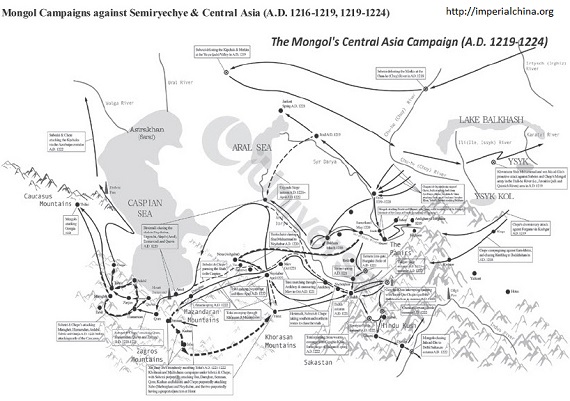
Mongol Campaign against the Jurchens (Battle of Yehuling, July of A.D. 1211)
Mongol Campaigns against Semiryechye & Central Asia (A.D. 1216-1219, 1219-1224)
Mongol Campaign against Kiev Rus (A.D. 1223)
Mongol Campaign against the Jurchens (A.D. 1231-1232)
Mongol Campaigns against the Volga Bulgars, Kipchaks, Alans, Rus Principalities, Crimea, Caucasus & Kiev Rus (A.D. 1237-1240)
Mongol Campaigns against Poland, Bohemia, Moravia, Hungary, Austria & Dalmatia (A.D. 1240-1242)
Mongol Campaign against Arsacia (Mulahida) from A.D. 1253 to A.D. 1256
Mongol Three-prong Campaign against Hezhou (Caaju) from late A.D. 1255 to early A.D. 1256
Mongol Continuous Campaigns in the Sichuan Basin (A.D.1257-1259)
Mongol Campaign against Hezhou (Caaju) & Diaoyucheng (A.D. 1257-1259)
Mongol Campaigns against the Abbasid Caliphate, Mecca, Misr (Egypt) Outposts, North Africa, and the Ayyubid & Mamluk Sultanates (A.D. 1257-1260)
|
|
In central Asia, in A.D. 1221, Genghis Khan attacked Puo-ha-er and Xie-mi-si-gan, i.e., Bukhara and Samarkand.
This was taken to be a second campaign to quell the rebellion of the two cities that were sacked in A.D. 1220.
In April, when stationing in the Tiemen'guan [iron gate] Pass, the Jurchen emperor sent an emissary requesting for being a "junior brother" of the Mongols. Jurchen 'xing sheng' [governor] at Dongping deserted the city. Yan Shi was ordered to guard Dongping. Southern Soong sent Gou Mengyue for peace with the Mongols. Soong general Shi Gui surrendered in today's southern Shandong Province. In today's Central Asia, in autumn, Genghis Khan attacked Ban-le-he, while Jochi-Chagatai-Ogodai attacked Yu-long-chi. In Oct, Tolui took over Ma-lu-ch-ye-ke, Ma-lu and Xi-la-si. In northern China, Muhuali departed from 'He-xi' (west of the Yellow River) to attack Suide, Bao'an and Yan'an (Yenan) of today's central and northern Shenxi Province. In November of A.D. 1211, over a quarrel with former red jacket army leader Li Quan, Soong Chinese governor Zhang Lin at Yi4du, who previously wrestled over Cangzhou and Qing1zhou of the Hebei-Dong-lu circuit, surrendered to the Mongols.
In A.D. 1222, Tolui took over Tu-si and Ni-cha-wu-er and pillaged the Mu-la-yi statelet, i.e., Munaixi (Hashasheen or Assassin or Arsacia), south of the Caspian Sea. Tolui and Genghis Khan converged on the Talihan Castle and captured it. In northern China, Muhuali failed to take over Fengxiang of today's Shenxi Province. Jala ad-Din fled to combine forces with Mieli-khan and defeated Mongol general Hu-du-hu. Genghis Khan then defeated and captured Mieli-khan. Ba-la was ordered to pursue Jala ad-Din across the Indus River. In autumn, the Jurchens dispatched Wusunzhongdun to the Mongol camp in the Wu-wu-er (Huihe/Uygur) territories for peace again. Genghis Khan ridiculed the Jurchens for not taking his offer to have the Jurchens be King of the 'He-nan' [to the south of the Yellow River] land. When Wusunzhongdun requested for mercy, Genghis Khan stated that the Jurchens surrender the cities in Guan-xi (west of the Han'guguan pass). Jurchen Duke Pingyang-gong surrendered the Qinglong-bao (Qinglong-bu) castle. In Oct, the Jurchen 'hezhong-fu' governor office surrendered.
The Jurchens would be defeated again later, but not completely defeated until A.D. 1234. Though, many Jurchen generals surrendered to and then rebelled against the Mongols.
The Khwarazm Campaign, the Fergana Valley Campaign (A.D. 1219-1223)
Western scholars, in their account of Genghis Khan's generals, would tout Subedei, son of Jelme (Genghis Khan's anda) and ancestors of the future Uriankhan (U) and Harqin banners of the Mongols, as the most brilliant. B.H. Liddel Hart devoted the first chapter of "Great Captains Unveiled" to 'Sabutai'. Cai Dongfan, however, commented that it would be Muhali (Muqali) who would be responsible for shaping Genghis Khan's bandit psychology into that of a ruler.
Muhali (Muqali), in northern China, began to hire the Han-ethnic Confucians who somehow persuaded the Mongols to adopt the benevolent philosophy of great saints in China's history.
By A.D. 1221-1222, Muhuali's
Mongols no longer ravaged North China in the autumn and left for north in the spring according to
Guo Wenzhen's report to the Jurchen emperor as noted in Xu Ding's biography in Jin Shi.
Genghis Khan conferred Muhuali (Mukali) kingship of the Zhongdu (Peking) territory, i.e., viceroy of today's Northern China, and the title of 'tai shi' in August.
In A.D. 1217, Muhuali (Mukali) was designated viceroy of Northern China. In today's Mongolia, Genghis Khan campaigned against the Keraits and the Tumats (Tu-man) who had rebelled earlier. A treaty was signed with Muhammad II of Khwarazm. In the same year, Genghis Khan campaigned against Kuchlug in Kara-Khitai (Western Liao Dynasty), i.e., the son of deposed khan of the Naiman. Kuchlug had earlier usurped the Khitai Kingdom of his Khitan father-in-law. Kuchlug colluded with Khwarazm in usurping the Kara-Khitai kingdom. Kuchlug, to make his new wife happy, forced the Kara-Khitai people into conversion to Buddhism. Genghis Khan hence sent Jebe on a campaign against Kuchlug.
Kara-Khitai was launched by
Yelü Dashi who, after the last Khitan Liao emperor was defeated by the Jurchens in southern Mongolia,
first fled to the Ongud (Wanggu) tribe, where he received Ongud chieftain Chuang-gu-er's assistance of 400 horses, 20 camels and 1000 sheep,
and then continued west to Beshbalik,
where the Uygur king Bi-le-ge (Pileko) gave him assistance in the form of 600 horses, 100 camels and 3000 sheep for helping to relaunch the Khitay kingdom, i.e., Kara-khitai.
Yelü Dashi recruited a cavalry force of 10,000 men from among the Uygurs and other western people.
Yelü Dashi first attempted to expand toward the Kirghiz territory to the north but pulled back in face of the Kirghiz strength.
In A.D. 1224, in the Khangai Mountain area, Yelü Dashi set his court at the ancient Uygur khan's Ke-dun (Khatun) city in today's Bulgan of Mongolia.
Rene Grousset (1885–1952), from Taoist Qiu Chuji's travelogue, believed that Yelü Dashi and the Khitans could have constructed a fort between the Kerulen and Tu'ula Rivers, with the ruins showing the street layout and the Khitan characters on the tiles.
After the Jurchens attacked the Khatun city a second time in A.D. 1135, Yelü Dashi moved south to Central Asia, where
Yelü Dashi obtained the abdication of Efrasiyab (Afrasiyab - which meant Samarkand), a khan carrying the famed Turan (Transoxiana) khan name from antiquity, and took control of Balasagun in the Chuy valley, a city next to today's Bishkek and Tokmok and also called by
Dashi-linya (Yelü-dashi {imperial scholar}'s ordo).
Genghis's general, Jebe, overran Kuchlug's forces west of Kashgar, in today's southwestern Chinese Turkestan. Kuchlug fled to Badakhshan, where he was captured and executed, and the Karakitai territory was annexed.
Guo Baoyu's biography stated that in the 'jia xu' year (A.D. 1214), Guo Baoyu followed Genghis Khan in campaigning against the Khitan remnants, passing through the E-yi-duo city of the ancient Gu-Xu-gui-guo state and defeating over 300,000 troops, on which occasion Guo Baoyu was so much injured in the chest by an arrow that Genghis Khan ordered to cut apart an ox's belly to place Guo Baoyu inside.
From Guo Baoyu's biography, it could be seen that the Mongols and the Kara-khitay were engaged in numerous battles in today's Chinese Turkestan, including the siege battles Bie-shi-ba-li (Beshbalik, i.e., Gushi or Jushi of the Han dynasty and Tingzhou of the Tang dynasty) and Bie-shi-lan.
By 1218, the Mongol state extended as far west as Lake Balkash and adjoined Khwarizm, a Muslim state that reached the Caspian Sea in the west and the Persian Gulf and the Arabian Sea in the south. Khwarizm, a previous vassal of the Kara-Khitai, had previously colluded with Kuchlug in overthrowing the Khitan ruler.
Right after the conquest of the Kara Khitai, the Mongols came into conflict with Khwarezm. So to say that Naiman's Kuchlug led Genghis Khan to Kara-khitai, and Kara-khitai led Genghis Khan to Khwarezm. Starting with Khwarezm, the wars for dominating the world began.
In A.D. 1218, governor of Oyrat (Otrar), an eastern province of Khwarizm, robbed and killed the Mongol merchants as spies, i.e., over four hundred Uygurs [except for one who escaped], and moreover in the following year killed a Mongol emissary (with name Bo-he-la per Xin Yuan Shi).
This was similar to the Central Asians' robbing the Han dynasty's gold horse, which led to a punitive two-prong campaign by General Li Guangli against Dawan (Dayuan) in 104 B.C. and its outpost city of Ershi, i.e., Osh of Kyrgyzstan.
This was after three Central Asia merchants returned to report to the Khwarazm shah what Genghis Khan claimed to be willing to take in the shah as an adopted son [for the apparent age difference].
History of the Yuan Dynasty put the killing of Mongol emissary in June of A.D. 1219 -- which was actually about the context of the war rather the time of actual killing of the Mongol emissary and merchants on two occasions [or the merchants in A.D. 1218 and the emissary in A.D. 1219], after which Genghis personally led a campaign to the west.
Rene Grousset (1885–1952)'s
L'Empire Mongol stated that a certain lead merchant by the name of Mahmud Ali Khwajah presented the shah with some lump of gold as gift from Genghis Khan.
Minhaj al-Siraj Muhammad Juzjani's Tabaqat-i Nasiri (historic records of Sultan Nasir-ud-Din r. 1246–1265) claimed that in A.D. 1216, a much earlier year than realistic, the shah sent a certain emissary by the name of Saidianchi-baoheding (Baha ad-Din Razi, who was speculated to be the same person as Sayyid-i-Ajall Baha ud-Din who was later sent to southwestern China by the Mongols as an administrator) to China for verifying the Mongol conquest of Taohuashi (Tobyac - with 'taohuashi' meaning peach flower stone, a soundex for the Tuoba or To'pa people who founded the Wei dynasty A.D. 386-534), i.e., northern China.
Rene Grousset mentioned the shah's conversation with Mahmud Ali Khwajah, which was bewilderment over the authenticity of the news of fall of Tobyac.
The Mongol troops led by Jochi was first defeated by troops of Shah Mohammed of Khwarezm. Genghis Khan retaliated with a force of more than 200,000 troops. The Wei-wu-er (Huihe/Uygurs) came to aid the Mongols. Genghis Khan and Subedei attacked from the north with 90,000 men, while Jebi (Chepe) attacked from the east with 30,000 men.
The Mongols, after crossing the A-la-yi Ridge, repelled a joint attack by Han-milike khan and Jala ad-Din who fled towards the Shen-he (Indus) River instead of the capital city Samarkand.
Genghis Khan, giving order that Chagatai and Ogodai attack the Oyrat continuously, would send three columns into Khwarizm territories. Jochi went to the northwest, one column to the southeast, and Genghis Khan himself to the northeast for Tashkent.
In the autumn of A.D. 1220, Genghis Khan's Mongols attacked and sacked the Wo-tuo-luo-er city, i.e., E-da-la (Oyrat).
The actual fall of Oyrat, that occurred in A.D. 1221, began in A.D. 1219 and lasted at leave over the six-month duration of the siege.
Otrar's governor, Inalchuq, would be killed by feeding melted silver into the mouth and ears etc.
Shah Mohammed-shah led 400,000 men against the Mongols. It was said that 180,000 were killed during the battle.
Genghis Khan himself, with Tolui and Subetei, crossed the Syr-Darya and the Jijierkumu (Jizzakh) Desert for Tashkent to attack Puo-ha-er (Bukhara).
Jala ad-Din (Jalal al-Din), the son of Sultan Muhammad and governor of the Afghanistan territory of today, asked to stay to defend Bukhara and Samarkand in the Fergana Valley, but was declined by his father.
The Mongols, after taking and massacring Bukhara, including its mercenary defenders, chased to Samarkand, where the defenders numbered by over 110,000.
The Mongols first sacked Bukhara in March of A.D. 1220, which was defended by 30,000 troops and then sacked the Khwarizm capital city of Samarkand in May.
Later in A.D. 1221, the Mongols captured Bokhara and Samarkand [a second time].
Genghis Khan pursued the Khwarizm armies to the River Amu-darya and crossed to the west bank of the river. Hearing that Khwarizm-shah had re-organized his troops in Samarkand, Genghis Khan crossed the River Amu-darya to campaign to the east. After taking over Samarkand where the soldiers surrendered after the Shah fled, Genghis Khan would kill all 40,000 prisoners at night. About 30,000 skilled workers and artisans would be spared, and another 30,000 labor would be taken as slaves.
The Mongols slaughtered numerous cities during their campaigns.
The desolateness of Samarkand was later described by Yelü Chucai as a city (Hezhong-fu, i.e., prefecture within two rivers) of monasteries buried in the wild fields and half of the streets and markets littered with tombs.
The city of Te'ermi (Termez), located to the south of Samarkand and along the river bank of the River Amu-darya, was massacred in the spring of A.D. 1221.
The Mongols spent at least half a year eliminating the forts and ships along the River Amu-darya.
The Ma-lu (Merv) city was taken and massacred by Tuloi in October of A.D. 1221.
Merv was situated to the west of Termez, to the southwest of Bukhara, to the southeast of Urgenchi, and to the north of Balkh.
At the historical silk trading polis Merv, the Mongols could have massacred 1.3 million people, which showed the persistent local resistance to the Mongols throughout the year of A.D. 1221.
The Ma-li (? Mukry) city along the River Amu-Darya, that was sacked by the Mongols likely
in the spring of A.D. 1221, was different from the Ma-lu (Merv) city that was taken by Tolui (Tu-lei/Tuloi) in October of A.D. 1221 -- that was wrongly recorded on the Islamic calendar as February 25th
of A.D. 1221.
Yuan Shi put
the massacre of Merv under October of A.D. 1221, followed by the sacking of Tus and Neyshabur in
the spring of A.D. 1222, while Xin Yuan Shi wrongly bundled the sacking of Merv and Neyshabur
under A.D. 1221, with a claim that Neyshabur was taken after a siege of three months, followed by the
taking of Herat before going on to reinforcing the Taloqan siege. The Merv massacre's causal logic
in the correct context should be triggered by rebellions conducted by the Central Asians to echo Jala
ad-Din's re-organized resistance at Ghazni in A.D. 1221, not earlier than that.
The Mongol history, for the lack of written
records concerning the early time period, was shrouded in mystery. In the last few hundreds of years,
Europeans and Americans conducted historical authentication on basis of the Arab and Persian
sources.
However, the Persian and Arab sources, that were premised on
the Muslim calendars, inadvertently contained the one-year error dating from the start of the Mongols' Central Asia campaigns of A.D. 1219-1224. It was said that Bolad-chingsang (prime minister Bolad
[Bei-luo; Pulad; Boluo; Po-lo], A.D., ?-1313) helped Rashid ad-Din in writing Jami al-Tawarikh (collected
chronicles, & history of the tribes).
Yuan Shi
and
Xin Yuan Shi were both wrong by one year in regards to the Mongol campaign after Bukhara and Samarkand, with the latter omitting the battle of Tiemen-guan (iron-colored mountain pass, Buzgala).
Guo Baoyu's biography stated that Wei-suanduan-han Sultan of the Ke-fei-cha (Kifchak) state (who previously defeated the Naimans) abandoned Xun-si-gan (Samarkand), escaped to Tie-men (iron gate) and stationed at the Big Snow Mountain (Badakhshan), with Guo Baoyu chasing the khan to Yin-du (India).
Tie-men, a mountainous terrain said to be either iron-colored mountain road or iron gate-blocked mountain road,
was situated to the north of the Amu Darya and to the northeast of Ban-le-hei (Ban-le), i.e., Balkh (Greek Bactria).
At the Big Snow Mountain (i.e., Badakhshan), seeing the snow as heavy as two yards, Guo Baoyu petitioned with Genghis Khan to confer the title of King Xuanji-wang (utmost darkness) onto the Kunlun-shan Mountain and King Huiji-wang (benefiting) onto the Big Salty Pond.
Guo Baoyu's biography could have bundled the events in two separate years in one sentence, with
the Battle of Tiemen (iron-gate, Buzgala) in A.D. 1221 and the excursion to the Big Snow Mountain (in southwestern Badakhshan) after the River Amu-darya sweep campaign, attack of Balkh south of the River Amu-darya, and campaign against the Taloqan castle in A.D. 1222.
In this timeframe, Xin Yuan Shi was wrong in bundling the Badakhshan diversion campaign with the attack of Termez along the River Amu-darya.
(This webmaster, who wrote this Mongols' page around year 2000 without looking at the Central Asia map, has now come back to re-examine the geography and completed the re-writing of the Mongol history of conquest of the world.
For details, see this webmaster's debunked and restituted Mongol history, i.e., The Scourges of God Tetralogy - Book 3: a Debunked Barbarians' History of the Khitans, Tanguts, Jurchens and Mongols.)
Subedei and Chepe went on to pursue the Shah with 2 tuman (20,000 men). After crossing the River Amu-darya, Jebe went northwest and Subedei to the southwest. They raided deep into the Persian territories and converged on the coast of the Caspian Sea. Khwarazm-shah, being attacked by a local feud, would flee to an island to the southeast of the sea where Khwarazm-shah died of miseries. Jala ad-Din was ordered to succeed him.
Xin Yuan Shi, relying on the forged European, Russian, Arab and Persian records, erroneously gave Subedei and Chepe a detailed campaign in the Zaros, Khorasan and Mazandaran Mountains like a circle of Tus, Damghan, Semnan, Qom, Kashan, and Isfahan, with purportedly a junction at Herat.
The Khwarazm-shah, deeply influenced by his own mother Terken Khatun, had erected a different son as his heir. This caused rifts with his son Jala ad-Din. Terken Khatun was from the Turkic Kang-li tribe, said to be related to the ancient Kangju statelet of Yuezhi ethnic nature. The Shah ruled the heterogeneous peoples without mercy. In face of Mongol attacks, the Khwarazm empire, with a combined army of 400,000, simply collapsed.
Subedei and Chepe later captured the mother, wife and daughters of the Khwarazm-shah and gave them to Chagatai and his generals, and the son of the dead Mongol merchant, as concubines.
Before the official start of siege of Urgenchi (? autumn A.D. 1221-spring A.D. 1222), the Khwarazm-shah's mother Tu-er-han (Terken Khatun) left Urgenchi while Jala ad-Din, i.e., the Khwarazm-shah's eldest son, came to Urgenchi to take command as heir -- which was the Khwarazm-shah's death wish.
However, Jala ad-Din was forced out of the city by the Turkic commander Hu-ma-er who objected to Jala ad-Din's succession and intended to kill the shah's son to declare a shah himself.
This likely happened at the turn of A.D. 1220-1221 and before the Mongols started the siege, nevertheless an earlier Mongol army frequenting Urgenchi during the A.D. 1220 chase of the Khwarazm-shah to the Caspian.
Genghis Khan was recorded to have written to Terken Khatun for striking peace, claiming that he was warring with Shah Muhammad, which showed a Mongol tactic to keep the hundreds of thousands of Urgenchi army troops out of the Sarmakand and He-zhong (the middle land of two rivers) campaigns as well as provided indisputable evidence that the Urgenchi siege could have only happened during the time period of autumn A.D. 1221 and spring A.D. 1222.
(Revisionist history that were based on the Persian and Arab sources were wrong by one year across the board.
Again, Henry Hart Milman's dismissing the Chinese chronicles for the inconsistency in his annotation on Edward Gibbon's
History of the Roman Empire and Fall of the Western Roman Empire was unfounded while acknowledging that he was "ignorant at what time these annals were composed and published".)
Subedei and Chepe then received order from Genghis Khan to attack a tribe called 'Qin-cha' (Kipchak or Qipchak) north of the Caspian Sea. This is because Qin-cha tribe had offered asylum to the Merkits. Subedei and Chepe raided towards the northwest.
The annals, without making distinction of two phases of Kipchak campaigns, i.e., the initial phase of the Mongol western campaign of A.D. 1216-1219 and the Khwarazm campaign of A.D. 1219-1222 (1224), continued to state that in A.D. 1222 (should be earlier in A.D. 1220 - with the year A.D. 1222 meant for the Caucasus campaign), Subetei and Jebe were ordered by Genghis Khan to chase
Muslim king Mie-li (i.e., Mieli-khan who was an ally to Jala ad-Din during the Afghan and Hindu Kush wars of A.D. 1221-1222), who was implied to be the Khwarazm shah, which led to the Mongols' attacking the rear of the Kipchaks from the Caucasus mountain direction in A.D. 1222-1223.
Subetei's biography in Yuan Shi, which claimed that Subetei and Chepe chased Muslim king Mie-li (who was mixed up with the Khwarazm shah) to the Huili-he River in A.D. 1222, where Chepe suffered setback and Subetei ordered troops to lit three torches per person on the eastern bank to scare the Muslim king into escaping overnight, was taken to be what Atâ-Malek Juvaini wrote as the Qaili and Qaimich (Qlmich, Qaimacli) Rivers.
The reconstructed history in regards to both the Battle of Hemi (? Qomul) and
the Battle of Qaili and Qaimich (Qlmich, Qaimacli) Rivers
was about Shah Muhammad and son Jala ad-Din's proactive attack against Subetei and Chepe's Mongol army which was en route of returning east from the Merkit-Kipchak campaign in A.D. 1219.
During this confrontation, Jala ad-Din's right wing defeated the Mongol left wing while the Mongol right wing defeated the Khwarazm left wing and surrounded Shah Muhammad's middle army, with Jala ad-Din rescuing his father - similar to Xue-du's rescuing Jochi.
Genghis Khan, after taking a rest for the summer, would order Jochi, Ogodai and Tolui on a campaign against Ur-da-chi (Urgenchi or Urganchi) in the south.
Ur-da-chi (Urgenchi or Urganchi) selected a Kangli Turk as their head.
The Siege of the Urgenchi
Twin Cities lasted from the autumn of A.D. 1221 to the spring of A.D. 1222).
Lacking stones around Urgenchi, the Mongols had difficulty sacking the city. The Mongols
sent 3000 troops to cut the bridge linking the twin cities of Urgenchi, with all the Mongol commandos
killed in battle.
The next year, in April of A.D. 1222, the Mongols changed the commander-in chief to Ogodai from Jochi after attacking Urgenchi in vain for over seven months. This was after the
discord was reported to Genghis Khan who was fighting the war at Ta-li-gan, i.e., Talihan (Taligan/
Thaleqan/Taloqan) but failed to sack the Nusrat Kush mountain fort -- which vindicated the Urgenchi
siege to be autumn A.D. 1221 to spring A.D. 1222. This was purportedly due to Jochi's attempt to
cause less damages to the city as a result of Genghis Khan’s promise to make Urgenchi into Jochi's
fief.
After fighting for 7 days and 7 nights, the city, situated on the two banks of the River Amu-darya, fell, and most of the residents, except for artisans and women, were slaughtered. Genghis Khan then ordered Tolui to attack Khurasan while he himself attacked a castle called Talihan Mountain. Tolui marched along the west bank of the River Amu-darya and marched towards Khurasan in the northwest. Hearing Genghis had trouble taking over Talihan, Tolui returned along the east coast of the Caspian. South of the Caspian, he defeated several Muslim city statelets. Tului then converged with Genghis and took over the city called Talihan which was already under siege for 7 months. All infantry soldiers of Talihan were killed while some cavalry fled.
At this time, Jala ad-Din re-assembled some army and combined his army with a brother and a khan [Mielike], numbering 60 to 70 thousand. In today's Kabul, Afghanistan, the Mongol armies under the banner of Genghis Khan's adopted son were thoroughly defeated by Jala ad-Din. In the siege of the city of Bami'an, Genghis Khan's grandson (i.e., Chagatai's son) was killed by an arrow. Chagatai would kill all people and animals of Bami'an, and Bami'an (today's Bamian of Afghanistan?) was said to be still a desolate place today. Then, Genghis Khan went southward towards Kabul. Two Jala ad-Din generals had a quarrel and split, and Jala ad-Din fled towards India, jumped into the Indus River and swam to the opposite shore. Jala ad-Din would later make a comeback. A Mongol general was sent across river to pursue Jala ad-Din. Genghis Khan then swept northward along the west bank of the Indus River and slaughtered whoever did not submbit.
In April of A.D. 1222, Qiu Chuji, with eighteen disciples, departed Samarkand, passed Tiemen-guan Pass, and arrived at the Mongol mobile palace at Baluwan next to the snowy mountain.
Balkh, which surrendered without a fight on the first occasion, was ordered to dismantle
the city walls, but nevertheless rebelled against the Mongols the following year, i.e., in-between
Taoist-master Qiu Chuji’s two trips (in March-April and in August of A.D, 1222) which were about
seeing Genghis Khan south of the River Amu-Darya.
In the summer and autumn, the two had two more meetings, with Genghis Khan apparently interested in finding a way to become an immortal like Taoist-master Changchun-zhenren ('forever spring' perfected person), a Dragon-gate sect Taoist.
Yelü Chucai recorded the two's conversations into the book Xuan Feng Qing Hui Lu (records of the celebrated meetings of the winds from the profundity origin gate).
Genghis Khan loitered in the Badakhshan area, taking the snowy mountains as the legendary Kunlun-shan Mountain where the immortals lived.
In February of A.D. 1223, Genghis Khan at one time expressed the wish to return east together
with Qiu Chuji in an attempt at retaining Qiu Chuji for a longer stay in Central Asia.
Bei-lu, after father Muhuali's death in March of A.D. 1223, paid a visit to Genghis Khan in
Central Asia in A.D. 1223, and was ordered by Genghis Khan to attack the Tanguts.
In A.D. 1224, Genghis Khan, before returning to North Asia, traveled to India to contemplate on attacking Jala ad-Din again but decided to end the campaign after spotting a horny animal in the Indus River, which was taken to be the propitious rhino that was written as 'jiao (horny) rui (propitious animal)' that was equivalent to similar propitious animals seen in the bamboo annals and other Chinese chronicles.
History annals contained an entry which was about the
Mongol khan's wish to return to China through India but was discouraged from doing so with the
prospect that the rebellious Tanguts could be waiting on the other side of India.
Under the advice of Yelü Chucai, Genghis Khan recalled his soldiers from across the Indus River.
The Mongols slaughtered 1.6 million people altogether in Central Asia, which was still a small number in comparison with 70-80 million deaths in North China and South China combined. Under the advice of Yelü Chucai, Genghis Khan recalled his soldiers from across the Indus River. Genghis Khan went northward and then eastward across the River Amu-darya. In Kabul, Genghis Khan sent orders to recall Jochi's column and Jebi/Subetei column. Then, they continued eastward. When passing through Samarkand, he ordered Khwarizm-shah's mother and wife to go east with him. Khubilai was at the age of 11 at this time.
The First European Campaign (A.D. 1222-1223)
Right after the war in 1219-1222 against the Khwarezmian empire, Chepe (Jebi) and Subedei, with a detachment of about 25,000 Mongols, detoured around the Caspian Sea and raided into today's Georgia. They attacked the Kipchak on the pretext that they had offered asylum to the Merkit remnants. While Genghis Khan was on the bank of the Indus River, Jebi and Subeitei had marched westward and crossed the Taihe Ridge, i.e., the Caucasus Mountains. After defeating the Qin-cha (Kipchak or Qipchak) relief armies comprising of the Georgians and the Cumans, they went on to attack the Russians. The Cumans or Kumans, identified with the Kipchaks, were known in Russian as the Polovtsi. The Cumans had come from northwestern Asian Russia, conquered Southern Russia and Walachia in the 11th cent., and for almost two centuries warred intermittently with the Byzantine Empire, Hungary, and Kiev. In the early 12th century, the Cumans were defeated by the Eastern Slavs. The Mongols would decisively defeat them in A.D. 1245.
Coming out of the Caucasus, they met several Qin-cha tribes under Yulijie. Jebi and Subeitei sent a local defector general to Qin-cha (Kipchak or Qipchak) to show goodwill, and then attacked the Qin-cha armies after they did not put themselves on alert. The Mongols killed chieftain Yulijie and his son. Then Jebi and Subetei sent a request to Jochi for relief armies. Jochi had just conquered Wu-er-da-chi (Urgenchi) and rested his armies on the east coast of the Caspian.
After defeating the Georgians and the Cumans in the Caucasus, Jebi and Subetei, with reinforcement from Jochi, crossed the Volga River and marched towards the Sea of Azov and the Black Sea.
They advanced into the steppes of the Kuban in A.D. 1222. Walking across the frozen Sea of Azov, the Mongols again defeated the Cumans and captured Astrakhan.
At this time, another Qin-cha (Kipchak or Qipchak) chieftain, Huotuosihan (brother of the dead Yulijie), came to avenge on his brother's death. The Mongols led Huotuosihan into a trap and destroyed majority of his armies. Huotuosihan fled northward towards Rus which boasted of 70 tribes at that time.
The Mongols crossed the Don River into Russia. They penetrated into the Crimea and then turned north into today's Ukraine territory.
The Mongols, pursuing the Cumans, raided into Crimea, and plundered the former Genoese city of Soldaia, i.e., the Constantinople Franc trading polis Su-da-hei (Soudagh).
In today's Southern Russia, there was a tribe called Halichi whose chieftain, Mizhisila (Mstislav?), was son-in-law of Huotuosihan. Mizhisila called on various Rus tribes including the Kiev tribe and the Chernigov tribe in the south and the Vladimir tribe in the north. Mstislav rallied troops from Kiev, Smolensk, Kursk, Chernigov and other principalities. An army of 82,000 was assembled, and they converged with Huotuosihan's Qin-cha (Kipchak or Qipchak) tribe. Jebi and Subetei tried to trick the Rus by sending 10 emissaries for peace. Huotuosihan told Mizhisila how his brother died of the Mongol trick, and they killed 8 Mongols, releasing two back to the Mongol camp with ears cut. Jebi and Subetei sent the two lucky guys to the Rus camp again to declare a war. Mizhisila (Mstislav?) led 10,000 cavalry across the Dnieper River and finished the Mongol reconnaissance team of a dozen people on the east bank.
(Some Mongol expert claimed that the Russian-Cuman army of 80,000 was under the leadership of Mstislav, that Mstislave was prince of Kiev and that they attacked the Mongols while the Mongols were camping near the mouth of the Dnieper River. Cai Dongfan wrote that the Kiev prince was Ruomu and that the Mongols were pursuing the Kipchak or Qipchak tribe to Rus, not resting at the Dnieper River.)
In May 1223, Mstislav chased the Mongols to the River Khalka.
Mstislav and Huotuosihan, without consulting with their allies, crossed the River Khalka by themselves. They were totally defeated by Subedei. Mstislav then fled across the River Khalka (near the Azov Sea) and sunken all ships. The Mongols crossed the River Khalka, attacked the Kiev tribe & Chernigov tribe and annihilated them. Altogether 6 chieftains and 70 marquises were killed. The Chernigov chieftain was sent to Jochi for execution. Youli the second of the Rus tribe of Vladimir had dispatched his nephew, Constantin, to the relief of Mstislav. Hearing of Mstislav's defeat, Constantin fled home. At this time, Jebe got ill.
The Mongols then swept north into the Northern Russian territories, reaching as far north as Bu-li-a-er (Bulgar).
The Mongol army, crossing the Volga River near today's Volgograd, swept through Volga Bulgaria, attacked the Qanglis Cumans, and defeated a Cuman army near the Ural Mountains.
In A.D. 1224, Subetei led the expedition home, after a trek of more than 6,400 kilometers. On the east coast of the Caspian, Subetei gave back the relief army to Jochi. On the way home, Jebe died of illness.
The Last Campaign of Genghis Khan
Muhali was busy attacking the Jurchen Jin armies on both banks of the Liao River, northeast of the Yellow River, in today's Shanxi-Shenxi Provinces, and on the Shangdong peninsula.
In A.D. 1223, Muhuali died of illness and was conferred King of the Lu-guo Fief posthumously.
In Oct, Jurchen Emperor Xuanzong died, and his son, Wanyan Shouxu, got enthroned as Jurchen Jin Emperor Aizong. The Soong Chinese sent Gou Mengyue to the Mongols again.
In A.D. 1224, Soong General Peng Yibin at Daming (in today's southern Hebei Province) invaded He-bei (territory north of the Yellow River). Shi Tianni defeated Peng. Genghis Khan returned from his campaigns in India. In January of A.D. 1225, Genghis Khan returned to Mongolia. In February of A.D. 1225, after the death of Muhuali, ex-Jurchen general Wu Xian rebelled in Zhending and killed Shi Tianni. Li Quan rebelled in Zhongshan on the eastern slope of the Taihang Mountain and in today's central western Hebei Province.
Wu Xian cooperated with Soong Dynasty's General Peng Yibin in fighting Shi Tianze. Shi Tianze requested aid from Muhuali's son and killed Peng Yibin.
In March, Shi Tianze drove Wu Xian away. In June, Soong General Peng Yibin answered Wu Xian's rebellion to invade into the Mongol territory. Shi Tianze captured and killed Peng.
Since Western Xia refused to provide troops in the war against the Khwarizm, and moreover, signed another alliance treaty with Jurchen Jin, Genghis Khan led a force of 180,000 troops for a new campaign against the Tanguts in A.D. 1225.
One year earlier, in A.D. 1224, Mongol omnipotent magistrate for Northern China, i.e., Bei-lu, already attacked the Tanguts' Yinzhou city where tens of thousands of the Tanguts died and defender Ta-hai was caught alive.
Purportedly,
Genghis Khan, en route of return from Central Asia, first attacked the Tanguts' Shazhou city and laid the siege for half a year, where the Tanguts burnt dead the Mongols digging through a tunnel and the Mongols withdraw the siege for a retreat to Mongolia after Tangut Emperor De-wang agreed to send in hostage.
This appeared to be a forgery record from Wu Guangcheng's Xi-xia Shu Shi[4] (western Xia's anecdotes), something built on similar misunderstandings of other European and Chinese historians' puzzle over the Mongol mass murderer's whereabouts in A.D. 1224-1226 -- as a result of the shortening of the Mongol Central Asia campaigns by one year across the board.
In A.D. 1225, Jochi died in the camp north of the Caspian Sea.
In A.D. 1226, Genghis Khan attacked the Tanguts the sixth and last time.
The Mongols attacked the westside or hindside of the Tanguts first and then turned around to the east.
Like in A.D. 1209 & 1217, the Mongols intruded into the east side of Helanshan Mountain and lay siege of Xingqing-fu (i.e., today's Yinchuan of Ningxia and Tanguts' capital).
In the spring of 1226, Genghis Khan, after zoning the fiefdoms for his four sons, attacked the Tanguts on the pretext that no hostage was sent in yet.
Two columns of armies were arranged, with one prong attacking Shazhou from the west, and another prong striking southward against Xixia.
In Feb, Genghis Khan took over the Heisui garrison [Khara Khoto], reached Mt Helanshan via a trek across the deserts (i.e., the same path Zhou King Muwang took around 1000 B.C. in a tour of China's northwestern territory), caught Tangut General A-sha-gan-bu, and waited for a conversion with the "western route". (A-sha-gan-bu had insulted Genghis Khan's emissary on the matter of attacking the Jurchens together with the Mongols.)
The Mongol "western route" first attacked Shazhou by utilizing a defector Tangut general called Li Qianbu. Li Qianbu and Mongol General Hudu-timur barely escaped a banquet set up by Shazhou defenders who faked a surrender. With pleading from Li Qianbu, Genghis Khan spared the city after sacking it.
The Mongol "western route" then attacked Suzhou with guide by a Tangut called Cha-han who grew up among the Mongols since childhood.
Suzhou defenders killed the general who was the brother of Li Qianbu.
The Mongols slaughtered the city, only sparing 106 households who were relatives of Li Qianbu.
After Suzhou would be Ganzhou whose defender was the father of Cha-han.
Tangut deputy defender killed the whole family of Cha-han's father. The Mongols failed to sack Ganzhou after six attacks.
At this time, Genghis Khan led his forces to Ganzhou, and combined forces for an attack at Ganzhou. Ganzhou was spared slaughter with the pleading from Cha-han.
In autumn, the Mongols took over Xiliang-fu when defenders surrendered. Hence, the whole "Western Corridor" fell to the Mongols.
In North China, the Mongols invaded the Shandong peninsula in A.D. 1226.
Zhang Rong, a local strongman, surrendered Ji'nan and Zizhou (Zibo) to the Mongols, for which he received the Mongol appointment as 'Shandong xing sheng' and 'du yuanshuai'.
In September of A.D. 1226, Li Quan attacked Yi4du and captured Zhang Lin, with Zhang Lin being forwarded to Southern Soong for punishment.
Beilu, i.e., Muhuali's son, attacked Li Quan.
At the turn of the year, Li Quan surrendered to the Mongols.
In the west, Genghis Khan trekked the Tengri Desert for the region called "Yellow River Nine Winding".
What happened was that the Mongols, at the same time of laying a siege of Shazhou, sent
Subetei across the Qilian-shan mountains for attacking the Chaidamu (Tsaidam, Qaidam) basin and
the Yellow River Winding Area.
The Mongols took over Yingli, and then dispatched a contingent against Xiazhou. The Mongols, with two columns, swept through the Tangut territory along the bank of the Yellow River's Western Bend.
By Nov, two columns pinched Tangut Xiping-fu city.
A Xixia general, by the name of Weimingling-gong, led 100,000 relief army from Zhongxing-fu, and challenged the Mongols for a battle near Helanshan Mountain. (Helan means great horse in northern dialect.) The Mongols crossed the frozen Yellow River and fought Tanguts on the two banks. Xixia armies were defeated at Helanshan. Weimingling-gong retreated into Lingzhou city with remnants and converged with deposed Tangut Prince De-ren.
In Nov, Genghis Khan lay siege of Tanguts' Ling-zhou.
The Mongols then sacked Lingzhou, and De-ren was killed.
The Mongol armies then took over various cities including Lingzhou Prefecture, Shizhou Prefecture, and then Lintao governor office including Taohe and Xining prefectures.
Five stars (planets), in a row, were noted in the skies. To the east, in Dec, Li Quan surrendered. Zhang Rou was conferred marshal and 'qian hu' (mingghan). Ogodai lay siege of Jurchens' 'nan-jing', i.e., the southern capital, and dispatched Tang Qing for extracting tributes from the Jurchens.
After the Battle of Lingzhou, the Mongols pushed at Zhongxing-fu, the Tangut capital, from Yanzhou.
In A.D. 1227, Genghis Khan attacked the Tanguts' capital, and in Feb, took over Lintiao-fu.
In February of A.D. 1227, the Mongols took over Lintiao-fu. In March, the Mongols took over the
Tao[zhou], He[zhou] and Xining prefectures. This was the Tibetan-Tangut fringe area of the Tao-he
River, which Wang Shao pacified in A.D. 1071 during Soong Emperor Shenzong's rein.
In Mar, the Mongols took over Xining prefecture and Xindu-fu. In April, the Mongols took over Deshun prefecture and killed 'jiedu shi' Ai Shen and 'jin[4] shi' Ma Jianlong.
At Deshun, Xixia General Ma Jianlong resisted the Mongols for days and personally led charges against the Mongols outside of the city gate. Ma Jianlong later died of arrow shots.
Genghis Khan, after taking over Deshun, went to Liupanshan Mountain (Qingshui County, Gansu Province) for shelter from the severe heat of the summer.
In the east, in May, the Mongols dispatched Tang Qing to the Jurchens again. In Jun, the Jurchens sent Wanyan Hezhou to the Mongols for peace. Genghis Khan stated that he had said one year ago, when five stars (planets) converged onto one line, that the Mongols should not kill people at random, and Genghis Khan made it a decree not to kill at random.
At the Tangut capital of Zhongxing-fu, rightside prime minister Gao Lianghui defended the citywall for half a year, day in and day out, and died of illness. An earthquake struck the capital. The epidemic erupted and more than half of the citizens and soldiers caught illness.
The new Xixia emperor, i.e., Xia Modi, being attacked by the Mongols, surrendered to the Mongols by requesting for one month grace period.
Genghis Khan, deeply ill himself, nominally agreed to the surrender request but secretly ordered the slaughter of the city before his death.
In August, Tangut Emperor Xia-modi left the capital for the Mongol camp where Tu-lei killed him on the spot.
The Mongols killed the Tangut emperor and his royal family members. Pillaging erupted throughout the capital.
The Mongols pillaged the Tangut "royal burial sites". (Later, the Mongols dug up Southern Soong Dynasty royal tombs in Hangzhou of Zhejiang Province as well.)
At the pleading of Cha-han, the Mongol stopped killing, with possibly one or two out of ten inhabitants left.
The Tanguts officially surrendered in A.D. 1227, after being in existence for 190 years, from A.D. 1038 to A.D. 1227.
(Five stars or planets in a row were interpreted as some omen as to rise and fall of an emperor or dynasty. History of the Yuan Dynasty mentioned that Genghis Khan, before his death, had ordered that the Mongols should not kill people at random. This certainly is a glorification since the Tangut massacre contradicted what Genghis Khan had decreed.)
Meanwhile, Genghis Khan sent Ogedei eastward with majority of his troops. They crossed the great bend of the Yellow River and began to attack the Jurchen Jin forces.
In July, Genghis Khan died at age 66 (73 ? per different record) near today's Liupanshan Mountain, Gansu Province, rumored to have been poisoned or killed by his Tangut concubine.
Menggu yuan-liu (Origin of the Mongols), a book written on basis of the Mongol legends and rumors by Sa-xiang-che-chen during the Manchu Qing dynasty, implied that the khan was killed by a Tangut concubine, i.e., Gu-er-bo-le-jin Guo-wo-ha-tun, as a result of injury to his sexual organ.
He was buried in Qinian Valley and was titled Taizu posthumously. Genghis Khan was also titled Emperor Shengwu, having a reign of 22 years and having conquered 40 countries. Tolui was made regent after Genghis Khan's death.
Genghis Khan, at death-bed, outlined to his youngest son, Tului, the plan for attacking the Jurchens, i.e., circumventing southward near the Soong-Jurchen border areas of Sichuan Province. Genghis Khan said the Soong Chinese would for sure acquiesce because the Jurchens were the feuds of the Soong Chinese.
Before Genghis Khan's death,
the Mongols, other than attacking the Jurchen Jin forces in western China, also intruded into the
Soong territory in A.D. 1127, on which occasion the Mongols sacked Jie4zhou (Wudu) and encircled
Tianshui-jun where Soong generals Zhang Wei and Cao Youwen were in defense -- which was the only
one of five prefectural cities outside of the three Soong passes, that did not fall into the Mongol
hands. Later in A.D. 1231-1232, the Mongols successfully broke the Jurchen Yellow River defense
to attack the Jurchen capital city via a southwestern circuitous attack from the Southern Soong's
Han-zhong territory.
Ogedei's Campaigns
After the death of Genghis Khan, for the period of 1227/1229, Tolui acted as a regent. In A.D. 1228, a khuriltai was held on the Kerulen River and Secret History of the Mongols was compiled. The Kuriltai at Karakorum in 1228 selected Ogedei as khan. At the kuriltai, plans were made for campaigns against the Bulghars, the Turks in the region of Kazan on the middle Volga River, and conquest of the Jurchens. By A.D. 1229, Batu Khan, son of Jochi and grandson of Genghis Khan, defeated most of the Bulghar posts. In A.D. 1229, Ogodei got enthroned according to Genghis Khan's wish. Yelü Chucai would persuade Ogedei into erecting rituals for officialdom and hiring civil officials for governance. Ogedei further ordered to promulgate the tax laws and persuaded the Mongols into less killing for sake of more tax revenue collection from the people conquered.
Ogedei declined Jurchen Jin's tributes meant for condoling Genghis Khan's death and declined again Jurchen Jin's tributes for congratulating Ogedei on his enthronement.
In the spring of A.D. 1230, Ogedei (i.e., Yuan Emperor Taizong posthumously) ordered a campaign against Jurchen Jin. The Mongols crossed the Yellow River into today's Shanxi Province and took over more than 60 towns and castles, and attacked the city of Fengxiang (which Muhuali failed to take earlier).
Jurchen Jin General Wanyan Hada, fearing the Mongol army, did not go to the relief of Fengxiang which fell after a siege of 2-3 months. Wanyan Dada sought safe haven in the Tongguan Pass. Tolui then went on to attack Tongguan Pass but failed to conquer it. In A.D. 1231, Ogedei sent an expedition to defeat the remnant Khitans who invaded Korea.
A Jurchen defector general called Li Guochang proposed that the Mongols march southeastward by circumventing the city of today's Baoji, Gansu Province, and flow down the Han-shui River to attack the Jurchens from the southwestern direction.
When the Mongol emissary arrived at Feizhou to borrow a path from Soong governor Zhang Xuan, Zhang Xuan killed the emissary. Ogedei then ordered Tolui to march out of Baoji to take over the Da'sanguan Pass. Tolui took over the Fengzhou Prefecture and slaughtered the Yang-zhou Prefecture. Tolui further sent a column into today's Sichuan Province by paving a road out of Guibieshan (turtle & tortoise) Mountain and crossing the Jialingjiang River. To avoid further confrontation with the Soong Chinese, the Mongols withdrew from the Soong territories and went to the Han-shui River to attack the Jurchens.
The Mongols, passing Hanzhong, the border areas with both Soong and Jurchen Jin in eastern Sichuan Province, were to defeat the Jurchens in the Hanzhong areas, and in the Tang-Deng areas (today's Yuxian County, Henan Province).
Wayan Hada was recalled from Tongguan to defend the He-nan [south of the Yellow River] land, and Jurchen General Wu Xian came to the reinforcement, too. A Jurchen general by the name of Fengdula advised against attacking the Mongols when the Mongols crossed Han-shui River halfway. The Mongols under Tolui, though numbering 30,000, managed to trick the Jurchen armies into thinking that they had retreated.
With 40,000 cavalry, Tuolei (Tolui) forcefully entered Southern Soong's Qin-ling Ridge territory for borrowing a path, passed through the Han-zhong territory, and invaded the Nanyang basin.
The first Mongol column, i.e., the middle route under Ogedei, crossed the Yellow River at the Baipo Town, Heqing County, and attacked the city of Zhengzhou. Subetei was ordered to attack Biancheng (i.e., today's Kaifeng) which was the Jurchens' capital city. The Jurchens had about 40,000 men around the capital, with the city wall being 20 Chinese li in perimeter.
Wanyan Hada and Fengdula were ordered to return north to guard the capital. Tolui chased the Jurchens with 3000 cavalry while Subetei also sent armies to attack the Jurchen relief column.
In the winter of A.D. 1231, 50,000 Mongol cavalry had a duel with 120,000 Jurchen cavalry and infantry.
At the Sanfengshan Mountain, the two Mongol columns encircled the Jurchens and defeated them by intentionally tricking them with fleeing and then ambushing the Jurchens via a trap.
The Jurchens fled to the Junzhou Prefecture (Yuzhou, Henan). Ogodei sent over a third column and took over the city. Wayan Hada was killed inside Junzhou, and another Jurchen general by the name of Shanhuashan, i.e., famed Jurchen mercenary Zhongxiao-jun (loyal & filial) army commander Wanyan Chenheshang, came to the Mongols to die in front of Tolui instead of dying among the soldiers.
Wanyan Chenheshang claimed that he was the Jurchen commander who defeated the Mongols at Dachangyuan [with 400 Jurchen cavalry against 8000 Mongols] in A.D. 1228, Weizhou [Weihui, Henan] in A.D. 1230 and Daohuigu [inverse flow valley, Liantian, Shenxi] in A.D. 1231.
Fengdula was captured on the road and was killed for refusing to surrender to the Mongols. The Jurchen main general at Tongguan, i.e., Wayan Chongxi, fled the city after hearing of Wayan Hada's destruction, and his deputy general surrendered to the Mongols. The Mongols went on to capture and kill Wanyan Chongxi and his family. The Mongols then attacked Luoyang. The Jurchen general at Luoyang committed suicide; however, the soldiers and residents, without a general, managed to defeat the Mongols who laid a siege for three months.
At the capital of Kaifeng, Jurchen Emperor Shouxu sent an emissary to Subetei for peace, but peace was refused by the Mongols. The Mongols deployed hundreds of 'stone cannons'. However, Kaifeng was fortified enough to withstand the cannon blastings. Kaifeng was rebuilt by Posterior Zhou Emperor Shizong during the Five Dynasties time period. The Jurchens sent a thousand men suicide mission to attack the Mongol cannon unit. After 16 days of siege, Subetei, under the order of Ogedei, agreed to peace by having a Jurchen prince sent to the Mongols as a hostage. Subetei then withdrew from the Kaifeng siege and deployed armies in the area between Yellow River and Luo-he River. However, about 30 Mongol emissaries for peace were killed by Jurchen's Feihu [flying tiger] Garrison troops. The Mongols renewed attacks at Kaifeng. Wu Xian assembled about 100,000 soldiers and came to the relief. At this time, Ogedei got ill. According to The Secret History, Tolui preyed to die on behalf of Ogedei and in A.D. 1233, Tolui died.
(Wu Xian, regrouping into 100,000 troops after the 1232 Sanfengshan debacle, intended to attack the Soong army in the Xiangyang area so as to tear open a path to enter the Sichuan basin, and during the subsequent battles with Soong General Meng Gong in A.D. 1233, Wu Xian was defeated at Xiangyang and Dengzhou, respectively. Fleeing with a few followers, Wu Xian entered the Mongol territory and was killed by the Mongols.)
Subetei now took charge. Before Subetei arrived in Kaifeng, Jurchen Emperor Shouxu fled the city. There were less than 30,000 units of grain left, and an epidemic had already taken away 100,000 lives.
Being chased all the way, the Jurchen emperor, fleeing on a single ship, first retreated to Gui'de in the north, and then retreated southward to the Caizhou Prefecture, inside of today's Henan Province.
Mongol generals Shi Tianze and Dong Jun, who participated in the A.D. 1232 siege of Bianliang, chased the Jurchen emperor to Gui'de in A.D. 1233.
Mongol general Sajisibuhua ordered the Mongol army to set up camps next to the Yellow River according to Meng-wu-er (Mongol) Shi-ji.
Zhang Rou raised objection, stating that should the Jurchens come out of the city to launch an attack, the Mongol army could be squeezed into the waters.
Sajisibuhua overruled Zhang Rou. While Shi Tianze was ordered to return to Bianliang, the Jurchen army, in a nightly raid, surrounded the Mongol army by the river and killed Dong Jun.
During the battle, the Mongols debarked the boats off the riverbank, with an order that whoever escaped to the boats would be executed.
Sajisibuhua's whole army was routed by the Jurchens.
Only Zhang Rou and some hundred cavalry escaped from the Gui'de Battle debacle.
This was the last Jurchen battle which saw a small Jurchen army of several hundreds defeating a strong Mongol army of over ten thousand troops.
According to Jin Shi, the total Jurchen force in the city of Gui'de included Pucha Guannu's 450 Zhongxiao-jun cavalrymen and Guoyi-ju (resolute army) 'du-wei' Ma Yong's 700 troops while the defeated Jurchen army troops fleeing from north of the Yellow River were dispersed for lack of discipline and grain supply.
At Kaifeng, a Jurchen marshal by the name of Cui Li killed two generals sent by the Jurchen emperor for fetching the empress and the imperial family. After raping the Jurchen empress and the royal family, Cui Li surrendered the Jurchen royal family to Subetei. Subetei killed the Jurchen princes and took in the women. Yelü Chucai managed to stop Ogedei from slaughtering Kaifeng which still possessed about 400,000 people. The Wanyan family did not get exemption, however. From beginning to end, Kaifeng had undergone continuous Mongol attacks for about one year.
At this time, the Mongols took over Luoyang. Ogedei sent an emissary to Soong Emperor Lizong, promising the land south of Yellow River in exchange for the Soong Chinese cooperation in attacking the Jurchens together. Then, Ogedei ordered Tacha'erbuzhan (who took over Luoyang earlier) to attack the city of Xiangyang for sake of encircling the Jurchens at Caizhou.
The Jurchens, not knowing the Mongol-Chinese alliance, sent an emissary to Soong Dynasty for borrowing grains. Soong flatly declined the request. Further, Soong Dynasty sent a general with 20,000 army and 300,000 units of grains to the Mongol camp and joined the siege of Caizhou.
The Mongols declined the Jurchen's request for surrender. In A.D. 1234, under the attacks of the Mongols to the north and the Chinese to the south, the last Jurchen emperor committed suicide after defending the city for two months, and Jurchen Jin Dynasty ended after 120 years in history (from A.D. 1115 to A.D. 1234). The Mongols and the Chinese divided the bones of the last Jurchen emperor (i.e., Jin Aizong) into two halves. They reached an agreement to have the northwest of Cai Prefecture as the dividing line. But half a year later, the Soong Chinese went to take over Kaifeng etc., provoking the Mongols into a war. An ex-Jurchen general killed Cui Li and surrendered to Soong Dynasty at Kaifeng. When the Soong armies, with five days of grain supply, went on to take over Luoyang, the city had only three hundred households left. Under the Mongol counter-attack, Soong evacuated from Luoyang. When the Mongols attacked and flooded Kaifeng with water from the Yellow River, the Soong armies fled south.
In the 7th year of Ogedei's reign, three Mongol armies invaded Soong China's Sichuan Province, south bank of the Han-shui River, and the area between the Huai River and the Yangtze. At this time, the Korean king killed a Mongol emissary. Ogedei had to redirect his efforts at Korea first. The Korean king surrendered his son to the Mongols as a hostage, and Korea was back as a vassal in A.D. 1236. (Back in A.D. 1231, Ogedei sent an expedition to defeat the remnant Khitans who invaded the Korean peninsula.)
While Ogedei intended to continue war with Soong China, Jala ad-Din had staged a comeback in Central Asia. Jala ad-Din had fled to the Kashmir in A.D. 1222. After the Mongols left, he crossed the Indus River back to the west and recovered the territories of today's Iraq, Khorasan and Masandelan (Mazandaran). Further, he invaded several tribes in the north, including Qin-cha (i.e., Kipchak). A tribal chieftain fled south and requested help with both the Egyptian King and the Roman Emperor in fighting Jala ad-Din. Three parties then pacified Jala ad-Din in the hope of having him counter the next wave of Mongol attacks. Ogedei, before an official campaign against the land of Russia and Europe, dispatched 30,000 men against Jala ad-Din. Jala ad-Din, who was indulgent in drinking, was defeated. On his way fleeing westward towards Rome, Jala ad-Din was killed by the locals.
|
|
|
|
|
|
|
Sovereigns & Thearchs;
Xia-Shang-Zhou dynasties;
Zhou dynasty's vassalage lords;
Lu Principality lords;
Han dynasty's reign years
(Sexagenary year conversion table-2698B.C.-A.D.2018; 247B.C.-A.D.85)
|
|
The Sinitic Civilization - Book I is
available now on
iUniverse,
Barnes & Noble,
Amazon,
Google Play|Books
and
Nook.
The Sinitic Civilization - Book II is
available at
iUniverse,
Amazon and Barnes & Noble.
Check out the 2nd edition preface that realigned the Han dynasty's reign years strictly observing the Zhuanxu-li calendar of October of a prior lunar year to September of the following lunar year, and the 3rd edition introduction that had an overview of Sinitic China's divinatory history of 8000 years.
The 2nd edition preface had an overview of the epact adjustment of the quarter remainder calendars of the Qin and Han dynasties, and the 3rd edition introduction had an overview of Sinitic China's divinatory history of 8000 years.
The 2nd edition realigned the Han dynasty's reign years strictly observing the Zhuanxu-li calendar of October of a prior lunar year to September of the following lunar year.
Stayed tuned for Book III that is to cover the years of A.D. 86-1279, i.e., the Mongol conquest of China, that caused a loss of 80% of China's population and broke the Sinitic nation's spine.
Preview of annalistic histories of the Sui and Tang dynasties, the
Five Dynasties, and the two Soong dynasties
could be seen in
From the Khitans to the Jurchens & Mongols: A History of Barbarians in Triangle Wars and Quartet Conflicts
(The Barbarians' Tetralogy - Book III: available at iUniverse;
Google Play|Books;
Amazon;
B&N).
(A final update of the civilization series is scheduled for October of 2022, that would put back the table of the Lu Principality ruling lords' reign years, that was inadvertently dropped from Book I during the 2nd update.)
|
|
Now, the Scourge-of-God-Tetralogy.
Book III of
The Barbarian Tetralogy, i.e., this webmaster's barbarism series, is released in October of 2022 by iUniverse. This barbarism series would be divided into four volumes covering the Huns, the Xianbei, the Turks, the Uygurs, the Khitans, the Tanguts, the Jurchens, the Mongols and the Manchus.
Book I of the tetralogy would extract the contents on the Huns from
The Sinitic Civilization-Book II,
which rectified the Han dynasty founder-emperor's war with the Huns on mount Baideng-shan to A.D. 201 in observance of the Qin-Han dynasties' Zhuanxu-li calendar.
Book II of the Tetralogy would cover the Turks and Uygurs.
And
Book IV would be about the Manchu conquest of China.
From the Khitans to the Jurchens & Mongols: A History of Barbarians in Triangle Wars and Quartet Conflicts
, i.e., Book III of
the Scourge-of-God-Tetralogy,
focused on the Khitans, Jurchens and Mongols, with the missing one-year history of the Mongols' Central Asia campaigns rectified.
This webmaster, other than the contribution to the Sinology studies in rectifying the Huns' war to 201 B.C., and realigned the missing one-year history of the Mongol Central Asia war, had one more important accomplishment, i.e., the correction of one year error in the Zhou dynasty's interregnum (841-828 B.C. per Shi-ji/840-827 per Zhang Wenyu) in
The Sinitic Civilization-Book I, a cornerstone of China's dynastic history.
|
The Scourges of God: A Debunked History of the Barbarians (available at iUniverse|Google Play|Google Books|Amazon|B&N)
From the Khitans to the Jurchens & Mongols: A History of Barbarians in Triangle Wars and Quartet Conflicts
(The Barbarians' Tetralogy - Book III)
Epigraph,
Preface,
Introduction,
Table of Contents,
Afterword,
Bibliography,
References,
Index
|
|
Written by Ah Xiang
|
|
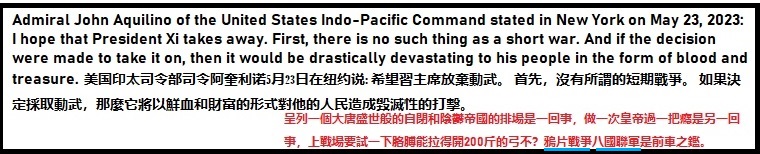
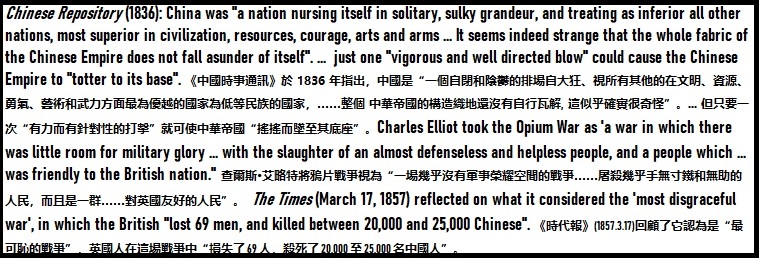

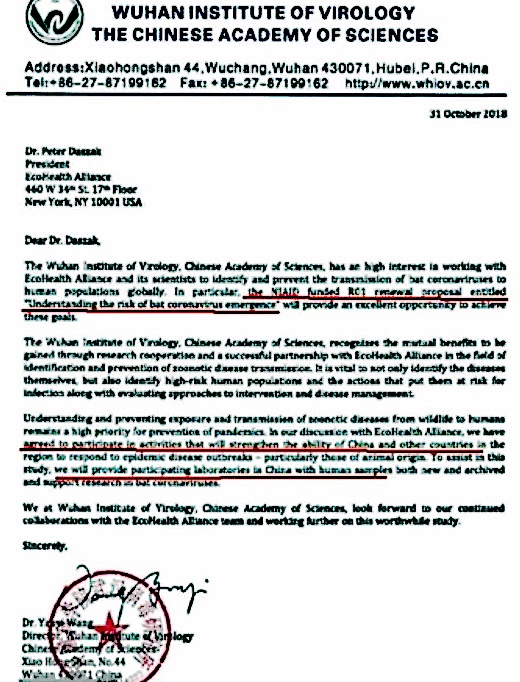





 ***
***


![Though, Anna Wang [Anneliese Martens], in her memoirs, expressed jealousy over Gong Peng by stating that the Anglo-American reporters had flattered the Chinese communists and the communist movement as a result of being entranced with the goldfish-eye'ed personal assistant of Zhou Enlai](GongPeng.jpg)