Sinitic Civilization-Book 1
Sinitic Civilization-Book 2
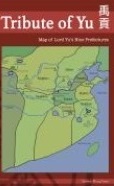
Tribute of Yu

Heavenly Questions
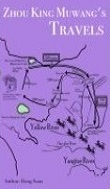
Zhou King Muwang's Travels
The Legends of Mountains & Seas
The Bamboo Annals - Book 1
The Scourge-of-God-Tetralogy:
From the Khitans to the Jurchens & Mongols: A History of Barbarians in Triangle Wars and Quartet Conflicts
(available at iUniverse;
Google;
Amazon;
B&N)
|
|
 This website's contents are the result of 20 years' writings --that could be compared to the "archaeological deposits" in a literary sense.
The freelance-style writings on the website were not proof-read.
Portion of the writings, i.e., related to Pre-History, Xia, Shang, Zhou, Qin, and Han dynasties, was extracted, polished, reconciled, and synthesized into
The Sinitic Civilization - Book I which is
available now on
Barnes & Noble,
Amazon,
Google Play|Books
and
Nook.
Book II is
available now on
Amazon
and Barnes & Noble.
Check out this webmaster's 2nd edition --that realigned Han dynasty's reign years strictly observing the Zhuanxu-li calendar of October of a prior lunar year to September of the following lunar year
and
cleared this webmaster's blind spot on the authenticity of the Qinghua University's Xi Nian bamboo slips as far as Zhou King Xiewang's 21 years of co-existence with Zhou King Pingwang was concerned.
To give the readers a heads-up, this webmaster had thoroughly turned the bricks concerning the Sinitic cosmological, astronomical, astrological, historical, divinatory, and geographical records, with the indisputable discovery
of the fingerprint or footprint of the forger for the 3rd century A.D. book Shang-shu (remotely ancient history),
and
close to 50 fingerprints or footprints of the forger of the contemporary version of The Bamboo Annals --a book that was twice modified and forged after excavation.
All ancient Chinese calendars had been examined, with each and every date as to the ancient thearchs being examined from the perspective how they were forged or made up.
Using the watershed line of Qin Emperor Shihuangdi's book burning to rectify what was the original before the book burning,
this webmaster filtered out what was forged after the book burning of 213 B.C.
This webmaster furthermore filtered out the sophistry and fables that were rampant just prior to the book burning, and validated the history against the oracle bones, bronzeware and bamboo slips.
There are dedicated chapters devoted to interpreting Qu Yuan's poem Asking Heaven, the mythical mountain and sea book Shan Hai Jing, geography book Yu Gong (Lord Yu's Tributes), and Zhou King Muwang's travelogue Mu-tian-zi Zhuan, as well as a comprehensive review of ancient calendars, ancient divination, and ancient geography.
One chapter is focused on the Huns, with a comprehensive overview of the relationship between the Sinitic people and the barbarians since prehistory.
The book has appendices of two calendars: the first Zhuanxu-li anterior quarter remainder calendar (247 B.C.-85 A.D.) of the Qin Empire, as well as a conversion table of the sexagenary years of the virtual Yin-li (Shang dynasty) quarter remainder calendar versus the Gregorian calendar, that covers the years 2698 B.C. to 2018 A.D.
Refer to
Introduction_to_The_Sinitic_Civilization,
Afterword,
Table of Contents - Book I (Index)
and
Table of Contents - Book II (Index)
for details.
This website's contents are the result of 20 years' writings --that could be compared to the "archaeological deposits" in a literary sense.
The freelance-style writings on the website were not proof-read.
Portion of the writings, i.e., related to Pre-History, Xia, Shang, Zhou, Qin, and Han dynasties, was extracted, polished, reconciled, and synthesized into
The Sinitic Civilization - Book I which is
available now on
Barnes & Noble,
Amazon,
Google Play|Books
and
Nook.
Book II is
available now on
Amazon
and Barnes & Noble.
Check out this webmaster's 2nd edition --that realigned Han dynasty's reign years strictly observing the Zhuanxu-li calendar of October of a prior lunar year to September of the following lunar year
and
cleared this webmaster's blind spot on the authenticity of the Qinghua University's Xi Nian bamboo slips as far as Zhou King Xiewang's 21 years of co-existence with Zhou King Pingwang was concerned.
To give the readers a heads-up, this webmaster had thoroughly turned the bricks concerning the Sinitic cosmological, astronomical, astrological, historical, divinatory, and geographical records, with the indisputable discovery
of the fingerprint or footprint of the forger for the 3rd century A.D. book Shang-shu (remotely ancient history),
and
close to 50 fingerprints or footprints of the forger of the contemporary version of The Bamboo Annals --a book that was twice modified and forged after excavation.
All ancient Chinese calendars had been examined, with each and every date as to the ancient thearchs being examined from the perspective how they were forged or made up.
Using the watershed line of Qin Emperor Shihuangdi's book burning to rectify what was the original before the book burning,
this webmaster filtered out what was forged after the book burning of 213 B.C.
This webmaster furthermore filtered out the sophistry and fables that were rampant just prior to the book burning, and validated the history against the oracle bones, bronzeware and bamboo slips.
There are dedicated chapters devoted to interpreting Qu Yuan's poem Asking Heaven, the mythical mountain and sea book Shan Hai Jing, geography book Yu Gong (Lord Yu's Tributes), and Zhou King Muwang's travelogue Mu-tian-zi Zhuan, as well as a comprehensive review of ancient calendars, ancient divination, and ancient geography.
One chapter is focused on the Huns, with a comprehensive overview of the relationship between the Sinitic people and the barbarians since prehistory.
The book has appendices of two calendars: the first Zhuanxu-li anterior quarter remainder calendar (247 B.C.-85 A.D.) of the Qin Empire, as well as a conversion table of the sexagenary years of the virtual Yin-li (Shang dynasty) quarter remainder calendar versus the Gregorian calendar, that covers the years 2698 B.C. to 2018 A.D.
Refer to
Introduction_to_The_Sinitic_Civilization,
Afterword,
Table of Contents - Book I (Index)
and
Table of Contents - Book II (Index)
for details.
|
|
Table of lineages & reign years:
Sovereigns & Thearchs;
Xia-Shang-Zhou dynasties;
Zhou dynasty's vassalage lords;
Lu Principality lords;
Han dynasty's reign years
(Sexagenary year conversion table-2698B.C.-A.D.2018; 247B.C.-A.D.85)
|
Epigraph|Preface|Introduction|T.O.C.|Afterword|Bibliography|References|Index
(available at iUniverse|Google|Amazon|B&N)
|
|
* In Commemoration of China's Fall under the Alien Conquests in A.D. 1279,
A.D. 1644 & A.D. 1949 *
 U.S.S.R./Comintern Alliance with the KMT & CCP (1923-1927)
 Korean/Chinese Communists & the 1931 Japanese Invasion of Manchuria Korean/Chinese Communists & the 1931 Japanese Invasion of Manchuria
American Involvement in China: Soviet Operation Snow, IPR Conspiracy, Dixie Mission, Stilwell
Incident, O.S.S. Scheme, Coalition Government Crap, Amerasia Case & The China White Paper
* Stay tuned for "Republican China 1911-1955: A Complete Untold History" *
|
|
Zou Rong's Revolutionary Army;
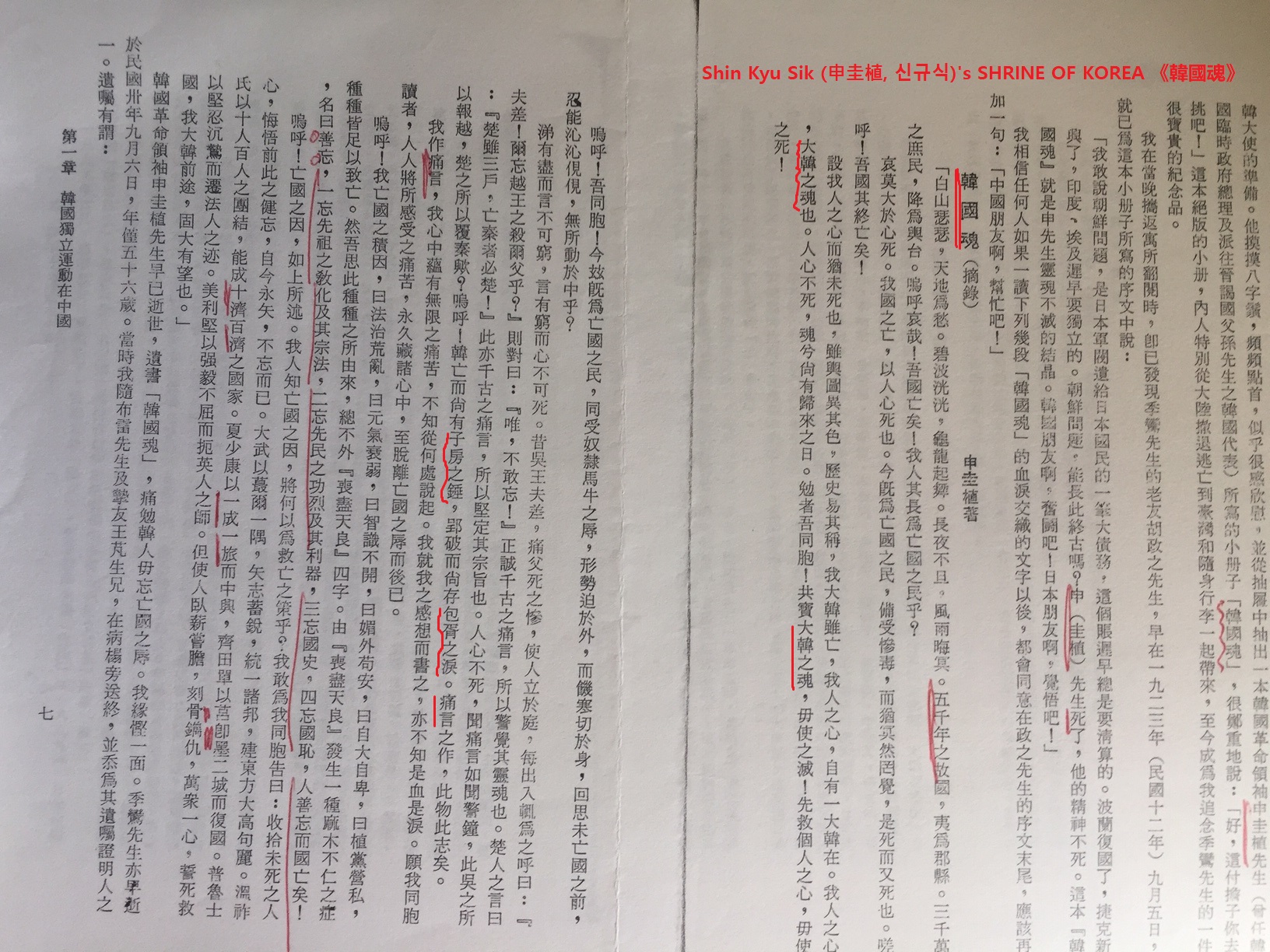
Shin Kyu Sik's
Shrine (Spirit, Kunitama) of Korea
|
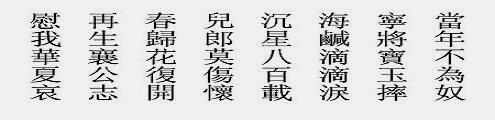
This snippet is for sons and daughters of China:
Heed the sons & ministers' agony and sorrow of our ancestors who died or lived through the Mongol, Manchu and Soviet-Chicom conquest
and
the Yongjia, Jingkang and Jiashen cataclysms !
Jeanne d'Arc of China:
Teenager girl Xun Guan breaking out of the Wancheng city to borrow the relief troops in the late Western Jinn dynasty;
Liu-Shao-shi riding into the barbarian army to rescue her husband in the late Western Jinn dynasty;
teenager girl Shen Yunying breaking into Zhang Xianzhong's rebels on the horseback to avenge on father's death in the late Ming dynasty.
China's Solitary and Lone Heroes:
Nan Jiyun breaking out of the Suiyang siege and charging back into the city in the Tang dynasty;
Zhang Gui & Zhang Shun Brothers breaking through the Mongol siege of Xiangyang in the Southern Soong dynasty;
Liu Tiejun breaking through three communist field armies' siege of Kaifeng in the Republican China time period;
Zhang Jian's lone confrontation against the communist army during the June 3rd & 4th Massacre of 1989.
|
|
|
THE KOREANS
In the ancient Chinese records, the name of Choson (Chosen, Chao-xian) had appeared in almost all dynastic chronicles. There are two mythical books that are worthy of special attention: Shan Hai Jing (The Legends of Mountains & Seas) and Huai Nan Zi (The Book by King Huai-nan of the Han Dynasty). Shan Hai Jing, also termed The Book of Mountains and Seas or The Classic of Mountains and Seas, recorded most of the myths and legends of ancient China, a book purportedly said to have been authored by Lord Yu (r. B.C.E. 2204-2195 ?; 2207-2198 per Lu Jinggui; 1989-1982 B.C. per the forgery bamboo annals; raw reign years B.C.E. 2002-1992 with three years' mourning per Y.D. Tse's adjustment of the forgery contemporary version [Jin Ben] of The Bamboo Annals)
and assistant Bo-yi. Korea or Choson, as a springboard for accessing Sakhalin, the Bering Straits, the Aleutian Islands and Japan, land and sea, was usually first mentioned.
Huai Nan Zi, a book that was contemporary of Han Emperor Wudi's campaign against the Korean peninsula, discussed ancient Korea from the perspective of divination and Shang Aetheling Ji-zi's conferral of the land of Korea.
For a history of the fuzzy geography of ancient China, refer to KOREA - FUZZY ANCIENT GEOGRAPHY.
|
|
|
|
|
|
|
Sovereigns & Thearchs;
Xia-Shang-Zhou dynasties;
Zhou dynasty's vassalage lords;
Lu Principality lords;
Han dynasty's reign years
(Sexagenary year conversion table-2698B.C.-A.D.2018; 247B.C.-A.D.85)
|
|
The Sinitic Civilization - Book I is
available now at
iUniverse,
Barnes & Noble,
Amazon,
Google Play|Books
and
Nook.
The Sinitic Civilization - Book II is available at
iUniverse,
Amazon and Barnes & Noble.
Check out the 2nd edition preface that had an overview of the epact adjustment of the quarter remainder calendars of the Qin and Han dynasties, and the 3rd edition introductory that had an overview of Sinitic China's divinatory history of 8000 years.
The 2nd edition, which realigned the Han dynasty's reign years strictly observing the Zhuanxu-li calendar of October of a prior lunar year to September of the following lunar year, also cleared this webmaster's blind spot on the authenticity of the Qinghua University's Xi Nian bamboo slips as far as Zhou King Xiewang's 21 years of co-existence with Zhou King Pingwang was concerned, a handicap due to sticking to Wang Guowei's Gu Ben Bamboo Annals and ignoring the records in Kong Yingda's Zheng Yi.
Stayed tuned for Book III that is to cover the years of A.D. 86-1279, i.e., the Mongol conquest of China, that caused a loss of 80% of China's population and broke the Sinitic nation's spine.
Preview of annalistic histories of the Sui and Tang dynasties, the
Five Dynasties, and the two Soong dynasties
could be seen in
From the Khitans to the Jurchens & Mongols: A History of Barbarians in Triangle Wars and Quartet Conflicts
(The Barbarians' Tetralogy - Book III: available at iUniverse;
Google;
Amazon;
B&N).
(A final update of the civilization series, that is scheduled for October 2022, would put back the table of the Lu Principality ruling lords' reign years, that was inadvertently dropped from Book I during the 2nd update.)
|
|
Book II - Table of Contents:
Chapter XXXI: The Han Dynasty's Chronological History p.367
Invasion into the Korean Peninsula p.391
Chapter XXXVI: The Western Expedition, The Kunlun Mountain & Shan Hai Jing p.489
Han Emperor Wudi Seeking Elixir from the Immortals on the Kunlun Mountain p.491
Credible Geography Book on the Mountains Possibly Expanded to Include the Legendary Kunlun Mountain p.493
Unearthly Things in the Mountains' Component of The Legends of Mountains & Seas p.501
The Divination Nature and Age of the Seas' Component of The Legends of Mountains & Seas p.506
Chapter XXXVII: The Legends of Mountains & Seas (Shan Hai Jing) & The Ancient Divination p.520
The Divination Nature and Age of the Seas' Component in The Legends of Mountains & Seas - Debunking the Theory of "Asiatic Fathers of America"
Shan Hai Jing, in the "within-seas" and "great [overseas] wilderness sections, contained three interesting matters, namely, an alternative history of the thearchs that differed from the five thearchs' lineage in Shi-ji and Da-dai Li-ji; the wind gods that had the trace from the oracle bones of the Shang dynasty time period; and the divination topics such as Xia King Qi3's bestriding the flying dragons to rise to the heaven.
It could be speculated that the mythic writings in the seas' components of Shan Hai Jing were the result of the emperor's seeking the panacea or elixir. Note that dozens of diplomatic missions were sent to the west, with an apparent side order for ascertaining the locality of the legendary Kunlun Mountain where the immortals lived. If the mountain sections of Shan Hai Jing was written before Zhang Qian's trip to the west, the writer(s) of the sea sections, possibly following the "mountains" component of Shan Hai Jing (i.e., The Legends of the Mountains and Seas), expanded the writings on Kunlun, the Queen Mother (old woman), and the origin of the Yellow River, etc., into the chapters known as "The Book on the Within-Seas", "The Book on the Inner Seas", "The Book on the Outer Seas", and "The Book on the [Overseas] Wilderness" --a highly speculative book that talked about the panacea, the immortals, the various gods, as well as the ancestral human gods like Tai-hao the Senior (i.e., wind or phoenix-surnamed ancestor), Huang-di the Yellow Thearch, Yan-di the Fiery Thearch, Shao-hao the Junior (i.e., Ji3-surnamed ancestor), Overlord Zhuanxu, Overlord Di-ku, Overlord Yao, Overlord Shun, the founder-kings of the Xia, Shang and Zhou dynasties, as well as mythical figures like Lord Di-jun, et al. (Depending on the coverage of the overlords in different sections of the sea components of Shan Hai Jing, there were unfounded claims among the modern historians that those particular sections of the book were from some particular past dynasties like Xia or Shang.)
The mountain part of Shan Hai Jing, while having its geographical layout built on top of Yu Gong (Lord Yu's Tributes), was not written as a geography book but with possibly two purposes, namely, a proclivity for expounding sacrifice and primitive prophecy conducted on the mountains and hills, and a description of the treasures and wealth of the mountains. The second purpose was similar to the forgery Han dynasty political economy book Guan Zi --which, like the "Salt & Iron Debate" of the Han dynasty, contained chapters on the mountains such as 'Shan-guo Gui' (mountain nations' track, i.e., finance management), Shan Quan Shu (mountain's whimsical mathematical strategy), and Shan Zhi Shu (mountain's utmost mathematical strategy), containing similar description of the treasures and wealth of the mountains. The writings sharing the common geographical data or similar raw materials with the mountain part of Shan Hai Jing included Qu Yuan's poems like Tian Wen (asking heaven); Mu-tian-zi Zhuan (Zhou King Muwang's travelogue); and Lv-shi Chun-qiu.
(The four eastern mountain ranges were mistakenly appropriated to North America by Henriette Mertz in the 1958 book Pale Ink, which was the author's overzealous pursuit of the topic of Asiatic fathers of the Amerindians. Henriette Mertz also had the wild imagination about the deep gully beyond the east sea, stating that it was the Grand Canyon of Arizona. Henriette Mertz, who had erroneously appropriated the mountains and valleys in Shan Hai Jing to North America, had some validity as to the link of monk Hui-shen to Quetzalcoatl.)
In contrast, the seas or overseas' components of Shan Hai Jing transcribed the unearthly animals, human-faced animal gods and strange-looking people in the mountain part of Shan Hai Jing into the names of countries or tribes as seen in Lv-shi Chun-qiu and Han dynasty book Huai Nan Zi, exhibiting the seas or overseas' components to be later than the mountain part. The seas or overseas' components could be further separated into two groups, namely, the "inner seas" and the "outer seas" sections that were compiled by Liu Xin of the Han dynasty and the "within-seas" and the "overseas wilderness" sections that were collected by Guo Pu of the Jinn dynasty, with the former two sections possibly synchronizing with the Han empire's military expansion, and the latter two sections sharing similar contents seen in the divinatory books Lian-shan Yi and Gui-cang Yi, including the Wangjiatai excavated divination texts of the 3rd century B.C. and possible materials from the Ji-zhong tomb excavation materials that were possibly a few decades earlier than the Wangjiatai texts.
Gui-cang Yi, like what the seas' component of Shan Hai Jing did in extensively copycatting Qu Yuan's and the other Chu Principality poems, had taken some of the poems' concepts as part of the divination texts, such as the "Feng-xue" (wind cave) in poem Bei Hui-feng [feeling sad about the percolating wind], and the "Yun-zhong[-jun]" (god in the cloud) and "Dong-jun" (eastern god) deities in poem Jiu Ge (nine songs), for example. While the divination in the seas or overseas' components of Shan Hai Jing could be relatively old, like the age of the Ji-zhong tomb and Wangjiatai excavation texts, the materials had apparently undergone revision through the Zhou, Qin, Han and Jinn dynasties, for about half millennium's time, as seen in Guo Pu's citation of eight polars in Qi3-shi1 of Gui-cang Yi to describe Xi-he2's reign in the empty mulberry land under the 'cang-cang' blue sky, as well as in the erroneous interpretation of Xia King Qi3's rising to the sky to be a high lord's guest as some theft of heavenly music, not an award from the high lord.
Simply speaking, the seas or overseas' components of Shan Hai Jing, though carrying the names of countries like in today's Korea, Chinese Turkestan and India, etc., were not about geography at all but divination. The divination materials, similar to those in Shi1 Fa, Gui-cang Yi, the Wangjiatai divination script, and the divination in Mu-tian-zi Zhuan, served the same augury purpose of the late Warring States time period, albeit possessing their separate freelance or freewheeling traits.
For example,
The one eyed son of Lord Shaohao in the "great northern wilderness" (Da Huang Bei Jing) section of Shan Hai Jing, like the one-hand and one-eye 'shen-mu-guo' (the deep eye socket) state in the "Northern Outer Seas" section, which was speculated to be the legendary one-eyed state Arimaspi that was described by Herodotus in Histories as located north of Scythia and east of Issedones and linked to the three-eye stone statutes of the Okunev Culture in Minusinsk, could have its source in some one-eye bird in the northern mountain range of Shan Hai Jing, and the one-eye and three-tail 'huan' foxlike animal on Mt. Yiwang-zhi-shan in the western mountain range.
Some conclusive statement could be made about the alternative divination methods other than Zhou Yi (i.e., Yi-jing). No matter Gui-cang Yi, Shi1 Fa, the Wangjiatai divination script, Mu-tian-zi Zhuan, or the mountain part and seas' part of Shan Hai Jing, they served the same augury purpose of the late Warring States time period, that possessed their separate freelance or freewheeling traits in the land of the Wei Principality in the case of the Ji-zhong tomb's type of Gui-cang Yi divination or in the land of the Chu Principality in the case of Shi1 Fa and Wangjiatai divination bamboo slips. The line augury objects in Shi1 Fa under the stalk numbers "eight", "five" and "four", with similarity to the augury topics in Zhou Yi and Gui-cang Yi's four trigram images or diagrams, could be said to be like what was seen as the primitive prophecy in the mountain part of Shan Hai Jing. Roughly, Shi1 Fa matched the primitive prophecy in the mountain part of Shan Hai Jing, while Gui-cang Yi, namely, the Wangjiatai scripts or the Ji-zhong tomb's type of Gui-cang Yi divination, matched the seas' part of Shan Hai Jing as far as divination was concerned.
For details, refer to
THE SINITIC CIVILATION Book II, available on Amazon,
B&N.
Epigraph|Preface|Introduction|T.O.C.|Afterword|Bibliography|References|Index
(available at iUniverse|Google|Amazon|B&N)
|
|
The Misnomer Dong-yi (Eastern Yi) Origin
Ancient Chinese had different terms for the barbarians in four directions. Dongyi or Yi-of-the-East will be designation for people in the east, i.e., the offsprings from the two clans of Tai-hao-shi and Shao-hao-shi, i.e., the ancient overlords of China from antiquity, who were innumerable epochs beyond the known history. The term meant for the different people during the different stages of history.
Legendary overlords of China, like Yandi (the Fiery Lord) and Huangdi (the Yellow Lord, r. B.C. 2697-2599 ?), might be both born near Qufu of today's Shandong Province in the east, and Lord Yandi, Lord Huangdi and Lord Zhuanxu were recorded to have treated Qufu of Shandong as the capital. Sima Qian's Shi-ji mentioned that Huangdi (Yellow Lord), in the east, climbed Mount Wan-shan (i.e., Fan-shan in today's Langya, Shandong Peninsula).
(Among the ancient eight Chinese overlords, seven belonged to the same old family per Sima Qian.
The lineage of Yandi (Shen-nong), Huangdi, Shaohao, Gaoyang (Lord Zhuanxu), Gaoxin (Diku), Tangyao (Lord Yao), and Yushun (Lord Shun) is spelled out in prehistory section. Even the barbarians could be traced to the same family as the Chinese founders. Kong An'guo of Han Dynasty claimed that the four evil tribes exiled by Lord Yao.
Kong An'guo of the Han Dynasty, on basis of Lu Lord Wen'gong's 18th year of Zuo Zhuan, claimed that Hundun was an unfilial descendant of Huangdi the Yellow Lord.
Shi-ji said that Hundun was an unfilial descendant of the Di-hong-shi clan, while Di-hong-shi was said to be the Yellow Overlord.
Shi-ji stated that Qiongqi was an unfilial son of the Shao-hao-shi clan.
Tao-wu (i.e., Gun) was an unfilial son of Lord Zhuanxu.
Zuo Zhuan and Shi-ji stated that Taotie was an unfilial son of the Jin-yun-shi clan.
Hence, those four tribes should be considered members of the big family.
Lu Lord Wen'gong's 18th year stated that Lord Shun exiled Hundun, Qiongqi, Taowu and Taotie to the four wilderness areas to guard against the monsters.)
At the very beginning, there was no 'east' connotation to the Yi people as the people living in the eastern Chinese coast, i.e., the offsprings from the two clans of Tai-hao-shi and Shao-hao-shi, were categorically called by 'Yi', a word that semantically meant the people carrying bows, not to do with the later denotation as the 'Eastern Barbarians".
During Zhou Dynasty, as a result of confrontation between the Zhou people who were from the west, and the remnant Shang people who were the natives dwelling in the middle China and along the eastern coast, the records began to carry passages after passages of fighting between the pretentious 'Central Kingdom' Zhou people
and the so-called barbarians (i.e., rebels) in the originally Shang Dynasty land to the east. (During the time of the Five Nomadic Groups Ravaging China, Liu Yuan,
the Hunnic rebel, claimed that the Zhou Dynasty royal house had origin from the Yi to the east, which could be construed to mean
that the Zhou Dynasty people, descendants of the Yellow Overlord and the Xia Dynasty, had their original activities traceable in today's Shandong peninsula.)
At the earliest time of history, the explicit barbarians mentioned would be Xunyu to the north, albeit leaving out details as to who the Xunyu people were. What was known from geography was that the Yellow Overlord fought the Zhuolu Battle, in Zhuolu [chasing deer], against the Chi-you people who were later known as China's agriculture god and the war god. The records that were repeated after the battles between the Yellow Overlord and the Fiery Overlord (who could be the same person as Chi-you) and between the Yellow Overlord and the Chi-you were interesting in stating that the descendants of the Fiery Overlord and/or descendants of Chi-you had gone to the so-called "bei-xiang", i.e., the northern countryland. Later, the Khitans claimed that they descended from the Fiery Lord. The Xianbei people, i.e., the Yuwen-shi clan, hundreds of years before the Khitans, also claimed that they descended from the ancient Chinese overlord.
By the time of Lord Yao (Tangyao, r. B.C. 2357-2258 ?), the northern barbarians were specifically named Shan-rong, Xianyun and Xunyu,
but nothing explicit was mentioned of the east other than the following legends: Lord Shun (? 2257 - 2208 B.C.E. per Lu Jinggui; 2222-2173 B.C. per Seng Yixing; 2285-2225 B.C. per Shao Yong; 2042-1993 per the forgery bamboo annals; reign 2044-2006 B.C.E. with rule of 39 years and life of 100 years per Zhu Yongtang's adjustment of [the forgery contemporary version Jin Ben of] The Bamboo Annals) suggested to Lord Yao to have Gun (Lord Yu's father) executed on Mount Yu-shan (feather mountain, in today's Linyi County, Shandong Province) for creating detente onto the 'Yi' barbarians
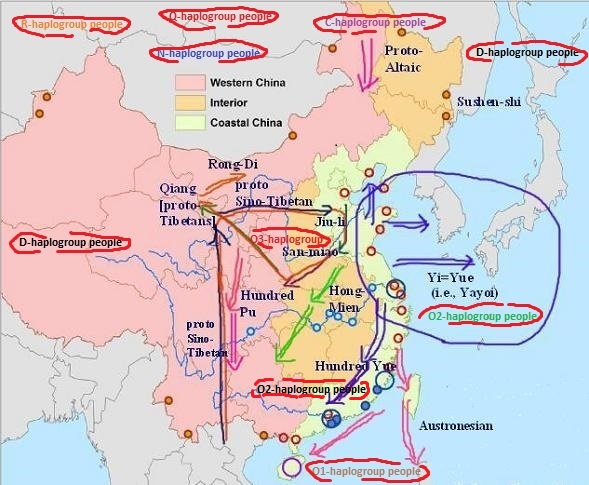
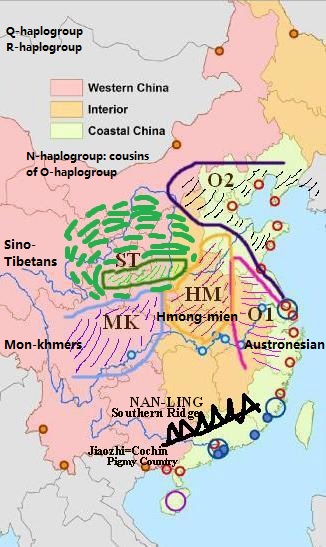
(i.e., the original [Sino-Tibetan] dwellers who pushed east from west
[possibly replacing ancestors of today's Miao & Man people or the Hundred Yue people - who in turn pushed out the ancestors of the Taiwan natives and the Pilipino onto Taiwan and the islands in today's Southeast Asia] and dwelled on the coast versus the late-coming Sino-Tibetans who came from the west).
Lord Shun himself was wrongly said to be a 'Yi' per Mencius, an apparently Warring States sophistry talk.
This was further mixed up by the later Eastern Jinn people, such as Zhou Chu and his book Feng Tu Ji.
The Yi people, as emphasized earlier, originally did not carry the directional denotation but for sure played the dominant role of influence in prehistoric China as all ancient Chinese overlords had their activities in today's eastern China, not western China.
After Lord Shun would be Lord Yu, i.e., someone who were cited by the barbarian rulers to be born in the barbarian land of the west and known as Rong-yu, i.e., someone who was born in the Rong barbarian land of the west, which was inferred to be in today's Sichuan.
As pointed out by scholar Zhang Fan in his article, "A Research Into Shang Totems and the Confucius Ancestry", Lord Yu, per Mo Zi, had spread teachings to the nine Yi people in the east. (See Xia-Shang Dynasties for details on the numerous Eastern Yi groups, including:
Quan-yi [doggy Yi], Yu-yi, Fang-yi, Huang-yi [yellow Yi], Chi-yi [red Yi], Bai-yi [white Yi], Xuan-yi [black Yi], Feng-yi [phoenix Yi], Zi-yi, and Yang-yi [sun Yi] etc.)
The Bai-yi [white Yi] is interesting here in that the later Xianbei people from Manchuria, who was Tungunsic in nature, was called by the
northern Chinese to be "bai lu", namely, the White-robe enemies. More, Shang Dynasty, i.e., ancestors of Ji-zi Chaoxian (Korea), as recorded in the wars against Zhou King Wuwang, was said to be a country adoring the white color.
Today's Koreans, who had a tradition of wearing the white-colored clothes, could have inherited the same heritage as the Xianbei people who constantly raided into the Korean peninsula
the same way as they ravaged northern China, or the Xianbei had directly inherited the white-color customs from Ji-zi.
(Also note that in Confucius' times, the ancient Chinese began to feel fuzzy about the whereabouts of the ancient Nine Yi people. Frequently, Confucius and his disciples
referred to a mythical land beyond the seas to be the land of the Nine Yi people without defining the actual locality. Often times, later historians inferred the land of the Nine Yi people to be in Japan.
On one rare occasion, Confucius seemed to be referring to a gentlemen's country to the east and implied it to be the country under the rule of descendants of Shang Dynasty Prince Ji-zi,
with whom Confucius himself shared the same origin as a sunset noble family from the Soong Principality. This gentlemen's country would have to be somewhere in southern Manchuria and northern Korea.
Scholar Wang Zhonghan pointed out that the character 'Yi', having appeared as the Shi-fang statelet in Shang Dynasty's oracle bones, would still exist in today's Shangdong-Jiangsu provinces and around the Huai-shui River by the late Spring & Autumn time period of Eastern Zhou Dynasty.
Wang Zhonghan, after analyzing the wars between the Zhou people and the numerous Yi people, had concluded that the "Eastern Yi" [in the Shandong Peninsula] had declined as a result of military expeditions by Duke Zhou-gong and Zhou King Cheng-wang in the early Western Zhou time period; that the "Huai-yi" [around Huai-shui River] emerged from the middle to late time periods of Western Zhou Dynasty; that the "Nan-yi" [in southern or southeastern direction] rose up in influence at the time of Zhou King Liwang; and that by the time of the Qin-Han Dynasties, the 'Dong-yi' people would be designation for the people in northeastern China, including Korea and Japan.
The Korean Claim As the True Descendants Of the [Misnomer] Dong-yi (Eastern Yi)
The character 'Yi', as shown above, was originally a neutral word denoting the people living in today's eastern China and along the coast,
but later mutated its meaning to mean for the barbarians in the east, i.e., the misnomer Dong-yi, and
later again expanded to be more an inclusive word to mean all aliens or barbarians without the directional distinction.
The big Korean school of thought, discussed in the prehistory section, claimed that the Koreans were true descendants of the misnomer Dongyi [Dong-yi] people.
According to Sima Qian's Shi-ji , the ancestor of the Shang people was named Xie, a son of Lord Diku. Legends said that Xie was born after his mother, Jiandi (Yousong-shi woman, a statelet located in Yuncheng of Shanxi Province), swallowed an egg of a black bird (swallow). Lord Yao conferred Xie the post of 'si tu' and the last name of 'Zi'. Lord Shun conferred Xie the land of Shang (known later as Shangluo County of today's Henan Province in one account but was disputed to be somewhere else, more like in the Shanxi-Hebei borderline area) for aiding Yu in flood control. The fourteen generation descendant would be Tang (Shang-Tang), founder of the Shang Dynasty. (The origin of the Shang Dynasty could be a puzzle as there were 5-6 discourse on where the Shang Dynasty founders came from; however, there was one interesting account pointing to Shang Dynasty founder-king Wang-hai [i.e., King Hai] herding animals in today's Yi-xian land, i.e., somewhere near Peking.
Per the forgery contemporary version of The Bamboo Annals, in year 11, Xia king Shao-kang ordered Marquis Shang-hou Ming to fix the flooding of the Yellow River, with a hint that the Shang people had a mandate to reign in the land of the Yellow River flow course; Wang-hai, who was a son of Marquis Yin-hou, was killed by You-yi-shi during the 12th year of Xia King Xie, and that Marqui Yin-hou, i.e., Wei, also known as Shang-jia [carrying the 'jia' stem, a hallmark of the Shang people], launched a campaign against You-yi-shi during the 16th year reign of Xia King Xie by borrowing the troops from He-bo or Count of the Yellow River - a same name vassal as was known in Zhou King Muwang's travelogue Mu-tian-zi, and reported the victory to the Xia court after killing King Mianchen of You-yi-shi.
This webmaster, inferring from Mu-tian-zi, believed that He-bo, as guardian of the North Yellow River bend, could be of the O2-haplogroup and might be related to the later Bo people who migrated to Manchuria to become the ancestors of the Fuyu people who subsequently invaded Korea.
The most direct hint as to the nature of the Shang people and the 'Jiang3', 'Ren4' and 'Su4' surnames lied in Zuo Zhuan, wherein a prophesy statement was made to the effect that Tang-shu or Uncle Tang, a fief conferred by Zhou King Chengwang onto Shu-yu or Uncle Yu in the early Zhou dynasty rule for the southern Shanxi land of Tang, would inherit the spirits of Shang Dynasty [after it was to be overthrown by what happened to be successor Zhou Dynasty] for the inherent reason that the Shang people could be of the same family as clans of the 'Jiang3', 'Ren4' and 'Su4' surnames.)
The Korean claim would be complicated by the fact that Shang Dynasty Prince Ji-zi was dispatched to Korea to be a ruler of Choson
during the 11th century B.C.E. This episode, from the Chinese point of view, would have introduced civilization to the Manchuria/Korea border areas
which was otherwise occupied by the barbarians and/or the Sushen-shi people dating from the 23rd century B.C.E.,
who
were known for its stone arrow that was similar to what was excavated on the American continent. By the time of China's Han Dynasty, the southern Korean peninsula was ruled by Mahan, Qinhan and Bianhan, among which Qinhan and Bianhan appeared to be more of Qin Chinese nature. After Ji-zi's Choson would be the Wei-man usurpation during the 3rd century B.C. and Han Emperor Wudi's invasion of Korea during the late 2nd century B.C. Thereafter came waves of the Tungusic invasion from the north,
similar to northern China's experiences of nomadic ravaging by the five nomadic/barbarian groups.
(Koguryo, a Tungusic people from Manchuria, claimed descent from ancient Lord Zhuanxu (Gao-yang-shi) and adopted the surname of 'Gao' (i.e., 'Ko') as their clan name. The Koguryo people, following the time period of the Xianbei ravaging of North China and North Korea, pushed south to establish a dynasty in Korea,
and was to give modern Korea the name Koryo. In China, at about the same time, two clans, i.e., the Gao clan and the Yuwen clan of the Xianbei origin, had usurped
Tuoba Wei Dynasty to establish the Eastern Wei and Western Wei dynasties. The Yuwen clan, in their tracing the ancestry, claimed to have descended from the ancient Chinese overlords
of the Yellow Overlord and the Fiery Overlord.)
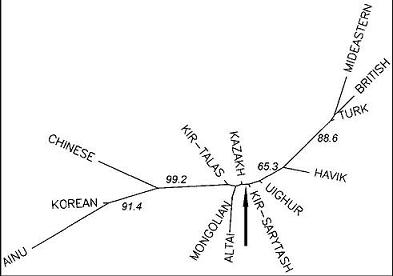 Hence, the identities of the Koreans had changed dramatically during the course of history. As one reader speculated, "modern-day Koreans" might very well have "appropriated their (Dongyi) history and myths".
The charcoal remains of 2000-year-old rice in western Japan pointed to China's Yangtze Delta as the place of origin. DNA studies conducted on the human remains excavated in the Shandong Peninsula
suggested the southern and northern points of origin for the Jormon and Yayoi Japanese. On basis of various historical records and modern technology analysis, I would speculate: i) that the early Korean culture was very much connected with eastern China as a result of the nascent human migration from south to north and ii) that the Tungusic invasion from Manchuria gradually overtook the early Continental traits.
Also refer to the section on the Diao-yi for this webmaster's view as to the
original Nine Yi people not being not homogeneous but could be living in the interface ground among the main Mongoloid groups
of the Sino-Tibetan, the Hmong-Mien and the Tungunsic, plus the people of the Hundred Yue nature [as the ancient Chinese records juxataposed 'yi' with both 'di' and 'yue' to become 'yi-di' and 'yi-yue'].
We could further deduce that as a result of the mixing-up of the Hmong-Mien people and the Tungunsic people in today's Hebei Province and on the Shandong Peninsula, we then have the phenomenon of the later people in Manchuria, Korea and Japan sharing the same archaic tradition as recorded among the ancient Nine Yi people of the 3rd millennium B.C.E.
The archaic 'Yi' traditions would include the historical practice of "dun ju" (squatting [spreading feet], which might have mutated into the Manchu practice of one leg kneeling on the ground while another leg bending at the knee, a Manchus protocol for seeing the superiors), the slate coffins, and bearing down the newborn's head with stone, etc.
In all cases, Tungusic or continental, the Koreans shared inseparable relations with the Chinese.
Hence, the identities of the Koreans had changed dramatically during the course of history. As one reader speculated, "modern-day Koreans" might very well have "appropriated their (Dongyi) history and myths".
The charcoal remains of 2000-year-old rice in western Japan pointed to China's Yangtze Delta as the place of origin. DNA studies conducted on the human remains excavated in the Shandong Peninsula
suggested the southern and northern points of origin for the Jormon and Yayoi Japanese. On basis of various historical records and modern technology analysis, I would speculate: i) that the early Korean culture was very much connected with eastern China as a result of the nascent human migration from south to north and ii) that the Tungusic invasion from Manchuria gradually overtook the early Continental traits.
Also refer to the section on the Diao-yi for this webmaster's view as to the
original Nine Yi people not being not homogeneous but could be living in the interface ground among the main Mongoloid groups
of the Sino-Tibetan, the Hmong-Mien and the Tungunsic, plus the people of the Hundred Yue nature [as the ancient Chinese records juxataposed 'yi' with both 'di' and 'yue' to become 'yi-di' and 'yi-yue'].
We could further deduce that as a result of the mixing-up of the Hmong-Mien people and the Tungunsic people in today's Hebei Province and on the Shandong Peninsula, we then have the phenomenon of the later people in Manchuria, Korea and Japan sharing the same archaic tradition as recorded among the ancient Nine Yi people of the 3rd millennium B.C.E.
The archaic 'Yi' traditions would include the historical practice of "dun ju" (squatting [spreading feet], which might have mutated into the Manchu practice of one leg kneeling on the ground while another leg bending at the knee, a Manchus protocol for seeing the superiors), the slate coffins, and bearing down the newborn's head with stone, etc.
In all cases, Tungusic or continental, the Koreans shared inseparable relations with the Chinese.
The Dong-yi (Eastern), Niao-Yi (bird) & Dao-yi (Island) Transformation
Sima Qian's Shi-ji stopped at Wudi's overthrowing of Wei-man Choson. In description of Xu Fu's elixir-seeking journeys, Sima Qian did repeat the ancient Chinese legends about the islands of Peng-Lai, Fang-Zhang and Ying-Zhou (land in the sea).
Chen Shou's San Guo Zhi covered the island of Japan and grouped the early Japanese in the section on Dongyi (the Eastern Yi). Later history records referred to the Japanese as Dao-yi (the Island Alien).
Sima Qian, in paragraphs about the Prefecture of Ji-zhou (the ancient land that was today's Shanxi Province but was appropriated to Hebei Province to mean Beijing) in section on the Xia Dynasty, used the designation of Niao-Yi (bird) for barbarians in the east and northeast. The interpretation would be that Niao-yi would be those people who made a living by capturing the birds and beasts.
In the ancient times, the Yi was associated with the word 'niao' for bird as a totem, and there were at minimum eight to nine different 'niao-yi' people in eastern China. The Shang Dynasty (16th-1066 B.C.) people were recorded to have treated 'Xuan Niao' (i.e., the Black bird, possibly sparrow) as their totem. (The Manchu legends as to the birth of their founder had something to do with swallowing the red fruit dropped by a bird.)
Toba Wei Dynasty (A.D. 386-534), in return for being called the nickname of 'suo lu' (the pigtailed enemies), called the southern Chinese by the derogatory name of 'niao yi' (i.e., the bird aliens) for possibly the southern Chinese pitched accents or generic-kind of name for the southeastern Chinese and islanders.
In the later times, the Yi designation would be associated with a word 'dao' for island, pointing to the barbarian people in East China Seas. (Both the character 'niao' and 'dao' looked quite close and might have corrupted consecutively during the course of history.) See the Japanese section for descriptions of the various statelets beyond Japan.
More about the "Eastern Yi People" is available at http://www.imperialchina.org/ImperialChina/?p=311
The Sushen-shi, Guzhu & Shan-rong
The first recorded statelet to the northeast direction would be the Sushen-shi bordering the Japan Sea. Sushen first submitted their renowned arrows and bows to Lord Shun during the 25th year reign of Lord Shun (? 2257 - 2208 B.C.E. per Lu Jinggui; 2222-2173 B.C. per Seng Yixing; 2285-2225 B.C. per Shao Yong; 2042-1993 per the forgery bamboo annals; reign 2044-2006 B.C.E. with rule of 39 years and life of 100 years per Zhu Yongtang's adjustment of [the forgery contemporary version Jin Ben of] The Bamboo Annals) per the forgery bamboo annals. Sushen continued to pay pilgrimage to the Zhou Dynasty.
The Sushen tribe was later known as Yilou. Chinese history recorded the succeeding names like the Wuji [Moji [commonly mispronounced as Huji]], Mohe, Bohai and Nüzhen tribes in the same area.
On record would be a statelet called Guzhu (i.e., the lonely bamboo), that existed in the Shang Dynasty time period, a Shang vassal state. It was said that the Zhou Dynasty founder, Ji Chang, managed his statelet so well that old people went to the west of China for retirement, and two princes of the Guzhu Statelet, Bo-yi and Shu-qi of the Mo-tai-shi clan, came to live in the Zhou land.
During the Zhou Dynasty, the barbarians closer to the Chinese would be called Shan-rong or the Mountain Rong (aka Bei-rong or Wuzhong) in the northeastern China.
Sima Qian, with the knowledge of the barbarians at the time of Han Emperor Wudi apparently, speculated that the Mountain Rongs, at one time, went across the Yan Principality of today's Hebei Province to attack the Qi Principality in today's Shandong Province; 44 years after that, they attacked Yan again; the Yan-Qi joint armies, under the joint command of Qi Counsellor Guan Zhong, Marquis Qi Huan'gong, and Count Yan, drove them out and moreover penetrated into the Rong land. Around 664 BC, the Yan-Qi joint armies destroyed the Mountain Rong Statelet as well as the Guzhu Statelet. Yan hence extended control over the Guzhu and Lingzhi territory, i.e., today's Lulong, Qianxi and Qian'an, between today's Peking and the Shanhaiguan Pass (Qinhuangdao).
(Previously, we already stated that the above sensational northern campaign by Qi Lord Huan'gong could never have happened, nor the sensational southern invasion of the Shandong peninsula by the Mountain Rong barbarians 55 years after the Zhou dynasty's relocation of the capital city to Luoyang.)
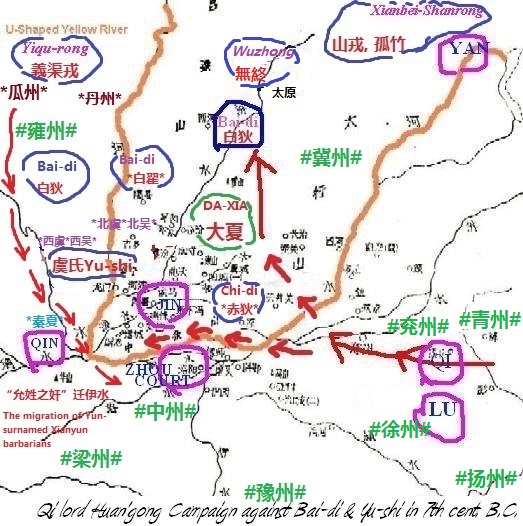
In 332 B.C., Yan, in the context of the decline of the Zhou court, proclaimed themselves a king, and the ancient Koreans under the Ji-zi family followed suit to proclaim themselves a king on the pretext of defending the Zhou court.
This sequence of events was based on the sophistry books of the late Warring States time period or some Han dynasty books recompiled on basis of the remnant post-book-burning materials.
During the Warring States time period (i.e., the later part of the Zhou Dynasty), the barbarians in today's northeast China, i.e., the successors of Shan-rong, came to be known as Dong Hu or the Eastern Hu people. A Yan Principality General, by the name of Qin Kai, after returning from Donghu as a hostage, attacked Donghu and drove them away for 1000-li distance at the turn of the 4th to 3rd centuries B.C.E, or about 300 B.C.E. Yan built the Great Wall and set up the Shanggu, Yuyang, You-beiping, Liaoxi and Liaodong prefectures.
After defeating the Eastern Hu to the north and northeast (i.e., today's southern Manchuria), Yan attacked Ji-zi Chaoxian (Korea) and expanded beyond today's Liaodong peninsula to reach the Yalu River, the Chongchon River [the Man-fan-han River per Yu Huan's Wei Lv], and consecutively the Deadong (Datong) River [per Shan Hai Jing (The Legends of Mountains & Seas)].
Yan hence extended its territory by another 2000-li distance to the east.
Around 290 B.C., Yan began to build the Great Wall extending from Zaoyang (Kalgan) towards southern Manchuria; after defeating the Eastern Hu in about 300 B.C., the Great Wall extended to Xiangping (Liaoyang), and Yan then extended the Great Wall deep into the Korean peninsula, towards the Deadong River and Chong'ch'on River. (It was said that it was Han Emperor Liu Bang who went beyond the Qin's Great Wall by extending it to the Deadong River from the Chongchon River, which Tang Emperor Taizong later took as the terminal point of the Qin Great Wall.)
After Qin defeated Yan and reunited China in 221 B.C., Ji-zi Chaoxian, under Ji Fou, submitted to Qin China.
Choson (Ji-zi Chaoxian [Korea])
While the Koreans boasted of the founding of the "ancient Choson" by Tangun (i.e., Tan-jun, by the name of Wang Jian, who was a forgery that derived from the Wang'gom-song fort [Pyongyang]) in 2333 BC, the Chinese records pointed to Ji Zi or Ki Jia or Chi Tsu (ex-Shang Dynasty prince) being dispatched to Korea by Zhou Dynasty Archduke as a ruler. Ji Zi was conferred the title of Marquis by the Zhou Dynasty. He devised eight clauses of teachings for his citizens, and it was said that during his reign, people did not have to close the doors at night. Ji Zi's dynasty lasted over 40 generations, till Ji Zhun proclaimed himself a king instead of a marquis. http://socrates.berkeley.edu/~korea/Old_1.html states that "in 1122 B.C. (note different calendar was used here; 1050 for the Shang reign years 1559 - 1050 per the forgery contemporary version of The Bamboo Annals), there was an alleged arrival of Kija from Shang China." Ji-zi was the uncle of last Shang ruler. http://www.koreanhistoryproject.org proposed a different story, namely, the Ji-zi exodus happened during the first campaign of Zhou King Wuwang, sometime before Zhou overthrew the Shang rule. It said that the group of people who migrated to Korea would be about 5000 in total. The Korean school of thought used a different calendar than what the Chinese had adopted. Their timeframe for Zhou Dynasty would be 1122 B.C. - 256 B.C. [1050 - 256 per the forgery contemporary version of The Bamboo Annals].
Ancient records show that Ji-zi was imprisoned by last Shang King Zhouwang and would not be set free till Zhou King Wuwang took over the Shang capital. The Ji-zi exodus must have occurred after Shang's demise.
History also claimed that after Shang Prince Wugeng's rebellion, another group of the Shang remnants fled to the ancient Su-shen-shi Statelet in Manchuria, and speculation went as far as the North American continent for a link of the American Indians and the Shang Chinese.
"Choson" would be the same name today's Chinese use in designating the Peninsula. It means the 'morning freshness ' or the 'morning dews'.
The second word in 'Choson' could have probably mutated from the word 'Xian', meaning fairy; and it could also be the River Xian-shui, i.e.,
one of the three ancient rivers in southern Manchuria and northern Korea.
One Koryo classics, "Dong-guo [eastern statelet] yudi [domain] shenglan [splendid view]", interpreted Chaoxian [Choson] as meaning the brightness [xian] of the morning [chao] sun,
which was what the forgery Chinese classics Shang-shu Da Zhuan put forward, in contrast with the other Chinese classics which invariably pointed to the three rivers near Pyongyang as the source for the name Chaoxian - a conflict with
the Chinese classics Huai Nan Zi which listed Chao-xian as a place on the Shandong peninsula where Shang Prince Ji-zi could have initially dwelled.
During the Warring States (403-221 B.C.), there was an invasion by Qin Kai of the Yan Principality in 311 BC, which caused the ancient Korea a loss of 2000-li territory. Qin Kai, after returning from Donghu as a hostage, would attack Donghu or the Eastern Hu barbarians and drive them away for 1000 li distance. Yan built the Great Wall and set up the Shanggu, Yuyang, You-beiping, Liaoxi and Liaodong prefectures. (Qin Kai was said to be an ancestor of the lad called Qin Wuyang who accompanied Jing Ke on the journey to assassinating Qin Emperor Shihuangdi.) Today's Koreans called their peninsula via a term of "Beautiful 3000 Li Territory", i.e., a measure of 2100 Korean li from north to south and 900 Korean li from west to east; and a comparative unit of measure could be used for interpretating the ancient "li" measure. By the end of Qin Dynasty [221 -206 BC], the rebellion of Chen Sheng & Wu Guang and in-fighting between Liu Bang and Xiang Yu led to an inflow of tens of thousands of the Yan-Qi-Zhao Principalities' people to the Korean Peninsula. In the early years of Han Dynasty (206 BC-23 AD), a Yan Principality general called Wei Man (alternatively called Ji [zhou royal name for the Yan state] Wei-man) entered Korea around 196-195 B.C. and he later usurped the Ji-zi family kingdom. (An excellent account of Korea's history would be that by a Korean veteran at http://www.koreanhistoryproject.org. It is said that Wei Man "pushed southward through the Chabiryong Pass to the Han River and subjugated the neighboring state of Chinbon. In the northeast, Wiman's forces conquered the Imdun tribes in the southern Hamgyong region. At its height, Wiman (wei-man) Choson controlled several hundred miles of territory across the waist of the Korean peninsula.")
In 128 B.C., Hui-jun (king for the Hui[-mo] Korean), by the name of Nan-lv, who surrendered to Wei-man, defected from Chaoxian (Korean) King Wei Youqu and took 280,000 people to the Liaodong peninsula for seeking protection under the Han Dynasty. Han Emperor Wudi approved the relocation and made the dwelling area the Hai-jun Commandery so as to weaken Wei-man Chaoxian.
In 109 BC, the Han court envoy to Choson, She He, killed the Korean escort and claimed to Wudi that he killed a Korean general. The Koreans avenged later by killing She He, i.e., "du wei" (captain) for Liaodong. Using She He's death as a pretext, Emperor Wudi dispatched two armies against Choson in the autumn of 109 B.C., via sea and land, respectively.
Wudi's campaigns against Korea had to do with his worries about a possible alliance between the Huns and the Koreans. Wudi was also unhappy about Choson's cutting off the trade routes between China and the state of Chen (Chenhan or Chinhan) which was on the southern end of the Korean peninsula.
Yang Pu, with 7000 soldiers from today's Shandong, crossed the Bohai Sea [disputed to be the Yellow Sea] for Korea, while Xun Zhi, with 50,000 troops, consisting of some convicts, attacked from Liaodong.
The land army, without coordinating with the sea route, initiated an attack and was defeated. The sea prong, not knowing the demise of the land route, pushed against today's Pyongyang with the limited number of troops, and was defeated as well.
Unable to subjugate Choson in the first campaign, Wudi sent another envoy to Choson and successfully persuaded the Korean King into sending a prince to China's court as hostage. But a Chinese general's attempt at dismantling the Korean prince's entourage aborted the peace efforts. The renewed fighting caused Choson to disintegrate internally.
Xiang-li-xi-qing [could be 'xiang' as the surname or meaning minister in essence, like Xiang Lixi, while 'qing' meaning minister] (Yok-kye), a Choson minister, fled south to the State of Qin-han with two thousand households including metallurgists, farmers and et al. In the summer of 108 B.C.,
Ni-xi-gu-xiang-can or Ni-xi-xiang-can ['xiang' could be the Sinitic surname or meaning a minister, while the name was actually Ni-xi, Xiang Can], a minister of the Choson King, assassinated their king and surrendered to the Chinese.
Wei-man Choson and Wang'gom-song fell to the Chinese. Thereafter, Wudi established four commanderies.
Ni-xi-gu-xiang-can and Xiang-haan-tao were conferred the title of marquisdom by the Han court.
In 107 BC, the Lelang Commandery was set up; in 106 BC, the Xuantu Commandery was set up. The four commanderies, in the order of north to south, would be Xuantu, Lindun (Lintun, i.e., near the settlement), Lelang, and Zhenfan (the true barbarians), with Xuantu along the Yalu River and Zhenfan to the south of today's P'yong'yang.
Under the new commandery system, Chaoxian (Korea or Choson) became merely the name of one of 25 counties of the Lelang Commandery that was subject to the Youzhou (i.e., northern dark prefecture) Prefecture near today's Peking.
As detailed at http://www.koreanhistoryproject.org, "Lolang, a newly-constructed walled-city on the south bank of the broad T'aedong River near Wang'gom-song, became the seat of power for China's colonial policy in Choson." However, the Chinese control gradually waned. "After twenty-five years of determined opposition by local populations, China abolished the Chen-fan and Lin-t'un military districts." In 82 BC, the commanderies of Zhenfan and Lindun were eliminated, and the areas under their jurisdiction were transferred to the administrative rule of Lolang (Lelang/Yuelang, i.e., music waves) and Xuantu (black rabbit). In 75 BC, the Xuantu commandary was moved "from former Yemaek territory to an area in east central Manchuria."
Reading through the Chinese records, the conclusion would be that the domain of Korea or Choson under Ji-Zi or Wei-Man was limited to the areas in and around today's eastern Liaoning Province and northern Korea. Emperor Wudi's control of the Korean Peninsula still failed to reach the southern tip. It would be during the time period of late Han Dynasty and the Three Kingdoms time period that China would control the whole segment of the Korean Peninsula, with influence extending to the southern tip. General Gongsun Du, under the order of Dong Zhuo (who hand-picked the last Han emperor), crossed the sea to campaign in Korea and set up several commanderies including Daifang (belt domain) and Lelang. General Guanqiu Jian (? -255 A.D.) of the Wei Dynasty (A.D. 220-265), one of the Three Kingdoms of China, would be responsible for defeating Koguryo and extended China's influence to Japan.
The Tungusic Speculation
The Korean language was said to belong to the Altaic family. The language family "Altaic" is a much later concept, devised by some Russian colonialists in the 20th century.
In history, we have today's French, descendants of the Barbarian Franks, speaking the Latin family while Rome was already gone with the Lingua Latina, an example that language does not determine the origin and ethnicity.
The Korean language, belonging to the so-called Altaic language family against the Sino-Tibetan language family of the Chinese, however, could be a much later phenomenon.
Further, recent linguists had determined that the language that were spoken today had a short history of development. Example, the Indo-European languages were formed about 7000-8000 years ago.
Hence, the language family that the Koreans belonged to could not have been formed much earlier than 8000 years ago, in comparison with the Sino-Tibetan language family.
As detailed below, ancient Korea was invaded by the Puyo and Koguryo people, i.e., the barbarian tribes from Manchuria and today's Inner Mongolia.
Ji-zi's Choson and Wei-Man's Korea, more Sinitic than those of the Manchuria origin, could very well be different from the later-entity Koguryo as far as the language / speech was concerned. The archaic Korean language was said to have already disappeared in Korea.
The Three Haan [Han2] Statelets
The South Koreans call their country 'Haan'(2) or 'Han'(2) (i.e., Da Haan Minh Guo) for a reason. There were several kingdoms by the name of 'Haan'(2) in today's South Korea 1600-2200 years ago, known collectively as the Samhan States. The prefix "sam" (san in Mandarin) means three in Chinese. According to Chen Shou's San Guo Zhi, during China's Han(4) Dynasty, there were on the Korean Peninsula three states with this suffix: Mahaan, Chenhaan (Chinhaan), and Bianhaan (Pyonhaan). The 'Haan' states are mostly states comprising of alliance of the city-walled tribes. Mahaan was situated to the west of the Korean Peninsula and did not have walls around their cities. Mahaan had around 50 tribes and over 100,000 households.
Wei-Man (Ji Wei-man), a Yan Principality general under King Lu Guan (Han Emperor Liu Bang's childhood pal) who rebelled against Han in 195 B.C. and fled to the Huns for asylum after a defeat, crossed the Deadong (Datong) River into Korea, where they requested for asylum with Korean King Ji Zhun (Ki Chun), the ruler of Old Choson and son of Ji Fou. Wei-Man assembled the Chinese refugees and, in a matter of years, went to Wang'gom-song (near P'yong'yang) where he defeated the Korean King. King Ji Zhun fled to southern Korea where he proclaimed himself the King of Haan (2) among the Mahan tribes. Chen Shou's San Guo Zhi recorded that Wei-Man drove many of Ji Zhun's palace people into the sea, and there was speculation that some of the Ji Zhun people fled to Japan.
(According to the Xianyu-shi clan's family lineage history, Xianyu in today's Taiyuan, like those in Korea, were descendants of the Ji-zi line.)
Chen Shou recorded that in the 3rd-4th centuries that some Koreans were still treating Ji Zhun as their ancestor. Chen Shou also recorded that the people in the state of Chenhan (Chinhan) claimed that their ancestors came from China's Qin Dynasty (221-206 B.C.) and they were allocated the land to the east of the Mahan State. Chenhan's language was different from Mahan, their people called their state by a Chinese name of "bang" (an archaic word meaning the statelet, the same character as the first name of Han First Emperor Liu Bang's given name), and they looked resembling to the Qin Chinese in the clothing style. Chenhan was also called Qinhan, with a prefix representing the Qin Dynasty. Chenhan originally has 6 states and it later split into 12 states. The Chenhan people were not allowed to have their own king, and had to obey to Mahan. The Chenhan people were capable of producing the iron and supplied the iron to both Mahan and the Wa people in Japan.
Bianhan (Pyonhan) also had 12 states. Together with Chenhan's 12 states, there were about 40-50,000 households. Chen Shou said that the Chenhan and Bianhan people lived together among themselves and they did possess the city walls.
http://www.koreanhistoryproject.org stated that "China's overwhelming presence on the Korean Peninsula affected not only Choson, but the
southern Samhan states, where there was strong interest in acquiring the benefits of China's
highly advanced culture. China had a great interest in Korea's natural resources, and whenever
the Han Chinese sought economic gain or political submission from areas beyond their direct
rule, they traditionally granted local leaders titular office and rank, official seals and
ceremonial attire. In exchange, the Chinese got what they wanted without having to resort to
force. Unlike the volatile Xiungnu to the north, southern Korea's inhabitants were primarily
settled people who seemed quite willing to adopt most of the essential elements of Chinese
culture. The leaders of the three Samhan States were generally eager participants in this
tributary relationship. Through such exchanges, southern Korea's tribal societies not only
absorbed the benefits of Chinese culture, they maintained their political independence in the
process. Although the entire region tended to remain a Chinese sphere of influence, the
Samhan states achieved impressive new developments on their own despite China's presence
and sowed the seeds of a new social dynamism in Korea."
The Dong-hu: Xianbei & Wuhuan
The modern Koreans, for the relationship of their ancestors [Koguryo and Paekche] to the Malgals, deserve a trace of the link back to the Dong-hu, i.e., the Xianbei & the Wuhuan, as well as the Fuyu people.
The Chinese records categorically said that "the ancestry of the Manchus can be traced back more than 2,000 years to the Sushen tribe, and later to the Yilou, Wuji [commonly mispronounced as Huji], Mohe and Nüzhen tribes which were natives to the Changbai Mountains and the drainage area of the Heilong River in northeast China." Here, the name Sushen would be used for ancient Manchurians during the Zhou Dynasty time period, Yilou during early Han Dynasty time period, Wuji during Toba's Northern Wei Dynasty, Mohe (Malgal) during Sui Dynasty, Bohai (Palhae) during Tang Dynasty, and Nüzhi (Nüzhen) during Soong Dynasty. The confusing part would be the time period when Manchuria and Korea experienced the first wave of Tungusic invasion, namely, after Han Dynasty and before Toba Northern Wei Dynasty.
(The Chinese way to tell the continuity of people in one area was unscientific: Sushen-shi was recorded to have sent in bows and arrows using the stone arrowhead and promenade arrow-shaft during the 25th year reign of Lord Shun [reign 2257-2208 B.C. ?] per the forgery bamboo annals. When Marquis Chen-guo asked about a fallen eagle with a stone arrowhead, Confucius reminded the marquis of an early record on the history book stating that Sushen-shi had sent in the arrow tributes to Zhou King Wuwang who subsequently subscribed the Sushen-shi characters on them and allocated them to the various vassals as a gift. Marquis Chen-guo did locate the ancient arrow in the storage and found it to be same. Sushen-shi, living in Manchuria bordering the Japan Sea, had sent in tributes after Zhou King Wuwang built the roads leading to four barbarian directions. However, the hair style could determine the ethnicity. Tuoba Xianbei, who were ascertained to have lived near today's Gaxiandong in northern Xing'an Mountain Range, might have differed from the Xianbei-Wuhuan to the south, in that the Tuoba mostly wore pigtails, for which they were called Suo-lu, i.e., the pigtailed enemies. Further, the Jurchens and the later Manchus had apparently adopted the customs of both the Tuoba and the Xianbei, in that they cut their hair at the front and bundled the remaining hair into the pigtails at the back.)
The Xianbei, who expanded to the Western Corridor area in the wake of the Hunnic decline, defeated last Hunnic ruler Feng-hou in A.D. 118 and took over the Hun remnants.
The demise of Han Dynasty saw the Xianbei and the Wuhuan taking over the old territories from the Huns in the northern borders (i.e., today's Outer Mongolia and Inner Mongolia) as well as invading into the Korean Peninsula.
At the time of Han Emperor Huandi [reign 168-189], the Xianbei, under the leadership of Tanshikui, took over the Huns' habitat, and attacked the Wusun territory to the west, the Dingling to the north, and the Fuyu to the east.
Tanshikui set his tent at Choushui [Huailai], near Mt Danhanshan (Shangdu), north of Gaoliu (Yanggao of Shanxi).
The Tanshikui alliance disintegrated after the death of Tanshikui. (The later Khitans were said to be descendants of the Tanshikui Xianbei.)
Chen Shou commented that the Ke'bineng Xianbei had at one time covered the territories from the Liao River of Manchuria in the east to Yunzhong/Wuyuan in the west. The Xianbei had prospered after Cao Cao conquered the Wuhuan during the Cao Cao-Yuan Shao wars. The Wuhuan people were absorbed by both Cao Cao and the Xianbei, and its name disappeared thereafter, only to re-emerge in the 10th century war with the Khitans.
Han Prime Minister Cao Cao's Campaign against the Wuhuan
Yan Zhi & Wang Xiong Pacifying the Xianbei
Cao Wei Dynasty's Campaign against the Gongsun Family in Manchuria
In A.D. 207, at the advice of counselor Guo Jia, Cao Cao launched a punitive campaign against the Wuhuan. Exiting the Lulongsai Pass and trekking deep into the mountains, Cao Cao's army penetrated to Liucheng (today's Chaoyang), i.e., the Wuhuan's home base in today's southern Manchuria, and at the Battle of Bailangshan (the white wolf mountain), defeated Wuhuan chieftain Tadun who offered asylum to two sons of Yuan Shao. Wei General Zhang Liao killed Tadun in a surprise charge downhill. (Cao Cao won over Yan Rou when he campaigned against the Wuhuan in A.D. 206.) The Wuhuan chieftains were all decapitated by the Gongsun family when they fled to Liaodong (east Liaoning Province) for asylum. Yuan Shang fled to Pingzhou (Liaoyang) for asylum with Gongsun Kang. Over 10,000 Wuhuan households under Yan Rou relocated to China under the order of Cao Cao. The Wuhuan people would then serve Cao Cao as the mercenary cavalry.
During the Qinglong Era, about 235 A.D., Cao Wei Emperor Mingdi (Cao Rui) took the advice of Wang Xiong ["ci shi" for Youzhou], who had Ke'bineng assassinated by some swordsman called Haan Long. The brother of Ke'bineng was selected as the new chieftain. With Ke'bineng killed, the Xianbei alliance kind of collapsed, and the Cao Wei Chinese court extended control into the whole territory of today's Inner Mongolia and Southern Manchuria.
Among the Eastern Xianbei, there would exist chieftains like Suli, Mijia and Jueji in Liaoxi (western Liaoning Province), Youbeiping (northwest of Beijing) and Yuyang. Jueji's son was conferred the title of King Qinhan (befriending Han), and Suli's brother, Chengluegui, succeeded the King title, too.
In A.D. 236, Sushen-shi, who had not submitted tributes to China since the early Zhou Dynasty, came to Wei China on a pilgrimage.
After pacifying the Wuhuan-Xianbei as well as the Sushen-shi people at the Japan Sea, Wei China, in A.D. 237 and 238, launched a third campaign against the Gongsun Family and wrestled control of southern Manchuria and northern-central Korea.
As we are to further elaborate below, Cao Wei Dynasty, to clear the threat from the north in order to concentrate on fighting against the Shu-Han and Sun-Wu dynasties to the south, made further long-distance excursion into Manchuria to defeat the Gongsun Family after routing the Wuhuan.
By deporting 40,000 households of Sinitic Chinese or over 300,000 people back to North China from Manchuria in A.D. 238, Sima Yi effectually yielded the area to the Tungunsic people.
Among the Xianbei who were to take the place of the Wuhuan to dominate the area would be
the clans of
Duan, Murong and Yuwen.
Fuyu [Puyo (Buyeo)] & Koguryo
As a result of Han Emperor Wudi's campaigns, the eastern Liaoning area and today's northern Korea, where the four Chinese commanderies were set up, would become a springboard for reaching other people to the east. Two groups of the Eastern Hu nomads existed to the west of four commanderies, the Xianbei and Wuhuan nomads in today's western Liaoning Province. To the northeast of the Xuantu Commandery would be an ancient country called Yilou (the ancient name being Su Shen [Sushen]) which had surrendered the treasures to Zhou Dynasty since the ancient times. Su-shen apparently had its border on the Japan Sea. To the north of the Xuantu Commandery would be a country called Fuyu (Puyo or Puyeo) which originally was subject to the Xuantu commandery.
(Yilou was subject to Fuyu from at least the 1st century B.C.E. to the early 3rd century A.D., after which Yilou, for the first time since the early Zhou Dynasty, submitted the stone arrows to Wei China in A.D. 236 after becoming relatively independent of the Fuyu domination. Yilou, in the 2nd century A.D., was at one time subject to Koguryo as well, which shared the Fuyu lineage.)
Fuyu, part of the ancient "Mo" and "He" people who could have lived in today's northern Shanxi Province and Inner Mongolia, had moved into Manchuria under the pressure of the ancient "Xianyun" [i.e., the predecessors of the Huns] according to classics Shi-jing.
Fuyu was speculated to be the ancient Bai-min [the white clothing people] or the ancient Fa-ren [the hair people]; however, in light of the eastern migration, Fuyu might not be of the same people as the original natives of Manchuria, such as the Su-shen-shi people bordering the Japan Sea. --The possible explanation was that the so-called Mo-hui people were a combination of the Mo (He) people from today's Inner Mongolia and the Hui[4] people who were speculated to have been pressured into a move into central Manchuria [from the Shandong peninsula and North China] when the Zhou people overthrew Shang Dynasty, a claim that would equate the "Hui" people as belonging to the same category as Shang Prince Ji-zi's exodus.
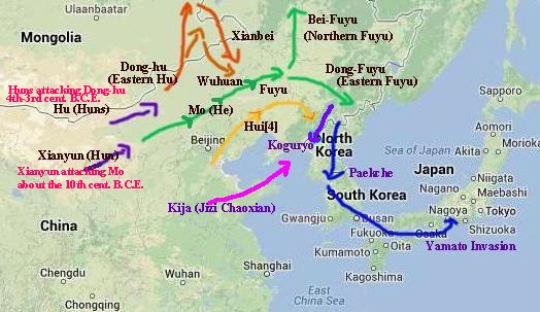
Fuyu (Puyo or Puyeo) bordered with Koguryo to the south, Yilou to the east, Xianbei to the west and Luoshui (soft water, ? the Nenjiang River in the Liaoning-Amur provinces) to the north. According to Chen Shou, Fuyu (Puyo or Puyeo) had 80,000 households. Fuyu shared the same customs as the Huns on the matter of taking over the concubines of late father or late brothers. Fuyu adopted the practice of live burial, with the burial objects reaching hundreds in headcount. The Fuyu kings themselves could be sacrificed to the god should the people experience droughts and disasters. (Fuyu's superstition could be compared to the later Japanese practice of selecting one crewman as a sacrificial object on the sea journey to the Chinese continent, with the victim killed should the journey run into the storms or other disasters.)
Fuyu later split into two parts, i.e., North Fuyu and East Fuyu, with the descendant of East Fuyu (i.e., Zhu-meng, founder of Koguryo) moving to the northeastern coast of the Korean peninsula.
Split from East Fuyu (Koguryo) would be the Paekche.
Later, in A.D. 723, Da-mo-lou, i.e., the descendants of North Fuyu which was destroyed by Korguryo, came to Tang Dynasty together with the Shi-wei tribe by the name of Dagou (Dadu). History stated that Da-mo-lou dwelled near the Du-na River which flew into the Amur River towards the northeastern direction.
http://www.koreanhistoryproject.org could have made an erroneous claim about the original habitat of Fuyu in the below statement to the effect that during the latter part of the 1st century B.C., Tungusic Puyo tribes moved south towards the Yalu and T'ung-chia [Datong-jiang] River basins from the Manchuria's Sungari [Songhuali] River basin. http://www.koreanhistoryproject.org stated that "five Puyo clans led by Chu-mong [Zhu-mang] rode into the rugged mountainous country of the Yemaek and established new settlements of their own. ... By 37 B.C., the territory emerged as the confederated kingdom of Koguryo. ... Koguryo emerged within the territory administered by China's Xuantu Commandery and developed in the context of a nearly continuous conflict with the Chinese. King Yuri-myong, who succeeded Tong-myong in 19 B.C., ruled Koguryo from his rugged mountain stronghold at Kungnae-song [Guonei-cheng]..."
Koguryo was said to have been founded in 37 B.C. According to Chen Shou, it was located thousand li (an ancient unit for distance) to the east of today's eastern Liaoning Province. Their ancestors had come from the background of the Tungunzic people in Manchuria. (The Xianbei and the Wuhuan were also referred to as Tungunzic people. I will say the Xianbei and Wuhuan, after being driven away by the Huns from today's eastern Inner Mongolia, had mixed up with the original Tungunzic people in Manchuria.) It bordered with Fuyu (Puyo or Puyeo) to the north and Woju (Ohcho?) to the east. It had 30,000 households.
Koguryo was recorded to have the same language and customs as Fuyu (Puyo or Puyeo). Its capital was at a place called Wandu. In comparison with Fuyu, the Koguryo land was all mountains and it had no plains or lakes.
It had five tribes at one time: the Weinu Tribe, the Juenu Tribe, the Sunnu Tribe, the Guannu Tribe, and the Guilou Tribe. During the Xin Dynasty (A.D. 9-23), Emperor Wang Mang had tried to recruit the Koguryo people in the campaigns against the Huns. But the Koguryo people refused to participate in the campaign, and most of the Koguryo soldiers fled northward as bandits. Governor Tian Tan tried to capture the Koguryo soldiers but got killed. Emperor Wang Mang tricked the Koguryo marquis into arrest and killed him. Wang Mang thus renamed Koguryo or Ko-guryo into Xia-guryo. In here, the prefix "Ko" means high, and "Xia" means lower in Chinese. By the time of the eighth year of first Latter Han (A.D. 25-220) Emperor Guangwudi's reign, the Koguryo marquis sent an emisary to the Chinese capital in the name of a king (rather a marquis).
In the late Latter Han (A.D. 25-220) Dynasty, Koguryo King Gong (Gao Gong) began to raid into the Liao-dong and Xuantu commanderies. Both Woju and Dong-hui (i.e., Eastern Hui-mo) were subject to the Koguryo King.
In A.D. 111, during Han Emperor Andi's Yongchu Era, the Fuyu king, with 7-8,000 cavalry, raided into the Lelang Commandery. In A.D. 120, Fuyu submitted to Han Dynasty, sending son Yuqiutai (Wigutae) to the Chinese capital of Luoyang with tributes.
In December of A.D. 121, when Koguryo King Gong (Gao Gong), with an alliance of the Ma-haan and Hui-mo troops, laid a siege of the Chinese Xuantu Commandery, the Fuyu king send Yuqiutai (Wigutae) and 20,000 army to the aid of the Chinese prefecture and commandery army in repelling the Koguryo invasion.
The Gongsun Family Exercising Control over Southern Manchuria and Northern Korea
By the end of Eastern Han Dynasty (A.D. 25-220), General Gongsun Du, under the order of Dong Zhuo, took over today's eastern Liaoning Province in A.D. 184, and was conferred the post of governor-general.
Gongsun Du declared himself an independent lord after locating a tripod stone shed in Xiangping, which was a sacrificial temple noted among the natives of the Pacific Islands. The huge stone with tripods was likened to the propitious stone that accompanied the rise of Han Emperor Xuandi.
Gongsun Du later sent generals Gongsun Muo and Zhang Pi to southern Korea where they defeated the Han(2) [Haan] people in southern Korea.
Gongsun Du's son, Gongsu Kang, set up a new commandery called Daifang (or Taifang) in central Korea, in addition to the Lelang Commandery in North Korea. The Daifang Commandery was in charge of both southern Korea and the Wa State in Japan. King Yuqiutai [or Yu-qiu-Tai, Yu chou Tai] of Fuyu (Puyo or Puyeo), submitted to Gongsun Du and was married with a daughter of the Gongsun family. Gongsun Du based his intermarriage on the consideration that Fuyu was in an important situation of being sandwiched between the Xianbei and the Koguryo. (In the late 230s A.D., Cao Wei Emperor Mingdi secretly ordered that Liu Xin of the Daifang Commandery and Xianyu Si of the Lelang Commandery attack the Haan-hui [central and southern Korea] and Wa statelets.)
Sima Yi's Forced Migration of the Sinitic Chinese Back to China from Southern Manchuria and Northern Korea
In Xiangping (Liaoyang) of Manchuria, the Gongsun family, starting from Gongsun Du ("tai shou" for Liao-dong and "zhou mu" for Pingzhou), through Gongsun Kang and Gongsun Gong, to Gongsun Yuan, ruled the relatively peaceful area for about half a century, A.D. 190 to 238.
Gongsun Du's territory extended to the Korean mid-peninsula, the eastern coast of Shandong, and the Luan-he River.
In the Liao-dong Commandery alone, the population used to be 64,158 households as recorded by "Jun-guo Zhi" (records on the commandery and fiefs) in "Xu-Hanshu" (Continuum to Han-shu).
After the fall of Dong Zhuo and the rise of Ts'ao Ts'ao (Cao Cao), Gongsun Kang (i.e., Gongsun Du's son), killed Yuan Shang and sent the head to Ts'ao Ts'ao, thus being conferred the title of Marquis of Xiangping. Gongsun Du's grandson, Gongsun Yuan (i.e., Gongsun Kang's son), who forced Gongsun Gong (i.e., Gongsun Kang's brother) into abdication in A.D. 228, would later play the trick of submission and defection among the Wei and Wu dynasties of the Three Kingdom China.
In A.D. 232, Wei Emperor Mingdi ordered the first sea-land campaign against Liao-dong (i.e., the southern and eastern Manchuria), with Tian Yu ("ci shi" for Pingzhou) attacking via sea and Wang Xiong ("ci shi" for Youzhou) attacking by land.
After defeating the Wei Army, Gongsun Yuan submitted a petition to the Wu Dynasty to express loyalty.
In A.D. 233, Sun Quan, the Wu Dynasty emperor who conferred the title of King Yan onto Gongsun Yuan, dispatched a fleet with 10,000 reinforcement to the port near today's Dairen in southern Manchuria.
Wei Dynasty then announced a new campaign against Gongsun Yuan, which forced Gongsun Yuan to waver between Wu and Wei.
After killing the Wu emmisaries (Zhang Mi et al.) and sending their heads to Wei Dynasty, Gongsu Yuan was conferred the title of Duke of Lelang and the post as "da sima".
However, Gongsun Yuan treated the Wei emissary with suspicion as well as displayed the troops during reception.
In A.D. 237, Wei Emperor Mingdi, after aligning Guanqiu Jian and a massive army at the Liao-dong border, ordered Gongsun Yuan to pay a visit to the capital of Luoyang, which forced Gongsun Yuan into rebellion.
Gongsun Yuan, thinking that nobody could control him in the remote areas of Korea, fought against General Guanqiu Jian ( ? -255 A.D.) of Youzhou Commandery, who enjoyed the titles of "ci shi" (satrap) for Youzhou, "jiang jun" (general) for Du-liao (the trans-Liaohe River area), and "xiao wei" (colonel) for the Wuhuan barbarians.
The two armies confronted each other at Liaoshui (Haicheng) across the Liao-he River.
Guanqiu Jian's campaign aborted as a result of the high water flooding.
Gongsun Yuan claimed to be King of Yan, declared the era of Shaohan, and sent an emissary for liaison with the Xianbei.
Guanqiu Jian, together with Sima Qi, attacked King Yan Gongsun Yuan at the turn of A.D. 237 and 238.
Over 5000 remnants from the Yuan brothers, who sought asylum in Liao-dong, surrendered to Wei.
Sima Yi, under the order of Cao Wei Emperor Mingdi (Cao Rui), campaigned against the Gongsun regime in the first lunar month of A.D. 238.
Other than the 40,000 army attacking over the land, a navy force departed Dengzhou of Shandong for Manchuria.
Gongsun Yuan, other than having his ministers write a letter to the Wei court, sent apology to the Wu court in the hope of deflecting the coming war.
In June of A.D. 238, the two armies confronted each other at the Liao-he River again.
Sima Yi, having distracted the defenders to the south, made a stealthy river-crossing to the north and attacked towards Xiangping. Outside of Xiangping, the Wei army intercepted Gongsun Yuan's army which was en route of return to relieving the capital city of Xiangping.
The Xiangping defenders surrendered months later after running out of supply, while Gongsun Yuan and son Gongsun Xiu broke out of the siege with a few hundreds of cavalry.
Sima Yi exterminated the whole family of Gongsun Yuan at the Yan-shui (Taizi-he) River, ending 50 years of the Gongsun family's ruling in Manchuria and Korea.
At Xiangping, Sima Yi massacred over 2000 senior officers and officials from General Bi Sheng downward, and further assembled over 7000 men above the age of 15 for another round of slaughter. Furthermore, Sima Yi deported 40,000 households of the Sinitic Chinese [per Biography of Emperor Xuandi in Jinn Shu], or over 300,000 people back to North China from Manchuria, yielding both a power vacuum as well as a population vacuum in the area and giving rise to the Xianbei, Fuyu and Koguryo people.
By A.D. 280, about 42 years later, the total population combining Liao-dong with the Xuantu, Daifang and Lelang of Korea numbered a little over 100,000 people per the Geography Section of Jinn Shu.
The loss of the Sinitic Chinese led to the loss of stalwarts against the Tungunsic people [including the ancient "Mo" ("He") and "Hui" people] who subsequently took over the area as their lasting homeland.
With the cross-see campaign, the Wei Chinese control was exerted over the areas of the Lelang and Daifang commanderies on the Korean peninsula.
Guanqiu Jian ( ? -255 A.D.) of Wei Dynasty (A.D. 220-265), one of the Three Kingdoms of China, would be responsible for defeating Koguryo and extending China's influence to Japan.
Wei China's Campaigns against Koguryo
During the Wei Dynasty (A.D. 220-265) of the Three Kingdoms period, the Koguryo people raided into the Chinese territories frequently. Gongsun Kang had at one time destroyed a state established by one of the two grandsons of Koguryo King Gong. The other grandson bore a son to be named the same name as their ancestor, Gong. This new Koguryo King Gong, i.e., Dong-chuan-wang (Dongcheon-wang), had earlier in the years assisted Wei China in its campaign against Gongsun Yuan.
General Guanqiu Jian of the Youzhou Commandery dispatched Governor of Xuantu, Wang Qi, to Fuyu (Puyo or Puyeo). Wang Qi successfully persuaded Fuyu in providing support to the Chinese army in the campaign against Koguryo. In the Fuyu (Puyo or Puyeo) state, there was a city called Mo which could be the same as the Mo state as recorded in the Chinese history. [Mo or Huimou would alternatively be known as Yemaek or Wimo.]
Chen Shou recorded that the Fuyu (Puyo or Puyeo) and Koguryo people shared the same language, but the different styles of clothing and temperament.
After Cao Wei destroyed Gongsun Yuan, they found in the Fuyu palace lots of the jade artifacts from the past generations, including the "Seal of King Hui-wang" as conferred by the Han Dynasty.
But years later, the Koguryo under Gong rebelled against China.
In A.D. 244, Guanqiu Jian ( ? -255 A.D.), departing the Xuantu Commandery, attacked Koguryo, chasing the Koguryo king, Dong-chuan-wang (Dongcheon-wang), all the way to Dong-woju at the Japan Sea.
While Wang Qi's prong pushed to the Sushen-shi sea coast, Liu Mao and Gong Zun's prong, from the Lelang and Daifang commanderies, attacked north to subjugate the various Hui and Mo statelets, pressing "Hui" Marquis Bunai-cheng into a surrender.
In May of A.D. 245, Guanqiu Jian ( ? -255 A.D.) inscribed the battle victory on a huge stone and returned to China.
Seventy years later, Koguryo rebuilt the capital city of Wandu-cheng, and after years of encroachment onto the Chinese commanderies, finally took control of the Lelang Commandery in A.D. 313.
(The destruction of Koguryo in A.D. 245 gave rise to the state of Silla to the southeast of the Korean peninsula.
In A.D. 342, the new Wandu-cheng city was burnt down again by the invading force of Anterior Yan under Murong Huang, which led to the rebuilding of the old Wandu-cheng city. Koguryo, in A.D. 371, suffered a major defeat in the hands of revitalized Paekche, with its King Gogugwon-wang killed by Paekche King Geunchogo-wang at the Battle of Pyongyang.)
Yilou, Woju, Eastern Woju & Northern Woju
General Guanqiu Jian of the Youzhou Commandery fought the wars against Koguryo in 244 A.D., forcing Koguryo King Gong into fleeing to Woju. (The Woju people were located in the Xuantu Commandery after Han Emperor Wudi defeated Korean [Choson] King Wei Youqu in 108 BC. Being attacked by the Mo people, Woju relocated to the northwest of Koguryo, and it was at one time a county under the Lelang Commandery. Woju was conferred the title of marquis. Woju submitted to Koguryo later.) Eastern Woju was said to have the similar language as Koguryo. Still one more Woju would be called Southern Woju. All Woju statelets shared the same customs though they were apart by 800 Chinese league distance.
Governor-general Wang Qi was ordered to press on against Gong. After another defeat, King Gong fled to Northern Woju, a state which bordered Yilou to the south. (Yilou would be where the ancient Su-shen state was or the Sushen-shi people were.) Yilou was famous for its long bow with poisonous arrowheads. It was on the seaside that Wang Qi asked the local people whether there were people in the sea. Chen Shou said the people of Yilou looked similar to Koguryo and Fuyu, but the language differed from each other. The locals said there was an island to the east where there was a habit of sinking a virgin girl every July of the year. That island could be either Sakhalin or Japan.
Limited pieces of the Fuyu language were available from the Chinese history book. Per the section on the alien domains in Zhou Shu, Paekche, which was said to be of the Fuyu lineage, called their kings by "Yuluoxia" while queens by "Yulu"; in contrast, the Ma-haan people called the Paekche king by "jizhi" which sounded similar to the name of Ji-zi Chaoxian.
Per Japanese linguist Kindaichi Haruhiko, the Chinese denotation on the stone monument of Koguryo king Hao-da-wang showed that the Fuyu language pronounced number three as "mi", number seven as "nan", and number ten as "dedunhu", etc., which were similar to that of the Japanese reading.
In the 2nd century, Yilou had to submit tributes to Koguryo in addition to Fuyu.
In the early 3rd century, Yilou resisted the rule of Fuyu.
Yilou, which submitted tribute to Wei China in A.D. 236 and 262, was attacked by Koguryo in A.D. 280 as punishment for robbing the Koguryo's border people, enjoyed a time period of relative independence after Koguryo suffered defeat in the hands of Paekche, but was attacked again by the revived Koguryo in A.D. 398.
Riding on ships, the Yilou people often pirate-attacked Bei-woju (northern Woju) which was located at the Tumen River rivermouth.
Hundreds of years later, the Yilou [or Sushen] people were called by Wuji [commonly mispronounced as Huji]. During Toba Wei Dynasty, the Mohe (Malgal) was renamed to the old name of Wuji. The Wuji people then were called by the Malgals during Sui Dynasty, who were very much a mixed-up people by that time.
The Shiwei people shared the same language as the Wuji [commonly mispronounced as Huji] people. They dwelled in the upper Heilongjiang River. The location was to the east of the Turks, the west of the Wuji, and the north of the Khitans.
They were connected with Koguryo in the south, around today's Changbaishan Mountains as well as with the Shiwei in the north. During the second year of Tang Emperor Taizong, A.D. 628, the Wuji land was made into Yanzhou Prefecture. The Wuji tribes joined Koguryo in resisting Tang Dynasty. During the tenth year of the Kaiyuan Era, A.D. 722, Tang Emperor Xuanzhong set up Heishui-fu or the Blackwater Governor office in the Wuji land. Sumuo, one of the Wuji tribes, sought protection with Koguryo, and after Koguryo's demise in the hands of Tang, became independent and established the State of Po'hai (Bohai or Parhae).
The Heishui [Blackwater] Mohe (Malgal) dwelled in the old land of Sushen.
This group of people were called the Bohai (Parhae) during Tang Dynasty, and the Nüzhi (Nüzhen) during Soong Dynasty.
Po'hai continued for a dozen generations till it was destroyed by the Khitans. When the later Jurchens defeated the Khitans, the Jurchens sent an emissary to Bohai, saying that the Jurchens (Nüzhi) and Bohai were of same family.
Note Bohai was recorded to have possessed a written language, music, government and rituals.
(Note that the Jurchens might not have anything to do with the Manchus.
According to Korean book LEE DYNASTY's FACTURAL RECORDS, the Manchus disclosed to the Korean emissary that they belonged to the Mongol stock.
In A.D. 1635, Huang-tai-ji prohibited the people from calling the Manchus by the Jurchens (i.e., 'Zhu-shen').
The presently dominant C haplogroup people in southwestern Siberia, i.e., the Mongols, were ascertained to be of the C2b1b1-F3796 type. The Manchus, a northern C2b branch that separated from the former about 3000 years ago, carried the rare C2b1b2a-F14751 gene.
As to the C haplogroup barbarians in western Siberia 4000 years ago, they were found with a minor presence in the bronze sites and carried the C41a genes while their closest relatives, like C4a2, C4a3, were seen moving on to today's Ukraine.
Note that the majority stock of the Huns, the Xianbei, and the Khitans were ascertained by Jirin University frontier people research institute to be of the same 'North Asia' or paleo-Siberia stock.
The physical anthropology studies of the Khitan tomb remains showed that the Khitans belonged to the "North Asia" or the "Siberia-Baikal" type with a low cranial forehead and a higher facial appearance, i.e., people who had no similarity to the East Asia type people.
Note that there existed the
fundamental difference in cranial length, width and height among the East Asian population and
the paleo-Siberia/paleo-Mongolian-Plateau population, that could be 181 millimeters versus 175, 138
versus 144, and 134 versus 127, respectively.)
Koguryo
When Han Emperor Wudi quelled Manchuria and Korea in 107 B.C., the Xuantu Commandery was organized, and the Koguryo territory was treated as a county. The Koguryo people later rebelled against the Han Dynasty by building a castle on the eastern border of the commandery, designating it with a name called Gou-lou. The sound is similar to the later statelet name.
Koguryo was said to have been founded by Zhu-meng [59-19 B.C.] in 37 B.C. on the bank of the Foliu [Fuer] River. Founder Zhu-meng, also known as Dongming (Dongmyeong, i.e., brightness in the east but could be a mutation of Zhu-meng as 'ming' in the ancient Chinese was equivalent to the 'meng' word for engendering or oath, which had the same sound as 'meng' in Zhu-meng), rose up in Gaojuli [Koguryo] county of the Xuantu-jun Commandery [i.e., the Xinbin-xian county of Liaoning Prov].
History chronicle Bei Shi (History of the Northern Dynasty) stated that the Fuyu king obtained the daughter of He-bo (the river god, i.e., an ancient China's Yellow River river god as known in Mu-tian-zi Zhuan) and bore an egg after being chased by the sunlight. This egg was not touched by the dogs, pigs, horses and buffalos when deserted to the wilderness. The birds were said to have covered the egg with feathers. After the birth-mother wrapped it with clothing, a boy, i.e., Zhu-meng (i.e., meaning a good arrow shooter), came out of the cracked egg.
When persecuted by the Fuyu court ministers, Zhu-meng fled across a river. He crossed the river by calling on turtles and tortoise to make a bridge. Zhu-meng claimed to be son of the SUN god and maternal grandson of the RIVER god. Zhu-meng made his statelet Koguryo in a place called the Qi-sheng-gu-cheng castle [the Huanren county of Liaoning Prov] and adopted Gao (i.e., Ko) as surname, which means "high" in Chinese.
Samguk Yusa cited the older Korean records to state that the founder of North Fuyu was Xie Mushu, i.e., father of Xie Fulou, and that North Fuyu was launched in 59 B.C.E.
The Koreans claimed that the Koguryo state was launched by Zhu-meng in 37 B.C.E.
Per Korean book Samguk Yusa, Koguryo was the [new] Fuyu statelet at Zoumou.
Further, Samguk Sagi stated that Xie Fulou, the North Fuyu king, prayed for son with the mountains and rivers, and went to the East Fuyu (Dong-buyeo) land, where he found a baby whom he called by Jin-wa (the golden baby).
The Koguryo people and the Fuyu predecessor were successively recorded by San Guo Zhi, Liang Shu and Bei Shi to have adopted the Shang Dynasty's practice and customs, namely, treating the month of lunar December as the start of the new year and lunar October the time for the sacred heaven-praying ceremony as well as wearing the white-colored clothing and decoration.
The October ceremony, with adoration of a cave spirit, was called by 'Dong [eastern] Meng [oath]".
What happened was that Zhu-meng, who was being persecuted by the Fuyu clansmen, fled to Zuoben, where he was married with Zhao-xi-nu, daughter of the local chieftain Yan-tuo-bo, and born two sons.
Zhu-meng left behind his elder son in the original North Fuyu land.
The elder son, i.e., future Koguryo king Liuli-wang, came to Zuoben to look for Zhu-meng, and was made into a crown prince.
Among three of Zhu-meng's sons, Foliu (Biryu) and Wenzuo (Onjo), after the arrival of the elder prince from Fuyu, departed for the central Korean peninsula where they were to found the Paekche kingdom and subjugate Ma-haan at about 10 A.D.
The grandson of Zhu-meng, Muo-lai, later had the [North] Fuyu kingdom subjugated and merged.
Muo-lai's grandson, i.e., Gao Lian, sent emissaries to the Tuoba Wei Dynasty per Zhou Shu.
In A.D. 3, the Koguryo capital was moved to the Guonei-cheng city [the Ji'an city of Liaoning Prov].
Another major city called Wandushan-cheng was built inside today's Ji'an of Jilin Prov.
The Koguryo statelet bordered with Woju to the east, Chaoxian (Korea) and Hui-mo to the south, and Fuyu to the north. Koguryo in about the 2nd century subjugated and merged those small statelets around.
During the Xin Dynasty (A.D. 9-23), Emperor Wang Mang had tried to recruit the Koguryo people in the campaigns against the northern nomads. But the Koguryo people refused to participate in the campaign, and most of the Koguryo people fled northward as bandits. Governor Tian Tan tried to capture the Koguryo people but got killed. Yan You tricked the Koguryo marquis into arrest and killed him. Wang Mang thus renamed Koguryo or Ko-guryo into Xia-guryo. In here, the prefix "Ko" means high, and "Xia" means lower in Chinese.
By the time of the eighth year of first Latter Han (A.D. 25-220) Emperor Guangwudi's reign, the Koguryo marquis sent emisary to the Chinese capital in the name of a king (rather a marquis).
The Chinese refugees fled to Korea at the times of turmoil.
Koguryo often raided into the Chinese commanderies to abduct people, and sometimes returned the abducted people back to the Chinese commanderies.
In 122, after the death of Koguryo King Gong the previous year, the new king returned some people to the Xuantu Commandery.
Samguk-sagi claimed that a large number of Chinese fled to Manchuria in A.D. 197.
In 217, the Chinese from Pingzhou (Liaoyang) fled to Koguryo.
Samguk-sagi claimed that in A.D. 302, Koguryo King Meichuanwang-yifuli commanded 30,000 troops to invade the Xuantu Commandery (Mukden) and abducted 8,000 people for relocation to the Pyongyang area, and further in October of 313, invaded the Chinese Lelang Commandery to abduct people.
In A.D. 319, when Jinn China fell apart, the Chinese "ci shi" at Pingzhou, Cui Bi, had at one time rallied an alliance of Koguryo, the Yuwen-shi Xianbei, and the Duan-shi Xianbei against the Murong-shi Xianbei. After a defeat, Cui Bi fled to Koguryo. The Murong Xianbei raided deep into the Korean peninsula.
According to the Biography on Murong Yun in Jinn Shu, Murong Yun's grandfather, i.e., Murong He, was a descendant of Koguryo.
History chronicle Xin Tang Shu (The New History of the Tang Dynasty) stated that Koguryo, with the capital city at Pyongyang (i.e., the China's equivalent Chang-an city, meaning "forever peaceful"), was where Han Dynasty's Lelang Commandery was. The major cities include Guonei-cheng and Han-cheng (Seoul). It had twelve levels of officialdom, five tribes, and 60 prefectures and counties.
The Confucian filiality of three year mourning for parents was adopted. The oblatory gods included the stars, the sun, ke-han (khan), Ji-zi (i.e., Shang Dynasty prince), and a divine cave.
Koguryo moved its capital to today's Pyongyang of Korea in A.D. 427, i.e., the 4th year of the Tuoba Wei Dynasty's Shiguang Era.
Mo (Huimou, Wimo Or Yemaek)
In southern Manchuria and northern Korea, there was numerous statelets by the name of 'Mo'. The Chinese records categorically said 'Mo' was an ancient ethnic group in Manchuria. But it did not specifically link it to any other major group.
Somewhere near today's Yexian County, where the ancient Yellow River turned north to merge with the Zhang-he [Zhuo-zhang-shui] River before continuing north to flow into the Hu-he and Hutuo-he rivers, there was a place known as Ji-mo [sacrifice for the elder uncle], where Ximen Bao of the Wei Principality had at one time stopped the sacrifice of virgin girls by throwing a sorceress and her accomplices into the water.
The sacrifice of virgin girls, 'niu2 [sinking] bi4 [favourite concubine]' on the Oracle bones, was ascertained to be a Shang Dynasty practice for pacifying the Yellow River flooding.
Here, it was deduced that the 'bo' [elder uncle] character had corrupted into the 'mo' character in 'Ji-mo', which was the name used for designating the Hui-Mo group of migrants into the Korean peninsula.
Fuyu, for the records showing their adoption of the Shang Dynasty customs of treating October as the first month of the year and wearing the white-clothing, could be descendants of the former Shang Dynasty people.
Though, it is not clear how those Shang Dynasty people relocated to Manchuria, the same way as Shang Prince Ji-zi or as part of the Ji-zi exodus, or as part of the "Mo" ["He"] people who were pressed to the east by the "Xianyun" barbarians as recorded in Shi-jing.
Note that in Zhou King Muwang's travelogue Mu-tian-zi Zhuan, there was an inference to the effect that Shang Dynasty remnants were assigned the fief of the Northern Yellow River Bend as the god of river.
(Prof Wei Juquan wildly speculated that the Mo people had later related to the Arctic area to become the Eskimo, for the 'mo' soundex.)
Reading through Chen Shou's San Guo Zhi, the conclusion would be that the Fuyu people had in their possession an ancient 'King Mo Seal'. This seal was found in a jade box that was sent to the Xuantu Commandery for safebox keeping. Inside of the Fuyu territories, there was a city by the name of Huimou (alternatively called Yemaek or Wimo).
Later, during the Toba Wei Dynasty time period, a Paekche king sent in a note to the Wei emperor, stating that they shared the same roots as Koguryeo (Koguryo), namely, the descendants of Fuyu King Yu-qiu-tai.
During the Jinn Dynasty time period, Paekche took advantage of turmoil in China to take control of Liaoxi (west of the Liao-he River) and the Jinping commanderies (between Liucheng and Beiping) while Koguryeo grabbed Liaodong (east of the Liao-he River).
The Mo city could be the same as the Mo state as recorded in the Chinese history. Since Fuyu (Puyo or Puyeo) and Koguryo people shared the same language, the speculation would be that the Mo people were the source of origin for Fuyu.
(The deduction was that North Fuyu defeated the "Hui" people in today's Jirin area, and took over the "Hui" capital city of Hui-cheng.)
Chen Shou's San Guo Zhi further said that to the south of Koguryo would be Choson (Chao-xian) [meaning the Ji family-controlled Ma-haan, perhaps] and Hui-mo. Also mentioned would be that both Woju and Dong-hui (i.e., the Eastern Hui-mo) that were subject to the Koguryo King. Still more reference to 'Mo' would be a group called 'Yi-mo' (the alien Mo) who drove the Eastern Woju people to the northwest of Koguryo. Still one more name related to 'Mo' would be a statelet called 'Xiao-shui-mo', meaning a 'Mo' statelet dwelling near a small river. This name applied to a so-called alternative race of Koguryo, a group of people who did not compete with the Koguryo people who had a habit of dwelling near the big river. The small river of 'Xiao-shui-mo' was situated to the west of an ancient county called Anping and it flowed southward into the sea. 'Xiao-shui-mo' was famous for producing a kind of bow called the 'Mo Bow'.
San Guo Zhi's records showed that the Chinese used 'Mo' as a categorical designation for the people in the area.
After Han Emperor Wudi invaded Korea in 108 B.C., the territory of Wei-Man Choson was divided into four commanderies, with the Woju city belonging to the Xuantu Commandery. A city called Bunaicheng was established to take charge of the seven counties in eastern Korea. In A.D. 30, Latter Han Emperor Guangwudi appointed all the chieftains as the county marquis. The Bunaicheng chieftain was named 'Mo Hou' or Marquis Mo.
When Usurper Emperor Wang Mang campaigned against Koguryo, a minister called Yan You named the Koguryo people as 'Mo Ren', i.e., the 'Mo' people. By the time of late Han Dynasty, under the reign of Emperor Huandi and Emperor Lingdi,
the Chinese fled to Korea in hordes because the so-called 'Han Hui' [Mo] was strong while China proper was in turmoil.
The reference here would be to equate Han(2) or Haan as the same statelet as 'Mo', or a combination of 'Haan' and Hui [Mo].
The 'Haan' [Han2] would be the more Sinitic statelets like Qinhan in southern Korea.
San Guo Zhi continued to say that 'Hui' or Hui-mo bordered with Qinhan to the south and the sea to the east. It had 20,000 households, all cultivated under the eight clauses of Shang Dynasty Prince Ji-zi. The people would include tens of thousands of the Chinese refugees who came to Korea during the demise years of Qin Dynasty. It possessed the titles like 'Hou Yi Jun' (the marquis city prince) and 'San Lao' (the three elderly people), titles from the Han Dynasty. The history said all Eastern Korea was under Marquis Mo who had the seat at the Bunaicheng city.
San Guo Zhi said the elderly people mentioned that they were of the same ethnical background as the Koguryo people to the north. The people adopted the Chinese way of marriage, namely, the people of the same last name could not marry each other.
As mentioned in the previous paragraph, by the time of late Han Dynasty, under the reign of Emperor Huandi and Lingdi, Korea was referred to as the so-called 'Haan Hui', pointing to the statelets like Qinhan in Southern Korea. When Gongsun Kang was ordered to launch the Daifang Commandery in the desolate areas to the south of Lelang, he attacked the so-called "Haan-hui". When the Chinese tried to divide the eight states of Qinhan for sake of giving them over to the Lelang Commandery, the Haan-hui people rebelled. Governor Gong Zun of the Daifang Commandery and Governor Liu Mao of the Lelang Commandery joined forces and conquered Haan-hui in the late 230s AD. (Gong Zun was killed in the war.)
Silla
Ouyang Xiu of Soong Dynasty, in his book New History Of Tang Dynasty, said that the founders of Silla were descendants of the Bianhan people who historically dwelled in the area of the then Lelang Commandery. (Ouyang also recorded that to the east of Silla there were a group of people called the 'Tall Guys' who were cannibals and that Silla had to dispatch thousands of soldiers to guard against them.
This could a myth similar to Confucius' purported comment on the prehistoric tall-leg-bone people.)
http://www.koreanhistoryproject.org gives details of the tribes involved:
"In 57 BC, the six clan chieftains of the King's Council met in the village of Kyongju,
capital of the small walled-town state of Saro. They formed a new political alliance among the
several smaller tribal states in the old Chinhan territory east of the Naktong River and chose
Pak Hyokkose of the Kumnyang clan as their first leader. By consolidation and outright
conquest, the walled-town state of Saro linked itself with other walled-town states in the
area, gradually expanded its frontier beyond the confines of the Kyongju plain, and evolved
into the rather large confederated kingdom of Silla. "
The change to Silla's demographic composition happened at the time Guanqiu Jian attacked and destroyed Koguryo.
Du You, in Tong Dian, carried on the account that the Silla statelet originated from Xinlu, part of the Chen-haan country, which was one among a dozen tribal statelets.
After Guanqiu Jian's campaign, Silla collected various groups of people in the area to form a statelet.
The confusing part was that a new Silla king appeared to be some Paekche [not necessarily a royal member] who fled into Silla from Paekche.
At the time of Fu Jian's Anterior Qin Dynasty, the Silla king, Lou-han, first sent in tributes. During the 2nd year of the Putong Era of Liang Dynasty Emperor Wudi, Silla King "Mu [last name] Qin" [first name] dispatched emissary on the Paekche embassy to southern China. By the time of Sui Dynasty, Silla King "Jin [last name] Zhenping [first name]" sent tributes to China, with a claim that the Jin (gold) lineage had lasted over 30 generations.
The Chinese history stated that they never figured out why the last name changed for Silla, but it was known that Silla was originally subordinate to Paekche, but as a result of Paekche's extraction of labor and manpower for attacking Koguryo, Silla was able to collect refugees and escapees to strengthen the country, and with the rise of population, embarked on merging Ren-na and Jia-luo and other small states to become one of the three competing kingdoms on the Korean peninsula.
Paekche
Ouyang Xiu of Soong Dynasty, in his book New History of the Tang Dynasty, said the Paekche derived from the Tungusic Puyo tribes in Manchuria.
As stated earlier, among three of Koguryeo founder Zhu-meng's sons, Foliu (Biryu) and Wenzuo (Onjo), after the arrival of the elder prince from [North] Fuyu, departed for the central Korean peninsula where they found the Paekche kingdom in about 18 B.C.E. south of the Han-jiang [Seoul] River.
After Foliu (Biryu) committed suicide, Foliu's people went to Wenzuo (Onjo), making the new country name to Paekche (Bai-ji, hundred families) from Shi-ji (ten families).
The third son, Wenzuo (Onjo), came to be known as Paekche King Wenzuo-wang.
Under attacks by Ma-haan, Wenzuo moved around along the Han-jiang River numerous times.
The Korean history purportedly claimed that Paekche subjugated Ma-haan at about 10 A.D., which conflicted with the Chinese records.
Per Chinese history book Sui Shu, the Paekche founder was someone called Yu-choutai (Yu-qiutai), a descendant of Dong-ming (i.e., Zhu-meng).
Further, in the late 230s A.D., Cao Wei Emperor Mingdi secretly ordered that Liu Xin of the Daifang Commandery and Xianyu Si of Lelang Commandery attack the Haan-hui [central and southern Korea] and Wa statelets, which was to say that the Paekche kingdom was not a true country with established domain yet.
Later, during the Toba Wei Dynasty time period, a Paekche king sent in a note to the Wei emperor, stating that they shared the same roots as Koguryeo, namely, descendants of Fuyu King Yu-qiu-tai.
In A.D. 111, during Han Emperor Andi's Yongchu Era, the Fuyu king, with 7-8,000 cavalry, raided into the Lelang Commandery. In A.D. 120, Fuyu submitted to Han Dynasty, sending son Yuqiutai (Wigutae) to the Chinese capital of Luoyang with tributes.
In December of A.D. 121, when Koguryo King Gong (Gao Gong), with an alliance of Ma-haan and Hui-mo troops, laid a siege of the Chinese Xuantu Commandery, the Fuyu king send Yuqiutai (Wigutae) and 20,000 army to the aid of the Chinese prefecture and commandery army in repelling the Koguryo invasion.
Here, the Korean records conflicted with the Chinese records in regards to the continuous existence of Ma-hann around the year of A.D. 121 --whereas the Koreans claimed that Paekche had destroyed Ma-hann which was ruled by the Ji-zi family since the days of Wei-man invasion of Korea.
In Han Dynasty, governor-general ("tai shou") for Liao-dong, Gongsun Du, who was appointed the frontier post by Han Emperor Lingdi in 184 A.D., married his daughter to Choutai (Qiutai).
King Yuqiutai [or Yu-qiu-Tai, Yu chou Tai] of Fuyu (Puyo or Puyeo), submitted to Gongsun Du and was married with a daughter of the Gongsun family. Gongsun Du based his intermarriage on the consideration that Fuyu was in an important situation of being sandwiched between the Xianbei and the Koguryo.
During the Jinn Dynasty time period, Paekche purportedly took advantage of turmoil in China to take control of Liaoxi (west of Liao-he River) and Jinping commanderies (between Liucheng and Beiping) while Koguryeo grabbed Liaodong (east of Liao-he River). There was dispute about the accuracy of this claim as Paekche was unlikely to cross the sea to take control of some territory to the west of the Liao-he River.
Jinn Dynasty assigned the name of Paekche Commandery onto the Paekche king.
After the demise of Jinn Dynasty, Paekche maintained relations with dynasties in southern China and upheld the calendar from the Liu Soong court.
Du You, in Tong Dian stated that the Paekche people had worshipping ancestor Yu-qiu-tai (a king of Fuyu) four times a year.
At one time, in A.D. 371, Paekche intruded into today's Pyongyang area, defeated Koguryo and killed the Koguryo king.
in 372, Paekche sent an embassy to Jinn China.
In 429, Paekche sent an embassy to Liu Soong Dynasty in South China.
However, after the revival of Koguryo, Paekche went downslope.
In 472, Paekche sought the military alliance with Tuoba Wei Dynasty against Koguryo.
In 475, Koguryo sacked Paekche's capital, forcing the latter into striking an alliance with Silla.
Toba Wei Emperor Xiaowendi [reign 471-499] sent an army to defeat Paekche.
Paekche had to relocate the capital to the south.
In A.D. 538, Paekche moved capital to Sibi, and renamed itself South Fuyu.
During Tang Dynasty time period, General Su Dingfang in A.D. 660 led a cross-sea campaign against Paekche.
After the Tang-Silla armies destroyed Paekche, the old Paekche land was rezoned into five governor-general offices. However, Silla soon encroached on the Paekche land, with Paekche remnants fleeing to seek asylum with the Turks and the Malgal tribe. Silla rebelled against Tang in A.D. 672. Meanwhile, the majority of Koguryo people were exiled to China by Tang Emperor Gaozong, yielding to a dramatic demographic change
on the Korean peninsula, namely, the dominance of the Silla people throughout the peninsula.
Wa Japan & the Ancient Koreans
There are very important questions here. Is Wa State mentioned in China's records in the early 1st century A.D. the same as that which existed during China's Sui Dynasty (A.D. 581-618)? Is the Wa State the same as the Yamato? And, is the Yamato Kingdom the same as Nippon (i.e., Chinese Ri Ben or English Japan) of the late 7th century A.D.? We will touch on these topics in Japanese section. Below, we will mention the relationship between the Wa State and the Koreans.
The Wa people in then Japan had close relationships with the Chenhan and Bianhan people in the southern tip of the Korean Peninsula. The Daifang Commandery of Wei China, located near the present capital city of Seoul, was in charge of affairs of the Wa State.
http://plaza14.m bn.or.jp/~sinkodai/efuruta/jimmue/jimmue.html said that "Chiu-T'ang-shu or old T'ang History (*5) contains the Records on Japan and Wa-state, and one passage in it radically contradicts the existing dogmatic interpretations advanced by historians of ancient Japan. According to this passage, Wa-state was granted a gold seal by Kuang -wu of Later Han dynasty."
Hou Han Shu, written in the 5th century, stated on basis of San Guo Zhi that "the King of Wa resides in the country of Yamadai (Yamatai, disputed to be Yamaichi as a result of the error by the author of Hou Han Shu). In the second year of the Jianwu Zhongyuan era, namely, A.D. 57, the Wa Nu Country (located in south of Wa) sent an envoy with tribute and he called himself Dafu. Guangwudi bestowed on him a seal. In the first year of the Yongchu era (A.D. 107), during the reign of Andi, the King of Wa presented one hundred sixty slaves. During the reigns of Huandi (147-168) and Lingdi (168-189), the country of Wa was in war and conflict raging on all sides and there was no ruler till a woman named Pimiko was selected as a ruler."
The Wa people requested for pilgrimage to the Chinese capital with Governor-General Liu Xia of the Daifang Commandery. Diplomatic emissaries were frequently exchanged, and seals were conferred upon the Wa Queen by Wei China. In the first year of Zhengshi, A.D. 240, Governor Gong Zun sent Ti Zhun to Wa. In Jan of A.D. 238, the Queen of Wa sent an emissary (da fu Nan-sheng-mi) to the Daifang Commandery, requesting pilgrimage for seeing Chinese emperor. In Dec, Emperor Mingdi (Cao Rui) acknowledged receipt of 4 Wa males and 6 Wa females, and conferred the title of Qin-wei-wo-wang (king befriending Cao Wei) onto Wa Queen plus hundred bronze mirrors, pearls, silk and other precious gifts. In A.D. 240, Gong Zun dispatched Ti Jun to Wa for conferral, and proxy Wa king replied with thanks.
In A.D. 243, Wa king dispatched Wa da fu to China. In A.D. 245, Wei China conferred Nan-sheng-mi a title. In A.D. 245, Governor Gong Zun and Governor Liu Mao defeated Marquis Bunai-hou. In A.D. 247, Marquis Bunai-hou [in southern Manchuria] sent tributes to Cao Wei Dynasty and was conferred the king of Bunai-Mo.
Later, around A.D. 247, when the Wa State in Japan had the internal turmoil because Himiko was at odds with the King of Kunu (Bei-mi-gong-hu-su), Queen Himiko (Pimiko) requested with the new Governor-General of the Daifang Commandery, Wang Qi, for assistance. An official called Zhang Zheng was dispatched to the Wa State in the 8th year of Cheng-shih or A.D. 247. When Pimiko passed away, Iyo, a girl of thirteen, was made queen.
Pimiko death led to a turmoil with thousand deaths. Pimiko's live burial included hundreds of slaves and servants.
When Zhang Zheng returned to China with two dozen Wa people, it was already dozens of years later and China was ruled by Western Jinn Dynasty which had usurped the Cao Wei Dynasty in A.D. 265.
The Mysterious Fourth Century
About one hundred years of history, from Queen Himiko era of A.D. 269 to the so-called 'Homuda' Invasion of A.D. 369, was in a kind of black box. There is no way to find out what happened to Himiko's Wa State or her rival state of Kunu. Some speculations exist: Himiko Wa of Kyushu absorbed Kunu and expanded into Yamato in Honshu, Kunu absorbed Wa and expanded into Yamato, or an invasion force from Korea landed in Kyushu and then expanded into Yamato in Honshu. To find out what might have happened, we would have to examine the traces of history from later times.
Liu Yu's Soong Dynasty (A.D. 420-479), according to Liang Dynasty (A.D. 502-557)'s historian Shen Yue, had conferred the (blank) title of 'King of the Six States' of Wa, Silla, Qinhan and Bianhan etc., onto Wa King. Throughout the short history of Eastern Jinn & Liu Soong dynasties, the Wa Japanese had sent numerous missions, and one Korean mission, with a Japanese emissary on board, was recorded to have cried aloud when they saw the dilapidated Chinese capital which just went through a war as a result of an internal rebellion. The contacts between the Japanese and southern Chinese were understandable in that northern China was in the hands of the barbarians and the traditional Korean route was already cut off at the time. Liu Soong Dynasty's designation of 'King of the Six States' could be a good proof that the Wa State (Wa-koku) did exert influences over Peninsula Korea in some way as a result of colonization by the Koreans. The two successive dynasties of Qi (A.D. 479-502) and Liang (A.D. 502-557) continued to receive the Japanese emissaries. Liang reaffirmed the title of 'King of the Six States' onto the Wa State.
Soong Shu recorded that in A.D. 421, Wa King Zan sent over tributes and Liu Soong Emperor Gaozu decreed that the Wa Statelet could be exempted from the requirement due to sea perils. It further stated that in A.D. 425, the Wa King dispatched a 'sima' called Cao Da to the Liu Soong court. When Wa King, Tsan [Zan] died, his brother, Zhen , came to the throne. He sent an envoy to the Liu Soong Court with tribute in A.D. 438 in the name of "King of Wa, Paekche, Silla, Imna, Chinhan, and Mahan (Mok-han) and Generalissimo Andong Da Jiangjun (i.e., the general who pacifies the east)." In A.D. 443, Wa King Ji (Sai) was also confirmed the same title as King of the 6 states. In A.D. 451, the title of 6 states was changed a bit, to the Six States of Wa, Silla, Imna, Kara, Chin-han, and Mok-han. "Paekche" was replaced by Kala (Kara). In A.D. 462, the son of Wa King, Xing (Ko), was confirmed the same title. King Bu, Ko's brother, was last granted the title in A.D. 478. Nan-Qi Shu recorded that Wa King Wu (Bu) was promoted to Zhendong Da Jiangjun (i.e., the general who quells the east), King of Wa, and 'du-du' or governor of the Seven States in A.D. 479, and Liang Shu recorded that King Bu was further promoted to Zhengdong Da Jiangjun (i.e., the general who campaigns in the east) in A.D. 502. Soong Shu or History of Liu Soong Dynasty did not expound the relationship between Wa and Korea of the time, unfortunately. In A.D. 478, Wa King sent an emissary to Emperor Shundi, claiming that they had campaigned against 55 eastern statelets of hairy people, 66 statelets in the east, and 95 statelets in the north.
Wa King also complained that Koguryo had raided his emissaries for the Liu Soong Dynasty court.
Wontack Hong, at http://gias.snu.ac.kr/wthong/, had a very good account of the intricacies involved in here. He pointed that many scholars ( including Hirano, 1977) believed that the "rulers of Yamato Wa were placed below the kings of Koguryeo and Paekche because when King was given the title of Andong Jiangjun in A.D. 462, ... , the king of Koguryeo bore the title of Zhengdong Jangjun and the king of Paekche Zhendong Da Jiangjun. ... The king of Paekche must have been in the position of an overlord ..."
Hong further stated that "Wa Kings could not have included the names of non-existent states (Chin-han, and Mok-han). One may then conclude that the remnants of Chin-han or Ma-han existed as other members of the Kaya Federation by ... fifth century. .. Town states constituting Ma-han and Chin-han were by themselves no longer independent political entities [having mostly been conquered by Paekche and Silla, except those remaining as the member states of the Kaya Federation]". Silla's position was apparently less than that of Paekche. "According to Samguk-sagi, Silla established the first contact with the Southern Chinese Dynasties in A. D. 521 by sending an envoy to the Court of Liang along with the Paekche envoy." Later, at one time, when Yamato Wa requested that their monks be sent to China under the umbrella of Silla embassy, the Silla flatly refused it.
The "Invasion" Theory
The Japanese could not agree upon any specific date as to their prehistory. The conventional world history book purportedly cited the event that happened in the year of A.D. 391 as something corroborated by three parties, China, Japan and Korea. The Chinese record is to be searched yet for this claim. The Koreans flatly denied that it was an invasion into Korea by Wa Japan at all.
But in this year, http://home. earthlink.net/~dlturk/japanhistory/yamatohistory.html stated that the "Japanese forces cross to Korea, defeat Paekche and Silla armies and establish a small colony (called Mimana) on the southern tip of the peninsula. To thank the Japanese for helping save his territory from the Silla, the king of Paekche sends scholars to Japan. With them they bring the Chinese writing system."
http://home. earthlink.net/~dlturk/japanhistory/yamatohistory.html made a rough time table for the Yamato Period to be A.D. 300-550. By adopting A.D. 300-550, the Jimmu Tenno Invasion would have happened around A.D. 300, instead of something like in the middle of first millennium BC. This certainly is close to the Korean claim that Paekche's Prince Homuda led a expeditionary force to Japan and colonized the country as Yamato.
--See the Japanese section for Wontack Hong's claim that Homuda (namely, Homuda no Sumeramikoto, tenno Ojin, or Homuda-wake-no-mikoto, a.k.a. the god of Hachimanshin/Yahata-no-kami) led a expeditionary force to Japan and colonized the country as Yamato. (Also note the writeup on the nana tsusaya no tachi or the Seven-Pronged Sword, as well as the possible Japanese forgery in Nihonshoki in regards to adding the extra 120 years or two sexagenary cycles to the early history of Japan.)
What happened then in the fourth century at all?
Wontack Hong, at http://gias.snu.ac.kr/wthong/, firmly believed that the so-called invasion of Mimana in southern Korea was not an action on the part of the Wa Japan, but an en-route campaign by Paekche armies. The Paekche armies, in order to cross the sea to Japan, would have no choice but to go through the territories of Mimana. Hong borrowed some research from a Japanese scholar called Egami (1964) who claimed that "Mimaki-iri-biko from Mimana" (i.e., a Chin-han ruler with connection to the Puyo people) was "the leader of the horse riding invasion force". In contrast with Egame, Hong claimed that it would be the Paekche who invaded Wa Japan and set up the Yamato State. Hong believed that Egame could not divest himself from the imperialist Japanese viewpoint that the Japanese could never be subjugated by an inferior race like the Koreans. In an academic article, Egami (1964) stated the 'Horserider Invasion' which was to say that "the alien people called the gods of heaven were a North East Asian people related to the people of Fu-yu [Puyeo] and Kao-chu-li [Koguryeo]... immediately prior to their invasion of Japan, they [the horseriding invaders] were based on the Mimana area in south Korea." Egame's theories, however, were built on undisputable artifacts excavated from the tombs of intermediate and late Kofun time periods. The tombs had shown striking similarities to those in Korea, which made the Japanese into an awkward position should they deny the sudden continental influx in the 4th [? or more exactly the 5th] century.
The Koreans claimed that it would be the Paekche people who would later set up the State of Yamato. This school of thought had claimed that the Paekches, out of hatred for the Sillas who conquered their country, had embarked on a mission to hide or destroy their Korean identities. They basically wrote the Kojiki and Nihon Shoki in late 7th and early 8th century to make the 'invasion' occur hundreds of years earlier than it actually occurred. http://www.koreanhistoryproject.org stated that "in the winter of 369 AD, Prince Homuda's expeditionary force landed on the northern shore of Kyushu at Hakata Bay on the westernmost of Japan's large islands... Prince Homuda's army pushed eastward for six years, encountering fierce resistance from many of the clans in its path... finally halted on the rich agricultural plain formed by the Yodo and Yamato Rivers at the head of Osaka Bay... Prince Homuda proclaimed the creation of his new kingdom, taking its name from the surrounding region and giving the country its first official 'name' - Yamato.
'Samguk Shidae': Korean's Three Kingdoms
Samguk Shidae sounds just like Chinese as meaning the times of the three kingdoms.
In the Korean Peninsula, the 1st to 3rd centuries would mark a contentious period in which various Korean states fought with each other and the Han Chinese. With Kaya (42 AD-562AD) included, some historians refer to this period as "Four Kingdoms" instead of Korea's "Three Kingdoms".
Koryo Dynasty (918-1392)
Choson Dynasty (1392-1910)
The Colonial Period under the Japanese Rule (1910-1945)
Liberation and the Korean War (1945-1953)
Contemporary Korea (Post-1953)
The Scourges-of-God Tetralogy
would be divided into four volumes covering
Hsiung-nu (Huns), Hsien-pi (Xianbei), Tavghach
(Tuoba), Juan-juan (Ruruans), Avars, Tu-chueh (Turks), Uygurs (Huihe), Khitans, Kirghiz, Tibetans, Tanguts, Jurchens, Mongols and Manchus and
southern barbarians.
Book I of the tetralogy would extract the contents on the Huns from
The Sinitic Civilization-Book II,
which rectified the Han dynasty founder-emperor's war with the Huns on mount Baideng-shan to A.D. 201 in observance of the Qin-Han dynasties' Zhuanxu-li calendar.
Book II of the Tetralogy would cover the Turks and Uygurs.
And
Book IV would be about the Manchu conquest of China.
From the Khitans to the Jurchens & Mongols: A History of Barbarians in Triangle Wars and Quartet Conflicts
, i.e., Book III of
the Scourge-of-God-Tetralogy,
focused on the Khitans, Jurchens and Mongols, as well as provided the annalistic history on the Sui and Tang dynasties, the
Five Dynasties & Ten Kingdoms, and the two Soong dynasties.
Similar to this webmaster' trailblazing work in rectifying the Han dynasty founder-emperor's war with the Huns to 201 B.C. in The Sinitic Civilization - Book II,
this Book III of the Scourge-of-God-Tetralogy
collated
the missing one-year history of the Mongols' Central Asia campaigns and restituted the
unheard-of Mongol campaign in North Africa.
|
The Scourges of God: A Debunked History of the Barbarians" - available at iUniverse|Google|Amazon|B&N
From the Khitans to the Jurchens & Mongols: A History of Barbarians in Triangle Wars and Quartet Conflicts
(The Barbarians' Tetralogy - Book III)
Epigraph,
Preface,
Introduction,
Table of Contents,
Afterword,
Bibliography,
References,
Index
|
|
Table of Contents
(From the Khitans to the Jurchens & Mongols: A History of Barbarians in Triangle Wars and Quartet Conflicts)
Section Two: The Sui & Tang Dynasties
Chapter II: The Sui Dynasty (A.D. 581-618).................................................21
Sui Emperor Yangdi (Yang Guang, r. A.D. 604-618) & the Koguryo Invasion Debacles ...30
Tang Emperor Taizong (Li Shiming, r. A.D. 627-649) [& Invasion of Koguryo].................38
Section Five: The Jurchens & the Mongols
Chapter XXXVIII: The Mongol Invasion of Koryo, Japan, Vietnam, South &
Southeast Asia & Island States.....669
|
|
Tang China's Campaign against Koguryo & Paekche, and the End of Korea's Three Kindgoms
Sui Emperor Yangdi (Yang Guang, r. A.D. 604-618) & the Koguryo Invasion Debacles
In March of A.D. 612, Emperor Yangdi personally arrived at the Liao-he River which began
melting already and ordered ‘gong-bu shang-shu’ Yuwen Kai to build three bridges over the river. Heh
Chou completed the bridge while under the attack by the Koguryo army, with generals Mai Tiezhang,
Qian Shixiong, and Meng Jincha killed in this battle. The Sui army crossed the bridge to surround the
Liaodong-cheng city. In June, the emperor arrived at Liaodong-cheng to personally direct the siege
from the newly-built Luhe-cheng command center, and scolded the generals for the incompetence.
The emperor divided the troops to attack the outlying cities as well. An army of 305,000 men under
the command of Yuwen Shu and Yu Zhongwen continued on to the Yalu-jiang River, with Koguryo
General Yizhi-wende (Eulji Mundeok) faking surrender to cross the river for detecting the Sui army’s
status.
After letting go Yizhi-wende, Yu Zhongde changed mind to chase after the Koguryo general, and
against Yuwen Shu’s objection in citing lack of supplies, crossed the Yalu-jiang River. Yizhi-wende
faked defeat seven times to induce the Sui army to Sa-shui (Qingchuan-jiang/Cheongcheon) River, and
when the Sui army crossed the river to attack Pyongyang in July, Yizhi-wende again pretended to
surrender with a promise to have the Koguryo king visit the Sui emperor to make apology and then
broke a pre-constructed dam on the upperstream Sa-shui River to inundate the Sui army. Yizhi-wende
then chased the Sui army all the way to the Yalu-jiang River, with 2700 Sui army troops surviving
to return to Liaodong-cheng which the Sui army failed to take after five months’ siege. Over the sea,
‘Canghai-dao’ navy general Lai Hu’er, as ‘Pingrang-dao (Pyongyang) xingjun zongguan3’ and with a
purported army strength of 200,000 men, crossed the Yellow Sea at Donglai, landed at the Pei-shui
(Datong-jiang/Deadong) River estuary to attack Pyongyang, initially defeated the Koguryo army led by
the king’s brother Gao Jian but was ambushed at the Pyongyang’s outer castles, where the Koguryo
army spread money and weapons on the ground to loosen the Sui army’s guards. After learning that
Yuwen Shu’s land army was defeated by Koguryo, Lai Hu’er aborted the Pyongyang campaign.
Nevertheless the large-scale uprisings nationwide in A.D. 611 that were directly triggered by
the Korean invasion, Emperor Yangdi in A.D. 612 ordered a second campaign to attack Koguryo
(Goguryeo) with organization of the Xiaoguo-jun (brave & resolute) army of 300,000 troops, which
started in A.D. 613. In March of A.D. 613, the emperor arrived at Liaodong-cheng. In April, Yuwen
Shu and Yang Yichen, et al., with six columns, crossed the Yalu-jiang River to attack Pyongyang.
During the second expedition, Lai Hu’er again led the navy to cross the sea at Donglai to attack
Koguryo. When Yang Xuan’gan rebelled in Liyang in June and attacked Luoyang, Emperor Yangdi
aborted the second Koguryo campaign and ordered Yuwen Shu and Lai Hu’er to return to quell the
rebellion. Yang Xuan’gan, i.e., son of court minister Yang Su (Duke Yueguo-gong), succeeded his
father’s title and was conferred the court minister title and post of ‘Honglu-qing’ and ‘li-bu shangshu’,
and was assigned the task of collecting the military grains in Junxian when he rebelled in the spring
of A.D. 613. Koguryo, after finding out from defector Hu Sizheng about Yang Xuan’gan’s rebellion,
chased behind Sui General Li Jing3 and defeated the Sui hind army.
After quelling Yang Xuan’gan’s rebellion, the emperor in A.D. 614 ordered a third Koguryo
campaign, on which occasion Lai Hu’er’s navy attacked the Bishe (Beisha) city on the Liaodong
Peninsula. Lai Hu’er was conferred the title of Duke Rongguo gong with stipends of 2,000 households
for quelling Yang Xuan’gan’s rebellion. Emperor Yangdi terminated the campaign after accepting
Koguryo King Gao Yuan’s request for submission and a goodwill offer in repatriating defector
‘bing-bu shi-lang’ Hu Sizheng, i.e., Yang Xuan’gan’s follower who escaped to Koguryo for asylum.
By the end of Sui Dynasty, a half brother called Jianwu succeeded Koguryo King Gao Yuan.
During Tang Emperor Gaozu's Wude Era (A.D. 618-626), Korean King Gao Jianwu sent in tributes. Tang Emperor, as a show of friendship,
deported all Koguryo people dwelling inside of China, about 10,000 people, back to Korea. Three years later, Korean King Gao Jianwu was conferred the title of "Shang-zhuguo" (i.e., high pillar minister), Liaodong-jun-wang (King of the Liaodong Commandery), and Gaoli-wang (King of Koryo). Some Taoists were dispatched to northern Korea for teaching the Lao-zi thoughts. Korean King Gao Jianwu assembled several thousands of people for listening to the Daoist (Taoist) lectures.
Tang minister Pei Ju and Wen Yanbo advised against Emperor Gaozu in demanding that the Korean King must submit to the Tang China as a minister in accordance with the Cao Wei Dynasty and Jinn Dynasty practices.
One year later, Silla and Paekche complained that that Koguryo deliberately blocked their diplomatic missions and the merchant corps' passage to China.
When Tang emissary Zhu Zishe rebuked the Koguryo king, King Jianwu requested for pardon.
At the times of Tang Emperor Taizong, King Jianwu sent in congratulation in regards to the capture of Turkic Khan Xieli and submitted a map about the Koguryo domain.
When Tang Emperor Taizong dispatched the troops for dismantling the Koguryo monuments at the site of Sui Dynasty soldiers' mass graves,
King Jianwu began to build walls for defending against the possible Tang invasion,
with the defence walls leading from Fuyu in the northeastern Korean coast [bordering the Japan Sea] to the seaside in the northwestern Korean coast.
In the late A.D. 630s, Tang intervened in the civil wars of Koguryo. A son of the
khan of Xueyantuo took advantage of Emperor Taizong’s first Koguryo expedition in attacking Tang
south of the Yellow River. Simo and Li Shiji, et al., participated in Emperor Taizong’s A.D. 644
campaign against Koguryo.
Emperor Taizong conducted several aborted A.D.
644-645, 647 and 648 attacks of Koguryo.
In A.D. 655, Silla requested with Tang China for military assistance after being invaded by the joint armies of Koguryo (Goguryeo), Paekche (Baekje), and Mohe (Malgal).
Tang Emperor Gaozong initially was reluctant to attack Koguryo, knowing that his father, Tang Emperor Taizong, invaded Koguryo in A.D. 645 but failed to defeat it owning to the mountainous geography of the northern Korean peninsula.
With Paekche (Baekje) continuing the attack at Silla in southern peninsula, Tang Emperor Gaozong answered Silla's new request in A.D. 660 to dispatch a land-sea expedition force against Paekche.
In A.D. 660, Tang Emperor Gaozong, after failing to diplomatically resolve the issue, sent 130,000 troops to aiding Silla in an attempt to pin down Koguryo and Mohe's armies in today's southern Manchuria so as to relieve the pressure on Silla.
The Chinese generals sent to Korea included Cheng Mingzhen, Su Dingfang, and Xue Ren'gui.
In lieu of the containment strategy against Korguryo from Liaodong to the north,
Tang armies adopted the strategic approach to gain a foothold on the peninsula, with a plan to defeat Paekche, and then deal with Korguryo in a pincer-attack from south and north.
In A.D. 660, General Su Dingfang, with the conferred title of omnipotent superintendent for Shen-qiu-dao (the divine hill circuit),
together with a Silla prince as deputy superintendent, departed Chengshan (Rongcheng, Shandong) for a cross-sea campaign.
The Tang-Silla fleet defeated the Paekche (Baekje) forces at the Xiongjin (Woongjin)-kou (Jinjiang-kou) rivermouth.
Ten days later, the joint army moved to take over the Paekche capital of Sabi.
In today’s Liaodong area, the Tang army also attacked
Koguryo and Mohe (Malgal). In A.D. 655, Silla King Gim Chunchu (r. A.D. 654-661) requested again
with Tang China for military assistance after being invaded by the joint armies of Koguryo (Goguryeo),
Paekche (Baekje), and Mohe (Malgal). Emperor Gaozong, in light of Emperor Taizong’s aborted A.D.
644-645, 647 and 648 attacks of Koguryo as well as the status of Silla’s rule by queen Seondeok
(r. A.D. 632-647), was reluctant to intervene, and back in A.D. 650 ordered the Wa Japan king to aid Silla
in the wars against Koguryo and Paekche, not knowing the same origin of Paekche and Japan’s ruling
cliques. Paekche sent a delegation to Japan in A.D. 661 for picking up a prince, with Japan sending
army and navy to aiding Paekche. A Tang navy, under Liu Ren’gui, was re-sent to aiding Silla against
Paekche while another Tang army of 44,000 attacked Koguryo capital city Pyongyang. In A.D. 662,
Koguryo also requested aid with Japan. Liu Ren’gui, against the emperor’s order of pullout, petitioned
for reinforcement and linked up the Tang garrisons with the Silla forts for supplies. In A.D. 663, Japan
sent an army of 27,000 men and 400 ships to Korea, with 170 Japanese ships burnt by Liu Ren’gui
at the Battle of Bailongjiang (white dragon river estuary), known as Hakusonko no Tatakai (white sand
estuary) in Japanese. On the land, Liu Renyuan and Sun Renshi, with additional reinforcement of 7000
troops from China and together with the Silla ally, defeated the Paekche (Baekje) infantry and cavalry.
In A.D. 664, 665, 669, 670 & 671, the Tang court sent to Japan numerous missions, with obscure
history entries pointing to the Japanese king’s being taken a prisoner of war in the A.D. 663 wars.
After eliminating Paekche in July of A.D. 660, Tang Dynasty established five governor-general offices. Su Dingfang took the prisoners to China, and retained Generals Liu Renyuan as the head of the Tang garrison forces in Korea.
Fu-xin, a follower of deposed Paekche (Baekje) king Fuyu Zhang, while defending the city of Zhouliu-cheng, sent emissaries to Japan for fetching
Prince Fuyu Feng who were serving in Japan as a hostage in accordance with the A.D. 653 Japan-Paekche friendship agreement, and requested for Japan to send a relief army.
The Paekche mission took with them over 100 Chinese prisoners of war as gift for Japan.
In order to keep the influence on the Korean Peninsula, the Japanese emperor made a decision to escort Fuyu Feng to Korea and
dispatched a Japanese fleet to aiding the remnant Paekche forces.
In January of A.D. 661, the Japanese emperor moved the command to the west coast of Kyushu for directing the campaign, and sent troops to Korea for aiding Paekche.
Meanwhile, the remnant Paekche forces launched a counterattack at the Chinese garrison force in Xiongjin (Woongjin). Tang Emperor Gaozong ordered to dispatch General Liu Ren'gui to the relief of Xiongjin (Woongjin). In April of A.D. 661, about 44,000 Tang army, attacked Goguryeo via sea and land. In July, the Tang army reached Pyongyang but failed to sack the fort, and had to pull back.
In August, the succeeding Japanese emperor ordered to send in a full army to Korea. In September, Fuyu Feng was escorted back to Korea.
In March of A.D. 662, Goguryeo requested with the Japanese for engaging with the Tang army.
Against the withdrawal order from Tang Emperor Gaozong to pull out of Korea,
Liu Ren'gui petitioned for more reinforcement, and further proactively attacked to link up with the Silla army. After the China-Silla joint army sacked the Zhenyan Fort, the Tang army was able to get the grain supply from Silla.
In August of A.D. 663, the Japanese reinforcement arrived at the White River [Baijiang-kou or Baekgang in Korean] rivermouth, the estuary of a tributary of the Jinjiang (Geum) River.
With the 7000-men reinforcement headed by Sun Renshi, the Tang army launched a two-prong attack at the Paekche (Baekje) remnants at the Zhouliu fort.
While Liu Renyuan, Sun Renshi and the Silla army attacked via land, Liu Rengui's navy force and the Silla navy moved along the river to attack Zhouliu.
En route, Liu Ren'gui encountered the Japanese Navy near a place called Baisha (white sand) where about 170 Japanese ships were anchored, with the Paekche cavalry guarding the riverbank. The Japanese ships, upon seeing the Tang-Silla navy, charged out of the anchor area. During the subsequent navy battle, the Chinese-Silla joint fleet completely routed the Japanese fleet via a strategy of inducing the enemy into the center of the battle scene for an encirclement.
According to Xin Tang Shu, the Tang navy, after four engagements, burnt 400 Japanese ships. This came to be known as the Battle of Baijiang-kou (the white river rivermouth), or the Battle of the White River Village Estuary
(Hakusuki-no-e no Tatakai or Hakusonko no Tatakai)
in Japan.
(It was deduced from miscellaneous records of history that the Japanese sent in their king, or tenno, to Tang China as hostage after the defeat. This Japanese delegation, not the later Japanese overseas students to China, which was responsible for the subsequent Japanese reforms.)
Fuyu Feng and the Paekche cavalry, after seeing the defeat of the Japanese, fled the scene.
At the Zhouliu fort, the Paekche (Baekje) princes surrendered to the Tang army on September 7th after learning of the defeat of the Japanese navy. The remnant Japanese army evacuated from Korea on September 19th.
Five years later, the Tang Dynasty successfully eliminated Korguryo, making Silla the de facto ruling dynasty on the Korean Peninsula.
Li
Shiji, who participated in Emperor Taizong’s A.D. 644-645 campaign against Koguryo, led a prong
of the Tang army to cross the Yalu River in August of A.D. 668, had a junction with Xue Rengui’s
army at Pyongyang, and eliminated Koguryo which had a history of existence for 705 years. 30,000
Koguryo people were exiled to China. Silla King Kim Beommin (r. A.D. 661-681) rebelled against
Tang in A.D. 672, and took out the Tang governor-general offices to unite Korea under one rule, with
the Tang army retreating to north of the Taedong River by A.D. 676.
In the Tang Dynasty time period, there existed the large-scale human smuggling operations in Korea, with the Silla people sold to China as slaves. Hence the Korean settlements sprang up along the Shandong coast, especially the area opposite to Korea, such as in today's Rongcheng and Rizhao counties. Li Shidao, a Korguryo descendant, colluded with the Korean pirates in perpetrating the crime. Jang Bogo [A.D. 790-846], who came to Tang China to serve in the Chinese imperial army, resigned to return to Korea in A.D. 824 to petition with the Silla king for the job to garrison the western Korean coast so as to ban the human trafficking.
In Rizhao, Silla monk Zhi-yin rebuilt Monk Huishen's dilapidated Tiantai-min-shi [pity of the heavenly terrace] Monastery as the Silla Monastery in the early Tang Dynasty.
In the Ming Dynasty, a stone monument bearing three characters of "Ri Zhao Xian" (Rizhao County) was erected by Korean Confucian Zheng Mengzhou when visiting the Silla settlements on the Shandong coast.
In 1899, in the aftermath of the "Clergymen Incident of Rizhao (sunshine shower) County", the Germans looted China's treasures prior to evacuation, including, among others, the three ancient stone monuments at the coastal Mt Tiantaishan in Rizhao County, including i) the Ju-guo ancestral reverence monument at the Wangxianjian (fairy seeking) Creek (possibly erected by the sun-worshipping Ju-guo people from the Shang-Zhou dynasty time period), ii) the reconstruction monument for the Shifeng-shi (stone phoenix) Monastery of Tanggu (spring valley), which was first built by Monk Huishen as Tiantai-min-shi [pity of the heavenly terrace] Monastery in the mid-5th century prior to his overseas trip to Fu-sang (?ancient Mexico), was rebuilt a second time by Silla monk Zhi-yin as the Silla Monastery in early Tang Dynasty, and was revamped by the Qin Dynasty descendants as Shi-feng-shi Monastery during Ming Dynasty; and iii) the stone monument bearing three characters of "Ri Zhao Xian" (Rizhao County) that was erected by Korean Confucian Zheng Mengzhou when visiting the Silla settlements.
As to the Fuyu lineage, the Chinese history said the Tang Chinese captured the Fuyu family and brought them to China. Liu made Fuyu Rong, a royal family member who was loyal to China, swear with the Silla king that they would not war against each other, and further buried the sworn testaments underneath their royal palaces, respectively. Liu designated Fuyu Rong as governor-general of Paekche and then sailed home. Shortly thereafter, Fuyu Rong fled to mainland China out of fear for Silla. The Tang court later ordered the Fuyu prince for him to go back to Korea in A.D. 677, but Fuyu Rong was still afraid of going home. Tang China continued on to conquer Koguryo. This Fuyu prince was afraid of going back to Korea because the Silla armies were in full control of his old land, and he was conferred some Chinese titles as an official in the Tang court. Fuyu Rong was ordered to go to Korea again, but he stopped short of the Korean peninsula and stayed in the old territory of Koguryo and he died there.
This would mutate into a history riddle for many historians in the fallacious belief that two Fuyu (Paekche) kingdoms had existed, one to the south of Goguryeo, and the other to the north of Goguryeo. (The Paekche remnants certainly fled to Japan as well. http://plaza14.mbn.or.jp/~sinkodai/efuruta/ikazuchi/ikazuchi.html claimed that "Prince Syon-kwang of Pekche and his people were given a residence at Naniha" of Japan in A.D. 664.)
The Demise of Koguryo
Koguryo was toppled by the allied army of Tang Dynasty and Silla in A.D. 668 after a history of existence for 705 years.
In A.D. 668, 30,000 Koguryo people were exiled to the Yangtze River and Huai-shui River areas as well as Shan-nan (i.e., south of the Qin-ling Ridge [Nan-shan], southwest of Mount Funiu-shan, and east of the Jialing-jiang River).
By A.D. 670, the Koguryo rebellion was quelled altogether, and the remnants fled to Silla. The Silla relief army was defeated by Tang Dynasty, too.
In A.D. 677, Korea ex-king Zang was released back to Korea with a conferred title of Liaodong-dudu (governor-general for Eastern Liaoning) and Chaoxian-jun-wang (King of the Korea Commandery). When Zang colluded with the Mohe [Malgal] (i.e., the Jurchen ancestor), the Tang court ordered that Zang be exiled to Qiong-zhou (Qionglai of Sichuan Province in western China) and that his followers be relocated to He-nan (south of the Yellow River) and Long-you (Gansu Province). When Zang died around A.D. 682, he was buried next to Turkic Khan Xieli's tomb. With the Koguryo territories merged by Silla and the remnants fleeing to the Turks and the Mohe [Malgal], the Gao-shi clan became almost extinct.
During A.D. 685-688, a grandson called Gao Baoyuan was conferred the title of Chaoxian-jun-wang (King of the Korean Commandery).
Around A.D. 698, Gao Baoyuan was upgraded to Zhongcheng-guo-wang (King of the Loyal Statelet), but he refused to go back to the Andong area.
The next year, Gao Baoyuan's son, Gao Dewu, was conferred the post of governor-general for Andong (the Yalu River rivermouth area), and the Gao-shi clan began to regroup.
By the late Yuanhe Era (A.D. 806-820), the Gao-shi clan submitted some music works to the Chinese court.
The Bohai (Palhae) Statelet
History chronicle Xin Wu Dai Shi (The New History of Five Dynasties) stated that after Tang Emperor Gaozong (reign 650-683) quelled Koguryo,
the remnants were exiled to the China proper. The Andong Governor-protector Office was established in today's Pyongyang.
At the times of Tang Empress Wuhou, the Khitans attacked China's northern border areas. Someone from an alternative Koguryo clan, i.e., Da Qiqi-zhongxiang, together with Mohe chieftain Qi-si-bi-yu, fled to Liaodong (i.e., east of the Liao-he River) and divided the former Koguryo territories into two parts as their respective kingdoms.
Empress Wuhou dispatched the troops against the Mohe [Malgal] chieftain and killed him.
Da Qiqi-zhongxiang's son, i.e., Da Zuorong, succeeded the throne and took over the remnants of the Mohe chieftain.
With 400,000 people, Da Zuorong dwelled in the former Yilou territory and submitted to Tang as a minister.
Tang Emperor Zhongzong (r 684-684) conferred him the title of Bohai-jun-wang (Prince [king] of Bohai Commandery) and governor-general for the Huhan-zhou Prefecture.
The Da-shi clan descendants later inherited the title by making Bohai a statelet name.
In A.D. 907, i.e., the first year of Posterior Liang Emperor Taizu (Zhu Wen, r 907- 915), the Bohai King submitted tributes.
Koryo
History chronicle Jin Shi (history of the Jurchen Jin dynasty) stated that after the Tang Dynasty exterminated Koguryo,
out of the two Mohe [Malgal] tribes which were formerly subordinate to Koguryo, i.e., Limo, fled to the Dongmoushan Mountain to build the later Bohai kingdom.
Po'hai continued for a dozen generations till it was destroyed by the Khitans.
After the Jurchen Jin Dynasty overthrew the Khitan Liao Dynasty, the Bohai descendants began to submit to the Jurchen Jin Dynasty.
When the later Jurchens defeated the Khitans, the Jurchens sent an emissary to Bohai, saying that the Jurchens (Nüzhi) and Bohai were of the same family.
The other clan of the two Mohe tribes [which were subordinate to Koguryo] would be the Hei-shui (black water) clan
which dwelled in the Changbai-shan Mountain, i.e., the place where the Jurchens rose.
The Jurchens, i.e., Nüzhi, submitted to Koryo a long time ago.
After the demise of Liao, Koryo submitted to Jurchen Jin in the same fashion as they did to the Khitans.
History chronicle Yuan Shi (history of the Mongol Yuan dynasty) stated that the Gao-shi clan, having lost the kingdom in A.D. 660s, re-established themselves after A.D. 685.
In the 10th century, i.e., the China's Five Dynasties time period, the Wang-shi clan replaced the Gao-shi clan as the ruler.
Wang Jian was a general who once led about 100 ships against the Posterior Paekche during the war from 909 to 915.
Wang Jian, i.e., a native of the Songyue-jun Prefecture, moved the capital to Songyue after establishing his kingdom in A.D. 918.
For the next 400 years, from Wang Jian to Wang Wang, the Koryo throne did not change hand for 27 kings.
In the times of the Korean Kingdom of Koryo, the Chinese chronicles stated that Koryo, i.e., "Gao-li", means two words of Gao [high] and Li [beautiful] and interpreted it as "high mountain and beautiful water".
The "Gao-li" name would revert back to "Chao-xian" [Choson] in the late 14th century when the Li-shi clan replaced the Wang-shi clan.
(Korean King [emperor] Li Xi, at the time of the Japanese control in the late 19th century, changed the country name to Da-Han [great Han2] in A.D. 1897.)
Koryo, since A.D. 1197, fell under control of military strongman Cui Zhongxian similar to the Japanese shogunate.
In A.D. 1216, at the times of Genghis Khan's Mongol invasion of Manchuria and North China, about 90,000 Khitan remnants, under Jin-shan and Liu-ge,
intruded into the Koryo territory and took over Jiangdong-cheng (a castle to the east of Yalu River).
The Khitans had internal strike, with the anti-Mongol faction continuing to encroach on Koryo and threatening the Koran capital city Kai-jing (Kasesong) in A.D. 1217.
Two years later, the Mongols dispatched Ha-zhi-ji and Zha-la against the Khitans.
In A.D. 1218, the Mongols dispatched Ha-zhen and Zhao-la to assisting Yelü Liuge in fighting against the Khitan rebels and quelled the disturbance.
The Koryo king sent Zhao Chong and Jin Jiuli to the allied action, with Jin Jiuli renouncing the vassalage with Hupu Wannu in preference for submission to the Mongol emperor.
The joint army sacked the rebel Khitans' capital city, with Yelü Han-she committing suicide and over 100 Khitan officials executed.
In January of A.D. 1219, Hong Daxuan, a Koryo person, led Ha-zhen and Zha-la, et al., about ten Mongols, to the Koryo king's palace, hence initiating the humiliating phases of the Mongols' extraction of tributes, virgin boys and girls, gold, silver, otter skins, paper, silk, hemp, horses, and money from Koryo for the dozens of years to come.
Gao Hao4, the Koryo king, surrendered to the Mongols and requested for vassalage.
Zha-la petitioned with Genghis Khan to have Koryo submit tributes with 10 emissaries per year.
The Koryo emissaries continued till A.D. 1224 when the banditry murdered the Mongol delegation.
Koryo, which collaborated with the Mongols in eliminating the Posterior Liao kingdom in A.D. 1219, broke off the alliance with the Mongols in A.D. 1225 owning to death of Mongol emissary Zhe-gu-yu on his return trip from a visit to Koryo.
Zhe-gu-yu visited Koryo almost yearly for extracting tributes.
Zhe-gu-yu was killed after crossing the Yalu-jiang River, with tribute materials like the cloth, etc., abandoned on the road.
Knowing that Soong Chinese migrated to Koryo, the Mongols demanded with the Koryo king to have the Chinese rounded up for handover. Zhu Qian, i.e., neo-Confucian Zhu Xi's grandson, came to Koryo with seven disciples to lecture on Confucianism but had to change name and move around to evade the Mongols.
This was similar to the Mongols' demand for the Vietnamese emperor to surrender the Central Asian merchants like Huihu (Uygurs).
In A.D. 1231, Koryo killed the Mongol messenger.
In Aug of A.D. 1231, Yuan Emperor Taizong dispatched Sa-li-ta against Koryo. About 1,500 households of the Koryo people under Hong Fuyuan
submitted to the Yuan army.
In A.D. 1231, the Mongols attacked Koryo on the pretext that the Koreans killed the Mongol messenger.
The Mongols, after failing to sack Xinxing-cheng (revived peace city), sacked and slaughtered Tiezhou (iron prefecture) in August. The Mongols then attacked Guizhou-cheng (turtle city), Xijing-cheng (western capital), Huangzhou (yellow), Fengzhou (phoenix), Longzhou (dragon), Xuanzhou and Guozhou.
In November, the Mongols slaughtered Pingzhou.
Yila Mainu, i.e., Yila Nie'er's son, sacked the Koryo city of Hualiang-cheng, Kaizhou, Long[cheng], Xuan[cheng], Yun[cheng] and Tai[cheng], altogether 14 cities.
Whang Rongzu participated in the Mongol siege of the Korean capital city.
The Mongols demanded 20,000 horses, 10,000 folds of cloth, 1000 virgin boys and girls and 10,000 otter skin. The Koryo king sent 'yu shi' Min Xi to condoling the Mongols.
Koryo sent duke Huaian-gong Wang Ting to offering gifts to Mongol general Salita, et al., including gold, white gold (platinum), silver, etc.
Koryo King Wang Che (Koryo King Gaozong, r. 1213-1260) sent cousin Wang Ting for peace. The Mongols left 72 supervisors in Koryo.
The Mongols pacified Koryo; however, the Koryo king was to rebel against the Mongols again.
In June of next year, Koryo killed all 72 Mongol officials, rebelled against the Mongols, and fled to the islands in the sea for seeking a safe haven.
Koryo prime minister Cui Yu forced the king to relocate to the Jianghua-dao Island in July of A.D. 1232, and sent orders to killing the Mongols.
The Koreans killed over seventy Mongol governors called by 'da-lu-hua-chi', for which the Mongols campaigned against Koryo again, on which occasion Salita was killed while attacking the Koryo Xi-jing (west capital) in December of A.D. 1232.
Sa-li-ta, in the new campaign, died of an arrow wound while attacking the Koryo Xi-jing (west capital) in December of A.D. 1232.
In April of A.D. 1233, the Mongol court sent over a rebuke decree.
In August of A.D. 1233, Hong Fuyuan instigated Koryo Xijing (western capital) general Bi Xianfu in surrendering to the Mongols.
In Oct, the Koreans attacked the Koryo people who submitted to the Mongol court together with Hong Fuyuan.
Koryo killed Bi Xianfu and expelled Hong Fuyuan.
In 1235, the Yuan court dispatched Tang-gu and Hong Fuyuan against the Koryo king.
In A.D. 1235, the Mongols sent King Tanggu-badu'er and Hong Fuyuan against Koryo.
In September of A.D. 1235, Koryo general Li Yuzhen was defeated by the Mongols at Haiping.
In A.D. 1235, Yila Mainu followed the Mongols in sacking the Koryo capital city.
In A.D. 1237, the Mongols attacked southern Koryo, with the Koryo king releasing Hong Fuyuan's father Hong Dachun for peace.
In A.D. 1238, two thousand Koryo people surrendered to the Mongol court and were assigned to Dong-jing (eastern capital).
In Dec, the Korean king dispatched Jin Baoding and Song Yanqi to the Mongol court for submission.
The Korean king refused to see the Mongol emperor in person, but continuously dispatched some large delegations to the Mongol-controlled China.
In the autumn of A.D. 1241, the Korean king sent in a nephew as a hostage.
In A.D. 1247, the Mongols ordered the Koryo king to vacate the Jianghua-dao Island for the peninsula. After two defeats in A.D. 1247 and 1251, the Koryo king left the island and further sent prince Wang Kan to the Mongols as hostage.
Xue-du's son Yelü Shou-gu-nu was to assist the Mongols in conquering and ruling Koryo.
Xue-du's son Yelü Shou-gu-nu was to assist the Mongols in conquering and ruling Koryo.
During the reigns of Mongol Emperor Dingzong & Xianzong, Koryo stopped tributes.
From 1247 to 1258, the Mongols campaigned against Koryo four times.
Around A.D. 1259, the Korean king sent in his son as a hostage.
The Korean king passed away in March of A.D. 1260. His son was released back to Koryo.
In April of A.D. 1260, Koryo King Wang Zhi personally went to the Mongol court.
In A.D. 1264, Wang Zhi personally went to the Mongol court again.
During 31 years of Khubilai's reign, Koryo sent in tributes 36 times.
In A.D. 1392, in the aftermath of Chinese uprising against and expulsion of the Mongols in mainland China, Li Chenggui overthrew the Wang clan of Koryo, making himself a king. In a report submitted to Ming Dynasty Emperor Zhu Yuanzhang, Li Chenggui requested for the sanctioning of a statelet name for Korea among two names of "He-ning [peaceful]" and "Chao-xian [morning freshness]", with "he-ning" being the domain of his father Li Zichun while acting as "wan-hu [ten thousand households]. Emperor Zhu Yuanzhang selected Chao-xian for the name of the Li dynasty of Korea.
TO BE CONTINUED !!!!!
The Mongol Invasion of Japan via Korea
The Japanese Piracy, Shogunate Tallies, Korea & the Taiwan Island
 Imperialist Encroachments On Korea
The 1894 Sino-Japanese War Over Korea
The Korean Restoration Movement & the Interim Korean Government
KOREAN COMMUNISTS & THE JAPANESE INVASION OF MANCHURIA - 1930-1931
[Modified : Saturday, 31-Mar-2012 04:14:16 EDT]
The Koreans' Ethnic Cleansing against the Chinese During the 1931 Wanbaoshan Incident
The 1950-1953 Korean War
From the memoirs related to some Taiwan native who joined the Japanese Kwantung Army and was later exiled by the Soviet Red Army to Siberia for the coolie labor, the Soviets, to help Mao Tse-tung and Kim Il Sung, on a wholesale scale, in 1947 repatriated the Korean-ethnic Japanese Kwantung Army prisoners of war to North Korea and the Taiwan-ethnic Japanese Kwantung Army prisoners of war to Manchuria, as fodder of war, which probably explained why there was no accounting of some huge numbers of the Japanese Kwantung Army troops in the later repatriation to Japan in the late 1950s.
According to Kim Il-sung, altogether 250,000 Korean mercenaries took part in the 1945-1950 civil war against the Nationalist Government.
Out of Kim Il Sung's supply of 250,000 North Korean mercenaries to fighting the Chinese civil war, about 60,000-70,000 survivors repatriated to North Korea for the 1950 Korea War, for example --something to remind the readers how North Korea developed to threaten the world with a nuclear winter today.
Note the fundamental difference between the 250,000 ethnic-Korean Japanese Kwantung Army diehards and the ethnic-Korean Chinese living in China. The communist statistics claimed that altogether 65,000 ethnic-Korean Chinese minority people, or the Korean migrants living in China, joined the communist army, with approximately 60% coming from the Jirin subprovince, 21% from the Sungari subprovince, and 15% from the Liaodong subprovince.
The communists' wholesale recruiting of the ethnic-Koreans in the three Manchuria subprovinces of Jirin, Sungari and Liaodong (Liao-tung), that bordered with Korea, the Soviet Maritime Province (a land stolen from Manchu China during the Second Opium War) and the Japan Sea and the Japan Sea, could only have happened at the turn of 1947-1948 --when the communists charged out of the hideouts in Port Arthur and North Korea to counter-attack the Chinese government troops.
Purportedly, archives from the Yonbyon (Yanbian) Korean Autonomous Prefecture claimed that 34,855 Koreans from five Jirin counties joined the Chinese communist army, with additional 100,000 ethnic Koreans serving as police and militia in the area that was known as Jiandao (sandwiched [triangular] island-shaped territory) under the Japanese, also known as Yanbian (Yonbyon).
Marshall deliberately flew back to China in the spring of 1946 to stop the Chinese Nationalist troops from chasing the disarrayed communists north of the Sungari River.
The communists, utilizing the truce brokered by Marshall to conduct a sweeping campaign against the pro-government forces and brigands in in 1946-1947, consolidated the hold in northern Manchuria, and then struck south in the so-called "Three Campaigns of Crossing the Sungari River" and struck west in the so-called "Four Campaigns to Linjiang from the Sino-Korean Border".
In Jan 1947, Lin Biao, after half year of respite, first crossed the Songhuajiang [Sungari] River to the south with 12 divisions.
Lin Biao, after rebuilding his army with new supplies from the Soviet-controlled depots in North Korea, mounted the so-called "Three Attacks to the South of Sungari", "Four Campaigns to Linjiang from the Sino-Korean Border", and "Two Sieges of Siping-jie".
Linjiang (by the river) was a small town on the northern bank of the Yalu-jiang River, facing Zhongjiang (middle river) on the Korean side.
Kim Il-sung's father in the 1920s organized the anti-Japanese Korean nationalist movement from the two riverside towns.
|
|
|
|
|
|
|
Sovereigns & Thearchs;
Xia-Shang-Zhou dynasties;
Zhou dynasty's vassalage lords;
Lu Principality lords;
Han dynasty's reign years
(Sexagenary year conversion table-2698B.C.-A.D.2018; 247B.C.-A.D.85)
|
|
The Sinitic Civilization - Book I is
available now on
iUniverse,
Barnes & Noble,
Amazon,
Google Play|Books
and
Nook.
The Sinitic Civilization - Book II is
available at
iUniverse,
Amazon and Barnes & Noble.
Check out the 2nd edition preface that realigned the Han dynasty's reign years strictly observing the Zhuanxu-li calendar of October of a prior lunar year to September of the following lunar year, and the 3rd edition introduction that had an overview of Sinitic China's divinatory history of 8000 years.
The 2nd edition preface had an overview of the epact adjustment of the quarter remainder calendars of the Qin and Han dynasties, and the 3rd edition introduction had an overview of Sinitic China's divinatory history of 8000 years.
The 2nd edition realigned the Han dynasty's reign years strictly observing the Zhuanxu-li calendar of October of a prior lunar year to September of the following lunar year.
Stayed tuned for Book III that is to cover the years of A.D. 86-1279, i.e., the Mongol conquest of China, that caused a loss of 80% of China's population and broke the Sinitic nation's spine.
Preview of annalistic histories of the Sui and Tang dynasties, the
Five Dynasties, and the two Soong dynasties
could be seen in
From the Khitans to the Jurchens & Mongols: A History of Barbarians in Triangle Wars and Quartet Conflicts
(The Barbarians' Tetralogy - Book III: available at iUniverse;
Google Play|Books;
Amazon;
B&N).
(A final update of the civilization series is scheduled for October of 2022, that would put back the table of the Lu Principality ruling lords' reign years, that was inadvertently dropped from Book I during the 2nd update.)
|
|
Now, the Scourge-of-God-Tetralogy.
Book III of
The Barbarian Tetralogy, i.e., this webmaster's barbarism series, is released in October of 2022 by iUniverse. This barbarism series would be divided into four volumes covering the Huns, the Xianbei, the Turks, the Uygurs, the Khitans, the Tanguts, the Jurchens, the Mongols and the Manchus.
Book I of the tetralogy would extract the contents on the Huns from
The Sinitic Civilization-Book II,
which rectified the Han dynasty founder-emperor's war with the Huns on mount Baideng-shan to A.D. 201 in observance of the Qin-Han dynasties' Zhuanxu-li calendar.
Book II of the Tetralogy would cover the Turks and Uygurs.
And
Book IV would be about the Manchu conquest of China.
From the Khitans to the Jurchens & Mongols: A History of Barbarians in Triangle Wars and Quartet Conflicts
, i.e., Book III of
the Scourge-of-God-Tetralogy,
focused on the Khitans, Jurchens and Mongols, with the missing one-year history of the Mongols' Central Asia campaigns rectified.
This webmaster, other than the contribution to the Sinology studies in rectifying the Huns' war to 201 B.C., and realigned the missing one-year history of the Mongol Central Asia war, had one more important accomplishment, i.e., the correction of one year error in the Zhou dynasty's interregnum (841-828 B.C. per Shi-ji/840-827 per Zhang Wenyu) in
The Sinitic Civilization-Book I, a cornerstone of China's dynastic history.
|
The Scourges of God: A Debunked History of the Barbarians (available at iUniverse|Google Play|Google Books|Amazon|B&N)
From the Khitans to the Jurchens & Mongols: A History of Barbarians in Triangle Wars and Quartet Conflicts
(The Barbarians' Tetralogy - Book III)
Epigraph,
Preface,
Introduction,
Table of Contents,
Afterword,
Bibliography,
References,
Index
|
|
Written by Ah Xiang
|
|



 ***
***



![Though, Anna Wang [Anneliese Martens], in her memoirs, expressed jealousy over Gong Peng by stating that the Anglo-American reporters had flattered the Chinese communists and the communist movement as a result of being entranced with the goldfish-eye'ed personal assistant of Zhou Enlai](GongPeng.jpg)