Sinitic Civilization-Book 1
Sinitic Civilization-Book 2
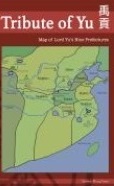
Tribute of Yu

Heavenly Questions
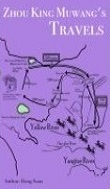
Zhou King Muwang's Travels

The Legends of Mountains & Seas
The Bamboo Annals - Book 1

The Scourge-of-God-Tetralogy:
From the Khitans to the Jurchens & Mongols: A History of Barbarians in Triangle Wars and Quartet Conflicts
(available at iUniverse;
Google;
Amazon;
B&N)
|
|
 This website's contents are the result of 20 years' writings --that could be compared to the "archaeological deposits" in a literary sense.
The freelance-style writings on the website were not proof-read.
Portion of the writings, i.e., related to Pre-History, Xia, Shang, Zhou, Qin, and Han dynasties, was extracted, polished, reconciled, and synthesized into
The Sinitic Civilization - Book I which is
available now on
Barnes & Noble,
Amazon,
Google Play|Books
and
Nook.
Book II is
available now on
Amazon
and Barnes & Noble.
Check out this webmaster's 2nd edition --that realigned Han dynasty's reign years strictly observing the Zhuanxu-li calendar of October of a prior lunar year to September of the following lunar year
and
cleared this webmaster's blind spot on the authenticity of the Qinghua University's Xi Nian bamboo slips as far as Zhou King Xiewang's 21 years of co-existence with Zhou King Pingwang was concerned.
To give the readers a heads-up, this webmaster had thoroughly turned the bricks concerning the Sinitic cosmological, astronomical, astrological, historical, divinatory, and geographical records, with the indisputable discovery
of the fingerprint or footprint of the forger for the 3rd century A.D. book Shang-shu (remotely ancient history),
and
close to 50 fingerprints or footprints of the forger of the contemporary version of The Bamboo Annals --a book that was twice modified and forged after excavation.
All ancient Chinese calendars had been examined, with each and every date as to the ancient thearchs being examined from the perspective how they were forged or made up.
Using the watershed line of Qin Emperor Shihuangdi's book burning to rectify what was the original before the book burning,
this webmaster filtered out what was forged after the book burning of 213 B.C.
This webmaster furthermore filtered out the sophistry and fables that were rampant just prior to the book burning, and validated the history against the oracle bones, bronzeware and bamboo slips.
There are dedicated chapters devoted to interpreting Qu Yuan's poem Asking Heaven, the mythical mountain and sea book Shan Hai Jing, geography book Yu Gong (Lord Yu's Tributes), and Zhou King Muwang's travelogue Mu-tian-zi Zhuan, as well as a comprehensive review of ancient calendars, ancient divination, and ancient geography.
One chapter is focused on the Huns, with a comprehensive overview of the relationship between the Sinitic people and the barbarians since prehistory.
The book has appendices of two calendars: the first Zhuanxu-li anterior quarter remainder calendar (247 B.C.-85 A.D.) of the Qin Empire, as well as a conversion table of the sexagenary years of the virtual Yin-li (Shang dynasty) quarter remainder calendar versus the Gregorian calendar, that covers the years 2698 B.C. to 2018 A.D.
Refer to
Introduction_to_The_Sinitic_Civilization,
Afterword,
Table of Contents - Book I (Index)
and
Table of Contents - Book II (Index)
for details.
This website's contents are the result of 20 years' writings --that could be compared to the "archaeological deposits" in a literary sense.
The freelance-style writings on the website were not proof-read.
Portion of the writings, i.e., related to Pre-History, Xia, Shang, Zhou, Qin, and Han dynasties, was extracted, polished, reconciled, and synthesized into
The Sinitic Civilization - Book I which is
available now on
Barnes & Noble,
Amazon,
Google Play|Books
and
Nook.
Book II is
available now on
Amazon
and Barnes & Noble.
Check out this webmaster's 2nd edition --that realigned Han dynasty's reign years strictly observing the Zhuanxu-li calendar of October of a prior lunar year to September of the following lunar year
and
cleared this webmaster's blind spot on the authenticity of the Qinghua University's Xi Nian bamboo slips as far as Zhou King Xiewang's 21 years of co-existence with Zhou King Pingwang was concerned.
To give the readers a heads-up, this webmaster had thoroughly turned the bricks concerning the Sinitic cosmological, astronomical, astrological, historical, divinatory, and geographical records, with the indisputable discovery
of the fingerprint or footprint of the forger for the 3rd century A.D. book Shang-shu (remotely ancient history),
and
close to 50 fingerprints or footprints of the forger of the contemporary version of The Bamboo Annals --a book that was twice modified and forged after excavation.
All ancient Chinese calendars had been examined, with each and every date as to the ancient thearchs being examined from the perspective how they were forged or made up.
Using the watershed line of Qin Emperor Shihuangdi's book burning to rectify what was the original before the book burning,
this webmaster filtered out what was forged after the book burning of 213 B.C.
This webmaster furthermore filtered out the sophistry and fables that were rampant just prior to the book burning, and validated the history against the oracle bones, bronzeware and bamboo slips.
There are dedicated chapters devoted to interpreting Qu Yuan's poem Asking Heaven, the mythical mountain and sea book Shan Hai Jing, geography book Yu Gong (Lord Yu's Tributes), and Zhou King Muwang's travelogue Mu-tian-zi Zhuan, as well as a comprehensive review of ancient calendars, ancient divination, and ancient geography.
One chapter is focused on the Huns, with a comprehensive overview of the relationship between the Sinitic people and the barbarians since prehistory.
The book has appendices of two calendars: the first Zhuanxu-li anterior quarter remainder calendar (247 B.C.-85 A.D.) of the Qin Empire, as well as a conversion table of the sexagenary years of the virtual Yin-li (Shang dynasty) quarter remainder calendar versus the Gregorian calendar, that covers the years 2698 B.C. to 2018 A.D.
Refer to
Introduction_to_The_Sinitic_Civilization,
Afterword,
Table of Contents - Book I (Index)
and
Table of Contents - Book II (Index)
for details.
|
|
Table of lineages & reign years:
Sovereigns & Thearchs;
Xia-Shang-Zhou dynasties;
Zhou dynasty's vassalage lords;
Lu Principality lords;
Han dynasty's reign years
(Sexagenary year conversion table-2698B.C.-A.D.2018; 247B.C.-A.D.85)
|
Epigraph|Preface|Introduction|T.O.C.|Afterword|Bibliography|References|Index
(available at iUniverse|Google|Amazon|B&N)
|
|
THE JURCHENS & THE MANCHUS
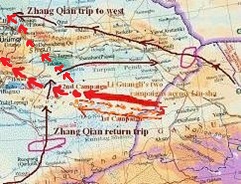 For details on when the east met with the west, see this webmaster's discussion on the Huns, the Yuezhi, the Tarim Mummies, the Yuezhi-Yushi misnomer,
the Mongoloid-Caucasoid admixture at 2000 B.C.E.,
the fallacy of the Aryan bearing of the Chinese civilization,
the fallacy of the Yuezhi jade trade,
the Yuezhi migration timeline,
as well as
the location of the Kunlun Mountain,
Queen Mother of the West,
the legendary book of mountains and seas at the Imperial China blog,
and the Qiang's possible routes of passage into Chinese Turkestan
at
http://www.imperialchina.org/Barbarians.htm which was embedded within the
Huns.html and
Turks_Uygurs.html pages.
(Note that Western Queen Mother had the prototype in an "earth mother" deity, not related to Queen Sheba of Charles Hucker.
The Mt. Kunshan jade was more likely the Mt. Huoshan jade in the Han dynasty book Huai Nan Zi, or the Mt. Yiwulü jade or the Kunlun jade that were juxtaposed together in the same book Huai Nan Zi, not related to Queen Mother of the West.
http://www.sino-platonic.org/complete/spp115_chinese_proto_indo_european.pdf provides another perspective of looking at things of the past from the perspective of language cognates. Rather believing that the Indo-Europeans ever invaded China and gave the Sinitic people the language, we could actually deduce that "Old Chinese", for its 43% correlation with the Proto-North-Caucasian, rather 23% with the Proto-Indo-European, was the source for both the cognates of the Proto-North-Caucasian and the Proto-Indo-European -- with the Proto-North-Caucasian falling under the umbrella of the Dene-Caucasian (Sino-Caucasian) Language Family that encompassed the [Proto-North-]Caucasian, Yeniseian and Sino-Tibetan languages. This is because our cousins, i.e., the N haplogroup people, relocated to North Asia and then to Latvia, Estonia, Finland and Scandinavia, bringing along the Sinitic language to the Proto-North-Caucasian who in turn gave it to the Proto-Indo-European. Note the Sinitic language cognates' 74% correlation with the Proto-Tibeto-Burman who split from the Sinitic people merely 5000-6000 years ago.)
For details on when the east met with the west, see this webmaster's discussion on the Huns, the Yuezhi, the Tarim Mummies, the Yuezhi-Yushi misnomer,
the Mongoloid-Caucasoid admixture at 2000 B.C.E.,
the fallacy of the Aryan bearing of the Chinese civilization,
the fallacy of the Yuezhi jade trade,
the Yuezhi migration timeline,
as well as
the location of the Kunlun Mountain,
Queen Mother of the West,
the legendary book of mountains and seas at the Imperial China blog,
and the Qiang's possible routes of passage into Chinese Turkestan
at
http://www.imperialchina.org/Barbarians.htm which was embedded within the
Huns.html and
Turks_Uygurs.html pages.
(Note that Western Queen Mother had the prototype in an "earth mother" deity, not related to Queen Sheba of Charles Hucker.
The Mt. Kunshan jade was more likely the Mt. Huoshan jade in the Han dynasty book Huai Nan Zi, or the Mt. Yiwulü jade or the Kunlun jade that were juxtaposed together in the same book Huai Nan Zi, not related to Queen Mother of the West.
http://www.sino-platonic.org/complete/spp115_chinese_proto_indo_european.pdf provides another perspective of looking at things of the past from the perspective of language cognates. Rather believing that the Indo-Europeans ever invaded China and gave the Sinitic people the language, we could actually deduce that "Old Chinese", for its 43% correlation with the Proto-North-Caucasian, rather 23% with the Proto-Indo-European, was the source for both the cognates of the Proto-North-Caucasian and the Proto-Indo-European -- with the Proto-North-Caucasian falling under the umbrella of the Dene-Caucasian (Sino-Caucasian) Language Family that encompassed the [Proto-North-]Caucasian, Yeniseian and Sino-Tibetan languages. This is because our cousins, i.e., the N haplogroup people, relocated to North Asia and then to Latvia, Estonia, Finland and Scandinavia, bringing along the Sinitic language to the Proto-North-Caucasian who in turn gave it to the Proto-Indo-European. Note the Sinitic language cognates' 74% correlation with the Proto-Tibeto-Burman who split from the Sinitic people merely 5000-6000 years ago.)
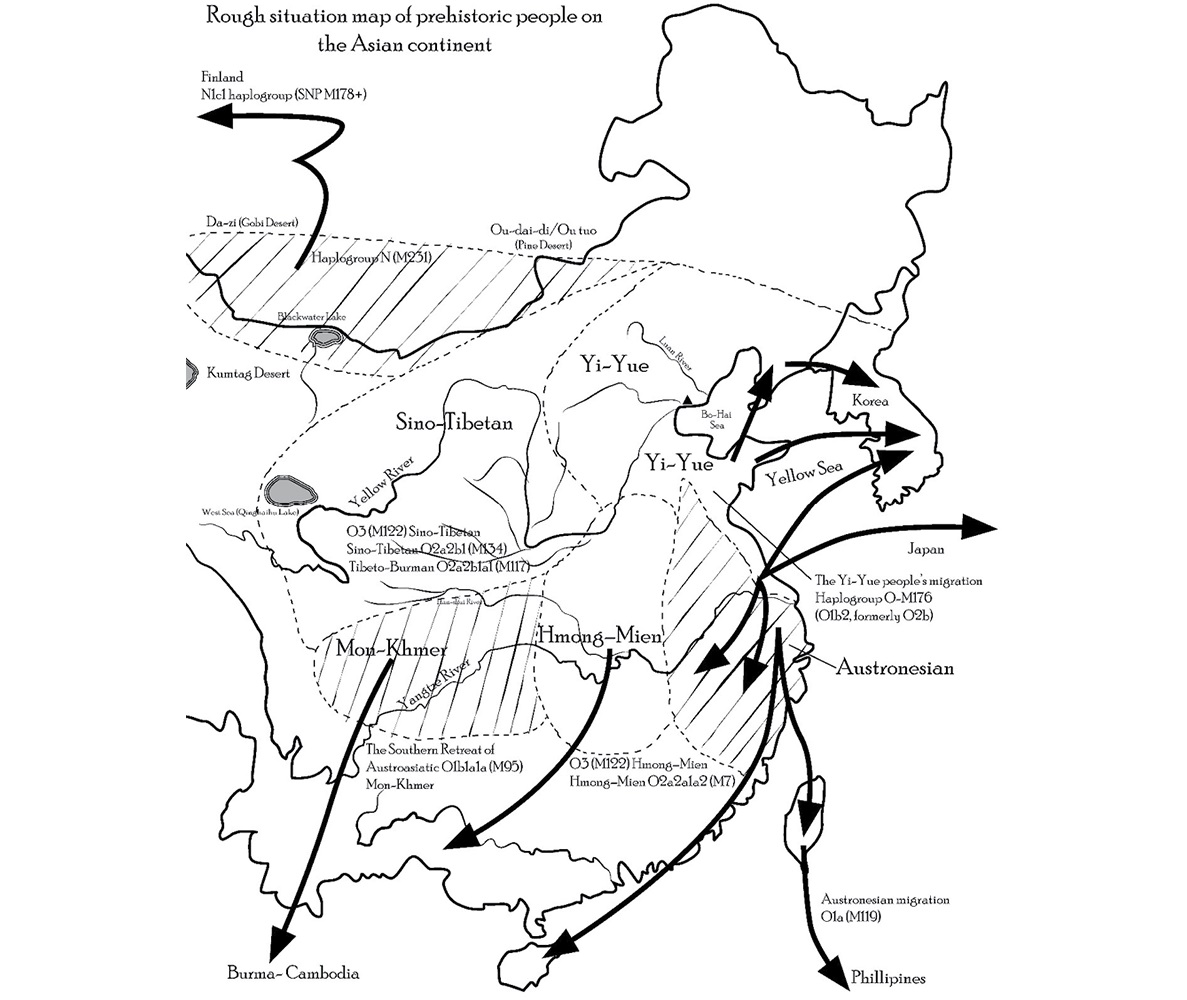
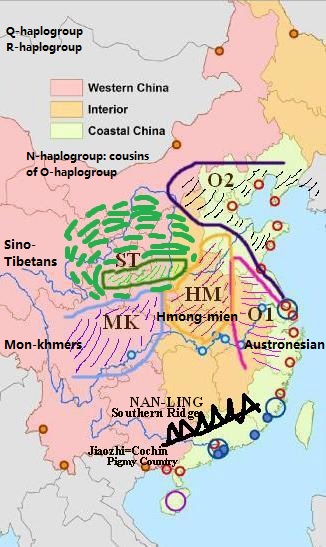
Li Hui of Fudan University of China analyzed the Asian DNAs to have derived a conclusion that ancestors of the [East] Asians possessed a distinctive Mark M89 by the time they arrived in Southeast Asia.
About 30,000 years ago, from the launching pad of Southeast Asia, the early Asians went through a genetic mutation to marker M122.
Li Hui claimed that the early migrants to the Chinese continent took three routes via two entries of today's Yunnan and Guangxi-Guangdong provinces.
More studies done after Li Hui had ascertained the dates of the O1, O2 and O3 haplogroup people, with the (O1, O2) entrants along the Southeast Chinese coast dated to have split away from the O3-haplogroup people like 20,000 years ago, much earlier than the continental peers, i.e., the Sino-Tibetans (O3a3c1-M117), Hmong-Mien (Miao-Yao, O3a3b-M7) and Mon-khmers.
According to
https://www.ncbi.nlm.nih.gov/pmc/articles/PMC5255561/
"Y chromosome suggested Tibeto-Burman populations are an admixture of the northward migrations of East Asian initial settlers with haplogroup D-M175 in the Late Paleolithic age, and the southward Di-Qiang people with dominant haplogroup O3a2c1*-M134 and O3a2c1a-M117 in the Neolithic Age. Haplogroup O3a2c1*-M134 and O3a2c1a-M117 are also characteristic lineages of Han Chinese, comprising 11.4% and 16.3%, respectively. However, another dominant paternal lineage of Han Chinese, haplogroup O3a1c-002611, is found at very low frequencies in Tibeto-Burman populations, suggesting this lineage might not have participated in the formation of Tibeto-Burman populations."
Namely, the haplogroup O3a1c-002611 Sinitic people, not the O3a2c1*-M134 and O3a2c1a-M117 barbarians, were responsible for engendering the Yangshao and Longshan civilization, and partially with the N-haplogroup people, engendering the Hongshan civilization.
The Zhou people were archaeologically speculated to have origin from today's Shanxi for the link to the Guangshe Culture –- which was in turn a derivative of the You'ao-type Laohushan Culture of the mixed N-haplogroup and O-haplogroup people.
(Since the O3a1c-002611 people were separated from the Northwestern cousins and Tibeto-Burmese at an early age, for it to have a part in the history of Northwestern China, the explanation would be to treat the Haplogroup O3a2c1*-M134 and O3a2c1a-M117 people as the historical Qiang and Hu barbarians, with the latter's paleo-Northwestern genes replacing the paleo-North-China and paleo-Central Plains genes of O3a1c-002611 Sinitic people by the Soong dynasty (A.D. 960-1279), that was likely triggered by the multiplication of the Tang dynasty's imperial house that had its origin from the Western Corridor.
The Soong dynasty royals took Tianshui of western China as the ancestral homeland, which was similar to the Tang dynasty royals' origin from the Western Corridor in western China, i.e., the Qin and Zhao states' common ancestral place.
The Soong royal house, however, could be of the Shatuo Turks' Q-haplogroup gene.
Also see this webmaster's discussion on
the ethnic nature of the ancient Huns belonging to part of the epic Jiang-rong human migration
of the Jiang-surnamed San-miao people and Yun-surnamed Xianyun people.)
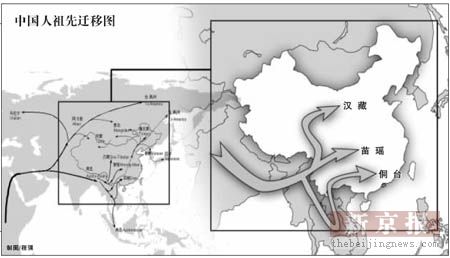 Li Hui commented that one branch of the early Asians, over 10,000 years ago, entered China's southeastern coastline with genetic marker M119. Li Hui, claiming the same ancestry as the Dai-zu and Shui-zu minorities of Southwestern China, firmly believed that his ancestors had dwelled in the Hangzhou Bay and the Yangtze Delta for 7-8 thousand years.
The people with the M119 marker would be the historical "Hundred Yue People".
The interesting theory adopted by Li Hui would be the migration of one branch of people who continued to travel non-stop along the Chinese coastline to reach the Liao-he River area of today's Manchuria.
Li Hui's speculation on basis of the DNA technology was an evolving process.
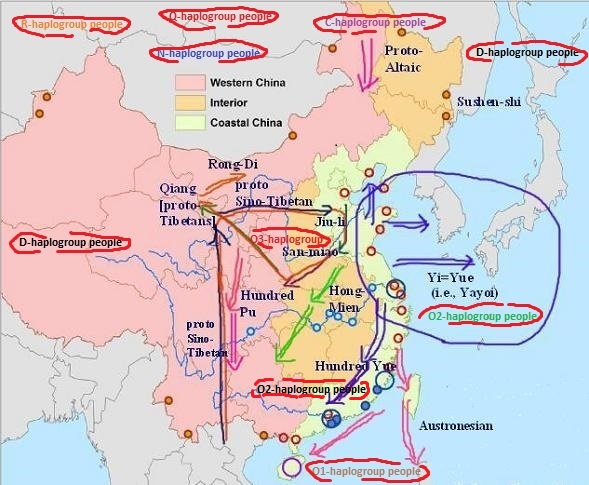
This would be likely the O2-haplogroup people, rather than the C-haplogroup or North Asia people whose historical presence in Asia could be dated 50,000 years ago, just after the earlier D-haplogroup people who were now mostly restricted in the area of Hokkaido, Japan, and known as the Ainu.
The C-haplogroup people developed into what this webmaster called by the Altaic-speaking people,
i.e., ancestors of the Mongols and Manchus.
What likely happened was that the O2-haplogroup people first travelled along the coast to reach Manchuria, and then traced back towards the south to reach the Yangtze area about 7-8000 years ago, where they evicted the O1-haplogroup people to the Southeast Asian islands.
At about the same time, the O3-haplogroup people, moving through the continent, reached today's western Liaoning at least 5000 years ago, or like 11,000 years ago on basis of the evidence of the pottery aging.
See the genetical analysis conducted by Li Hongjie of Jirin University on the remains of prehistoric people extracted from the archaeological sites.
Li Hui commented that one branch of the early Asians, over 10,000 years ago, entered China's southeastern coastline with genetic marker M119. Li Hui, claiming the same ancestry as the Dai-zu and Shui-zu minorities of Southwestern China, firmly believed that his ancestors had dwelled in the Hangzhou Bay and the Yangtze Delta for 7-8 thousand years.
The people with the M119 marker would be the historical "Hundred Yue People".
The interesting theory adopted by Li Hui would be the migration of one branch of people who continued to travel non-stop along the Chinese coastline to reach the Liao-he River area of today's Manchuria.
Li Hui's speculation on basis of the DNA technology was an evolving process.
This would be likely the O2-haplogroup people, rather than the C-haplogroup or North Asia people whose historical presence in Asia could be dated 50,000 years ago, just after the earlier D-haplogroup people who were now mostly restricted in the area of Hokkaido, Japan, and known as the Ainu.
The C-haplogroup people developed into what this webmaster called by the Altaic-speaking people,
i.e., ancestors of the Mongols and Manchus.
What likely happened was that the O2-haplogroup people first travelled along the coast to reach Manchuria, and then traced back towards the south to reach the Yangtze area about 7-8000 years ago, where they evicted the O1-haplogroup people to the Southeast Asian islands.
At about the same time, the O3-haplogroup people, moving through the continent, reached today's western Liaoning at least 5000 years ago, or like 11,000 years ago on basis of the evidence of the pottery aging.
See the genetical analysis conducted by Li Hongjie of Jirin University on the remains of prehistoric people extracted from the archaeological sites.
  Northeast (southeastern Inner Mongolia)
    Niuheliang, Lingyuan, the Hongshan Culture, 5000 YBP,
    4 N, 1 C*, 1 O

  North
   Yuxian County (the Sanguan site), Hebei,
   the Lower Xiajiadian Culture, 3400-3800 YBP, all O3
Combining Li Hui's study with the pottery excavation, we could see a clear path going north extending from around 15,000 years ago to 10,000 years ago.
Refer to Yaroslav V. Kuzmin's discourse on potteries
to see the path of migration of
proto-Mongoloids
from southwestern China (approx. 15,120+/-500 BP) to
Northeast Asia (Manchuria [13,000 BP, or c. 14,000 - 13,600 cal BC] and
Japan [c. 11,800-10,500 cal BC (c. 13,800 - 12,500 cal BP)]) to
Siberia (11,000 BP, or 11,200 - 10,900 cal BC).
In the timeframe of about 10,000 years, developing a genetic mutation to the marker M134, one branch of people who went direct north, per Li Hui, would penetrate the snowy Hengduan Mountains of the Tibetan-Qinghai Plateau to arrive at the area next to the Yellow River bends.
Owning to the cold weather environment, some physique, such as big noses, heavy lips and longer faces, developed among this group of people, i.e., ancestors of the Sino-Tibetans.
Splitting out of the northbound migrants would be those who went to the east with a new genetic marker M117, i.e., ancestors of the modern Han [a misnomer as the proper term should be Sino-Tibetan, nor the later Sinitic] Chinese.
We could say that our Sino-Tibetan ancestors forgot that they had penetrated northward the Hengduan Mountains from the Indo-China "CORRIDOR" in today's Burma-Vietnam.
"Walking down Mt Kunlun", i.e., the "collective memory of the ethnic Han Chinese" throughout China and the Southeast Asian Chinese communities, that was echoed in Guo Xiaochuan's philharmonic-agitated epic, would become the starting point of the eastward migration which our Chinese ancestors remembered.
(Li Hui grouped the 3000-year-old Chu and Qi people in the same category as the Han Chinese, albeit meeting the ancient classics' records as to the Qi statelet's lineage from the Qiangic-Tibetan Fiery Lord.
According to
https://onlinelibrary.wiley.com/doi/full/10.1111/j.1759-6831.2012.00244.x
"the frequencies of the three main subhaplogroups of O3-M122: O3a1c-002611, O3a2c1*-M134, and O3a2c1a-M117 in Han Chinese are 16.9%, 11.4%, and 16.3%, respectively (Yan et al., 2011).
The northward migration of haplogroup O3a1c-002611 started about 13 thousand years ago (KYA). The expansions of subclades F11 and F238 in ancient Han Chinese began about 5 and 7 KYA immediately after the separation between the ancestors of the Han Chinese and Tibeto-Burman.
Haplogroup O3a1c-002611 and O3a1c1-F11 started their northward migration about 12 KYA from Southeast Asia, along with other O3-M122 lineages, and reached the upper and middle Yellow River basin. About 7 KYA, haplogroup O3a1c2-F238 originated in the ancestors of modern Sino-Tibetan populations. About 6 KYA, the Han Chinese split from the Proto-Sino-Tibetan, and started their migration to the east and south (Su et al., 2000b). About 5 KYA, haplogroup O3a1c1-F11 experienced rapid expansion, probably in the Eastern Han Chinese, with recent gene flow with surrounding populations and eventually became prevalent in different ethnic groups in East Asia.)
Li Hui then pointed out that the ancient Wu people, with M7 genetic marker, came to the lower Yangtze area about 3000 years ago.
While Li Hui claimed that the M7 Wu people had split away from the northbound M134 Sino-Tibetan people, the historical Chinese classics pointed out that the Wu Statelet was established by two uncles of Zhou Dynasty King Wenwang, i.e., migrants from the Yellow River area.
The general layout by Lu Hui seems to have corroborated with Scholar Luo Xianglin's claim that early Sino-Tibetan people originated from the Mt Minshan and upper-stream River Min-jiang areas of today's Sichuan-Gansu provincial borderline and then split into two groups, with one going north to reach the Wei-shui River and upperstream Han-shui River of Shenxi Province and then eastward to Shanxi Province by crossing the Yellow River.
--Though, this webmaster's analysis of China's prehistory shows that the Sino-Tibetan people who moved to the eastern coast was one group, with the future Tibetans being actually the exiles to Northwest China from eastern and central China during the era of Lord Shun. Namely, the split of the Sinitic and proto-Tibetan people occurred prior and during the exile in the late 3rd millennium B.C.E.
(George Driem proposed that the Sino-Tibetans had splitoffs like the Western Tibeto-Burmans and the Eastern Tibeto-Burmans, with the Eastern Tibeto-Burmans forming two groups of northern and southern, who in turn split into the Northwestern Tibeto-Burmans, the Northeastern Tibeto-Burmans, the Southwestern Tibeto-Burmans, and the Southeastern Tibeto-Burmans, with a claim that the western offshoots went all the way to the Kashmir before returning east along the northern slope of the Himalayas to have a reunion with their cousins and that the Northeastern Tibeto-Burmans were the Sinitic people.)
What Li Hui did not touch on in his earliest studies were the cousin tribes of the Sino-Tibetans, namely, the Hmong-miens and Mon-khmers.
As noted at http://www.ncbi.nlm.nih.gov/pmc/articles/PMC3164178/, "A clear hierarchical structure (annual ring shape) emerged in the network of O3a3b-M7 (Fig. 2B), in which MK (Mon-Khmers) haplotypes lay at the center of the network (immediately next to the origin), HM (Hmong-Mien) haplotypes were distributed at the periphery to the MK haplotypes, and the ST (here the subfamily Tibeto-Burman) haplotypes were only found further away from the origin."
|
|
* In Commemoration of China's Fall under the Alien Conquests in A.D. 1279,
A.D. 1644 & A.D. 1949 *
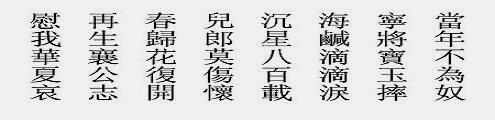 U.S.S.R./Comintern Alliance with the KMT & CCP (1923-1927)
 Korean/Chinese Communists & the 1931 Japanese Invasion of Manchuria Korean/Chinese Communists & the 1931 Japanese Invasion of Manchuria
American Involvement in China: Soviet Operation Snow, IPR Conspiracy, Dixie Mission, Stilwell
Incident, O.S.S. Scheme, Coalition Government Crap, Amerasia Case & The China White Paper
* Stay tuned for "Republican China 1911-1955: A Complete Untold History" *
|
|
Zou Rong's Revolutionary Army;
Shin Kyu Sik's
Shrine (Spirit, Kunitama) of Korea
|
This snippet is for sons and daughters of China:
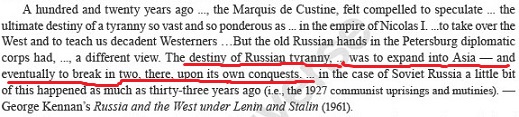
Heed the sons & ministers' agony and sorrow of our ancestors who died or lived through the Mongol, Manchu and Soviet-Chicom conquest
and
the Yongjia, Jingkang and Jiashen cataclysms !
Jeanne d'Arc of China:
Teenager girl Xun Guan breaking out of the Wancheng city to borrow the relief troops in the late Western Jinn dynasty;
Liu-Shao-shi riding into the barbarian army to rescue her husband in the late Western Jinn dynasty;
teenager girl Shen Yunying breaking into Zhang Xianzhong's rebels on the horseback to avenge on father's death in the late Ming dynasty.
China's Solitary and Lone Heroes:
Nan Jiyun breaking out of the Suiyang siege and charging back into the city in the Tang dynasty;
Zhang Gui & Zhang Shun Brothers breaking through the Mongol siege of Xiangyang in the Southern Soong dynasty;
Liu Tiejun breaking through three communist field armies' siege of Kaifeng in the Republican China time period;
Zhang Jian's lone confrontation against the communist army during the June 3rd & 4th Massacre of 1989.
|
|
|
|
There is a need to make a distinction between the Jurchens and the Manchus.
The royal family of the Jurchens could be different from the Jurchens that they ruled.
The history annals pointed out that the Jurchen founders came from the Korean peninsula, namely, different from the Jurchen natives in Manchuria.
According to Meng-da Bei Lu, the Jurchens and the Dadan [i.e., the Mongols], whose C haplogroup gene was validated today, were of the same family, with the distinction made for the Dadan people due to their civilized levels.
Those near the Chinese were called by cooked, those faraway called raw, and among the raw, there were two groups of black and white, black meaning the extreme uncivilized and the white meaning somewhat civilized. Genghis Khan's Mongols, according to the book, belonged to the Black Dadan, whose barbarity was exhibited in its customs of having each horseman round up ten non-Mongol villagers as fodder to fill moats and sack forts, while the Jurchens belonged to the White Dadan. The Dadan, according to the Chinese classics, could have some ingredients from the Shatuo Turks of the Tang Dynasty period.
Now, the Jurchens, when they were overrun by the Mongols, had been decimated.
The later Manchus could have nothing to do with the Jurchens, at most hijacking the Jurchen name.
The Manchu clan names bore no resemblance to the Jurchen clan names, such as the royal Wanyan name.
The purported Manchu founder Nuerhachi's six-generation ancestor carried the Mongol name 'Mengge-timuer'.
According to Korean book Lee Dynasty's factual Records, the Manchus disclosed to the Korean emissary that they belonged to the Mongol stock.
In A.D. 1635, Huang-tai-ji prohibited the people from calling the Manchus by the Jurchens (i.e., 'Zhu-shen').
The 'Qing' dynasty's name purportedly meant 'brave' in the Mongol language.
The fellow tribesmen that the Manchus acknowledged to be their own included Manzhou (Jianzhou), Hada, Wula, Huifa, and Yehe.
According to Lü Simian's analysis, the two characters 'Manzhou' (with the water sign to mean a midstream island or continent) for the Manchus derived from the 'Man-zhu' which was a Manchu chieftain's declension for self like what the word Malgal was for, with a conclusion that the Jurchens in Manchuria never changed their name for thousands of years since the Su-shen time of the Zhou dynasty but were given alternative names of 'Yi-lou' (cave dwelling) and 'Man-zhu' or Mohe (Malgal) for the chieftains' declension.
(The presently dominant C haplogroup people in southwestern Siberia, i.e., the Mongols, were ascertained to be of the C2b1b1-F3796 type. The Manchus, a northern C2b branch that separated from the former about 3000 years ago, carried the rare C2b1b2a-F14751 gene.
As to the C haplogroup barbarians in western Siberia 4000 years ago, they were found with a minor presence in the bronze sites and carried the C41a genes while their closest relatives, like C4a2, C4a3, were seen moving on to today's Ukraine.
Note that the majority stock of the Huns, the Xianbei, and the Khitans were ascertained by Jirin University frontier people research institute to be of the same 'North Asia' or paleo-Siberia stock.
The physical anthropology studies of the Khitan tomb remains showed that the Khitans belonged to the "North Asia" or the "Siberia-Baikal" type with a low cranial forehead and a higher facial appearance, i.e., people who had no similarity to the East Asia type people.
Note that there existed the
fundamental difference in cranial length, width and height among the East Asian population and
the paleo-Siberia/paleo-Mongolian-Plateau population, that could be 181 millimeters versus 175, 138
versus 144, and 134 versus 127, respectively.)
|
|
In Chinese history, the people in today's Manchuria were classified into the "Anterior Jurchens" and the "Posterior Jurchens". The "Anterior Jurchens" would be a group of people who defeated the Khitans' Liao Dynasty
(A.D. 907-1125), and set up the Jin [Gold] Dynasty (A.D. 1115-1234) that lasted 119-120 years in northern China.
The "Posterior Jurchens" were the name first adopted by the Manchus when they rebelled against the Chinese Ming dynasty's rule. They renamed themselves the Manchu (Man-zhou, with the three dot 'zhou' meaning a continent or an island in the river, which was an absurd usage of a Chinese character) in the early 17th century.
In the Turk & Uygur section, this webmaster mentioned that Jian Bozan, a writer who committed suicide during the Cultural Revolution, happened to be an ethnic Uygur from Hunan Province. Another writer, Lao She [i.e., the elder She], who also committed suicide during the Cultural Revolution, was an ethnic Manchu.
The Chinese records categorically said that "the ancestry of the Manchus can be traced back more than 2,000 years to the Sushen tribe, and later to the Yilou, Wuji [commonly mispronounced as Huji], Mohe [Malgal] and Ruzhen (Nüzhen, Nüzhi) tribes native to the Changbaishan Mountains and the drainage area of the Heilongjiang River in northeast China." Here, the name Sushen would be used during the Zhou Dynasty time period, Yilou during the early Han Dynasty time period, Wuji during Toba's Northern Wei Dynasty, Mohe (Malgal) during Sui Dynasty, Bohai (Palhae) during Tang Dynasty, and Ruzhen (Nüzhen, Nüzhi) during Soong Dynasty.
This was of course after hundreds of years of mixing-up or confrontation between the original inhabitants of Su-shen (Yilou) and the invaders such as the Mo (He) & Hui, Fuyu and Xianbei people.
Not to mention the Han Dynasty's establishment of four commanderies extending from today's southern Manchuria to the northern and central Korean peninsula, with the Sinitic Chinese influence cut short by the deportation in A.D. 238 of 40,000 households of the Sinitic Chinese or over 300,000 people back to North China, yielding the area to the Tungusic people (i.e., the Xianbei and Wuhuan) and the Fuyu people (including Koguryo & Paekche).
The deportation was repeated in the late time period of Ming Dynasty, when border general Li Chengliang dismantled the six garrison towns in southeastern Manchuria, yielding the area to the Manchu control.
--The Chinese way to tell the continuity of people in one area was unscientific: Sushen-shi was recorded to have sent in bows and arrows using the stone arrowheads and promenade arrow-shafts during the 25th reign of Lord Shun [reign 2257 - 2208 B.C.E.; reign 2044-2006 with rule of 39 years and life of 100 years per Zhu Yongtang's adjustment of The Bamboo Annals {which might have its pre-Xia records on the ancient sovereigns inserted by the latter-day people}]. When Marquis Chen-guo asked about a fallen eagle with a stone arrowhead, Confucius reminded the marquis of an early record on the history book, which stated that the Sushen-shi people had sent in some arrow tributes to Zhou King Wuwang who subsequently inscribed the Sushen-shi characters and allocated to various vassals as gift. Marquis Chen-guo did locate the ancient arrow in the royal storage and found it to be true. This was similar to The Analects' stories in which Confucius was often consulted by the kings and dukes for deciphering the strange animals and people, such as 'qilin' [giraffe] and the long-leg people. Sushen-shi, living in today's Manchuria bordering the Japan Sea, had sent in tributes after Zhou King Wuwang built roads leading to the four barbarians' direction.
(The Analects carried stories similar to Guo Yu, a book containing sophistry talks, precursor to Zhan Guo Ce. The Guo Yu story about the Wu king consulting with Confucius about the long-leg story was a forgery as Confucius was on exile during the Wu-Yue war. The passage about Lord Shun's receiving the Su-shen-shi tribute in The Bamboo Annals could be a later insertion as the Jinn dynasty scholars, after the excavation of the said book, commented that it had the history from the Xia dynasty downward, not before the Xia dynasty.)
Origin Of the Jurchens
The Jurchens were said to be a group of people who lived in today's Manchuria for many centuries and the tribal name was known since the 7th century according to some historical record. The book History of the Jurchen Jin Dynasty, written by Yuan's Prime Minister Toktoghan (Tuo-tuo), recorded that the ancestors of the Jurchens were from the tribe called Wuji or the Mohe (Malgal), located in the land of the ancient state of Sushen bordering the Japan Sea.
Sushen-shi, Gu-zhu, Ji-zi Chaoxian, "Mo", "Hui", Dong-hu & the [Misnomer] Dong-yi (Eastern Yi) Barbarians
This webmaster mentioned the Sushen State in the Korean section. The Sushen Statelet first submitted their renowned arrows and bows to Lord Shun during the 25th reign of Lord Shun (reign 2257-2208 BC ?) per the forgery bamboo annals. Also note that the stone arrows were often used on the American continents. Sushen continued to pay pilgrimage to the Zhou Dynasty later. Sushen renewed the tribute in the Cao Wei dynasty of the Three Kingdom era.
Also on record would be a statelet called Guzhu (i.e., lonely bamboo) in southern Manchuria, i.e., a Shang Dynasty vassal. It was said that Zhou Dynasty founder, Ji Chang, managed his statelet so well that the old people went there for retirement, and two princes of the Guzhu Statelet (i.e., the Mo-tai-shi clan), Bo-yi and Shu-qi, came to live in the Zhou land.
After the demise of the Shang Dynasty, Ji-zi, a Shang Dynasty prince who had his Shang-conferred fief at Ji (Taigu, Shanxi; or the ancient Yangyi, near Taiyuan), departed for the land of the east [possibly a destination on the Shandong peninsula, called the 'Ming-yi' [bright Yi or sunny Yi] land, and then a cross-sea trip to either today's southern Manchuria or northern Korea] that came to be known as "Chao-xian [Korea]" in the ancient classics of Shan Hai Jing (The Legends of Mountains and Seas).
Ji-zi, after declining Zhou King Wuwang's invitation, was said to have fled to the land to the east, where he practiced the eight clauses of administration.
The forgery contemporary version of The Bamboo Annals claimed that 'fu-shi' [fatherly imperial tutor], i.e., Ji-zi, had taken over the Gu-zhu [lonely bamboo] land to be king among the Yi [barbarian] people. (Tang Dynasty emperor Gaozu later named the Khitan Liao land as the 'Ji[1]-zhou' prefecture.)
Ji-zi ('tai shi'), together with Wei-zi and Bi-gan ('shao shi'), were touted as three Shang saints by Confucius in the Wei Zi section of The Analects, i.e., a post-Confucius forgery which inadvertently applied the non-Shang titular titles of imperial tutors like 'tai shi' and 'shao shi'.
No matter how the Shang Dynasty exodus took place to reach Korea or today's Manchuria, Shang Prince Ji-zi of the 11th century B.C.E. and the Chaoxian (Korea) designation of the 4th century B.C.E. apparently all belonged to the Sinitic family, as all available ancient Korean words as recorded in the book Fang Yan (i.e., Dialects) by Western Han Dynasty minister Yang Xiong, all appeared to be one syllable characters, none like multi-syllables as today's Tungusic or Korean languages are.
According to Yu Gong, a Zhou Dynasty book about the tributes to the nation's capital, today's Liao-dong Peninsula was a Sinitic civilization world, with the established cross-sea trade route
Yu Gong, which was precise in making the distinction among the Yi people, listed the Dao-yi (island Yi) in the ancient Ji-zhou prefecture [who came from today's Liaodong Peninsula by sea, using the Jie-shi mountain around today's Mountain and Sea Pass as the beacon tower equivalent, and sailed into the ancient Yellow River for surrendering tributes], the Yu-yi [sea corner Yi] and Lai-yi [the Laizhou prefecture Yi] in the ancient Qing-zhou prefecture, the Huai-yi [the Huai-shui River Yi] in the ancient Xu-zhou prefecture, the Niao-yi -bird totem Yi] in the ancient Yang-zhou prefecture, plus the He-yi in the ancient Liang-zhou prefecture.
(Note that the ancient book Yu Gong made a difference between the Dao-yi and Niao-yi while the two characters later corrupted into each other to mean the wrong Yi group, i.e., the island Yi in today's southeastern Manchuria being swapped to be the bird totem Yi in the Yangtze River area.)
Interspersed among the major groups of people of Sushen (Yilou), Dong-hu and Ji-zi Chaoxian (Korea) were numerous "Mo" ("He") people and "Hui[4]" people.
Those groups of people were later treated to be the same as Fuyu.
According to Chen Shou, Fuyu (Puyo or Puyeo) had 80,000 households. Fuyu shared the same customs as the Huns on the matter of taking over the concubines of late father or late brothers.
Fuyu, part of the ancient "Mo" and "He" people who could have lived in today's northern Shanxi Province and Inner Mongolia, had moved into Manchuria under the pressure of the ancient "Xianyun" [i.e., predecessors of the Huns] according to classics Shi Jing. Fuyu was speculated to be the ancient Bai-min [white clothing people] or the ancient Fa-ren [hair people].
In light of the eastern migration, Fuyu might not be of the same people as the original natives of Manchuria, such as the Su-shen-shi people bordering the Japan Sea. --The possible explanation was that the so-called Mo-hui people were a combination of the Mo [He] people from today's Inner Mongolia and the Hui[4] people who were speculated to have been pressured into a move into today's Manchuria [from the Shandong peninsula and North China] when the Zhou people overthrew Shang Dynasty, a claim that would equate the "Hui" people to belonging to the same category as Shang Dynasty Prince Ji-zi's exodus.
Somewhere near today's Yexian County, where the ancient Yellow River turned north to merge with the Zhang-he [Zhuo-zhang-shui] River before continuing north to flow into the Hu-he and Hutuo-he rivers, there was a place known as Ji-mo [sacrifice for the elder uncle], where Ximen Bao of the Wei Principality had at one time stopped the sacrifice of virgin girls by throwing a sorceress and her accomplices into the water.
The sacrifice of virgin girls, 'niu2 [sinking] bi4 [favorite concubine]' on the Oracle bones, was ascertained to be a Shang Dynasty practice for pacifying the Yellow River flooding.
Here, it was deduced that the 'bo' [elder uncle] character had corrupted into the 'mo' character in 'Ji-mo', which was the name used for designating the Hui-Mo group of migrants into the Korean peninsula.
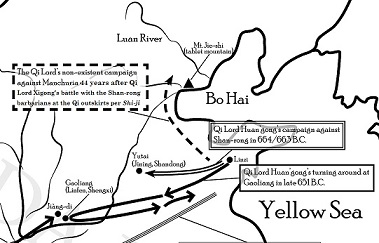 By the time of the Spring and Autumn time period of Zhou Dynasty, the northern or northeastern barbarians who were closer to the Sinitic Chinese would be called by Shan-rong or the Mountain Rongs (aka Beirong or Wuzhong) and by the Chi-di [Red Di], Bai-di (White Di) and Chang-di (long-leg Di), about the area of today's central and southeastern Shanxi, Shanxi-Hebei border area, the Western Hill areas to the west of Peking, and the Jehol mountains - which was termed the You-yi-shi land during the Xia dynasty time period.
Sima Qian, in the perspective of the Han Emperor Wudi's invasion of Korea and extrapolating on the then-layout of the barbarians by 600-700 years backward, claimed that the Mountain Rongs, at one time, like 55 years after Zhou Ping Pingwang's eastward relocation of the capital city, went across the Yan Principality to attack the Qi Principality in today's Shandong Province; 44 years after that, they attacked Yan again; the Yan-Qi joint armies, under the command of Qi Counsellor Guan Zhong, Marquis Qi Huan'gong, and Count Yan, drove them out and moreover penetrated into the Rong land. Sima Qian, without distinction between the North Yan and South Yan states, claimed that the Yan-Qi joint armies destroyed the Mountain Rong Statelet as well as the Guzhu Statelet.
By the time of the Spring and Autumn time period of Zhou Dynasty, the northern or northeastern barbarians who were closer to the Sinitic Chinese would be called by Shan-rong or the Mountain Rongs (aka Beirong or Wuzhong) and by the Chi-di [Red Di], Bai-di (White Di) and Chang-di (long-leg Di), about the area of today's central and southeastern Shanxi, Shanxi-Hebei border area, the Western Hill areas to the west of Peking, and the Jehol mountains - which was termed the You-yi-shi land during the Xia dynasty time period.
Sima Qian, in the perspective of the Han Emperor Wudi's invasion of Korea and extrapolating on the then-layout of the barbarians by 600-700 years backward, claimed that the Mountain Rongs, at one time, like 55 years after Zhou Ping Pingwang's eastward relocation of the capital city, went across the Yan Principality to attack the Qi Principality in today's Shandong Province; 44 years after that, they attacked Yan again; the Yan-Qi joint armies, under the command of Qi Counsellor Guan Zhong, Marquis Qi Huan'gong, and Count Yan, drove them out and moreover penetrated into the Rong land. Sima Qian, without distinction between the North Yan and South Yan states, claimed that the Yan-Qi joint armies destroyed the Mountain Rong Statelet as well as the Guzhu Statelet.
The sensational northern campaign by Qi Lord Huan'gong could never have happened, nor the sensational southern invasion of the Shandong peninsula by the Mountain Rong barbarians 55 years after the Zhou dynasty's relocation of the capital city to Luoyang. Lu Lord Huan'gong, in 710 B.C., visited the Tang-di (Yutai, Shandong) place to have a summit with the Rong barbarians who could be the later so-called Bei-rong or Northern Rong barbarians, namely, some group of the barbarians whom Sima Qian, 600-700 years later, extrapolated to mean the Guzhu, Lingzhi and Hui-he barbarians in today's southern Manchuria.
That is, a different time and a different space.
(The geography of the You-yi-shi land could be a dispute, as well as the geography of the Yan state.
The Yan state, which was commonly taken to be located in Jixian County, Tianjin, Hebei Province, could be wrong as the archaeological excavation showed that the Yan state might have originally established itself along the Liuli-he River for the first part of the Zhou dynasty, southwest of today's Peking, while the Jixian area was constantly referred to as the country of Viscount Wuzhong-zi. The relative locality of both the Yan state and the Wuzhong state could be a puzzle as the Wuzhong state was more likely in today's central Shanxi [before it was pushed north to let's say Yuyang or Jixian during the early Eastern Zhou Dynasty time period while the Yan state might have relocated southward to today's Baiyangdian Lake area during the same time period. Note that in this area, King Wuwang initially conferred the descendant of Lord Yao the Ji fief [later Jizhou prefecture, a statelet to the southwest of today's Peking as well as the abbreviation for the Hebei province], which was taken over by the Yan later.
During the Han dynasty, scholars could have recompiled the book Guan Zi.
In Guan Zi, there was a wild assertion to the effect of the Qi army had skirted the Jinn Principality's land to reach the Yellow River inflexion area to conquer the barbarians in the 'da-xia' [grand Xia] land, coined with the phrases of crossing the 'liu sha' [quick sand] and climbing the 'bei-er' [?Zhongtiao] mountain.)
During the Warring States time period, the barbarians in the same area came to be known as Dong-Hu or the Eastern Hu people. A Yan Principality General, by the name of Qin Kai, after returning from Donghu as a hostage, attacked Donghu and drive them away for 1000 li distance, and further attacked Ji-zi Chaoxian (Korea), extending the control to the Jeanyeong or Zaining-jiang River of Korea. Yan built the Great Wall [which preceded the great walls built by the succeeding Chinese dynasties, all the way to Ming Dynasty] and set up the Shanggu, Yuyang, You-beiping, Liaoxi and Liaodong prefectures. The Sushen tribe was then known as Yilou.
(The Chinese history recorded succeeding names like Wuji , Mohe, Bohai and Nüzhen (Nüzhi) tribes in the same area.)
Hence, in today's southern Manchuria and northern Korea, major identifiable groups of people included the Sushen people at the Japan Sea, the Fu-yu people interspersed in-between, the Ji-zi Chaoxian Koreans to the south, and the Dong-hu to the west.
Chen Shou said the people of Yilou, who were speculated to be Tungusic, looked similar to Koguryo and Fuyu, but the language differed from each other.
Fuyu (Puyo or Puyeo) and the Koguryo people, i.e., more likely of the Mo people family, shared the same language.
Chen Shou recorded that the Fuyu (Puyo or Puyeo) and Koguryo people shared the same language, but had different styles of clothing and temperament.
Eastern Woju, which was near today's Tumen River estuary, was said to have the similar language as Koguryo.
(The Shiwei people shared the same language as the Wuji people. They dwelled in the upper Heilongjiang River.)
In the 2nd century, Yilou had to submit tributes to Koguryo in addition to Fuyu. In the early 3rd century, Yilou resisted the rule of Fuyu. Yilou, which submitted tribute to Wei China in A.D. 236 and 262, was attacked by Koguryo in A.D. 280 as punishment for robbing the Koguryo people at the border, enjoyed a time of relative independence after Koguryo suffered defeat in the hands of Paekche, but was attacked again by the revived Koguryo in A.D. 398. Riding on ships, the Yilou people often pirate-attacked Bei-woju (the northern Woju) which was located in the land between today's Vladivostok and the Tumen Rivermouth.
After a couple hundreds of years, the native Yilou people apparently mixed up with the migrant Fuyu people [i.e., what Egami meant by the horse-riding invaders against Japan] to transform into the later Jurchen or Manchu people.
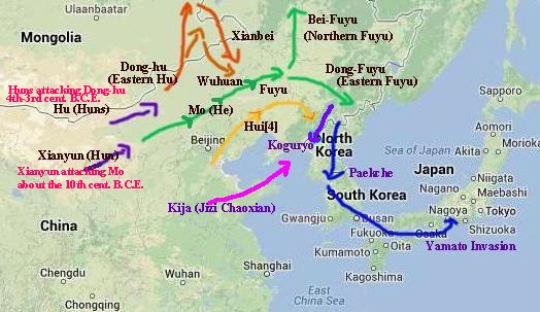
More about Sushen-shi, Gu-zhu, Ji-zi Chaoxian, "Mo", "Hui", Dong-hu is available at imperialchina.org/Koreans.html
Donghu: Wuhuan & Xianbei
The Jurchens were said to be related to the Tungus. The Xianbei-Wuhuan, who were said to be of the Tungus stock, were driven to the Xianbei and Wuhuan Mountains after they accused the first Hunnic king Mote (Modu) of patricide.
They were later relocated to today's Liaoning Province, i.e., southern Manchuria, by Han Emperor Wudi for sake of segregation from the Huns. Hence, they were called the Donghu or Eastern Hu barbarians, inheriting an old tribal name that long existed in the Zhou times. The important thing to be noted about the earlier Huns or the Donghu (i.e., the Xianbei-Wuhuan) will be that they were living alongside the Chinese for hundreds of years and should be deemed semi-Sinicized and semi-civilized. The later Khitans or the Jurchens or the Mongols fared much worse as ate raw meat and did not know how to count their ages.
After the Hunnic decline in late first century A.D., the Xianbei expanded west. The Xianbei mixed up with the Huns. The Hunnic Xia Dynasty, established by Helian Bobo, was said to be of a mingle nature, called 'Tie Fu'. The Tie Fu Huns were born of Xianbei mothers and Hunnic fathers. There appeared a Xianbei chieftain called Tanshikui (reign A.D. 156-181) who established a Xianbei alliance by absorbing dozens of thousands of the Huns. The Tanshikui alliance disintegrated after the death of Tanshikui. Another chieftain called Kebi'neng emerged. Warlord Yuan Shao campaigned against the Wuhuans and controlled three prefectures of the Wuhuans.
In 207, Cao Cao, who controlled the last Han Dynasty emperor, launched a punitive campaign against the Wuhuan people. Exiting the Lulongsai Pass and trekking deep into the southern Manchuria mountains, Cao Cao's army penetrated to Liucheng (today's Chaoyang), i.e., Wuhuan's home base in today's southern Manchuria.
At the Battle of Bailangshan (white wolf mountain), Cao Cao defeated Wuhuan chieftain Tate (Tadu, Tadun). Over 10,000 Wuhuan households under Yan Rou relocated to China under the order of Cao Cao. The Wuhuan people, with the three prefectures' equivalent of cavalry force, served Cao Cao as the mercenaries.
Ts'ao Wei Dynasty broke a new Xianbei alliance by sending an assassin to killing chieftain Kebi'neng.
Following the destruction of Wuhuan, Sima Yi, in the name of Cao Wei Dynasty, penetrated further into today's Manchuria.
Sima Yi exterminated the Gongsun Family who ruled southern Manchuria and northern/central Koreas for almost half a century, massacred thousands of the Gongsun regime's officials and officers as well as the able-bodied men, and in A.D. 238 deported 40,000 households of the Sinitic Chinese or over 300,000 people back to North China from Manchuria, yielding the area to the Tungusic people (i.e., the Xianbei and Wuhuan) and the Fuyu people (including Koguryo & Paekche).
(A repeat of history: In the late time period of Ming Dynasty, border general Li Chengliang dismantled the six garrison towns in southeastern Manchuria, which were linked by beacon towers and the great walls on the mountain ridges, and forcefully deported hundreds of thousands of the Sinitic Chinese to North China, yielding the area to the Manchu control.)
Among the Xianbei who were to take the place of the Wuhuan to dominate the area would be
the clans of
Duan, Murong and Yuwen.
The Xianbei, with major tribes of Murong, Yuwen, Duan, established many short-lived successive states in North China and along the Chinese frontiers. Among these states was that of the Tuoba or Toba (T'o-pa in Wade-Giles), a subgroup of the Xianbei, in modern China's Shanxi Province.
Wuji & Mohe
During Toba Wei Dynasty, the Mohe (Malgal) was renamed to the old name of Wuji .
At the times of Toba Wei Dynasty, Wuji possessed altogether seven tribes.
The Wuji people then were called by the Malgals during Sui Dynasty, who were very much a mixed-up people by that time.
By Tang Dynasty, two tribes, i.e., Heishui (black water) and Sumuo, were known.
Sumuo, one of the Wuji tribes, sought protection with Koguryo, and after Koguryo's demise in the hands of Tang, became independent and established the State of Bo-hai (Po'hai) (Palhae) around the Dongmoushan Mountains. Po'hai continued for a dozen generations till it was destroyed by the Khitans. Note Bohai (Po'hai) was recorded to have possessed a written language, the music and rituals, a government with systems. It possessed five big cities, fifteen prefectures and sixty-two zhou (lesser prefectures).
During the second year of Tang Emperor Taizong, A.D. 628, the Wuji land was made into the Yanzhou Prefecture. The Wuji tribes joined Koguryo in resisting Tang Dynasty. During the tenth year of the Kaiyuan Era, A.D. 722, Tang Emperor Xuanzhong set up Heishui-fu or the Blackwater Governor office in the Wuji land.
The Heishui [Blackwater] Mohe (Malgal) dwelled in the old land of Sushen.
The Blackwater Tribe, who dwelled in the ancient Sushen land, also sought protection with Koguryo, and at one time, sent 150,000 troops to fight against the Tang army on behalf of Koguryo. They were defeated by Tang in a place called An'shi. In the Kaiyuan Era of Tang Dynasty, the Blackwater Tribe came to pay pilgrimage to Tang and its land was made into Heishui-fu (i.e., the Blackwater Governor Office) and its tribal chieftain was conferred the title of 'dudu' or governor-general. The Blackwater Tribe was given the Tang family name of 'Li'. After Po'hai became a strong power, this tribe became subordinate to the Sumuo Tribe.
The Shiwei people, i.e., the future Mongols under Genghis Khan, shared the same language as the Wuji people. They dwelled in the upper Heilongjiang River.
The location of the Shi-wei was to the east of the Turks, the west of the Wuji, and the north of the Khitans. They were connected with Koguryo in the south, around today's Changbaishan Mountains as well as with the Shiwei in the north.
Part of the Fuyu people had dwelled next to the Shi-wei people along the Amur River.
In the early times, Fuyu split into two parts, i.e., North Fuyu and East Fuyu, with the founder of East Fuyu moving to the northeastern coast of the Korean peninsula. Later, in A.D. 723, Da-mo-lou, i.e., a descendant of North Fuyu which was destroyed by Koguryo, came to Tang Dynasty together with the Shi-wei tribe of Dagou (Dadu). History stated that Da-mo-lou dwelled near the Du-na River which flew into the Amur River towards the northeastern direction.
Successors Of the Xianbei-Wuhuan-Tuoba
After the Xianbei-Wuhuan-Tuoba disappeared into China's melting pot during the 16 Nations time period (A.D. 304-420), the newcomers from the northern hemisphere, together with the remaining Tungusic people, would be occupying the eastern part of today's Mongolia and Manchuria.
In A.D. 443, the barbarians who took over Tuoba's old territories, i.e., the upper Heilongjiang River and northern Xing'an Ridge, came to see Tuoba Wei Emperor (Tuoba Tao) and told him that they found the Tuoba ancestor's stone house, called by 'Ga Xian Dong'. Tuoba Tao sent a minister called Li Chang to the stone house which was carved out of a natural cavern. In the 1980s, this cavern was discovered as well as the inscription left by Li Chang.
The people who dwelled in the old Xianbei-Wuhuan-Tuoba territories would be the later Shiwei Tribes (ancestors of the Mengwu Shiwei or Genghis Mongols), the Khitans, the Xi nomads, and the Mohe people et al. Among them would be ancestors of the later Jurchens or the Mongols.
The Khitans first appeared on the stage.
New History of the Tang Dynasty mentioned that the Khitans were descendants of the Kebi'neng Xianbei. (Alternatively, Old History of the Five Dynasties said that the Khitans were an alternative race of the Huns.)
New History of the Tang Dynasty said that by the time of Toba's Northern Wei Dynasty (A.D. 386-534), the ancestors of the Khitans adopted the name 'Khitan' for themselves. The Khitans lived around the Liao River in today's Manchuria. To the east of the Khitans will be Koguryo, to the west the Xi Nomads, to the north Mohe (Malgal) and Shiwei Tribes, and to the south the Yingzhou Prefecture of Toba Wei Dynasty. The Shiwei statelets would be where this webmaster is to trace the Mongols for their origin. The Mohe (Malgal) would be where the Jurchens came from.
New History of the Tang Dynasty said that the Khitans possessed eight tribes and they were subject to the Turks. The Eastern Turks assigned Khan Tuli in charge of the Khitan and the Wuji tribes. The Khitan chieftain was conferred the title of 'Sijin' by the Turks. Around A.D. 620s, the Khitan chieftain came to see Tang's first Emperor, Tang Gaozu, together with a Wuji chieftain. The Khitans rebelled against the Turks and fled to Tang for asylum. In A.D. 628, the Turks pleaded with Tang Emperor Taizong to have the Khitans relocate back to be under the Turk control, but Tang Taizong declined this request.
The Xi people, according to New History of the Tang Dynasty, were derived from the Tadu's Wuhuan (one branch of the Eastern Hu barbarians) who were defeated by Ts'ao Ts'ao during the Three Kingdoms time period. Alternatively, they were said to be a different race of the Huns. By the time of Toba Wei, Xi renamed themselves to Kuzhen-xi and they bordered with the Turks in the west and the Khitans in the northeast. By the time of Sui Dynasty, they changed their name back to Xi. A chieftain called Suzhi followed Tang Emperor Taizong in the Korean campaigns and was conferred the post as Governor-General of Raole, in charge of six prefectures. At one time, the Xi people followed the Khitans in rebelling against Tang, and Xi sent some captured Tang general to the Muchuo's Orchon Turks for execution. During the second year of the Jaiyuan Era of Xuanzong, Tang Emperor Xuanzong once sent Tang Princess Gu'an to the Xi chieftain and conferred the title of King of Raole onto this chieftain. The Xi chieftain came to the Tang capital the second year for the marriage. More Tang princesses would be married to the Xi chieftains. By the 4th year of the Zhenyuan Era, the Xi joined the Shiwei in attacking the Zhengwu Governor office. Xi also joined Huihe and Shiwei in attacking today's Chinese Turkistan. In the first year of the Dazhong Era, Tang General Zhang Zhongwu defeated the Xi people and burnt 200,000 tents. When the Khitans strengthened, the Xi submitted to the Khitans. Badly treated by the Khitans, the Xi fled to Tang and was assigned to the Guizhou Prefecture, where they split into the Eastern Xi and Western Xi.
The Shiwei people were said to be an alternative race of the Khitans, according to New History of the Tang Dynasty. They could be related to the ancient 'Dingling' people (while Dingling was said to be derived from the ancient Chi-di people who were of the same Zhou royal family name of 'Ji' and had intermarriage with the Jinn principality). They shared the same language as the Mohe [Malgal] people. They dwelled in the upper Heilongjiang River, to the east of the Turks, the west of the Mohe [Malgal], and the north of the Khitans. There were over 20 Shiwei tribes on record, including Mengwu Shiwei. They first came to Tang Dynasty during the 5th year of Tang Emperor Taizong's reign. The Shiwei people came to the Tang court over a dozen time. By the 4th year of the Zhenyuan Era, Xi joined Shiwei in attacking the Zhengwu Governor office.
The Ruzhen (Nüzhen, Nüzhi), i.e., the Jurchens
The Sumuo group of the Wuji people was called the Bohai (Parhae) during the Tang Dynasty, and the Ruzhen (Nüzhen, Nüzhi) during Soong Dynasty. Po'hai continued for a dozen generations till it was destroyed by the Khitans.
During the Five Dynasties time period, the Khitans took over the Po'hai land. The Blackwater Jurchens who remained in the south, including the former Sushen territories, were subordinate to the Khitans and were named the 'acquaintance Jurchens' or the 'cooked Jurchens', while the remaining Jurchens living in the north, near today's Heilongjiang River, would be named the 'stranger Jurchens' or the 'raw Jurchens'.
According to Meng-da Shi-lu (The Factual Notes on the Black Dadan), the Jurchens and the Dadan [i.e., the Mongols], whose C haplogroup gene was validated today, were of the same family, with their appearance being that of hairlessness except for Genghis Khan and his immediate circle, and that the distinction made for the Dadan people was due to their civilized levels, with those near the Chinese called by cooked, those faraway called raw, and among the raw, there were two groups of black and white, black meaning the extreme uncivilized and the white meaning somewhat civilized. Genghis Khan's Mongols, according to the book, belonged to the Black Dadan, whose barbarity was exhibited in its customs of having each horseman round up ten non-Mongol villagers as fodder to fill moats and sack forts, i.e., the same 'human wave' attack tactic that the Chinese communists similarly adopted in its so-called people's war of 1945-1950, while the Jurchens belonged to the White Dadan. The Dadan, according to the Chinese classics, could have some ingredients from the Shatuo Turks of the Tang Dynasty period.
When the later Jurchens defeated the Khitans, the Jurchens sent an emissary to Bohai, saying that the Jurchens (Nüzhi) and the Bohai people were of same family.
(Note the later Jurchens, who were called by the "cooked" or white Dadan versus the "raw" or black Dadan [i.e., the Mongols] had more pigs than horses. This could mean a different life style and a different group of people.)
The Jurchens' defeat by the Mongols would be after their 119-20 years of stay in China, and by that time, they had become very much Sinicized. The other mistake they made was in relocating their capital from today's Beijing to Bianliang or today's Kaifeng. That move basically cut off their tribal and logistical support from their homeland in Manchuria.
There is a need to touch on the hair style to determine the ethnicity of the ancient barbarians.
There wore the pigtail style of the Tuoba, the cut hair style of the Xianbei and Wuhuan, and the cut hair and pigtail style of the Jurchens and Manchus, to state that both the Huns and the later Turks had in fact shared a similar hair style as the Sinitic Chinese, namely, no hair cut plus the bundling of hair. The difference between the Huns and the Sinitic Chinese was "hu2 [Huns] fu2 [clothing] ZHUI1 [back of the head] jie2 [bundling the hair]", while the Sinitic Chinese bundled the hair at the top of the head. As commented by historian Huang Wenbi, the Qiangic people in western China, who had been exiled there from the east as this webmaster had repeatedly said, shared the same customs as the ancient Yi people along the eastern Chinese coast, namely, they did not bundle hair and further had an opposite direction as far as wrapping the clothing was concerned, namely, "bei4? pi1?[dangling] fa1 [hair] zuo3 [left] REN4 [overlapping part of Chinese gown]".
The point was that the barbarians from today's Manchuria were conspicuously different from the Sinitic Chinese or the Huns or Turks, whereas they might share some similar customs, like the dangling hair, with the ancient Yi people along the eastern Chinese coast or the ancestors of the Qiangs who were exiled to the northwest from the eastern coast.
The ancient Chinese had different terms for the barbarians in four directions. Yi, who originally meant for the bow-carrying people in eastern China and along the Shandong peninsula coast,
later mutated its meaning to mean Dongyi or Yi-of-the-East, who would include the people in Manchuria, Korea and Japan. In the early times, the Yi was associated with the word 'niao' for bird, and there were eight to nine different 'niao-yi' people in the east. The Shang Dynasty people, considered a group of Yi people, were recorded to have treated 'Xuan Niao' (i.e., Black bird, possibly sparrow) as the totem. Manchurian legends as to the birth of their founder had something to do with swallowing the red fruit dropped by a bird. Toba Wei Dynasty, in return for being called the nickname of 'suo lu' (pigtailed enemies), would call the southern Chinese by the derogatory name of 'niao yi' (i.e., bird-like aliens) for possibly southern Chinese accents or generic-kind of name for southeastern Chinese and islanders. [This interesting epithet, however, would sometime mean that the Tuoba Xianbei might not be related to the original Nine Yi people who were driven away from the eastern Chinese coast.] In later times, the Yi designation would be associated with a word 'dao' for island, pointing to the barbarian people in East China Seas. (Both the character 'niao' and 'dao' looked quite close and might have corrupted consecutively during the course of history.) Yi is more an inclusive word to mean aliens. The big Korean school of thought, touched on in prehistory section, claimed that the Koreans were true descendants of the Dongyi people.
Founding Father of the Jurchens
History of the Jurchen Jin Dynasty recorded that the founding father of Jurchens had two more brothers. At age 60 plus, the second brother, by the name of Hanpu, left Koryo for Manchuria with his younger brother Baofuli. The elder brother, A'gunai, who was fond of Buddhism, told the two brothers that he could not leave Koryo because their descendants would for sure reunite here in Koryo.
Hanpu went to live among the Wayan people, a prominent Jurchen tribe in Manchuria.
Hanpu, at age above 60, went to live among the Wayan people, a prominent Jurchen tribe in Manchuria.
After mediating over the feud of two neighboring tribes, Hanpu was given an old virgin woman for marriage. Two sons were born, Ulu and Wolu, plus a daughter called Zhusiban. Hanpu was posthumously entitled "shi-zu" (the beginning ancestor).
Son Wulu was posthumously entitled De-di (the virtue lord).
Wulu's son, Ba-hai, was posthumously entitled An-di (the peace lord).
Ba-hai's son, named Sui-ke, was posthumously entitled Xian-zu (the oblation ancestor).
At Sui-ke's times, there was no house built in the Blackwater Tribe area. The barbarians lived in caves dug out of hill, with beams supporting the ceiling. In the summer times, the barbarians moved with the herds to graze the new grass. After Sui-ke moved to Haigushui, the Jurchens began to build the fixed dwellings, called by Nageli which meant residence in Chinese.
Sui-ke's son, called Shilu, first started to erect rules and creeds in reforming the "raw Jurchens" customs of lawlessness as a result of lack of a written language and contracts.
Shilu was posthumously entitled Shao-zu (the shining ancestor).
Shi-lu's son, called Wugunai, was born in A.D. 1021 (the first year of Khitan Liao's Taiping Era).
Wugunai was the sixth generation tribal chieftain for the Jurchens.
Wugunai was posthumously entitled Jing-zu (the bright ancestor).
Wugunai first started the Jurchen expansion by taking control of various tribes including Baishan (white mountain), Yehui, Tongmen, Yelai and Tugulun etc.
To prevent the Khitans from penetrating into the Jurchen land, Wugunai often rounded up the convicts and refugees from the Khitan territory, including the Tiele [Turkic] tribesmen etc., for handover to the Khitans.
The Khitan emperor received Wugunai at the Liao dynastic palace and conferred him the post of 'jiedu-shi' (satrap) for the raw Jurchen tribes.
However, Wugunai put off accepting the satrap seal.
The Jurchens under Wugunai then used the Liao conferral to set up the governance system, and the Jurchens, who did not have iron, began to buy iron shields from the neighboring country.
Wugunai's second son, who was born in A.D. 1039 (the 8th year of Khitan Liao's Chongxi Era) and posthumously entitled Shi-zu (the dynastic ancestor),
inherited the satrap conferral from the Khitans.
Shi-zu (the dynastic ancestor), at age 54, died in A.D. 1092 (the 8th year of Khitan Liao's Da'an Era) after a reign of 19 years.
The 4th son succeeded the 2nd son as Su-zong (the serious lord, born A.D. 1042).
Su-zong, when seeing the Khitan emperor, often misled the interpreter so that he could be asked to move closer to the imperial seat to talk to the Khitan emperor direct.
The 5th son succeeded the 4th son as Mu-zong (the solemn lord, born A.D. 1053).
Mu-zong often played tricks against the various Jurchen tribes to win favor from the Khitans.
In the 9th year reign, Mu-zong paid a pilgrimage to the Khitan emperor at Yusuo.
In the 10th year reign, Koryo first sent an emissary to the Jurchens.
Mu-zong passed the reign to the son of Shi-zu (dynastic lord) after death.
This would be Kang-zong (the prosperous lord, born A.D.1061).
During the 4th year reign, the Jurchens and the Koryo began to have military conflicts over the reciprocal repatriation of refugees and convicts.
During the 11th year reign, Kang-zong died at age 53.
The succeeding Jurchen ruler, Taizu [the grand ancestor, born A.D. 1068], Wanyan Min (Aguda), was the 2nd son of Shi-zu [dynastic ancestor].
Wanyan Min (Aguda) first challenged the Khitan rule by building castles.
When the Khitans sent Xiao-da-buye to Ningjiang-zhou with an army, the Jurchens countered by assembling the Jurchen tribes to form an army.
Aguda sent emissary to the Bohai domain, pacifying them by a claim that the Jurchens and the Bohai people were of the same family.
In A.D. 1114, the Jurchens attacked, sacked and massacred Ningjiang-zhou (river quelling prefecture) at the Sungari River.
The Jurchens subsequently defeated Bohai (Balhae), i.e., the former East Khitan state,
defeated Khitan General Xiao Sixian at Hedian (river shop; Zhuhe-dian),
and defeated four routes of Khitan 'du-tong' generals at Lailiu-he (Lailiu river),
Huanglong-fu (yellow dragon prefecture),
Xian2zhou (salty prefecture),
and Haocaoyu (good grass valley).
Along the way, the Jurchens blanketed the young and strong as soldiers, and killed women and children, with children stabbed by the long spears for flying in the sky.
The Jurchens amassed an army of over 100,000 cavalrymen.
Khitan Liao Emperor Tianzuo-di, after ordering a campaign against the Jurchens, was enraged by a fake Jurchen surrender, which was used by the Jurchens to stir up the belligerent sentiment on the pretext that the Khitans would slaughter all Jurchens without mercy.
The Khitan army, with over 100,000 troops, attacked the Jurchens with multiple prongs along the Changchun-lu circuit.
The Jurchens defeated the Khitans, pillaged Qing4zhou and Rao2zhou,
sacked Dong-jing (eastern capital), Huanglong-fu, Sufu[zhou], Bohai and Liaoyang, with several millions of ethnic-Chinese in the fifty-four prefectures massacred by the Jurchens.
The Jurchens invaded the Khitan Liao territory beyond the Liaodong-lu and Changchun-lu circuits.
After defeating the Khitans,
Taizu declared himself an emperor, the dynastic name of Da-jin [grand gold] to counter the Khitan dynastic embodiment of iron, and proclaimed the era of Shouguo in A.D. 1115.
The Jurchens and Soong Chinese reached a Hai-shang (above the Bo-hai Sea) Alliance to pincer-attack the Khitans.
However, uprising erupted in southern China.
The Soong crack army, which was experienced in fighting the Tanguts, was called over to southern China instead of the scheduled attack at Khitan Liao.
In A.D. 1120, Soong general Zhang Jun led the frontier army across the Yangtze.
The Soong army subsequently quelled another uprising in North China.
When Soong General Dong Guan turned around to attack the Khitans, the Jurchens were almost finished in sweeping the Khitan home base in southern Manchuria.
Khitan Emperor Tianzuo-di in early A.D. 1222 fled Zhong-jing (Chifeng) for the Jia-shan mountain of Mongolia under the attacks of the Jurchens.
At today's Peking,
Yelü Dashi (Prester John) supported a Khitan king by the name of Yelü Chun as a new emperor, i.e., Liao Emperor Xuanzong (r. A.D. 1122) or Emperor Tianxi-di.
At the time the Jurchens attacked Khitan Liao, Khitan general Guo Yaoshi surrendered to Soong with the Zhuozhou and Yizhou prefectures.
With 6000 Soong army troops, Guo Yaoshi attacked Yan-jing (Peking) but was repelled by the Khitan army led by Yelü Dashi and Khitan Empress Xiao-fei who was wife of late Khitan Liao Emperor Xuanzong.
It would be the combined efforts of the Jurchens and Soong Chinese that the Khitans were defeated.
Yelü Dashi fled Yan-jing for joining Khitan Liao Emperor Tianzuo-di in the Gobi Desert before fleeing west to launch Western Liao in the future.
In accordance with the alliance treaty, Soong obtained seven of sixteen Yan-Yun prefectures including Yan, Zhuo, Tan, Shun, Ji, Mo and Ying while the prefectures of Ru, Gui, Wu, Xin, Yu4, Ying, Huan2, Shuo and Yun were still in the zigzag status between Khitan Liao and Jurchen Jin.
However, in the same year Aguda died, i.e., A.D. 1123, Zhang Jue2 (Zhang Gong), a former Khitan Liao general who surrendered to Jurchen General Wanyan Zonghan in A.D. 1223 and received the Jurchen appointment as 'Nan-jing (southern capital) liu-shou' for Pingzhou (Linyu/Lulong, Hebei) and 'Linhai-jun jiedu-shi', defected to Soong in June of A.D. 1223 as a result of Soong's instigation.
Zhang Jue2's subordinates rebelled against Jurchen Jin after hearing that Khitan Liao Emperor Tianzuo-di conducted military operations to the south of the Gobi Desert and intended to yield Pingzhou to Soong for using the Soong military power against Jurchen Jin.
Zhang Jue2 killed Khitan-Jurchen minister Zuo-qi-gong who was against Jurchen Jin Emperor Taizu (Wanyan Aguda)'s returning seven out of sixteen Yan-Yun prefectures to Soong.
The Khitans then attacked Zhang Jue2 who was defeated while traveling out of Pingzhou to receive the Soong court's award and conferral.
When the Khitans laid a siege of the Yan-jing city, Soong executed Zhang Jue2 to appease the Khitans.
Zhang Jue2's being betrayed to the Jurchens by Soong 'Yanshan-fu xuanhu shi' Wang Anzhong in November of A.D. 1123 led to defection of other former Khitan Liao generals to the Jurchens' side.
Guo Yaoshi and the former ethnic-Han Khitan Liao generals and soldiers all cried over Zhang Jue2's death.
At the time the Jurchens attacked Yan-jing in A.D. 1125, Guo Yaoshi surrendered to the Jurchens immediately.
However, after triumphant return from the siege of Kaifeng, Wanyan Zongwang ordered to kill all officers under Guo Yaoshi and further arranged to have 8000 former Khitan Changsheng-jun (ever victorious) army soldiers killed at Songtingguan (pine pavilion pass) per San-chao Bei-meng Hui-bian (compilings of northern alliances versus the three dynasties).
(Note that the Soong dynasty books about the barbarians contained a large portion of forgeries, especially the part concerning the matter of the early Mongols.
Both Xu Mengxin (A.D. 1126-1207)'s San-chao Bei-meng Hui-bian (compilings of northern alliances versus Huizong, Qinzong and Gaozong's three courts)
and Li Xinchuan's Jianyan yilai chaoye zaji (highlights of annalistic records since the Jianyan Era [A.D. 1227]) was a similar potpourri of unfiltered compilings to Xu Mengxin (A.D. 1126-1207) were a potpourri of unfiltered compilings.)
The Jurchens' Wars against the Khitans, Zu-bu (Da-da) and Tatars
Yelü Dashi, after the last Khitan Liao emperor was defeated by the Jurchens in southern Mongolia,
first fled to the Ongud (Wanggu) tribe, where he received Ongud chieftain Chuang-gu-er's assistance of 400 horses, 20 camels and 1000 sheep.
In A.D. 1224, in the Khangai Mountain area, Yelü Dashi set his court at the ancient Uygur khan's Ke-dun (Khatun) city in today's Bulgan of Mongolia, i.e., the Khitan Liao dynasty's Jian'an[-jun] garrison, where the Khitan 'Zu-bo [barbarians] jiedu-shi' office and 'Xibei-Lu [northwestern] zhaotao si' office was.
Intermittent wars with the Jurchens continued.
The Jurchens attacked the Khatun city a second time in A.D. 1135, and
later in A.D. 1165, the Jurchens sacked and destroyed the Khatun city.
In A.D. 1134,
Yelü Dashi obtained the abdication of Efrasiyab (Afrasiyab - which meant Samarkand), a khan carrying the famed Turan (Transoxiana) khan name from antiquity, and took control of Balasagun in the Chuy valley, a city next to today's Bishkek and Tokmok and also called by
Dashi-linya (Yelü-dashi {imperial scholar}'s ordo).
The terminology of Da-da, with different pictograph transliteration of Da-da1, Da-da3, and Ta-tan, etc., originally meant for a group of adversaries living to the east of the Turks in the 5th century, and was seen in the Turks' steles, such as Otuz-Tatar (san-shi-xing [thirty surnames] Da-da2) on the Kul-tigin Stele (A.D. 732) that was known as the Orkhon [river valley] stele inscription, and
Toquz-Tatar (jiu-xing [nine surnames] Da-da2)
on the Bilge Qaghan Stele (A.D. 734).
Liao Shi (history of the Liao dynasty) had multiple entries about nine Da-dan4 tribes -- a name the Mongols changed to Zu-bu according to Wang Guowei but more likely changed by the Khitans themselves (who were of the same family as the later Mongols) for differentiation from their barbarian cousins of the Mongol stock [which was ethnically different from the Turkic/Uygur/Kirghiz stock to the west and geographically different from the Tungusic stock in Manchuria].
Jin Shi (History of the Jurchen Jin Dynasty), in the biography on rightside prime minister Tudan Yi, called the Mongols by Da-dan4.
During the Mongol Yuan dynasty, Tao Zongyi (A.D. 1329-1410), in Nan-cun Chuo-geng Lu (writings during the break from ploughing at the village to the south of Hating), talked about the Mongols as Da-da2.
The Mongols apparently disliked the name Da-da2 or Da-dan4, which was similar to the Khitans' disliking the name Da-da2.
Yuan Shi, in the clan lineage table, claimed that Bodunchar took in a Wu-liang-ha tribe woman who had a posthumous child Cha-zhi-lai (i.e., Jamuka's Jadirat) engendering the Da-da2 people.
Da-da2 could have origin in clatter of a horse's clip-clop hoof beat.
It would be Khubilai Khan who would officially endorse the name 'Mengwu', the English equivalent of which was 'Mongol'.
Zhao Gong, author of Meng Da Bei-lu (temporarily-prepared notes on the Black Dadan), claimed that he inquired with the Mongols about the legendary Menggu-guo (Mongol) state, and received a reply to the effect that this state had ceased a long time ago.
That is, the Menggu-guo state was a myth to begin with while the Da-da2 or Zu-bu state - in which the later Tatars or the Shiwei Major tribe could be the dominant clan, with the Mongols' ancestors subject to Da-dan4 (i.e., Da-da2) as Chen Jing said in Tong-jian Xu Bian.
The Scourges-of-God Tetralogy
would be divided into four volumes covering
Hsiung-nu (Huns), Hsien-pi (Xianbei), Tavghach
(Tuoba), Juan-juan (Ruruans), Avars, Tu-chueh (Turks), Uygurs (Huihe), Khitans, Kirghiz, Tibetans, Tanguts, Jurchens, Mongols and Manchus and
southern barbarians.
Book I of the tetralogy would extract the contents on the Huns from
The Sinitic Civilization-Book II,
which rectified the Han dynasty founder-emperor's war with the Huns on mount Baideng-shan to A.D. 201 in observance of the Qin-Han dynasties' Zhuanxu-li calendar.
Book II of the Tetralogy would cover the Turks and Uygurs.
And
Book IV would be about the Manchu conquest of China.
From the Khitans to the Jurchens & Mongols: A History of Barbarians in Triangle Wars and Quartet Conflicts
, i.e., Book III of
the Scourge-of-God-Tetralogy,
focused on the Khitans, Jurchens and Mongols, as well as provided the annalistic history on the Sui and Tang dynasties, the
Five Dynasties & Ten Kingdoms, and the two Soong dynasties.
Similar to this webmaster' trailblazing work in rectifying the Han dynasty founder-emperor's war with the Huns to 201 B.C. in The Sinitic Civilization - Book II,
this Book III of the Scourge-of-God-Tetralogy
collated
the missing one-year history of the Mongols' Central Asia campaigns and restituted the
unheard-of Mongol campaign in North Africa.
|
The Scourges of God: A Debunked History of the Barbarians" - available at iUniverse|Google|Amazon|B&N
From the Khitans to the Jurchens & Mongols: A History of Barbarians in Triangle Wars and Quartet Conflicts
(The Barbarians' Tetralogy - Book III)
Epigraph,
Preface,
Introduction,
Table of Contents,
Afterword,
Bibliography,
References,
Index
|
|
Table of Contents
(From the Khitans to the Jurchens & Mongols: A History of Barbarians in Triangle Wars and Quartet Conflicts)
Chapter XVI: The Jurchens ................................................................291
The [Misnomer] Dong-yi (Eastern Yi) Barbarians: Sushen-shi,
Gu-zhu, Ji-zi Chaoxian (Korea) , “Mo�, “Hui�, Eastern Hu (Donghu)
Barbarians (Wuhuan & Xianbei) .........................293
The Eastern Hu Barbarians & Successors: Shi-wei, Khitans, Wuji, Mohe, Bohai
(Parhae) & Nüzhen (Nüzhi, i.e., the Jurchens) ............297
Founding Father of the Jurchens ...........................................................299
The Jurchens' Rebellion against the Khitans ..........................................300
Chapter XVIII: The Mongol Attacks on the Jurchens..............................316
The Jurchens Expanding the Construction of the Great Walls on the Steppe ...316
The Mongols' First-Stage Campaign against the Jurchen Jin Dynasty
(Battle of Yehuling, A.D. 1211) ..............318
The Mongols' Second-Stage Campaign against the Jurchen Jin Dynasty (A.D. 1213) .327
Fall of the Jurchen Jin Capital City Zhongdu (A.D. 1215) ........................333
Chapter XIX: The Jurchen Jin's Triangle & Quartet Wars ........................337
The Jurchens' Two-Front Wars with the Tanguts & Mongols .....................340
The Jurchens Launching a Third Battlefront against Southern Soong ...........345
Southern Soong's Taking the Shan-dong & He-bei Territory from the Mongols &
Jurchens ..347
The Jurchens' Conferral of Nine Dukes as Feudatories against the Mongols ....352
Southern Soong's Northern Campaign against the Mongols & Jurchens ........357
The Mongols' Attacking the Jurchen & Soong's Western Territories after
Elimination of the Tangut Xia Dynasty ....360
Chapter XXV: Demise of the Jurchen Jin Dynasty (A.D. 1115-1234) ............458
The Mongols' Campaigns against Dong-Xia (Eastern Jurchen) & Koryo ........458
Ogedei Khan's Campaign against the Jurchens South of the Yellow River .......459
The Sanfengshan Battle (January of A.D. 1232) ............................................ 461
The Mongol Siege of the Jurchen Bian-jing Capital city (February-April of
A.D. 1232) .....466
The Battle of Gui'de (May of A.D. 1233) .......................................................468
The Jurchen Jin Dynasty's Demise at Caizhou (January of A.D. 1234) .............473
|
|
The Mongol Attacks On the Jurchens
The Jurchens had in early days defeated the Khitans in a seven-year war (A.D. 1115-1122) by means of an alliance with Northern Soong (A.D. 960-1127), and founded the Jin Dynasty (A.D. 1115-1234). They subdued neighboring Koryo (Korea) in A.D. 1126 and invaded Soong, while the son of defeated Khitan Liao ruler fled with the small remnant of his army to the Tarim Basin where he allied himself with the Huihe (i.e., Uygurs/Uighurs) and established the Karakitai state (Western Liao Dynasty, A.D. 1124-1234).
Genghis Khan declared war in A.D. 1211 on the Jurchens. The Jurchens had fights with the early 'Mengwu' people (led by Kabul-khan) in 1139 and in 1147, and they nailed Ambaki and Kabul-khan's elder son to a wooden donkey and hence were feuds of Genghis Khan's Mongols.
The Ta-ta-er (the Tartars) had assisted the early Jurchens in defeating the Mongol (Meng-wu) rebellions, handed over Mongol leader Ambakai (disputed to have adopted the tribal name of Tayichi'ut) and his son to the Jurchens for execution in A.D. 1150s, and dealt the remaining Meng-wu tribes a decisive defeat near Lake Buir in A.D. 1160s.
The Jurchens, to defend against the northern nomadic barbarians, in the 1190s-1200s built a Mingchang Great Wall extending from Wuchuan of the Yinshan mountain to Moqi of the Xing'an Ridge.
To the south, the Jurchens had to defend against the Soong Chinese who launched a northern expedition. During Soong Emperor Ningzong's reign, there was an abortive campaign against the Jurchens in A.D. 1206 under Soong prime minister Haan Tuozhou.
The Soong army, with three routes, crossed the Huai-shui River and at one time took over Xixian and Sizhou. The middle prong general Huangfu Bin was defeated by the Jurchens at Tanghe and Runan.
In the Sichuan basin to the west, Soong general Wu Xi surrendered to the Jurchens, while to the east, Soong general Deng Wenlong was dismissed by the emperor for defeats by the Jurchens.
The Jurchens counterattacked the Soong in crossing the Huai-he River and laid a siege of Yangzhou.
Meanwhile, the Jurchens sacked Xiangyang. And in the area southwest of the Qin-ling Ridge, the Jurchens attacked Heshang-yuan (monk plateau) and defeated Soong general Wang Xi.
The Mongols, to clear the threat of the Tanguts from the flank while contemplating on attacking the Jurchens, first launched attacks at the Tanguts.
After sacking two Tangut cities of Wulahai and Hanhailuo but failing to advance further, the Mongols retreated, and then in A.D. 1209 regrouped to attack the Tanguts from the Blackwater Lake direction.
After taking Hanhailuo, the Mongols attacked and laid siege of Zhongxingfu.
Tangut Emperor Li Anquan sent a messenger for seeking relief with the Jurchens.
Jurchen Jin Emperor Wanyan Yongji broke the Jurchen-Tangut alliance and declined the request.
The Mongols withdrew the siege after its water dam failed to conserve water to inundate the Tangut capital city. The Tanguts, other than surrendering a daughter, agreed to surrender tributes to the Mongols.
Jurchen Emperor Zhangzong died in A.D. 1208.
When the new Jurchen Jin Emperor Wanyan Yongji sent an emissary to Genghis Khan, Genghis Khan refused to bow down to take the decree.
Genghis Khan used to pay tributes to the Jurchens, and at one time in A.D. 1208 visited Jingzhou (today's Siziwang-qi [four princes] Banner of Inner Mongolia) to see the Jurchen emperor. When Jurchen Emperor Weishaowang (i.e., King of Weishao, Wanyan Yongji) enthroned in A.D. 1209, Genghis Khan refused to take the Jurchen imperial decree by spitting in front of the Jurchen emissary.
The Mongols gained insight into the Jurchen weakness from Khitan defectors such as Yelü Ahai who was sent to the Kerait tribe by Jurchen Emperor Zhangzong.
When Jurchen Emperor Weishaowang (i.e., King of Weishao, Wanyan Yongji) enthroned in A.D. 1209, Genghis Khan refused to take the Jurchen imperial decree by spitting in front of the Jurchen emissary.
Wanyan Yongji was a nephew of late Jurchen Emperor Xizong. Between Xizong and Wanyan Yongji, there elapsed three Jurchen emperors: Jin Feidi, Jin Shizong and Jin Zhuangzong, and one usurper, King Hailingwang.
In A.D. 1210, the Mongols terminated the surrender of tributes to the Jurchens.
In the spring of A.D. 1210, the Jurchens conspired to attack the Mongols by building the castle of Wu-sa-bao (Wusabu), according to History of the Yuan Dynasty. With the tip from the Jurchen traitors, the Mongols decided to take initiative to attack the Jurchens.
In A.D. 1211, Genghis Khan held a khuriltai (assembly). Arslan-khan (A-xi-lan) of the Karluks (Ha-la-lu) came to surrender to the Mongols, and the Wei-wu-er (Uygur) chieftain Yi-du-hu came to show respect, too.
First assembly was in A.D. 1206.
Genghis Khan declared war in A.D. 1211 on the Jurchens.
In February, departing the Kelulun River, the Mongols, with 100,000 army, advanced into northern China to attack Jurchen Jin, with Zhebie (Jebe, Jebi, Chepe) as a forerunner general.
In February, departing the Kelulun River, the Mongols, with 100,000 army, advanced into northern China to attack Jurchen Jin, with Zhebie (Jebe, Jebi, Chepe) as a forerunner general.
The Jurchens sent Duji Sizhong and Wanyan Chengyu to Changzhou (Jiulian-cheng, Taipu-shi-bi of Inner Mongolia), Huanzhou (Zhenglan-qi of Inner Mongolia) and Huzhou (Zhangbei) against the Mongols, while stationing Hu Shahu at Datong.
Duji Sizhong reinforced the 300-li distance great wall.
In August, the Jurchens amassed a force of 450,000 at the border.
The Mongols split into two routes, with Zhuchi (Jochi), Chahetai (Chagatai) and Wokuotai (Ogodei)'s western prong attacking Datong, and Genghis Khan's eastern route attacking Wushabu.
In July, Chepe took over the castle of Wu-sa-bao (Wusabu). In August, the Mongols defeated the Jurchens at Xuanping.
With the Great Wall breached, the Jurchens dismissed Duji Sizhong. Wanyan Chengyu withdrew army from the Great Wall and abandoned the Huanzhou grazing ground and its million horses to defend Yehuling (wild fox ridge, Wan'quan, Hebei) which was to the east of Datong, north of Zhuolu (Zhouzhou) and to the south of Huzhou (Zhangbei), namely, today's Kalgan.
Genghis Khan defeated Jurchen General Ding Xue at the Yehuling Ridge (wild fox ridge).
Muhuali (Mukali), ordering his cavalry to dismount to fight as infantry, defeated the dislodged Jurchens and chased to kill the Jurchens to all the way to Huihebu (Huai'an, Hebei) to the south of Yehuling.
In the Jurchen debacles of Wu-sha-bu and Huihe-bu, the Mongols caused a casualty of over 200,000 onto the 450,000 Jurchen army and dispersed the rest.
After the battle, some local strongmen and brave people went to the Mongol side, while some others, notably the Guo family, rallied the ethnic Chinese in the mountain area and organized resistance that came to be known as the Jurchen Huamao-jun (flowery hat) army that fought against the Mongols for the next twenty years.
Wanyan Chengyu, who was sent to southern Manchuria the following year as 'bingma du zongguan' (supervisory infantry and cavalry ombudsman) for the Xianping-fu-Lu circuit, was to be defeated by rebel Yelü Liuge.
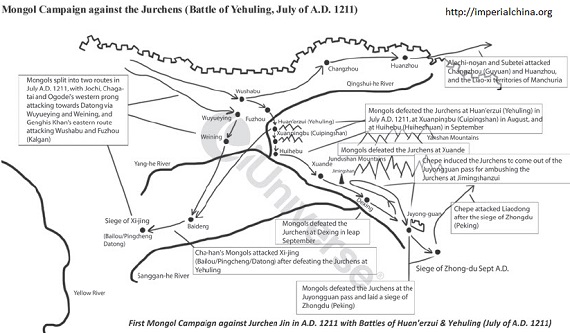
Mongol Campaign against the Jurchens (Battle of Yehuling, July of A.D. 1211)
Mongol Campaigns against Semiryechye & Central Asia (A.D. 1216-1219, 1219-1224)
Mongol Campaign against Kiev Rus (A.D. 1223)
Mongol Campaign against the Jurchens (A.D. 1231-1232)
Mongol Campaigns against the Volga Bulgars, Kipchaks, Alans, Rus Principalities, Crimea, Caucasus & Kiev Rus (A.D. 1237-1240)
Mongol Campaigns against Poland, Bohemia, Moravia, Hungary, Austria & Dalmatia (A.D. 1240-1242)
Mongol Campaign against Arsacia (Mulahida) from A.D. 1253 to A.D. 1256
Mongol Three-prong Campaign against Hezhou (Caaju) from late A.D. 1255 to early A.D. 1256
Mongol Continuous Campaigns in the Sichuan Basin (A.D.1257-1259)
Mongol Campaign against Hezhou (Caaju) & Diaoyucheng (A.D. 1257-1259)
Mongol Campaigns against the Abbasid Caliphate, Mecca, Misr (Egypt) Outposts, North Africa, and the Ayyubid & Mamluk Sultanates (A.D. 1257-1260)
|
|
In Sept, the Dexing (virtue prospering) governor office (today's Xinbao'an-Huailai-Tumu-Langshan) was taken, and the Juyongguan Pass was deserted.
Xin Yuan Shi claimed that Genghis Khan sacked Xuande, and attacked Dexing-fu.
Xin Yuan Shi implied that the attack against Dexing-fu was aborted, with Tolui and son-in-law Chi-ku ordered to pillage the forts and cities within the Dexing domain.
At the Juyong-guan Pass, Chepe induced the Jurchens to come out of the pass and then ambushed them at Jimingshanzhui (rooster mountain entry, in today's Xiahuayuan and between Xuanhua and Xinbao'an) of Xuande-fu.
The Juyong-guan Pass was deserted according to Yuan Shi.
Jebe (Jebei, Chepe or Zhebie), with aid from the Khitans and the Chinese who served in the Jurchen army, took over the Juyong-guan Pass of the Great Wall (near today's Beijing).
Unable to sack Zhongdu, the Mongols pillaged today's Hebei plains the same way as the Manchus did to the Ming dynasty in the 17th century.
Menggu Mi Shi and Da Jin Guo Zhi (a forgery book) implied that Jebe detoured around Jinshan to attack the Juyong-guan Pass from the south.
Note that there were several Mongol attacks against the pass, with records from different years very much mixed up.
In the winter times, the Mongols attacked Jurchen's ranch and captured millions of war horses, and Yelü A'mei surrendered. Jochi, Chagatai and Ogodai took over numerous prefectures of northern China.
Zhuchi (Jochi), Chahetai (Chagatai) and Wokuotai (Ogodei)'s western prong, with Whanggu tribal chieftain Alawusitijihuli as guide, sacked Jingzhou, Fengzhou (Dong-baita-zhen, Huhhot), Dongsheng (Toketuo), Wuzhou (Wuzhai, Shanxi) and Shuozhou.
In October, Zhuchi's Mongols sacked Yuneizhou, another Jurchen pasture to the west, pillaged the cities along the Northeastern Yellow River Bend, including Dongshengzhou (eastern Shengzhou), Shuozhou and Wuzhou, and then attacked Jurchen General Hu Shahu at Datong.
Genghis Khan retreated back to the Juyongguan Pass. In the winter of A.D. 1211, Genghis Khan rested at the northern Jurchen territories.
Liu Bolin and Jiagu Changge surrendered to the Mongols.
Hu Shahu, a Jurchen carrying a Chinese-sounding name, abandoned Datong for Zhongdu, where he later deposed the Jurchen emperor in A.D. 1213.
The Mongols took over Datong, Xinghe and Shangyi,
and defeated Jurchen General Hu Shahu.
Out of 450,000 Jurchen army, the Mongols caused a casualty of over 200,000 onto the Jurchens and dispersed the rest after the campaign of the Yehuling ridge, mount Cuipingshan and Huihebu.
Hu Shahu, fleeing the battleground, returned to Zhongdu, and en route, robbed the money of the Yuzhou office, and killed magistrate of the Laishui county.
With two Husha persons likely mixed up here, Husha Hu actually fled to the capital city via Yu4zhou and Laishui to the south of the Sanggan-he River [while the Yehuling ridge and mount Cuipingshan was located to the north of the Yang-he River].
Hu Shahu, with a history of disobedience, previously refused to follow Jurchen prime minister Wanyan Xiang in the northern campaign against Dadan in the mid-1190s.
In A.D. 1212, a Khitan who served as a Jurchen general, Yelü Liuge, took over today's east Liaoning Province and sent an emissary to Genghis Khan, expressing wish to be a vassal.
Genghis Khan sacked Changzhou (Jiulian-cheng, Taipu-shi-bi of Inner Mongolia), Huanzhou (Zhenglan-qi of Inner Mongolia) and Huzhou (Zhangbei), etc.
Genghis Khan defeated a Jurchen relief army of 300,000 led by Heshilie-qiujin at Huan'erzui (meles mouth).
Heshilie-qiujin could be Hu Shahu who was known as 'zhi2 zhong' Ge-shi-lie.
In the autumn of A.D. 1212, the Mongols attacked the Jurchens a second time.
The Mongols laid a siege of Datong, i.e., the Jurchens' xi-jing (western capital) city.
Jurchen General Ao-tun-xiang, lending a relief to Datong, was ambushed and defeated at Migukou (secret valley entrance), to the northeast of Datong.
The Mongols then began the siege against Datong.
In autumn of A.D. 1212, Genghis Khan laid siege of Jurchen's Xi-jing (west capital) and destroyed the Jurchen relief army at Migukou. While attacking Jurchen's Xijing, Genghis Khan was wounded by an erratic arrow.
The Mongols then began the siege against Datong.
Genghis Khan, who was wounded by an arrow in Datong, agreed to a peace with the Jurchens with the condition that the Jurchen princess be sent to him as a bride. He then retreated to Mongolia.
Hence, Genghis Khan retreated. But in September and December, the Mongols continued their attacks in today's Manchuria.
Jebe (Jebei, Chepe or Zhebie) sacked and pillaged the Jurchen eastern capital Dong-jing (Liaoyang, Liaoning).
In A.D. 1212, Hu Shahu, who was dismissed of a garrison post for disobedience, was recalled to the Jurchen capital city; however, after ministers Zhang Xingxin and Tudan Yi (Tushan Yi, a prime minister) raised objection, Hu Shahu was dismissed again before he was recalled in May of A.D. 1213 as 'zhi zhong' (justice minister) and 'you fu yuan-shuai' (rightside deputy marshal) with command of several thousand garrison troops.
In August of A.D. 1213, Hu Shahu, rather than defending against the Mongols, led troops to the imperial palace to stage a coup, killed leftside deputy marshall Tudan Nanping, burnt the palace gate, and deposed and killed the Jurchen emperor.
Hu Shahu also arrested and killed Jurchen minister Wanyang Gang on the pretext that Wanyan Gang lost the Sichuan territory in 1207 and was defeated by the Mongols at Jinshan (Yanqing, Hebei) in A.D. 1213.
Hu Shahu, after listening to objection from Tudan Yi as to possible rebellion of people against a non-Wanyan emperor, chose Wanyan Xun as Emperor Jin Xuanzong.
Hu Shahu assigned himself the posts of 'tai-shi' (tutor), 'shang-shu ling' (secretariat head), 'du yuan-shuai' (grand marshal), 'jian-xiu guo-shi' (supervisor of chronicle editing), and King Ze-wang, etc.
On October 15th of A.D. 1213, 'yuanshuai you dujian' (rightside supervisor under the marshal) Zhuhu Gaoqi, who was promoted to 'ci shi for Qinzhou and given the command of the Jurchen Zhan3-jun (quiver) army in A.D. 1211
for the victories over the Soong army, killed Hu Shahu who was also called 'zhi zhong' Ge-shi-lie, for fearing the court martial over defeats in the hands of the Mongol army.
The Jurchen emperor spared Zhuhu Gaoqi in exchange for ordering him to assassinate Hu Shahu, and assigned him the post of 'zuo fu yuan-shui' (leftside deputy marshal) and 'pingzhang zhengshi' (A.D.judicating administrative affairs, i.e., assistant prime minister equivalent) .
Citing Confucius' petitioning the Lu lord for campaigning against the Qi state over usurpation by the Chen family, Mongol prime minister Toktoghan (Tuo-tuo)'s Jin Shi commented that out of nine Jurchen emperors, three were assassinated, with majority of the culprits escaping punishment.
The new Jurchen Emperor, Jin Xuanzong, however, made a strategic mistake by relocating his capital to Bianliang (today's Kaifeng) after striking peace with the Mongols, which essentially enraged Genghis Khan as well as cut himself off from the Jurchen base in Manchuria. The successor Jin emperor would be defeated again later, but not completely defeated until 1234.
Jin Emperor Xuanzong later realized that Zhuhu Gaoqi was one of two cunning misters who caused the Jurchen Jin's demise, with the other one being Tuan-duo.
Tuan-duo was blamed for killing several generals of the Jurchen Zhan3-jun (quiver) army after the relocation of the capital city to Bian-jing (Kaifeng, Henan), which caused the Jurchen crack army to lose the fighting capabilities.
Using the Jurchens' relocation as an excuse, Genghis Khan sent Muhuali against the Jurchens. Muhuali attacked Jurchen's northern capital in today's west Liaoning Province at the advice of Shi Tianni. Shi Tianxiang was responsible for defeating 200,000 Jurchen army at the northern capital of 'Bei-jing' (i.e., today's Ningchen of Inner Mongolia). When the Mongols returned to attack today's Beijing, Prince Wanyan Shouzhong fled to Bianliang in July. In Oct, Muhuali attacked Liaodong (an area to the east of the Liao-he River). A Jurchen general (Zhang Jing) at Jinzhou killed Jurchen 'jiedu-shi' (governor), declared himself King of Linghai, and surrendered to the Mongols.
With three armies into the heart of the Jurchen Jin territory, in A.D. 1214, siege of Zhongdu (Beijing) began. Meantime, the Mongols devastated northern China, sacking numerous cities in today's Hebei/Shandong provinces, reducing them into all ruins.
Jurchen Jin Emperor surrendered Princess Qi-guo-Gongzhu, money, cloth and virgin boys and girls to the Mongols.
The Mongols hence exited the Tiemen-guan (Juyong-guan) Pass.
However, Genghis Khan ordered Muhuali (Mukali) and son-in-law Beitu to continue the war against the Jurchen Liao-dong and Liao-xi territories.
Shimo Yexian, an ethnic Khitan whose original clan name was Shulü or Han soundex 'Xiao' that produced the Khitan empress line and derived from the ancient Diela Khitan tribe, acted as guide for the Mongols to take over the Jurchen 'dong-jing' east capital city.
Shimo Yexian rode into 'dong-jing' pretending to be an emissary of the Jurchen emperor.
Then, Shimo Yexian directed the Mongols in sacking the Jurchen 'bei-jing' north capital city and Xingzhong-fu city.
By A.D. 1215, Beijing (known as Yanjing) fell, and history recorded the horrors of massacre and suicides.
As to the residents inside of Beijing, hunger led to cannibalism, too, and at the time when Beijing fell, innumerable number of women and girls jumped down from the city wall to commit suicide. Some western traveler recorded that the human oil from burning those dead bodies had been so thick that it did not disappear for a long time. In A.D. 1216, Genghis went back to Mongolia.
According to Minhaj al-Siraj Muhammad Juzjani's Tabaqat-i Nasiri (historic records of Sultan Nasir-ud-Din r. 1246–1265),
Khwarazm shah Muhammad II sent an emissary by the name of Saidianchi-baoheding (Baha ad-Din Razi, who was speculated to be the same person as Sayyid-i-Ajall Baha ud-Din who was later sent to southwestern China by the Mongols as an administrator) to Taohuashi (Tobyac - with 'taohuashi' meaning peach flower stone, a soundex for the Tuoba or To'pa people who founded the Wei dynasty A.D. 386-534, or 'Tang-jia' or the Tang dynasty's royal house), i.e., northern China, for visiting the Mongols and verifying that the Mongols had conquered the nation, with the emissary claiming that before the entourage approached Chung-tu, they noticed a white hill like a snowy mountain, which turned out to be a pile of skeletons and corpses, with the human fat overflowing the ground that they trekked on, and that 60000 young women and girls threw themselves to their death from the city wall.
In A.D. 1216, Zhu-hu Gao-qi was promoted to 'shang-shu' (secretariat) and 'you cheng-xiang' (rightside prime minister).
The Jurchen emperor, however, adopted Zhu-hu Gao-qi's policy of making gain on the south side to compensate for the loss on the north side.
The Southern Soong Chinese, taking advantage of the Jurchen-Mongol army, renegaded on the surrender of tributes, hence initiating the seven-year 'Sui-bi' (annual monetary tributes) War in A.D. 1217.
The Soong Chinese, under the command of Meng Zongzheng and Meng Gong, defended the Jing-hu territories, defeated the Jurchen 'wu-xian jun' army, and scored victories at the Battles of Xiangyang and Zaoyang.
Later in A.D. 1219, Jurchen Emperor Xuanzong killed Zhu-hu Gao-qi.
In October of A.D. 1216, the Mongols attacked and sacked the Tongguan Pass in the west, and intruded to the Song[shan] mountain and Ru (i.e., Henan) area.
Jurchen minister 'shi [attache] quetai-yuan [rostrum palace] ling [minister in charge]' Gao Yi submitted a petition to the Jurchen emperor in regards to sending Zhuhu Gaoqi to proactively fighting the Mongols, citing the loss of three opportunities to turn around the events in the context of the debacles of losing the He-Shuo War (in the Shuozhou and Datong area), passive defense of the Zhongdu capital city, and the do-nothing situation at the time the Mongols pulled out of the Zhongdu siege.
With the Mongols ravaging the central plains after breaching the Tongguan and Xiao-guan passes, the Jurchen ministers at Yushi-tai (justice ministry) submitted a petition about dispatching the capital city's garrison troops to fighting the Mongols.
Jurchen Emperor Xuanzong issued a decree to Shang-shu-Sheng (secretariat). However, Zhuhu Gaoqi objected to it, and further had the Jurchen emperor spend resources to build an inner palace fort, instead.
The Mongols were defeated by the Jurchen army called 'Hua-Mao-jun [flowery hat army] Garrison'. The Mongols retreated after reaching Bian-jing (Kaifeng).
The Flowery Hat Army was composed of ethnic-Han Chinese from the Xi-shan (western mountains, i.e., Taihang-shan) area, to the west of 'Zhong-du' (Peking), that was organized by Li Xiong, Guo Zhongyuan and Guo Xingzu at the time of the Jurchen debacle at the Battle of Yehuling (wild fox ridge).
In October, Guo Zongyuan's Flowery Hat Army defeated Sanmuhe-badu's 10,000 Mongol cavalry at Xinghuaying (apricot flower camp), 20-li distance from Bianjing.
The Mongols retreated after reaching Bian-jing (Kaifeng), and en route of retreat, retook Tongguan, and then crossed the frozen Yellow River at Sanmen (three middle-of-the-river gates) and Xijin crossings, that was sprayed the dust to strengthen the ice.
Guo Zhongyuan, after repelling the Mongols, proposed to build the Qin-Lan mountain defense works by citing the importance of frustrating the Mongols' strategy of detouring Xiaoling (small ridge) and Zijing[-guan] (violet thorn) to attack the Juyong-guan Pass in the siege of 'Zhong-du' (Peking).
To prevent the Mongols from taking the Jinkeng (forbidden pit) path to sack the Tongguan Pass again, mountain defense works were constructed along the passes and mountain mouths such as at Jinkeng and in the Shangzhou prefecture.
Xu Ding, Jurchen 'pingzhang zhengshi' was put in charge of the passes.
In Oct, Hupu Wannu surrendered and sent his son to the Mongols as a hostage; Hupu Wannu rebelled thereafter and declared the dynastic name of Dong-xia (Eastern Xia Dynasty). In A.D. 1217, a monk took over Wuping, and Shi Tianxiang quelled it. Mongol General Cha-han defeated the Jurchens at Ba-zhou, and the Jurchens requested for peace.
Genghis Khan conferred Muhuali (Mukali) kingship of the Zhongdu (Peking) territory, i.e., viceroy of today's Northern China, and the title of 'tai shi' in August.
Muhuali went on to take over various cities on the Shandong Peninsula. The Tu-man tribe rebelled in Mongolia and was quelled.
With authorization to fly the Mongol khan's 'jiu [nine] liu [ribbons] bai [white] dao [flag]' white flag, Muhuali launched the "du xing-sheng" governor-general office, with five Mongol 'tan-ma [scout cavalrymen] chi [red] jun [army]' cavalry forces organized.
Cai Dongfan, however, commented that it would be Muhuali (Muqali) who would be responsible for shaping Genghis Khan's bandit psychology into that of a ruler.
Muhuali (Muqali), in northern China, began to hire the Han-ethnic Confucians who somehow persuaded the Mongols to adopt the benevolent philosophy of great saints in China's history.
To counter the Mongols, the Jurchens in A.D. 1120 conferred nine duke-equivalent posts onto the military strongmen in North China, including Wu Xian, i.e., Duke Hengshan-gong.
Wu Xian, back in A.D. 1214, was appointed 'quan Weizhou ci-shi' acting satrap for Weizhou after rallying a large army in Xishan (i.e., Taihang-shan), and was upgraded to 'Weizhou ci-shi', 'Zhending-fu zhi-zhong' and 'quan zhi Zhending-fu shi' in A.D. 1217 before further appointment as 'zhi Zhending-fu shi' and 'Heping-jun jiedu-shi', etc.
The Mongols were defeated by the Jurchen army called 'Hua-Mao-jun [flowery hat army] Garrison'. The Mongols retreated after reaching Bian-jing (Kaifeng). In Oct, Hupu Wannu surrendered and sent his son to the Mongols as a hostage; Hupu Wannu rebelled thereafter and declared the dynastic name of Dong-xia (Eastern Xia Dynasty). In A.D. 1217, a monk took over Wuping, and Shi Tianxiang quelled it. Mongol General Cha-han defeated the Jurchens at Ba-zhou, and the Jurchens requested for peace.
Genghis Khan conferred Muhuali (Mukali) kingship of the Zhongdu (Peking) territory, i.e., viceroy of today's Northern China, and the title of 'tai shi' in August.
Muhuali went on to take over various cities on the Shandong Peninsula. The Tu-man tribe rebelled in Mongolia and was quelled.
In A.D. 1218, the Mongols departed from the Zijingguan Pass and captured Jurchen 'yuanshuai xingshi' Zhang Rou (who was father to later Mongol generals Zhang Honglüe and Zhang Hongfan). Muhuali departed 'xi-jing' for 'he-dong' (east of Yellow River) and captured Taiyuan, Dai, Feng, Lu, Huo-zhou and Pingyang of today's Shanxi Province. Jurchen General Wu Xian attacked Man-zhou, and Zhang Rou defeated Wu Xian. The Tanguts were attacked by the Mongols in this year. The Tangut Emperor fled to 'xi-liang' (west of Gansu Province). A Khitan, by the name of Liuge, took over 'Jiangdong' (east of the Yalu river) of Koryo. The Mongols dispatched Ha-zhen and Zhao-la against Liu-ge, and the Koryo king requested for vassalage.
In A.D. 1219, Zhang Rou defeated Wu Xian again and took over Qiyang and Zhongshan. In June of A.D. 1219, Xi-yu (western territories), i.e., today's Chinese Turkistan, killed the Mongol emissaries, and Genghis Khan personally campaigned against 'Xi-yu' and captured chieftain Ha-zhi-er-zhi-lan-tu. (In A.D. 1218, the governor of Oyrat, an eastern province of Khwarizm, robbed and killed several hundreds of the Mongol merchants.) In autumn, Muhuali captured Ji2-zhou and slaughtered Jiang-zhou. In A.D. 1220, Genghis Khan took over Puhua, Xun-shi-gan and Wo-tuo-luo-er cities. Wu Xian surrendered when Muhuali arrived at Zhending. Muhuali conferred Shi Tianni the post in charge of the western armies north of the Yellow River and assigned Wu Xian the deputy post. More Jurchen generals surrendered. Jurchen 'jiedu-shi' [governor or magistrate] at Xing-zhou surrendered, too.
At Xingzhou, Muhuali established the '<9>du yuan-shuai fu' office, with Liu Lun assigned the 'du-tong' post.
Liu Lun was father to later Mongol minister Liu Bingzhong.
In central Asia, in A.D. 1221, Genghis Khan attacked Puo-ha-er and Xie-mi-si-gan, i.e., Bukhara and Samarkand. Jochi attacked Yang-jie-gan and Ba-er-zhen.
In A.D. 1221, the Mongols captured Bokhara and Samarkand.
Subedei and Chepe then received order from Genghis Khan to attack a tribe called 'Qin-cha' (Kipchak or Qipchak) north of the Caspian Sea.
Right after the war in 1219-1222 against the Khwarezmian empire, Chepe (Jebi) and Subedei, with a detachment of about 25,000 Mongols, detoured around the Caspian Sea and raided into today's Georgia.
In April of A.D. 1221, when stationing in the Tiemen'guan [iron gate] Pass, the Jurchen emperor sent an emissary requesting for being a "junior brother" of the Mongols. Jurchen 'xing sheng' [governor] at Dongping deserted the city. Yan Shi was ordered by the Mongols to guard Dongping. Southern Soong sent Gou Mengyue for peace with the Mongols. Soong general Shi Gui surrendered in today's southern Shandong Province. In today's Central Asia, in autumn, Genghis Khan attacked Ban-le-he, while Jochi-Chagatai-Ogodai attacked Yu-long-chi. In Oct, Tolui took over Ma-lu-ch-ye-ke, Ma-lu and Xi-la-si. In northern China, Muhuali departed from 'He-xi' (west of the Yellow River) to attack Suide, Bao'an and Yan'an (Yenan) of today's central and northern Shenxi Province.
In November of A.D. 1221, Zhang Lin, who had a quarrel with former red jacket army leader Li Quan, surrendered to the Mongols.
(Li Quan and Zhang Lin, et al., belonged to the Red Jacket rebellion. In the Shandong peninsula, Yang Aner, who was pacified by the Jurchens in A.D. 1211, deserted the Zhuolu garrison for returning to Shandong to stage an uprising under the name of Hong-ao-Jun (Red Jacket army), and by A.D. 1214, sacked Laizhou and Dengzhou, and declared himself emperor with the Tianshun Era.
The Jurchens failed to quell the rebellion.)
In A.D. 1222, Tolui took over Tu-si and Ni-cha-wu-er and pillaged the Mu-la-yi statelet, i.e., Munaixi (Hashasheen or Assassin or Arsacia), south of the Caspian Sea. Tolui and Genghis Khan converged on the Talihan Castle and captured it. In northern China, Muhuali failed to take over Fengxiang of today's Shenxi Province. Jala ad-Din fled to combine forces with Mieli-khan and defeated Mongol general Hu-du-hu. Genghis Khan then defeated and captured Mieli-khan. Ba-la was ordered to pursue Jala ad-Din across the Indus River. In autumn, the Jurchens dispatched Wusunzhongdun to the Mongol camp in the Wu-wu-er (Huihe/Uygur) territories for peace again. Genghis Khan ridiculed the Jurchens for not taking his offer to have the Jurchens be King of the 'He-nan' [to the south of the Yellow River] land. When Wusunzhongdun requested for mercy, Genghis Khan stated that the Jurchens surrender the cities in Guan-xi (west of the Han'guguan pass). Jurchen Duke Pingyang-gong surrendered the Qinglong-bao (Qinglong-bu) castle. In Oct, the Jurchen 'hezhong-fu' governor office surrendered.
The Jurchens would be defeated again later, but not completely defeated until A.D. 1234. Though, many Jurchen generals surrendered to and then rebelled against the Mongols.
Muhuali was busy attacking the Jurchen Jin armies on both banks of the Liao River, northeast of the Yellow River, in today's Shanxi-Shenxi Provinces, and on the Shangdong peninsula.
In A.D. 1223, Muhuali died of illness and was conferred King of the Lu-guo Fief posthumously.
In Oct, Jurchen Emperor Xuanzong died, and his son, Wanyan Shouxu, got enthroned as Jurchen Jin Emperor Aizong. The Soong Chinese sent Gou Mengyue to the Mongols again.
In A.D. 1224, Soong General Peng Yibin at Daming (in today's southern Hebei Province) invaded He-bei (territory north of the Yellow River). Shi Tianni defeated Peng. Genghis Khan returned from his campaigns in India. In January of A.D. 1225, Genghis Khan returned to Mongolia. In February of A.D. 1225, after the death of Muhuali, ex-Jurchen general Wu Xian rebelled in Zhending and killed Shi Tianni. Li Quan rebelled in Zhongshan on the eastern slope of the Taihang Mountain and in today's central western Hebei Province.
Wu Xian cooperated with Soong Dynasty's General Peng Yibin in fighting Shi Tianze. Shi Tianze requested aid from Muhuali's son and killed Peng Yibin.
In March, Shi Tianze drove Wu Xian away. In June, Soong General Peng Yibin answered Wu Xian's rebellion to invade into the Mongol territory. Shi Tianze captured and killed Peng Yibin.
Since Western Xia refused to provide troops in the war against the Khwarizm, and moreover, signed another alliance treaty with Jurchen Jin, Genghis Khan led a force of 180,000 troops for a new campaign against the Tanguts in A.D. 1225.
In A.D. 1226, Genghis Khan attacked the Tanguts the sixth and last time.
In the spring of 1226, Genghis Khan, after zoning the fiefdoms for his four sons, attacked the Tanguts on the pretext that no hostage was sent in yet.
Genghis Khan died in A.D. 1227 during his campaigns against the Tanguts. Since Western Xia had refused to provide troops in the war against the Khwarizm, and moreover, signed another alliance treaty with Jurchen Jin, Genghis Khan readied a force of 180,000 troops for a new campaign against the Tanguts. Late in A.D. 1226, when the rivers were frozen, the Mongols struck southward. On the banks of the frozen Yellow River the Mongols defeated a Xixia army of more than 300,000. The Mongols killed the Tangut emperor in a mountain fortress. His son took refuge in the walled city of Ningxia. Leaving one-third of his army to take Ningxia, Chinggis sent Ogedei eastward, across the great bend of the Yellow River, to attack the Jurchen Jin. The Mongols, as a precautionary measure, marched southeast to eastern Sichuan Province, where the Western Xia, the Jin, and the Soong empires met, to prevent Soong reinforcements from reaching the Tanguts in Ningxia. Here he accepted the surrender of the new Western Xia emperor but rejected peace overtures from Jin. On his death in 1227, he outlined to his youngest son, Tului, the plans that later would be used by his successors to complete the destruction of the Jin empire.
In North China, the Mongols invaded the Shandong peninsula in A.D. 1226.
Zhang Rong, a local strongman, surrendered Ji'nan and Zizhou (Zibo) to the Mongols, for which he received the Mongol appointment as 'Shandong xing sheng' and 'du yuanshuai'.
In September of A.D. 1226, Li Quan attacked Yi4du and captured Zhang Lin, with Zhang Lin being forwarded to Southern Soong for punishment.
Beilu, i.e., Muhuali's son, attacked Li Quan.
At the turn of the year, Li Quan surrendered to the Mongols.
In the east, in May of A.D. 1227, the Mongols dispatched Tang Qing to the Jurchens again. In Jun, the Jurchens sent Wanyan Hezhou to the Mongols for peace.
After the death of Genghis Khan, for the period of 1227/1229, Tolui acted as a regent. In A.D. 1228, a khuriltai was held on the Kerulen River and Secret History of the Mongols was compiled. The Kuriltai at Karakorum in 1228 selected Ogedei as khan. At the kuriltai, plans were made for campaigns against the Bulghars, the Turks in the region of Kazan on the middle Volga River, and conquest of the Jurchens.
In A.D. 1229, Ogodei got enthroned according to Genghis Khan's wish. Yelü Chucai would persuade Ogedei into erecting rituals for officialdom and hiring civil officials for governance. Ogedei further ordered to promulgate the tax laws and persuaded the Mongols into less killing for sake of more tax revenue collection from the people conquered.
Ogedei declined Jurchen Jin's tributes meant for condoling Genghis Khan's death and declined again Jurchen Jin's tributes for congratulating Ogedei on his enthronement.
Jurchen Jin Emperor Aizong (Wanyan Shouxu) ordered 'quan shumi-yuan fu shi' Yila Pu'a (Pu'e, Puwa, or Buha) to render relief from Binzhou.
Wanyan Chenheshang (Wanyan Yi), with 400 Zhongxiao-jun Army consisting of Huihu, Naiman, Qiang, Tu[yu]hun and Han cavalrymen, volunteered to go to the front as a forerunner general, and went straight towards the Mongol camp to defeat the 8000 Mongol cavalry at Dachangyuan (Ningxian, Gansu), for which 'ti-kong' Wanyan Chenheshang was promoted to 'Dingyuan da jiang-jun' and 'Pingliang-fu pan-guan'.
The Zhongxiao-jun Army soldiers from the He-shuo circuits enjoyed three times the regular Jurchen army's stipends and were commanded by Shimo Yanshannu, Pucha Dingzhu, Wanyan Chenheshang and Pucha Guannu, successively.
Wanyan Chenheshang, who fled from the Mongol captivity ensuing from the A.D. 1211 invasion of Fengzhou (Dong-baita-zhen, Huhhot), was a descendant of Jurchen King Xiao-wang.
Wanyan Chenheshang was known for diligent studies of Confucian classics under Wang Wo (Wang Zhongze).
Later, Wanyan Chenheshang fought and defeated the Mongol army at Wei4zhou [Weihui, Henan] in A.D. 1230 and Daohuigu [inverse flow valley, Liantian, Shenxi] in A.D. 1231.
In the spring of A.D. 1230, Ogedei (i.e., Yuan Emperor Taizong posthumously) ordered a campaign against Jurchen Jin. The Mongols crossed the Yellow River into today's Shanxi Province and took over more than 60 towns and castles, and attacked the city of Fengxiang (which Muhuali failed to take earlier).
Jurchen Jin General Wanyan Hada, fearing the Mongol army, did not go to the relief of Fengxiang which fell after a siege of 2-3 months. Wanyan Dada sought safe haven in the Tongguan Pass. Tolui then went on to attack Tongguan Pass but failed to conquer it. In A.D. 1231, Ogedei sent an expedition to defeat the remnant Khitans who invaded Korea.
A Jurchen defector general called Li Guochang proposed that the Mongols march southeastward by circumventing the city of today's Baoji, Gansu Province, and flow down the Han-shui River to attack the Jurchens from the southwestern direction.
When the Mongol emissary arrived at Feizhou to borrow a path from Soong governor Zhang Xuan, Zhang Xuan killed the emissary. Ogedei then ordered Tolui to march out of Baoji to take over the Da'sanguan Pass. Tolui took over the Fengzhou Prefecture and slaughtered the Yang-zhou Prefecture. Tolui further sent a column into today's Sichuan Province by paving a road out of Guibieshan (turtle & tortoise) Mountain and crossing the Jialingjiang River. To avoid further confrontation with the Soong Chinese, the Mongols withdrew from the Soong territories and went to the Han-shui River to attack the Jurchens.
The Mongols, passing Hanzhong, the border areas with both Soong and Jurchen Jin in eastern Sichuan Province, were to defeat the Jurchens in the Hanzhong areas, and in the Tang-Deng areas (today's Yuxian County, Henan Province).
Wayan Hada was recalled from Tongguan to defend the He-nan [south of the Yellow River] land, and Jurchen General Wu Xian came to the reinforcement, too. A Jurchen general by the name of Fengdula advised against attacking the Mongols when the Mongols crossed Han-shui River halfway. The Mongols under Tolui, though numbering 30,000, managed to trick the Jurchen armies into thinking that they had retreated.
With 40,000 cavalry, Tuolei (Tolui) forcefully entered Southern Soong's Qin-ling Ridge territory for borrowing a path, passed through the Han-zong territory, and invaded the Nanyang basin.
The first Mongol column, i.e., the middle route under Ogedei, crossed the Yellow River at the Baipo Town, Heqing County, and attacked the city of Zhengzhou. Subetei was ordered to attack Biancheng (i.e., today's Kaifeng) which was the Jurchens' capital city. The Jurchens had about 40,000 men around the capital, with the city wall being 20 Chinese li in perimeter.
With 40,000 cavalry, Tolui (Tuolei) forcefully entered Southern Soong's Qin-ling Ridge territory for borrowing a path, passed through the Han-zong territory for the Han-shui River.
Wayan Heda was recalled from Tongguan to defend the He-nan [south of the Yellow River] land.
When the Mongols reached the Xiangyang and Han-shui River in November of A.D. 1231, Wanyan Heda and Yila Pu'a (Pu'e) stationed the army at Dengzhou.
Jurchen General Wu Xian came to the reinforcement from the Jingzi-kou Pass.
Wu Xian previously stationed at the Huling-guan Pass to guard the Jinzhou-lu Circuit (Ankang, Shenxi) after failing to attack Luzhou (Changzhi, Shanxi, namely, the Shangdang area) in A.D. 1230 but was subsequently surrounded by the Mongols at Wei4zhou (Ji2xian, Henan) and escaped Weizhou (Ji2xian, Henan) with the help of Wanyan Heda and Yila Pu'a (Pu'e, Puwa)'s relief army.
A Jurchen general by the name of Fengdula advised against attacking the Mongols when the Mongols crossed the Han-shui River halfway. The Mongols under Tolui, though numbering 30,000, managed to trick the Jurchen armies into thinking that they had retreated and then crossed the river.
Zhang Hui, i.e., a Jurchen Flowery Hat Army general, proposed to attack the Mongols by the Han-shui River as otherwise there was no precarious pass between the river and the capital city of Bianjing.
Tolui crossed the Han-shui River at Qiaoshitan (crag stone beech), and invaded the Nanyang basin.
Wanyan Hada and Fengdula were ordered to return north to guard the capital. Tolui chased the Jurchens with 3000 cavalry while Subetei also sent armies to attack the Jurchen relief column.
In the winter of A.D. 1231, 50,000 Mongol cavalry had a duel with 120,000 Jurchen cavalry and infantry.
At the Sanfengshan Mountain, the two Mongol columns encircled the Jurchens and defeated them by intentionally tricking them with fleeing and then ambushing the Jurchens via a trap.
Mongol Campaign against the Jurchens (Battle of Yehuling, July of A.D. 1211)
Mongol Campaigns against Semiryechye & Central Asia (A.D. 1216-1219, 1219-1224)
Mongol Campaign against Kiev Rus (A.D. 1223)
Mongol Campaign against the Jurchens (A.D. 1231-1232)
Mongol Campaigns against the Volga Bulgars, Kipchaks, Alans, Rus Principalities, Crimea, Caucasus & Kiev Rus (A.D. 1237-1240)
Mongol Campaigns against Poland, Bohemia, Moravia, Hungary, Austria & Dalmatia (A.D. 1240-1242)
Mongol Campaign against Arsacia (Mulahida) from A.D. 1253 to A.D. 1256
Mongol Three-prong Campaign against Hezhou (Caaju) from late A.D. 1255 to early A.D. 1256
Mongol Continuous Campaigns in the Sichuan Basin (A.D.1257-1259)
Mongol Campaign against Hezhou (Caaju) & Diaoyucheng (A.D. 1257-1259)
Mongol Campaigns against the Abbasid Caliphate, Mecca, Misr (Egypt) Outposts, North Africa, and the Ayyubid & Mamluk Sultanates (A.D. 1257-1260)
|
|
The Jurchens, after the Sanfengshan debacle, fled to the Junzhou Prefecture (Yuzhou, Henan). Ogodei sent over a third Mongol column which took over the city.
Yang Woyan, a Tang-kuo-di-la person from Shuozhou and later with given Jurchen name Wulinda-wolie, committed suicide at Juzhou.
Wayan Heda was killed at Junzhou. Another Jurchen general by the name of Shanhuashan, i.e., famed Jurchen mercenary Zhongxiao-jun (loyal & filial) Army commander Wanyan Chenheshang, came to the Mongols to die in front of Tolui instead of dying among the soldiers.
Wanyan Chenheshang claimed that he was the Jurchen commander who defeated the Mongols at Dachangyuan [with 400 Jurchen cavalry against 8000 Mongols] in A.D. 1228, Weizhou [Weihui, Henan] in A.D. 1230 and Daohuigu [inverse flow valley, Liantian, Shenxi] in A.D. 1231.
Wanyan Chenheshang was cut off legs and tendon, and cut open in the mouth and face, with the Mongols later commenting that Wanyan Chenheshang was the No. 1 Jurchen hero of last 100 years.
The Jurchen main general at Tongguan, i.e., Wayan Chongxi, fled the pass after hearing of Wayan Heda's destruction, and his deputy general surrendered to the Mongols.
At Tongguan, Jurchen General Li Ping surrendered to the Mongols on the 'xin-chou' day, and the Jurchen army at Xu2zhou (Xuchang) surrendered on the 'geng-xu' day.
Xin Yuan Shi claimed that Ogodei in February reached Lushi (Luzhi), where Jurchen General Tudan Wudian's army collapsed without a fight, and that when Wanyan Chongxi came to surrender, Ogodei ordered the Jurchen general to be executed in front of his horse.
The Mongols then attacked Luoyang. The Jurchen general at Luoyang committed suicide; however, the soldiers and residents, without a general, managed to defeat the Mongols who laid a siege for three months.
In March, the Mongols took over Zhong-jing (middle capital), i.e., Luoyang; however, Jurchen General Qiang Shen re-captured it.
Subetei was ordered to lay a siege of Nan-jing (southern capital).
On the 'ren-yin' day, the Jurchen emperor sent 'jian-yi (admonition) da-fu' Peiman-ahudai and 'tai-fu jian' Guo Shirong to the Mongols for peace, as well as brother Wanyan E'ke (King Cao-wang) to the Mongol camp as hostage.
In March, the Mongols laid a siege of Bian-jing, i.e., Nan-jing (southern capital).
After 16 days of siege, Subetei, under the order of Ogodei (Ogedei), agreed to peace by having a Jurchen prince sent to the Mongols as a hostage.
Ogodei (Ogedei) returned north, taking the path of Ban-du (half crossing), Zhending-fu, Zhong-du (Peking), Juyong-guan, and the Guan-shan pasture.
Leaving behind Subetei for a continuous encirclement, Ogodei declined Ta-si's request for attacking a corner of Bian-jing after a divination turned out to be not propitious.
Subetei, after truce, withdrew from the Kaifeng siege and deployed armies in the area between the Yellow River and the Luo-he River. However, about 30 Mongol emissaries for peace were killed by the Jurchen's Feihu-jun [flying tiger] garrison troops. The Mongols renewed attacks at Kaifeng.
After leaving the Mongol siege of Bian-jing (Kaifeng), Ogodei (Ogedei) got ill in May.
In June, according to Secret History of the Mongols, Tolui preyed the heaven and earth to die on behalf of Ogedei and later in September, Tolui died at a place called A-la-he-di-si.
Alternatively speaking, Tolui was poisoned to death by Ogodei (Ogedei) while both were en route of return to Mongolia.
In July, the Mongols sent Tang Qing to pacifying the Jurchen emperor; however, the Jurchens killed Tang Qing and the entourage of more than thirty persons on the 'jia-shen' day.
In late A.D. 1233, Jurchen Emperor Aizong (Wanyan Shouxu) fled the city for Guide-fu.
Xin Yuan Shi put the Jurchen attack at Wei4zhou under the 'xin-hai' day of January of A.D. 1233, that followed the Jurchen emperor's Yellow River crossing under January 1st, and listed the Jurchen defeat at Baigong-miao on the 'ding-si' day, which was after the attack of Wei4zhou, to be followed by the Jurchen emperor's fleeing south to Gui'de-fu.
At Gui'de, the Jurchen army led by Zhongxiao-jun Army general Pucha Guannu, in a nightly raid in April of A.D. 1233, surrounded the Mongol army by the river and defeated the enemy with a fire attack.
Pucha Guannu, knowing that the Zhongxiao-jun cavalry army was short of hands, launched a simultaneous boat attack at the Mongol hind to create panic.
During the battle, the Mongols debarked the boats off the riverbank, with an order that whoever escaped to the boats would be executed.
Sajisibuhua's whole army was routed by the Jurchens.
Dong Jun was killed in battle, which likely ensued from drowning in the river.
Only Zhang Rou and some hundred cavalrymen escaped from the Gui'de Battle debacle.
This was the last Jurchen battle which saw a small Jurchen army of several hundreds defeating a strong Mongol army of over ten thousand troops.
According to Jin Shi, the total Jurchen force in the city of Gui'de included Pucha Guannu's 450 Zhongxiao-jun cavalrymen and Guoyi-ju (resolute army) 'du-wei' Ma Yong's 700 troops while the defeated Jurchen army troops fleeing from north of the Yellow River were dispersed for lack of discipline and grain supply.
At Gui'de, the emperor sent messengers to Bian-jing for requesting Cui Li for forward the two empresses.
Cui Li, however, launched a coup in breaking into the palaces, forcing the dowager-empress to make King Wei-wang's son Wanyan Congke into King Liang-wang and regent ('jian-guo') while assigning himself half a dozen titles including 'tai-shi1' (tutor).
Cui Li killed Jurchen garrison commanders Wanyan Nushen and Wanyan Xinieabu and surrendered to the Mongols on January 23rd of A.D. 1233.
Xin Yuan Shi put 'jingcheng xi-mian yuan-shuai' Cui Li's killing 'liu-shou' garrison general Wanyan Nushen
under the 'wu-chen' day of January of A.D. 1233.
Cui Li allowed the Mongol army to enter Bian-jing; however, the Mongol army raided Cui Li's home for Cui Li's women.
In April, Jurchen King Liang-wang, King Jing-wang and five hundred royal members, who were sent to Mongolia, were killed as sacrifice for the Mongol ancestors.
Xin Yuan Shi stated that Cui Li sent the Jurchen royals to the Mongol camp on the 'gui-si' day of April, with Subetei killing King Liang-wang (Wanyan Congke)) and King Jing-wang (Wanyan Shouchun) on the 'jia-wu' day and sending Jurchen dowager-empress Tai-hou-Wang-shi and empress Huang-hou-Tudan-shi to Ogodei's camp in Mongolia.
From beginning to end, Kaifeng had undergone continuous Mongol attacks for about one year.
After the fall of Kaifeng, Mongol general Zhang Rou went to the imperial library and archives' bureau to locate Jin Shi Lu (factual records of the Jurchen Jin dynasty) plus other maps and books, as well as secured the safety of one dozen Jurchen Confucian ministers including 'Hu-bu (household ministry) shang-shu' Gao Kui and 'du zhuanyun shi' Li Teli according to Wang Pan's Cai-guo-gong shendao bei (Duke Caiguo-gong Zhang Rou's monument) and Su Tianjue's Yuan Mingchen Shi-lüe (records of prominent Yuan ministers).
Later, Yuan Haowen, for writing a history on Jin-yuan-shi (i.e., Jurchen Wanyan-shi), failed to borrow Jin Shi Lu from Zhang Rou.
Su Tianjue claimed that Zhang Rou donated the Jurchen Jin royal records to the court in the early years of Khubilai's Zhongtong's era.
Yelü-chucai located Confucius' 51st generation grandson Kong Yuancuo and had the Mongols confer the title of Duke Yansheng-gong onto Kong Yuancuo plus building a Confucius' temple.
Later in A.D. 1237, Yelü-chucai managed to get Ogodei (Ogedei) approve the launch of imperial exams for hiring Confucians.
The imperial exams' system was to be revoked by Khubilai in the future.
The Jurchen emperor, however, refused to go to the eastern coast to seek safe haven with Jurchen general Guo Yong'an (Wanyan Yong'an) as suggested by Pucha Guannu.
Guo Yong'an claimed that the Jurchen emperor lost an opportunity when he received no response from Jurchen General Hou Zhi at the Kaiyang-men gate for a pincer-attack of the Mongol army [that suffered from a pestilence that caused numerous deaths but presented a good occasion of presence of seventeen military heads at the same time] while he himself was following the Mongols in the siege of Bian-jin.
Later in January of A.D. 1234, Guo Yong'an led a relief army to the aid of Peixian which was under the siege by A-zhu-lu's Mongol army, and after a defeat, retreated towards Xuzhou where he committed suicide in a river, with his face skin peeled off, corpse attached to a horse tail and flesh eaten by Tian Fu's followers.
The Jurchens retreated southward to a small town close to the Soong border called Caizhou (today's Runan, Henan Province).
In June of A.D. 1233, the Mongols sacked the Jurchen 'zhong-jing' city, i.e., Luoyang.
In August of A.D. 1233, Mongol General Ta-cha attacked Ruzhou and Caizhou.
The Mongols started the siege of Caizhou in September of A.D. 1233, with building of the long wall, and by October 1st, completed the construction of trenches and barracks.
Xin Yuan Shi, which could have mistake in claiming that the Mongols sent emissary Wang Ji to Southern Soong in A.D. 1232, continued to state that Wang Ji was sent to Southern Soong for appropriation of the grains.
From Lushan, Jurchen marshal Yuan Zhi, at a loss of half of his thousand men, fought the way to Caizhou; and from Xi2zhou, Zhongxiao-jun marshals Cai Baer and Wang Shaer came to aid Caizhou.
The Jurchens sent a messenger to the Soong Chinese requesting for help in fighting the Mongols. Soong Emperor Lizong flatly denied it, and moreover, Soong struck a deal with the Mongols in attacking the Jurchens together. Soong would then play the card of allying with the Mongols in destroying Jurchen Jin, and it even sent tens of thousands of carts of grain to the Mongol army in the besieging of the last Jurchen stronghold.
By the end of the year, the Jurchens lost four marshals, three 'du wei' lieutenant generals, and numerous 'zong shuai' commanding generals.
Past the new year day, the Mongol army breached the western wall into five openings.
With the Mongols attacking the north gate and the Soong Chinese attacking the south gate, the Jurchens were completely defeated and the last emperor, Jin Aizong, committed suicide.
In January of A.D. 1234, under the attacks of the Mongols to the north and the Chinese to the south, the last Jurchen emperor, yielding the throne to avoid being written in history as a last emperor, committed suicide.
The remnant Jurchen generals and royal family members jumped to the river to commit suicide. (There is a saying that the Jurchens who survived the Mongols had later retreated towards Manchuria. However, the truth of fact is that Manchuria was already in the Mongol hands; besides, the Jurchens in northern China were already very much Sinicized to be differentiated from the local Chinese.)
After the fall of Caizhou (Runan), at the time of massacre of the city, Mongol general Zhang Rou saved Confucian Wang E4, who was chained to a row of ten persons, from the death row for his extraordinary appearance.
In A.D. 1244, Wang E4 was asked by Khubilai to talk about Confucian classis Xiao Jing (filiality), [Shang-]Shu (book of documents), and [Zhou-]Yi (divination).
Wang E4 got Khubilai's permission to travel to the Ru-shui River to make sacrifice for Jin Emperor Aizong.
Wang E4 cried after seeing the burial site inundated by the water.
Wang E4 was to become Khubilai Khan's 'hanlin xueshi chengzhi' in the future.
The Soong Chinese's Game Of Triangular Warfare
For hundreds of years, the Soong Dynasty, built on top of Northern Zhou (A.D. 951-960) of the Cai(1) family, would be engaged in the games of 'three kingdom' kind of warfare. Northern Soong (A.D. 960-1127) would face off with the Western Xia (A.D. 1032-1227) and Khitan Liao in a triangle, and then played the card of allying with the Jurchens in destroying the Khitan Liao. With Northern Soong defeated by the Jurchens thereafter, Southern Soong (A.D. 1127-1279) would be engaged in another triangle game, with the other players being Western Xia and the Jurchen Jin. Southern Soong would then play the card of allying with the Mongols in destroying Jurchen Jin, and it even sent tens of thousands of carts of grain to the Mongol army in the besieging of the last Jurchen stronghold. Soon after that, the Southern Soong generals broke the agreement with the Mongols and they shortly took over the so-called three old capitals of Kaifeng, Luoyang and Chang'an. But they could not hold on to any of the three because what they had occupied had been empty cities after years of warfare between the Jurchens and Mongols.
The Later Manchus
The later Manchus could be just a kinsmen tribe of the original Jurchens, and at most descendants of the Jurchens who remained in the homeland throughout the Jurchen expansion in northern China during the period of 1115-1234 AD. Similar to the legends about the Jurchen founders, the ancestor of the Manchu founders, Bu-ku-li-yong-shun, had wandered into a village where he was taken in as a distinguished guest and given a woman for marriage. Bu-ku-li-yong-shun was said to have been born after his mother swallowed a red fruit dropped by a sparrow. Bu-ku-li grew up under the foot of the Changbaishan (i.e., snow-capped) Mountain. When he asked who his father was, his mother told him the sparrow story and gave him the last name of 'Ai-xin-jue-luo' which was translated into Chinese as the 'jin' or gold for Ai-xin and 'surname' for Jue-luo. Bu-ku-li-yong-shun, similar to the Jurchen founders, would somehow pacify the generations of fighting between this village where he took as home and two other neighboring villages. He was supported by all three villages as chieftain, called 'bei-le'. Hence the 'Ai-xin-jue-luo' tribe came into existence.
Bu-ku-li-yong-shun descendants would relocate to a place called He-tu-a-la (i.e., later Xingjing). Jue-chang-an, the grandfather of later Nurhaci (i.e., Nu-er-ha-chi, 1559-1626), gradually grew in the tribal strength. A Ming Dynasty general (Li Chengliang) at Liaoxi, in order to suppress the Jurchen growth, would attack the grandson-in-law of Jue-chang-an. Jue-chang-an and his son died as a result of a conspiracy between the Huron Chieftain Ni-kan-wai-lan and Ming Dynasty General Li Chengliang. Nurhaci, around the age of 25 at that time, attacked Huron Chieftain Ni-kan-wai-lan to avenge the death of his father/grandfather. Ni-kan-wai-lan fled to the Ming territories, and Nurhaci wrote a letter to the Ming court asking for hand-over of Ni-kan-wai-lan. The Ming court, however, only condoled Nurhaci with 30 horses, two coffins, the post of 'dudu' (i.e., governorship) of Jianzhou-wei, and the title pf General 'Long-hu' (dragon and tiger). Nurhaci hence set up four banners of armies, trained his soldiers, and attacked the Ming border castle to have Ni-kan-wai-lan captured and executed.
By late Ming Dynasty, three Jurchen tribes were known, Jianzhou (jianzhou Prefecture), Haixi (east of the sea [Huron Lake]), & Yeren (Uncivilized people). Under Nurhaci [Nurhachu] (1559-1626), the Manchus united various tribes and expanded their territory.
Nurhaci first defeated the Ye-he Statelet at Huron Lake. The territories of the Huron Lake area was named Haixi-wei {garrison of west of the lake) by Ming Dynasty, where the Ye-he tribe was the biggest of the four subtribes in the area. The Ye-he tribe chieftain, considered a vassal of Ming, was jealous of Nurhaci's expansion, and he called upon an army of 30,000, including some Mongols, for an attack on Nurhaci. Nurhaci thoroughly defeated the Ye-he tribe. The Ye-he tribe promised to send in their daughter for inter-marriage with Nurhaci, but the Ye-he tribe then promised to marry the princess to the Mongols. (The Ye-he family would later produce the Empress Dowager Cixi.)
By A.D. 1616, Nurhachu proclaimed the founding of 'Da Jin', namely, Grand Gold Dynasty, at a place called Xingjin. The Manchu claim of relation to the Jin dynasty of China was purportedly the justification for conquering China in the 17th cent. and establishing the Qing dynasty.
In addition to the original four banners of yellow, red, blue and white, Nurhachu set up four extra embedded banners of yellow, red, blue and white.
The so-called 'Eight Banner' system was used for organizing armies into eight columns. The Manchus set up eight Mongol and Chinese banners, respectively, on basis of the ethnic composition.
Nurhachu, after making an oath of 'seven hatreds for the Ming Dynasty', led an army of 20,000 against the Ming border town of Fushun. Before arriving in Fushun, a Chinese intellectual, by the name of Fan Wencheng, came to Nurhaci's camp to serve as a counsellor. Nurhaci asked Fan whether Soong Dynasty's prime minister Fan Zhongyan was his ancestor, and Fan replied 'yes'. Fan Wencheng somehow persuaded Ming general at Fushun, Li Yongfang, into a surrender. Nurhaci then defeated Ming relief armies to Fushun and killed three generals. When the news arrived at Ming court, Emperor Shenzong sent someone called Yang Hao to counter Nurhaci. Yang Hao, who had lost a battle to the Japanese in Korea, would lose the Battle of Saerhu. Though Yang Hao mobilized an army of 200,000, including 20,000 Koreans and 20,000 Ye-he tribesmen, Nurchaci used smart tactics and defeated the Ming armies one by one within a matter of half a year. Yang Hao was arrested and demoted by Ming court, and Xiong Tingbi was conferred the post of 'jing lüe' for Manchuria.
After rebelling against Ming Dynasty and defeating the Ming army at the Battle of Sa'erhu in A.D. 1619 (?), they moved their capital today's Shenyang City, called Shengjin at the time. Southern Manchuria, Liaoning Province, was historically Ming Chinese territories. Nuerhachu later died of the cannon of Ming General Yuan Chonghuan at the battle of Ningyuan (today's Xingcheng, Liaoning Province). Yuan had built this kind of long range canon with the help of the Jesuits, and Yuan named it 'Red-Hair Alien Cannon'. Nuerhachu's successor, Huangtaiji, would first attack the Koreans and Mongols, and then played a dissension to have Ming Emperor Chongzhen kill Yuan. In A.D. 1636, Huangtaiji changed their name to Manchu from Jurchen and declared their dynasty name of 'Qing', namely, clearness.
After the death of Huangtaiji, Emperor Shunzhi would be enthroned. Huangtaiji's brother, Duo'ergun (Dorgon), would be responsible for pushing the war against Ming. The Manchus boasted of an army of 220,000 for the Eight Banners. (After taking over China, they had raised an additional army of 660,000 for the Green Camp Battalions.)
The Manchus first used the Khitan's Siniform script.
The Uygur script indirectly influenced the Manchus when they adopted the Mongol script in 1599. (The Manchus finally adopted the Chinese logographic characters.)
In northern China, Ming Dynasty was already devastated by the rebellion led by Li Zicheng and Zhang Xianzhong. Li followed his uncle-in-law in rebelling against Ming Dynasty in A.D. 1628. After a defeat in Shenxi, Li re-organized his rebels in Henan Province. While in Henan, Li acquired two intellectuals, by the name of Niu Jinxing and Li Yan, and re-shaped his bandit approach. By 1644, Li Zicheng sacked Xi'an and captured King Qin Zhu Cunshu, attacked Taiyuan and killed King Jin Zhu Qiushu. After conquering the Daizhou Prefecture, Li Zicheng went all the way to attack the Ming capital of Peking in the east. He sacked Peking (Beijing) and caused the last Ming Emperor Sizong (Chongzhen) to hang himself inside of the Forbidden City.
Meanwhile, in the west, Zhang Xianzhong intruded into Sichuan of western CHina.
A Ming general at Ningyuan, Wu San'gui, was on his way to Peking to rescue the Ming emperor, but he stopped at the Shanhaiguan Pass when he heard of the fall of the capital. Wu surrendered to the Manchu when he heard that his mistress was grabbed by the rebels. After the Manchus were invited by Wu San'gui the gatekeeper for the Shanhaiguan Pass, the Manchus used the slogan of 'Restoring the Ming Dynasty' to call for cooperation among the Ming Chinese remnant armies in the wars against the rebels. Duo'ergun relocated Manchu Emperor Shunzi to Peking. The Manchus pursued Li Zicheng to Xi'an. After a defeat in the Tongguan Pass, Li fled southward to the Jiugongshan Mountain, Hubei Province where Li was killed by the local Ming warlords. The Manchu armies went on to Sichuan to kill rebel Zhang. The Manchus attacked the Southern Ming Court and slaughtered the city of Yangzhou on the north bank of the Yangtze. Ming General Shi Kefa died during this battle. Then, crossing the Yangtze River, the Manchus slaughtered more cities, Jiading and Zhejiang etc.
Wu San'gui would be responsible for fighting the new Ming Emperor who received support from a general under rebel Zhang Xianzhong.
The new Ming emperor fled to Burma and was later handed over to Wu by the Burmese king. Wu and another two Chinese generals would control southwestern China and southern China as the so-called Three Vassals for dozens of years.
In southern China, General Zheng Chenggong rebelled against his father who had surrendered to the Manchus. He launched a war to recover Taiwan from the Dutch, from Dongshan Islands, Fujian Province. The Zheng family would rule Taiwan till A.D. 1683. Shi Lang, a general under Zheng's son, would defect to the Manchus and be responsible for taking over Amoy and Quemoy in A.D. 1680 and subsequent leading the Manchus landing in Taiwan.
Ethnic contention between Manchu and Han Chinese was intense. During the 266 years of Manchu rule, numerous Chinese rebellions had occurred. The Manchu imposed a strict rule of haircutting.
The Manchus had a special hair style: They cut hair off the front skull of their head and made the remaining hair into a long pigtail. The pigtail story might be related to the early Tobas of the 4th-6th century. The Tobas were called "suo nu", namely, pigtail styled robbers. The Chinese had no choice, either hair or head to be cut.
The Manchus also adopted predatory methods of land deprivation. They set up a caste system in the attempt of avoiding the possibility of being assimilated by the Chinese.
Today, the Manchus had lost their ethnic identities. If anyone called himself a Manchu, it would be for sake of child birth or college entrance quota. The Manchus may have lost their identities because they lacked a religion. The Hui Muslims could claim to be a Hui because they believed in Islam no matter how Chinese they look. The Manchus have nothing to cling to as a differentiation from the Chinese.
|
|
|
|
|
|
|
Sovereigns & Thearchs;
Xia-Shang-Zhou dynasties;
Zhou dynasty's vassalage lords;
Lu Principality lords;
Han dynasty's reign years
(Sexagenary year conversion table-2698B.C.-A.D.2018; 247B.C.-A.D.85)
|
|
The Sinitic Civilization - Book I is
available now on
iUniverse,
Barnes & Noble,
Amazon,
Google Play|Books
and
Nook.
The Sinitic Civilization - Book II is
available at
iUniverse,
Amazon and Barnes & Noble.
Check out the 2nd edition preface that realigned the Han dynasty's reign years strictly observing the Zhuanxu-li calendar of October of a prior lunar year to September of the following lunar year, and the 3rd edition introduction that had an overview of Sinitic China's divinatory history of 8000 years.
The 2nd edition preface had an overview of the epact adjustment of the quarter remainder calendars of the Qin and Han dynasties, and the 3rd edition introduction had an overview of Sinitic China's divinatory history of 8000 years.
The 2nd edition realigned the Han dynasty's reign years strictly observing the Zhuanxu-li calendar of October of a prior lunar year to September of the following lunar year.
Stayed tuned for Book III that is to cover the years of A.D. 86-1279, i.e., the Mongol conquest of China, that caused a loss of 80% of China's population and broke the Sinitic nation's spine.
Preview of annalistic histories of the Sui and Tang dynasties, the
Five Dynasties, and the two Soong dynasties
could be seen in
From the Khitans to the Jurchens & Mongols: A History of Barbarians in Triangle Wars and Quartet Conflicts
(The Barbarians' Tetralogy - Book III: available at iUniverse;
Google Play|Books;
Amazon;
B&N).
(A final update of the civilization series is scheduled for October of 2022, that would put back the table of the Lu Principality ruling lords' reign years, that was inadvertently dropped from Book I during the 2nd update.)
|
|
Now, the Scourge-of-God-Tetralogy.
Book III of
The Barbarian Tetralogy, i.e., this webmaster's barbarism series, is released in October of 2022 by iUniverse. This barbarism series would be divided into four volumes covering the Huns, the Xianbei, the Turks, the Uygurs, the Khitans, the Tanguts, the Jurchens, the Mongols and the Manchus.
Book I of the tetralogy would extract the contents on the Huns from
The Sinitic Civilization-Book II,
which rectified the Han dynasty founder-emperor's war with the Huns on mount Baideng-shan to A.D. 201 in observance of the Qin-Han dynasties' Zhuanxu-li calendar.
Book II of the Tetralogy would cover the Turks and Uygurs.
And
Book IV would be about the Manchu conquest of China.
From the Khitans to the Jurchens & Mongols: A History of Barbarians in Triangle Wars and Quartet Conflicts
, i.e., Book III of
the Scourge-of-God-Tetralogy,
focused on the Khitans, Jurchens and Mongols, with the missing one-year history of the Mongols' Central Asia campaigns rectified.
This webmaster, other than the contribution to the Sinology studies in rectifying the Huns' war to 201 B.C., and realigned the missing one-year history of the Mongol Central Asia war, had one more important accomplishment, i.e., the correction of one year error in the Zhou dynasty's interregnum (841-828 B.C. per Shi-ji/840-827 per Zhang Wenyu) in
The Sinitic Civilization-Book I, a cornerstone of China's dynastic history.
|
The Scourges of God: A Debunked History of the Barbarians (available at iUniverse|Google Play|Google Books|Amazon|B&N)
From the Khitans to the Jurchens & Mongols: A History of Barbarians in Triangle Wars and Quartet Conflicts
(The Barbarians' Tetralogy - Book III)
Epigraph,
Preface,
Introduction,
Table of Contents,
Afterword,
Bibliography,
References,
Index
|
|
Written by Ah Xiang
|
|
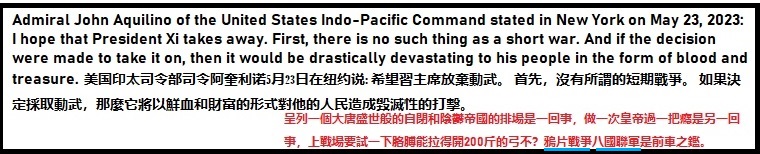
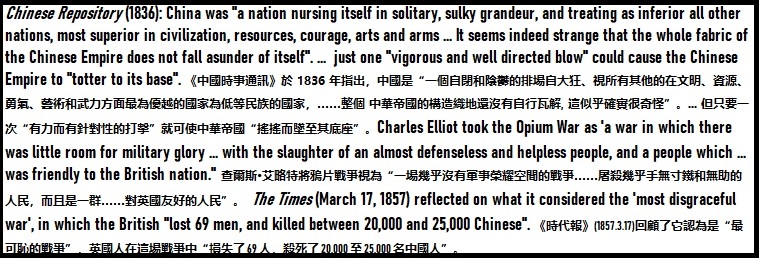






 ***
***


![Though, Anna Wang [Anneliese Martens], in her memoirs, expressed jealousy over Gong Peng by stating that the Anglo-American reporters had flattered the Chinese communists and the communist movement as a result of being entranced with the goldfish-eye'ed personal assistant of Zhou Enlai](GongPeng.jpg)