Sinitic Civilization-Book 1
Sinitic Civilization-Book 2

Tribute of Yu

Heavenly Questions
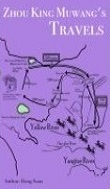
Zhou King Muwang's Travels

The Legends of Mountains & Seas
The Bamboo Annals - Book 1

The Scourge-of-God-Tetralogy:
From the Khitans to the Jurchens & Mongols: A History of Barbarians in Triangle Wars and Quartet Conflicts
(available at iUniverse;
Google;
Amazon;
B&N)
|
|
JINN DYNASTY
The Jinn Dynasty could be compared with the Roman Empire. In the Dark Age in Europe, the Roman Empire experienced incessant waves of invasion by the barbarians like the Alamanni, the Anglo-Saxons, the Franks, the Gepids, the Goths, the Lombards and the Vandals as well as the Huns and the Avars. It would be the so-called Huns who would be responsible for pushing the Germanic Ostrogoths and Visigoths westward in the late 4th century. The Huns drove the Visigoths across the Danube into the Roman Empire and caused the chain reaction that led to the defeat of the Roman army under Emperor Valens at Adrianople in 378 AD. In China, the Hunnic-Xianbei rebellion against the Jinn Chinese led to the turmoil in northern China called the 'Sixteen Nations' or the 'Five Hu [Nomadic Groups] Ravaging China'. Jinn China would be divided into two periods, Western Jinn Dynasty (A.D. 265-317) and Eastern Jinn (A.D. 317-420), with the latter ruling southern China, including the territory to the south of the Huai-shui River. (Here, I deliberately spelled Jin(4) into Jinn for sake of distinction from Jurchen Jin(1). Jin(4) is spelled Tsin in Wade-Giles.)
The Hunnic-Xianbei rebellion was the result of internal turmoil among the Jinn Chinese princes. The late Jinn China period was known as the 'Turmoil of Eight Sima Kings' (Ba Wang Zhi Luan), with the surname of Sima carrying the last character 'ma' (meaning 'horse', while si-ma, meaning administering the horse, was an ancient title for the defense minister). The dynasty was launched by the Sima family who usurped the Cao Wei Dynasty.
From A.D. 291 onwards, under the instigation of empresses, the Jinn Court underwent numerous coups. The Sima princes started their wars as a result of the manipulation by Empress Jia-hou who was married to a retarded son of Jinn Emperor Wudi. When Sima princes almost finished off each other, Wang Jun, a border general at Youzhou, i.e., today's Peking, colluded with the Xianbei in the attempt of fighting the Jinn Court.
Liu Yuan, a Hun hostage at the Jinn Court, was released for organizing the anti-Xianbei forces among the Southern Huns. Soon after that, Liu Yuan proclaimed the founding of Hunnic Han Dynasty (A.D. 304-329) in Zuoguocheng (leftside tribal statelet's city, i.e., Lishi of Shanxi), took control of Bingzhou (Shanxi) and went on to route the two Jinn capitals of Luoyang and Xi'an, respectively.
In June of A.D. 311, the Huns captured Luoyang, the capital of the Western Jinn Dynasty, and caught Emperor Huaidi who enthroned in 306 and pronounced the era of Yongjia. This came to be known in the Chinese history as the "Cataclysm of Yongjia". In A.D. 316, the Huns captured the new Jinn emperor, Mindi, in Chang'an (present Xi'an).
The Western Jinn Dynasty lasted fifty-one years with four emperors on the throne. After the demise of Jinn, China endured disunity for 272 years thereafter.
A Jinn prince, Sima Rui, had earlier crossed the Yangtze River, where he proclaimed the new Jinn Chinese Court in Jiankang (Nanking) in A.D. 317, i.e., Eastern Jinn Dynasty.
In northern China, the time period called the 16 Nations (A.D. 304-420) started already. The Chinese chronology set the year of A.D. 304 as the start of this period. However, Cheng Han (A.D. 301-347) of Di(1) nomadic nature already took over today's Sichuan Province in A.D. 301. The 16 Nations (A.D. 304-420) were comprised of various nomadic groups of people, i.e., the Huns, Jie-hu, Xianbei (including Wuhuan & Toba), Qiang, & Di. A Jie-hu under Hunnic Han (alternatively named Zhao) Dynasty set up Posterior Zhao Dynasty. Ran Min, the adopted son of Shi Le, killed all Jie-hu and set up a Wei Dynasty, alternatively called Ran Wei. Some Chinese general on the Silk Road set up Anterior Liang (A.D. 317-376). A Xianbei by the name of Murong Jun defeated Ran Min's Ran Wei Dynasty, caught Ran Min, and set up Anterior Yan (A.D. 337-370). Murong Jun's brother, Murong Chui, defeated the northern expedition led by Eastern Jinn China's Huan Wen; however, Murong Chui was not trusted by the nephew emperor. Hence, Murong Chui fled to Fu Jian's Di (1) people for asylum. Fu Jian, whose ancestor served under the Jie-hu, defeated Anterior Yan and set up Anterior Qin (A.D. 351-394). After the fall of Di's Anterior Qin, the Xianbei re-established Posterior Yan (A.D. 384-409) and the Qiangs set up Posterior Qin (A.D. 384-417). Among Western Xianbei, Qifu would set up Western Qin (A.D. 385-400, 409-431), and Tufa would set up Southern Liang[2] (A.D. 397-414). Numerous statelets, like Posterior Liang, Northern Liang, Southern Yan, Western Liang, Hunnic Xia and Northern Yan would follow. Ultimately, the Tobas, who were of the Xianbei heritage, took over northern China and assumed power in northern China after defeating the Xianbei, and the Huns. Toba would set up their Toba Wei or Northern Wei Dynasty, lasting through A.D. 386-534, till it split into Eastern Wei (A.D. 534-550) and Western Wei (A.D. 535-557).
* In Commemoration of China's Fall under the Alien Conquests in A.D. 1279,
A.D. 1644 & A.D. 1949 *
 U.S.S.R./Comintern Alliance with the KMT & CCP (1923-1927)
 Korean/Chinese Communists & the 1931 Japanese Invasion of Manchuria Korean/Chinese Communists & the 1931 Japanese Invasion of Manchuria
American Involvement in China: Soviet Operation Snow, IPR Conspiracy, Dixie Mission, Stilwell
Incident, O.S.S. Scheme, Coalition Government Crap, Amerasia Case & The China White Paper
* Stay tuned for "Republican China 1911-1955: A Complete Untold History" *
|
|
Zou Rong's Revolutionary Army;
Shin Kyu Sik's
Shrine (Spirit, Kunitama) of Korea
|
This snippet is for sons and daughters of China:
Heed the sons & ministers' agony and sorrow of our ancestors who died or lived through the Mongol, Manchu and Soviet-Chicom conquest
and
the Yongjia, Jingkang and Jiashen cataclysms !
Jeanne d'Arc of China:
Teenager girl Xun Guan breaking out of the Wancheng city to borrow the relief troops in the late Western Jinn dynasty;
Liu-Shao-shi riding into the barbarian army to rescue her husband in the late Western Jinn dynasty;
teenager girl Shen Yunying breaking into Zhang Xianzhong's rebels on the horseback to avenge on father's death in the late Ming dynasty.
China's Solitary and Lone Heroes:
Nan Jiyun breaking out of the Suiyang siege and charging back into the city in the Tang dynasty;
Zhang Gui & Zhang Shun Brothers breaking through the Mongol siege of Xiangyang in the Southern Soong dynasty;
Liu Tiejun breaking through three communist field armies' siege of Kaifeng in the Republican China time period;
Zhang Jian's lone confrontation against the communist army during the June 3rd & 4th Massacre of 1989.
|
|
|
Western Jinn Dynasty
Jinn Dynasty was founded by the Sima family. Sima Yi was originally a clerk under Han Prime Minister Cao Cao. Cao Cao used to cite the saints in ancient times to show his loyalty for the Han emperors, but his son (Cao Pi) usurped Han Dynasty and established Wei Dynasty (A.D. 220-265), leading to the Three Kingdoms time period. Sima Yi would be responsible for fighting the wars with Shu-Han Dynasty and Wu Dynasty on behalf of Wei Dynasty for dozens of years. Other than fighting the wars to the south, Sima Yi was responsible for exterminating the Gongsun Family who ruled southern Manchuria and northern and central Koreas for almost half a century and in A.D. 238 deported 40,000 households of Sinitic Chinese or over 300,000 people back to North China from Manchuria, yielding the area to the Tungunsic.
Sima Yi, who was empowered the same right as Cao Shuang for mentoring Wei Emperor Cao Fang, staged a coup and killed Cao Shuang, with Cao Shuang's whole family exterminated, including women who were married to non-Cao families.
During the Gaopingling coup, Sima Yi exterminated the three lineages of both "da jiangjun" Cao Shuang and "da si-nong" Heng Fan.
Sima Yi's elder son, Sima Shi, deposed Wei Emperor Cao Fang (reign A.D. 240-254).
Sima Yi's junior son, Sima Zhao, further authorized his people (Jia Chong) in having guard Cheng Ji kill Wei Emperor Cao Mao (reign A.D. 254-260). Sima Zhao then selected fifteen-year-old Cao Huan as the new Wei Emperor.
(The change of dynasties, from Han to Cao Wei, and then the usurpation of the Cao Wei dynasty, led to a phenomenon among the intellectuals and court officials known as "seeking hermitage" in the outside world and the emergence of a Jinn-specific nihilist life philosophy, something that contributed to the demise of the Sinitic ruling in the context of the barbarian invasion.
Sui Dynasty scholar Wang Tong had made the comment that it was not Confucius' fault that Shi-jing and Shang-shu were so popular that the Qin empire had its demise; it was not Lao-zi and Zhuang-zi's fault that the xu-xuan [virtual and metaphysical] philosophy was so popular that the Jinn Dynasty court had its demise; and it was not Sakya Buddha's fault that Liang Emperor Wudi was so indulged in Buddhism that the Southern Liang state had its demise.)
Sima Zhao dispatched General Zhong Hui and Deng Ai on a campaign against Shu Han Dynasty and destroyed Shu Han in A.D. 263. The last Shu-Han emperor, who surrendered to the Wei army, was made into Duke of Anle (happiness).
Hence, Sima Zhao, for the war efforts, was conferred the title of Duke of Jinn and the post as 'xiangguo', i.e., chief counsellor or prime minister. Shortly after that, Sima Zhao died. Sima Zhao's son, Sima Yan, succeeded the power, and further pressured Cao Huan into abdication.
Sima Yan declared the founding of Jinn Dynasty in A.D. 265, with Luoyang as the capital city. Sima Yan would be titled Jinn Emperor Wudi posthumously. (Eighty-year-old Sima Fu, the brother of Sima Yi, retired as a loyal minister of Wei Dynasty. Later, Western Jinn Emperor Mindi, when told of the story of Duke Gaoguixiang-gong [Cao Mao, i.e., the 4th Wei Emperor], threw his face onto the bed and exclaimed as to how could Jinn Dynasty sustain itself with such an atrocious history.)
Sima Yan, thinking that Wei was usurped by him as a result of lack of royal family kings and dukes, would confer kingship onto his kinsmen while all ex-kings of the Wei Dynasty were downgraded into marquis. Sima Yan also conferred the title of Duke of Lugong onto Jia Chong for his contribution to the usurpation. In A.D. 267, under the influence of Empress Yang-hou and Jia Chong, Sima Yan (Emperor Jinn Wudi) made his retarded son into the Crown Prince.
In A.D. 271, Tufa Xianbei first rebelled against Jinn China.
In A.D. 281, Murong Shegui's Xianbei, who relocated his capital city to the Liaodong-jun Commandary (Liaoyang, Liaoning) from Jicheng (thorn city, i.e., Yixian, Liaoning), began to rebel against Jinn.
In 282 A.D., Yan Xun, Jinn "an-bei jiangjun" General, repelled Murong Shegui's invasion at the Changli-jun Commandary.
Murong Shegui's sons would be Murong Tuyuhun, Murong Wei (Murong Gui) and Murong Yun.
In A.D. 272, Jia Chong's daughter was married over to the retarded Jinn Crown Prince, i.e., Sima Zhong (Jinn Emperor Huizong, reign A.D. 290-306).
In A.D. 278, Yang Hu, who was "zhen-nan [pacifying the south] jiangjun [general]", recommended Du Yu as his replacement when he died of illness.
Du Yu defeated Zhang Zheng, the Wu State's general at the western border.
In A.D. 280, Du Yu petitioned the Jinn emperor for a campaign against the Wu state.
Du Yu sacked the Jiangling city, while Wang Jun killed Lu Jing, the Wu waterborne army general.
Du Yu cited the story of Yue Yi almost exterminating the Qi Principality to propose a continuous campaign against the Wu state, claiming a proverb of cutting through the bamboo with a sharp knife.
In A.D. 280, the Jinn army, under the supervision of Jia Chong and Yang Ji, launched a multi-route land-navy assault on the Wu Dynasty, with two Jinn generals (Wang Junn and Tang Bin) leading a column of ships down the Yangtze River.
Sun Hao, the Wu State's emperor, surrendered.
After overthrowing the Wu Dynasty, China was finally reunited again.
Du Yu (222-285), a historian who claimed to Jinn Emperor Wudi that his hobby was studying Zuo-Zhuan, Chun-qiu Zuo-shi Zhuan, was conferred the title of Marquis Dangyang-xian-hou. Tang Dynasty poet Du You, a descendant, listed Yang Hu and Du Yu as the most brilliant military strategists of the Western Jinn dynasty, on par with Jiang-tai-gong of the Zhou dynasty, Wang Jian of the Qin empire, Haan Xin, Zhao Chongguo, Geng Gong, Yu Xu [who quelled the Qiangic rebellion as magistrate of the Wudu-jun commandery during Han Emperor Andi's era] and Duan Jiong [who quelled the Qiangic rebellion during Han Emperor Lingdi's era] of the Han dynasties, Sima Yi of the Cao-Wei dynasty, Zhou Yu of the Sun-Wu dynasty and Zhuge Liang of Shu-Han dynasty.
* In Commemoration of China's Fall under the Alien Conquests in A.D. 1279,
A.D. 1644 & A.D. 1949 *
U.S.S.R./Comintern Alliance with the KMT & CCP (1923-1927)
Korean/Chinese Communists & the 1931 Japanese Invasion of Manchuria
American Involvement in China: Soviet Operation Snow, IPR Conspiracy, Dixie Mission, Stilwell
Incident, O.S.S. Scheme, Coalition Government Crap, Amerasia Case & The China White Paper
* Stay tuned for "Republican China 1911-1955: A Complete Untold History" *
|
|
Zou Rong's Revolutionary Army;
Shin Kyu Sik's
Shrine (Spirit, Kunitama) of Korea
|
This snippet is for sons and daughters of China:
Heed the sons & ministers' agony and sorrow of our ancestors who died or lived through the Mongol, Manchu and Soviet-Chicom conquest
and
the Yongjia, Jingkang and Jiashen cataclysms !
Jeanne d'Arc of China:
Teenager girl Xun Guan breaking out of the Wancheng city to borrow the relief troops in the late Western Jinn dynasty;
Liu-Shao-shi riding into the barbarian army to rescue her husband in the late Western Jinn dynasty;
teenager girl Shen Yunying breaking into Zhang Xianzhong's rebels on the horseback to avenge on father's death in the late Ming dynasty.
China's Solitary and Lone Heroes:
Nan Jiyun breaking out of the Suiyang siege and charging back into the city in the Tang dynasty;
Zhang Gui & Zhang Shun Brothers breaking through the Mongol siege of Xiangyang in the Southern Soong dynasty;
Liu Tiejun breaking through three communist field armies' siege of Kaifeng in the Republican China time period;
Zhang Jian's lone confrontation against the communist army during the June 3rd & 4th Massacre of 1989.
|
|
|
About the year 279 A.D. (the Western Jinn Dynasty emperor Wudi's 5th year of the Xianning Era) or A.D. 281 (the 1st year of the Taikang Era), an important event occurred that shaped the studies of the ancient Chinese history.
A tomb digger, by the name of Fou Biao, accidentally intruded into a Warring States time period tomb in the Ji-jun Commandary (Weihui, Henan), thought to be the tomb of Wei Principality King Xiangwang (?-296 B.C.E.) or some other Wei royal member, and used the bamboo slips, which carried the black ink characters, as lighting materials to find the buried treasures.
The Western Jinn Dynasty officials, under the leadership of Xun Xu ('zhongshu jian') and He2 Jiao ('zhongshu ling'), collected the remnants of the strips totaling over ten thousand tadpole characters, which were shipped to the nation's capital by ten carts.
Shu Xi (A.D. ?-300), who was 'shangshu lang' at the court, worked with Xun Xu and Wei Heng to have the texts compiled into seventy-five chapters.
The contents were made into over one dozen books, with the most significant book being The Bamboo Annals (Zhu SHu Ji Nian), Zhou Shu (i.e., the [upper] Zhou Dynasty Records, a book that Confucius [551-479 B.C.E.] had purportedly abridged from Shang Shu [remotely ancient history] as the "wasted films"), Mu-tian-zi Zhuan ("Zhou King Muwang's Travelogue [Legends]"), and Shi Chun [which was an apparent word-for-word extraction of the necromancy paragraphs of Chun-qiu Zuo-shi Zhuan by the person called Shi Chun], etc.
Jinn Dynasty scholars, after reorganization, stated that The Bamboo Annals covered the period from the Xia dynasty to Zhou King Youwang, and then continued on to the then Wei King Xiangwang's 20th year or 299 B.C.
The Bamboo Annals stopping with a last sentence that the ending was the present [Wei] king's 20th year [namely, 299 B.C.].
The popularity of Chun-qiu Zuo-shi Zhuan during the Warring States time period could be seen in the excerpts of Shi Chun.
Xun Xu et al., relying on The Bamboo Annals, as well as Shi Ben, a remnant Zhao Principality book, corrected Sima Qian's errors in Shi-ji.
With this finding, everything that was covered in Chun-qiu Zuo-shi Zhuan was validated.
(Wei Heng and most of his family members were killed by empress Jia Nanfeng and King Chu-wang Sima Wei in A.D. 291., which was the start of the 'Turmoil of Eight Sima Kings'.)
Jinn Dynasty scholar Du Yu, who had written an annotation book Chun-qiu Jing-Zhuan Ji-jie [comprehensive interpretation] about the time he campaigned and defeated the Wu Dynasty [A.D. 280], made a comment in A.D. 281 that he just learnt that there was a Ji-jun commandery excavation, namely, The Bamboo Annals, etc., and did not validate his book against the excavated texts, such as the common mistake and confusion about Zhou King Youwang's son Bo-fu2 versus Zhou King Xiewang, a king who simultaneously existed with Zhou King Pingwang. This meant that The Bamboo Annals was excavated in 279, two years ahead of the commonly taken date of 281 when the Jinn dynasty scholars began to record the event.
At about the same time, Huangfu Mi, a great grandson of Huangfu Song and a third-level master to Eastern Jinn scholar Mei Ze (Mei Yi), wrote a ten-epoch book Di (emperors) Wang (kings) Shi4-ji that traced the history beyond Sima Qian's Shi-ji to the three sovereigns.
It was speculated that Huangfu Mi might have written something about the new findings from The Bamboo Annals, a fundamental cause that there were two sets of citation about his book in the next 900 years.
The 'Turmoil of Eight Sima Kings'
Yang Jun, who was given the task of advising Jinn Emperor Huidi, took measures to control the capital city's garrison troops.
In A.D. 291, Empress Jiahou secretly contacted King Runan-wang Sima Liang and King Chu-wang Sima Wei to have the two kings come to the capital city for dealing with Yang Jun.
With King Chu-wang's army in Luoyang, Empress Jiahou had the emperor decree to attack Yang Jun's house.
Yang Jun was killed.
King Nunan-wang Sima Liang and Wei Guan, seeing that Sima Wei was cruel, suggested that the king should return to his King Chu's domain.
King Chu-wang rallied the 36 armies in the capital city to have Sima Liang and Wei Guan killed.
Empress Jiahou then had the emperor take Zhang Hua's advice to get Sima Wei killed.
Sima Wei's son, Sima Fan, succeeded the royal line as King Xiangyang-wang.
In A.D. 296, Baima-Di[] under Yang Maosou (Linghu Maosou) rebelled against Jinn China, took the Wudu and Pinping-jun commanderies and launched the Anterior Qiuchi state. In this year, i.e., the 6th year of Yuankang Era, a Hun by the name of Hao-Duyuan rallied the Qiang and Hu tribes in rebellion, with Di[1] chieftain Qi-Wannian answering the rebellion and defeating Jinn General Zhou Chu at Liangshan (Qianxian, Shenxi). Qi-Wannian's rebellion continued to A.D. 299.
In A.D. 299, Empress Jiahou, after making the crown prince drunken, forged a letter in the crown prince's name to state the intention to usurp the throne, which led to the banishment of the crown prince to Jinyongcheng in Xuchang.
Zhang Hua, who claimed that it could not be the crown prince's letter of intent for rebellion, was deprived of the rankings.
(The crown prince's wife, Hui-feng, who was minister Wang Yan's daughter, later died in resisting Hunnic rebel Liu Yao's order to have her remarry with a Hun general.)
Sima Yong, a royal family member, asked Sun Xiu, a counsellor of Sima Lun (King of Zhao), to help the crown prince.
Sima Lun (King of Zhao) already got in touch with Sima Ya and Xu Chao, i.e., the capital district's commanders, for agitating against the empress.
Knowing that Empress Jiahou wanted to murder the crown prince, Sima Lun took the advice of Sun Xiu in sitting out the conflict and planned to usurp the throne by incriminating Empress Jiahou once the empress was to murder the crown prince.
In A.D. 300, Empress Jiahou, hearing of a rumor that was spread by Sun Xiu, sent an eunuch to poisoning the deposed crown prince, i.e., Sima Yu, who was Empress Jiahou's stepson and Emperor Huidi's elder son (grandson of Emperor Wudi [Sima Yan]).
Sima Lun, i.e., Sima Yi's 9th son, then conducted a coup to banish Empress Jiahou and got rid of the empress gang's hold on the power.
Sima Lun defeated Sima Yun (King of Huai-nan) to consolidate the monopoly of power over the court. Further, Sima Lun forced Emperor Huidi to abdicate, demoting the emperor as "tai shang huang" (paramount emperor), and changed the era to Jiangshi.
Sima Lun killed Zhang Hua, author of BO-WU ZHI (an encyclopedia of earthly things), on the pretext that he was an accomplice to the empress for refusing to join the coup against the empress.
Empress Jiahou's death in A.D. 300 triggered the turmoil in the Sichuan basin.
Zhao Xin, 'ci-shi' for the Yizhou prefecture, was a crony of Empress Jiahou. Fearing the recall to the nation's capital city, Zhao Xin decided to declare independence in the Sichuan basin, with a purported imperial era declared through December 300-January 301 per Zi-zhi Tong Jian's citation of Jinn Chun-qiu.
Zhao Xin recruited the marauders from the Qiangic and Di barbarian territory, like the Li Te brothers.
Zhao Xin killed 'nei-shi' Geng Teng [who was ordered to succeed Zhao Xin], and declared himself 'da jiangjun', 'da dudu' and 'yizhou mu'.
Zhao Xin, fearing the over 4000 mercenary cavalry of the Li Te family, then killed Li Xiang the cavalry chief, which then triggered the rebellion led by Li Te who intruded into Chengdu in January A.D. 301 and killed Zhao Xin at Guangdu.
Li Te was credited as founder of the Cheng-Han dynasty with start year A.D. 303 and posthumous title of Emperor Jinghuangdi (r. Jan-Feb A.D. 303).
Li Te, over rumors that the Jinn court wanted the Di[1] marauders relocate back to Guan-zhong and that the new Jinn magistrate for Sichuan was scheming to kill the native Di[2] and Sou people' marquis and kings, rebelled against new Yizhou satrap Luo Shang.
Li Xiong, i.e., Li Te's son, sacked Chengdu in A.D. 304 and called himself King Chengdu-wang, officially launching the Cheng-Han regime, and in A.D. 306 upgraded himself to be an emperor.
* In Commemoration of China's Fall under the Alien Conquests in A.D. 1279,
A.D. 1644 & A.D. 1949 *
U.S.S.R./Comintern Alliance with the KMT & CCP (1923-1927)
Korean/Chinese Communists & the 1931 Japanese Invasion of Manchuria
American Involvement in China: Soviet Operation Snow, IPR Conspiracy, Dixie Mission, Stilwell
Incident, O.S.S. Scheme, Coalition Government Crap, Amerasia Case & The China White Paper
* Stay tuned for "Republican China 1911-1955: A Complete Untold History" *
|
|
Zou Rong's Revolutionary Army;
Shin Kyu Sik's
Shrine (Spirit, Kunitama) of Korea
|
This snippet is for sons and daughters of China:
Heed the sons & ministers' agony and sorrow of our ancestors who died or lived through the Mongol, Manchu and Soviet-Chicom conquest
and
the Yongjia, Jingkang and Jiashen cataclysms !
Jeanne d'Arc of China:
Teenager girl Xun Guan breaking out of the Wancheng city to borrow the relief troops in the late Western Jinn dynasty;
Liu-Shao-shi riding into the barbarian army to rescue her husband in the late Western Jinn dynasty;
teenager girl Shen Yunying breaking into Zhang Xianzhong's rebels on the horseback to avenge on father's death in the late Ming dynasty.
China's Solitary and Lone Heroes:
Nan Jiyun breaking out of the Suiyang siege and charging back into the city in the Tang dynasty;
Zhang Gui & Zhang Shun Brothers breaking through the Mongol siege of Xiangyang in the Southern Soong dynasty;
Liu Tiejun breaking through three communist field armies' siege of Kaifeng in the Republican China time period;
Zhang Jian's lone confrontation against the communist army during the June 3rd & 4th Massacre of 1989.
|
|
|
In A.D. 301, Sima Jiong, who assisted Sima Lun in killing Empress Jiahou one year earlier, contacted Sima Yong et al to oppose Sima Lun's enthronement.
Sima Ying, who had his fief at Yecheng (Linzhang of Hebei), colluded with Sima Yong (King of He-jian) and Sima Jiong (King of Qi) to attack Sima Lun (King of Zhao). Sima Lun, who was first put under house arrest at Jinyongcheng, was later killed together with four sons.
In August of A.D. 302, Sima Jiong erected eight-year-old Sima Tan (King of Qinghe) as the crown prince while he himself acted as the tutor for the crown prince.
In December of A.D. 302, Sima Yih ('piaoqi/piaoji jiangjun' and King of Changsha) and Sima Yong attacked Sima Jiong from inside and outside of the Jinn capital, defeating Sima Jiong.
Sima Yih's army laid siege of Luoyang, and killed Sima Jiong after a three-day battle. Sima Jiong's three lineages were exterminated.
In 303, Sima Yong and Sima Ying, being resentful over Sima Yih (King of Changsha)'s monopoly of power, joined forces to attack the capital city of Luoyang.
Zhang Fang, commanding 70,000 troops, attacked from the west, while Sima Ying's army, about 200,000, attacked from the north.
The battles lasted several months. In October, the siege against Luoyang began.
In early 304, Sima Yue conducted a coup in Luoyang, killed Sima Yih, and surrendered to and welcomed Sima Ying into Luoyang.
Sima Ying was conferred the post as prime minister, and self-proclaimed himself the crown brother.
In July 304, "shangshu-ling" Sima Yue, who controlled the puppet emperor (Jinn Huidi), launched a northern campaign to attack Sima Ying. After a defeat at Dangyin (Tangyin), Sima Yue (King of Dong-hai) fled east to his own fief, Donghai-guo at Xuzhou.
Sima Ying retrieved and welcomed puppet Jinn Emperor Huidi into Yecheng, where he changed the era to Jianwu.
Future founder of Eastern Jinn Dynasty, Sima Rui, who was a lieutenant for Sima Yue, was caught by Sima Ying. Sima Rui later fled Yecheng.
In August, Sima Teng (Sima Yue's brother) and Wang Jun, a Jinn Dynasty border general ("ci-shi") and an enemy of Sima Ying, on the pretext that Sima Ying had insulted the emperor [with abduction], invited the Xianbei (chieftain Duan Wuhuchen) and Wuhuan (chieftain Jiezhu), i.e., the proto-Tungusic people, as well as Sima Teng (Duke Dongying-gong) in attacking Sima Ying.
Wang Jun's Xianbei-allied army reached Ye, with Jie-zhu defeating Sima Ying's army.
After a defeat, Sima Ying and Emperor Huidi fled towards Luoyang.
The Xianbei under Wang Jun sacked Yecheng, conducted a massacre of the city, looted several tens of thousands of Chinese women for the north, and dumped the remaining 8 thousand women into the Yi-shui River when Wang Jun ordered the barbarians to surrender all women hidden among the troops.
Sima Ying and the emperor fled by a dozen cavalry. En route, they met Zhang Fang who commanded 20,000 troops to the rescue at the order of Sima Yong. Zhang Fang, controlling the emperor, hence forced the entourage to move to Chang'an.
Taking advantage of the new rounds of war, Sima Yong, with a large force headed by Zhang Fang, took over Luoyang, forcing both Emperor Huidi, Sima Chi (King of Yuzhang) and Sima Ying into relocation to Chang'an, and restored the era of Yong'an.
In December, Sima Yong petitioned the emperor to banish Sima Ying so as to weaken the power of the Sima prince in East China.
In December 304, Sima Yong revoked the crown brother title from Sima Ying, and transferred it onto Sima Chi. Further, Sima Yong changed the era to Yongxing, and ordered Sima Ying to return to Yecheng.
Sima Muo, Duke Pingchang-gong, a brother of Sima Yue, was sent to Ye to take the fief from Sima Ying.
On the pretext of retrieving Sima Ying, Gongshi Fan, a Sima Ying subordinate, came over with an army, pillaged the way back to Yecheng in July of A.D. 305, where they were defeated by Gou Xi, a general sent over by Sima Xiao. Serving under Gongshi Fan would be a Jie-hu barbarian band. Gongshi Fan was later killed by Gou Xi.
In July of 305, Sima Yue and Sima Xiao rallied a force to attack Sima Yong so as to fetch the emperor for returning east. Sima Yue retained Sima Rui at Xiapi for supervising Xuzhou and Dongping.
In August, Sima Yue appointed Sima Ying as "da jiangjun" and the post in charge of "he-bei" (north-of-the-Yellow-River) with garrison at Yecheng.
In September of A.D. 305, Sima Yong re-appointed Sima Ying.
Sima Ying [who previously hired the Huns and in 304 released Liu Yuan to the Hunnic domain], with the posts [appointed by Sima Yong] in charge of the "he-bei" (north-of-the-Yellow-River) territory, returned towards Luoyang and Ye to the east.
Liu Yuan was Hunnic 'zuo-bu shuai' and 'five Hunnic tribes da-dudu'.
While stationing in Luoyang in December, Sima Ying, fearing Sima Yue's strong northern army, fled towards "guan-zhong" (i.e., the area around Chang'an).
Sima Yue launched a new war, defeated Sima Yong, and sacked Chang'an.
Sima Yong and Sima Ying fled to "Nanshan" (i.e., the Qinling Ridge) and moved to the Han-shui area.
In May of A.D. 306, Sima Yue's herald army, commanded by Qi Hong, defeated Sima Yong's army.
Sima Yong and Sima Ying fled to the Nanshan (Qinling Ridge) area.
Sima Yue, with the Xianbei mercenaries among his armies, pillaged Chang'an.
The Xianbei mercenaries, who served in Qi Hong's army on behalf of Sima Yue, killed over 20,000 people.
[Was this the incident that the later Tang and Soong poets, Zhang Ji and Su Shi, had talked about, respectively, by hinting the Xianbei to be "huangtou (yellow head)" Xianbei? Does not appear to be so since Zhang Ji's poem claimed that the Xianbei had actually sat down at the "ming [bright] tang [house]" (i.e., a Zhou Dynasty's ancestral temple, which was termed "tai [grand] shi [house]" in the Xia dynasty time period or "chong [double] wo [house]" in the Shang dynasty time period) to be judge-kind of figures in a pretentious way --which was erroneously linked to the Hunnic sacking of Luoyang in A.D. 311, instead. That is, the Tang poet had either mistaken the Huns to be the Xianbei or treated the Huns to be the same as the Xianbei -- whereas the Xianbei, as we discussed in the Koreans' section, had indeed taken over the Hunnic land at the turn of the 1st and 2nd centuries after the defeat of the Huns, and further incorporated the remnant Huns among their ranks.
Modern erudite Wang Guowei had located more Jinn, Tang and Soong dynasty writers' poems with description of the hairy and highnose physique. Wang Guowei ascertained Posterior Tang Emperor Zhuangzong's appearance through a record about Wang Jinqing's observance of the emperor's statute near Luoyang, which exhibited someone with hair surrounding the two eyes.]
In June of A.D. 306, Sima Yue escorted Jinn Emperor Huidi back to Luoyang.
In August, Sima Yue was appointed the post as "tai-fu", namely, one of the top three gentlemen of the court.
Subsequently, Sima Yong and Sima Ying were killed consecutively.
En route of escape towards the east for conversion with Gongshi Fan's army, Sima Ying was caught by Feng Song, "tai-shou" for Dunqiu, and transferred to Yecheng for house arrest.
In October, Sima Xiao died.
In November, Sima Yue killed emperor Jinn Huidi with poisonous pancake, and erected Sima Chi as Jinn Emperor Huaidi.
In December, an official ("zhang-shi") at Yecheng, being afraid that Sima Ying could rise up again, ordered to have Sima Ying killed secretly after Sima Xiao (King of Fanyang) passed away at Yecheng in October.
In the Han-shui River area, Sima Muo (King of Nanyang and a brother of Sima Yue) killed Sima Yong (King of He-jian) at Yonggu in December.
After the death of Gongshi Fan in A.D. 306 in the hands of Gou Xi [who served Sima Xiao, King of Fanyang, after Sima Ying defeated Sima Yue and Emperor Huidi's expedition], Ji Sang and Shi Le, two Jie-hu barbarians, returned to the Shandong territory where they rallied some troops to continue the battles against Sima Yue and Sima Teng.
In 307, Ji Sang, whose boss was killed while crossing the Yellow River at Baima-xian the previous year, declared himself "da jiangjun".
The Jie-hu barbarian leaders sacked Yecheng and killed Sima Teng after sacking Yecheng.
Ji Sang carried Sima Ying's coffin in the army. Sima Yue sent Gou Xi against Ji Sang while the latter was to attack Yanzhou.
Gou Xi defeated Ji Sang in 8-9 battles.
In the subsequent battles, Ji Sang was killed by the marauding migrants under Sima Teng.
Sima Teng, as a result of famine in Bingzhou, took people to Jizhou, which was said to have started the marauding "qi [beg] huo [life] jun [army]" in North China that was to continue for dozen years.
During the war years, there were no grain harvests and hence the marauding history of China was a repeating theme of cannibalism which saw the antagonistic armies eating the opposite parties as food.
Shi Le, after the death of Ji Sang, then joined Liu Yuan's Hunnic army to attack the Jinn court.
In Jizhou (today's Hebei), Shi Le defeated and killed Jinn General Liang Ju and massacred tens of thousands of Jinn troops.
Later, Gou Xi, who was retained by multiple Sima kings as general and took part in Sima Yue's campaign against Sima Ying at Yecheng in A.D. 304, was killed by Shi Le in A.D. 311.
When Wang Jun invited the Xianbei and Wuhuan nomads (proto-Tungusic people) in attacking the Jinn Chinese capital in A.D. 304, Liu Yuan requested with the Jinn emperor to go back to the Hun tribes for organizing the counter-Xianbei forces.
Liu Yuan returned to the Huns, and helped Jinn defeat the Xianbei and the Jinn rebel Wang Jun. Thereafter, Liu Yuan was appointed 'Da dudu' (i.e., "grand marshal") of the five Hunnic Tribal Groups. Liu Yuan then rebelled against the Jinn Chinese.
To counter the rebellions, the Jinn court conferred the title of dukes onto the Xianbei chieftains, with Duan Xianbei chieftain Duan Wuwuchen as Duke Liaoxi-gong,
Tuoba Xianbei chieftain Tuoba Yilu as da-chanyu and Duke Dai-guo-gong,
and Murong Xianbei's self-proclaimed title of da-chanyu in Liaodong acknowledged.
In A.D. 311, Hunnic King Youxianwang Liu Xuan proposed that Liu Yuan proclaim himself to be the great Hunnic emperor. Liu Yuan, who, like all other Hunnic kings, had adopted the family name "Liu" of Han emperors, agreed to the proposal and proclaimed the founding of the dynasty of Hunnic Han, meaning a posterior dynasty of Han against Jinn (A.D. 265-316) and Wei (A.D. 220-265) which usurped Han, in the sense of succession. Liu stated, "The great Chinese saint, Lord Yu, was originally a Xirong (western Rong) and the Zhou kings (1122? BC - 221 B.C.) were from the Dongyi (eastern Yi), where is the logic that the emperors must be of the same ethnical origin?" After Liu Yuan's death, the Huns under Liu Yuan's son, Liu Cong, took over the Jinn capital Luoyang in A.D. 311.
After the Huns sacked Luoyang in June, Xun Fan ('si-kong'') fled to Yangcheng, and Hua Hui ('henan yin') fled to Chenggao.
Li Ju, commanding the hometown villager forces, cracked down on rebel Hou Du, and supported Xun Fan and Hua Hui in re-establishing the regime (i.e., 'xing [moving] tai [platform]').
Xun Fan, acting as 'tai wei', assigned Li Ju the post of 'tai-shou' for Xingyang.
Xun Fan made Chu Sha into "Liang-guo nei-shi', and Wei Jun a general in charge of the Shiliang-wu fortress to the north of Luoyang.
Li Ju, who had been responsible for cracking down on Qi-wan-nian's Di1 barbarian rebellion in the late 3rd century, rallied a hometown citadel force as 'wu zhu' (village fortress head) at the time Liu Yuan's Huns invaded Pingyang in A.D. 308.
In October of 311, Li Ju repelled Shi Le's attack in a mountain valley ambush, for which he received the conferral from Sima Rui the titles of Marquis Yangwu-xian-hou and General 'Guan-jun' (i.e., champion), with concurrent posts of 'tai-shou' for He-dong and Pingyang.
In A.D. 311, Sima Yue, i.e., King of Dong-hai (east sea), mustered a force of 200,000 against Shi Le's Jie-hu; however, en route, Sima Yue died of illness. Gou Xi, who was suspected by Sima Yue of rebellion, was retained by Emperor Huaidi as "da jiangjun - da dudu'"; however, Emperor Huaidi did not take Gou Xi's advice in relocating the capital. Wang Yan ("tai wei", imperial captain) was supported as the new military leader against the Hu and Jie-hu. Wang Yan sent Qian Rui against the barbarian rebels. Shi Le defeated and killed General Qian Rui. Wang Yan et al., half a dozen royal princes and high office holders, were killed by Shi Le via locking them up in a house and then capsizing the walls at night.
Hearing of the tragedy of the expedition force, Heh Lun and Li Hun, i.e., leftside and rightside garrison generals, took Sima Yue's wife and son on an escape from Luoyang. En route, the entourage was intercepted by Shi Le, with another batch of royal family members and high office ministers killed by the barbarians.
Shi Le then took 30,000 cavalry to converge with Liu Yao's Hunnic army to lay siege of Luoyang. After sacking Luoyang, Shi Le ascribed the contribution to Liu Yao's Hunnic army and departed for Xuchang.
Hence began the historical time period called the "Five Hu [Nomadic Groups] Ravaging China", with the five groups being the Huns, Jie-hu, Xianbei (including Wuhuan & Toba), Qiang, & Di.
After the loss of the capital, Gou Xi and Wang Zan fled to Cangyuan, where they supported Sima Rui (King of Yuzhang) as the crown prince. Gou Xi subsequently moved to Mengcheng while Wang Zan garrisoned at Yangxia. Both resisted Shi Le till captured and killed by Shi Le.
In the aftermath of the loss of Luoyang,
Li Hun, after killing his own wife, fled to Guangzong (Wei[1]xian of Hebei) where he re-assembled the anti-Hun and anti-Jie-hu forces, later named it the "qi [beg] huo [life] jun [army]", and fought against the Jie-hu barbarians till killed at the Battle of Shangbai in A.D. 313.
Serving under Li Hun would be a general called by Guo Jing whose life was spared by Shi Le for the favor Shi Le received while he was being sold as a slave in North China. Shi Le, in lieu of massacre, spared Li Hun and Guo Jing's remnant army, allowing the Chinese troops to form a separate army under the Jie-hu command.
South of the Yellow River, Chen Wu and Chen Chuan brothers rallied another "qi [beg] huo [life] jun [army]" at Chenliu (east of Kaifeng, Henan).
Chen Wu, with Wang Zan, previously followed Gou Xi's order to counterattack the barbarians after Emperor Huaidi (Sima Chi) sent a handwritten decree empowering Gou Xi with the omnipotent military power in A.D. 311.
The "qi [beg] huo [life] jun [army]" was said to have modelled after Sima Teng's relocating over 20,000 households to Jizhou (Hebei) from Bingzhou (Shanxi) in the consequence of famine.
The [Western] Jinn court selected a new emperor one year later and re-established its capital in Chang'an (today's Xi'an, Shaanxi province), only to be sacked again in A.D. 316.
In 313, after the news came that Huaidi was poisoned to death, Zi-ye, the 3rd son of Sima Yan {King of Wu), who was made into the crown prince and the regent in October of A.D. 312, was supported by Qu Yun, Suo Lin and Liang Fen to become an emperor, i.e., Jinn Emperor Mindi (Sima Ye, 300-318, reign 313-316). At Chang'an, the total households left numbered no more than 100. The palace and court did not even have horses and chariots for the emperor to ride. Altogether there were four carts in the city. Emperor Mindi sent a message to Sima Rui (King of Langya) at Shouchun, calling for a concerted campaign against the barbarians. Liu Shu, i.e., Mindi's emissary, reached Yangzhou at the Yangtze bank in August.
There was a plan to have three routes of armies attack the Huns, including the northern prong by Liu Kun and the eastern prong by Sima Rui.
'Bingzhou ci-shi' Liu Kun (270-318), who was at one time
'ji-shi du' and 'cong-shi[4] zhong-lang' for Sima Lun and 'ta-zi zhan-shi [4]' when Sima Lun claimed the emperor's throne before subsequently engaging himself in more Sima princes and kings' civil wars, was sent to Jinyang in the north by Sima Yue in A.D. 306-307 to be in charge of Xinxing and Yanmen commanderies, etc.
With the Huns (Xiongnu) to the west and south,
the Tuoba-Xianbei Dai state to the north,
and
Youzhou satrap Wang Jun and his Duan-shi Xianbei to the east,
Liu Kun allied with Tuoba Yilu and sworn as brothers
against the Huns and Shi Le's Jie-hu barbarians.
In A.D. 310, Liu Kun and Tuoba Yilu
defeated Liu Wulugu (Liu Wu/Liu Hu, ?-341, r. A.D. 309-341)'s Hunnic Tiefu tribe and
the Bai-bu (white) Xianbei tribe (that was taken by Zi-zhi Tong Jian as the Murong Xianbei that had origin in the White Mountain of Changbaishan in Manchuria).
At Liu Kun's recommendation, Tuoba Yilu was
conferred the titles of
'da-chanyu' (great chanyu' and King Dai-wang, after which Liu Kun came into conflicts with Wang Jun over the control of Daizhou.
Tuoba Yilu repelled Wang Jun's attack.
In A.D. 312, Jinn Shu stated that Liu Kun requested military assistance with Tuoba Yilu and petitioned to have the Jinn emperor confer the title of Duke Dai-gong onto Tuoba Yilu.
Liu Kun, a talented arts and music person but was criticised by historians for lack of capabilities, killed 'fenwei jiang-jun' Linghu Sheng for cunnining musician Xu Run's slander, which led to Linghu Sheng's son Linghu Ni's defection to Hunnic Han.
'Shangdang tai-shou' Xi Chun also rrendered to Hunnic Han.
When Liu Kun left Jinyang for quelling the Wuhuan rebellion at Yanmen, Liu Cong in A.D. 312 sent son Liu Can to stealthily raiding and sacking Jinyang under the guidance of Linghu Ni.
At Jinyang, 'Taiyuan tai-shou' Gao Qiao and 'Bingzhou bie-jia[-cong-shi{4}] (adjutant)' Hao Yu surrendered to the Huns.
Liu Kun recovered Jinyang (Tauyuan) with Tuoba Yilu's help.
In A.D. 313, Emperor Mindi conferred upon Liu Kun the titles and posts
of
'da-jiangjun', and
'dudu Bing-Ji-You zhu-jun-shi[4]'.
In March of A.D. 314, Shi Le sacked Youzhou, killed 'zhou-mu' Wang Jun, and massacred over 10,000 people.
In early 314, Liu Kun answered Emperor Mindi's call to attack south. With Liu Kun moving along Xihe (western Yellow River) against Xiping (Linfen) and Tuoba chieftain Yilu attacking Pingyang, Liu Cong realigned the Hunnic army and repelled the attack.
After the failed attack at the Huns, Liu Kun authorized Guo Mo, 'tai-shou' for He-nei, to serve under Li Ju. Surrounded by the Anterior Zhao Dynasty's Huns, Guo Mo dared not leave fort for the south of the Yellow River.
Borrowing a Xianbei cavalry contingent, about 500 cavalrymen accompanying Liu Kun's emissary on a trip to Chang'an, Li Ju managed to cause detente onto the Huns, and furthermore launched a night raid against Huaicheng and defeated the Huns.
Guo Mo hence crossed the Yellow River in small boats.
In July of A.D. 316, Liu Yao's Hunnic army sacked Bei-di and subsequently took over the land north of the Wei-shui River. In October, the capital city of Chang'an ran out of grain supply. By the end of November of A.D. 316, Liu Yao, after laying siege of Chang'an since August, sacked Chang'an. Emperor Mindi surrendered, and was made into Marquis Huaian-hou.
(Back in March of A.D. 307, Sima Rui, i.e., King of Langya, proclaimed himself King of Jinn at Jiankang and declared the era of Jianwu. After the death of Emperor Mindi in December 317, Sima Rui officially became an emperor and started the Eastern Jinn court south of the Yangtze.)
In A.D. 317, Liu Kun sent newphew-in-law 'zuo-zhangshi' Wen Qiao (288-329) to Jiankang for requesting Sima Rui to declare himself an emperor in southern China.
Duan Pidi's emissary was 'zuo-zhangshi' Rong Shao who was previously 'san-ji chang-shi' and 'Qinghe tai-shou'.
With two Jinn rulers in Chang'an and Jiankang, two groups of Jinn forces competed for power in the area between the Yangtze River and Yellow River.
In Xiangyang, Di Wuyi, i.e., 'ci-shi' for Jingzhou, was assigned by late Jinn Emperor Mindi.
Du Zeng ('tai-shou' for Jingling), who was related to Di Wuyi, was in the pro-Chang'an regime camp.
Tao Kan forced him into retreating north to Shunyang-jun.
This snippet is for sons and daughters of China:
Heed the sons & ministers' agony and sorrow of our ancestors who died or lived through the Mongol, Manchu and Soviet-Chicom conquest
and
the Yongjia, Jingkang and Jiashen cataclysms !
Jeanne d'Arc of China:
Xun Guan breaking out of the Wancheng city to borrow a relief army in the late Western Jinn dynasty;
Liu-Shao-shi riding into the barbarian army to rescue her husband in the late Western Jinn dynasty;
Shen Yunying breaking into Zhang Xianzhong's rebels on the horseback to avenge on father's death in the late Ming dynasty;
China's Solitary and Lone Heroes:
Nan Jiyun breaking out of the Suiyang siege and charging back into the city in the Tang dynasty;
Zhang Gui & Zhang Shun Brothers breaking through the Mongol siege of Xiangyang in the Southern Soong dynasty;
Liu Tiejun breaking through three communist field armies' siege of Kaifeng in the Republican China time period
;
Zhang Jian's lone confrontation against the communist army during the June 3rd & 4th Massacre of 1989.
|
|
At Wancheng, Xun Song, a great grandson of Xun Yu of the Cao-Wei Dynasty time period, supported the Jiankang regime.
In the spring of A.D. 317, Du Zeng attacked Wancheng.
Xun Guan, a thirteen year old daughter of Xun Song, volunteered to break out of the siege to seek relief.
With a few dozens of brave men, the girl broke out of the siege. Alone, the girl reached Xiangcheng and asked help with Shi Lan who suggested to go to Xunyang for 'tai-shou' Zhou Fang to help.
Xun Guan then wrote a letter in the name of her father and went to Xunyang.
Zhou Fang sent son Zhou Hu to the relief of Wancheng.
In February of A.D. 317, Liu Chang and about 30,000 Hunnic army attacked Xingyang.
Li Ju stationed at the former King Haan-wang's fortress, about seven leagues from the Huns.
Li Ju declined the Huns' emissary as to surrender.
To delay the Hunnic attack, Li Ju showed off the weak and old soldiers to the Hunnic emissary, sent a return mission to Liu Chang with beef and wine, and then launched a night raid.
Li Ju was noted in Jinn Shu for at one time ordering the prays at the former Zheng Principality minister Zi-chan's temple to ask for blessings before attacking the Huns commanded by Liu Chang, a cousin of Liu Cong.
The word spread was like this: "When you (Zi-chan) were prime minister of the Zheng state, the vicious birds dared not make noise; how could the vicious Hu barbarians ('xiong Hu') and the repugnant odorous Jie-hu barbarians ('chou Jie') be allowed to pass the front hall of your tomb?"
During the raid, Liu Chang barely escaped alive.
Guo Zhi, a brother of Guo Mo, chased the Huns after being given 500 horses from Li Ju.
Further, Li Ju won over Zhao Gu from the Hunnic camp, and retained Zhao Gu as commander for Luoyang.
Zhao Gu and Li Ju, two loyal Jinn generals, intruded into the Hun-controlled territory to fight the Huns.
* In Commemoration of China's Fall under the Alien Conquests in A.D. 1279,
A.D. 1644 & A.D. 1949 *
U.S.S.R./Comintern Alliance with the KMT & CCP (1923-1927)
Korean/Chinese Communists & the 1931 Japanese Invasion of Manchuria
American Involvement in China: Soviet Operation Snow, IPR Conspiracy, Dixie Mission, Stilwell
Incident, O.S.S. Scheme, Coalition Government Crap, Amerasia Case & The China White Paper
* Stay tuned for "Republican China 1911-1955: A Complete Untold History" *
|
|
Zou Rong's Revolutionary Army;
Shin Kyu Sik's
Shrine (Spirit, Kunitama) of Korea
|
This snippet is for sons and daughters of China:
Heed the sons & ministers' agony and sorrow of our ancestors who died or lived through the Mongol, Manchu and Soviet-Chicom conquest
and
the Yongjia, Jingkang and Jiashen cataclysms !
Jeanne d'Arc of China:
Teenager girl Xun Guan breaking out of the Wancheng city to borrow the relief troops in the late Western Jinn dynasty;
Liu-Shao-shi riding into the barbarian army to rescue her husband in the late Western Jinn dynasty;
teenager girl Shen Yunying breaking into Zhang Xianzhong's rebels on the horseback to avenge on father's death in the late Ming dynasty.
China's Solitary and Lone Heroes:
Nan Jiyun breaking out of the Suiyang siege and charging back into the city in the Tang dynasty;
Zhang Gui & Zhang Shun Brothers breaking through the Mongol siege of Xiangyang in the Southern Soong dynasty;
Liu Tiejun breaking through three communist field armies' siege of Kaifeng in the Republican China time period;
Zhang Jian's lone confrontation against the communist army during the June 3rd & 4th Massacre of 1989.
|
|
|
In December of A.D. 317, Liu Cong took advice to kill "Zi-ye" (i.e., deposed Jinn Emperor Mindi of age 18) so that his name could not be used to rally the anti-Hunnic forces.
To deal with Liu Kun, Liu Cong appointed Shi Le the post of "ci-shi" for Bingzhou.
Shi Le was to divide and conquer Liu Kun and Duan Pidi.
In A.D. 317, Eastern Jinn Emperor Yuan conferred upon Liu Kun the posts of
'shi-zhong'
and
'tai-wei'.
Duan Pidi separately appointed Liu Kun as 'da-dudu' (grand governor-general) over the Duan-shi Xianbei's army to attack Shi Le.
Shi Le sowed dissension by bribing Duan Pidi's cousin Duan Mobei, which resulted in internal discord among the Duan-shi Xianbei.
In A.D. 318, Duan Mobei defeated Duan Pidi, Liu Kun's son Liu Qun
and declared himself 'da-chanyu'. Duan Mobei captured Liu Kun's son Liu Qun and treated him well. Liu Qun wrote a letter to Liu Kun to form an alliance against Duan Pidi, over which Liu Kun was arrested by Duan Pidi.
The following year, several generals under Liu Kun attempted to rebel and rescue Liu Kun but failed.
Purportedly, Eastern Jinn minister Wang Dun sent a messenger to Duan Pidi with authorization to execute Liu Kun.
On the 8th day of May, Duan Pidi executed Liu Kun and his three sons, one nephew and two clan nephews in the name of the Jinn emperor.
Liu Kun, hearing that Wang Dun's emissary had come but did not see him, commented to his son Liu Zun that they were to be executed and wrote a poem about unrealized life mandate with citation of historic figures in Chinese history and regrets about unfulfilled mission to avenge national and familial humiliation.
Previously serving under Wang Jun would be Shao Yi, a son of Shao Xu who had rallied a local army in Yanci (Yangxin).
After Shi Le's Jie-hu army sacked Youzhou and killed Wang Jun, Shi Le had Shao Yi pacify father Shao Xu.
Duan Pidi, who was based in Jizhou (south of Peking), called on Shao Xu to serve under Eastern Jinn Emperor Yuandi.
Shi Le killed hostage Shao Yi over his father's defection.
With the help of Duan Wenyang's Xianbei army, Shao Xu repelled the Jie-hu attack.
Later in A.D. 318, Duan Pidi, after killing Liu Kun, lost support.
The Duan Xianbei family members got embroiled in the internecine fight.
The Jie-hu took advantage of the situation to defeat both Duan Pidi and Shao Xu.
In A.D. 319, Duan Pidi abandoned Jicheng and came to Leling to seek Shao Xu's protection.
Other than battling the Jie-hu, Shao Xu had to constantly fight Cao Yi, a warlord in today's Shandong peninsula and a former follower of Wang Mi (a descendant of Wang Shuo).
Duan Pidi, who was reinforced with Shao Xu's troops, fought back towards the north against the Xianbei adversaries.
In A.D. 321, taking advantage of Duan Pidi's campaign to the north, Jie-hu sacked Yanci (Fuping-cheng), i.e., Shao Xu's homebase.
Duan Pidi had suffered defeat when he borrowed Shao Xu's army in a northern campaign against his clansmen, which gave the Jie-hu an opportunity to attack in the waist.
Duan Pidi retreated south to Shao Xu's homebase.
Shao Ji, i.e., Shao Xu's brother, surrendered Duan Pidi to the Jie-hu.
Shao Xu's son-in-law, i.e., Liu Xia, continued the resistance against the barbarians in today's Shandong-Jiangsu area.
Though Western Jinn Emperor Mindi was dead, his Jianxing Era was being used by Anterior Liang at the Western Corridor till A.D. 353, when Zhang Zuo usurped the throne belonging to the family of his brother Zhang Gui and publicly named the era of Heping.
Zhang Gui established
the Wuxing-jun commandery at Guzang, and the Jinxing-jun commandery south of the Huangshui River for resettling the Chinese refugees. At the northwesternmost segment of the Western Corridor, a Jinchang-jun commandery was set up.
Under the attack of Hunnic Anterior Zhao (formerly Hunnic Han, A.D. 304-329), Zhang Mao, i.e., Zhang Shi's brother, received the conferred title of King Liang-wang, i.e., the regime of
Anterior Liang (A.D. 317-376) at Liangzhou.
Zhang Jun, i.e., Zhang Shi's son, inherited Zhang Mao's title but proactively attacked Hunnic Anterior Zhao.
Zhang Jun and Yang-nan-di attacked Liu Yao's Anterior Zhao which was allied with Di[1]-Qiang.
In A.D. 327, Zhang Jun was defeated by Hunnic Anterior Zhao.
After Anterior Liang's defeat, Murong Tuyan, i.e., Murong Tuyuhun's son, was pressured by the Huns into leaving the Xia-he River area in A.D. 329 for the Bailan-qiang's high plateau, to the north of mount Jishishan (Animaqing), where he was killed by Qiangic chieftain Jiang Cong.
In A.D. 329, Shi Le's Posterior Zhao destroyed Liu Yao's Anterior Zhao Dynasty, and took control of Longdong and Linxia.
Later in A.D. 353, Zhang Zuo usurped the Anterior Liang throne and adopted the era of Heping.
The Scourges-of-God Tetralogy
would be divided into four volumes covering
Hsiung-nu (Huns), Hsien-pi (Xianbei), Tavghach
(Tuoba), Juan-juan (Ruruans), Avars, Tu-chueh (Turks), Uygurs (Huihe), Khitans, Kirghiz, Tibetans, Tanguts, Jurchens, Mongols and Manchus and
southern barbarians.
Book I of the tetralogy would extract the contents on the Huns from
The Sinitic Civilization-Book II,
which rectified the Han dynasty founder-emperor's war with the Huns on mount Baideng-shan to A.D. 201 in observance of the Qin-Han dynasties' Zhuanxu-li calendar.
Book II of the Tetralogy would cover the Turks and Uygurs.
And
Book IV would be about the Manchu conquest of China.
From the Khitans to the Jurchens & Mongols: A History of Barbarians in Triangle Wars and Quartet Conflicts
, i.e., Book III of
the Scourge-of-God-Tetralogy,
focused on the Khitans, Jurchens and Mongols, as well as provided the annalistic history on the Sui and Tang dynasties, the
Five Dynasties & Ten Kingdoms, and the two Soong dynasties.
Similar to this webmaster' trailblazing work in rectifying the Han dynasty founder-emperor's war with the Huns to 201 B.C. in The Sinitic Civilization - Book II,
this Book III of the Scourge-of-God-Tetralogy
collated
the missing one-year history of the Mongols' Central Asia campaigns and restituted the
unheard-of Mongol campaign in North Africa.
|
The Scourges of God: A Debunked History of the Barbarians" - available at iUniverse|Google|Amazon|B&N
From the Khitans to the Jurchens & Mongols: A History of Barbarians in Triangle Wars and Quartet Conflicts
(The Barbarians' Tetralogy - Book III)
Epigraph,
Preface,
Introduction,
Table of Contents,
Afterword,
Bibliography,
References,
Index
|
|
Table of Contents
(From the Khitans to the Jurchens & Mongols: A History of Barbarians in Triangle Wars and Quartet Conflicts)
Section One: The Barbarians of the Steppes
Chapter I: The Hu (Huns) & Eastern Hu Barbarians ............................................1
The Huns .............................................................................................................3
The Eastern Hu (Dong-hu) Barbarians: Xianbei & Wuhuan ....................................7
The Duan, Murong & Yuwen Xianbei Clans, and the Tuoba Xianbei ..................... 13
The Khitans, Xi, Kuzhen-xi, Shi-wei & Malgal ......................................................15
Section Two: The Sui & Tang Dynasties
Chapter III: The Turks vs. the Sui Dynasty .............................................................25
Chapter IX: The Shatuo Turks ..............................................................................106
Origin of the Shatuo ..............................................................................................106
Shatuo Mercenaries Serving the Tang Dynasty .......................................................109
Shatuo Quelling the Rebellion of Pang Xun, Wang Xianzhi & Huang Chao ............. 110
The Khitans, the Shatuo, the Tanguts vs. the Five Dynasties ..................................170
Chapter XXII: The Mongol Attacks on the Tatars, Naimans, Keraits, Tanguts,
Jurchens, Khitans in Manchuria & Kara-Khitay (from A.D. 1202
to 1219) ....................403
Chapter XXIII: The Mongol Campaigns Against Semiryechye & Central Asia
(A.D. 1216-1224) ................423
The Mongol Campaign against Kuchlug's Kara-Khitay (A.D. 1218) ........................425
|
|
Eastern Jinn Dynasty
Sima Rui proclaimed the new Jinn Chinese Court in Jiankang in April of A.D. 317, i.e., Eastern Jinn Dynasty.
Back in September of A.D. 307, Sima Rui (King of Langya, 276-323), son of Jinn Emperor Wudi (Sima Yan), had taken the advice of Wang Dao in moving south to Jianye (Jiankang) shortly after Liu Yuan launched the Hunnic rebellion. In 307, Sima Rui was appointed the military post in charge of Yangzhou.
In 313, Sima Rui received Emperor Jinn Mindi's appointments as well as an order to launch a northern expedition and converge troops in the central plains.
Seeing that Sima Rui had no intention to attack north, Zu Ti (Zu Di), who came south with hundreds of households of his Hebei natives, petitioned for campaigning north.
Prior to the eruption of the wars among eight Sima princes, Zu Ti, a friend of Liu Kun and noted for practicing swords at the sound of the crow, had sworn not to face off with each other should conflicts and wars break out in the central plains.
Sima Rui granted the funds for 1000 men and 3000 units of cloth to Zu Ti (Zu Di), with authorization to organize an army at will. Zu Ti, commanding his family members and North China natives, crossed the Yangtze, with a swear in the mid-Yangtze waters not to return south without cleansing the central plains of the barbarians, and after recruiting over 2000 men in Huaiyin, marched north.
Zu Ti, stationing in Yongqiu (Qixian of Henan), came into conflict with various Chinese "wuzhu", namely, warlord-like citadel or fortress leaders who fought against and compromised with the barbarians at times, to the south of the Yellow River.
In 317, Zu Ti moved to Luzhou (Boxian of Anhui) and fought against Zhang Ping (self-appointed "ci-shi" for Yuzhou by Liu Yan) and Fan Ya (self-appointed "tai-shou" for Qiao-jun by Liu Yan).
Zu Ti took over Qiaocheng (Bozhou of Anhui) after Chen Chuan (who self-appointed himself "ning shuo" [pacifying north] general and "tai-shou" for Chenliu) and Wang Han ("nan [south] zhonglang-jiang") managed to persuade Fan Ya into subordination.
In A.D. 317, Shi Hu and the Jie-hu army attacked Qiaocheng (Bozhou of Anhui). Zu Ti (Zu Di) repelled the invasion. Emperor Yuandi (Sima Rui) further dispatched reinforcements to the north to aid Zu Ti.
In North China, Hunnic ruler Liu Cong sent son Liu Jie against Luoyang.
Zhao Gu fled to Mt. Yangcheng-shan, and sent a messenger for help with Li Ju.
Li Ju sent Guo Mo and Guo Song to the relief.
Guo Mo ordered subordinates, Geng Ya and Zhang Pi, to command one thousand troops for a cross-river raid against the Huns at the north of the Mengjin Crossing.
Hunnic general Liu Jie, not taking advice against the coming raid, was defeated and fled the scene for Yangxiang.
When the Huns found out that it was a small force and counterattacked, Li Ju sent 3000 men across the Yellow River but were stopped at the river by the Huns.
Li Ju then sent a 1000-men force to Geng Ya's camp at night, and after killing the captured cows and horses and burning the weapons and equipment, pulled back to the southern bank for the Hulao-guan Pass.
Liu Cong was maddened to death over this incident.
Li Ju received the emperor's conferral of 'dudu'' for the three He-nan commandaries and Marquis Xiuwu-xian-hou.
In April of A.D. 318, Sima Rui, who assumed the title of King Jinn one year earlier but declined the petition to be an emperor, assumed the emperor's title after the news of Emperor Mindi's death reached Jiankang, and declared the era of Taixing, replacing the Jianwu era of King Jinn.
In 319, numerous military strongmen, generals and governors of North China prefecture and garrisons, including Chen Chuan, et al., either surrendered to the Huns or the Jie-hu or got killed by the barbarians, while famine erupted in Xuzhou, Yangzhou and various prefectures west of the Yangtze.
In May, Zu Ti was defeated by Shi Le at Junyi, which Chen Chuan surrendered to the Jie-hu after being attacked by Zu Ti.
The root cause was over Zu Ti's award of Fan Ya's horse to Li Tou, Chen Chuan's subordinate general who contributed to the war against Fan Ya.
Chen Chuan, who stationed in Junyi and Pengbei, out of jealousy over subordinate general Li Tou's praise for Zu Ti, killed Li Tou, which led to the defection of Li Tou's followers to Zu Ti. Chen Chuan, after a defeat in Gushui in the hands of Zu Ti, surrendered Junyi (Kaifeng of Henan) to Shi Le in April of A.D. 319.
When Zu Ti attacked Pengguan (Pengbei, i.e., today's Kaifeng of Henan), Shi Le sent Shi Hu and a 50,000 Jie-hu army to the aid of Chen Chuan. After losing the battle at Junyi, Zu Ti retreated to Huainan (Shouxian of Anhui).
At two quarters of Junyi (Kaifeng), Chen Chao, a subordinate to Zu Ti, confronted Shi Le's army since June. After intercepting the Jie-hu's grain supply at Bian-shui (Kaifeng River), Chen Chao pressed Tao Bao and the Jie-hu army into retreating to Dong-yancheng (Yanjin of Henan). In July, Shi Le's counterattack, numbering 10,000 cavalry, was defeated by the Jinn army.
In October of A.D. 319, Chen Chao, a subordinate to Zu Ti, was killed by Shi Le's army when attacking Yao Bao at Pengbei-wu.
To the south of the Yellow River, Zu Ti pacified the other military strongmen, such as Zhao Gu, Shangguan Si, Li Ju and Guo Mo et al.
Shi Le, who adopted a policy of fighting the Huns and consolidating North China, attempted to make peace with Zu Ti. Shi Le ordered Zu Ti's family ancestral tombs to be repaired and maintained.
Zu Ti acquiesced with the trade between the north and south.
In April of A.D. 319, Liu Yao changed the Hunnic Han Dynasty to be Zhao Dynasty.
In November of A.D. 319, Shi Le tacked on the Zhao King's title and declared the dynasty of [Posterior] Zhao.
In today's Manchuria, Murong Wei (Murong Hui, Murong Gui) attacked Liaodong and expelled "ci-shi" Cui Bi to Koguryo from Pingzhou.
In A.D. 320, Li Ju and Guo Mo sent troops towards Luoyang to help the Huns defend against the Jie-hu.
The defenders colluded with the Jie-hu.
Shi Sheng's Jie-hu army, about 5000 cavalry, entered Luoyang.
The city defenders then sought defection with Li Ju.
Li Ju sent 500 troops to Luoyang.
Seeing that Luoyang was in a precarious situation, Shi Sheng fled to the north of the Yellow River with his army.
Li Ju hence controlled the territory to the south of the river.
Guo Mo repelled several attacks from Shi Sheng.
This snippet is for sons and daughters of China:
Heed the sons & ministers' agony and sorrow of our ancestors who died or lived through the Mongol, Manchu and Soviet-Chicom conquest
and
the Yongjia, Jingkang and Jiashen cataclysms !
Jeanne d'Arc of China:
Xun Guan breaking out of the Wancheng city to borrow a relief army in the late Western Jinn dynasty;
Liu-Shao-shi riding into the barbarian army to rescue her husband in the late Western Jinn dynasty;
Shen Yunying breaking into Zhang Xianzhong's rebels on the horseback to avenge on father's death in the late Ming dynasty;
China's Solitary and Lone Heroes:
Nan Jiyun breaking out of the Suiyang siege and charging back into the city in the Tang dynasty;
Zhang Gui & Zhang Shun Brothers breaking through the Mongol siege of Xiangyang in the Southern Soong dynasty;
Liu Tiejun breaking through three communist field armies' siege of Kaifeng in the Republican China time period
;
Zhang Jian's lone confrontation against the communist army during the June 3rd & 4th Massacre of 1989.
|
|
In eastern China, Liu Xia, as 'wu zhu', namely, the fortress head, organized resistance between the Yellow River and the Ji-shui River.
Shao Xu previously married a daughter to Liu Xia.
Jinn Emperor Yuandi conferred the post of 'nei-shi' for Pingyuan and Xiapi, as well as the title of General 'long-xiang jiangjun'.
At one time, when Liu Xia was surrounded by the Jie-hu barbarians, wife Liu-shao-shi, taking few cavalrymen with her, charged into the enemy's formation to rescue her husband.
In A.D. 319, Zhou Jian (Zhou Hu) rebelled in Pengcheng by killing fellow fortress head Zhou Mo [who surrendered to Zu Ti].
The emperor gave Liu Xia the 'nei-shi' job in Pengcheng, and ordered him to combine forces with Cai Bao ('ci-shi' for Xuzhou) and Xu Kan ('tai-shou' for Taishan) to quell the rebellion.
Shi Le sent the Jie-hu army to aiding Zhou Jian (Zhou Hu).
In 324, Liu Xia quelled Wang Ding's rebellion and tacked on the post as 'ci-shi' for Xuzhou.
After that, Liu Xia was assigned the job of 'ci-shi' for Yanzhou, till he retreated to Sikou in A.D 324.
In 324, Liu Xia, answering Wen Qiao's order, quelled Qian Feng's rebellion, which was part of Wang Han and Wang Dao's rebellion against the Jinn court.
After Liu Xia died in 326, subordinates, including brother-in-law Tian Fang, rebelled when the emperor ordered Xi Jian to be 'ci-shi' for Xuzhou and Guo Mo to command the former army.
Wife Liu-shao-shi, who did not want to collude with the rebels, burnt the supplies.
Later, Liu-shao-shi and son Liu Zhao were retrieved for the capital city of Jiankang.
In July of A.D. 320, Wei Ce under Zu Ti defeated Shi Le's Jie-hu army at Bianshui.
In April of A.D. 321, Shi Le, in the north, sacked Yanci and killed Duan Pidi.
In 321, Eastern Jinn Emperor Yuandi sent Dai Ruosi to the north to supervise Zu Ti.
Zu Ti, hearing of possible infighting between the emperor and Wang Dun's gang, sent his family members to a citadel in the Damushan [big tree] mountain in Runan in lieu of taking advice to attack Hulao (tiger lockup), namely, today's Xingyang of Henan.
In September, Zu Ti passed away due to illness and worries. Brother Zu Yue succeeded all posts two months later. (Zu Yue, who later in 327 participated in Su Jun's rebellion, fled to the Jie-hu territory for seeking asylum, where he was killed by Jie-hu.)
History said that after the death of Zu Ti, Wang Dun had no concern about conducting a mutiny.
In January of 322, Wang Dun attacked the Jinn court for taking out the ministers and generals implanted by the emperor.
Wang Dun, after winning the war, declared himself "cheng xiang" (prime minister).
To the north, Shi Le continued to attack the Jinn posts. In May, Shi Le crossed the Yellow River to attack south.
In October, Shi Le sacked Xiangcheng and Chengfu, driving Zu Yue to Shouchun.
Emperor Yuandi passed away in late A.D. 322 as a result of resentment over Wang Dao and Wang Dun's control of the Jinn court.
Previously, Jinn Emperor Yuandi claimed that Wang Dao was like his 'Xiao He' (prime minister for Han founding emperor Liu Bang) and Yi-wu (Guan Yi-wu/Guanzi, a minister who assisted Qi Lord Huan'gong in becoming a hegemony lord during the Zhou Dynasty time period).
For acting as prime ministers for three emperors, Wang Dao was called by 'jiang-zuo Yi-wu', namely, Guan-zi of the left or south side of the Yangtze River.
In North China, the Jie-hu and the Hu (Huns) split, with Shi Le declaring a separate Zhao Dynasty (A.D. 319-352).
In A.D. 322, Jinn Emperor Mingdi, Sima Shao, succeeded Sima Rui. Emperor Mingdi, who was commented to have yellowish "xu" (mustache or whiskers), was said to be born by mother Xun-shi, a court concubine with the background from the Yan-Dai prefectures, where the Xianbei barbarians (including the so-called "huangtou xianbei" [yellow head Xianbei]) were in control.
In June of A.D. 324, Emperor Mingdi, who was noted for bravery and martialness, at one time intruded to the proximity of rebel Wang Dun's army barracks, and directed the campaign to quell the rebellion. Rebel Wang Dun was a prominent Jinn court minister. After quelling the rebellion, Mingdi absolved the people involved in rebellion, and continued to use Wang Dao as court minister.
During the four-year reign, the barbarians in North China continued to attack south.
In A.D. 323, Shi Le's Jie-hu attacked Xiapi, forcing "ci-shi" Bian Dun into withdrawal to Xuyi (today's Huai'an), while Liu Yao's Huns sacked Chencheng. Shi Le further sacked Qingzhou on the Shandong peninsula and killed "ci-shi" Cao Yi.
In 324, Shi Hu (Shi Jilong) attacked Yanzhou to the east, forcing "ci-shi" Liu Xia into retreat to Sikou (Qingjiang of Jiangsu), while the Hunnic army under Liu Yao attacked Weixing and Nanyang to the west.
While Eastern Jinn was embroiled in quelling the Wang Dun rebellion, Shi Le's Jie-hu army went west to station in Luoyang, forcing Zu Yue, "ci-shi" for Yuzhou, into withdrawal to Shouyang.
In 325, Shi Le took over Sizhou, Yanzhou and Yuzhou. In June of 325, Shi Hu attacked and sacked Xin'an which was guarded by Liu Yue, a Hunnic general under Liu Yao.
It was just at the time when the Huns and Jie-hu barbarians were fighting in North China that Jinn Emperor Mingdi passed away due to illness.
In 325, the war between the Huns and Jie-hu broke out over the defection of North Qiangic King Peng-ju to Liu Yao's Anterior Zhao Dynasty.
When the Jie-hu, about 5000 troops under Shi Liang, attacked the Jinn army, the latter sought aid with Liu Yao's Huns.
Earlier, when Zu Yue's Eastern Jinn army defeated Guo Mo, the Jie-hu barbarians attacked Guo Mo as well, which made Guo Mo request with Li Ju for surrendering to the Jie-hu.
Hunnic general Liu Zhun decided to send army into the "guan-dong" (east of the pass) territory against the Jie-hu.
In June of A.D. 325, Shi Sheng's Jie-hu army stationed in Luoyang and pillaged the surrounding areas.
Li Ju and Guo Mo, after several defeats in the hands of the Jie-hu, contacted the Huns for aid.
Liu Yao send Liu Yue, i.e., Hunnic King Zhongshan-wang, to He-yin against the Jie-hu.
Liu Yao's Hunnic army, in cooperation with Li Ju and Guo Mo's Eastern Jinn remnants, attacked Shi Sheng's Jie-hu army.
The Jie-hu encircled Liu Yue.
After losing battles at Jin'gu [near Luoyang], Liu Yao retreated to Mianchi, and further fled back to Chang'an.
Liu Yue surrendered to Jie-hu General Shi Hu.
Shi Le buried alive over 10,000 prisoners of war.
Guo Mo, after a defeat, fled.
Li Ju managed to have Guo Song persuade Guo Mo into leaving behind the soldiers.
Unable to rein in the troops, Li Ju and the remnants numbering 100, mostly officers who abandoned their families behind, retreated south towards Jiankang.
En route, Li Ju fell off a horse and died near Luyang.
Shi Le hence controlled all territories of Sizhou, Yuzhou, Xuzhou and Yanzhou, etc.
Shi Le further defeated rebel Wang Teng to the north and retook Bingzhou.
* In Commemoration of China's Fall under the Alien Conquests in A.D. 1279,
A.D. 1644 & A.D. 1949 *
U.S.S.R./Comintern Alliance with the KMT & CCP (1923-1927)
Korean/Chinese Communists & the 1931 Japanese Invasion of Manchuria
American Involvement in China: Soviet Operation Snow, IPR Conspiracy, Dixie Mission, Stilwell
Incident, O.S.S. Scheme, Coalition Government Crap, Amerasia Case & The China White Paper
* Stay tuned for "Republican China 1911-1955: A Complete Untold History" *
|
|
Zou Rong's Revolutionary Army;
Shin Kyu Sik's
Shrine (Spirit, Kunitama) of Korea
|
This snippet is for sons and daughters of China:
Heed the sons & ministers' agony and sorrow of our ancestors who died or lived through the Mongol, Manchu and Soviet-Chicom conquest
and
the Yongjia, Jingkang and Jiashen cataclysms !
Jeanne d'Arc of China:
Teenager girl Xun Guan breaking out of the Wancheng city to borrow the relief troops in the late Western Jinn dynasty;
Liu-Shao-shi riding into the barbarian army to rescue her husband in the late Western Jinn dynasty;
teenager girl Shen Yunying breaking into Zhang Xianzhong's rebels on the horseback to avenge on father's death in the late Ming dynasty.
China's Solitary and Lone Heroes:
Nan Jiyun breaking out of the Suiyang siege and charging back into the city in the Tang dynasty;
Zhang Gui & Zhang Shun Brothers breaking through the Mongol siege of Xiangyang in the Southern Soong dynasty;
Liu Tiejun breaking through three communist field armies' siege of Kaifeng in the Republican China time period;
Zhang Jian's lone confrontation against the communist army during the June 3rd & 4th Massacre of 1989.
|
|
|
By A.D. 328-329, Shi Le's Posterior Zhao destroyed Liu Yao's Anterior Zhao Dynasty.
Shi Le first took over fifty counties to the east of the Yellow River.
Liu Yao, aligning the Di[1]-Qiang army to counter Zhang Jun and Yang-nan-di's threat from the west and southwest, mobilized all troops for relieving "he-dong" (east of the Yellow River). The Hunnic army pressed the Jie-hu back to Luoyang.
While Liu Yao laid siege of Luoyang, Shi Le, under the advice of Xu Guang, in November 328 led a strong relief force to the aid of Luoyang from Xiangguo.
Liu Yao made a strategic mistake in massing troops to the west of Luoyang in lieu of Cheng'gaoguan Pass.
In the subsequent battle, Shi Le caught drunken Liu Yao alive, and killed him for refusal to call on his sons to surrender.
In September of A.D. 329, Shi Le, departing Luoyang, took an army against Chang'an and Shanggui, defeated Liu Xi, killed Liu Yi, Liu Yin, and over 3000 Hunnic nobles and ministers, and civil and military officials, and eliminated Anterior Zhao Dynasty.
The Jie-hu relocated the renowned locals to Xiangguo.
After rounding up the Hunnic Tuge clan members, the Jie-hu killed them at Luoyang.
Eastern Jinn Dynasty, after the death of Mingdi, selected an infant son, Sima Yan (321-342) to be Emperor Chengdi in 325. Hence dowager empress Yu-taihou (Yu Wenjun) took over the regency. After Yu-taihou died during the 327 Su Jun rebellion, Wang Dao and Yu Liang were to control the regency.
In April 326, Shi Le took the Jie-hu army to attacking Runan where rebels surrendered "nei-shi" Zu Yue and the city to the Jie-hu.
In October, Sima Zong, one of the senior Sima princes, was killed.
In November, Shi Cong commanded the Jie-hu army to attack Shouyang.
In October 327, Liu Yao dispatched son Liu Yin and a Hunnic army to attacking Jinn army at Baohan, south of the Yellow River.
Yu Liang, an in-law family member, attempted to weaken the Wang family's hold on power. When Yu Liang ordered to call over Su Jun, a general at Liyang-hen Garrison, to serve at the court as 'da si-nong', Su Jun, with the support of Zu Yue, rebelled in November of A.D. 327.
In December, the rebels sacked Gushu, and defeated Huan Yi's army at Huwu.
Wen Qiao, a former Liu Kun strategician [who was sent south to seeing the emperor and retained at the court], ordered Wang Qianqi, Deng Yue and Ji Zhan to counter the rebels with navy a force.
In February 328, the rebels intruded into Jiankang.
Su Jun took over Jiankang in February 328.
Yu Liang, with the dowager-empress' decree, fled to seek refuge with Wen Qiao at Xunyang.
Wen Chong, i.e., Wen Qiao's brother, proposed to call over Tao Kan for support.
At Guangling, Xi Jian ("ci-shi" for Xuzhou), from north of the Yangtze, sent Liu Ju to aiding the Jinn court.
In May, Tao Kan arrived in the Jiankang area.
In September, the allied army defeated Su Jun at Jiankang.
To the north, the Jie-hu attacked and took over Nanyang in April.
In May, Su Jun put both the emperor and Wang Dao under house arrest at Shidoucheng (stone citadel). Wang Dao fled, leaving the emperor with Su Jun. Two Jinn Dynasty generals, Tao Kan and Wen Qiao, counterattacked the rebels.
In July, Zu Yue's army was defeated by Shi Cong's Jie-hu army in North China, with remnants fleeing to Liyang. ((Zu Yue was attacked by Chen Guang, someone from Yingchuan.) Meanwhile, the Jie-hu under Shi Hu attacked Liu Yao's Hunnic army at Puban. Liu Yao counterattacked the Jie-hu, surrounding Shi Sheng at Luoyang, which led to Shi Le's counterattack in December, ending in the demise of Hunnic Zhao Dynasty.
The Jie-hu defeated Fu Hong and the Di[1] at Longshan.
* In Commemoration of China's Fall under the Alien Conquests in A.D. 1279,
A.D. 1644 & A.D. 1949 *
U.S.S.R./Comintern Alliance with the KMT & CCP (1923-1927)
Korean/Chinese Communists & the 1931 Japanese Invasion of Manchuria
American Involvement in China: Soviet Operation Snow, IPR Conspiracy, Dixie Mission, Stilwell
Incident, O.S.S. Scheme, Coalition Government Crap, Amerasia Case & The China White Paper
* Stay tuned for "Republican China 1911-1955: A Complete Untold History" *
|
|
Zou Rong's Revolutionary Army;
Shin Kyu Sik's
Shrine (Spirit, Kunitama) of Korea
|
This snippet is for sons and daughters of China:
Heed the sons & ministers' agony and sorrow of our ancestors who died or lived through the Mongol, Manchu and Soviet-Chicom conquest
and
the Yongjia, Jingkang and Jiashen cataclysms !
Jeanne d'Arc of China:
Teenager girl Xun Guan breaking out of the Wancheng city to borrow the relief troops in the late Western Jinn dynasty;
Liu-Shao-shi riding into the barbarian army to rescue her husband in the late Western Jinn dynasty;
teenager girl Shen Yunying breaking into Zhang Xianzhong's rebels on the horseback to avenge on father's death in the late Ming dynasty.
China's Solitary and Lone Heroes:
Nan Jiyun breaking out of the Suiyang siege and charging back into the city in the Tang dynasty;
Zhang Gui & Zhang Shun Brothers breaking through the Mongol siege of Xiangyang in the Southern Soong dynasty;
Liu Tiejun breaking through three communist field armies' siege of Kaifeng in the Republican China time period;
Zhang Jian's lone confrontation against the communist army during the June 3rd & 4th Massacre of 1989.
|
|
|
In September 328, Su Jun was killed at the Battle of Baishi (white stone).
In January 329, Zu Yue was defeated at Liyang, and fled to seek refuge with Shi Le.
In February 329, the rebellion was put down after one year and four months. Zu Yue fled to seek asylum with the Jie-hu after a defeat, and later was killed by the Jie-hu together with his whole family.
Guo Mo rebelled in December by killing Liu Yinn "ci-shi" for Jiangzhou.
In May 330, Tao Kan caught and executed Guo Mo at Xunyang.
Shi Le tacked on the Jie-hu emperor's post in August, and dispatched Guo Jing (former "qi huo jun" general - a role the self-proclaimed Manchu descendant Jin Yong utilized for writing his treacherous martial arts novel on the Mongol-Soong war of the 13th century) against Xiangyang.
Guo Jing stationed at Fancheng, controlling the displaced North China ["zhong zhou" or the central prefecture] migrants in the area. In October, Li Xiong, another group of Di[1] people in Sichuan, continued to encroach on the Eastern Jinn territory and attacked Badong and Jianping, pressing Guan Qiuao and Yang Qian into retreat to Yidu on the Three Yangtze Gorges. In December, Zhang Jun on the Western Corridor submitted to the Jie-hu.
In July 331, Li Xiong's Ba-di[1] intruded into Yinping, and defeated and subjugated Yang Nandi's Wudu-di[1].
In April 332, Guo Jing took over Xiangyang.
"tai wei" [imperial captain] Tao Kan sent son Tao Bin and Huan Xuan[1] against Guo Jing. Fancheng was recovered. Li Yang, "tai-shou" for Jingling, took over Xinye and Xiangyang. In December, Jinn Emperor Chengdi moved into the new palace, as the former palaces were burnt down in the Su Jun rebellion.
In May 333, Murong Wei (Murong Hui, Murong Gui) died, and son Murong Huang enthroned. In July, Shi Le died, and son Shi Hong enthroned. Shi Cong, over dispute with Shi Hong, surrendered Qiao to Eastern Jinn, while Shi Sheng, who rebelled against Shi Hong in "guan zhong", sent a messenger to submit Qinzhou to Eastern Jinn. Shi Hong sent Shi Hu to attacking and eliminating Shi Lang in Luoyang and Shi Sheng in "guan zhong".
In June 334, Li Xiong died, and nephew Li Ban enthroned. In October, Li Qi, son of Li Xiong, killed Li Ban. In November, Shi Hu killed Shi Hong to be "tian wang" [heavenly king].
In 335, Shi Hu launched several excursions against Liyang and Zhonglu to the south.
In this year, Zhang Jun sent Yang Xuan to campaigning against the Western Territories.
In February 336, Koguryo came to submit tributes. In October, Eastern Jinn defeated the Yelang statelet.
In November 337, Murong Huang self-enthroned himself as King of Yan.
In February 338, Shi Hu, commanding a force of 70,000, attacked "Liao-xi" (west of the Liao River) and defeated Duan Liao.
In April, Li Shou killed Li Qi and declared himself emperor of [Cheng-]Han.
For Murong Huang's defeating Shi Hu, the Jinn court conferred the post of "zhengbei [campaigning north] da jiangjun" onto the Xianbei chieftain.
In May, Wang Dao, Xi Jian, and Yu Liang were appointed the most senior posts of the court.
In March 339, Deng Yu, "ci-shi" for Guangzhou, attacked Shu (i.e., Cheng-han Dynasty).
In April, Yu Liang ordered to attack the Jie-hu at Bajun and Jiangyang. In September, Shi Hu sent Kui An and Li Nong to sacking Miannan, while Zhang He to sacking Zhucheng. Li Yang, "tai-shou" for Jingling, repelled Kui An's siege of Shicheng.
In February 340, Murong Huang defeated the Jie-hu at Liao-xi. In February 341, Murong Huang requested with the Jinn court for conferral of the seal for King Yan.
In June 342, Jinn Emperor Chengdi got ill.
The young emperor, who was courageous and intelligent, once rebuked Yu Liang about killing Sima Zong, one of the original five Sima (i.e., 'wu ma' or five horses) princes and kings who relocated to south of the Yangtze from North China.
Before he passed away due to illness, he took the advice of Yu Bing to allow brother Sima Yueh to succeed the throne in lieu of his infant sons.
Brother Sima Yueh, i.e., Emperor Kangdi, yielded the power to Yu Bing and Heh Chong while he was in mourning.
(Wei Shu, from the North China regimes' perspective, claimed that Yu Bing deposed the infant son of Emperor Chengdi.)
In July 343, Emperor Kangdi, hearing the news that Murong Huang had inflicted heavy casualties onto the Jie-hu, decreed to launch a northern expedition. Huan Wen was sent to Lihuai while Yu Yi was sent to Xiangyang. After the death of Li Shou, Shi Hu sent the Jie-hu army against Cheng-han via the Di-dao route.
In December, Shi Hu's army was defeated by Xie Ai, a general under Zhang Jun, while invading the Western Corridor. In December, Kogoryo sent in tributes.
In February 344, Murong Huang defeated Yuwen Gui at Changli, driving the Yuwen Xianbei remnants to north of the [pine] desert.
In September, Emperor Kangdi died after a reign of two years.
Yu Bing and Yu Yi brothers continued to advocate enthroning an elder royal member, uncle Sima Yu (i.e., elder son of Emperor Yuandi and brother to Emperor Mingdi), as the new Jinn emperor.
At the suggestion of Heh Chong, infant son Sima Dan was made into emperor Mudi, following the deathbed wish of Sima Yue.
Like Yin Hao and Zhu Pou, Huan Wen ("fuguo jiangjun" & "nei-shi" for Langya) was a follower of Heh Chong. Huan Wen was to rise up against the Yu Bing family.
In August 345, Huan Wen succeeded Yu Yi as "zhengxi [campaigning west] jiangjun [general]".
Shi Hu appointed Lu Yong, a Jinn defector, to garrisoning Shouchun.
In December, Zhang Jun sent an army to attacking and subjugating Yanqi in today's Chinese Turkestan.
In June 346, Shi Shu sent an army to attacking the Western Corridor.
In November, Huan Wen led an army to attack Chen-han Dynasty.
In January 347, Huan Wen's Jinn army sacked Chengdu. Li Shi, who took the advice of Chang Qu [author of Hua Yang Guo Zhi] and Wang Gu, surrendered. In today's Vietnam, Fan Wen of Linyi rebelled, sacked Rinan, and killed "tai-shou" Xiahou Lan.
In October, the Jinn court, for Zhang Chonghua's defeating Ma Qiu's Jie-hu army in August, conferred Zhang Chonghua the post of "ci-shi" for Liangzhou, the post of "da dudu'", "hu [governing] qiang [the Qiangs] jiao-wei [colonel]".
In August 348, Huan Wen was upgraded to "zhengxi [campaign west] da [grand] jiangjun [general]", while Xie Shang "zhengxi [campaign west] jiangjun [general]".
In September, Murong Jun succeeded Murong Huang. In October, Shi Hu sent Fu Jian to attacking Jingling.
In January 349, Shi Hu assumed the Jie-hu emperor's title at Ye.
In February 349, Zhu Pou, "zhengbei [campaigning north] da [grand] jiangjun [general]", sent Wang Kan against the Jie-hu in a northern campaign. In May, Shi Zun deposed Jie-hu emperor Shi Shi to be a new emperor.
In June 349, hearing that Posterior Zhao was undergoing the internal turmoil, Huan Wen sent an army to Anlu. Wang Jia, Posterior Zhao's "ci-shi" for Yangzhou, yielded Shouchun to the Jinn army.
Zhu Pou, who had been commanding troops north of the Yangtze for avoiding the impression of influence over the Jinn court through her daughter's status as empress to Emperor Mudi, submitted a northern expedition petition.
In July, Zhu Pou sent troops into Pengcheng. Wang Kan, sent by Zhu Peng to retrieve hundreds of households of people at Lujun, was defeated by a Jie-hu army led by Li Nong. In August, Zhu Pou pulled back to Guangling. Chen Kui burnt Shouchun and fled south.
Innumerable northern Chinese, who fled across the Yellow River to escape the turmoil of Posterior Zhao Dynasty, failed to receive aid from the Eastern Jinn army.
In November, Shi Jian killed Shi Zun with the aid of Ran Min.
Zhu Pou, for the debacle at the Battle of Daipi [over which the emperor relieved Zhu Pou of the general's post for the northern expedition] and hearing the family members of dead troops crying aloud in Jingkou (Zhenjiang), died at the end of the year.
In South China, Huan Wen, who petitioned for the northern expedition repeatedly, in December of A.D. 351 pressed court minister Yin Hao into concession.
In North China, in February of A.D. 352, Ran Min killed Shi Jian and declared Wei Dynasty, alternatively called Ran Wei Dynasty.
Ran Min at one time killed about 200 thousand Jie-hu and history said he killed whoever looked like Jie-hu because of high nose bridge and growing abnormal mustache and whiskers.
By killing the Jie-hu barbarians, Ran Min saved the Sinitic Chinese from being eliminated by the Jie-hu barbarians.
(Later, during the A.D. 755-763 An-Shi Rebellion of the Tang Dynasty time period,
Gao Juren, a general under Shi Chaoyi, issued a similar order to Ran Min of the Sixteen Nation time period, namely, an order to kill the Hu (i.e., high nosebridge and hairy) barbarians --who were of the mixed barbarian background, with An Lushan being born by a Turkic mother and a Hu [Sogdian] father.)
Yin Hao's petition to send the southern army to Xuchang and Luoyang was approved.
Yin Hao was in competition with Huan Wen for the role of taking the expedition to the north.
Xie Shang, as "anxi [pacify the west] jiangjun", and Xun Xian, moved to garrison at Shouchun; however, a subordinate general by the name of Zhang Yu rebelled at Xuchang. Zhang Yu sent Shangguan En to occupying Luoyang, and sent Le Hong to attacking Cangyuan. Hence the northern expedition stalled.
To the west, Xie Shang and Qiangic ally Yao Xiang attacked rebel Zhang Yu at Xuchang.
In the subsequent war between rebel Zhang Yu and Xie Shang/Yao Xiang, Fu Jian sent in the Di[1] army, defeating the Chinese-Qiangic allied army.
Fu Jian dispatched the D[1] army to the aid of Zhang Yu. Xie Shang, after losing 15,000 men, fled to Huainan under the escort of Yao Xiang. Yin Hao, hearing of Xie Shang's defeat, withdrew the northern expedition army to Shouchun. In July, Fu Jian moved Zhang Yu and 50,000 households of people of Chen, Ying, Xu[chang] and Luo[yang] to "guan zhong".
While the battle for the land of Central China was lost, Jinn Chinese luckily retrieved the jade seal that purportedly originated from the He-shi-bi jade that was first surrendered to Qin Dynasty Emperor Shihuangdi.
After Ran Min was defeated by Xianbei's chained 5000-horse cavalry phalanx,
Jiang Gan, a subordinate, defended the capital city of Ye, where the Ran Min's family was, for months.
In May, starvation inside of Ye led to cannibalism that finished up all the court maids and concubines of the former Jie-hu Zhao court. Jiang Gan send a messenger out of the Xianbei encirclement to seek relief with the Eastern Jinn Army at the Huai River.
The Xianbei sent in more troops to lay siege of Ye.
In June, the southern army [that was subordinate to Dai Shi at Fangdou] sent a 100+ commando team into Ye to convince Jiang Gan on the matter of delivering the jade seal as a condition for relief from Eastern Jinn Dynasty.
Jiang Gan, commanding 5000 troops and the Eastern Jinn commando, lost 4000 men in a subsequent battle against the Xianbei outside of Ye.
In August, generals at Ye surrendered to the Xianbei. Dai Shi [i.e., Eastern Jinn general] and Jiang Gan slipped off the city wall for escape towards Cangyuan.
Murong Jun, making a fake announcement that he had obtained from Ran Min's wife (Yundong-shi) the surrender of the jade seal, conferred the title of "fen-xi-jun" onto the widow.
At Jiankang, i.e., Eastern Jinn's capital, Xie Shang received a celebration for fetching the jade seal that Xie Shi and Jiang Gan took to Fangdou from Ye.
Against the advice of Wang Xizhi, Yin Hao renewed the northern expedition in September.
Wang Xizhi, a calligrapher as well as 'nei-shi' for Kuaiji, had advised the Jinn court against launching the northern expedition over the concern that the southern court did not have adequate resources as a result of Huan Wen controlling the majority of Eastern Jinn territories while the southern court had limited supply from the former Wu and Yue territories, only.
In October, Eastern Jinn took over Xuchang.
In September of A.D. 353, around the Huai River, Yin Hao put Yao Xiang's brothers under house arrest due to fear over the growing strength of the Qiangs.
In October, Yin Hao, being duped by a Di[1] Qin general who promised to kill Di[1] Qin King (emperor) Fu Jian, led 70,000 troops towards Luoyang, with Yao Xiang's Qiangs as herald army. En route, Yao Xiang rebelled and attacked Yin Hao, killing over 10,000 Jinn troops.
In December, Yao Xiang, after crossing the Huai River, recruited the marauding refugees to develop his army into 70,000 men, and further petitioned Jinn Emperor for rebuking Yin Hao.
At the Western Corridor, Zhang Zuo took over all the posts from his brother's son, including "zhou mu" for Liangzhou.
Zhang Zuo in January of A.D. 354 declared himself King of Liang.
Ding Qi, who objected to the declaration of the Liang kingdom by pointing out how the Zhang family had survived against the barbarians for over 50 years by rallying loyal Jinn Chinese, was killed.
As a result of Yin Hao's debacles, Huan Wen successfully impeached his political enemy and tacked on all power of the Jinn court.
Previously, the Jinn army refused to render aid to Ran Min, especially after Ran Min declared the Wei dynastic era.
In February of A.D. 354, i.e., the 10th year of the Yonghe Era of Eastern Jinn Emperor Mudi (Sima Dan, 343-361), Huan Wen commanded the northern expedition army against "guan zhong".
In February, Huan Wen launched a northern expedition against Di[1]-Qin by mobilizing 40,000 troops from Jiangling as well as calling on Sima Xun to attack Di[1]-Qin from the Ziwu-dao Path [i.e., the Hanzhong area, between Sichuan and Shenxi].
In March, Yao Xiang surrendered to Yan.
From the Western Corridor, the Liang army attacked Chencang to echo Huan Wen's expedition, while Sima Xun attacked Di[1] Qin's western border area.
Fu Jian assembled 50,000 Di[1] Qin troops to counter Huan Wen at Xiaoliu.
In April, Huan Wen and the Di[1] Qin army battled at Lantian.
The Eastern Jinn Army pushed to the outskirts of Chang'an, where they were welcome by the elderly locals with tears.
However, Huan Wen, who had ambition to usurp the Jinn throne, stopped short of crossing the Ba-shui River to attack Chang'an, where Fu Jian had arranged the bulk of the Di[1]-Qin army, about 30,000 men, in front of the south citywall while retaining 6,000 elderly and weak inside of the inner city.
Wang Meng, who later went to serve Fu Jian as the chief counsellor, came to see Huan Wen and replied that the brilliant Chinese in the old capital area did not come to see Huan Wen because they did not see Huan Wen intending to route the barbarians in Chang'an. (While Huan Wen stationed troops at Bashang, Xie Zhen, "tai-shou" for Shunyang, commanded a small force to cross the river to intrude towards Chang'an. Later, after learning Huan Wen had withdrawn troops, Xie Zhen pulled back as well, and was killed by Huan Wen for voicing complaints.)
After confronting with the Di[1] Qin army for some time, Huan Wen suffered setbacks, and when running out of the grain supply, Huan Wen failed to harvest the wheat that the Di[1] Qin people had cut beforehand and had to return south. In June, Huan Wen was attacked by Fu Jian at the Battle of Bailu-yuan (white deer plains).
After a defeat, Huan Wen forced over 3000 households to move south with him. En route of retreat to Tongguan, the Di[1] Qin army traced behind and continued to inflict heavy casualties onto the Jinn army.
After driving out the Jinn army, the Di[1] Qin army attacked Sima Xun and Zhang Zuo in retaliation.
In September, Huan Wen returned to Xiangyang.
In March 356, Huan Wan was sent to campaign against Yao Xiang who took over Xuchang.
In August, the Jinn army defeated Yao Xiang at the Yi-shui River, defeating the Qiangs.
To the east, Murong Ke attacked Duan Kan at Guanggu.
In January 357, Murong Ke captured and killed Duan Kan.
In May, the Di[1] army defeated the Qiangs at Sanyuan and killed Yao Xiang.
In June, Fu Jian[1] killed Fu Sheng to be the new D[1] emperor. Xie Yi succeeded Xie Shang's posts.
In March 358, Emperor Mudi ordered Xie Yi and Xun Xian to conduct a northern expedition against Murong Jun's Xianbei who took over most of prefectures in Jizhou.
In June, with the defection of Feng Yang to Murong Jun's side, the Xianbei took over most of the "he-bei" (north of the Yellow River) land. The Jinn army commanded by Xun Xian was defeated by the Xianbei at Shanren in December.
In July 359, Gao Chang was forced to flee Baima for Xingyang under the attack from Murong Jun.
In October, Murong Jun attacked Dong'a (Dong'e), and defeated Xie Wan and Xi Tan who were sent to Xiacai and Gaoping to counter Murong Jun.
In January 360, Murong Jun died.
In May 361, Jinn Emperor Mudi died.
Fu Jian, whose ancestor served under Jiehu's Posterior Zhao, set up Anterior Qin (A.D. 351-394).
Fu Jian pushed the Anterior Liang Liang force back to the Western Corridor and defeated the Tiefu Huns before attacking east against the Xianbei.
Taking advantage of Anterior Liang's defeat, the Western Territories rebelled and became independent.
Fu Jian sacked Yecheng and defeated Anterior Yan (A.D. 337-370) in A.D. 370.
After seeing the demise of Anterior Yan (A.D. 337-370),
Tuyuhun King Suixi surrendered 5000 horses and 500 ounces of gold to Anterior Qin as tributes.
Suixi received the conferral as General 'anyuan jiang-jun' and Marquis Qiangchuan-hou.
In A.D. 371, Fu Jian of Anterior Qin Dynasty conquered the Qiuchi Di[1] state.
Fu Jian,
taking advantage of Eastern Jinn general Huan Wen (312-373)'s death, campaigned against the Sichuan basin in A.D. 373.
In A.D. 376, Anterior Qin attacked and sacked Anterior Liang's Guzang city. Liangzhou satrap Zhang Tianxi surrendered to Anterior Qin, with Anterior Liang (A.D. 317-376) eliminated.
In the same year, Tuoba's Dai-guo state was destroyed by Anterior Qin.
Fu Jian united northern China, with the northern border into the Mo-bei deserts and southern border to the Huai-shui River.
In A.D. 383, Fu Jian, in order to reunite China, launched a war against Eastern Jinn against death-bed objection from counselor Wang Meng, while earlier in A.D. 382 dispatching Lü Guang against the Western Territories with an army of 75,000.
As a result of the collapse of the barbarian allied army's campaign against the Eastern Jinn court at the A.D. 383 Battle of Fei-shui, Anterior Qin collapsed.
After the fall of Di's Anterior Qin, the Xianbei re-established Posterior Yan (A.D. 384-409) and the Qiangs would set up Posterior Qin (A.D. 384-417).
Eastern Jinn recovered the territories of Sichuan, Hanzhong, Henan, Shandong, etc., with Eastern Jinn General Liu Laozhi in April of 385 rendering relief to Anterior Qin's Yecheng city which was under siege by Posterior Yan.
Fu Pi triggered Murong Chui's rebellion in A.D. 384 when he ordered the Xianbei to attack Zhai Bin, a Dingling rebel.
Earlier,
in the aftermath of the Fei-shui River debacle, Murong Chui, who maintained his troops relatively intact and further transferred the troops to Fu Jian, was let go to the east.
Murong Chui launched the Posterior Yan state (A.D. 384-409) that controlled today's Hebei and Liao-xi area and later defeated the Western Yan (A.D. 384-386, 386-394).
Fu Jian himself triggered the Qiangic rebellion by Yao Chang, when
Fu Jian ordered Fu Rui, Dou Chong and Yao Chang to attack
two brothers Murong Hong and Murong Chong rebelled in A.D. 384, forcing Yao Chang to flee to the horse ranch north of the Wei-he River.
Yao Chang launched the Posterior Qin state (A.D. 384-417).
Taking advantage of uncle Murong Chui's Posterior Yan rebellion in Hebei, two brothers Murong Hong and Murong Chong also rebelled in A.D. 384, with Murong Hong rebelling in Huayin, to the east of the Anterior Qin capital Chang'an, and and 'Pingyang taishou Murong Chong rebelling in Hedong.
The two brothers combined forces and launched Western Yan (A.D. 384-386, 386-394).
Among the Western Xianbei, Qifu would set up Western Qin (A.D. 385-400, 409-431), and Tufa would set up Southern Liang[2] (A.D. 397-414). Numerous statelets, like Posterior Liang (A.D. 386-389, 389-403), Northern Liang, Southern Yan, Western Liang, Hunnic Xia (i.e., Western Xia dynasty 407-431) and Northern Yan would follow.
After the death of Fu Jian in A.D. 385, Lü Guang launched Posterior Liang (A.D. 386-389, 389-403) at Guzang (Wuwei, Gansu).
In southern China, Eastern Jinn underwent several rounds of turmoil after the death of strongman Huan Wen (312-373).
Huan Xuan (369-404), son of Huan Wen,
grew up lamenting the Huan family (of the Qiaoguo-jun commandery's ancestral background)'s decline,
in A.D. 397 took advantage of the confrontation of the Jinn court royals like Sima Daozi and regional strongman Wang Gong ('Qingzhou & Yanzhou ci-shi') to instigate Jingzhou strongmen
Yin Zhongkan ('Jingzhou ci-shi') and Yang Quanqi ('Nan-jun xiang') in a rebellion.
Wang Gong was defeated after Liu Laozhi defected to the Jinn court.
Huan Xuan managed to take out Yin Zhongkan and Yang Quanqi in A.D. 399 and took over the Jingzhou territory.
After that,
Huan Xuan, on the pretext of quelling the rebellion of 'wudou-mi (five bushels of rice) Dao' Taoist Sun En, intruded to the Jinn capital district area in A.D. 401
and
took control of the court in A.D. 402.
In A.D. 403, Huang Xuan forced the emperor into conferring him the title of King Chu-wang, and subsequently in December forced Emperor Andi (Sima Dezong, r. 397-419) into abdication to become the Chu emperor, i.e., the Huan-Chu regime.
In A.D. 404, three months after the usurpation, Liu Yu, Heh Wuji and Liu Yi, namely, former Beifu-jun Army generals under Liu Laozhi, campaigned against and defeated Huan Xuan.
Huan Xuan's remnant family members and followers fled to Posterior Qin for asylum, while Posterior Qin took advantage of the Jinn turmoil to take over the He-nan (south of the Yellow River) land.
In the third year of Long'an (399), Latter Qin took over Luoyang south of the Yellow River in October and captured 'He-nan tai-shou' Xin Gongjing, while Murong De's Southern Yan occupied Qingzhou (the Shandong Peninsula) in June, killed 'longxiang jiang-jun' Pilü Hun, declared himself as an emperor, and established the capital City at Guanggu (Yi[4]du.
In the Sichuan basin, 'Yizhou ci-shi' Mao Ju was killed by the locals, and Qiao Zong launched the Qiao-Shu regime in A.D. 405 and called himself King Chengdu-wang.
Eastern Jinn Dynasty's army, under general Liu Yu, renewed northern expeditions and destroyed the Posterior Qin Dynasty of the Qiangs (A.D. 384-417) in Xi'an and Southern Yan Dynasty of the Xianbei (A.D. 398-410).
Liu Yu, who had organized the strong fighting force called by the 'bei-fu jun', namely, the army troops consisting of the descendants of the Chinese from the northern Chinese prefectures, at one time took over the old capital city of Chang'an but then left for southern China for sake of usurping the Jinn court (A.D. 317-420).
His army in the Luoyang-Xi'an areas were defeated by the Hunnic Xia (A.D. 407-431).
The Hunnic Xia, however, would soon be replaced by the Tuoba Wei Dynasty (A.D. 386-534), first getting defeated at Chang'an in A.D. 426, then in A.D. 427 at the Western Xia capital city Tongwancheng and finally eliminated by Tuyuhun after fleeing to the Yellow River Winding Area.
In A.D. 420, General Liu Yu usurped the power by proclaiming the Southern Soong Dynasty (A.D. 420-479), starting what history called by
the South Dynasties (A.D. 420-589)
in southern China.
|
|
|
|
|
|
|
Sovereigns & Thearchs;
Xia-Shang-Zhou dynasties;
Zhou dynasty's vassalage lords;
Lu Principality lords;
Han dynasty's reign years
(Sexagenary year conversion table-2698B.C.-A.D.2018; 247B.C.-A.D.85)
|
|
The Sinitic Civilization - Book I is
available now on
iUniverse,
Barnes & Noble,
Amazon,
Google Play|Books
and
Nook.
The Sinitic Civilization - Book II is
available at
iUniverse,
Amazon and Barnes & Noble.
Check out the 2nd edition preface that realigned the Han dynasty's reign years strictly observing the Zhuanxu-li calendar of October of a prior lunar year to September of the following lunar year, and the 3rd edition introduction that had an overview of Sinitic China's divinatory history of 8000 years.
The 2nd edition preface had an overview of the epact adjustment of the quarter remainder calendars of the Qin and Han dynasties, and the 3rd edition introduction had an overview of Sinitic China's divinatory history of 8000 years.
The 2nd edition realigned the Han dynasty's reign years strictly observing the Zhuanxu-li calendar of October of a prior lunar year to September of the following lunar year.
Stayed tuned for Book III that is to cover the years of A.D. 86-1279, i.e., the Mongol conquest of China, that caused a loss of 80% of China's population and broke the Sinitic nation's spine.
Preview of annalistic histories of the Sui and Tang dynasties, the
Five Dynasties, and the two Soong dynasties
could be seen in
From the Khitans to the Jurchens & Mongols: A History of Barbarians in Triangle Wars and Quartet Conflicts
(The Barbarians' Tetralogy - Book III: available at iUniverse;
Google Play|Books;
Amazon;
B&N).
(A final update of the civilization series is scheduled for October of 2022, that would put back the table of the Lu Principality ruling lords' reign years, that was inadvertently dropped from Book I during the 2nd update.)
|
|
Now, the Scourge-of-God-Tetralogy.
Book III of
The Barbarian Tetralogy, i.e., this webmaster's barbarism series, is released in October of 2022 by iUniverse. This barbarism series would be divided into four volumes covering the Huns, the Xianbei, the Turks, the Uygurs, the Khitans, the Tanguts, the Jurchens, the Mongols and the Manchus.
Book I of the tetralogy would extract the contents on the Huns from
The Sinitic Civilization-Book II,
which rectified the Han dynasty founder-emperor's war with the Huns on mount Baideng-shan to A.D. 201 in observance of the Qin-Han dynasties' Zhuanxu-li calendar.
Book II of the Tetralogy would cover the Turks and Uygurs.
And
Book IV would be about the Manchu conquest of China.
From the Khitans to the Jurchens & Mongols: A History of Barbarians in Triangle Wars and Quartet Conflicts
, i.e., Book III of
the Scourge-of-God-Tetralogy,
focused on the Khitans, Jurchens and Mongols, with the missing one-year history of the Mongols' Central Asia campaigns rectified.
This webmaster, other than the contribution to the Sinology studies in rectifying the Huns' war to 201 B.C., and realigned the missing one-year history of the Mongol Central Asia war, had one more important accomplishment, i.e., the correction of one year error in the Zhou dynasty's interregnum (841-828 B.C. per Shi-ji/840-827 per Zhang Wenyu) in
The Sinitic Civilization-Book I, a cornerstone of China's dynastic history.
|
The Scourges of God: A Debunked History of the Barbarians (available at iUniverse|Google Play|Google Books|Amazon|B&N)
From the Khitans to the Jurchens & Mongols: A History of Barbarians in Triangle Wars and Quartet Conflicts
(The Barbarians' Tetralogy - Book III)
Epigraph,
Preface,
Introduction,
Table of Contents,
Afterword,
Bibliography,
References,
Index
|
|
Written by Ah Xiang
|
|




 ***
***



![Though, Anna Wang [Anneliese Martens], in her memoirs, expressed jealousy over Gong Peng by stating that the Anglo-American reporters had flattered the Chinese communists and the communist movement as a result of being entranced with the goldfish-eye'ed personal assistant of Zhou Enlai](GongPeng.jpg)