Sinitic Civilization-Book 1
Sinitic Civilization-Book 2

Tribute of Yu

Heavenly Questions
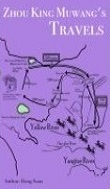
Zhou King Muwang's Travels

The Legends of Mountains & Seas
The Bamboo Annals - Book 1

The Scourge-of-God-Tetralogy:
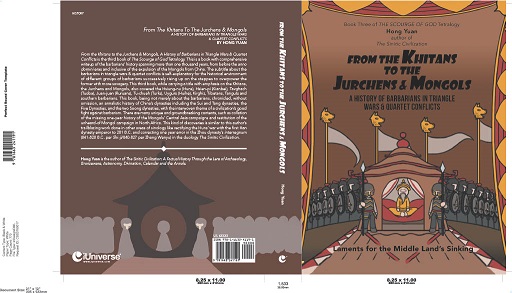
From the Khitans to the Jurchens & Mongols: A History of Barbarians in Triangle Wars and Quartet Conflicts
(available at iUniverse;
Google;
Amazon;
B&N)
|
|
FIVE DYNASTIES & TEN KINGDOMS
The demise of Tang Dynasty brought about the so-called Five Dynasties (A.D. 907-960) in northern China and 10 Kingdoms (A.D. 902-979), with nine kingdoms in southern China and Northern Han (A.D. 951-979) in today's Taiyuan, Shanxi.
As recorded in history, the three dynasties in between Posterior Liang and Posterior Zhou were of alien nature and founded by generals who belonged to a group of barbarians called Shatuo (Sha'to), a Turkic tribe. While Posterior Liang (A.D. 907-923) was set up by Zhu Wen (who first betrayed rebel leader Huang Chao and then usurped Tang Dynasty), the leaders of later Posterior Tang (A.D. 923-936), Posterior Jinn (A.D. 936-946) and Posterior Han came from nomadic Shatuo (Sha'to) ancestry.
Origin of Shatuo
There is a section devoted to Shatuo in New History of the Tang Dynasty. Shatuo had its origin from the 'Chuyue' tribe, an alternative race of the Western Turks. New History of the Tang Dynasty stated that the Eastern Turks and the Western Turks divided the ancient land of Wu'sun (today's Ili area). The 'Chuyue' tribe and 'Chumi' tribe co-lived with the Turks in this area. In the 7th year reign of the Zhen'guan Era, i.e., A.D. 633, Tang Emperor Taizong supported Duolu as khan for the Western Turks. A Turkic chieftain called Buzhen tried to absorb the people of his brother Mishe, causing Mishe and the Chuyue Tribe to seek vassalage with Tang. Shortly thereafter, Buzhen sought vassalage with Tang, too. Khan Duolu erected Helu, the son of a 'tele' (prince), as the chief in charge of the remnant Western Turks. Later, the Western Turks had internal strife and split into two courts. The Chuyue Tribe went with the northern court under arch-chieftain Khan Duolu, and they lived to the south of Jinsuoshan Mountain, to the east of which would be a desert called Shatuo [sand dune]; hence, the Chuyue Tribe called themselves by the Shatuo (Sha'to) Turks.
In A.D. 639, with the help of the Xueyantuo (Sheyanto) tribe (one component of the Tiele Tribes), the Tang army of 100,000 travelled 7,000 li distance to fight the Gaochang Statelet (the Turpan area), scaring Gaochang King Qu Wentai to death. Qu Wentai's son surrendered after learning that the relief army of the Western Khanate Turks had fled home half way. Emperor Taizong renamed Gaochang to Xizhou, and made it the locality for the governor-general office in charge of Yutian, Suiye (Tokmok), Shule and Chouci. Later, in A.D. 659, Xizhou or the Anxi 'Protector-General (Marshal Presidio)' office was relocated to Chouci. In A.D. 702, Tang would set up the Beiting 'Protector-General (Marshal Presidio)' office in Tingwai or Tingzhou (present-day Jimsar), a place located to the east of Suiye (Tokmok), to the south of Xizhou (Turpan), and to the west of Yizhou (Hami).
The Turks of Beiting (Beiting meaning the original 'northern Turkic court'), under Khan Duolu, once attacked Yizhou (Hami) and surrounded the areas around the Tianshan Mountains with two columns of army. Tang Governor-General for An-xi, Guo Xiaoke, defeated the Turks and took over Chuyue's sijin (governor) city. Khan Duolu later was defeated and he fled southward to the 'Tu-huo-luo' statelet. (Tu-huo-luo', an area surrounded by Afghanistan, Tibet and Turkistan, was said to have mutated from the Chinese characters of 'da [grand] xia', and some Central Asians, who claimed descent from the Huns or Xia Chinese, even likened the sound of Avar to the Chinese characters of 'ah hua'.) Helu surrendered to Tang. Tang erected Helu as the governor of Yaochi [Queen Mother West's pond] and relocated his tribe to the Mohecheng city of the Tingzhou Prefecture. A Chuyue sijin, Zhuye Que, sought vassalage with Tang.
In A.D. 650, Helu rebelled against Tang. A Chuyue chieftain, Zhuye Guzhu, killed a Tang officer, zhaowei-shi (i.e., pacifying and consoling inspector) Lian Heh. Zhuye Guzhu joined Helu in rebelling against Tang. Chuyue occupied the Laoshan Mountain. Tang conferred Helu's title onto another Chuyue chieftain (Shatuo Nasu). In A.D. 651, a Tang army, under the command of Lian Jianfang (zong-guan or omnipotent magistrate of the Gongyue-dao [bow moon] Circuit) and Qibi Heli (a Tang general of nomadic origin), defeated a Chuyue chieftain by the name of 'Zhuye Guzhu', killed him, and captured 9000 Shatuo people. In A.D. 652, Tang revoked the Yaochi governorship and made the Chuyue land into two prefectures of Jinman and Shatuo, to be under two governors, instead. After Helu fled, an-hu da-shi (pacifying ambassador) Ashina Mishe went for the Ili River area. Tang erected the Kunling Protector-General Office for control of the Duolu tribe, with Ashina Mishe as du-hu, i.e., protector-general.
In A.D. 661, a Chuyue chieftain, Shatuo Jinshan, assisted Tang General Xue Rengui in campaigning against the Tiele Tribes. Shatuo Jinshan was conferred the title of moli-jun taoji-shi, i.e., the campaigning general for the Moli-jun Garrison.
Shatuo Jinshan was upgraded to the title of governor for the Jinman-zhou prefecture and Duke Zhangye-jun-gong during the second year of the Chang'an Era, i.e., A.D. 702.
After the death of Shatuo Jinshan, his son Zhuye Fuguo succeeded the post. The Shatuo tribe relocated northward to the Beiting office for sake of avoiding the Tibetans and led a pilgrimage to the Tang court. During the 2nd year of the Kaiyuan Era, i.e., A.D. 714, Shatuo was conferred the title of governor for the Jinman-zhou prefecture again. Zhuye Fuguo's mother (Shu-ni-shi) was conferred the title of Shan'guo Furen or Lady Shan'guo. Zhuye Fuguo was later upgraded to the title of King Yongshou-jun. His son, Zhuye Guduozhi, succeeded him.
When Huihe sought vassalage with Tang in the early Tianbao Era, i.e., A.D. 714, Zhuye Guduozhi was conferred the title of deputy protector-general for the Huihe tribe.
In the A.D. 740s, Chuyue followed Huihe (Uygurs) in aiding Tang Emperor Suzong during the An-Shi Rebellion. A Chuyue chieftain, Zhuye Guduozhi, was conferred the title of 'tejin' (governor) and xiaowei shang-jiangjun (i.e., colonel high general). After Zhuye Guduozhi would be son Zhuye Jinzhong. Zhuye Jinzhong succeeded the title and was further conferred the title of jinyu-wei da-jiangjun and Duke of Jiuquanxian-gong (Jiuquan County).
During the eras of Zhide (A.D. 756) and Baoying (A.D. 762), China was undergoing turmoil, and Xizhou and Beiting were disconnected from China. Emissaries between the west and China had to go through exploitation while travelling through the Huihe territories. The Shatuo people were oppressed by Huihe.
In the late A.D. 790s, 7000 Shatuo tents, under Shatuo Jinzhong (Zhuye Jinzhong), sought suzerainty with the Tibetans. Together with the Tibetans, they attacked the Beiting governor office. The Tibetans later relocated the Shatuo to the Ganzhou Prefecture. The Tibetans used Shatuo Jinzhong (Zhuye Jinzhong) as the front-runner armies against the Tang border area. When Huihe took over Liangzhou of today's Gansu Province, the Tibetans became wary of Shatuo's relationship with Huihe.
The Tibetans, suspicious of Shatuo's loyalty, intended to relocate Shatuo to some distant place. In A.D. 808, Shatuo Jinzhong (Zhuye Jinzhong) consulted with Zhuye Zhiyi and decided to lead 30,000 people on an exodus to the Xiaoguan Pass of Tang China. The Tibetans chased them all the way, along the Wudejian-shan Mountain, fought major battles at Lintao and Shimen [stony gate], and killed Shatuo Jinzhong (Zhuye Jinzhong). Zhuye Zhiyi led the remnants to the Lingzhou-sai border pass. Tang General Fan Xichao of the Lingzhou Prefecture offered asylum to the Shatuo people, assigned them to the Yanzhou Prefecture, and bought buffalo and sheep on behalf of the Shatuo people. The Shatuo elderlies and children, coming from the Fengxiang-dao, Xingyuan-dao and Taiyuan-dao circuits, would find their way to Yanzhou to get a reunion.
Shatuo Jinzhong's brother, Shatuo Ge-le-a-bo, led about 700 remnants to Zhenwu and was conferred the title of leftside wuwei grand general and governor for the Yinshan-fu prefecture.
Zhuye Zhiyi came to the Tang capital Chang'an and was granted some silk clothing and horses and conferred the titles of 'tejin' and 'jinyu-wei jiang-jun'.
When Fan Xichao was dispatched to Taiyuan of today's Shanxi Province, Fan Xichao selected two thousand Shatuo cavalry and named it the 'Shatuo Column'. Rest of the Shatuo people were settled in the Dingxiangchuan area. Zhuye Zhiyi was ordered to guard Huanghuadui [yellow flower pile] of the Shenwuchuan area and they renamed themselves the "Northern Shatuo of Yinshan".
Shatuo Serving the Tang Dynasty
Quelling the Wang Chengzong Rebellion:
When the Tang emperor personally led campaign against the Zhenzhou prefecture, Zhuye Zhiyi led 700 Shatuo as the forerunner column and fought against a rebel army in tens of thousands under Wang Chengzong. Zhuye Zhiyi, against the rain of arrows, defeated Wang Chengzong's ambush at the Mudaogou Valley. Tang General Li Guangyan followed through by destroying over ten thousand rebels. Zhuye Zhiyi was conferred the title of ci-shi (inspector) for the Yuzhou (Yuxian, Hebei) prefecture. The Tang court, at the suggestion of Wang Er (jiedu-shi or governor-general for Taiyuan), distributed the Shatuo people among ten prefectures for sake of weakening their unity.
Fighting the Huihe & Quelling the Wu Yuanji Rebellion
Later, Huihe attacked Tang's Xicheng and Liugu areas by crossing the Gobi desert. Zhuye Zhiyi was ordered to guard Tiande. When Tang campaigned against rebel Wu Yuanji, Zhuye Zhiyi was called upon to serve under the command of Li Guangyan. Zhuye Zhiyi participated in the attacks at Shiqu and the Lingyunshan Camp. Zhuye Zhiyi was conferred the post of shang-shu for jianxiao xingbu (i.e., monitoring and censoring justice department) after cracking down on the Wu Yuanji rebellion.
During the Changqing Era (A.D. 821), Zhuye Zhiyi, still under the command of Li Guangyan, was ordered to attack Zhenzhou. The Shatuo army cooperated with the Yiding-jun Garrison in sacking a rebel city of the Shenzhou prefecture. Zhuye Zhiyi was conferred the title of jin wuwei jiangjun.
During the Taihe Era (A.D. 827), Liu Gongchuo was in charge of he dong, i.e., east of the Yellow River. Citing the fact that the Shatuo people were feared by the Nine Tiele Name tribes and six northwestern prefecture peoples, Liu Gongchuo proposed that Shatuo Zhiyi be conferred the posts of governor (dudu) for Yinshan-fu and zhaohu-shi for Daibei Xingying (i.e., military camp for north of the Dai prefecture).
Fighting the Huihe & Quelling the Wang Chengzong/Yang Bian Rebellion
After the death of Zhuye Zhiyi, his son, Zhuye Chixin, succeeded. During the 4th year of the Kaicheng Era, i.e., A.D. 839, Huihe crossed the mouth of the desert and arrived at the Yulin-sai border pass. Huihe prime minister, Jue-luo-wu, sent 300 good horses to Zhuye Chixin for sake of attacking Huihe Khan Zhuangxin. After the death of Khan Zhuangxin, jiedu-shi Liu Mian led the Shatuo army against the Huihe at the Sha-hu-shan Mountain (Hu nomad killing ridge). Later, Tang campaigned against rebel Liu Zhen at Lu (Zhuozhang River, Shanxi Province) and called upon Zhuye Chixin's 3000 cavalry to be under the command of Shi Xiong. The Shatuo cavalry acted as a forerunner column, sacked the Shihui-guan Pass, and aided Wang Zai in taking over Tian1-jing3. Further, Shatuo cavalry converged with the Taiyuan-jun Garrison, arrived at Yushe, cooperated with jianjun-shi Lü Yizhong in capturing rebel Yang Bian. After quelling the Luzhou prefecture, Zhuye Chixin was conferred the post of ci-shi for the Shuozhou prefecture as well as retained zhaohu-shi for Daibei Xingying.
Fighting the Tibetans
During the mid-Dazhong era (Dazhong starting from A.D. 859), Tubo (Tibet) combined the Dangxiang (Tanguts)/Huihe (Uygur) forces and invaded he xi, i.e., west of the Yellow River. Wang Zai, a Tang official in charge of Taiyuan, led various armies from Daibei (north of the Dai prefecture) against the Tibetans, with the Shatuo cavalry as a forerunner column. The Tibetans were often defeated and they propagated a myth stating that they saw fire burning on the general riding a red horse (i.e., Zhuye Chixin). Historians claim that the Tibetan power began to wane after they lost the Shatuo people to Tang. Tang Emperor Xuan(1)-zong (r. 847-859) recovered three prefectures as well as seven passes west of the Yellow River. Zhuye Chixin were conferred the post of ci-shi for the Yuzhou (Yuxian, Hebei) prefecture and shouzhuo-shi (guard and capture) for the Yunzhou prefecture.
Quelling the Pang Xun Rebellion
In A.D. 862, when the Nanzhao kingdom invaded Jiaozhi (Vietnam), the Tang court sent 2000 troops from Xuzhou and Si4zhou to southwestern China, with 800 troops later retained at Guizhou (Guilin) for garrisoning.
Before the An Lushan-Shi Siming rebellion of A.D. 755-763, the Tang army suffered a loss of 200,000 troops in the campaign against Nanzhao, which was after the debacle of a Tang army of 80,000, all to do with punishing the escaping-home of Nanzhao's hostage son Ge-luo-feng.
In July of A.D. 868, the soldiers agitated for returning home as they were promised to return home in three years at the beginning. Tang 'guancha-shi' Cui Yanceng asked for extension of one more year, which led to mutiny that killed officer Wang Zhongfu and made Pang Xun, a grains officer ('liang-liao pan-guan'), into the chief for leading the army back to northern China.
When the Pang Xun Rebellion erupted, the Tang court made Kang Chengxun into xingying zhaotao-shi, with Zhuye Chixin in charge of 3000 cavalry. At one time, Kang Chengxun was encircled at the Huan-shui River; Zhuye Chixin led 500 cavalry to Kang's rescue. Pang Xun, with 80000 strong army, intended to have a fast duel. Zhuye Chixin led the cavalry on a charge at the enemy camp and defeated Pang Xun in cooperation with the Tang army; Zhuye Chixin's brother, Zhuye Chishuai, chased Pang Xun to a place called Bo-dong (east of Bo, i.e., Shangqiu of Henan Province). After quelling the Pang Xun Rebellion, Zhuye Chixin was conferred the post of jiedu-shi for the Datong-jun Garrison, and the Tang royal family name of 'Li' and first name of 'Guochang' (prospering the country).
Fighting the Huihe
When Huihe attacked Yulin of Shenxi Province and harassed Lingzhou / Yanzhou, Tang conferred Li Guochang (Zhuye Chixin) the post of jiedu-shi for Fuyan (today's Fuxian county, Shenxi Province). When Huihe attacked Tiande, Li Guochang was moved to Zhenwu.
Quelling the Wang Xianzhi Rebellion
In A.D. 875, Wang Xianzhi, a salt smuggler, launched a rebellion in Changyuan of Henan together with Shang Junchang, Chai Cun, Bi Shiduo, Liu Yanzhang, Liu Hanhong and Li Chongba.
In May, the rebels sacked Caozhou and Puzhou, and combined troops with rebel Huang Chao for attacking Yih2zhou.
Huang Chao echoed Wang Xianzhi's rebellion at hometown Yuanju (Heze/north of Caoxian).
When rebel Wang Xianzhi sacked the Jing-Xiang areas of Hubei Province, the Tang court called upon the various prefectures for aiding the crackdown on the rebellion.
Li Guochang, i.e., a Shatuo Turk, dispatched Liu Qian's cavalry to today's Hubei Province and defeated rebels several times.
In February of A.D. 878, Wang Xianzhi was defeated and killed by 'zhaotao-shi' Zeng Yuanyu (i.e., Soong Wei's successor) at Huangmei, with remnants taken by Shang Rang for conversion with Huang Chao's rebels at Bo1zhou.
In A.D. 876, a Tang official in charge of Daibei and Yunzhong, Duan Wenchu, was hated by his subordinate officials. Those officials went to see the son of Li Guochang, shouzhuo-shi for Yunzhong, Li Keyong, for sake of getting rid of Duan Wenchu. Li Keyong agreed with it and led over 10000 army to the Yunzhou prefecture, attacked Doujitai, and killed Duan Wenchu. The Tang court sent the armies to crack down on Li Keyong. When Rebel Huang Chao crossed the Yangtze River, the Tang court called off the campaign against Li Keyong, granted amnesty, conferred the post of fangyu-shi for the Datong-jun Garrison onto Li Guochang. When Li Guochang refused the conferrals, the Tang court called upon Cui Yanzhao (jiedu-shi for He Dong) and Zhang Gongsu of the Youzhou prefecture to crack down on Li Guochang, but the Tang armies failed to fight Li Guochang.
The three garrisons of Fanyang (Youzhou), Chengde and Weibo had remained quasi-independent of the Tang court since the end of the An-Shi Rebellion, and hence did not help the Tang court with cracking down on the rebellion, giving the Shatuo Turks a chance to perform.
The Tanguts came to fight Li Guochang, but to no avail. A Tuhun (previously Tuyuhun) chieftain from the Datong-chuan area, by the name of Helian Duo attacked the city of Zhenwu and took over Li Guochang's equipment and grain supply. Li Guochang fled to the Yunzhou prefecture with 500 cavalry, but the Yunzhou city refused to take in Li Guochang. Helian Duo took over Yunzhou. Li Keyong, meantime, fought between Yuzhou (Yuxian, Hebei) and Shuozhou with 3000 soldiers. When Li Keyong stationed at the Xincheng city, Helian Duo came to attack him with over ten thousand soldiers. Helian Duo dug tunnels underneath the city wall, but three days later, Helian Duo still failed to take the city, while incurring heavy casualties. Li Guochang led a relief army to Xincheng from Yuzhou (Yuxian, Hebei). Helian Duo withdrew. Helian Duo was conferred the post of jiedu-shi for Datong by Tang Emperor Xizong. In A.D. 879, the Tang court conferred the post of beimian (northside) zhaotao-shi onto Li Jun, in charge of the Luzhou and Taiyuan armies. Li Jun stationed at the Daizhou prefecture. Li Keju of the Youzhou prefecture combined forces with Helian Duo in attacking Yuzhou (Yuxian, Hebei). Li Guochang faced off with opponents with one column, while Li Keyong led a column on an attack at the Zhelucheng city. At the time, heavy snow fell, and Li Jun's army collapsed and Li Jun died from his erratic retreating soldiers.
In A.D. 880, the Tang court conferred the post of zhaotao (campaigning) dutong (governing general) for Yuzhou (Yuxian, Hebei) and Shuozhou onto Li Zhuo. Li Zhuo stationed dozens of thousands of soldiers in Daizhou. Li Keyong dispatched Fu Wenda to Yuzhou (Yuxian, Hebei) for relief, but Gao Wenxi (ci-shi for Shuozhou) arrested Fu and handed him over to Li Zhuo. Li Zhou then went on to attack Yuzhou (Yuxian, Hebei) and defeated Li Guochang. Li Guochang/Li Keyong, with the whole family, fled northward to the Dada [Dadan] nomadic tribe for asylum. Helian Duo secretly contacted the Dada [Dadan] chieftain for having the Li rebels delivered back to Tang. Li Keyong, hearing of the scheme, deliberately showed the Dada [Dadan] chieftains his shooting skills by aiming at the leaves hundred steps away during a gathering; Li Keyong further claimed that the Tang court would for sure grant him amnesty soon after rebel Huang Chao came northward to the central plains and that he would lead his folks back to the south to establish feats rather than dying away in the deserts. The Dada [Dadan] chietains, hearing Li Keyong had no plan for staying among the nomadic north, felt relaxed and declined Helian Duo's proposal for extradition.
The Huang Chao Rebellion
Like many historians, Scholar Luo Xianglin, in A History of Chinese Nationalities (Chinese Culture Publishing Enterprise Co, Taipei, Taiwan, May 1953 edition), traced the cause of the Second Forced Migration Of Chinese to the invasion by Nan-zhao of Southwestern China.
Nan-zhao, consisting of the Hundred Yue family and Western Qiang descendants, began to encroach on Tang Dynasty after the era of Tang Emperor Taizong.
The Tang court stationed garrison troops in Yongning of Guilin [Guangxi Prov], and Ya'an & Songfan [Sichuan Prov] against Nan-zhao.
During the Xiantong Era of Tang Emperor Yizong, a border general by the name of Pang Xun rebelled at the Guilin garrison.
The Pang Xun rebels departed Guilin for today's Hunan Province in the same way as the later Taiping Heavenly Kingdom rebels. The rebels further sacked and pillaged the areas of the Yangtze River and Huai-shui River.
After this rebellion, the Tang societal weakness began to emerge.
Another rebellion by the name of Huang Chao assembled the Pang Xun remnants for a new round of pillage.
Wang Xianzhi and Huang Chao's rebels, with the Pang Xun remnant rebels, continued the rebellion after Wang Xianzhi's death and ravage both southern and northern China.
Zhu Wen, who was to usurp the Tang dynasty in the future in A.D. 907, joined the Huang Chao rebellion.
Huang Chao intruded into south of the Huai-shui River from today's Henan Province, attacked today's eastern Zhejiang Province, changed direction to sack today's Jiangxi Province, swept into today's Fujian Province, returned to today's Jiangxi Province, further entered today's Hunan Province, touched today's eastern Guangxi Province, rerouted southward to Guangzhou [Canton] of today's Guangdong Province, returned to today's Hunan Province, went north to today's Hubei Province, harassed today's Anhui Province, crossed the Huai-shui River to take over Luoyang of today's Henan Province, and finally took over the capital of Chang'an [in today's Shenxi Prov].
The Huang Chao Rebellion lasted a dozen years. The Tang court had to rely upon nomadic mercenaries, including the Shatuo and Tanguts, for quelling the rebellion.
The end result of the Huang Chao Rebellion would be the usurpation of Tang Dynasty by Zhu Wen who defected from the Huang Chao camp.
Zhu Wen's establishing Posterior Liang Dynasty would throw northern China into the turmoil time period called the "Five Dynasties and Ten Kingdoms".
The rebels took over the capital of Chang'an [Shenxi Province] in late A.D. 880, with
'jinyu ({bronze [ceremonial] mace-bludgeon [holder]) da-jiangjun (grand general)' Zhang Zhifang organizing a welcome party at Bashang.
Zhang Zhifang was later killed by the rebels for harboring the senior Tang ministers such as Cui Hang, Liu Ye, Yu Cong, Pei Shen, Zhao Meng, Li Pu and Li Tang, et al.
Instead of chasing after the emperor, Huang Chao ascended the throne as an emperor, and declared the founding of the Da-Qi (i.e., Shandong peninsula) dynasty with the Jintong Era.
A few satraps expressed loyalty for the rebel regime, among who were
'Xia-Sui jiedu-shi' Zhuge Shuang (who was appointed the rebel satrap for Heyang),
'Hezhong jiedu-shi' Li Du (who was expelled by subordinate 'xing-jun sima' Wang Chongrong),
'Zhongwu jiedu-shi' Zhou Ji and
'Pinglu jiedu-shi' Wang Jingwu.
At Fengxiang, 'Fengxiang & Longyou jiedu-shi' Zheng Tian2 (A.D. 825-887) sent out requests for the satraps of the nation to come to the aid of the emperor.
Zheng Tian2, who was later in A.D. 881 evicted by subordinate Li Changyan whose satrap post was succeeded by Li Changfu, joined the emperor at Chengdu where he was appointed the prime minister equivalent post of 'tong zhongshu-menxia pingzhang-shi4'.
The rebels, who maintained constraint initially, then started pillaging, which was recorded in history as 'tao-wu' (water-washing for the treasures).
Huang declared the dynasty of Da-qi in the Daminggong Palace. At one time in early A.D. 881, the government troops under the command of 'Jing-xi zhu-dao xingying fu-dutong' Cheng Zongchu and 'xingying sima' Tang Hongfu
counterattacked the rebels and entered Chang'an, over which the Huang Chao rebels conducted a massacre of the city population for siding with the government troops.
Quelling the Huang Chao Rebellion
When Huang Chao sacked the Tongguan Pass and entered Chang'an the capital, the Tang court ordered that Hedong (east of Yellow River) jianjun (monitoring general) Chen Jingsi assemble the armies in Daibei (north of the Daizhou prefecture). At the time, a Shatuo dudu (governor general) by the name of Li Youjin was in charge of the Xingtang-jun Garrison, and a Sa'ge chieftain (Mi Haiwan) and a dudu for Anqing (Shi Jingchun) were in charge of the Ganyi-jun Garrison. Hearing that the Emperor had fled to west, Chen Jingsi and Li Youjin led 5000 cavalry to the city of Jiang4 (Shanxi Province). Undisciplined soldiers stole the government money. Upon returning to Daizhou, Chen Jingsi recruited 30,000 more soldiers. When the soldiers disturbed peace, Li Youjin said to Chen that his brother (situ father and son, i.e., Li Guochang and Li Keyong) et al., being talented warriors feared by the soldier ranks, would be able to pacify and rally the heroic soldiers north of the Daizhou area for defeating the rebels. Chen Jingsi petitioned with the Tang emperor to have Li Guochang spared. The Tang court hence conferred the post of ci-shi for Daizhou onto Li Keyong.
Li Keyong, i.e., later Posterior Tang leader, had once gone into exile in another nomadic group of people called Dada [Dadan] (a name to be mixed up with the Tartar/Tatar later) till he was recalled by the Tang emperor for quelling the Huang Chao rebellion.
Historians believed that the Dada tribe could be related to the earlier Shatuo Turks for their affinity.
The cause was to do with the killing of Duan Wenchu ("Datong jiedu-shi") in a mutiny in 878, and the subsequent killing in A.D. 880 of Kang Chuangui ("Hedong jiedu-shi") and sacking of the Taiyuan city.
After a defeat in the hands of the Tang army, Li Keyong fled to the Dada tribe for asylum.
In A.D. 881, Tang Emperor Xizong pardoned the Li Keyong father and son, and ordered them to take the Shatuo mercenary army to the south against Huang Chao (i.e., self-proclaimed emperor of the Da-Qi regime.
Li Keyong hired over 10,000 Dada [Dadan] nomads as mercenaries and brought them back to Daizhou. En route southward to Taiyuan, Li Keyong was refused entry by jiedu-shi Zheng Congdang at the Shiling-guan [stony ridge] Pass. Li Keyong circumvented around to Taiyuan and stationed outside of the city wall for five days. When refused the grain supply by Zheng Congdang, Li Keyong retreated back to Daizhou.
In A.D. 882, Su You (ci-shi for Yuzhou (Yuxian, Hebei)) combined forces with Helian Duo for sake of attacking Li Keyong at Daizhou. Li Keyong led 500 cavalry on a surprise attack at Yuzhou (Yuxian, Hebei) and took over the city. When Li Keyong stationed at the Meinü-gu Valley (beauty valley) outside of Yuzhou (Yuxian, Hebei), Helian Duo and Li Keju of Youzhou led a 70,000 army against Yuzhou (Yuxian, Hebei). Li Keyong broke through the camps of Helian Duo and Li Keju, entered the city of Yuzhou (Yuxian, Hebei), burnt the supplies and departed for the Yanmen [swan gate] area. At this time, Li Guochang led the relief army from Dada [Dadan]. The two Li disturbed the areas of Fen, Bing and Loufan without releasing armours. The Tang emperor decreed that Li Keyong could return to Shuozhou, and Wang Chuchun (jiedu-shi for Yiwu) and Wang Chongrong (jiedu-shi for Hezhong, i.e., the middle Yellow River) passed on an imperial order to have Li Keyong campaign against rebel Huang Chao in return for amnesty. Li Keyong, excited upon receiving the decree, assembled a 30,000-men army comprising of soldiers from the Xin-Dai-Wei-Shuo prefectures and the Dada [Dadan] nomads, in addition to 5000 cavalry. Li Guochang was left at Daizhou for garrison while Li Keyong led the army southward. Again, Zheng Congdang refused to lend the path. Li Keyong camped near Taiyuan, offered horses/money to Zheng Congdang and shouted that he was going west and wished to have a talk with Zheng. Thereafter, Zheng Congdang went to comfort Li Keyong and returned money to Li. Li Keyong then went to the Hezhong area. The Tang emperor conferred Li Keyong the posts of jiedu for Yanmen, zhen'er (i.e., quelling) for the Shen-ce (divine tactics) Tianning-jun Garrison, and guancha-shi (i.e., observer general) for the Xin-Dai areas.
The next year, prime minister Wang Duo conferred the post of xingying du-tong (general in charge) for the northeast-side onto Li Keyong and the post of jianjun-shi onto Chen Jingsi. Li Keyong ordered his brother (Li Kexiu) lead a 500-men cavalry across the river, while Li Keyong himself crossed the river at the Xiangyang port. Xue A'tan was left to guard the river port. Li Keyong marched on Tongzhou and then defeated the rebels at the Liangtian-po Slope. Li marched on Weiqiao, and then took over the capital from the rebels.
In January of A.D. 883, Li Keyong defeated rebel Huang Kui at Shayuan (sandy garden, south of Dali).
In February, Li Keyong pushed to Qiankeng (heaven stem pit) to converge with the Tang armies of He-zhong, Yi-Ding and Zhongwu-jun.
At Liangtianbei, the Tang army defeated Shang Rang (rebel 'shangshu-ling' & 'tai-wei') and Zhao Zhang (rebel 'shi-zhong' & 'tong pingzhang shi4')'s 150,000 rebel army.
In early A.D. 883, after the loss of Huazhou and Lantian, rebel Huang Chao abandoned Chang'an for fleeing into the Shangshan mountain.
To delay the government army's chase, Huang Chao spread treasures along the road of retreat.
In April, rebel Huang Chao, who fled the Chang'an capital district under the attacks of Li Keyong, retreated from the Lan-guan pass and the Shangshan mountain.
Li Keyong was rated No. 1 in the military feats and was conferred the post of pingzhuang-shi (secretary for quelling rebellion) under tongzhongshu-men (royal palace gate of the central secretariat) and the title of Duke Longxi-jun-gong. Li Guochang was conferred the title of jiedu-shi for the Daibei-jun Garrison. After that, Li Keyong was further conferred the post of jiedu for Hedong (east of the river).
Rebels Huang Chao and Qin Zongquan combined forces in attacking he nan (south of the Yellow River). In A.D. 884, Li Keyong led the he dong and dai bei soldiers southward again, departing from Ze-zhou and Lu-zhou and marching on the Tianjing-guan [heavenly well] Pass. At Heyang (sunnyside river), Zhuge Sang defended the line. Li Keyong hence crossed the river at Hezhong (area in the middle segment of the river) and arrived at the Xu-zhou prefecture (Xuchang, Henan Province). Li Keyong combined the Xu[-zhou] and Bian (Kaifeng, Henan Province) forces and defeated Shang Rang at Taikang. Li Keyong went on to defeat rebels at Xihua and quelled the he nan (south of the river) area. Li Keyong chased the enemies to Bei-cao-zhou (north Caozhou prefecture).
Huang Chao committed suicide at the Langhu-gu Valley, i.e., wolf and tiger valley, near today's Laiwu, Shandong.
When returning via Bian (Kaifeng), Zhu Wen (Zhu Quanzhong, i.e., "Xuanwu jiedu-shi") invited him for a stay; Li Keyong left his soldiers at the outskirts and went to the Shangyuan-yi Guest-house. At night, Zhu Wen (Zhu Quanzhong) personally served the dinner, offered the treasures, and held hands as a show of condolence for Li's war efforts. Zhu Wen fed Li Keyong into intoxication; Zhu Wen, meantime, arranged his troops to have the guest house surrounded for sake of eradicating Li Keyong. Zhu Wen was jealous of Li Keyong's ferociousness and intended to kill Li so that he would usurp the Tang dynasty in an easy way. When Zhu Wen's soldiers attacked the guest house, Li Keyong's bodyguard general (Guo Jingzhu) blew off the candles and walked Li Keyong off by putting his arms around Li; still intoxicated, Li pulled his bow and shot arrows at the enemies. Utilizing the heavy smoke from the fires and lightening in the skies, Li Keyong and Xue Zhiqin escaped from the guest house, climbed the city gate of Nan-qiao-men (watch-tower gate at the south of the city), threw down a thread and climbed down the wall. Li Keyong, seeing that hundreds of his followers had died, would re-assemble his troops and retreat to Taiyuan for the preparation of revenge. Li Keyong ordered that his brother Li Keqin station the troops at he zhong (area in the middle segment of the river). Li Keyong petitioned with the emperor to attack Zhu Wen. Emissaries exchanged messages and condolence eight times between the emperor and Li Keyong. The emperor conferred the titles of jianxiao taifu and King Longxi-jun-wang onto Li Keyong to pacify him.
In A.D. 885, Li Keju of Youzhou and Wang Jingchong of Zhenzhou claimed that the Yi-Ding areas, belonging to the Yan-Zhao territories, should be rezoned to their jurisdiction. Li Keju took over the Yizhou prefecture, while Wang Jingchong attacked Wuji. Wang Chucun, jiedu-shi for the Yi-Ding areas, requested relief with Li Keyong.
In A.D. 885, eunuch Tian Lingzi quarreled with Wang Zhongrong, i.e., 'jiedu-shi' for the He-zhong territory.
The emperor ordered a campaign against Wang Chongrong (jiedu-shi for Hezhong, i.e., the middle Yellow River).
Wang Zhongrong requested aid with Li Keyong.
Wang Zhongrong and Li Keyong's army defeated Zhu Mei ('jing-nan jiedu-shi') and Li Changfu, and pressed on against Chang'an.
Eunuch Tian Lingzi, together with Emperor Xizong, fled to Fengxiang (Baoji, Shenxi).
Zhu Mei erected King Xiang-wang (Li Yun) as the new emperor.
Emperor Xizhong ordered Wang Zhongrong and Li Keyong to attack Zhu Mei.
Wang Xingyu, a subordinate, killed Zhu Mei.
Wang Zhongrong killed King Xiang-wang.
Soong Wentong, who served under Wang Xingyu, received the imperial conferral as "Wuding jiedu-shi", and the name of Li Maozhen.
In Fengxiang, Li Changfu attacked the emperor's camp in A.D. 887, which was to do with Li Changfu's obstruction of the emperor's plan to return to the nation's capital.
Li Maozhen killed Li Changfu, for which he received the appointment as "Fengxiang jiedu-shi".
In A.D. 890, Li Maozhen was upgraded to King Longxi-jun-wang.
After the new emperor was enthroned, Li became arrogant and showed disrespect. From 893 onward, Li repeatedly beat back the imperial army. The Tang court had to offer Li further titles such as King Qi-wang.
In A.D. 890, Zhu Wen and prime minister Zhang Ruili proposed to attack the Hedong territory to weaken Li Keyong's power.
The allied troops were defeated by Li Keyong.
The emperor had to restore Li Keyong's ranking and titles.
In A.D. 893, Tang Emperor Zhaozong ordered King Sitan-wang (Li Sizhou) to take the imperial garrison army against Li Maozhen.
Li Maozhen and Wang Xingyu defeated the emperor's army.
The emperor was forced to order prime minister Du Rangneng killed as a scapegoat.
In A.D. 895, Wang Chongying, who was "Huguo jiedu-shi" (or "Hezhong jiedu-shi"), died. Li Keyong and Li Maozhen supported two different persons as successor, one being a nephew and Li Keyong's son-in-law and the other a son of Wang Chongying's.
For the emperor's attitude, Li Maozhen and et al, killed two prime ministers without the emperor's approval, and further attempted to depose the emperor.
Li Keyong came south of the river to defeat the Li Maozhen army, killed Wang Xingyu, and wrestled back the emperor.
Emperor Zhaozong, for balancing against Li Keyong, stopped the further campaign against Li Maozhen.
After Li Keyong returned to Hedong, Li Maozhen re-asserted control in the Hexi [west of the river] territory, and took over Jingnan-jun and Jingyuan-jun territories.
In A.D. 896, Li Maozhen attacked the nation's capital over the emperor's attempt at organizing an army, forcing the emperor into fleeing to Huazhou (Huaxian, Shenxi).
In A.D. 896, Li Keyong received the emperor's conferral as King Jinn-wang.
For the next few years, Li Keyong, Liu Ren'gong and Zhu Wen were engaged in the zigzag wars, which somehow delayed Zhu Wen's usurpation of the Tang throne.
Liu Ren'gong, who sought shelter with Li Keyong after an aborted rebellion against Li Kuangchou ("Fanyang jiedu-shi") in 893 and obtained the "Fanyang jiedu-shi" after Li Keyong sacked Fanyang in 894, rebelled against Li Keyong in 897.
Li Keyong failed to attack Fanyang.
In 898, Liu Ren'gong defeated Lu Yanwei ("Yichang jiedu-shi").
But when Liu Ren'gong attempted to attack further south in 899, he was defeated by Zhu Wen.
Li Keyong failed to rescue son-in-law Li Ke ("Hedong jiedu-shi") who surrendered to Zhu Wen. By A.D. 900, Zhu Wen gained an upper hand over Li Keyong.
In 901 and 902, Zhu Wen laid siege of Taiyuan consecutively.
Li Keyong repelled the two-time attacks.
Later in A.D. 906, Li Keyong recovered Luzhou (Changzhi, Shanxi) from Zhu Wen's army.
In A.D. 906, Li Keyong led a relief to the aid of Liu Ren'gong when Zhu Wen attacked Youzhou.
In 901, Tang Emperor Zhaozong (Li Ye) was hijacked by eunuch Haan Quanhui, and moved to Fengxiang where Li Maozhen (Soong Wentong) was in charge.
The trigger was Zhu Wen ("Xuanwu jiedu-shi")'s march towards the nation's capital.
In 902, Zhu Wen led an attack at Fengxiang but failed to sack the fort after about one year's fighting.
Gao Jixing proposed to induce Li Maozhen out of the city by spreading rumor that Zhu Wen's army had retreated. With Li Maozhen lured out of Fengxiang, Zhu Wen managed to defeat the city defenders and forced Li Maozhen into handing over the emperor. The emperor returned to the throne in Chang'an.
Li Maozhen also lost control of the territories to the south of the Qin-ling Ridge to Wang Jian.
In 904, Zhu Wen forced the emperor into relocating to Luoyang over prime minister Cui Yin's scheme against Zhu Wen.
Months later, Zu Wen sent "shu-mi shi" Jiang Xuanhui to killing the emperor.
Zhu Wen selected a young son of the emperor, Li Zuo, as an emperor, i.e., Tang Emperor Aidi.
In 905, Zhu Wen killed the young emperor's nine brothers, as well as killing all the court ministers.
In 907, Zhu Wen usurped the Tang dynasty, forced Emperor Tang Aidi into abdication, and declared the founding of the Liang dynasty in Kaifeng which was the ancient Liang city.
Zhu Wen killed the emperor the next year.
Zhu Wen, who was lascivious and conducted incest in his later life and after his wife's death, was later killed by his third son Zhu Zhen (Zhu Yougui) in A.D. 912.
While wife Zhang Hui was still alive, Zhu Wen was restrained.
Zhu Wen first spotted the young girl, who was a daughter of the Songzhou 'ci-shi', before the rebellion, and made a similar claim as Eastern Han Emperor Guangwu-di as to beauty Yin Lihua.
The end of the 289-year Tang dynasty led to the turmoil period called the Five Dynasties and Ten Nations.
With the end of the Tang dynasty, Li Maozhen continued to use the eras of Tang Emperor Zhaozong and Tang Emperor Aizong.
Li Maozhen called himself King Qi[shan]-wang.
Li Maozhen was sandwich-attacked by Wang Jian and Zhu Wen.
In 923, Posterior Tang eliminated Posterior Liang.
Li Maozhen then submitted to Posterior Tang.
Li Cunxu renamed Li Maozhen to King Qin-wang.
The Five Dynasties
In 907, i.e., the 4th year of Tang Emperor Aidi's Tianyou Era, Li Si'an, a general under Zhu Wen, attacked Youzhou.
Liu Ren'gong dwelled on the palaces built on top of Da'anshan Mountain, northwest of today's Fangxian, where he had placed the court maids and alchemists for pleasure seeking and elixir refinement.
Since Liu Ren'gong was not at the city, son Liu Shouguang led the troops into Youzhou to repel the Posterior Liang army.
After that, Liu Shouguang marched against the Da'anshan Mountain and put his father under arrest.
Liu Shouguang declared himself to be "Youzhou jiedu-shi", and then attacked his brothers, like Liu SHouwen who was "Yichang jiedu-shi".
After Liu Shouguang killed Liu Shouwen and defeated the Yichang-jun Army [which was in charge of the area of Cangzhou, JIngzhou, Dezhou and Qizhou], Posterior Liang Emperor Zhu Wen conferred the title of King Yan-wang onto Liu Shouguang.
In A.D. 911, Liu Shouguang schemed to make the military chiefs of the six garrisons to support him as 'shang fu', namely, proxy father kind of minister to the emperor.
Li Cunxu, i.e., King Jinn-wang and "Hedong jiedu-shi", took the advice of subordinate generals to cooperate with Whang Rong ("Chengde-jun [Zhengding, Hebei] jiedu-shi"), Wang CHuzhi ("Yiwu-jun jiedu-shi"), Li Sizhao ("Zhaoyi-jun jiedu-shi"), Zhou Dewei ("Zhenwu-jun jiedu-shi") and Soong Yao ("Tiande-jun jiedu-shi") in infatuating Li Shouguang so as to make him a target of Posterior Liang Emperor Zhu Wen.
Li Shouguang petitioned with the emperor for the post of "du tong" (commander-in-chief) for the He-bei (north of the Yellow River) territory, and furthermore declared himself emperor of the Da-Yan State with the Yingtian (answering the Heaven) Era.
In A.D. 913, Zhou Dewei, a general under Li Cunxu, sacked Youzhou, and caught both Liu Shouguang and Liu Ren'gong.
Zhou Dewei received the conferral of "Lulong jiedu-shi".
In A.D. 914, the Liu father and son were killed at the Posterior Jinn's ancestral temple.
During the Five Dynasties time period, the Tuoba-Li family of the Tanguts expressed loyalty to all five succeeding central plains courts as well as the Northern Han Dynasty to the east of the Yellow River. Only Posterior Tang had launched one campaign against Tuoba-Li's Tangut regime.
In A.D. 895, Tuoba Sigong (i.e., Li Sigong) passed away. Brother Li Sijian assumed the post of "ding-nan-jun jiedu-shi" (i.e., Governor-general for the Quelling-turmoil Garrison). When Posterior Liang was founded by Zhu Wen, Li Sijian expressed loyalty and received some extra titles of "jianxiao taiwei' [monitoring captain] and "shi-zhong" [imperial attache].
In 908, Li Sigong's grandson, Li Yichang, took over Li Sijian's post. Three months later, Li Yichang was killed by his general, Gao Zongyi. An uncle, by the name of Li Renfu, was supported as the new Governor-general for the Quelling-turmoil Garrison.
Li Renfu was attacked by Li Cunxu (i.e., King Jinn-wang).
Li Cunxu encircled the Xiazhou prefecture.
Posterior Liang Emperor Taizu (i.e., Zhu Wen) came to the relief of Li Renfu.
Posterior Tang leader had once gone into exile in another nomadic group of people called Dada [Dadan] (a name to be mixed up with the Tartar/Tatar later) till he was recalled by the Tang emperor for quelling the Huang Chao rebellion. When Zhu Wen usurped Tang, General Li Keyong and his son Li Cunxu set up the Posterior Tang dynasty. To combat the Posterior Liang dynasty, he would strike an agreement with the Khitans (a branch of the earlier Xianbei) against Posterior Liang.
The Shatuo Li family was of the Western Turks' origin of Central Asia, and hence carried the non-Mongoloid physique.
Modern erudite Wang Guowei ascertained Posterior Tang Emperor Zhuangzong's appearance through a record about Wang Jinqing's observance of the emperor's statute near Luoyang, which exhibited someone with hair surrounding the two eyes.
(The very original Turks, however, were of the Mongoloid stock, as seen in depiction of a Turk prince called Simo.
Simo, for his appearance similar to the Hu barbarians of today's Central Asia, was suspected to be not of the Ashina stock, and hence was conferred the post as 'Jiabi Tele [te-le]', not a higher post as 'she[4]'.)
The Khitans, in A.D. 917, laid siege of Youzhou for over two hundred days but failed to sack the city which was defended by Zhou Dewei.
Zhou Dewei previously did not pay attention the defense works along the seaside strip from the Yu-guan Pass (i.e., tdoay's Pass of Mountains and Seas) all the way towards the Liao-dong peninsula.
The Khitans took over the seaside territory as well as the land to the northeast of Youzhou.
The Khitans, under Yelü Ahbaoji (Yeh-lu A-pao-chi) and his Uygur wife, colluded with Posterior Liang. The Khitans obtained a Chinese minister called Han Yanwei and conquered, in A.D. 926, tribes like Dangxiang (the Tanguts) in the west and the Tungusic P'o-hai (Bohai) and north Korea in the east. The Khitans became a much larger northern power.
After Li Cunxu overthrew Posterior Liang, Tangut's Li Renfu expressed loyalty to Posterior Tang.
In A.D. 933, Tangut's Li Yichao assumed the post of his father Li Renfu.
Posterior Tang Emperor Mingzong [Li Siyuan or Li Dan, reign 926-933] had campaigned against Li Yichao for his refusal to relocate to Yanzhou. After laying siege of Xiazhou in vain for over hundred days, Posterior Tang Emperor Mingzong withdrew the siege and re-confirmed Li Yichao's post.
After Li Yichao's death in A.D. 936, brother Li Yiyin assumed the Tangut post.
In 935, Li Yiyin succeeded Li Yichao's post, with Posterior Tang Emperor Modi continued the conferral of 'Ding-nan-jun jiedu-shi' onto Li Yiyin.
In northern China, in 934, Tang Emperor Mingzong (Li Siyuan), after some internal power struggle, called in son Li Conghou who succeeded as Posterior Emperor Mindi.
Li Conghou's attempt at weakening the power of the royals led to the rebellion of King Lu-wang Li Conghou (i.e., 'Fengxiang jiedu-shi').
Li Conghou, after failing to quell the rebellion at Fengxiang, fled east, and when passing through Weizhou (Jixian/Weihui, Henan), i.e., Shi Jingtang's domain, was put under arrest while his entourage and bodyguards were killed by Liu Zhiyuan, a general under Shi Jingtang.
Li Congke, i.e., Posterior Tang Emperor Modi and an adopted son of Li Siyuan, took over the throne, which led to rebellion of Shi Jingtang who was a son-in-law of Posterior Tang Emperor Mingzong (Li Siyuan).
Shi Jingtang, who was satrap for the He-dong (i.e., east of the Yellow River), tested the emperor's response with a petition to relocate away from the heartland territory.
When the emperor agreed to make him satrap 'Tianping jiedu-shi', Shi Jingtang rebelled.
Shi Jingtang sought the assistance with the Khitans for rebellion in A.D. 936.
Posterior Jinn (A.D. 936-946) was led by a Posterior Tang general called Shi Jingtang, also a Shatuo (Sha'to) nomad. Shi, in order to fight Posterior Tang, ceded 16 zhou (a unit larger than prefecture but smaller than province) to the Khitans, including today's Beijing city which was never recovered from the nomads till Ming Dynasty (A.D. 1368-1644) overthrown the Mongol Yuan Dynasty.
Yelü Ahbaoji's son, Yelü Deguang, assisted Posterior Jinn in destroying Posterior Tang and hence take over 16 northern Chinese prefectures as a ransom. With the help of the Khitans, Posterior Jinn took over Luoyang and destroyed Posterior Tang.
In A.D. 937, Shi Jingtang and the Khitan allied army laid a siege of Luoyang.
The Posterior Tang emperor committed suicide by setting himself on fire.
The historical imperial seal, i.e., he-shi-bi, was lost hence.
(Gu Yanwu, a Ming-Qing dynasty transitionary figure, disputed the number of 16 prefectures in his book RI ZHI LU, stating that the Yingzhou, Pingzhou and Luanzhou territories were not among those surrendered by Shi Jingtang, and hence were not requested by the Soong dynasty emissary when negotiating with the Jurchens for a joint campaign against the Khitans.
Gu Yanwu traced the history to point out that Zhou Dewei, a Posterior Tang general, who received the post as 'Lulong jiedu-shi' in charge of today's Peking and the seaside corridor towards the Yu-guan Pass (i.e., the Pass of Mountains and Seas), had abandoned the Niu-kou (oxen) Pass, which was to the northeast of the Yu-guan Pass, thinking that he was capable of defending against the Khitans with his strength, not the precarious mountain pass. Hence, the Khitans penetrated into the Pingzhou-Yingzhou area, took over the area, and further launched the Khitan Luanzhou prefecture to settle the prisoners of war.)
When Shi Jingtang, i.e., Posterior Tang Emperor Mingzong's son-in-law, colluded with Khitans in overthrowing Posterior Tang and establishing Posterior Jinn, Tangut's Li Yiyin continued to receive the old conferrals.
In 1943, Li Yimin, a brother of Li Yiyin's and 'Suizhou [Suide] ci-shi', rebelled, and after a defeat, fled to Yanzhou (Yenan).
Posterior Jinn further arrested the Tangut rebels in A.D. 943 on behalf of Li Yiyin, and deported Li Yimin to Xiazhou.
Posterior Jinn further caught the Tangut rebels in A.D. 943 on behalf of Li Yiyin.
When Khitans attacked Posterior Jinn in A.D. 944, Li Yiyin led a combined force of 40,000 Tibetans, Qiangs and Han Chinese in attacking the west of Khitans by crossing the Yellow River at Linzhou.
However, rifts between Khitan Liao and Posterior Jinn ensued.
In 942, Shi Chonggui, i.e., Posterior Jinn Emperor Chudi and a nephew of Shi Jingtang, was enthroned.
Jinn Emperor Chudi took the advice of Jing Yanguang not to appease the Khitans.
When Posterior Jinn Emperor Chudi refused to acknowledge vassalage to the Khitans, Yelü Deguang attacked Posterior Jinn and destroyed Posterior Jinn in A.D. 946. The Khitans renamed their dynasty name to Liao Dynasty in A.D. 947 in the attempt of ruling northern China.
In 944, the Khitans attacked Posterior Jinn.
In 946, after three years of wars, Posterior Jinn generals Du Chongwei, Li Shouzhen and Zhang Yanze surrendered to the Khitans.
Using Zhang Yanze as a guide, the Khitans intruded into the Kaifeng city.
Shi Chonggui surrendered to the Khitans.
The Khitans destroyed Posterior Jinn.
Yelü Deguang downgraded the Posterior Jinn emperor to Marquis Fuyi-hou (i.e., the marquis who betrayed the gratitude).
When weather got hot and the Chinese under Liu Zhiyuan rebelled against the Khitans, Yelü Deguang retreated to the north and died en route home, at a place called the Fox-killing Ridge.
A Posterior Jinn general of the Shatuo tribe origin, Liu Zhiyuan, would be responsible for rallying an army and pressured the Khitans into retreat, and hence Liu founded the Posterior Han Dynasty (A.D. 947-950), citing the same family name as the Han Empire's founder.
At this time, Southern Tang (A.D. 937-975) in today's Nanking, south of the Yangtze River, had contacted the Khitans expressing a desire to go to the ex-Tang capital of Chang'an to maintain the imperial tombs.
Posterior Jinn was destroyed by the Khitans in A.D. 946. The second year, Liu Zhiyuan of the Shatuo Turkic origin, at the instigation of Zhang Yanwei, declared himself an emperor in Taiyuan but using the Posterior Jinn's Tianfu (heaven's fortune Era, and subsequently in the summer intruded into Bianjing (Kaifeng) to established Posterior Han Dynasty, faking a claim to be a descendant of the Han royal house.
(After Shi Jingtang established Posterior Jinn (A.D. 936-946), Liu Zhiyuan, who was against ceding the land to the Khitans, was conferred the posts of "Zhongwu-jun jiedu-shi" in 937, "Daming-fu liu-shou" and "Hedong jiedu-shi" in 941, "zhong-shu ling" in 943 under the successor Posterior Jinn emperor, and King Taiyuan-wang in 944.
Liu Zhiyuan died in 948, and was succeeded by son Liu Chengyou or Northern Han Emperor Yindi.)
In A.D. 948, Liu Zhiyuan appointed Li Yiyin the concurrent post of 'shi-zhong', i.e., imperial attache.
Posterior Han Dynasty continued the pacification policy as to the Tanguts, and further ceded Jingzhou (Mizhi county of Shenxi) to Li Yiyin in A.D. 949 and conferred the title of "zhongshu-ling" (minister for central secretariat).
Yelü Deguang's nephew (Wuyue Yelü Ruan), would succeed the Khitan post in A.D. 947. Five years later, in A.D. 951, he was assassinated.
Yelü Deguang's son, Wulu (Yelü Jing), would now succeed in A.D. 951. Note that the Yelü family had adopted the Chinese first names here, and they had Sinicized by adopting the Chinese language, rituals and governmental structure.
Guo Wei, a general of Posterior Han Dynasty responsible for the defeating Posterior Jinn, rebelled after his family were slaughtered in the capital; Guo later staged a change of dynasty by having his soldiers propose that he be the emperor of Posterior Zhou (A.D. 951-960). The uncle of Posterior Han emperor declared Northern Han (A.D. 951-979) in today's Shanxi and allied with the Khitans.
After Guo Wei, i.e., "liu shou" (governing magistrate) for Yedu (Yecheng of Shanxi), killed Posterior Han Dynasty Emperor Yindi (r. 948-950), Guo Wei upgraded Tangut's Li Yiyin to the title of King Longxi-jun-wang in A.D. 951.
Guo Wei, i.e., Posterior Zhou Dynasty Emperor Taizu (r. 951-954), conferred the title of King Xiping-wang onto Li Yiyin in A.D. 954.
Li Yiyin did not severe relations with Northern Han Dynasty till A.D. 957.
Guo Wei's Posterior Zhou will pass on to his foster son, Chai Rong, to be eventually replaced by his general called Zhao Kuangyin who founded the Northern Soong Dynasty (A.D. 960-1127).
When Northern Han (Liu Chong) and Khitan Liao attacked Posterior Zhou by taking advantage of the death of Guo Wei, Chai Rong led the imperial bodyguard troops to Gaoping to counter the Northern Han army and the Khitans. A general, zhi hui Fan Aineng fled the scene. When Chai Rong was targeted by the enemy arrow shooters, Zhao Kuangyin led a dozen brave soldiers on a charge against the enemies and rescued Chai Rong. The Posterior Zhou army chased Liu Chong to the He-dong [west of the eastern Yellow River bend] city. Zhao Kuangyin personally led a fire attack at the city. Chai Rong retreated after Zhao suffered an arrow wound in the left arm. When the Posterior Zhou army retreated to Biandu (Kaifeng) the capital, Zhao Kuangyin was conferred Marquis Duyu-hou and ci-shi of the Yanzhou prefecture.
During the third year reign of Emperor Zhou Shizong, i.e., A.D. 956, Posterior Zhou campaigned against the Huai-nan territories of Southern Tang. Both Zhao Kuangyin and Zhao Hongyin joined the campaigns. Posterior Zhou defeated a Tang army of over 10000 Guokou [Wokuo, the Guo/Wo rivermouth] and killed bingma (soldier & horse) du-jian (monitoring general) Heh Yanxi. The Southern Tang army, claiming 150000, which was led by jiedu-shi Huangfu Hui and Yao Feng, overflowed the Qingliu-guan Pass. When Zhao Kuangyin chased the Tang army to the city, Huangfu Hui requested for stationing his troops outside of the citywall for a duel. Huangfu Hui was personally decapitated by Zhao, and Yao Feng was captured. When Zhao Kuangyin entered the city, he ordered that the city gates be closed at night; Zhao Hongyin was dissuaded from entering the city at night. When Haan Lingkun took over Yangzhou, the Southern Tang came to the relief. Haan Lingkun proposed to retreat. Emperor Shizong ordered that Zhao Kuangyin lead 2000 relief soldiers to Luhe to counter the Tang relief army. Zhao issued an order stating that should Haan Lingkun's soldiers retreat to Luhe, they would be cut off the feet. Haan Lingkun hence solidified his defence at Yangzhou. Thereafter, Zhao defeated King Qi Jingda of Southern Tang east of Luhe and killed over 10000 enemies. Upon return to the capital, Zhao was conferred the post of dianqian (front of the imperial seat) du-zhi-hui-shi (directing general) and jiedu-shi for the Dingguo-jun Garrison Circuit.
During the fourth year reign of Zhou Shizong, i.e., A.D. 957, Zhao Kuangyin participated in the campaign against Shouchun. Posterior Zhou took over the Zhu-zhai Garrison and the Shouzhou city. Upon return, Zhao was conferred the post of jianxiao (censoring and inspecting) taibao (gestapo) and jiedu (governor-general) for the Yicheng-jun Garrison Circuit. In the winter, Posterior Zhou campaigned against the Hao-Si areas of today's Anhui Province. Southern Tang stationed its army on the beach of Shibali-tan (eighteen Chinese mile beach). Zhou Emperor Shizong intended to cross the river by riding on the camels. Zhao Kuangyin jumped into the river to lead the way for his soldiers. Zhao defeated the Southern Tang army, and then flowed down to take over the Sizhou city. The Tang army then stationed at the Dunqing-kou rivermouth. Zhao followed Zhou Emperor Shizong in marching along the east bank of the Huai River and chased the enemy to Shanyang. Zhao captured Tang jiedu-shi Chen Chengzhao and took over the Tuzhou city. Zhao went on to defeat the Southern Tang army at another river mouth, burnt the Tang camps south of the river, and defeated Tang at Guabu. After the Zhou army's quelling the Huainan (south of Huai River) areas, Southern Tang tried to sow a dissension between Zhao Kuangyin and Zhou Shizong by sending 3000 Chinese ounces of 'baijin' (white gold) as a bribe. Zhao submitted the gold to the imperial coffer. The next year, Zhao was conferred the post of jiedu-shi for the Zhongwu-jun Garrison Circuit.
In A.D. 959, Zhou Shizong led a northern campaign against Canzhou. Zhao was conferred the post of sui-lu du bushu ('land-water governing general in charge').
Zhou Shizong personally went to the Qianning-jun Garrison Circuit to lead the attack at Ningzhou. Ningzhou ci-shi Wang Hong surrendered. Then, Haan Tong was assigned the job of taking charge of a land army and Zhao in charge of boats and a water-born army. The Zhou army attacked the Yijin-guan Pass. When Wang Hong called upon the guarding general, Zhong Tinghui, for surrender, Zhong agreed. Zhong Tinghui was retained at the pass.
When reaching the Mozhou area, Zhao deserted boats and attacked the Waqiao-guan Pass. Zhao defeated guarding general Yao Neibing at the Waqiao-guan Pass. When the Zhou armies, led by du zhihui-shi Li Chongjing, by Haan Tong (who pacified Mozhou and Yingzhou) and by the emperor himself, converged under the Waqiao-guan Pass, Yao Neibing surrendered and he was assigned the post of ci-shi for Nuzhou. Zhou quelled the area south of the pass.
Zhou Shizong then ordered a campaign against the Khitans at Youzhou and Yizhou. Li Chongjing was ordered to attack northward. Li took over the Gu'an city. North of the city was the An'yang-shui River. The Khitans dismantled the bridges and hid the boats. Zhou Shizong, seeing that the river was wide, ordered the re-construction of the bridge and then left for the Waqiao-guan Pass. Zhou Shizong fell ill. Meantime, Sun Xingyou was ordered to attack Yizhou and he took over the city and captured ci-shi Li Zaiqin. Li Zaiqin refused to surrender and was ordered to be executed by Zhou Shizong. When Zhou Shizong's illness got worse, Zhao Kuangyin persuaded him into returning to the capital. Waqiao-guan was renamed Xiongzhou and Chen Sirang was to guard it; Yijin-guan was renamed Bazhou and Haan Lingkun was to guard it.
Zhou Shizong accidentally read about a 3-foot wood document stating that 'dian-jian' would be the new emperor'.
Upon return to the capital, Zhou Shizong deprived dian-jian Zhang De of his post and re-assigned it onto Zhao Kuangyin, plus the title of jianxiao taifu. After Zhou Shizong died and Posterior Zhou Emperor Gongdi was enthroned, Zhao was conferred the post of jiedu for the Guide-jun Garrison Circuit and jianxiao tai-wei (grand captain).
The next year, i.e., A.D. 960, Northern Han and the Khitans were rumored to have invaded Zhou territories. Zhao hence utilized this rumor to lead an army to counter the purported Khitan attack. While stopping at the Chenqiao-yi postal station, Zhao's follower, Miao Xun, pointed to the sky for a second sun under the sun. At deep night, Zhao's generals had an assembly and proposed that Zhao Kuangyin be the new emperor. They put a yellow gown onto Zhao. The next day, Zhao led his troops back to the capital and usurped the Posterior Zhou dynasty.
This is Zhao Kuangyin's Chenqiao Coup by which he took over the reign from Posterior Zhou and established the Soong dynasty as Emperor Taizu (r. 960-976).
Tangut's Li Yiyin promptly dispatched an emissary to the Soong court for expressing loyalty, and changed his name to Li Yixing for avoiding the conflict with the last character of the given name of Zhao Kuangyin's father.
Li Yiyin surrendered 300 stallions to the Soong court in A.D. 962 and received a jade-belt as imperial bestowal in return.
When Li Yiyin died in A.D. 967, Soong Emperor Taizu ordered a mourning for three days and conferred Li Yiyin the title of King Xia-wang posthumously.
Tangut's Li Guangrui assumed his father's post.
The Scourges-of-God Tetralogy
would be divided into four volumes covering
Hsiung-nu (Huns), Hsien-pi (Xianbei), Tavghach
(Tuoba), Juan-juan (Ruruans), Avars, Tu-chueh (Turks), Uygurs (Huihe), Khitans, Kirghiz, Tibetans, Tanguts, Jurchens, Mongols and Manchus and
southern barbarians.
Book I of the tetralogy would extract the contents on the Huns from
The Sinitic Civilization-Book II,
which rectified the Han dynasty founder-emperor's war with the Huns on mount Baideng-shan to A.D. 201 in observance of the Qin-Han dynasties' Zhuanxu-li calendar.
Book II of the Tetralogy would cover the Turks and Uygurs.
And
Book IV would be about the Manchu conquest of China.
From the Khitans to the Jurchens & Mongols: A History of Barbarians in Triangle Wars and Quartet Conflicts
, i.e., Book III of
the Scourge-of-God-Tetralogy,
focused on the Khitans, Jurchens and Mongols, as well as provided the annalistic history on the Sui and Tang dynasties, the
Five Dynasties & Ten Kingdoms, and the two Soong dynasties.
Similar to this webmaster' trailblazing work in rectifying the Han dynasty founder-emperor's war with the Huns to 201 B.C. in The Sinitic Civilization - Book II,
this Book III of the Scourge-of-God-Tetralogy
collated
the missing one-year history of the Mongols' Central Asia campaigns and restituted the
unheard-of Mongol campaign in North Africa.
|
The Scourges of God: A Debunked History of the Barbarians" - available at iUniverse|Google|Amazon|B&N
From the Khitans to the Jurchens & Mongols: A History of Barbarians in Triangle Wars and Quartet Conflicts
(The Barbarians' Tetralogy - Book III)
Epigraph,
Preface,
Introduction,
Table of Contents,
Afterword,
Bibliography,
References,
Index
|
|
Table of Contents
(From the Khitans to the Jurchens & Mongols: A History of Barbarians in Triangle Wars and Quartet Conflicts)
Section Three: Five Dynasties & Ten Kingdoms
Chapter XI: Five Dynasties (A.D. 907-960) ..........................................................141
The Posterior Liang Dynasty (A.D. 907-923) ........................................................141
The Posterior Tang Dynasty (A.D. 923-936) .........................................................150
The Khitans vs. the Posterior Tang Dynasty ...........................................................152
The Posterior Jinn Dynasty (A.D. 936-946) ...........................................................161
The Posterior Han Dynasty (A.D. .947-950) vs. the Khitan Liao Dynasty ...............164
The Posterior Zhou Dynasty (A.D. .951-960) ........................................................ 166
The Khitans, the Shatuo, the Tanguts vs. the Five Dynasties .....................................170
Chapter XII: Ten Kingdoms (A.D. 902-979) ..........................................................175
The Anterior Shu (Qian-shu) Kingdom (A.D. 907-925) ...........................................175
The Posterior Shu (Hou-shu) Kingdom (A.D. 934-965) ..........................................182
The Jing-nan (Nanping) State at Jiangling (A.D. 924-963) .......................................183
The Chu-guo State (A.D. 907-951) ........................................................................186
The Yang-Wu State (Yang Xingmi, Yang Wo and Yang Longyan's King Wu-wang
state, A.D. 902-927, Yang Pu's King Wu-wang & Emperor Wu-huangdi State
A.D. 920-927/927-937) ..188
The Southern Tang (Nan-tang) State (Qi A.D. 937; Southern Tang A.D. 938-958;
Jiangnan-guo A.D. 958-975) ...192
The Wu-Yue State (A.D. 907-978) .........................................................................196
The Min-guo State (A.D. 909-945) .........................................................................200
The Southern Han (Nan-Han) State (A.D. 917-971) ................................................207
The Northern Han (Bei-Han) State (A.D. 951-979) ..................................................211
|
|
Ten Nations
Scholar Luo Xianglin, stating that Chinese had been fleeing Huang Chao rebellion throughout the territories sacked by the rebels, summarized the following safe havens: refugees to Sichuan Province where Wang Jian established Shu Regime; refugees to Hunan Province where Ma Yin established Chu Regime; refugees to Guangdong & Guangxi provinces where Liu Yin established Southern Han Regime; refugees to Fujian Province where Wang Shenzhi established Min Regime; refugees to Zhejiang Province where Qian Mu established Wu-Yue Regime; and refugees to Anhui-Jiangsu provinces where Yang Xingmi & Li Zhigao established Yang-Wu and Southern Tang regimes.
The city of Beijing would remain in the hands of the Khitans (A.D. 907-1125), and then passed into the Jurchens (A.D. 1115-1234) after a short interim under the Soong administration, Mongol Yuan (A.D. 1279-1368) till Ming Dynasty overthrew the Mongol yoke in A.D. 1368. For hundreds of years, the Soong dynasty, built on top of Northern Zhou (A.D. 951-960) of the Chai(1) family, was engaged in the games of 'three kingdom' kind of warfars. Northern Soong (A.D. 960-1127) would face off with the Western Xia (A.D. 1032-1227) and Khitan Liao in a triangle, and then played the card of allying with the Jurchens in destroying the Khitan Liao. With Northern Soong defeated by the Jurchens thereafter, Southern Soong (A.D. 1127-1279) would be engaged in another triangle game, with the other players being Western Xia and the Jurchen Jin. Southern Soong would then play the card of allying with the Mongolians in destroying Jurchen Jin, and it even sent tens of thousands of carts of grain to the Mongol army in the besieging of the last Jurchen stronghold. Soon after that, the Southern Soong generals broke the agreement with the Mongols and they shortly took over the so-called three old capitals of Kaifeng, Luoyang and Shangqiu. But they could not hold on to any of the three because what they had occupied had been empty cities after years of warfare between the Jurchens and Mongols. Similar to the times of the Western Jinn (A.D. 265-316) and Eastern Jinn (A.D. 317-420), the northern Chinese would have fled to the south during these conflicts. While Eastern Jinn re-established their capital in Nanking, the Southern Song, driven away from Nanking by the Jurchens, chose today's Hangzhou as the new capital. Hangzhou, however, had been the capital of Warring Kingdoms in Zhou times.
The Qian-shu (Anterior Shu) Kingdom
In A.D. 907, Wang Jian (847-918) declared himself an emperor in Chengdu and launched the [Anterior-]Da-Shu kingdom.
This was in response to Zhu Wen's usurpation of the Tang court.
Back in A.D. 904, when Zhu Wen forced Emperor Zhaozong to relocate to Luoyang, Wang Jian refused to adopt the era of Tianyou.
Wang Jian, was originally an officer under Qin Zhongguan who was in turn a subordinate under Zhou Ji -- who killed superior "Zhongwu-jun jiedu-shi" Xue Neng and surrendered to the Huang Chao rebels in A.D. 880 before Zhou Ji defected back to the Tang government in A.D. 881 and was later killed by former subordinates Lu Yanhong in the mid-A.D. 880s. Wang Jian, et al., rebelling against superior Lu Yanhong in A.D. 884, defected back to the government side. Lu Yanhong was originally ordered to go to Sichuan for protecting the Tang emperor but loitered in the Han-zhong area to be a warlord, instead. Wang Jian, who first fought for the Tang emperor in the Zhongwu-jun Army when rebel Huang Chao attacked Chang'an in A.D. 880, received the emperor's conferral as 'qingdao-shi' when Tang Emperor Xizong fled to the Han-zhong territory in A.D. 886; and intruded into the Sichuan basin in A.D. 891. Wang Jian was taken in by eunuch Tian Lingzhi as adopted son and received the appointment as an imperial escort 'du-jiang' general among five such 'hu-jia (protecting the emperor's chariot) wu-du (five generals)' generals, with his army organized under the 'shence-jun' forbidden palace guards.
Wang Jian first fought for the Tang emperor in the Zhongwu-jun Army when rebel Huang Chao attacked Chang'an in 880 A.D.; received the emperor's conferral as 'qing dao shi' when Tang Emperor Xizong fled to the Hanzhong territory in 886 A.D.; and intruded into the Sichuan basin in 891 A.D.
From the Hanzhong territory, Wang Jian expanded towards the Sichuan basin.
In A.D. 891, Wang Jian, with two thousand troops, attacked towards Chengdu and fought against Chen Jingxuan.
Wang Jian sacked Lutou-guan (i.e., the deer head pass), and Han-zhou, attacked Peng-zhou, defeated an army of 50,000 under Chen Jingxian, and sacked Chengdu.
Chen Jingxuan and eunuch Tian Lingzi surrendered, and were killed.
Wang Jian then defeated Wang Jianzhao ('qian-nan jiedu-shi'), Gu Yanhui ('dong-chuan jiedu-shi'), and Tuoba Sijing ('wu-ding jiedu-shi').
In A.D. 897, Wang Jian took over Zi (Santai, Sichuan) and Yu (Chongqing, Sichuan).
After defeating the local magistrates and generals, Wang Jian received the title of King Shu-wang from Tang Emperor Zhaozong.
By A.D. 902, Wang Jian controlled the 'shan-nan' (i.e., south of the Qin-lin Ridge) territory.
In A.D. 902, Wang Jian received the title of King Shu-wang from Tang Emperor Zhaozong.
Serving under King Wang Jian would be a literati called Mao Wenxi who previously fled to Sichuan with Tang Emperor Xizong.
Another literatus who served under Wang Jian would be poet Wei Zhuang who had a poem calling the Sichuan basin by 'jiang-nan', namely, the paradise to the south of the Yangtze, to the effect of forgetting about the native hometown of northern China: "wei lao [not reaching the old age] mo [no] huan-xiang [returning home], huan-xiang [returning home] xu [would] duan chang [get one's intestine broken].
Wei Zhuang was responsible for drafting the government system, the decrees, the penal codes, and rituals and protocol.
The Qian-shu (Anterior Shu) Kingdom was destroyed by the Posterior Tang Dynasty.
The successor emperor Wang Yan mismanaged the Shu state with reaping profits with conferral of officialdom, entrusting the affairs of the general state to the eunuchs, employing cunning and corrupt officials such as 'Li-bu shang-shu' Han Zhao who presided over the imperial services examinations but blatantly accepting bribes to sell prefectural 'ci-shi' posts, hiring Langzhong alchemist Heh Kui as 'Xingyuan-fu shao-yin' and eunuch Yan Ningyue as the prefect of Pengzhou, and indulging in extravagant nationwide tours. In September of A.D. 925, Li Cunxu, after repelling the Khitans, turned around to invade the Sichuan basin. Li Cunxu sent son Li Jiji and Guo Chongtao to Sichuan as marshals. Li Cunxu came up with the idea of attacking the Shu state first at the dissuasion of Jing-nan warlord Gao Jixing from attacking the Wu kingdom first.
In September of A.D. 925, Lu Cunxu ordered the Tang army to attack Shu while having Gao Jixing attack along the Yangtze as an auxiliary force. Wang Yan, not knowing the pending crisis, undertook another trip for Qinzhou in October. At Hanzhou (Guanghan), Wang Yan dismissed the Tang invasion as rumor. In November, the Tang army entered the Dasanguan pass. Shu satrap Wang Chengjie surrendered Feng4zhou, Xingzhou, Wenzhou and Fu2zhou to Tang; Shu 'Qinzhou jiedu-shi' An Chongbao, a former peer of Li Siyuan but fled to seek asylum with Posterior Liang and Former Shu consecutively, surrendered the western prefectures of Long-xi to Tang. After a defeat at Sanquan (three springs) of Li4zhou in the hands of Tang General Kang Yanxiao, the Shu emperor fled Li4zhou for the south. Shu 'liu-hou' Soong Guangbao surrendered Zi3zhou, Mian2zhou (Mian2yang; Fuxian), Jian4zhou, (dragon prefecture) and Pu3zhou (Suining) to Tang. Wang Zongbi, an adopted son of the late Qian-shu emperor Wang Jian, put the emperor Wang Yan under arrest and surrendered to the Posterior Tang army.
The Hou-shu (Posterior Shu) Kingdom
Meng Zhixiang, a general of the Posterior Tang Dynasty, declared himself an emperor and re-established the Shu kingdom.
Meng Chang, a third son, succeeded the throne in A.D. 934.
After the death of Posterior Tang Emperor Zhuangzong, the successor Tang Emperor Mingzong (Li Siyuan)'s prime minister An Chonghui, in the attempt at limiting the regional military strongmen's power, triggered the separatism activity of two Sichuan satraps Meng Zhixiang and Dong Zhang. Meng Zhixiang in A.D. 932 defeated rival Dong Zhang and monopolized the Sichuan basin. After Emperor Mingzong died, Meng Zhixiang (r. A.D. 934) in January of A.D. 934 declared himself emperor of the Da-shu state, i.e., the Latter Shu kingdom, but died in the same year, and was succeeded by son Meng Chang (Emperor Houzhu, r. A.D. 934-965), a third son.
In A.D. 964, Soong Emperor Taizu appointed Wang Quanbin the post of 'Xi-chuan xingying qian-jun du-bushu' for the invasion of Sichuan. The Soong dynasty army of 20,000 palace infantry and cavalry troops plus 10,000 prefectural troops, under the command of Wang Quanbin, launched a two-prong invasion of Sichuan along the Feng4zhou-lu route. The Soong army sacked the two forts of Ganqudu (heavenly stem canal crossing) and Wanren-yanzi (10,000 ren high swallow fort), took over Xingzhou, and attacked Jian'men.
In A.D. 965, the Soong army laid a siege of the Chengdu city.
Meng Chang ordered minister Li Wu to draft a surrender letter.
Wang Quanbin, who admired Lady Huarui-fu-ren (flower's pistil)'s beauty, demanded the woman or threatened to massacre the city. Soong 'du-jian' superintendent Cao Bin dissuaded Wang Quanbin's attempt, and when the Shu emperor surrendered, escorted Meng Chang and his concubine Huarui to the Soong capital according to Soong Taizu's order.
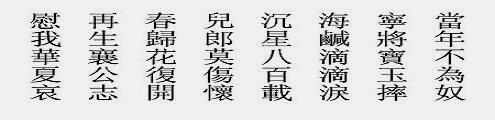
Among Meng Chang's concubines would be Lady Huarui-fu-ren (flower's pistil) who wrote the poem about 140,000 troops shedding shields at the same time.
This was a poem recorded in Wu Renchen's book Shi Guo Chun-qiu.
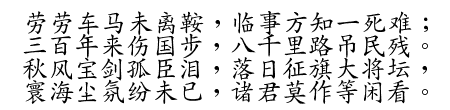
Communist China's imbecilic secretary Xi Jinping, who was nostalgic about the Soviet Union's pan-communism cause, lamented Gorbachev's reform that led to the dissolution of the Soviet empire with citation of Lady Huarui-fu-ren's poem that accused the defenders (namely, the Soviet Red Army) of being not a man.
The Jing-nan (Nanping) State at Jiangling (A.D. 924-963)
The Jing-nan (Nanping) regime, also called by the Northern Chu-guo state, was launched by 'Jing-nan jiedu-shi' Gao Jichang (Gao Jixing), i.e., Posterior Liang Emperor Zhu Wen's former 'qin-cong (kinsmen-like guard) zhihui-shi' and an adopted son of Li Rang (Zhu Yourang) who was in turn adopted by Zhu Wen.
In July of A.D. 905, Zhu Wen sent 'Wuning jiedu' Yang Shihou to attacking Zhao Kuangning.
Zhu Wen followed through by personally commanding a heavy army.
The Liang army took over six prefectures of Tang2, Deng4, Fu4, Ying3, Sui2 and Fang2.
Zhao Kuangning burnt the city and ships, and broke out of the siege by sailing down the Han-shui River for seeking asylum with Yang Xingmi.
After Zhu Wen usurped the Tang dynasty to become an emperor of the Posterior Liang dynasty, Gao Jichang (Gao Jixing) was assigned the post of 'Jing-nan jiedu-shi'.
Successor Gao Conghui (r. [inherited] King Nanping-wang A.D. 928-932; King Bohai-wang A.D. 932-934; King Nanping-wang A.D. 934-948) kept a low profile, called the various warlords and strongmen by emperors, including Posterior Tang, Posterior Jinn, Khitan Liao, Posterior Han, Southern Han, Min-guo, Southern Wu (Huai-nan/later Southern Tang), and Posterior Shu, over which he often received the imperial bestowals and nicknamed the bilker.
Son Gao Baorong (r. inherited King Nanping-wang A.D. 948-951; King Bohai-jun-wang A.D. 951-9354; King Nanping-wang A.D. 954-960) assumed the 'Jing-nan jiedu-shi' post.
Gao Baoxu (r. A.D. 960-962), who was favored by his father Gao Conghui and nicknamed 'wan-shi xiu' (all things dispelled), inherited the Jing-nan satrap post and died early as a result of indulgence in pleasure. Gao Jichong, a nephew who was Gao Baorong's son, took over the satrap post in late A.D. 962. In A.D. 963, Soong Emperor Taizu (Zhao Kuangyin, r. A.D. 960-976), on the pretext of borrowing a path for quelling Zhang Wenbiao's rebellion against the eleven-year-old successor 'Wuping jiedu-shi' Zhou Baoqian, sent a Soong army to Jiangling and eliminated the Jing-nan regime.
The Chu-guo Statelet
The Chu-guo Statelet had origin in Ma Yin's job as "jiedu-shi" in A.D. 896 for the Wu'an-jun Garrison of the Tang dynasty. In 907, Posterior Liang conferred Ma Yin as King Chu-wang.
Ma Yin was a follower of rebel Sun Ru who was in turn a subordinate under rebel Qin Zongquan. Liu Jianfeng and Ma Yin, after Sun Ru's death in A.D. 892 in the war with Yang Xingmi, with 7000 remnants fled to Hongzhou and Tanzhou, consecutively, where Ma Yin was supported as a leader in A.D. 896 after Liu Jianfeng was killed by subordinates in April of A.D. 896. The Tang emperor appointed Ma Yin the posts of 'Hunan liu-hou' and 'pan Hunan junfu-shi4'. Later in A.D. 898, Ma Yin was further appointed the post of 'Wu'an-jun jiedu-shi'.
In 927, Posterior Tang conferred Ma Yin as King Chu-guo-wang.
In 951, the Southern Tang army, under Bian Hao, invaded westward to occupy Changsha. A subordinate general, Liu Yan, repelled the Southern Tang army and re-established the Chu-guo statelet. In 952, subordinate Wang Jingkui killed Liu Yan; in 955, subordinate Pan SHusi killed Wang Jingkui; and subsequently, Zhou Xingfeng attacked the capital city of Langzhou and killed Pan Shusi. When subordinate Zhang Wenbiao rebelled against Zhou Baoquan, i.e., son of Zhou Xingfeng, the northern army, in the name of assisting the Zhou family in cracking down on the rebellion, took over Tanzhou and the whole territory of today's Hunan Province, ending the Jing-nan [south of Jing{Hubei}] or the Chu-guo kingdom.
After the death of Ma Yin, junior son Ma Xisheng took over the reign, sent a request to Posterior Tang for self-downgrading himself to 'jie-shuai', and 'jiedu-shi', not a king. Ma Xisheng (r. A.D. 930-932), who called himself 'liu-hou', faked succession through the late father's will. Posterior Tang conferred Ma Xisheng the posts of 'Wu'an & Jingjiang jiedu-shi' and 'zhongshu-ling'. Ma Xisheng was succeeded by twin-brother Ma Xifan (r. A.D. 932-947). In A.D. 934, Posterior Tang Emperor Modi re-conferred the title of King Chu[-guo]-wang onto Ma Xifan. Ma Xifan, after death of his wife Peng-furen, indulged himself in sex and wine, increased taxation on the people, and sold the officialdom posts for money. Ma Xifan was succeeded by brother Ma Xiguang who was Ma Yin's 35th son. Ma Xiguang (r. A.D. 941-951) enjoyed the same rank of King Chu-wang conferred by the Posterior Han dynasty. In A.D. 949, 'Wuzhen (Wuping) jiedu-shi' Ma Xi'e, an eldest brother and Ma Yin's third son, rebelled against Ma Xiguang
Ma Xi'e, with the posthumous title of King Gongxiao-wang (r. A.D. 950-953), switched allegiance to Southern Tang rather than the northern dynasty emperors. In A.D. 951, Wang Kui and Zhou Xingfeng, two Chu-guo generals, took over Langzhou and supported Ma Guanghui, i.e., Ma Yin's grandson, as a satrap. Wang Kui and Zhou Xingfeng then supported 'Chen1zhou ci-shi' Liu Yan in replacing Ma Guanghui as 'quan Langzhou liu-hou' and 'quan Langzhou jiedu-shi'. Liu Yan was a former subordinate under 'Ji1zhou ci-shi' Peng Gan and fled with Peng Gan to the Chu-guo state when the Nan-wu regime attacked Jiangxi in A.D. 909. Months later, Xu Wei, another general, supported Ma Xichong as 'liu-hou' and put Ma Xi'e under house arrest at Hengshan, where lower-level generals Liao Yan, Liao Kuangning and Peng Shigao restored Ma Xi'e as King Hengshan-wang. At Tanzhou, Ma Xichong, after discerning that subordinate Xu Wei had an attempt on his life, sent a request to the Southern Tang emperor for help. In A.D. 951, the Southern Tang army, under Bian Hao, invaded westward to occupy Changsha. Southern Tang relocated Ma Xichong and his family back to Southern Tang
In A.D. 952, Liu Yan, who refused to visit the Southern Tang viceroy at Tanzhou, sent Wang Kui and Zhou Xingfeng to attacking the Southern Tang army at Tanzhou. Wang Kui and Zhou Xingfeng evicted the Southern Tang army from Hunan.
In A.D. 956, subordinate Pan Shusi, who was 'Yuezhou tuanlian-shi', attacked Langzhou and killed Liu Yan outside of Wuling. Pan Shusi fetched 'quan zhi Tanzhou jun-fu shi4' and 'Wuqing jiedu-shi' Zhou Xingfeng to Langzhou from Tanzhou.
Zhou Xingfeng induced to kill Pan Shusi for the rebellion. The Posterior Zhou dynasty conferred upon Zhou XIngfeng the post of 'Wuping jiedu-shi'.
In A.D. 963, Soong Emperor Taizu (Zhao Kuangyin, r. A.D. 960-976) quelled the Nan-ping (Gao Jichong's Jing-nan) and Wuping (today's Hunan) regimes. The Chu-guo successor, i.e., 11-year-old Zhou Baoquan, son of Zhou Xingfeng, requested aid with both the Jing-nan regime and the Soong court for quelling the rebellion of Zhang Wenbiao. Soong Emperor Taizu sent Murong Yanzhao and Li Chuyun to the south.
On March 26, the Soong army took over Sanjiang-kou [three rivers' confluence area] and consecutively took over Yueyang and Langzhou (Changde of Hunan Province). The Soong army, in the name of borrowing a path, also took over the Nanping-guo regime in passing through Jiangling. Subsequently, Soong in A.D. 965 eliminated the Posterior Shu regime. Zhou Baoquan (r. A.D. 962-963), during Soong Emperor Taizong's reign, was appointed the post of 'zhi Bingzhou (Yuci)'.
The Yang-Wu State
The Nan-Tang State
In October of A.D. 937, Xu Zhigao killed the Wu emperor's brother Yang Meng, deposed Yang Pu, made Yang Pu into Emperor Rang-huangdi (yielding emperor), and promulgated the
Qi State -- which was renamed to the Nan-tang (Southern Tang)
State in A.D. 938 or early A.D. 939.
Xu Zhigao set the capital city at Jinling and called Yangzhou-fu 'Dong-du' (eastern capital).
Xu Zhigao (posthumous Emperor Liezu, r. A.D. 937-943), claiming descent from the Tang dynasty royal house, renamed himself to Li Bian.
After Li Bian died of poisoning from the alchemists' panacea, son Li Jing (posthumous Emperor Yuanzong, r. A.D. 943-958; as king A.D. 958-961) ascended the throne.
During Li Jing's reign, the Southern Tang territory was the largest, with addition of seven prefectures by
constantly invading the neighboring states.
Li Jing, against his late father's wish,
began to resort to the military campaigns on a large scale to expand the territories, and eliminated the Min-guo state in A.D. 945 by taking advantage of
civil strife due to the successors' competition for the throne
and
the Chu-guo state in A.D. 951 -- before the two states' subordinate generals temporarily revived the Chu-guo and Min-guo states that continued till the Soong dynasty was to annex the two states and reunite China.
In A.D. 951, the Southern Tang army, under Bian Hao (Bian Gao), invaded westward to occupy Changsha. A subordinate general, Liu Yan, repelled the Southern Tang army and re-established the Chu-guo statelet.
The Southern Tang army was to be expelled by Chu-guo General Liu Yan in October of A.D. 952.
At about the same time, Li Jing sent Huangfu Hui to the Haizhou and Si4zhou area to recruit the warlord and local strongmen-organized armies.
In the Min-guo state, General Li Hongyi (Li Renda)
took control of Fu2zhou and switched loyalty to the Wu-Yue state, while General Liu Congxiao took over Quanzhou and submitted to the Southern Tang rule.
Under the attack of Liu Congxiao and the Southern Tang army, Li Hongyi (Li Renda) sought suzerainty with Posterior Jinn and requested aid with the Wu-Yue state which defeated the Southern Tang dynasty's army from A.D. 947 to 950.
In June of A.D. 961, Li Jing was succeeded by Li Yu (r. A.D. 961-975) who was known in history as Li-houzhu (last Li lord).
Li Yu retained Jinling as the capital city.
Li Jing previously banished minister Zhong Mo for advice against making Li Yu into a crown prince for the latter's devotion to Confucianism (being an acclaimed lyric poet) and Buddhism (being fond of building pagodas and monasteries).
Li Yu, however, was not lascivious as the other rulers were, giving special favor and love to empress (queen) Zhou-zhaohui-hou and later the queen's sister.
After the queen died in December of A.D. 964, Li Yu wrote elegy Yi Zhaohui-Zhou-hou Lei (dirge for the empress Zhou-zhaohui-hou) that he personally chiseled onto the headstone, in which he expressed deep feelings to the effect of
likening his romance to the legendary Gaotang goddess of the Yunmeng lake (in the prose Gaotang Fu)
and Luo-pu nymph at the Luo-he River bund,
questioned the life-long marriage ordained in the Gui-mei (returning sister) hexagram and the ‘yao’ six-liners' dictum of the Xian (salty; male-female telepathy) hexagram,
lamented the swear of holding the opposite party's hands ('zhi zi zhi shou') and growing old together ('yu zi xie lao') - as said in poem Ji Gu (striking the war drums) of Bey Feng,
recalled how the couple worked together to re-compose the lost pipa music Ni-chang yu-yi qu (neon and feather clothes dancing music) from Tang Emperor Xuanzong (Tang-minghuang)'s times,
and
expressed the wish that nothing had changed:
'wo si shu-zi' (I yearn for the beautiful lady),
'yong nian you chu' (eternally remembering like it was at the beginning).
In September of A.D. 974, the Soong emperor ordered Cao Bin and Pan Mei to attack Southern Tang with a water-borne army of 100,000, that sailed down the Yangtze from Jiangling.
The Soong army invaded Southern Tang with three routes.
At the same time, King Wu-Yue-wang Qian Chu pincer-attacked Southern Tang from the [south]east.
Wang Ming, i.e., 'Yuezhou & Yue-jiang-Lu jiang-lu (Yangtze) xun-jian' and 'zhanzhao (warships) du-bushu', was ordered to attack the Southern Tang army at Hukou.
In October, the Soong army crossed the Yangtze.
The Soong army scored three victories at Caishi, Qinhuai-he and Wankou.
In March of A.D. 975, the Soong army surrounded Jiangning-fu (Nanking).
In November, Cao Bin attacked Jinling from three directions.
Fifteen days later, the Soong army breached the city and took over Jinling after a campaign that lasted
for over one year.
The Min State
The Wu-Yue State
The Nan-Han State
The Bei-Han State
|
|
|
|
|
|
|
Sovereigns & Thearchs;
Xia-Shang-Zhou dynasties;
Zhou dynasty's vassalage lords;
Lu Principality lords;
Han dynasty's reign years
(Sexagenary year conversion table-2698B.C.-A.D.2018; 247B.C.-A.D.85)
|
|
The Sinitic Civilization - Book I is
available now on
iUniverse,
Barnes & Noble,
Amazon,
Google Play|Books
and
Nook.
The Sinitic Civilization - Book II is
available at
iUniverse,
Amazon and Barnes & Noble.
Check out the 2nd edition preface that realigned the Han dynasty's reign years strictly observing the Zhuanxu-li calendar of October of a prior lunar year to September of the following lunar year, and the 3rd edition introduction that had an overview of Sinitic China's divinatory history of 8000 years.
The 2nd edition preface had an overview of the epact adjustment of the quarter remainder calendars of the Qin and Han dynasties, and the 3rd edition introduction had an overview of Sinitic China's divinatory history of 8000 years.
The 2nd edition realigned the Han dynasty's reign years strictly observing the Zhuanxu-li calendar of October of a prior lunar year to September of the following lunar year.
Stayed tuned for Book III that is to cover the years of A.D. 86-1279, i.e., the Mongol conquest of China, that caused a loss of 80% of China's population and broke the Sinitic nation's spine.
Preview of annalistic histories of the Sui and Tang dynasties, the
Five Dynasties, and the two Soong dynasties
could be seen in
From the Khitans to the Jurchens & Mongols: A History of Barbarians in Triangle Wars and Quartet Conflicts
(The Barbarians' Tetralogy - Book III: available at iUniverse;
Google Play|Books;
Amazon;
B&N).
(A final update of the civilization series is scheduled for October of 2022, that would put back the table of the Lu Principality ruling lords' reign years, that was inadvertently dropped from Book I during the 2nd update.)
|
|
Now, the Scourge-of-God-Tetralogy.
Book III of
The Barbarian Tetralogy, i.e., this webmaster's barbarism series, is released in October of 2022 by iUniverse. This barbarism series would be divided into four volumes covering the Huns, the Xianbei, the Turks, the Uygurs, the Khitans, the Tanguts, the Jurchens, the Mongols and the Manchus.
Book I of the tetralogy would extract the contents on the Huns from
The Sinitic Civilization-Book II,
which rectified the Han dynasty founder-emperor's war with the Huns on mount Baideng-shan to A.D. 201 in observance of the Qin-Han dynasties' Zhuanxu-li calendar.
Book II of the Tetralogy would cover the Turks and Uygurs.
And
Book IV would be about the Manchu conquest of China.
From the Khitans to the Jurchens & Mongols: A History of Barbarians in Triangle Wars and Quartet Conflicts
, i.e., Book III of
the Scourge-of-God-Tetralogy,
focused on the Khitans, Jurchens and Mongols, with the missing one-year history of the Mongols' Central Asia campaigns rectified.
This webmaster, other than the contribution to the Sinology studies in rectifying the Huns' war to 201 B.C., and realigned the missing one-year history of the Mongol Central Asia war, had one more important accomplishment, i.e., the correction of one year error in the Zhou dynasty's interregnum (841-828 B.C. per Shi-ji/840-827 per Zhang Wenyu) in
The Sinitic Civilization-Book I, a cornerstone of China's dynastic history.
|
The Scourges of God: A Debunked History of the Barbarians (available at iUniverse|Google Play|Google Books|Amazon|B&N)
From the Khitans to the Jurchens & Mongols: A History of Barbarians in Triangle Wars and Quartet Conflicts
(The Barbarians' Tetralogy - Book III)
Epigraph,
Preface,
Introduction,
Table of Contents,
Afterword,
Bibliography,
References,
Index
|
|
Written by Ah Xiang
|
|

 ***
***


![Though, Anna Wang [Anneliese Martens], in her memoirs, expressed jealousy over Gong Peng by stating that the Anglo-American reporters had flattered the Chinese communists and the communist movement as a result of being entranced with the goldfish-eye'ed personal assistant of Zhou Enlai](GongPeng.jpg)