Sinitic Civilization-Book 1
Sinitic Civilization-Book 2
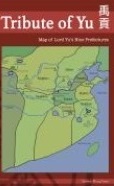
Tribute of Yu
Heavenly Questions
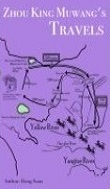
Zhou King Muwang's Travels
The Legends of Mountains & Seas
The Bamboo Annals - Book 1
The Scourge-of-God-Tetralogy:
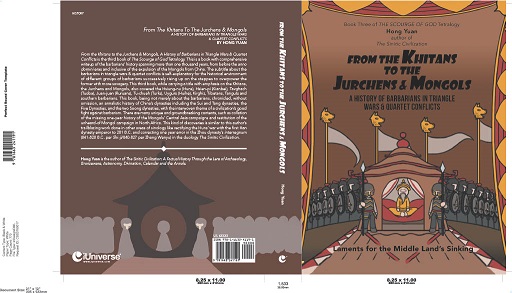
From the Khitans to the Jurchens & Mongols: A History of Barbarians in Triangle Wars and Quartet Conflicts
(available at iUniverse;
Google;
Amazon;
B&N)
|
|
|
|
Invasion Of
Manchuria, Chaha'er & Jehol
1931-34
The Mukden
Incident - 9/18/1931 & Battle Of
Jiangqiao
The Shanghai
Provocation - 1/28/1932
Battles
of the Great Wall
China In
Crises Of Internal Turmoil &
Foreign Invasion
The Japanese
Invasion (1937-1945)
Marco Polo
Bridge Incident & Battle
of Tianjin-Peking
Campaign Of
Nankou & Campaign of
Xinkou
Air
Battles Directed By Chenault
& With
Russian Pilots
Battles
of Shanghai, Jiangyin,
Si'an
& Nanking
Defence
Rape
Of Nanking & The Great
Rescue Of 1937
Eight
Year Long Resistance War
Mingguang,
Linyi-Tengxian,
Tai-er-zhuang , & Xuzhou
Battles of
Lanfeng, Wuhan,
Nanchang,
& Sui-Zao,
1st
Changsha Battle, Kunlunguan,
Wuyuan,
& Zao-Yi,
Fatigue
Bombing of Chongqing by Japanese
Aggression
Against Vietnam & Southeast Asia
Yu-nan &
E-bei, Shanggao,
& Mt
Zhongtiaoshan
2nd
Changsha Battle, & Pacific
Wars
3rd
Changsha Battle, & Zhe-Gan
Campaign
Second
Burma Campaign, & Phase
II
|
| [ revolution.htm
& tragedy.htm] |
Communist
Armed Rebellions
Second
Northern Expedition
War Of
Chiang Kai-shek versus Gui-xi (March
1929)
War
Of The Central Plains (May 1930)
Campaigns
Against Communist Strongholds
The
Long March
Xi'an
Incident - Turning Point of Modern
History
Demise
Of Red Army Western Expedition
|
| [ campaign.htm
& terror.htm
] |
[ war.htm
] |
|
1945-1949 Civil War
THE KOREAN WAR &
THE VIETNAM WAR
(*** machine-translated Chinese language version:  ***) ***)
1) World War II, in both the East and the West, was the result of the inducement of the British, American[, and French] interest groups and syndicates, as well as the result of the scheme by Soviet Russia. First there was the October 1925 Locarno Treaties which, per Polish foreign minister Jozef Beck, led to the opinion that "Germany was officially asked to attack the east, in return for peace in the west." Poland, as a country, was anti-Republic of China since birth, as it colluded with Japan at the 1919 Paris Conference, at the post-1931 League of Nations' conference, and at the post-1937 League of Nations' conference, in the attempt at encouraging Japan in the invasion against China to ultimately war with the Soviet Union.
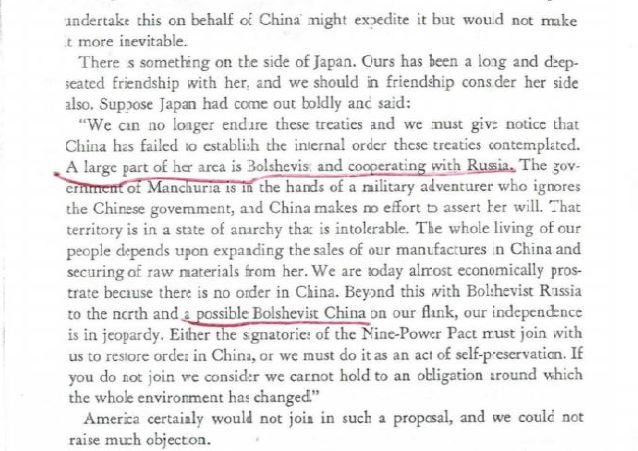
In 1931, President Herbert Hoover gave Japan a free hand in the invasion of Manchuria on the pretext that Japan could not tolerate a half-Bolshevik China.
After the eruption of the 1937 war, the Anglo-Americans, still biased towards Japan and against China, adopted a policy of "neutrality" (what Utley called by "unpositive neutrality") against the 'belligerent' countries, namely, Japan and China, which was free and unrestrained arms sale to Japan and de facto arms embargo against China.
Note that the Japanese navy had a full blockade of China's coastline. Note that the blockade would choke China since China did not have an industrial base to produce the basic weapons while Japan's factories could roll out the warships and airplanes on a wholesale scale.
Thereafter the September 1938 Munich Agreement. For what? Britain, France and the United States wanted Hitler to attack the Soviet Union, and wanted Japan to suppress China's nationalist movement and counter the Soviet Union. In both cases, Stalin out-smarted the Anglo-American and the French. Hitler attacked westward instead, and signed a non-aggression pact with Stalin to halve Poland; and Japan attacked Southeast Asia and the Pearl Harbor after China, not the Soviet Union.
Half a year before the Russo-Japanese Neutrality Treaty of April 1941 and one year ahead of the Pacific War, Japan already reached a secret deal with the U.S.S.R. to halve China, mapping the "Poland partition" scheme by the U.S.S.R. and Nazi Germany, as evidenced by the clauses of the Dec 1940 negotiation and treaty between Wang Ching-wei's puppet R.O.C. government and Japan in regards to the reserved territories for the Chinese communists and the hinted Western China's boundary between the U.S.S.R. and Japan.
(More available at "Changing Alliances On the International Arena", "Century-long American hypocrisy towards China", "Anglo-American & Jewish romance with the Japanese",
"America's Unpositive Neutrality in the Sino-Japanese War",
"Joe Stilwell's Authorization To Assassinate Chiang Kai-shek", and "What Foreign Powers Did To The Flowery Republic Prior To, During And After The 1911 Revolution".)
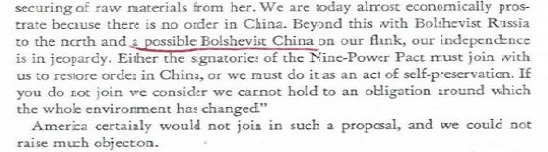
A rather simple explanation for the ultimate American intervention in China in March 1940, i.e., the Americans' hastily giving Chiang Kai-shek a badly-needed loan, would be to prevent Japan and China from reaching a truce since Chiang Kai-shek deliberately spread a rumor that his Chongqing government could merge with the puppet Nanking government.
As Paul Reinsch and Arthur Young repeatedly said, the United States of America could have done just a little to help China in WWI or WWII, but chose to do nothing during WWI other than a Lansing-Ishii Agreement [which was to acknowledge that Japan had its special interests (in the specified areas of China specified by the secret memorandum)], chose to do lip-service to Wu Peifu's ROC government while the Soviets equipped Feng Yuxiang and Sun Yat-sen's military factions with free guns; chose to do nothing after making sure China was to stay in the Second World War by merely granting the currency stabilization loan of 1940; and chose to use the Lend-Lease coercion to force China into throwing the crack troops at northern Burma just prior to the Japanese Ichigo Campaign in 1944.
2) Stalin was the evil genius of the 20th century. Stalin, after the 1929 war against Zhang Xueliang over the Chinese-Eastern Railway [which erupted over the Soviet Russian and Chinese communist agitation in sabotaging Japan's attempt at building five additional railways in Manchuria and Inner Mongolia], quickly divested himself of the railway when Japan invaded Manchuria on Sept 18th, 1931. After initially calling on the world communists to militarily defend the Soviet Union from 1931 to 1933, Stalin subsequently designed the united front and popular front in 1935, and in the time period of 1936-1937 successfully lit the fuse of the Sino-Japanese War by means of repeated G.R.U. operations in northern China and Manchuria.
To thwart the Anglo-American attempts at using Japan against the U.S.S.R., Stalin hijacked the American government policies by utilizing agents, saboteurs, provocateurs and sympathizers from the Institute of Pacific Relations. "16 out of 17 of the AMERICANS that were involved in creating the U.N. were later identified, in sworn testimony, as secret communist agents." The whole United States government was in fact taken over by the Comintern agents, including: Alger Hiss; Harry Dexter White; Lauchlin Currie; Laurence Duggan; Frank Coe; Solomon Adler; Klaus Fuchs; and Duncan Lee."
John Fairbank and Owen Lattimore, i.e., two "Old China Hands" who were repeatedly cited by the Chi-com for substantiation of the cause and success of the Chinese communist revolution, had merely been the Soviet Russian and/or Chicom tools. (Most of the Comintern spies of the European and American background had been recruited during their stay in China during the turbulent 1920s. Note that 95% of the Comintern agents sent to China were American Jews and 100% of the Soviet Red Army G.R.U. agents sent to China were German Jews. Owen Lattimore's belief and orientation should have been shaped during his early years in Peking in the 1920s. John King Fairbank, who had done everything Agnes Smedley had asked him to do other than putting his name on the roster of the G.R.U. (Main Intelligence Directorate of the General Staff of the Armed Forces of the Russian Federation), was a member of the Chinese League for the Protection of Civil Rights in late 1932 and early 1933, and further rafted with Comintern agent Harold Isaacs on the Jehol River in 1934 before the latter switched to the Trotskyite path. Working directly under Lattimore would be two Chicom spies called Chi Chao-ting and Chen Han-sheng who designed America's China policies.)
3) It was the century's misfortune for China to have to see the Anglo-American interest groups and Russian/Comintern agents colluding with each other in subverting Nationalist China
--
the last bastion against the imperialists and colonialists and
the beacon tower
for the independence of all Asian countries and people
, colonized or semi-colonized by the West,
as "...British Ambassador personally suggested to me [Albert Wedemeyer]
that a strong unified China would be dangerous to the world and certainly would jeopardize the white man's position immediately in Far East and ultimately throughout the world."
No matter it was the 1904-05 Russo-Japanese War, or the Japanese invasion of Manchuria in 1931, or the 1937-1945 Sino-Japanese War, the aforesaid parties, plus the Chinese communist henchmen, were the ONLY people who wanted Japan to invade China, albeit for different reasons and agenda at different stages and times.
In another word, the Japanese never realized that they had been brought up and used as a tool since Matthew Perry's timeframe, first as a tool against Russia in 1904-5 and then used by the Soviets as a tool against China.
"When other nations tried to bar ... [Japan] progress or slur ... [Japan] reputation," as commented by Inazo Nitobe:
"America always stood for ... [Japan] ...[America's] Stars heralded to the world the rising of ... [Japan] Sun..."
The warships and planes built and used against China in 1931/2 were the products of twenty years of military alliance between Britain and Japan,
following the American support of the Japanese ventures against Ryukyu and Taiwan in the late 19th century.
(Do not forget the post-WWI ten-year arms embargo against Republic China and George Marshall's post-WWII arms embargo against Republic China 1946-1948, as well as
the synarchists' backing Japan's war against China and Sun Yat Sen.)
4) There is no truth in Stalin and Truman racing against each other as suggested by Tsuyoshi Hasegawa. While Truman was blindfolded as to the making of the Atomic Bomb, the Russians had been receiving ships of the uranium ore throughout the war, which was to make sure that the United States was not to become the nuclear monopoly. Stalin's American proxies already had Truman agree to the terms reached by Roosevelt at Yalta. The United States had utterly no preparation for racing its army to Japan or Korea. "It was after the U.S. dropped two bombs onto Japan, on Aug 6th & 9th, respectively, that Rusk & Bonesteel, drew up the 38th Parallel on the map as an artificial division line separating the U.S. sphere of influence from the U.S.S.R.
(The Japanese, of course, don't know that they were used as a tool against China.
Working as a secretary of the Japanese prime minister Konoye Fumimaro as one of the five brain trusts, Stalin's spy Ozaki,
likening Japanese prime minister Konoe to Alexander Kerenski (head of the 1917 transitionary Russian government),
wanted to turn Japan into a replay of the Soviet revolution.
How brilliant it was to hit two birds (China and Japan) with one stone!
It was the Tokyo Special Higher Police, 'tokko' or 'tokubetsu', who broke the Sorge-Ozaki spy rings in China and Japan, not the Japanese military kempeitai or the Japanese military that was permeated with the JCP and Tobun [same language] Academy spies.
Do you Japanese know that?)
5) Japan already explored with the Soviets for surrender. But the Soviets declined it. Otherwise, what's the need to enter Manchuria and Korea? Since the Russians were eager to invade Manchuria & Korea, Japan had to turn around to request with Sweden for relaying a message of surrender.
Japan was in self-denial over the prospect of the Russian entry into war. Intelligence already poured into Japan as to the Russian complicity at Yalta. Back on June 9th, 1945, Truman officially told TV Soong (Soong Ziwen) that he was to honor the late President's signature on the Yalta Agreement and requested that China dispatch a delegation to Moscow for stamping a Sino-Russian friendship agreement no later than July 1st. The Chinese were busy repairing the damages. Japan knew about it. Japan sent secret negotiators to Chiang Kai-shek multiple times in July-August of 1945 for the peace talks. Looking in hind sight, China, separately, should have struck a partial peace with Japan to ward off the Soviets.
(When the Soviet Red Army invaded Manchuria, Japan, who had issued orders to its armies to surrender across the battlefields of China and Southeast Asia, had to make a special order to the Kwantung Army to resist the Soviet Red Army in Jehol, Manchuria, and the Sakhalin for about 20 days for sake of stopping the Soviets from landing in Hokkaido.)
6) Though, the Japanese emperor played a trick in surrender. He signed a "truce" order to his army and listing Britain, American and China and etc., but when he made the announcement on radio, he changed China to Chungking [Chongqing] the Chinese interim capital. We know Japanese have a problem with saving face. But the truth is known no matter how the professor wanted to discount the atomic bombs and gave weight to the Russian entry into the war. Professor Tsuyoshi Hasegawa, who skipped the name of China in his book title and ignored the death toll of 1 million Japanese on mainland China, should spend more time researching into the fate of half of the 500-600,000 Kwantung Army that had perished in Russian Siberia.
Konoe Fumitaka, i.e., son of imbecilic Japanese prime minister Konoe Fumimaro who designed the policy of "Shokaiseki o aite to sezu", was exiled to Siberia by the Soviets
and just days before repatriation in the late 1950s, could have been killed by the Soviets.
(From the memoirs related to some Taiwan native who joined the Japanese Kwantung Army and was later exiled by the Soviet Red Army to Siberia for the coolie labor, the Soviets, to help Mao Tse-tung and Kim Il Sung, on a wholesale scale, in 1947 repatriated the Korean-ethnic Japanese Kwantung Army prisoners of war to North Korea and the Taiwan-ethnic Japanese Kwantung Army prisoners of war to Manchuria, as fodder of war, which probably explained why there was no accounting of some huge numbers of the Japanese Kwantung Army troops in the later repatriation to Japan and the Republic of China's generals kept mentioning that the Koreans and the Japanese were manning the guns and the tanks of the Chinese communist army.)
The Soviets sorted out at least 30,000 Japanese artillery troops, medical Kwantung Army staff, a full airforce contingent with generals and crewmen under Hayashi Yayichiro, and no less than two full Korean-ethnic divisions for deployment by the Chinese communists in the civil war against the Nationalist Chinese Government, not to count the Outer Mongolian Cavalry and 100,000 fully-trained Korean mercenaries sent to China in 1947, with about 60,000-70,000 remnants [out of the total headcount of 250,000 Korean mercenaries] shipped back to Korea prior to the Korean War of June 1950. According to Kim Il-sung, altogether 250,000 Korean mercenaries took part in the 1945-1950 civil war against the Nationalist Government, with 60,000-70,000 remnants surviving the bloody Chinese civil war to return to Korean for the 1950 Korean War.
Note the fundamental difference between the 250,000 ethnic-Korean Japanese Kwantung Army diehards and the ethnic-Korean Chinese living in China.
The communist statistics claimed that altogether 65,000 ethnic-Korean Chinese minority people, or the Korean migrants living in China, joined the communist army, with approximately
60% coming from the Jirin subprovince,
21% from the Sungari subprovince, and
15% from the Liaodong subprovince.
7)
Stalin and the Soviets were behind each step of monster Mao Tse-tung in making sure that no peace could have a chance from the day Japan surrendered. Cumulatively, the Soviet Russians acknowledged in the 1970s that they had given the Chinese communists 700,000 guns, with North Korea's arsenals open for free pickup throughout the Chinese civil wars. (On the 1947 anniversary date of the Russian Revolution, the Soviet Russians already disclosed that they had given the Chinese communists massive military aid - which the Americans refused to acknowledge.) At about the same time the Republican Party forced through the China Aid Act in 1948, Stalin officially stamped a loan for the Chinese communists of an equivalent amount allocated by the China Aid Act, with no strings attached.
Stalin understood that the generations of brave Chinese during first part of the 20th century were the flower that China ever had in the whole history of 5000 years, a force that must be destroyed so that the Soviet Russian scheme at world domination could succeed.
Didn't know the Russian cold-bloodedness? Read into the Katyn Murder of 20,000+ Polish officers, and Stalin's plan to shoot 50,000 German officers- which Roosevelt echoed by lessening to 49,500.
Separately, Stalin disclosed to the son of Chinese president that he wanted to imprison 500,000 to 600,000 Japanese lower-level officers and 12,000 Japanese generals for preventing the Japanese from rising up again to pose threat to the Soviet Union.
Likely, Stalin passed on a suggestion to McArthur to arrest 8000 to 12,000 Japanese generals.
(Numerous nationalist army generals, who survived the valiant wars against the Japanese invasion, would be imprisoned and executed by the communists from 1949 to 1975. E.g.,
Lu Shiyang was executed by the communists in 1951 simply because he was a former Nationalist Army company commander even though he left the army after the VJ (victory over Japan) day in 1945 and never ever fought against the communist army.
Wu Dehou, released by the CCP's amnesty on Dec 15th, 1975, returned to his impoverished Shanxi Province countryside as a peasant.
Du Yuming, the war hero on the Burma Theater, was released from over 10-year long prison sentence on Dec 4th, 1959 in accordance with the CCP's 17 Sept 1959 First Amnesty Order for sake of having him show off at a diplomatic meeting in April 1960 with former British General Montogomery as well as for sake of instigating the return of his son-in-law, i.e., noble prize winner Yang Zhenning.
The Nationalist Army colonel-level officers, about one tenth of the total captives rounded up in the communist provincial quasi-prisons since the 1950s, survived the execution, torture and hunger to get amnesty in 1975.
It would be in 1985 that the CCP first declared the title of 'national heroes' for 85 Nationalist generals who sacrificed their lives in the Resistance Wars Against Japan.)
As this webmaster had elaborated on the battles and campaigns in Civil Wars section,
the Chinese Civil War of 1945-1950 [using the Korean War as a breakpoint rather than the PRC's proclaimed date of founding] is the "Last Duel of the Middle Earth"
involving millions of the fighting-to-death Yellow Men,
with the outcome determined on the battlefields by means of a) the military tactics and strategies,
b) political conspiracy and plots, c) economic manipulation and sabotage, c) societal disruption and coercion,
and d) international alliance and betrayal, never ever the free choice of the Chinese people or the 'Mandate of Heaven' as John Fairbank and Owen Lattimore
[and their student-sinologists in the American colleges and universities] wanted you to believe in.
|
The brave R.O.C. soldiers against the armed-to-the-teeth Japanese Army
After squandering the 1st tier troops of 1st-20th Shidans and 2nd tier troops of 100th-120th Shidans in the "yocho" (penalizing) action against China, the Japanese sent the demoralized Shidans
to the Pacific War graves, to the extent that by the time Japan surrendered, the Japanese homeland soldiers of 1-2 million new recruits possessed bamboo sticks and spears
for defense, while the Soviet/Comintern agents inside of the Japanese government/military, in the name of moving the duel battlefield to the mainland, hoarded large cache of weapons in Manchuria/Korea for free pickup by the Soviets and the
Chinese/Koreans.
Working as a secretary of Konoye Fumimaro the Japanese prime minister as one of five brain trusts, Stalin's spy Ozaki,
likening Japanese prime minister Konoe to Kerenski (head of the 1917 transitionary Russian government),
wanted to turn Japan into a replay of the Soviet revolution.
(It was the Tokyo Special Higher Police, 'tokko' or 'tokubetsu', who broke the Sorge-Ozaki spy rings in China and Japan, not the Japanese military kempeitei or the Japanese military that was permeated with the JCP and Tobun [same language] Academy spies.
Do you Japanese know that?)
|
|
|
The brave and victorious National Revolutionary Army (NRA) of the Republic of China chased the remnant communists to the north bank of the Sungari River.
|
|
The Americans sold out China in Tehran, Yalta and Potsdam. In late 1944, American navy general Leahy was probing China about the Soviet demand for Dairen, Port Arthur and the railways. Roosevelt locked up the secret treaties in his drawer till his death. Both Hurley and Leahy merely knew part of the Roosevelt's secret deals with Stalin. Truman pressured China numerous times demanding that China sign an agreement with the Soviets no later than July 1st, 1945. Late 1945, George Marshall and the Americans continued to sell out China on the matter of the Soviet pillage of Manchuria, and held a U.S.-U.K.-U.S.S.R. three-country foreign ministers' meeting, to demand that the Republic of China must talk peace with the communists --namely, the imposition of a worldwide arms embargo against the Republic of China.
Marshall, in the spring of 1946, flew back to China to stop the Chinese army from moving beyond the Sungari River.
As disclosed by the documents at the George Marshall foundation, George Marshall, possibly the most hideous agent working on behalf of Stalin and the Soviet Union, saved the ass of the Chinese Communists with a threat to withhold the economic aid that was supposedly coming from the U.S. export-import bank, which never materialized.
|
|
|
|
G Marshall, from 1946 to 1948, repeatedly probed numerous Chinese officials and generals as to who could be Chiang's successor.
The U.S. Department of State, run by the Russian agents, were repeatedly sending out rumors about getting a successor for Chiang. Marshall's hands had the blood of millions of Chinese killed in the civil wars.
G Marshall, as Wedemeyer said, first armed China and then disarmed China.
This was what Wedemeyer, after taking over Stilwell's job, began as the 30-division training place in the spring of 1945 --that did not get fully started before it was scrapped, with Shi Jue's 13th Corps going into Manchuria in the spring of 1946 with one third of the American-supplied training ammunition, for example.
The U.S. arms embargo continued till the China Aid Act of 1948, and ammunition did not get released till Nov of 1948.
After weapons were shipped
out, Acheson and the undercover Russian agents further attempted to order the ships to turn around at Guam, Saipan and Okinawa.
In Oct 1949, Acheson pleaded with the British, where the Cambridge Soviet Spy Ring was at work, for recognition of Communist China, which Britain did on Jan 1st, 1950.
After that, Acheson declared the Aleutian curvature, which directly led to the eruption of the Korean War.
The Korean War and the Vietnam War, invariably, were the extension of the Chinese Civil War of 1945-1950.
|
America, i.e., the United States, was and is still shortsighted today, not knowing that Korea, at one time paradise of the American Evangelicals, was delivered into the hands of the Japanese imperialists as a result of the Anglo-American confrontation against Czar Russia, and in this geopolitical process, China, the land of the Great Sinitic Civilization (Barnes & Noble,
Amazon,
Google Play|Books
and
Nook Book), was made into a piggy-backed sacrificial/funereal object -the land ruled by the most evil cult called 'communism' that was an 'import' or an 'export' of Soviet Russia.
America would not learn the lesson that the geopolitical actions it is taking today would yield the 'bad fruit' 50 years or 100 years down the road.
America, and their British cousins, must have forgot the twenty-year Anglo-Japanese military alliance that allowed Japan to develop the warplanes and aircraft carriers to invade mainland China, not to mention the post-WWI ten-year arms embargo against Republic China and George Marshall's post-WWII arms embargo against Republic China 1946-1948.
They forgot that in 1931, President Herbert Hoover gave Japan a free hand in the invasion of Manchuria on the pretext that Japan could not tolerate a half-Bolshevik China.
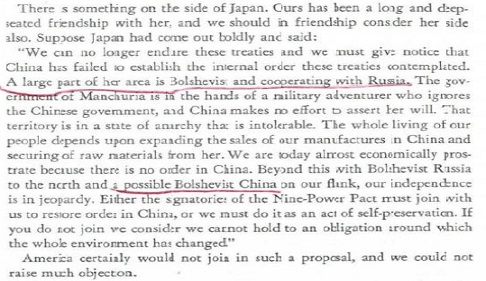 Earlier, President Hoover, who personally nipped the post-WWI communist uprisings in Germany and Hungary with the grains embargo, fed Lenin the ingenuity, i.e., the [worldwide communist revolution] road to Paris lay through Peking.
They of course forgot that
after the eruption of the 1937 Sino-Japanese War, the Americans, biased towards Japan and against China, adopted a policy of "neutrality" (what Utley called by "unpositive neutrality") against the 'belligerent' countries, namely, Japan and China, which was free and unrestrained arms sale to Japan and de facto arms embargo against China.
Note that the Japanese navy had a full blockade of China's coastline.
Note that the blockade would choke China since China did not have an industrial base to produce the basic weapons while Japan's factories could roll out the warships and airplanes on a wholesale scale.
Also note that in contrast with the Americans, the European powers, being constrained by the mediation role of the League of Nations, dared not openly sell arms to Japan.
Through 1940-1941, prior to the U.S. revocation of the 1911 U.S.-Japan Commerce Treaty, the Americans were the biggest supplier of raw material, oil, aviation oil, and weapons, to the extent that some U.S. senator called by Scott making a claim that out of every one million Chinese killed by the Japanese, 544,000 Chinese were killed by the Americans.
Thirty-one U.S. congressional members made a joint declaration to the effect that the U.S., not NAZI Germany, nor Italy, was the best ally of Japan.
Earlier, President Hoover, who personally nipped the post-WWI communist uprisings in Germany and Hungary with the grains embargo, fed Lenin the ingenuity, i.e., the [worldwide communist revolution] road to Paris lay through Peking.
They of course forgot that
after the eruption of the 1937 Sino-Japanese War, the Americans, biased towards Japan and against China, adopted a policy of "neutrality" (what Utley called by "unpositive neutrality") against the 'belligerent' countries, namely, Japan and China, which was free and unrestrained arms sale to Japan and de facto arms embargo against China.
Note that the Japanese navy had a full blockade of China's coastline.
Note that the blockade would choke China since China did not have an industrial base to produce the basic weapons while Japan's factories could roll out the warships and airplanes on a wholesale scale.
Also note that in contrast with the Americans, the European powers, being constrained by the mediation role of the League of Nations, dared not openly sell arms to Japan.
Through 1940-1941, prior to the U.S. revocation of the 1911 U.S.-Japan Commerce Treaty, the Americans were the biggest supplier of raw material, oil, aviation oil, and weapons, to the extent that some U.S. senator called by Scott making a claim that out of every one million Chinese killed by the Japanese, 544,000 Chinese were killed by the Americans.
Thirty-one U.S. congressional members made a joint declaration to the effect that the U.S., not NAZI Germany, nor Italy, was the best ally of Japan.
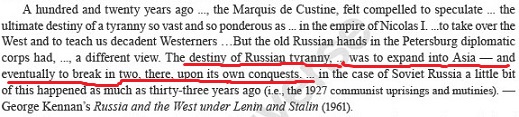 Not to mention that the Japanese navy had a full blockade of China's coastline.
America, the 'stars' that engendered or heralded the rise of the [Japan] 'sun', long ago had the blueprint to make Japan into a stalwart against China and Russia, i.e., the source of the Yellow Peril and the source of the Half-Tartars [or the Russians], respectively, --whom the Americans could not assimilate according to George Kennan.
William Christian Bullitt Jr. (1891-1967) disclosed that the Americans' national policy or strategic aim was to see the Russians and Japanese' holding a balance of power against each other in China rather than seeing either the Russians or the Japanese overpowering the other party in taking control of China.
In making this geopolitical decision, you had victimized the 1 billion humble Chinese peasants.
(Note President Wilson's doctrine that the intactness of China was vital to the white civilization -- in the sense that the nation of China should be managed delicately, that is, should not be allowed to grow too powerful to pose threat to the white civilization, nor should it be allowed to be hijacked by a non-U.S. power since China's immense human labor could be turned against the white civilization.
The theme of China to the white civilization, morphing superficially into a ***hypocritical*** American national policy of engagement with Communist China for changing the Chinese communists' behavior, rested on the same underlying logic:
"The
China Exception: Russian Communism being wicked, the
Chinese are good communists", which is an inherent fear
of the Yellow Peril,
i.e., billion Chinese would actually enjoy real
democracy, go to college and develop their intelligence.
Now, President Biden, a stooge of Communist China, explicitly abandoned the
hypocritical American policy of engagement to change communist China to his imbecilic communist buddy and dictator Xi Jinping.
Other than the stooge Bidens who ripped communist China's financial coffer (Tony Bobulinski FULL INTERVIEW Tucker Carlson), don't forget that President Roosevelt boasted of his family's ripping the China trade money in the 19th century, i.e., the opium trade;
and President Hoover certainly got the first bin of gold from the Kai-luan coal mine in collusion with the British during the 1900-1901 boxers' incident-related invasion.)
Not to mention that the Japanese navy had a full blockade of China's coastline.
America, the 'stars' that engendered or heralded the rise of the [Japan] 'sun', long ago had the blueprint to make Japan into a stalwart against China and Russia, i.e., the source of the Yellow Peril and the source of the Half-Tartars [or the Russians], respectively, --whom the Americans could not assimilate according to George Kennan.
William Christian Bullitt Jr. (1891-1967) disclosed that the Americans' national policy or strategic aim was to see the Russians and Japanese' holding a balance of power against each other in China rather than seeing either the Russians or the Japanese overpowering the other party in taking control of China.
In making this geopolitical decision, you had victimized the 1 billion humble Chinese peasants.
(Note President Wilson's doctrine that the intactness of China was vital to the white civilization -- in the sense that the nation of China should be managed delicately, that is, should not be allowed to grow too powerful to pose threat to the white civilization, nor should it be allowed to be hijacked by a non-U.S. power since China's immense human labor could be turned against the white civilization.
The theme of China to the white civilization, morphing superficially into a ***hypocritical*** American national policy of engagement with Communist China for changing the Chinese communists' behavior, rested on the same underlying logic:
"The
China Exception: Russian Communism being wicked, the
Chinese are good communists", which is an inherent fear
of the Yellow Peril,
i.e., billion Chinese would actually enjoy real
democracy, go to college and develop their intelligence.
Now, President Biden, a stooge of Communist China, explicitly abandoned the
hypocritical American policy of engagement to change communist China to his imbecilic communist buddy and dictator Xi Jinping.
Other than the stooge Bidens who ripped communist China's financial coffer (Tony Bobulinski FULL INTERVIEW Tucker Carlson), don't forget that President Roosevelt boasted of his family's ripping the China trade money in the 19th century, i.e., the opium trade;
and President Hoover certainly got the first bin of gold from the Kai-luan coal mine in collusion with the British during the 1900-1901 boxers' incident-related invasion.)
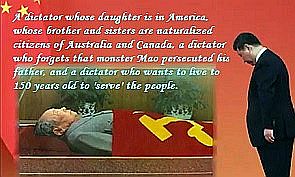 Now, you, as the midwife who delivered China into the communist hands, are morally obligated to take China [and North Korea {and Vietnam}] out of communism.
This time, you may feel your hands forced as North Korea, with its nuclear weapons, could become Communist China's cecal appendix in a repeat of history.
(The Chicoms don't understand the urgency of Trump's trade war having the roots in nuclear North Korea, nor the domino effect on North Korea and Russia after the knock-out of communist China.
Putin thought he would reap profits by sitting on the fence of the U.S.-China trade war, i.e., the Zheltorossiya dream
- revitalized by Aleksandr Gelyevich Dugin
[, and India would not be satisfied with grabbing South Tibet, Bhutan, and Sikkim alone].
Previously, this webmaster thought that the Americans could be hoodwinked by the Chicoms who might just sign any agreement just for sake of getting a red carpet at the White House in lieu of a visit to Mar-a-Lago.
With Trump's war with Communist China flaring up, this webmaster believed that China's dictator would continue to commit blunders and became the tomb digger for the Chinese communist regime.
The thuggery communists, who would not allow the millions of the Hongkong people to have autonomy, could have caused the demise of the regime over the inevitable crackdown, not knowing that the communist ascension to power had its very roots in Churchill's collusion with Roosevelt in selling out the Republic of China for sake of retaining crown jewel Hongkong after hoodwinking Wellington Koo and Chiang Kai-shek that Britain would return Hongkong to China after Japan was to surrender so as not to damage the British wartime morale.
--What happened was that Putin first jumped off the fence ahead of communist China in launching an invasion of Ukraine.)
Now, you, as the midwife who delivered China into the communist hands, are morally obligated to take China [and North Korea {and Vietnam}] out of communism.
This time, you may feel your hands forced as North Korea, with its nuclear weapons, could become Communist China's cecal appendix in a repeat of history.
(The Chicoms don't understand the urgency of Trump's trade war having the roots in nuclear North Korea, nor the domino effect on North Korea and Russia after the knock-out of communist China.
Putin thought he would reap profits by sitting on the fence of the U.S.-China trade war, i.e., the Zheltorossiya dream
- revitalized by Aleksandr Gelyevich Dugin
[, and India would not be satisfied with grabbing South Tibet, Bhutan, and Sikkim alone].
Previously, this webmaster thought that the Americans could be hoodwinked by the Chicoms who might just sign any agreement just for sake of getting a red carpet at the White House in lieu of a visit to Mar-a-Lago.
With Trump's war with Communist China flaring up, this webmaster believed that China's dictator would continue to commit blunders and became the tomb digger for the Chinese communist regime.
The thuggery communists, who would not allow the millions of the Hongkong people to have autonomy, could have caused the demise of the regime over the inevitable crackdown, not knowing that the communist ascension to power had its very roots in Churchill's collusion with Roosevelt in selling out the Republic of China for sake of retaining crown jewel Hongkong after hoodwinking Wellington Koo and Chiang Kai-shek that Britain would return Hongkong to China after Japan was to surrender so as not to damage the British wartime morale.
--What happened was that Putin first jumped off the fence ahead of communist China in launching an invasion of Ukraine.)
|
President Trump
understood the China situation and the China problem.
Should the American politicians follow the footsteps of Anson Burlingame (1820-1870),
Paul Samuel Reinsch (1869-1923)
and
Patrick Jay Hurley (1883-1963), i.e., three most prominent U.S. statemen who loved China and the Chinese people,
then the Chinese people could have a chance of salvation from the communist tyranny.
Note the historic recurrence and the repetition of similar events:
Anson Burlingame, in opposition to the anti-Chinese discriminatory whirlwinds rampant in the U.S. in the 19th century, authored the Burlingame Treaty for China and
died for China in 1870 in St. Petersburg
while still on the Manchu China's mission to the U.S. and Europe;
Paul Samuel Reinsch, who was disillusioned by President Wilson's betrayal of China over the division of WWI spoils at the Paris Peace Conference, quit the minister-to-China job to work for China and died for China in Shanghai in 1923;
and
Patrick Jay Hurley, who convinced President Roosevelt of the American moral blunders in selling out the Republic of China at Tehran and Yalta, personally travelled to Moscow and London for sake of averting and reverting China's fate of becoming a victim of WWII war spoils (i.e., the loss of Port Arthur and Hong Kong, etc.), but failed to make remedy to the secret Tehran and Yalta agreements in the aftermath of President Roosevelt's death in April 1945.
|
|
For better understanding the head-on collision between the United States and Communuist China,
refer to
the U.S.-China fatalistic conjunction through the hands of the Japanese firepower during WWII, that derived from the American unpositive neutrality;
the U.S.-China fatalistic conjunction through the hands of communist army's firepower during the 1945-1950 civil war, that derived from American-supplied Soviet August Storm weapons; and
the U.S.-China fatalistic conjunction through Joseph Stalin, Kim Il Sung and Mao Tse-ting's hands during the 1950-1953 Korean War.
|
|
|
|
More, refer to the Communist Platonic Club at wartime capital Chungking
and
The American Involvement in China: the Soviet Operation Snow, the I.P.R. Conspiracy, the Dixie Mission, the Stilwell Incident, the O.S.S. Scheme, the Coalition Government Crap, the Amerasia Case, & The China White Paper.
|
|
|
|
* In Commemoration of China's Fall under the Alien Conquests in A.D. 1279,
A.D. 1644 & A.D. 1949 *
 U.S.S.R./Comintern Alliance with the KMT & CCP (1923-1927)
 Korean/Chinese Communists & the 1931 Japanese Invasion of Manchuria Korean/Chinese Communists & the 1931 Japanese Invasion of Manchuria
American Involvement in China: Soviet Operation Snow, IPR Conspiracy, Dixie Mission, Stilwell
Incident, O.S.S. Scheme, Coalition Government Crap, Amerasia Case & The China White Paper
* Stay tuned for "Republican China 1911-1955: A Complete Untold History" *
|
|
Zou Rong's Revolutionary Army;
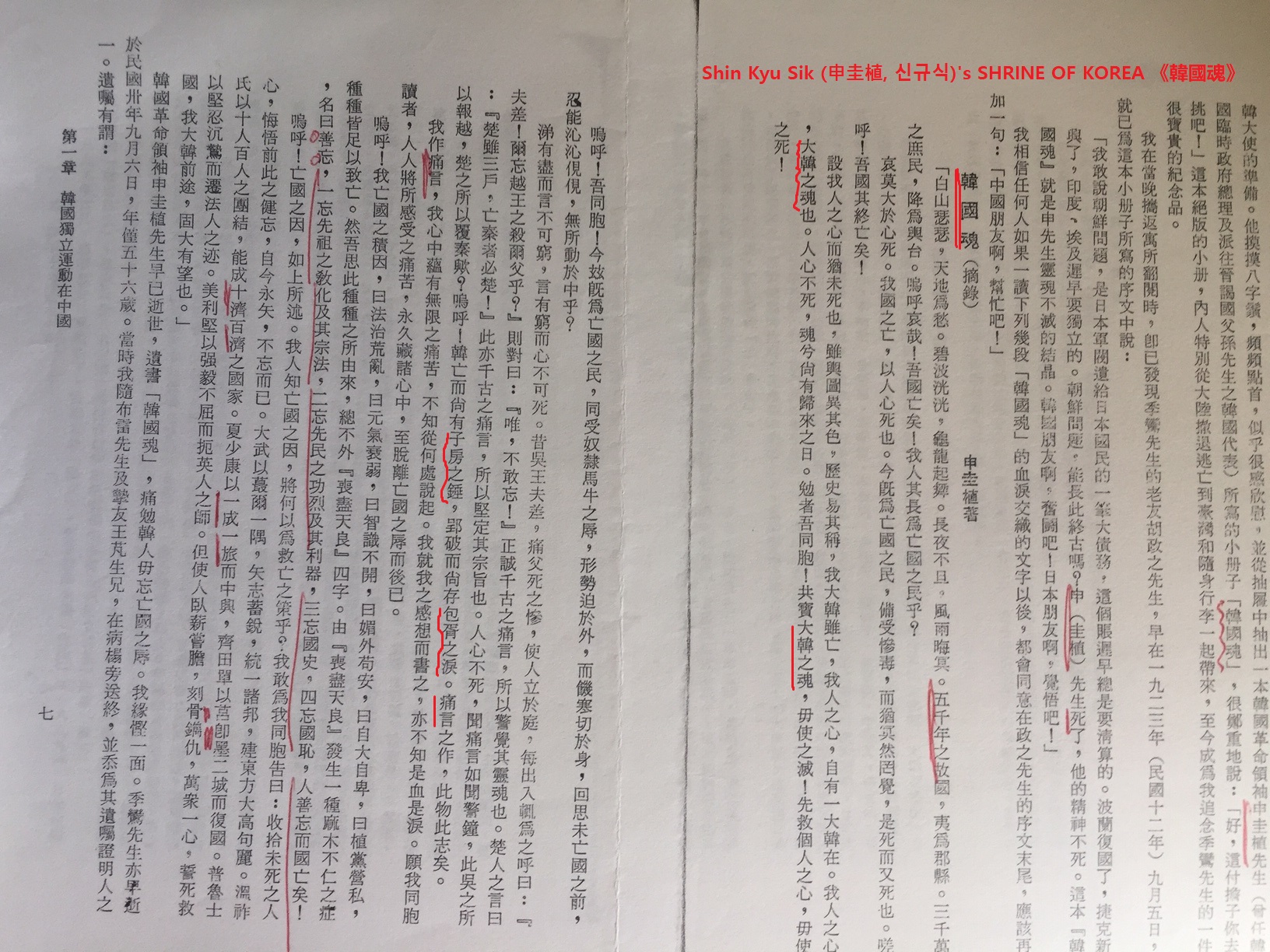
Shin Kyu Sik's
Shrine (Spirit, Kunitama) of Korea
|
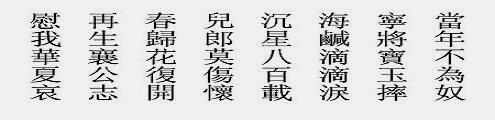
This snippet is for sons and daughters of China:
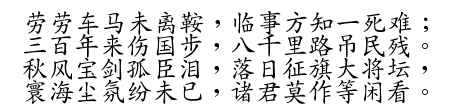
Heed the sons & ministers' agony and sorrow of our ancestors who died or lived through the Mongol, Manchu and Soviet-Chicom conquest
and
the Yongjia, Jingkang and Jiashen cataclysms !
Jeanne d'Arc of China:
Teenager girl Xun Guan breaking out of the Wancheng city to borrow the relief troops in the late Western Jinn dynasty;
Liu-Shao-shi riding into the barbarian army to rescue her husband in the late Western Jinn dynasty;
teenager girl Shen Yunying breaking into Zhang Xianzhong's rebels on the horseback to avenge on father's death in the late Ming dynasty.
China's Solitary and Lone Heroes:
Nan Jiyun breaking out of the Suiyang siege and charging back into the city in the Tang dynasty;
Zhang Gui & Zhang Shun Brothers breaking through the Mongol siege of Xiangyang in the Southern Soong dynasty;
Liu Tiejun breaking through three communist field armies' siege of Kaifeng in the Republican China time period;
Zhang Jian's lone confrontation against the communist army during the June 3rd & 4th Massacre of 1989.
|
|
|
THE KOREAN WAR (6/25/1950 - 7/27/1953)
To know what happened to the priority of the Korean
Communists' attacks on South Korea and the Chinese
Communists' attack at Taiwan, one would still need to go
back to the Comintern [Soviet Russian] conspiracy as well
as the Communist takeover of the United States government
[i.e., a fact that the U.S. is just ashamed of
acknowledging].
Historian Shen Yunlong had a writing on Taiwan's sabotage
of a Soviet telegraph set in Taipei months before the
Korean War eruption, stating that the Taiwan government,
after capturing the two agents, i.e., Whang Shenghe couple, deliberately
maintained the wireless connection with Chita of the
Soviet Far East, continuously broadcasting disinformation,
and faking news about the activities of non-existent
American planes and American warships in Taiwan. Shen
Yunlong, who did not know the Soviet infiltration of the
U.S. State Department, Treasury Department and the O.S.S.,
etc., wrongly concluded that Stalin, bedazzled by the
espionage reports, decided to take out the easy target,
i.e., South Korea.
Note the Soviet-hijacked American government did not
modify the anti-Chiang Kai-shek policy till after the
eruption of the Korean War, with Douglas MacArthur sending in a
Survey Team to Taiwan in October 1950 and Karl L. Rankin
signing an agreement on the American "Military Assistance
and Advisory Group" mission in January-February 1951,
which led to William Curtis Chase's being sent to Taiwan
as a delegation chief in 1951.
At the same time, the Soviet agents in the U.S. government
continued the scheme of nullifying Taiwan's status as part
of China, using the excuse and pretext from the relatively
loosely-termed Yalta Agreement to make a case of Taiwan as
a trustee country, and splitting Chiang Kai-shek's
government with the training of a THIRD FORCE military
band in Okinawa and elsewhere.
Acheson, who refused to see Wellington Koo for well over one year after issuing The China White Paper, massaged words to explain the U.S. government's standground that the Yalta declaration in regards to Taiwan was only binding to the Four Powers and hence Taiwan's trustee status needed to be put on the United Nations' agenda. Literatus Lin Yutang published an op-ed with a question: Should the United States put Taiwan under the United Nations' trusteeship, the Republic of China could request that Ryukyu be put under the trustee status of the United nations. Rusk and Acheson then promised that should the Republic of China refrain from objecting to the Taiwan trusteeship issue, the United States would defeat the Soviet and their satellite states' motion to allow a Communist China observer to enter the U.N. to raise protests in regards to American bombing of the Sino-Korean border area and the 7th Fleet's violation of communist China's sovereighty in entering the Taiwan Straits.
It would be after Dwight David Eisenhower became president
in 1953 that the U.S. would declare the secret Yalta
Agreement to be invalid and began to support Chiang
Kai-shek's regime in Taiwan.
Taiwan followed through with voiding the 1945 Sino-Soviet
friendship treaty, a treaty that Stalin was initially
reluctant to replace with the Mao-proposed 1950 USSR-PRC
friendship treaty for the befuddled legality that it was
built on top of Churchill and Roosevelt's Yalta
endorsements.
As to Stalin's decision to invade South Korea, ROC
ambassador Shao Yulin, in his memoirs, detailed the
defection of a South Korean government official, who had
visited Stalin with a claim that about 200,000 underground
Korean Communists were ready to echo the communist
invasion.
The difference between Taiwan and South Korea is that
Chiang Kai-shek immediately sealed off the coastline of
Taiwan while South Korea and North Korea had uninterrupted
traffic prior to the war eruption.
Ambassador Shao Yulin, who had engaged himself in the
Korean restoration movement since the college days in
Tokyo, had played an important role in advising Chiang
Kai-shek on the abandonment of the Zhoushan [Chushan]
Island for sake of making South Korea the protruding point
of the Asian curvature, that was declared by Acheson as
the American line of defense against Communist China.
Chiang Kai-shek's two separate visits to the Philippines
and South Korea had exerted pressure on Stalin, Mao
Tse-tung & Kim Il-sung as far as the formation of an
anti-communism Asian alliance was concerned, according to
the Taiwan historians.
 Why Mao Tse-tung wanted to aid North Korea? Obligation and
secret treaties. China and North Korea signed a secret
treaty about mutual aid. During China's 1945-1950 civil
wars, the Soviets sorted out two Korean-ethnic divisions
from the 560k-strong Japanese Kwantung Army for the civil
war against the Chinese Nationalist Government, not to
include at least 30,000 Japanese artillery, medical
Kwantung Army staff, a full airforce contingent with
generals and crewmen under Hayashi Yayichiro, plus the
Outer Mongolia cavalry. Kim Il Sung claimed that
250,000 Koreans joined the Chinese Communists in the
civil war of China, with about 60,000-70,000 remnants [out
of the total headcount of 250,000 Korean
mercenaries] shipped back to Korea prior to the Korean War
of June 1950.
(As Freda Utley pointed out, "in March 1947, Lieutenant
General John R. Hodge, a U.S. commander in North Korea,
stated that Chinese Communist troops were participating in
the training of a Korean army of 500,000 in Russian-held
North Korea. The Chinese Central News Agency stated in
June [1947] that more than 100,000 Russian-trained Koreans
plus a cavalry division from Outer Mongolia were in action
against the Chinese Nationalist forces".
From the memoirs related to some Taiwan native who joined
the Japanese Kwantung Army and was later exiled to the
Siberia for coolie labor by the Soviet Red Army, the
Soviets, to help Mao Tse-tung and Kim Il-sung, on a
wholesale scale, had repatriated the Korean-ethnic
Japanese Kwantung Army to North Korea and the
Taiwan-ethnic Japanese Kwantung Army to Manchuria, which
probably explained why there was no accounting of some
huge numbers of the Japanese Kwantung Army troops in the
later repatriation of the late 1950s to Japan.
Note that the Soviets could have killed retarded Japanese prime minister Konoe's son, i.e., Konoe Fumitaka, just days before repatriation.)
Why Mao Tse-tung wanted to aid North Korea? Obligation and
secret treaties. China and North Korea signed a secret
treaty about mutual aid. During China's 1945-1950 civil
wars, the Soviets sorted out two Korean-ethnic divisions
from the 560k-strong Japanese Kwantung Army for the civil
war against the Chinese Nationalist Government, not to
include at least 30,000 Japanese artillery, medical
Kwantung Army staff, a full airforce contingent with
generals and crewmen under Hayashi Yayichiro, plus the
Outer Mongolia cavalry. Kim Il Sung claimed that
250,000 Koreans joined the Chinese Communists in the
civil war of China, with about 60,000-70,000 remnants [out
of the total headcount of 250,000 Korean
mercenaries] shipped back to Korea prior to the Korean War
of June 1950.
(As Freda Utley pointed out, "in March 1947, Lieutenant
General John R. Hodge, a U.S. commander in North Korea,
stated that Chinese Communist troops were participating in
the training of a Korean army of 500,000 in Russian-held
North Korea. The Chinese Central News Agency stated in
June [1947] that more than 100,000 Russian-trained Koreans
plus a cavalry division from Outer Mongolia were in action
against the Chinese Nationalist forces".
From the memoirs related to some Taiwan native who joined
the Japanese Kwantung Army and was later exiled to the
Siberia for coolie labor by the Soviet Red Army, the
Soviets, to help Mao Tse-tung and Kim Il-sung, on a
wholesale scale, had repatriated the Korean-ethnic
Japanese Kwantung Army to North Korea and the
Taiwan-ethnic Japanese Kwantung Army to Manchuria, which
probably explained why there was no accounting of some
huge numbers of the Japanese Kwantung Army troops in the
later repatriation of the late 1950s to Japan.
Note that the Soviets could have killed retarded Japanese prime minister Konoe's son, i.e., Konoe Fumitaka, just days before repatriation.)
In early 1950, Mao sorted out 60-70,000 Korean ethnic PLA
soldiers, i.e., survivors of the 250,000 Koreans
from the bloody 1945-1950 Chinese Civil War, and
dispatched to Korea at the request of Kim Il Sung. (Only
two Koreans, who were cadets of the Whampoa Academy,
followed the communist Long March to Yenan, with one
surviving the later wars to go back to North Korea. The
hundreds of CCP-controlled Koreans, who returned to Korea
in 1945-1946, came from the steering-away of a portion of
the Korean Restoration Army that was trained by the
Chinese nationalists at the war-time capital Chungking,
but steered away to the communists under a scheme of the
American OSS which was hijacked by the Soviet spies.)
Historians still debated whether the Chinese communists
knew in advance about Kim Il Sung's move. It was a dispute
between the Russians and Chinese after Stalin's death,
with the Russians claiming that the Chinese knew about it
but the Chinese communists denied being a part of it.
After the Russian declassification of archives, historians
continued to look for clues. It is clear that Stalin, Mao
Tse-tung and Kim Il Sung all agreed upon one thing, i.e.,
expanding communism by taking out South Korea and Taiwan
[and Vietnam]. The only disagreement was the priority,
i.e., Taiwan first or South Korea first.
When the Korean-ethnic divisions were shipped out, Mao
Tse-tung was already an accomplice.
What Stalin, Mao Tse-tung and Kim Il Sung did not
anticipate was that South Korea's remnant army, led by a
Korean general who was the former chief of staff of the Chinese Youth
Army in war-time Republic of China, had sustained
the dozens of days in defense, just long enough to be
reinforced by MacArthur's relief army.
Jin Hongyi (Gim Hong-yil, Choi Se-pyeong, Wang Yishu), a Guizhou infantry academy graduate, a Whampoa cadet and a war hero at the 1938 Battle of Wanjialing, was responsible
for taking control of about two S Korean divisions and
fought on for two weeks till MacArthur sent over
reinforcement from Japan.
Jin Hongyi later served as an ambassador to Republic of China, enjoying the title of ambassador emeritus with the summa cum laude honor.
The Chinese communists' armies, which had already
concentrated on the Zhejiang-Fujian coastline, had to
relocate to Korea thereafter. Altogether 3 million PLA
troops had rotated their duties in North Korea as a
coverup for the war casualties. My father, at age a bit
over 14 at the time, was almost conscripted. China spent
5-10 years of GDP worthy of money in supporting the war in
North Korea. Possibly 700k to 1 million soldiers died. It
was a complete disaster for mainland China but life-saving
for Taiwan.
After the truce in 1953, hundreds of thousands of
soldiers, including the brother of my mother's, did FREE
coolie work for North Korea till recall in 1958. Out of
the expatriated army, 100,000 Chinese officers were
expatriated to the Manchurian-Ussuri border for military
farming, where my father was sent as a mechanical
technician.
Korea After the Japanese Surrender
Right after the U.S. dropped two bombs onto Japan, on Aug
6th & 9th, respectively, two young officers under
Truman, i.e., Dean Rusk and Charles Bonesteel, drew up the
38th Parallel on the map as an artificial division line
separating the U.S. sphere of influences from the USSR.
Seeing that the Russians poured into Manchuria after
midnight of August 9th and pushed toward South Korea with
four divisions, the American military and navy, which were
less infiltrated by the Russian agents, wanted a bargain
on the 38th parallel with the Russians for fear that its
troops in Okinawa would not have time to race to Korea.
The Russians took over Xiongji & Luojin on August 12th,
and Pyongyang on August 24th.
The Americans did not bother to land in Inchon &
Fushan of Korea till after signing the Japan surrender
paper on Missouri on September 2nd.
The Russians, with full acquiesce, pulled back from Inchon
& Kaesong (Kaicheng).
MacArthur, on September 7th, issued the order to the Koreans as
an occupation commander-in-chief.
China immediately announced the recognition of the interim
Korean government headed by Jin
Jiu. The Americans raised a protest. Owning to the
American objection to Jin Jiu, T V Soong (Song Ziwen)
suggested the second option, i.e., dispatching Jin Jiu
back to Korea as an individual.
On September 17th, Chiang Kai-shek offered the interim Korean
government 100 million worth of "legalized currency" as
well as 200,000 U.S. dollars.
The Americans then claimed that Jin Jiu was welcome back
in Korea only in the name of an "individual".
The U.S. State Department, which was already hijacked by
the Comintern agents, intended to make a leftist-leaning or a rightist Korean with leftist leaning, Jin Kuizhi (i.e., Kim Kyu-sik/Kimm Giusic/Kimm Kiusic), into a leader.
Lieutenant General John R. Hodge also favored Jin Kuizhi who attended the 1921-1922 Soviet First Congress of the Toilers of the Far East (Irkutsk, Moscow, Petrograd) together with another leftist-communist Lv Yunheng (Yeo Un-hyeong).
However, an American officer, OSS agent Preston
Goodfellow, who privately supported Syngman Rhee (Lee Seung Man)'s exile
activity in the U.S., stealthily circumvented the U.S.
State Department and the U.S. occupation commander in
sending Syngman Rhee to Tokyo and South Korea,
consecutively.
This was speculated by Max Hastings to be some undertable
deal between Preston Goodfellow and Syngman Rhee without
the understanding that the OSS itself was a hotbed of the
Soviet agents from the U.S. headquarters to the overseas
operations; that the pro-communist U.S. State Department
wanted leftist Jin Kuizhi (i.e., Kim Kyu-sik/Kimm Giusic/Kimm Kiusic) to be a South Korean leader; and
that Jack Service and his pro-CPUSA or undercover CPUSA
political advisers in MacArthur's Tokyo office, which
probably played a role in releasing the Sorge ring
survivors to the Soviets, would not have welcomed Syngman
Rhee's arrival in North Korea. (Syngman Rhee's title in
the U.S. was chairman of the foreign relations department
of the Korean provisional government in Chungking.
Jin Jiu was premier of the Korean provisional government
in Chungking.
Jin Jiu and his comrades, who were first shipped to
Shanghai by Chiang Kai-shek via two ROC transporters on
November 5th, 1945, then took ride of the American planes for
South Korea on November 12-13th.
Jin Jiu failed to run his interim government; Jin Jiu, not
wishing to participate in the election of president of
South Korea, was put on the ballot out of a consipracy and
was discredited by the loss to Syngman Rhee's grabbing of
92.3% of the votes; and on June 26th, 1949, he was
assassinated by Ahn Doo-hee, under order from Kim
Chang-ryong, an military police officer under Syngman
Rhee, or to do with Kim Chang-ryong's being related to the
American Counter Intelligence Corps (CIC).
Note that Syngman Rhee himself was marked for
assassination by the Americans for the insubordination
--as Syngman Rhee, from day one, was opposed to the
Soviet-American scheme (i.e., the U.S.-Soviet Cooperation
Committee) of conducting a political consultative committee
and launching a coalition government.
Over 100,000 Koreans attended Jin Jiu's mourning.)
In November 1945, the Russians pretentiously proposed to the
Americans a mutual withdrawal of troops from Korea.
The American State Department as well as the U.S. army
[which was controlled by the undercover Comintern agents
disguised as "political advisers"] already decided on the
path of abandoning South Korea to the Russians.
In December 1945, China, the U.S., Britain and the USSR failed
to reach consensus in regards to the 'trustee' status for
Korea.
There was a Moscow Conference (1945) between the Soviet
Union and United States to establish a trusteeship for
Korea and a coalition government between the Korea
communists and the nationalist, a similar crap to what
Jack Service and the Dixie Mission offered to the Chinese
communists in 1944-1945. A so-called U.S.-Soviet
Cooperation Committee meeting was held in 1946 to no
avail.
The Soviets did not zero down on a communist figurehead
for North Korea till two to three months after the Japan
surrender.
After Japan surrendered, the Soviet "Russian Field-battle
Teaching Brigade" (i.e., the Soviet 88th Brigade), which
was reorganized on basis of the remnant Northeast Anti-Japanese
Coalition Army - the successor of the Chinese
Youth-Party-dominated "Northeastern Volunteer
Righteous & Brave Fighters" & the "People's
Revolutionary Army Of Northeast China" ensuing from the
1931 Japanese invasion of Manchuria, returned to
Manchuria, with Kim Il-sung and his gang of Korean pals
splitting off to head off for Korea.
(The guerrilla resistance in Manchuria lasted till about
1941 when the Soviets, who had signed the neutrality
treaty with Japan,
instructed an end to active resistance and recalled the
volunteer fighters back to the Soviet Union for training.
The Soviet order was to wait out for the coming of some
new international development, namely, a war between Japan
and the U.S.A. or the Pearl Harbor attack.
That is, Kim Jong-il, who was born at Viatsk and called
Yuri, could not have been born on the Paektu Mountain.)
Kim Il-sung, who arrived at North Korea under an alias
after the Japanese surrender, did not publish his name and
was not officially acknowledged by Stalin and the Soviet
Union to be a North Korea communist party leader till
two-three months after the arrival in North Korea.
According to Kim Il-sung's memoirs, Kim Il-sung, who was
always known as "Cheng [accomplished, pronounced by 'sung'
in the Sinicized Korean language] zhu [pillar]", adopted
the name of a dead Korean martyr to enter Korea and
ordered his lieutenants to fan out to solicit and build
support.
This is the origin of an accusation that Kim Il-sung was
an impostor.
Months after the Japanese surrender, at a meeting in an
auditorium, with a Soviet Red Army colonel-equivalent
present, Kim Il-sung announced him to be the legendary
'Cheng zhu', a name known among the Koreans for Kim
Il-sung's maverick communist activities among the Korean
nationalists and Korean communists --as a result of the
origin of Kim Il-sung's father from the evangelical
Christian school, a cradle of the Korean nationalists
fighting for the independence of Korea since the 1910
Japanese annexation of Korea.
In Korea, there was also the native Korean Communist Party faction
in the Greater Pyongyang-Seoul area, in charge of the
remnants of the native Korean communists.
The main Korean band, that was to arrive in Korea and came
to be known as the so-called Chinese communists' "Yenan
faction", would belong to the hundreds of the Korean
Restoration Army, which was trained by the Republic of
China at the wartime capital city of Chungking but was
steered to the Chinese communist side by the American
Dixie Mission on the pretext of providing the firearms for
fighting the Japanese in Manchuria and Korea and the
post-Japan-surrender occupation of North Korea.
The Yenan faction was to be purged by Kim Il-sung after
Khrushchev's secret 1956 speech and about the time the
Chinese communists pulled out the 'volunteer' army in
1958.
(Remember that only two Koreans, who were cadets of the
Whampoa Military Academy, followed the communist Long
March to Yenan, with one surviving the later wars to go
back to North Korea.)
Japan's Revival Under MacArthur
In Japan, MacArthur, for making his control over Japan
smooth and easy, had retained the Japanese emperor as a
symbol after nominally depriving him of deity and the
administrative power in the new constitution released on
November 3rd, 1946.
To deflect criticisms by the American politicians and the
Chinese government, MacArthur organized several "inspection
delegations" for visiting his experiment with 'democracy'
in Japan.
The Chinese officials, believing that the Japanese really
wanted a 3rd world war, commented that MacArthur's intent
was merely against the USSR in reviving Japan.
Lu Keng pointed out that China's occupation force for
Japan was hindered by MacArthur.
The Chinese embassy was also hindered by MacArthur from
being re-established in Japan.
Similarly, MacArthur obstructed Shao Yulin from going to
Korea to establish a Chinese legation.
After the visit of the Roy Howard delegation, MacArthur
asked Zhu Shiming, i.e., China's delegation chief to
Japan, to relay an invitation to China.
(American ambassador John Stuart Leighton's personal
adviser Fu Jingbo later disclosed that Stuart had passed
on the Chinese resentment over to MacArthur, which led to
MacArthur's order for China to send a delegation, i.e., the
embassy staff, to Korea.)
 MacArthur, with the communist fellow travelers working in
his Tokyo office, had adopted a policy of disarming South
Korea to make it a prey to the Soviets and the communists,
as well as devised a policy of supporting a Third Force in
Taiwan to replace Chiang Kai-shek.
The CIA in Okinawa trained a group of the former Chinese Nationalist Army troops as a Third Force, i.e., a scheme to sabotage Chiang Kai-shek's rule in Taiwan.
The C.I.A.'s Third Force program, in 1952, orchestrated an idiotic mission of parachuting John T. Downey and Richard G. Fecteau into Manchuria, which led to the two guys falling into victims as communist prisoners of war till the early 1970s.
MacArthur, with the communist fellow travelers working in
his Tokyo office, had adopted a policy of disarming South
Korea to make it a prey to the Soviets and the communists,
as well as devised a policy of supporting a Third Force in
Taiwan to replace Chiang Kai-shek.
The CIA in Okinawa trained a group of the former Chinese Nationalist Army troops as a Third Force, i.e., a scheme to sabotage Chiang Kai-shek's rule in Taiwan.
The C.I.A.'s Third Force program, in 1952, orchestrated an idiotic mission of parachuting John T. Downey and Richard G. Fecteau into Manchuria, which led to the two guys falling into victims as communist prisoners of war till the early 1970s.
For Taiwan, before the Chinese communists launched the
campaign against Southwestern China in late 1949, the
pro-communist American State Department began to instigate
the Tibetan independence, commenting that the Chinese
communists should attack and take out Taiwan before
invading Southwestern China.
Why so?
It was the mentor Owen Lattimore with an unofficial desk
in the U.S. State Department, a so-called professor
without a college degree, someone who had 'adopted' the
Mongols and Tibetans and someone who harbored the CPUSA
gang from the Tsing Hua University class 1925 in the
Institute of Pacific Relations, who designed the United
States' Taiwan or Formosa policy.
MacArthur at one time invited General Sun
Li-jen to visiting Japan and instigated General Sun Li-jen
in taking control of Taiwan. Dean Rusk at one time claimed
to have a letter from Sun Li-jen about agitation to take
over power from Chiang Kai-shek.
Meanwhile, Chiang Kai-shek had purportedly sent a letter
to Truman, expressing his wish to retire and leave power
[for sake of obtaining the American support for the Taiwan
government].
General Sun Li-Jen, who was empowered as the infantry
commander-in-chief in Taiwan on March 25, 1950, would lose
his utility after the eruption of the Korean War, with his
lieutenants being arrested one by one, ending in the
deprivation of his job and lifelong house arrest after the
passing of the 1954 Taiwan-U.S. Mutual Defense Treaty
[which was a dilemma treaty that Chiang Kai-shek decided
to enter into, after the Chinese communists, who signed
the 1953 Korean Armistice Agreement, in commotion launched
a massive bombardment of the Quemoy Island on September
3rd, 1954, a dilemma in the sense that the Americans had
told Chiang Kai-shek that the alliance with the U.S.,
defensive in nature, prohibited Taiwan from proactively
attacking the mainland to drag the Americans into a war
and would render it invalid if otherwise].
Truman and Acheson [and George Marshall] Selling Out
South Korea
The United Nations passed an act in regards to the Korean
independence in November 1947.
In March 1948, the communist North Korea's Labor Party
expressed opposition to a unilateral election in the
south.
The Americans launched an election for the "National
Parliament" on July 12th, 1948.
On August 15th, 1948, U.S. returnee Syngman Rhee was elected
president of the Republic of Korea. On August 25th, Kim Il
Sung held his "Supreme People's Assembly". Syngman Rhee,
for his insubordination to the American "political
advisers" and occupation commander, was already targeted
for assassination - which only fell off with the outbreak
of the Korean War. In the following month, North Korea
declared the founding of the People's Democratic Republic.
Kim Il Sung assumed the "prime minister" post on September 8th.
The so-called People's Democratic Republic of Korea was
declared the next day.
President Harry Truman, resentful over the purported
support by the Republic of China for his political enemy
Thomas Dewey, had Acheson declare a defense curvature
excluding Korea & Taiwan in January 1950, i.e., the Aleutian Arc, Japan and the Philippines.
(Chiang Kai-shek, throughout the Korean War, attempted to
explain to Truman that the ROC never meddled into the
American domestic politics. Indeed, the first recorded
incident would be in 1954, not in the 1940s.)
In Feb, Mao & Stalin signed an alliance treaty, with
an understanding that the USSR would supply weaponry for
20 divisions should China be required to aid North Korea
in its war of 'liberation' against South Korea.
At the request of Kim Il Sung, Mao sorted out 60-70,000
Korean-ethnic PLA soldiers and dispatched to Korea in
April-May 1950.
More troops were sent to North Korea by Mao in October 1950,
prior to open conflicts between China and the U.N. forces.
George Marshall, who quit his Chief of Staff job in 1945
to wait for a pre-arranged phone call from Truman to go to
China as a special envoy for burying the fate of the
Republic of China, quit the job again, this time the
Secretary of State's job from 1947-1949, to be ready for
another pre-arranged call from Truman. Truman sacked
defense minister Johnson, and recalled George Marshall for
the transitional time period, solely for getting rid of
MacArthur.
President Truman fired Secretary Louis A. Johnson, making
Marshall as Secretary of Defense in September 1950, for
sake of implementing the strategy of the Asian curvature,
namely, abandoning South Korea and defending the Japan,
Okinawa and the Philippines curvature, a Soviet crap job.
(George Marshal first conspired to force Chennault into retirement or resignation in early 1945 for avenging on Stilwell's recall [pretentiously], then sealed the John Birch Murder file so as not to arouse the American public's indignation against the Chinese communists, and continued to sabotage the United States' policy during the Korean War, i.e., devising the scheme for President Truman to fire General MacArthur. General MacArthur, however, wrongly thought it was the British communists who forced Truman to fire him.)
Outbreak Of The Korean War
On June 26th, 1950, at about 4:00 am, Kim Il Sung, with
the backing from Joseph Stalin and Mao Tse-tung, launched
a sudden offensive at South Korea. The North Korean army
of 135,000 (alternatively numbered 223,000) soldiers,
headed by Choo Yong Gum, crossed the 38th parallel, and sacked Kaicheng (open city) and Chunchuan (spring river).
The South Korean Army, which was a police-converted force, collapsed within two to three days.
To resist the North Korean army armed with tanks, Syngman Rhee, claiming that the South Korean army lacked anti-tank guns, asked for advice from Shao Yulin who gave the same raw idea as given to South Korean chief of staff Cai Bingde (Ch'ae Pyongdok), namely, the Chinese army soldiers' suicidal tactic in throwing the kerosine bottles against the Japanese tanks during the 1937 Battle of Shanghai.
The South Korean army, after a defeat, blew up the bridges south of Seoul before
escaping further south, while the refugees were still walking on the
four bridges of the Han-jiang (Seoul) River.
Jin Hongyi, before the fall of Seoul, inspected the war front at Yizhengfu (parliamentary government), where the South Korean 2nd and 7th Divisions mounted resistance, and proposed to Syngman Rhee to pull back the troops from north of Seoul to defend the Han-jiang (Seoul) River. But Syngman Rhee did not take the advice.
Syngman Rhee, in a panic, fled the capital city without notifying the foreign embassies and the veteran Korean nationalist leaders.
South Korean generals and the veteran nationalist leaders, who were captured by the communists, suffered the fate of being abducted to and paraded in Pyongyang, forced confession in the public, and later execution. Such was the case of Jin Kuizhi (i.e., Kim Kyu-sik/Kimm Giusic/Kimm Kiusic, January 29, 1881-December 10, 1950), a veteran nationalist leader who also worked as an English language and literature professor at Fudan University, Northern Sea University, Nanking Political School and ShChwan College during the exile years in China.
Soong Husheng (Song Ho-seong), i.e., Seoul garrison commander, who was at one time deputy division commander of the Chinese NRA 88th Division, was captured, humiliated and forced to command a puppet North Korea volunteer army among South Korea prisoners of war before being arrested by the communists as a reactionary in 1954.
The Vatican representative (Archbishop Burns), the British consul (Vyvyan Holt), and others who chose to stay in Seoul, were all abducted to Pyongyang via foot walking and also suffered the fate of persecution, confession and death.
French consul (M. Beruche) was released by North Korea after the armistice was signed.
ROC ambassador Shao Yulin escaped Seoul with the American embassy's help. Under the North Korean warplanes' bombardment and strafing, Shao Yulin and staff from other countries' embassies, repeatedly jumping off and onto vehicles on the road, spent hours to reach the Seoul airport that was strewn with damaged passenger planes, and lifted off for Japan in an American transport that did a quick landing while the North Korean warplanes flew away.
At the Fukuoka army base, Shao Yulin detected McArthur's secret order to prep the U.S. army troops for returning to Korea, and immediately wired to Taiwan with intelligence.
Republic of China in Taiwan, who already received Syngman Rhee's S.O.S. call, strengthened the will to send in the National Revolutionary Army's crack force to intervene in the Korean War.
The Korean War, lasting 3 years and 42 days, led
to a total casualty of 2,171,875 people, with death toll
on the Chinese side no
less than 700,000 to one million.
Cheng Ganyuan, a former communist "united front" cadre, about the same age as this webmaster's father, volunteered for service in the Korea War and was sent into the Korean battlefield in 1951.
According to his recollection, his logistics company of 120 soldiers suffered a casualty of more than half, with 49 killed [including his company commander, a 40-year-old former R.O.C. army soldier] and 20 wounded, all victims of the American night-time "locked down" bombing of 150 passes and nexus, exposed by the lighting flaring and the napalm, by the frequency of every fifteen minutes.
The total Chinese war deaths amounted to 800,000 to 900,000 troops out of the total headcount of 3.5 million deployed to the Korean battlefields, according to Cheng Ganyuan.
The Korean War, by 1952, would cost China
100,000,000,000,000 or 100 trillion yuan (equiv to the new
currency 10,000,000,000 or 10 billion yuan), while China's
1952 fiscal revenue amounted to no more than 2,300,000,000
or 2.3 billion yuan. Hua Min cited communist financial
czar Chen Yun in stating that the KMT government net no
more than 0.8 to 0.9 billion yuan, including revenues from
Manchuria, prior to 1931. Mao Tse-tung, during debates
with agriculturalist Liang Suming, claimed that the CCP's
"maximum benevolent governance" would be developing
industry and fighting the Korean War instead of "small
benevolent governance" such as less taxation on the
peasants.
The only good thing for China out of the Korean War was the death of Mao Tse-tung's elder son Mao Anying, which allowed China to avert the fate of a Mao dynasty as happened to Kim's dynasty in North Korea.
Later, at the 'Peng Dehuai Anti-Party Clique' movement on Mount Lushan in 1959, Mao Tse-tung attacked Peng Dehuai by invoking the death of his senior son in Korea in November 1950, exclaiming a famous comment: "Wasn't it true that whoever manufactured the first prototype of pottery figurine (terra cotta), i.e., launching the Korean Relief War, would be doomed in losing his lineage?" -- This was a silly allusion to the fact that Qin First Emperor Shihuangdi, who had the terra cotta soldiers buried in his tomb, would cause his family to be exterminated by General Xiang Yu in the aftermath of the uprising against the Qin Dynasty.
The consequence of the Korean War would be the ensuing
Cold War between the camps of socialism and capitalism in
the international arena, the isolation of [the PR of]
China economically and diplomatically, the one-sidedness
of the Chinese communist party, and the CCP's
schizophrenia in launching various political movements,
mass murder and persecution against whoever had the U.S.
or KMT connection or implication.
The Chinese communists linked up the movement of the
"elimination of reactionaries" and "land reform" to the
"Korean War" via citation of a trinity movement.
Mao claimed that that was a lifetime opportunity to take
out the class enemies.
(During the Korean War, in early 1952, Mao Tse-tung initiated a book-burning movement with millions of volumes of books burnt or made into paper pulp in a similar fashion to what the Soviet national literature and publication administration bureau did in June 1922, followed by another book-burning movement during the August 1966 Movement of the "Elimination of Four Olds" that was parallel to what the Soviets did in the 1939 Great Purge.)
During the Korean War, millions of Chinese, who were
horrified by the bloody land reform, rose up across China
against the communist rule, having false hope that the
Nationalist Army could return to the mainland, not knowing
that Truman and Acheson had blockaded the Taiwan Straits
to prevent the Nationalist Government troops from
counterattacking the mainland.
In the Guangxi Province alone, about a million around
bandits were eliminated for the years of 1950-1954,
accounting for like 1/5th of the total provincial adult
population.
The communist statistics claimed that from 1949 to 1952,
the Guangxi bandits who were killed numbered 512,900.
Among the rebel leaders would be the northern expedition
army veteran generals such as Zhou Zuhuang and Zhong
Zupei, as well as Burma War veteran general Gan Lichu.
The communists, for fomenting the civil war, conducted the
land reform in 1947 and killed the landlords en mass so as
to create a rivalry between the two groups of people in
each and every village. Stalin suggested that the Chinese
communists relocate the landlords and wealthy peasants to
some place like what he did with settling 3 million
landlords to Siberia. But the CPC declined it. See Shi
Zhe's memoirs pp 533-534. The CPC just decided to kill
them all, but pretended to Stalin that they wanted the
'poor' peasants to supervise the landlords and reform them
into a laborer.
The United Nations & the Korean War
The U.N. Security Council passed Resolution 82 demanding
North Korea's immediate withdrawal. Immediately
thereafter, President Truman dispatched the 7th Fleet into
the Taiwan Straits, nominally for neutralizing the CCP-KMT
conflict but ostensibly for assuring the Chinese
Communists that China should have no worry about a
"Second Battlefield" other than the Korean War.
President Truman, other than dispatching the 7th Fleet into the Taiwan Straits, declared the trustee status for Taiwan.
After being questioned by the news media as to what the U.S. motive was, Truman revised his declaration to state that once the Korean War crisis was over, the American 7th Fleet would be withdrawn from the Taiwan Straits. Truman, who concurred with Acheson's declaration to exclude South Korea and Taiwan from the Aleutian Arc, had a change of mind on Taiwan but still instructed MacArthur with exerting only the American air and navy force to helping South Korea, which enraged MacArthur so much that he told his followers to do nothing and then flew to Taiwan.
Three times, Truman vetoed the plan to invoke the Republic of China's armed forces for deployment to the Korean peninsula.
On
the 27th, Resolution 83 passed with a stronger-toned
warning against North Korea.
On the 28th, Zhou Enlai, i.e., premier of communist China, claimed
that China would not stand by in regards to the U.S.
invasion of Korea.
On the 30th, the American Congress authorized Truman in
taking actions against the North Korean aggression. On
July 7th, Resolution 84 endorsed the formation of a United
Nations Army to be commanded by Douglas MacArthur, with 16
countries contributing a total force of 39,000.
The U.S.S.R. representative was deliberately absent for
the U.N. Security Council voting so as to make it a
matter-of-fact that the U.S. and China would end up
beating up each other. The Russian pretext was that
its ambassador, Yakov Aleksandrovich Malik, exited the UN
in protest of the U.N. Security Council's putting off the
membership petition for the Communist China to replace
Nationalist China.
In China, Zhou Enlai was authorized in passing a
resolution entitled the "Decision In Regards To
Safeguarding the Northeastern Border". In Aug, Deng Hua,
Hong Xuezhi and Han Xianchu were conferred the posts of
commander and deputy commanders for the Northeastern
Border Patrol Army which was converted from the 13th
Conglomerate of the 4th Field Army of the People's
Liberation Army (PLA). The headcount totaled about
320,000.
In early July, the United States Army sent a Task Force
Smith Brigade to impeding the North Koreans. The Smith
force was run over by the North Korean tanks.
In July, U.S. army commander Walker commanded the 8th Army
for relieving the forces in Korea.
The U.S. 8th Army, by August, was pinned down along a
small strip of land at the southeastern corner of the
Korean Peninsula. The U.S. firepower successfully repelled
the North Korean penetration of the Natong River.
In mid-August, more U.N. forces began to come to Korea via
the Pusan port.
On September 1st, the North Koreans launched the last
futile offensive across the front.
On September 25th, MacArthur, against objections inside of the
U.S. government, successfully landed at Inchon and
thoroughly defeated the North Korean army.
In Sept, Lin Biao was called to Peking but he declined the
job for entering Korea. Lin Biao claimed that "China
already had enough after 10 years of the civil wars, 8
years of the resistance war and 4 years of the liberation
wars". At the suggestion of Zhu De, Peng Dehuai was
selected for commanding the People's Volunteer Army (PVA),
a term construed by a scholar by the name of Huang Yanpei.
MacArthur, however, was restrained in his military
campaigns as a result of the maneuvers by undercover
American & British communists. Truman and Eden agreed
to make the Korean War a "limited war". Later, in
retirement, MacArthur commented to Shao Yulin that he was
sacked by the British communists on April 11, 1951
by pointing out how one
British diplomatic personnel admonished MacArthur as to
his job while having a dispute.
In light of the "Cambridge Spy Ring" working in the
British government, the Anglo-American decision-making on
the Korean War was apparent to the Soviets from the hind
sight.
http://www.republicanchina.org/ShaoYulin-p283-285.jpg
http://www.republicanchina.org/ShaoYulin-p286-287.jpg
http://www.republicanchina.org/ShaoYulin-p288-289.jpg
The People's Volunteer Army Entering Korea
Even though Truman and Eden had decided on the nature of
the Korean War to be something to be fought for with no
achievement of victory, the Chinese communists had to
exert millions of troops to the "fire hell" with the
"human flesh", i.e., the communist patented human wave (or human sea) attack.
Thomas Salciccia, an American of Italian descent and a lieutenant in the artillery, described his Korean War experience as pure massacre as his army units used the field-to-air guns to have mowed down hundreds of thousands of pitiful and many barehanded Chinese soldiers rushing down the hill at the American position, and then used bulldozers to bury the mounds of Chinese troops' corpses.
Mao sent 60%+ of his 5.4 million troops to Korea, in the
form of rotation and maintaining about 1.5-2 million men
on a constant basis. Historian Liang Jingdun estimated
that 700,000 Chinese troops had perished in Korea.
http://www.republicanchina.org/700k-death-toll.jpg
The Chinese troops numbered at 5.4 million in June 1950.
Over half of them did not have a gun. At the time of the
communist victory, on October 1st, 1949, the Chinese
communists had 2
million guns versus 5.4 million men. Even though the
Russians promised the equipment for 60 divisions of the
Chinese communist forces,
the Russians only supplied 4 division equipment in 1950.
The Russian weapons were outdated WWII-era stuff, with
some belonging to the American Lend-Lease weapons that
Stalin transferred to Mao during the 1945-1949 civil war.
The Chinese army officers said to the barehanded soldiers:
"We the Chinese people's army always got our weapons from
the 'enemies'. Once you arrive at the front, you will have
plenty of choice from weapons abandoned by the United
Nations forces."
This is a joke. The Russians gave Mao
800,000 rifles in the aftermath of the Japanese surrender,
not to mention the continuous supply through 1949.
In
1954, after Stalin's death, all 60 division equipment and
weapons were delivered.
Altogether, 66% of the 5 million Chinese communist army were exerted
to Korea, as well as 62% of the artillery troops and 70%
of the tank force and airforce. During the three-year war,
twenty five army groups, 70 artillery divisions, three
tank divisions, 12 airforce divisions, 10 railway corps
divisions, and 15 engineering divisions were sent to
Korea.
The fate of Chinese soldiers in North Korea was like two
thirds dying from lack of clothing, medicine and food -
only one third death related to the battles. With cooked
flour and lacking vitamin, they were almost all
night-blind, and often died traveling at nights - the only
way to move around under the American air bombardment.
E.g., by January 51, the original Chinese Army Group were
replenished by 40,000 soldiers, with 30,000 NEW recruits
and 10,000 former army soldiers. Within 15 days of the
First Campaign, China lost 40% of 1000 trucks it sent to
Korea.
Hong Xuezhi said, 40% of the supplies were destroyed by
the American airforce.
(Cheng Ganyuan recalled that two-thirds of the trucks were destroyed by the American bombing within two to three months, with most of his supervisory officers dead from the bombing, and estimated more than half of the truck drivers were killed throughout the war.
At the 150 passes and nexus, every night, two to four hundred trucks, out of thousands of trucks moving every night, were destroyed.
The wounded did not receive proper treatment, with only communist high-level officers eligible for receiving the penicillin.)
http://www.republicanchina.org/KoreaWar-GaoWenjun-p119.jpg
http://www.republicanchina.org/KoreaWar-GaoWenjun-p125.jpg
http://www.republicanchina.org/KoreaWar-GaoWenjun-p126.jpg
http://www.republicanchina.org/KoreaWar-GaoWenjun-p130-131.jpg
On the other side, the Soviet-spy-infiltrated American
government, which had repeatedly advised MacArthur to pull
back to Japan for preserving the troops, threw in
purportedly 73 million tons of war supplies and 83 billion
dollars.
The Americans dropped 635,000 tons of explosives, including 32,557 tons of napalm.
The Americans blanket-bombed everything moving on
the ground and killed 20% of the North Korean population
according to the recitals of some American airforce
generals.
(Curtis Lemay claimed that the Strategic Air Command killed "20 percent of the [Korean] population".
Dean Rusk claimed that the Americans bombed everything that moved in North Korea.)
MacArthur sighed that Truman's shortsightedness had doomed
the Korean War because the North Koreans and the Chinese
Communists had no air cover in the initial phase of the
war owing to Stalin's cowardice. Stalin did not provide
the air cover till 2-3 months after the Chinese
Communists' entry into the war.
Initially, Stalin sent in one airforce division of 124 jet pursuit planes to Andong to entice the Chinese side to deploy seven infantry divisions along the Sino-Korean border as detente against the possible American and United Nations' expansion of war in Korea, but with order not to cross the Yalu River, when Mao and the communists were still debating the military intervention on July 7th, 1950, i.e., the day the United Nations passed a resolution of intervention. It would be in early 1951, i.e., after February 1951 and the so-called communist PVA 4th Campaign, that Stalin gave in to the pressure from the Chinese side to redeploy the Soviet pursuit divisions, by then two in total in Andong, on the southern riverbank or the North Korea side while shuffling more Soviet airforce to Andong on the Chinese side as backup.
Stalin promised to provide ten backup pilots for every Soviet pilot and agreed to train ten pursuit divisions for communist China in addition to upgrading Mig-9 to Mig-15.
Apparently, Mao's ragtag pilots, who were trained by the Japanese Kwantung Army in Manchuria throughout the late 1940s, were not up to par for action in Korea.
Mao Tse-tung secured more equipment from Stalin, such as equipment for 37 infantry divisions, 4 artillery divisions and 4 anti-air gun divisions, a swap scheme built on top of blood and flesh of millions of innocent Chinese men.
During the Korean War, China purportedly lost 231 planes,
with 116 pilots killed; whereas, the Russians sent to
Korea and China 13 AIRFORCE DIVISIONS, with a purported
death toll of 1500 pilots.
Truman and the Soviet spies in the White House and the
State Department wanted to sack MacArthur right after the
Korean War eruption because MacArthur visited Taiwan on
his own accord, and wanted help from Chiang Kai-shek.
Mme Chiang Kai-shek mindlessly betrayed MacArthur by
writing to George Marshall about the secret agreements
and promises made by MacArthur.
Absent the Inchon landing success, MacArthur was to be
sacked any minute. The brilliant campaign at Inchon saved
MacArthur's job for the time being. Though, the Russian
spies in the White House and the State Department found
another way to make it happen. They first sacked defense
minister Johnson, and recalled George Marshall for the
transitional time period, solely for ridding off MacArthur.
It was purely a miscalculation by Stalin and Mao that they
forfeited the chance to end the Korean War in late 1950.
The UK, the U.S. and dozens of countries, including India,
had put on the United Nations some ballots several times
to award the PRC with a U.N. seat should the Chinese
Communists seek for a peaceful settlement. The Korean War,
after MacArthur's dismissal, would merely become a Chinese
communist war to wrestle back the prisoners of war for
"saving face".
http://www.republicanchina.org/StalinMaoChiang-p527.jpg
http://www.republicanchina.org/StalinMaoChiang-p528.jpg
http://www.republicanchina.org/StalinMaoChiang-p529.jpg
The Inchon Landing
MacArthur visited Korea in early July of 1950 and devised
the Inchon plan. The Joint Chief of Staff, Bradley, did
not respond to the plan for three weeks. When MacArthur
requested time and again, the JCS sent two officers to
Tokyo. Still, no approval. After MacArthur convinced the
JCS and Truman, the JCS and Truman changed mind again one
week ahead of September 15th. MacArthur pleaded directly with
Truman. Truman gave in and authorized the Inchon Landing.
Hence, MacArthur, who assembled the troops around Pusan,
including the marines, navy and infantry, into a 10th Army
Corps, initiated the invasion of Inchon to cut the North
Korean Army in the waist.
The 10th Army Corps landed at two beaches after the
American planes bombed Inchon for about a week. The
invasion purportedly cost the United Nations army only
twenty casualties.
135 miles to the south, the North Korean Army continued
the siege of Pusan for one week without the knowledge of
the loss of Inchon.
The 10th Corps then crossed the Han [Seoul] River at two
places to lay siege of Seoul, taking out the hilltop
resistance of the North Korean Army with days of pounding
by the planes and tanks.
The North Koreans ignored the warnings and prediction from
the Chinese side that a coming Inchon landing would cut
off the return path of the North Koreans. Numerous Chinese
books talked about the prediction for three possible
high-tide days in July, August and September of 1950, as well as
talked about the Chinese notification to Kim Il-sung. Why
would the North Koreans ignore it? The only explanation is
that the Soviet moles in the U.S./UK governments had
passed on Truman's abandonment order to Moscow.
To wrap up the Korean War, it was fought by Kim Il-sung
with troops delivered by Mao in July-Aug 1949 and another
48,000 troops around April 1950. It was a war fought with
Stalin's auspice after Acheson declared the curvature from
the Aleutian to the Philippines islands, excluding Korea
and Taiwan. It was already an abandoned war by Truman
whose repeated orders to MacArthur were passed on to Moscow
and Pyongyang, the result of which was that the North
Koreans ignored the Inchon landing possibility altogether.
In November 1950, the JCS and the National Security Council,
after the entry of the Chinese Communists into the war,
devised the policy of "limited war". Truman and the
British held a meeting about the same stance. The JCS gave
an order to MacArthur of "fighting and retreating" towards
the Jinjiangkou (Hakusonko) rivermouth, and then to Japan.
Back and forth, the JCS ordered MacArthur to retreat to
Japan so that no further loss in manpower and materials
were to be incurred. In January 1951, Truman further in a
personal letter, asked MacArthur to withdraw to Japan.
The war should have ended in June 1951 when the Soviets
first proposed peace. In 1952, Larry
Wu-tai Chin, i.e., the top CCP mole inside of the
U.S. and the CIA since the 1940s, visited the Korean
battleground as a U.S. army facilitator and interpreter in
relations with the Chinese prisoners of war. It was said
that Larry Wu-tai Chin disclosed the status of
anti-communism prisoners of war to China, an event that
had prolonged the Korean war till 1953.
Larry Wu-tai Chin, a journalism graduate of the GRU-cradle
Yenching University, first worked for the American OWI in
Fuzhou (i.e., John King Fairbanks' CPUSA-dominated Office
of War Information) in 1944, infiltrated into the American
consulate in Shanghai in 1949, relocated to Hongkong in
1950, worked as translator in the Korea POW camps in 1951,
entered the CIA in Okinawa in 1952 and relocated to the
CIA office in Santa Rosa, California in 1961.
The war went on for two more years because the Chinese
communists wanted the prisoners completely repatriated to
China; but Harry Truman, for sake of having the Democrats
win the American election against Republican candidate
Eisenhower, decided to go against the U.S. Army by
adopting the Geneva convention of repatriation on the
voluntary basis - which was the inverse of what the U.S.
did to the anti-communist Russian exiles and nationals
residing in Germany and Eastern Europe at the time of the
German surrender.
In the final, Eisenhower's threat to use the Atomic bombs
and revoke Truman's "limited war" policy contributed to
the truce agreement to end the war.
The Five Korean Campaigns
The Chinese Prisoners of War In Korea
Gao Wenjun, a Whampoa 23rd Session cadet who was sold out
by the academy principal to the communist PLA together
with 3000 classmates and later was forced into service in
the PVA in Korea, recalled his war experiences and his
unrelenting struggle for the right to be repatriated to
Taiwan in "Recollection Of the Korean War"
(Shengzhi Culture Enterprise Publishing House, http://www.ycrc.com.tw,
Taipei, Taiwan, July 2000). Out of 21,000 prisoners of war
behind the barbed wire in Korea, altogether around 15,000
chose to go to Taiwan. Further, over 73% of those soldiers
caught by the United Nations army, including Gao Wenjun
and Wang
Shunling, had voluntarily sought for defection by
crossing the frontline with the "Safe Conduct Pass" in
their hands. In Taiwan, 14,343 "anti-communist heroes"
received a warm welcome.
Later Gao Wenjun took part in a worldwide tour to
propagate their aspiration for freedom during the years of
custody in Korea.
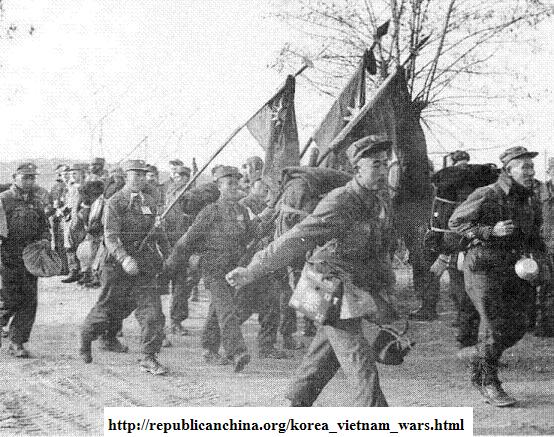
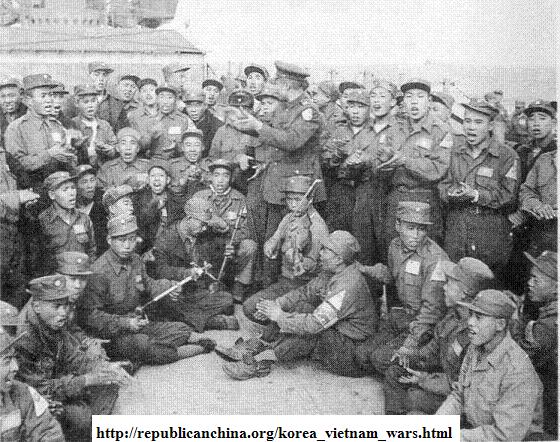
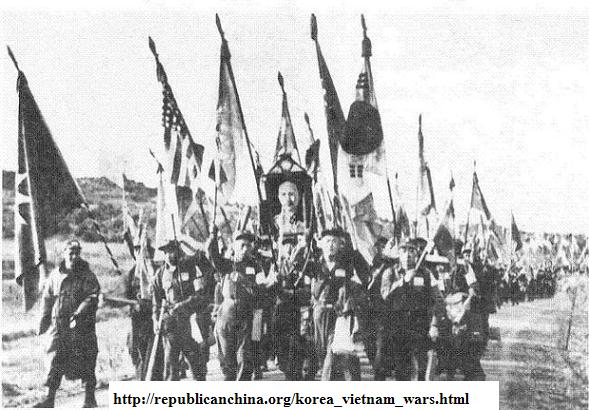
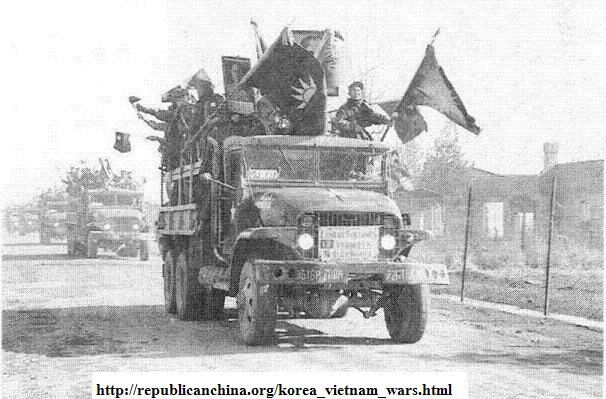
Some talk points this webmaster made at
http://www.chinahistoryforum.com/index.php?/topic/863-could-an-undivided-china-repel-the-ija/
South Korea had no army till within one year of the
withdrawal of the U.S. Army. The United States treated S
Korea much worse than what they did to today's Iraqi
puppet government. There was no heavy weapon assigned to S
Korea's police-converted troops. -Two factions of the
Americans at play: one faction intending on colonizing S
Korea with an aim of weakening the S Korean military; and
the other faction, being undercover Russian agents and of
the CPUSA background, overpowered the previous faction by
having the U.S. troops officially withdraw from S Korea as
an echo of the "Russian withdrawal" from N Korea.
North Korea had hundreds of thousands of soldiers.
In Korea, there was a similar scam, i.e., the Political
Consultative Conference as happened in China. The South
Koreans split into two factions, with one group doing the
so-called PCC peace talks with N Korea. There was the
through traffic between the two sides. N Korea knew
exactly how many troops and guns S Korea had.
S Korea had survived purely because of a general who
previously served as tactician-in-general of the Chinese
Youth Army. This general by the name of Jin Hongyi (Gim Hong-yil, Choi Se-pyeong, Wang Yishu), a Guizhou infantry academy graduate, a Whampoa cadet and a war hero at the 1938 Battle of Wanjialing, was responsible
for taking control of about two South Korean army divisions and
fought on at Daqiu, near Pushan, for two weeks till MacArthur sent over
reinforcement from Japan.
The Koreans whom Mao sent to Kim in 1949 and 1950 were
previously 1) puppets under the Japanese Kwantung Army;
and ii) a batch of about 250,000 plus Koreans whom Kim
lent to Mao for the Chinese civil war in Manchuria.
Kim Il Sung claimed altogether he sent 250,000 Koreans
to Mao for fighting China's civil wars.
The Korean generals commanding the mercenary army included Kang Kon, Park Rakkwon (Piao Luoquan), and Choe Kwang (Cui Guang).
Choe Kwang, not following Kim Il Sung who returned to Korea via sea in September 1945, was a regimental commander in the Chinese communist's Eastern Jirin military subdistrict before returning to North Korea in 1946 to be in charge of constabulary army's training.
Kang Gen, who returned to North Korea with Kim Il Sung in September 1945, apparently returned to China for the Manchuria civil war before he was to return to North Korea again sometime in 1946.
According to Li Danhui's compiling of CCP-published writings on the Koreans, close to 800 Korean politico-military officials returned to North Korea from 1946 to March 1949 for beefing up Kim Il Sung's military.
Mu Chong's Korean detachment, i.e., the Yenan faction, also dispatched cadres to Korea in late 1945.
Note the fundamental difference between the 250,000 ethnic-Korean Japanese Kwantung Army and the ethnic-Korean Chinese living in China.
The communist statistics claimed that altogether 65,000 ethnic-Korean Chinese minority people, or the Korean migrants living in China, joined the communist army, with approximately
60% coming from the Jirin subprovince,
21% from the Sungari subprovince, and
15% from the Liaodong subprovince.
Purportedly, archives from the Yonbyon (Yanbian) Korean Autonomous Prefecture claimed that 34,855 Koreans from five Jirin counties joined the Chinese communist army, with additional 100,000 ethnic Koreans serving as police and militia in the area that was known as Jiandao (sandwiched [triangular] island-shaped territory) under the Japanese, also known as Yanbian (Yonbyon).
The communists' wholesale recruiting of the ethnic-Koreans in the three Manchuria subprovinces of Jirin, Sungari and Liaodong (Liao-tung), that bordered with North Korea, the Soviet Maritime Province (a land stolen from Manchu China during the Second Opium War) and the Japan Sea, could only have happened at the turn of 1947-1948 --when the communists charged out of the hideouts in Port Arthur and North Korea to counter-attack the Chinese government troops.
The communists, utilizing the truce brokered by Marshall to conduct a sweeping campaign against the pro-government forces and brigands in 1946-1947, consolidated the hold in northern Manchuria, and then launched the campaigns of
"Three Campaigns of Crossing the Sungari River",
"Four Campaigns to Linjiang from the Sino-Korean Border", and
"Two Sieges of Siping-jie".
It was in January 1947, that Lin Biao, after half year of respite and rebuilding his army with new supplies from the Soviet-controlled depots in North Korea, first crossed the Songhuajiang [Sungari] River to the south with 12 divisions.
The Koreans had a Restoration Army in China since the
1910s. They enrolled in the Whampoa Academy in the 1920s
by about 100-200. Very few Koreans joined the Chinese
communists. Only two among some dozen Koreans, who
enrolled in the Whampoa Academy, survived the communist
Red Army's Long March. In the 1930s, the Koreans split
into two factions. The KOREAN RESTORATION ARMY, however,
continued to operate under Chiang Kai-shek till the early
1940s. Then, Zhou Enlai instructed Sima lu (Ma Yuanfu) in infiltrating
the Korean Independence Army's Headquarters in Chongqing
(Chungking). About several hundreds of the Korean
Restoration Army cadres were steered to the communist camp
en route to the north to fight the Japanese, and would become part of Mu Chong's Korean detachment of 3000 men who were sent to Mukden of Manchuria in early November of 1945. The root
cause could still be an O.S.S. covert operation, or put it in
that way, a deliberate Soviet spy operation inside of the
O.S.S. to steer the Koreans to the communist side on the
pretext of helping to equip the Koreans for the war
against Japan.
At the time Japan surrendered, the Russians had steered
majority of the Korean communists from both northern China
and from the Russian Far East, to N Korea, straight.
Kim Il-sung went back to Korea with the Koreans from among
the Far Eastern teaching brigade that was formed in the
early 1940s among the remnants of the guerrillas who
withdrew from Manchuria
on the purported Soviet order that the guerrillas
should cease the fighting against Japan [with the
apparent Soviet-Japanese Non-aggression Treaty signed] in
expectation of changes in the world wide war,
i.e., the pending eruption of the Pacific War which
the Soviet agents began to foment
years before its actual eruption. However, Kim Il-sung
entered Korea under an alias, took a low profile in
sending his lieutenants across the country to build
support, and did not announce his real name 'Cheng zhu'
till two-three months after, till Stalin and the Soviets
had finalized the selection of a stooge.
THE VIETNAM WAR
The Vietnam War should be traced to the Chinese communists
as well. During the Korean truce talks in 1952 and 1953,
the Americans repeatedly told the Chinese counterparts
that China should not reshuffle the troops to the border
with Vietnam once the Korean War was to stop. What
happened was exactly what the Americans had feared the
most: The Chinese communists redirected the troops and
military supplies to Vietnam, helping the Vietnamese
communists (i.e., Viet Minh) in the counter-attack against
the French in Dien Bien Phu in March-May 1954, which
effectively led to a thorough defeat of the French army
and the subsequent signing of the Geneva peace accord that
divided Vietnam into the two parts of North Vietnam and
South Vietnam, and allowed the North Vietnamese communists
to have a secured staging ground to continue the invasion
against South Vietnam.
(The Chinese communists, who signed the 1953 Korean
Armistice Agreement, additionally launched a massive
bombardment of the Quemoy Island on September 3rd, 1954
--thanks to Harry Truman's sending in the American 7th
Fleet to the Taiwan Straits, after the eruption of the
1950 Korean War, to prevent Taiwan from launching a Second
Battlefield against mainland China, as well as a Third
Battlefield in the Golden Triangle area of northern
Burma.)
The Vietnamese communists, who had a wide-range
cooperation with American OSS [infiltrated by the
Comintern agents] during the WWII, were commented by the
U.S. State Department to have the least trace of
contacts with Moscow among all Southeast Asian communists.
Superficially, the American policy towards Vietnam was to
prevent the French from re-asserting the colonial rule
over Vietnam. Fundamentally, the undercover Russian agents
inside of the U.S. State Department hijacked the American
foreign policy to lend support to the Communist movement
in Vietnam.
The Chinese nationalist government, being anti-British and
anti-French, always took into own hands the role of acting
as the beacon tower for the liberation and independence of
all colonized and semi-colonized countries of Asia. Hence,
the Chinese army, which took over the surrender of Japan
in North Vietnam, hindered the return of the French troops
and indirectly lent support to the small contingent of few
thousand men led by the Vietnamese communist leader, Ho
Chi Minh. The Chinese army, before pulling out from
Vietnam in May of 1946, had supplied Ho's force with the
firearms. Ho, like the Chinese communists who
intentionally hid their identity and pretended to be a
so-called "democratic allied army" upon entry into
Manchuria, called themselves by Viet Minh, i.e., the
Vietnamese [national] [democratic] alliance.
Ho purportedly established some regime right after the
Japanese surrender in August 1945. However, open
confrontation against the French did not start till
November of 1946.
Similar to the Korean War, ethnic-Chinese generals had
fought the war against the Vietnamese communists.
The fallacious read of the Vietnam War was the mistaken
belief of the Vietnamese Communists' true abilities at the
end of WWII.
For five years, from 1945 to 1950, the Vietnamese
Communists could not fight the ethnic Chinese militia or
the civilian corps in the Chinese-ethnic towns, villages
and settlements of North Vietnam.
The ethnic Chinese living in North Vietnam, at the time
the R.O.C. troops pulled out of Vietnam at the turn of
1945-1946, were given some token numbers of guns for
self-defence in the major residential points. Ho
controlled merely a tiny area near the Tonkin [eastern
capital] Bay.
It would be after the Chinese nationalist government lost
the civil war that Ho Chi Minh got in direct contact with
the Chinese communists for military supplies.
After the fall of China to the Chinese Communists, the
Chinese army remnants acted as buffer in the Golden
Triangle area at the Burmese-Chinese border and the
Thai-Chinese border.
In Vietnam, the buffer that could have existed was
destroyed by the French themselves.
The French, being shortsighted as they were, hoodwinked
and disarmed the Chinese Nationalist Army remnants, who
retreated into Vietnam under General Huang Jie, the war
hero from the 1933 Battle of the Great Wall. Among Huang
Jie's remnant troops would be about 400 Henan Province
middle school students, i.e., remnants of about 3000-4000
exile students, who tenaciously travelled across the
country and walked through the high Shiwan [One Hundred
Thousand] Mountains of Southwestern China.
In 1950, Vo Nguyen Giap, a general under Ho, claimed to
have 4 divisions of troops. In 1950, France dispatched
General Jean de Lattre de Tassigny to Vietnam for leading
the French expedition army for the First Indochina War.
From 1950 to September 1951, Tassigny commanded the French
troops to win three major victories at Vinh Yen, Mao khe
(near the port of Haiphong) and Yen Cu Ha (in the Red
River Delta), in January 1951, March 1951, and late May
1951.
The Chinese Communists, who had wrapped up the war in
Korea in 1953, shifted their weaponry and army southward
towards the Vietnam to take the fight against the French,
ending in the French debacle at the Battle of Dien Bien
Phu.
The Chinese dispatched Wei Guoqing, a Zhuang-ethnic
general, to Ho's camp as the chairman of the Chinese
military delegation, for directing the war against the
French.
Tassigny's successors, Raoul Salan and Henri Navarre, did
not fare well. In late 1953, the French conducted a
campaign against Dien Bien Phu, a town close to the Laos
border. The French sacked the town.
The Vietnamese communists, under the support of the
Chinese communists, counter-attacked the French. In
March-May 1954, after some month-long campaign, the
Vietnamese communists thoroughly defeated the French army.
The French in July signed the Geneva peace accord that
divided Vietnam into the two parts of North Vietnam and
South Vietnam, and effectively pulled out of Vietnam. The
North Vietnamese communists, who had demanded with the
Chinese communists to continue to take the battle to the
south, beyond the 16th Parallel, hence blamed the Chinese
communists for the betrayal.
The North Vietnamese communists, with control of North
Vietnam, secured a base to continue the invasion against
South Vietnam.
Across Southeast Asia, the torrents of communism, which
won the Vietnam War with the support of the Soviets and
the Chinese Communists, swept their way all over the area.
The American sell-out of the Catholic Vietnamese
President
With the French defeat, the power was yielded to the last
remaining ruler of the Nguyen dynasty, i.e., Bao-dai.
To counter North Vietnam which launched a government,
Bao-dai organized his regime in southern Vietnam.
Ngo Dinh Diem (Wu Tingyan), at the invitation of the
Vietnamese emperor Bao-dai, returned to Vietnam to be
prime minister in 1954.
In October of 1955, the Vietnamese Republic was launched
after Ngo Dinh Diem deposed Emperor Bao-dai to become
president.
Ngo Dinh Diem, while suppressing the Buddhists, was an
adamant anti-communist, something with do with Ho Chi
Minh's killing his elder brother and father.
In 1959, the communist spy returned to the north to
suggest to Ho Chi Minh to initiate attack at South
Vietnam, with a claim that any further delay could mean
the loss of chance of re-uniting Vietnam as Ngo Dinh Diem
had developed the economy and society so well that
communism would not find favor in South Vietnam.
Ngo Dinh Diem allowed the communist fake defectors to work
in the South Vietnamese government, including spy Fan
Yucao who later worked in the Vietnamese embassy to the
United States and spy Fan Chun'an who worked for the TIMES
magazine.
In 1963, the Americans sold out Ngo Dinh Diem in allowing
the younger officers to stage a coup.
The pretext was to do with Ngo Dinh Diem's anti-Buddhism
stance, with the burning Buddhists' self-immolation shot
into the documentary videos.
To be continued !
* In Commemoration of China's Fall under the Alien Conquests in A.D. 1279,
A.D. 1644 & A.D. 1949 *
U.S.S.R./Comintern Alliance with the KMT & CCP (1923-1927)
Korean/Chinese Communists & the 1931 Japanese Invasion of Manchuria
American Involvement in China: Soviet Operation Snow, IPR Conspiracy, Dixie Mission, Stilwell
Incident, O.S.S. Scheme, Coalition Government Crap, Amerasia Case & The China White Paper
* Stay tuned for "Republican China 1911-1955: A Complete Untold History" *
|
|
Zou Rong's Revolutionary Army;
Shin Kyu Sik's
Shrine (Spirit, Kunitama) of Korea
|
This snippet is for sons and daughters of China:
Heed the sons & ministers' agony and sorrow of our ancestors who died or lived through the Mongol, Manchu and Soviet-Chicom conquest
and
the Yongjia, Jingkang and Jiashen cataclysms !
Jeanne d'Arc of China:
Teenager girl Xun Guan breaking out of the Wancheng city to borrow the relief troops in the late Western Jinn dynasty;
Liu-Shao-shi riding into the barbarian army to rescue her husband in the late Western Jinn dynasty;
teenager girl Shen Yunying breaking into Zhang Xianzhong's rebels on the horseback to avenge on father's death in the late Ming dynasty.
China's Solitary and Lone Heroes:
Nan Jiyun breaking out of the Suiyang siege and charging back into the city in the Tang dynasty;
Zhang Gui & Zhang Shun Brothers breaking through the Mongol siege of Xiangyang in the Southern Soong dynasty;
Liu Tiejun breaking through three communist field armies' siege of Kaifeng in the Republican China time period;
Zhang Jian's lone confrontation against the communist army during the June 3rd & 4th Massacre of 1989.
|
|
|
|
TEN TRAINS EQUIVALENT AMERICAN LEND-LEASE WEAPONS THAT STALIN & RUSSIANS GAVE TO MAO & CHINESE COMMUNISTS;
FORTY SHIPS EQUIVALENT QUANTITY OF TANKS & CANNONS, BOTH AMERICAN-MADE & JAPAN-MADE
3300 TONS OF PETROL FROM RUSSIANS IN 1947 ALONE; PLUS 2000 TONS OF DIESEL, 1000 TONS OF PLANE FUEL, 700 TONS OF EXPLOSIVES & 2000 TONS OF MACHINERY OIL
30000 TONS OF PETROL FROM RUSSIANS IN 1948; PLUS 1000 TONS OF PLANE FUEL, 5000 TONS OF KEROSINE, 3000 HEAVY WEIGHT TRUCKS & 150 ARTILLERY TRACTORS
DEATH OF MILLIONS OF YELLOW MEN, & POSSIBLY MORE IN THE FUTURE WAR AGAINST TAIWAN !!!!!
Reference: see the writing by James Perloff China Betrayed Into Communism on Friday, 24 July 2009 at
http://www.thenewamerican.com/index.php/history/world/1464
August Storm lend-lease weapons ended up in Mao's hands.
"At the Teheran and Yalta wartime conferences, however, Roosevelt asked Stalin if he would break his pact with Japan and enter the Far East war. Stalin agreed, but attached conditions. He demanded that America completely equip his Far Eastern Army for the expedition, with 3,000 tanks, 5,000 planes, plus all the other munitions, food, and fuel required for a 1,250,000-man army. Roosevelt accepted this demand, and 600 shiploads of Lend-Lease material were convoyed to the USSR for the venture. Stalin's Far Eastern Army swiftly received more than twice (i.e., in fact ten times as substantiated by this webmaster) the supplies we gave Chiang Kai-shek during four years as our ally.
"General Douglas MacArthur protested after discovering that ships designated to supply his Pacific forces were being diverted to Russia. Major General Courtney Whitney wrote: 'One hundred of his transport ships were to be withdrawn immediately, to be used to carry munitions and supplies across the North Pacific to the Soviet forces in Vladivostok.... Later, of course, they were the basis of Soviet military support of North Korea and Red China.'
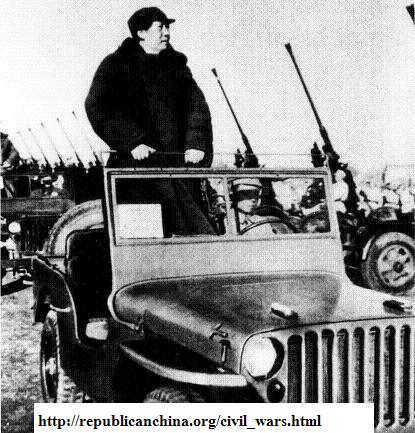
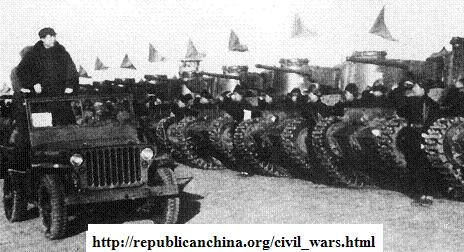
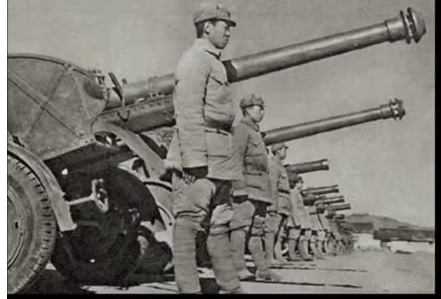 The pseudo-encyclopedia website like wikipedia also made the fallacious claim that would make the Chinese communists laugh to the teeth:
"However, the nearly nonexistent Soviet help proved not to be a problem for the Communists; in the meantime, the huge Communist need was filled by an unexpected source: their adversaries, the Nationalists. Due to the fatal mistake the Nationalists made in their demilitarization, the Communists were able to pinpoint nearly every Japanese secret depot with the help of former Nationalist troops in their ranks, and the total amount of Japanese weaponry recovered was enough to sustain the Communists for 2 years before relying on captured American weaponry from the Nationalists in the later stage of the war. For example, a single secret depot typically contained as much as 150,000 artillery rounds. By February 1947, hundreds of artillery pieces were recovered by the communists, including: 49 howitzers, 300 heavy mortars, 137 anti-aircraft artilleries, 141 anti-tank guns, 108 mountain guns, 97 cannons, and many other smaller artillery pieces, almost one-third of the Nationalist weaponry."
The pseudo-encyclopedia website like wikipedia also made the fallacious claim that would make the Chinese communists laugh to the teeth:
"However, the nearly nonexistent Soviet help proved not to be a problem for the Communists; in the meantime, the huge Communist need was filled by an unexpected source: their adversaries, the Nationalists. Due to the fatal mistake the Nationalists made in their demilitarization, the Communists were able to pinpoint nearly every Japanese secret depot with the help of former Nationalist troops in their ranks, and the total amount of Japanese weaponry recovered was enough to sustain the Communists for 2 years before relying on captured American weaponry from the Nationalists in the later stage of the war. For example, a single secret depot typically contained as much as 150,000 artillery rounds. By February 1947, hundreds of artillery pieces were recovered by the communists, including: 49 howitzers, 300 heavy mortars, 137 anti-aircraft artilleries, 141 anti-tank guns, 108 mountain guns, 97 cannons, and many other smaller artillery pieces, almost one-third of the Nationalist weaponry."
|
Wu [no] Wang [forgetting] Zai [at] Ju [the Ju fort]
|
|
|
The communists had conquered China owning to the key battle success in Manchuria, which was the result of treacheries on the part of Wei Lihuang, i.e., the government troops' commander-in-chief in Manchuria, a treachery that was comparable to Soong Dynasty prime minister Jia Sidao's abandoning to the Mongol the Xiangyang city [which was under siege for 4-5 years] and Ming Dynasty general Wu Sangui's betrayal of the Mountain and Sea Pass to the Manchus.
Wei Lihuang, with the communist mole by his side from the days of the resistance war, overrode General Wang Tiehan's proposal and made the government army into the sitting ducks in the isolated pockets and cities of Manchuria, for the communist army to attack.
Namely, Wei Lihuang allowed the communist army to take the transcendental secret manoeuvre to ship thousands of artillery to the foot of the Jinzhou city wall under the assistance of the Soviet railway army corps.
General Wang Tiehan suggested that the Changchun garrison troops could break out towards Mukden to the south as intelligence had shown that the communist army had disappeared along the trunk line of Changchun-Jirin-Mukden.
Only the 52nd Corps, that was hoodwinked by Wei Lihuang into attacking towards Shenyang [i.e., Mukden] as the relief troops but impeded by the communist army halfway for lack of coordination between Wei Lihuang and the communist army, managed to return to wrestle back the Yingkou port to escape the Manchurian battleground via sea.
A part of the Youth Army division, which broke out of the Mukden siege, fought its way along the Liao-xi Corridor to arrive at the Mountain and Sea Pass.
We don't need to remind the readers that the communist army was a motley group of mercenaries including about 250,000 ethnic-Korean Japanese Kwantung Army diehards per Kim Il-sun plus the Japanese 8th Route Army (i.e., the Japanese medical staff, airforce staff, officer corps, and tank and artillery operators), the ethnic-Taiwan Japanese Kwantung Army, the Outer Mongolian cavalry army, not counting the Soviet railway army corps.
According to the Soviets, the 'railway' tag was a guise for intervening in the Chinese civil wars, namely, the cloak of secrecy under which the Soviets orchestrated the historical Soviet conquest of China to fulfill Stalin's mantle that pro-Soviet regimes must be established in all territories that the Soviet Red Army ever stepped on, no matter Europe or Asia.
That is, Soviet military staff, not merely Soviet military advisers, fought the Chinese civil wars in Manchuria as the railway staff.
Ivan V. Kovalev, as Stalin and All-Union Communist Party (Bolsheviks)'s plenipotentiary to the Chinese Communist Party (CCP), was sent to China for directing the civil war as a railway czar.

George Kennan's Fallacious Disclaim of Soviet Instigation and Bankrupt 'Long' Containment View:
George Kennan
naively discounted
the Chinese communist revolution as "part of the Soviet system" and asserted its victory to be an
exception to the Soviet "military intimidation or invasion" and not a result that could be ascribed
"primarily to Soviet propaganda or instigation" (American Diplomacy, p. 119. The U of Chi Press 1951,
expanded edition).
George Kennan's bankrupt 'long' view as to communism was "a long-term, patient but firm and vigilant containment", which was to seek solutions in the "historical"
context, namely,
the "Russian or the oriental mind" of the "Russian-Asiatic world", something the communist China twin shared, that was
seemingly perceived as an innate matter that could not be overcome.
|
|
|
|
|
* In Commemoration of China's Fall under the Alien Conquests in A.D. 1279,
A.D. 1644 & A.D. 1949 *
U.S.S.R./Comintern Alliance with the KMT & CCP (1923-1927)
Korean/Chinese Communists & the 1931 Japanese Invasion of Manchuria
American Involvement in China: Soviet Operation Snow, IPR Conspiracy, Dixie Mission, Stilwell
Incident, O.S.S. Scheme, Coalition Government Crap, Amerasia Case & The China White Paper
* Stay tuned for "Republican China 1911-1955: A Complete Untold History" *
|
|
Zou Rong's Revolutionary Army;
Shin Kyu Sik's
Shrine (Spirit, Kunitama) of Korea
|
This snippet is for sons and daughters of China:
Heed the sons & ministers' agony and sorrow of our ancestors who died or lived through the Mongol, Manchu and Soviet-Chicom conquest
and
the Yongjia, Jingkang and Jiashen cataclysms !
Jeanne d'Arc of China:
Teenager girl Xun Guan breaking out of the Wancheng city to borrow the relief troops in the late Western Jinn dynasty;
Liu-Shao-shi riding into the barbarian army to rescue her husband in the late Western Jinn dynasty;
teenager girl Shen Yunying breaking into Zhang Xianzhong's rebels on the horseback to avenge on father's death in the late Ming dynasty.
China's Solitary and Lone Heroes:
Nan Jiyun breaking out of the Suiyang siege and charging back into the city in the Tang dynasty;
Zhang Gui & Zhang Shun Brothers breaking through the Mongol siege of Xiangyang in the Southern Soong dynasty;
Liu Tiejun breaking through three communist field armies' siege of Kaifeng in the Republican China time period;
Zhang Jian's lone confrontation against the communist army during the June 3rd & 4th Massacre of 1989.
|
|
|
|
|
Invasion Of
Manchuria, Chaha'er & Jehol
1931-34
Mukden
Incident - 9/18/1931 & Battle Of
Jiangqiao
Shanghai
Provocation - 1/28/1932
Battles
of the Great Wall
China In Crises
Of Internal Turmoil & Foreign
Invasions
Japanese Invasion
(1937-1945)
Marco Polo
Bridge Incident & Battle
of Tianjin-Peking
Campaign Of
Nankou & Campaign of
Xinkou
Air
Battles Directed By Chenault &
With
Russian Pilots
Battles
of Shanghai, Jiangyin,
Si'an &
Nanking
Defence
Rape Of
Nanking & The Great Rescue
Of 1937
Eight Year
Long Resistance War
Mingguang,
Linyi-Tengxian,
Tai-er-zhuang , & Xuzhou
Battles of
Lanfeng, Wuhan,
Nanchang,
& Sui-Zao,
1st Changsha
Battle, Kunlunguan,
Wuyuan,
& Zao-Yi,
Fatigue
Bombing of Chongqing by Japanese
Aggression
Against Vietnam & Southeast Asia
Yu-nan &
E-bei, Shanggao,
& Mt
Zhongtiaoshan
2nd
Changsha Battle, & Pacific
Wars
3rd
Changsha Battle, & Zhe-Gan
Campaign
Second
Burma Campaign, & Phase
II
|
| [ revolution.htm
& tragedy.htm] |
Communist
Armed Rebellions
Second
Northern Expedition
War Of
Chiang Kai-shek versus Gui-xi (March
1929)
War Of
The Central Plains (May 1930)
Campaigns
Against Communist Strongholds
The
Long March
Xi'an Incident
- Turning Point of Modern History
Demise
Of Red Army Western Expedition
|
| [ campaign.htm
& terror.htm
] |
[ war.htm
] |
|
1945-1949 Civil War
Written by Ah
Xiang
|
|
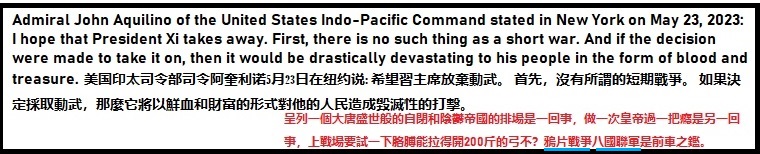
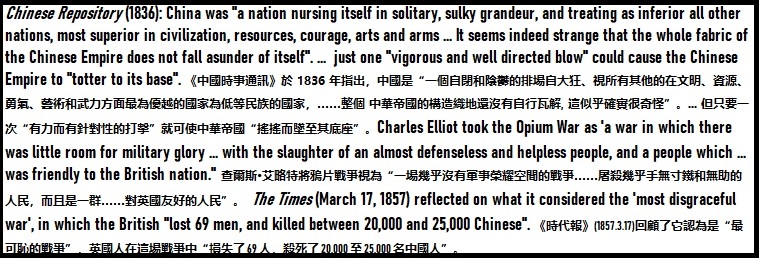
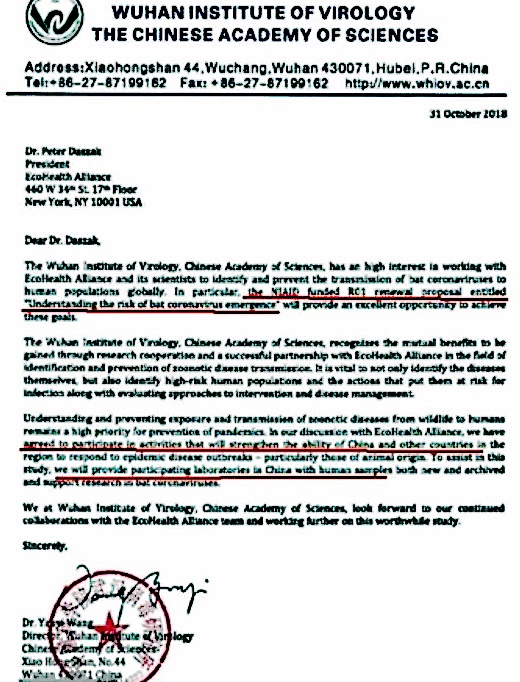
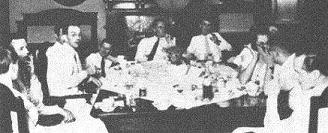
![Though, Anna Wang [Anneliese Martens], in her memoirs, expressed jealousy over Gong Peng by stating that the Anglo-American reporters had flattered the Chinese communists and the communist movement as a result of being entranced with the goldfish-eye'ed personal assistant of Zhou Enlai](GongPeng.jpg)